
BuddhistCatholicContemplativeEvangelicalGeneral ChristianHinduJewishLatter-day SaintMuslimNew VisionsProgressive Christian
Beliefs
- Buddhist
- Catholic
- Contemplative
- Evangelical
- General Christian
- Hindu
- Jewish
- Latter-day Saint
- More Voices
- Muslim
- New Visions
- Pagan
- Progressive Christian
Topics
- Religion News
- Food and Religion
- Sports and Religion
- Religious Art
- Religious Music and Entertainment
- Religious Events
- History and Religion
- Style and Religion
- Politics and Religion
- Women in Religion
- Recreation Outdoors and Religion
- Business Finance and Religion
- Careers Workplace and Religion
- Education and Religion
- Family Parenting and Religion
- Health Fitness and Religion
- Home and Religion
- Relationships and Religion
- Technology and Religion
- Travel and Religion
Columnists
- Buddhist Columnists
- Business Finance and Religion Columnists
- Careers Workplace and Religion Columnists
- Catholic Columnists
- Contemplative Columnists
- Education and Religion Columnists
- Evangelists Columnists
- Family Parenting and Religion Columnists
- General Christian Columnists
- Health Fitness and Religion Columnists
- Hindu Columnists
- History and Religion Columnists
- Home and Religion Columnists
- Jewish Columnists
- More Voices Columnists
- Latter Day Columnists
- Muslim Columnists
- New Visions Columnists
- Nonreligious Columnists
- Pagan Columnists
- Politics and Religion Columnists
- Progressive Columnists
- Recreation Outdoors and Religion Columnists
- Relationships and Religion Columnists
- Religion News Columnists
- Religious Art Columnists
- Religious Events Columnists
- Religious Music and Entertainment Columnists
- Sports and Religion Columnists
- Style and Religion Columnists
- Technology and Religion Columnists
- Travel and Religion Columnists
- Women in Religion Columnists
Resource Library
- 2026 Calendar
- Library of World Religions
- The 100 Most Holy Places on Earth
- Patheos Answers
- Podcasts
- Videos
- Faith Leaders Database
- Anglican Episcopalian
- Bahai
- Baptist
- Buddhism
- Christianity
- Confucianism
- Eastern Orthodoxy
- Hinduism
- Holiness and Pentecostal
- ISKCON
- Islam
- Judaism
- Lutheran
- Methodist
- The Church of Jesus Christ of Latter-day Saints
- New Age
- Paganism
- Presbytarian and Reformed
- Protestantism
- Religion Behind the Scenes
- Roman Catholic
- Scientology
- Shia Islam
- Sikhism
- Sufism
- Sunni Islam
- Taoism
- Zen
- See all religions
Research Tools
 Ad-Free & Subscriber Log-In Subscription Support
Ad-Free & Subscriber Log-In Subscription Support
Follow Patheos 

- Trending:
- Forgiveness
- |
- Marriage
- |
- Consciousness
- |
- Death Penalty
- |
- Election
- |
- Halloween

-
About
-
Catholic Apologetics
-
Church History
-
Great Apologists
-
Christian Worldview
-
Protestantism & Misc.
- Home
- Catholic
- History and Religion
- John Wesley vs. Extrinsic Justification & “Faith Alone”
John Wesley vs. Extrinsic Justification & “Faith Alone”
Last updated on: June 6, 2026 at 12:54 am by Dave Armstrong
John Wesley vs. Extrinsic Justification & “Faith Alone” 2026-06-06T00:54:32-04:00 Dave Armstrong
Patheos Explore the world's faith through different perspectives on religion and spirituality! Patheos has the views of the prevalent religions and spiritualities of the world.
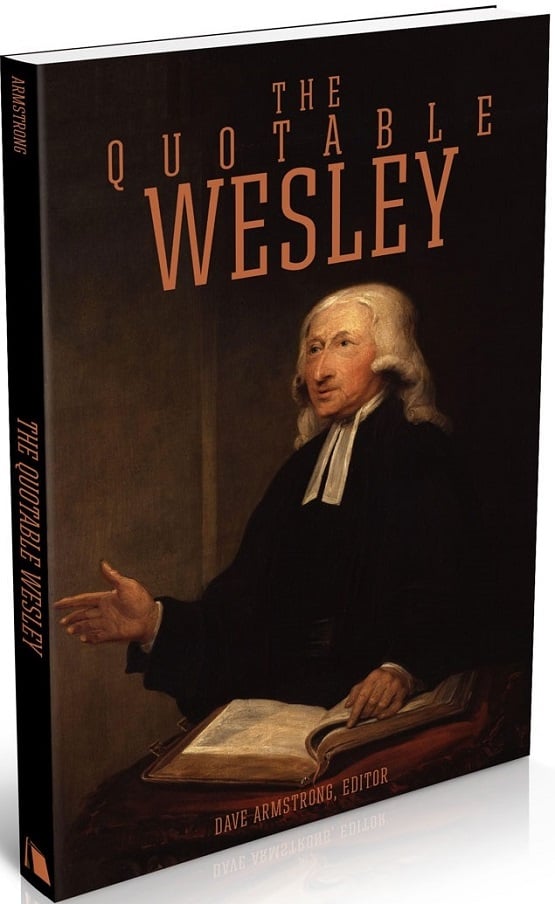
Photo credit: cover of my book (The Foundry Publishing: 2014).
John Wesley (1703-1791), the evangelistic giant of the 18th century revival in England and figurehead of Methodism (though he himself never formally left the Anglican Church) thought that imputed justification was false and thus spiritually harmful as a result. He is the most well-known and influential Protestant who rejected faith alone as an explanation of the biblical soteriological data. Of this there can be no doubt, because we have an abundance of confirming statements from him.
Alister McGrath, in his book, Iustitia Dei: A History of the Christian Doctrine of Justification (Cambridge University Press, 4th edition, 2020, p. 272), sums up his opposition in one sentence, observing that Wesley “saw certain theological commitments as serious obstacles to personal holiness – including, as we shall see, the orthodox Protestant theology of justification by imputed righteousness”. As the editor of The Quotable Wesley (The Foundry Publishing: 2014), published by a Wesleyan publishing house, I have many such statements at hand, conveniently categorized by topic:
Faith Alone (Falsity of)
In flat opposition [to “faith alone”] . . . I began to expound the Epistle of S. James, the great antidote against this poison. (Journal, 6 June 1740)
Beware of solifidianism; crying nothing but, ‘Believe, believe’ and condemning those as ignorant or legal who speak in a more scriptural way. At certain seasons, indeed, it may be right to treat of nothing but repentance, or merely of faith, or altogether of holiness; but, in general, our call is to declare the whole counsel of God, and to prophesy according to the analogy of faith. The written word treats of the whole and every particular branch of righteousness, descending to its minutest branches; as to be sober, courteous, diligent, patient, to honour all men. So, likewise, the Holy Spirit works the same in our hearts, not merely creating desires after holiness in general, but strongly inclining us to every particular grace, leading us to every individual part of ‘whatsoever is lovely.’ And this with the greatest propriety; for as ‘by works faith is made perfect’, so the completing or destroying the work of faith, and enjoying the favour, or suffering the displeasure, of God, greatly depends on every single act of obedience or disobedience. (A Plain Account of Christian Perfection, 1767; rev. 1777; from Farther Thoughts on Christian Perfection, 1762)
Here is the master-piece of Satan: farther than this he cannot go. Men are holy without a grain of holiness in them! Holy in Christ, however unholy in themselves: they are in Christ, without one jot of the mind that was in Christ. In Christ, though their nature is whole in them. They are “complete in Him,” though they are in themselves as proud, as vain, as covetous, as passionate as ever: it is enough. They may be unrighteous still, seeing Christ has “fulfilled all righteousness.” (A Blow at the Root, 1762)
Justification: Imputed
Least of all does justification imply, that God is deceived in those whom he justifies; that he thinks them to be what, in fact, they are not; that he accounts them to be otherwise than they are. It does by no means imply, that God judges concerning us contrary to the real nature of things; that he esteems us better than we really are, or believes us righteous when we are unrighteous. Surely no. The judgment of the all-wise God is always according to truth. Neither can it ever consist with his unerring wisdom, to think that I am innocent, to judge that I am righteous or holy, because another is so. He can no more, in this manner, confound me with Christ, than with David or Abraham. Let any man to whom God hath given understanding, weigh this without prejudice; and he cannot but perceive, that such a notion of justification is neither reconcilable to reason nor Scripture. (Sermon 5: Justification by Faith; 6 Oct. 1739)
We do not find it expressly affirmed in Scripture, that God imputes the righteousness of Christ to any. Although we do find, that faith is imputed to us for righteousness. (Methodist Conference, June 25, 1744)
Frequent mention is made in Scripture, of “faith counted for righteousness.” So Gen. xv. 6: “He (Abraham) believed in the Lord, and he counted it to him for righteousness:” a text repeated, with but little variation, over and over in the New Testament. Rom. iv. 5: “To him that worketh not, but believeth on him who justifieth the ungodly, his faith is counted for righteousness.” Thus it was that “Noah became heir of the righteousness,” the justification, “which is by faith.” Heb. xi. 7. Thus also “the Gentiles,” when the Jews fell short,” attained to righteousness, even the righteousness which is by faith.” Rom. ix. 30. But that expression, the righteousness of Christ, does not occur in any of these texts. . . . We are all agreed as to the meaning, but not as to the expression, the imputing the righteousness of Christ, which I still say, I dare not insist upon, neither require any one to use; because I cannot find it in the Bible. If any one can, he has better eyes than I: and I wish he would show me where it is. Now, if by the righteousness of Christ we mean any thing which the Scripture does not mean, it is certain we put darkness for light. If we mean the same which the Scripture means by different expressions, why do we prefer this expression to the scriptural? Is not this correcting the wisdom of the Holy Ghost, and opposing our own to the perfect knowledge of God? (Thoughts on the Imputed Righteousness of Christ; 5 April 1762)
Justification: Infused
Without faith we cannot be justified, . . . as soon as any one has true faith, in that moment he is justified. Good works follow this faith, but cannot go before it (Luke vi, 43); much less can sanctification, which implies a continued course of good works, springing from holiness of heart. But it is allowed that entire sanctification goes before our justification at the last day (Heb. xii, 14). (Conditions of Justification; 1744)
Far other qualifications are required, in order to our standing before God in glory, than were required in order to his giving us faith and pardon. In order to this, nothing is indispensably required, but repentance, or conviction of sin. But in order to the other it is indispensably required, that we be fully cleansed from all sin: that the very God of peace sanctify us wholly, even . . . our entire body, soul, and spirit. It is not necessary therefore (nor indeed possible, that we should before justification, patiently wait upon God, by lowliness, meekness, and resignation, in all the ways of his holy law. And yet it is necessary in the highest degree, that we should thus wait upon him after justification. Otherwise, how shall we be ‘meet to be partakers of the inheritance of the saints in light?’ (Answer to the Rev. Mr. Church’s “Remarks on the Rev. Mr. Wesley’s Last Journal”; 2 February 1745)
Both inward and outward holiness, are consequent on this faith, and are the ordinary, stated condition, of final Justification. . . . I not only allow, but vehemently contend, that none shall ever enter into glory, who is not holy on earth, as well in heart, as in all manner of conversation. (A Farther Appeal to Men of Reason and Religion; 1745)
I believe God implants righteousness in every one to whom he has imputed it. I believe “Jesus Christ is made of God unto us sanctification,” as well as “righteousness;” or, that God sanctifies, as well as justifies, all them that believe in him. They to whom the righteousness of Christ is imputed, are made righteous by the Spirit of Christ; are renewed in the image of God, “after the likeness wherein they were created, in righteousness and true holiness.” (Sermon 20: The Lord Our Righteousness; 22 Oct. 1758)
“Without holiness no man shall see the Lord,” shall see the face of God in glory. Nothing under heaven can be more sure than this: “For the mouth of the Lord hath spoken it.” And though heaven and earth pass away, yet his “word shall not pass away.” As well therefore might God fall from heaven, as this word fall to the ground. No, it cannot be: None shall live with God, but he that now lives to God. None shall enjoy the glory of God in heaven, but he that bears the image of God on earth. None that is not saved from sin here, can be saved from hell hereafter. None can see the kingdom of God above, unless the kingdom of God be in him below. Whosoever will reign with Christ in heaven, must have Christ reigning in him on earth. He must have “that mind in him which was in Christ,” enabling him “to walk as Christ also walked.” And yet as sure as this is, and as clearly as it is taught in every part of the Holy Scripture, there is scarcely one among all the truths of God, which is less received with men. . . . How shall they hope to see God without holiness? Why, by doing no harm, doing good, going to the church and sacrament. And many thousands sit down content with this, believing they are in the high road to heaven. (A Blow at the Root; 1762)
They know, indeed, that at the same time a man is justified, sanctification properly begins. For when he is justified, he is “born again,” “born from above,” “born of the Spirit;” which, although it is not (as some suppose) the whole process of sanctification, is doubtless the gate of it. Of this, likewise, God has given them a full view. They know, the new birth implies as great a change in the soul, in him that is “born of the Spirit,” as was wrought in his body when he was born, of a woman: Not an outward change only, as from drunkenness to sobriety, from robbery or theft to honesty; (this is the poor, dry, miserable conceit of those that know nothing of real religion;) but an inward change from all unholy, to all holy tempers,—from pride to humility, from passionateness to meekness, from peevishness’ and discontent to patience and resignation; in a word, from an earthly, sensual, devilish mind, to the mind that was in Christ Jesus. . . . It is, then, a great blessing given to this people, that as they do not think or speak of justification so as to supersede sanctification, so neither do they think or speak of sanctification so as to supersede justification. They take care to keep each in its own place, laying equal stress on one and the other. They know God has joined these together, and it is not for man to put them asunder: Therefore they maintain, with equal zeal and diligence, the doctrine of free, full, present justification, on the one hand, and of entire sanctification both of heart and life, on the other; being as tenacious of inward holiness as any Mystic, and of outward, as any Pharisee. (Sermon 107: On God’s Vineyard; 5 Dec. 1779)
How admirably pardon and holiness are comprised in that one word, grace! Mercy and strength! So are our justification and sanctification woven together. (Letter to Joseph Benson; 2 April 1781)
Faith and Works
The first usual objection to this is, that to preach salvation, or justification, by faith only, is to preach against holiness and good works. To which a short answer might be given: It would be so, if we spake, as some do, of a faith which was separate from these: but we speak of a faith which is not so but necessarily productive of all good works and all holiness. (Sermon: Salvation by Faith; St. Mary’s Oxford, 18 June 1738)
I considered the second assertion, that there is but one commandment in the New Testament, viz. “To believe;” that no other duty lies upon us; and that a believer is not obliged to do any thing as commanded. How gross, palpable a contradiction is this to the whole tenor of the New Testament! Every part of which is full of commandments, from St. Matthew to the Revelation! But it is enough to observe, 1. That this bold affirmation is shamelessly contrary to our Lord’s own words: ‘Whosoever shall break one of the least of these commandments shall be called the least in the kingdom of heaven’, for nothing can be more evident, than that he here speaks of more than one, of several commandments, which every soul, believer or not, is obliged to keep as commanded. 2. That this whole scheme is overturned from top to bottom by that other sentence of our Lord, ‘When ye have done all that is commanded you, say, We have done no more than it was our duty to do.’ 3. That, although to do what God commands is a believer’s privilege, that does not affect the question. He does it nevertheless, as his bounden duty, and as a command of God. 4. That this is the surest evidence of his believing, according to our Lord’s own words: ‘If ye love me, (which cannot be unless ye believe,) keep my commandments.’ 5. That to desire to do what God commands, but not as a command, is to affect not freedom, but independency,—such independency as St. Paul had not; for, though ‘ the Son had made him free,’ yet was he not without law to God, but ‘under the law to Christ:’ such as the holy angels have not; for they ‘ fulfil his commandments,’ and hearken to the voice of his words: yea, such as Christ himself had not; for ‘as the Father had given him commandment, so he spake.’ (Journal, 23 April 1740)
St. Paul requires nothing on the part of man, but only a true and living faith. Yet this faith does not shut out repentance, hope, and love, which are joined with faith in every man that is justified. But it shuts them out from the office of justifying. So that although they are all present together in him that is justified, yet they justify not all together. Neither does faith shut out good works necessarily to be done afterward. But we may not do them to this intent—to be justified by doing them. Our justification comes freely of the mere mercy of God . . . But it should also be observed what that faith is whereby we are justified. Now that faith which brings forth not good works is not a living faith, but a dead and devilish one. (The Principles of a Methodist; 1742)
Are works necessary to the continuance of faith? Without doubt; for a man may forfeit the free gift of God either by sins of omission or commission. How is faith made perfect by works? The more we exert our faith, the more it is increased. To him that hath shall be given. (Methodist Conference, June 25, 1744)
Faith may be (in the sense above described) the sole condition of justification, and yet not only repentance be our duty before, but all obedience after we believe. (Answer to the Rev. Mr. Church’s “Remarks on the Rev. Mr. Wesley’s Last Journal”; 2 February 1745)
“We find there good works as strongly insisted on as faith.” I do as strongly insist on them as on faith. But each in its own order. (Answer to the Rev. Mr. Church’s “Remarks on the Rev. Mr. Wesley’s Last Journal”; 2 February 1745)
Such a faith as is without works cannot bring a man to heaven. (A Farther Appeal to Men of Reason and Religion; 1745)
You add, “It is plain then that good works are always, in St. Paul’s judgment, joined with faith.” (So undoubtedly they are, that is, as an effect is always joined with its cause.) (A Farther Appeal to Men of Reason and Religion; 1745)
25. Does faith supersede (set aside the necessity of) holiness or good works? A. In nowise. So far from it, that it implies both, as a cause does its effects. (Minutes of the Methodist Conference at Bristol; 2 August 1745)
Agreeably to those ancient records, by Christian or justifying faith I always meant, faith preceded by repentance, and accompanied or followed by obedience. So I always preached; so I spoke and wrote. (Letter to “John Smith” [probably one of the Archbishops of Canterbury, Thomas Herring or Thomas Secker]; 28 Sep. 1745)
Is not the whole dispute of salvation by faith or by works a mere strife of words? A. In asserting salvation by faith, we mean this: (i.) That pardon (salvation begun) is received by faith producing works. (2.) That holiness (salvation continued) is faith working by love. (3.) That heaven (salvation finished) is the reward of this faith. (Minutes of Some Late Conversations; 1746)
24. But do you consider, that we are under the covenant of grace, and that the covenant of works is now abolished? A. All mankind were under the covenant of grace, from the very hour that the original promise was made. If by the covenant of works you mean, that of unsinning obedience made with Adam before the fall, no man but Adam was ever under that covenant; for it was abolished before Cain was born. Yet it is not so abolished, but that it will stand, in a measure, even to the end of the world; that is, If we “do this,” we shall live; if not, we shall die eternally: if we do well, we shall live with God in glory; if evil, we shall die the second death. For every man shall be judged in that day, and rewarded “according to his works.” (Minutes of Some Late Conversations; 13 May 1746)
“But does he practise accordingly?” If he does not, we grant all his faith will not save him. And this leads me to show you, in few and plain words, what the practice of a true Protestant is. I say, a true Protestant; for I disclaim all common swearers, Sabbath breakers, drunkards; all whoremongers, liars, cheats, extortioners; in a word, all that live in open sin. These are no Protestants; they are no Christians at all. Give them their own name; they are open Heathens. (A Letter to a Roman Catholic; Dublin: 18 July 1749)
St. Paul says he [Abraham] was justified by faith, Romans 4:2, &c.: yet St. James does not contradict him; for he does not speak of the same justification. St. Paul speaks of that which Abraham received many years before Isaac was born, Genesis 15:6. St. James, of that which he did not receive till he had offered up Isaac on the altar. He was justified, therefore, in St. Paul’s sense, (that is, accounted righteous,) by faith, antecedent to his works. He was justified in St. James’s sense, (that is, made righteous,) by works, consequent to his faith. So that St. James’s justification by works is the fruit of St Paul’s justification by faith. (The New Testament, with Explanatory Notes; on James 2:21; 1754)
All who expect to be sanctified at all, expect to be sanctified by faith. But, meantime, they know, that faith will not be given but to them that obey. Remotely, therefore, the blessing depends on our works; although immediately, on simple faith. (Letter to Miss Furly; 19 Aug. 1759)
St. Paul speaks of works antecedent to justification: St. James of works consequent upon it. This is the plain, easy, natural way of reconciling the two apostles. (A Letter to the Rev. Dr. Horne; 5 March 1762)
You want nothing but this – to be filled with the faith that worketh by love. (Letter to Philothea Briggs; 5 January 1772)
If we duly join faith and works in all our preaching, we shall not fail of a blessing. (Letter to Charles Wesley; 4 Nov. 1772)
It is by works only that it [faith] can be made perfect. (Letter to Mary Bishop; 30 Nov. 1774)
For seeing no faith avails, but that “which worketh by love,” which produces both inward and outward good works, to affirm, No man is finally saved without this, is, in effect, to affirm, No man is finally saved without works. . . . I still hold, (as I have done above these forty years,) that “by grace we are saved through faith;” yet so as not to contradict that other expression of the same Apostle, “Without holiness no man shall see the Lord.” (Thoughts on Salvation by Faith; 1779)
Works and Grace; Co-Laborers with God
“All our works, thou, oh God! hast wrought in us.” These, therefore, are so many more instances of free mercy . . . Wherewithal then shall a sinful man atone for any, the least of his sins? With his own works? No. Were they ever so many or holy, they are not his own, but God’s. . . . Neither is salvation of the works we do when we believe: for it is then God that worketh in us: and, therefore, that he giveth us a reward for what he himself worketh, only commendeth the riches of his mercy, but leaveth us nothing whereof to glory. (Sermon 1: Salvation by Faith; St. Mary’s Oxford, 18 June 1738)
With regard to the former of these assertions, “If man has any free-will, then God cannot have the whole glory of his salvation,” is your meaning this: “If man has any power to work out his own salvation, then God cannot have the whole glory?” If it be, I must ask again, What do you mean by God’s “having the whole glory?” Do you mean, “his doing the whole work, without any concurrence on man’s part?” If so, your assertion is, “If man do at all work together with God, in working out his own salvation, then God does not do the whole work, without man’s working together with him.” Most true; most sure; but cannot you see how God nevertheless may have all the glory? Why the very power to “work together with him,” was from God. Therefore, to him is all the glory. . . . If, then, you say, “We ascribe to God alone, the whole glory of our salvation,” I answer, So do we too. If you add, “Nay, but we affirm, that God alone does the whole work, without man’s working at all;” in one sense, we allow this also. We allow it is the work of God alone, to justify, to sanctify, and to glorify, which three comprehend the whole of salvation. Yet we cannot allow that man can only resist, and not in any wise work together with God: or, that God is so the whole worker of our salvation, as to exclude man’s working at all. This I dare not say; for I cannot prove it by Scripture: nay, it is flatly contrary thereto: for the Scripture a express, that (having received power from God) we are to “work out our own salvation:” and that (after the work of God is begun in our souls) we are “workers together with him.” (Predestination Calmly Considered; 1752)
Suffer me to warn you of another silly, unmeaning word; Do not say, I can do nothing. If so, then you know nothing of Christ: Then you have no faith. For if you have, if you believe, then you “can do all things,” through Christ who strengtheneth you. You can love Him, and keep his commandments: and to you his “commandments are not grievous:” Grievous to them that believe! Far from it. They are the joy of your heart. Show then your love to Christ by keeping his commandments, by walking in all his ordinances blameless. Honour Christ, by obeying Him with all your might, by serving Him with all your strength. Glorify Christ by imitating Christ in all things, by walking as He walked. Keep to Christ, by keeping in his ways. Trust in Christ, to live and reign in your heart. Have confidence in Christ, that He will fulfil in you all his great and precious promises, that he will work in you all the good pleasure of his goodness, and all the work of faith with power. Cleave to Christ, till his blood have cleansed you from all pride, all anger, all evil desire. Let Christ do all! Let Him that has done all for you, do all in you. Exalt Christ, as a Prince, to give repentance: a Saviour, both to give remission of sins, and to create in you a new heart, to renew a right spirit within you. This is the gospel, the pure, genuine gospel; glad tidings of great salvation. Not the new, but the old, the everlasting gospel: the gospel, not of Simon Magus, but of Jesus Christ. (A Blow at the Root; 1762)
Again, you say, “I who believe am authorised to expect life, not through any condition or act, inward or outward, performed by me. “I who believe.” But cannot you as well expect it without believing? If not, what is believing but a condition? For it is something sine qua non. And what else do you, or I, or any one living, mean by a condition? And is not believing an inward act? What is it else? But you say, “Not performed by me.” By whom then? God gives me the power to believe. But does he believe for me? He works faith in me. But still is it not I that believe? And if so, is not believing an inward act performed by me? (Letter to Mr. Hart; 11 July 1763)
If we were not utterly impotent, our good works would be our own property; whereas now they belong wholly to God, because they proceed from him and his grace: While raising our works, and making them all divine, he honours himself in us through them. (A Plain Account of Christian Perfection, 1767; rev. 1777)
No good is done, or spoken, or thought by any man, without the assistance of God, working together in and with those that believe in him . . . all good tempers, and, remotely, all good words and actions are the fruit of the good Spirit . . . (Sermon 72: Of Evil Angels; 7 Jan. 1783)
But (say some) what connexion is there between the former and the latter clause of this sentence? Is there not rather a flat opposition between the one and the other? If it is God that worketh in us both to will and to do, what need is there of our working? Does not his working thus supersede the necessity of our working at all? Nay, does it not render our working impracticable, as well as unnecessary? For if we allow that God does all, what is there left for us to do?” Such is the reasoning of flesh and blood. And at first hearing, it is exceedingly plausible. But it is not solid; as will evidently appear, if we consider the matter more deeply. We shall then see, there is no opposition between these; “God works; therefore, do ye work;”-—but, on the contrary, the closest connexion; and that in two respects. For, first, God works: therefore you can work: secondly, God works, therefore you must work. First, God worketh in you; therefore you can work: otherwise it would be impossible. If he did not work, it would be impossible for you to work out your own salvation. . . . Yet this is no excuse for those who continue in sin, and lay the blame upon their Maker, by saying, “It is God only that must quicken us, for we cannot quicken our own souls.” For allowing that all the souls of men are dead in sin by nature, this excuses none, seeing there is no man that is in a state of mere nature; there is no man, unless he has quenched the Spirit, that is wholly void of the grace of God. No man living is entirely destitute of what is vulgarly called natural conscience. But this is not natural: it is more properly termed preventing grace. Every man has a greater or less measure of this, which waiteth not for the call of man. . . . Secondly, God worketh in you; therefore you must work: you must be “workers together with him” (they are the very words of the Apostle,) otherwise he will cease working. The general rule on which his gracious dispensations invariably proceed is this: “Unto him that hath shall be given, but from him that hath not”— that does not improve the grace already given— “shall be taken away what he assuredly hath,” (so the words ought to be rendered.) Even St. Augustine, who is generally supposed to favour the contrary doctrine, makes that just remark. . . . ”He that made us without ourselves, will not save us without ourselves.” He will not save us, unless we “save ourselves from this untoward generation;” unless we ourselves “fight the good fight of faith, and lay hold on eternal life;” . . . and labour by every possible means to make our own “calling and election sure.” (Sermon 85: On Working Out Our Own Salvation; Oct. 1785)
Works (in Grace) and Salvation
1. That none shall finally be saved, who have not, as they have had opportunity, done all good works; and 2. That if a justified person does not do good, as he has opportunity, he will lose the grace he has received, and if he ‘repent’ not and ‘do the former works,’ will perish eternally. But with regard to the unjustified, (if I understand him,) we wholly disagreed. He believed, it is not the will of God, that they should wait for faith in doing good. I believe, this is the will of God, and that they will never find Him, unless they seek Him in this way. (Journal; 1 August 1741; the other person was Mr. Ingham, a Moravian Methodist)
And in fact, every believer, till he comes to glory, works for as well as from life. . . . We have received it as a maxim, that ‘a man is to do nothing in order to justification.’ Nothing can be more false. (Minutes of Several Conversations, 1744-1789; 1744)
Good works (properly so called,) cannot be the conditions of justification: because it is impossible to do any good work before we are justified. And yet, notwithstanding, good works may be (and are) conditions of final salvation. (Answer to the Rev. Mr. Church’s “Remarks on the Rev. Mr. Wesley’s Last Journal”; 2 February 1745)
By resolutely persisting according to your little strength, in all works of piety and mercy, you are waiting on God in the old Scriptural way: and therein He will come and save you. (Letter to Miss Furly; 22 Dec. 1756)
Instead of teaching men that they may be saved by a faith which is without good works, without “Gospel obedience and holiness of life,” we teach exactly the reverse, continually insisting on all outward as well as all inward holiness. For the notorious truth of this we appeal to the whole tenor of our sermons, printed and unprinted; in particular to those upon “Our Lord’s Sermon on the Mount,” wherein every branch of Gospel obedience is both asserted and proved to be indispensably necessary to eternal salvation. (A Letter to the Rev. Mr. Downes; 17 Nov. 1759)
It is undoubtedly true, that nothing avails for our final salvation without . . . a new creation, and consequent thereon, a sincere, uniform keeping of the commandments of God. This St. Paul constantly declares. (A Letter to the Rev. Dr. Horne; 5 March 1762)
We have received it as a maxim, that ‘a man is to do nothing, in order to Justification:’ nothing can be more false. Whoever desires to find favour with God, should ‘cease from evil and learn to do well.’ Whoever repents, should do ‘works meet for repentance.’ And if this is not in order to find favour, what does he do them for? Is not this ‘salvation by works’? Not by the merit of works, but by works as a condition. What have we then been disputing about for these thirty years? I am afraid, about words. As to merit itself, of which we have been so dreadfully afraid: we are rewarded ‘according to our works,’ yea, because of our works. How does this differ from ‘for the sake of our works’? And how differs this from ‘secundum merita operum’?— As our works deserve? Can you split this hair? I doubt, I cannot.” (Large Minutes; 1770)
And who can deny that both inward good works (loving God and our neighbour) and outward good works (keeping His commandments) are a condition of this? What is this more or less than ‘Without holiness no man shall see the Lord’? (Letter to Several Preachers and Friends; 10 July 1771)
No one is a real Christian believer (and consequently cannot be saved) who doeth not good works, where there is time and opportunity . . . (Minutes; 9 Aug. 1771)
I believe . . . that final salvation, is ‘by works as a condition.’ And let any one read over the twenty-fifth chapter of St. Matthew, and deny it if he can. (Some Remarks on Mr. Hill’s Farrago Double-Distilled; 14 March 1773)
Nor steel nor flint alone produces fire; Nor spark arises till they both conspire: Nor faith alone, nor works without, is right; Salvation rises when they both unite. (Letter to Miss Bolton; 18 July 1773)
[My brother and I] set out upon two principles: 1. None go to heaven without holiness of heart and life: 2. Whosoever follows after this (whatever his opinions be) is my “brother, and sister, and mother”: and we have not swerved a hair’s breadth from either one or the other of these to this day. (Letter to Samuel Sparrow, Esq.; 28 Dec. 1773)
None of us talk of being accepted for our works: that is the Calvinist slander. But we all maintain, we are not saved without works; that works are a condition (though not the meritorious cause) of final salvation. It is by faith in the righteousness and blood of Christ that we are enabled to do all good works; and it is for the sake of these that all who fear God and work righteousness are accepted of him. (Letter to Mrs. Elizabeth Bennis; 1 March 1774)
When the Son of Man shall come in his glory and assign every man his own reward, that reward will undoubtedly be proportioned, first to our inward holiness, our likeness to God, secondly to our works, and thirdly to our sufferings; therefore for whatever you suffer in time, you will be an unspeakable gainer in eternity. (Letter to Ann Bolton; 15 Dec. 1786)
Grace: Degrees or Greater Measure of
Everyone must be entirely sanctified in the article of death. . . . till then a believer daily grows in grace, comes nearer and nearer to perfection . . . (A Plain Account of Christian Perfection, 1767; rev. 1777; from a Methodist conference on 16 June 1747)
You seem to think I allow no degrees in grace, and that I make no distinction between the full assurance of faith, and a low or common measure of it. (Letter to Mr. Richard Tompson; 2 Feb. 1756)
But is there not a repentance consequent upon, as well as a repentance previous to justification? And is it not incumbent on all that are justified to be zealous of good works? Yea, are not these so necessary, that if a man willingly neglect them he cannot reasonably expect that he shall ever be sanctified in the full sense, that is, perfected in love? Nay, can he grow at all in the grace, in the loving knowledge of our Lord Jesus Christ? Yea, can he retain the grace which God has already given him? Can he continue in the faith which he has received, or in the favour of God? (Sermon 43: The Scripture Way of Salvation; 22 May 1758)
Can those who are perfect grow in grace? . . . Undoubtedly they can; and that not only while they are in the body, but to all eternity. (A Plain Account of Christian Perfection, 1767; rev. 1777; from Farther Thoughts on Christian Perfection, 1762)
It is certain God does at some times, without any cause known to us, shower down his grace in an extraordinary manner. And he does in some instances delay to give either justifying or sanctifying grace, for reasons which are not discovered to us. (Letter to Mr. Merriweather; 2 Feb. 1766)
Sometimes there is painful conviction of sin, preparatory to full sanctification; sometimes a conviction that has far more pleasure than pain, being mixed with joyful expectation. Always there should be a gradual growth in grace; which need never be intermitted from the time we are justified. Do not wait therefore for pain or any thing else, but simply for all-conquering faith. (Letter to Miss Bishop; 5 Nov. 1770)
Baptismal Regeneration
Be baptized and wash away thy sins: Baptism administered to real penitents is both a means and seal of pardon. Nor did God ordinarily in the Primitive Church bestow this on any, unless through this means. (The New Testament, with Explanatory Notes; on Acts 5:16; 1754)
By baptism we, who were “by nature children of wrath,” are made the children of God. And this regeneration, which our Church in so many places ascribes to baptism, is more than barely being admitted into the Church, though commonly connected therewith; being “grafted into the body of Christ’s Church, we are made the children of God by adoption and grace.” This is grounded on the plain words of our Lord, “Except a man be born again of water and of the Spirit, he cannot enter into the kingdom of God” (John iii, 5). By water then, as a means, the water of baptism, we are regenerated or born again; whence it is also called by the apostle “the washing of regeneration.” Our Church, therefore, ascribes no greater virtue to baptism than Christ himself has done. Nor does she ascribe it to the outward washing, but to the inward grace, which, added thereto, makes it a sacrament. Herein a principle of grace is infused which will not be wholly taken away, unless we quench the Holy Spirit of God by long-continued wickedness. (A Treatise on Baptism; 11 Nov. 1756)
By Baptism we are admitted into the Church, and consequently made members of Christ, its head. For ‘as many as are baptized into Christ,’ in His Name, ‘have thereby put on Christ’ (Gal. iii. 27)—that is, are mystically united to Christ, and made one with Him. For ‘by one Spirit we are all baptized into one body’ (1 Cor. xii. 13)— namely, ‘the Church the Body of Christ.’ From which spiritual, vital union with Him proceeds the influence of His grace on those that are baptized. By Baptism we who were by nature children of wrath, are made the children of God. And this Regeneration, which our Church in so many places ascribes to Baptism, is more than barely being admitted into the Church, though commonly connected therewith; being ‘grafted into the body of Christ’s Church, we are made the children of God by adoption and grace.’ By water, then, as a means—the water of Baptism—we are regenerated, or born again: whence it is also called by the Apostle, ‘the Washing of Regeneration.” Our Church, therefore, ascribes no greater virtue to Baptism than Christ Himself has done. Nor does she ascribe it to the outward washing, but to the inward grace, which added thereto makes it a Sacrament. In consequence of our being made children of God, we are heirs of the Kingdom of Heaven. ‘If children (as the Apostle observes), then heirs; heirs with God, and joint heirs with Christ.’ (A Treatise on Baptism; 11 Nov. 1756)
The outward sign duly received is always accompanied with the inward grace. (Journal, 5 Feb. 1760)
Baptism and Being “Born Again”
I baptized John Smith (late an Anabaptist) and four other adults at Islington. Of the adults I have known baptized lately, one only was at that time born again, in the full sense of the word; that is, found a thorough, inward change, by the love of God filling her heart. Most of them were only born again in a lower sense; that is, received the remission of their sins. And some (as it has since too plainly appeared) neither in one sense nor the other. (Journal, 25 Jan. 1739)
That these privileges—the being born again, born of God, born of the Spirit; the being a son or a child of God, or having the Spirit of Adoption—are ordinarily annexed to Baptism, we know. (Sermon 18: The Marks of the New Birth; 3 April 1741)
It is certain, our Church supposes that all who are baptized in their infancy are at the same time born again; and it is allowed, that the whole Office for the Baptism of infants proceeds upon this supposition. [Sermon 45: The New Birth; 29 May 1743)
The expression, being born again, was not first used by our Lord in his conversation with Nicodemus. It was well known before that time, and was in common use among the Jews when our Saviour appeared among them. When an adult Heathen was convinced that the Jewish religion was of God, and desired to join therein, it was the custom to baptize him first, before he was admitted to circumcision. And when he was baptized, he was said to be born again; by which they meant, that he who was before a child of the devil, was now adopted into the family of God, and accounted one of his children. This expression, therefore, which Nicodemus, being “a teacher in Israel,” ought to have understood well, our Lord uses in conversing with him; only in a stronger sense than he was accustomed to. And this might be the reason of his asking, “How can these things be?” They cannot be literally; a man cannot “enter a second time into his mother’s womb, and be born;” but they may spiritually; a man may be born from above, born of God, born of the Spirit, in a manner which bears a very near analogy to the natural birth. (Sermon 45: The New Birth; 29 May 1743)
The plain meaning of the expression, ‘except a man be born of water,’ is neither more nor less than this, ‘except he be baptized.’ And the plain reason why he ought to be thus born of water is because God hath appointed it. (A Letter to the Rev. Mr. Law; 6 Jan. 1756)
Baptism and Justification
Infants indeed, our Church supposes to be justified in baptism, although they cannot then either believe or repent, But she expressly requires both repentance and faith, in those who come to be baptized when they are of riper years. (A Farther Appeal to Men of Reason and Religion; 1745)
But “as by the offense of one, judgment came upon all men to condemnation, so by the righteousness of one, the free gift came upon all men, to justification of life.” And the virtue of this free gift, the merits of Christ’s life and death, are applied to us in baptism. “He gave himself for the Church, that he might sanctify and cleanse it with the washing of water by the word” (Eph. v, 25, 26); namely, in baptism, the ordinary instrument of our justification. Agreeably to this, our Church prays in the baptismal office that the person to be baptized may be “washed and sanctified by the Holy Ghost, and, being delivered from God’s wrath, receive remission of sins, and enjoy the everlasting benediction of his heavenly washing;” . . . (A Treatise on Baptism; 11 Nov. 1756)
Baptism and Salvation
. . . [our (Anglican) Church] declares in the rubric at the end of the office, “It is certain, by God’s word, that children who are baptized, dying before they commit actual sin, are saved.” And this is agreeable to the unanimous judgment of all the ancient fathers. . . . Baptism doth now save us, if we live answerable thereto; if we repent, believe, and obey the Gospel, supposing this, as it admits us into the Church here, so into glory hereafter. . . . In the ordinary way there is no other means of entering into the Church or into heaven. (A Treatise on Baptism; 11 Nov. 1756)
*****
Photo credit: cover of my book (The Foundry Publishing: 2014).
Summary: John Wesley’s views on “faith alone” & justification closely approached the Catholic view, and were quite antithetical to the standard Protestant theology of extrinsic justification.
[25 pages]
Calvinism & General Protestantism
Previous Post
April 28, 2026
John Calvin & Calvinists on Forensic Justification
Next Post
April 30, 2026 Salvation by Grace Alone: 25 Passages
Recent Comments
"And lastly, I belong to no denomination and am free to serve God as He ..."
Is Venerating Men & Angels Worship? ..."
"And obeisance doesn't mean "worship". It means "respect", "obey", or "submission". Very weird that you ..."
Is Venerating Men & Angels Worship? ..."
"Many of these scriptures you have noted have been taken out of context. With Daniel, ..."
Is Venerating Men & Angels Worship? ..."
""Protestants often point out that Jesus is now triumphant in heaven and object to Catholics ..."
Three More Anti-Catholic Lies About Catholicism ..."
Browse Our Archives
Select a Category & Last Things About Me Anti-Catholicism Atheism & Agnosticism Baptism and Sacramentalism Bible and Tradition Blessed Virgin Mary Books by Dave Armstrong C. S. Lewis Calvinism & General Protestantism Catholic Apologetics Catholic Apologists Catholic conversion Catholic converts Christmas Church (Ecclesiology) Church History Conversion and Converts Development of Doctrine Eastern Orthodoxy Ecumenism & Christian Unity Eucharist & Liturgy Fathers of the Church French Translations G. K. Chesterton Hell Hell & Satan Hell & Satan & Last Things Heresies & Comparative Religion Holistic Health Inquisition & Crusades & Scandals James White Jews & Judaism & Old Testament John Calvin John Henry Newman Liberal / Modernist Theology Life Issues Literary Resume Lutheranism Mariology Martin Luther Music Orthodoxy Papacy & Infallibility Personal Page Philosophy & Science Political & Ethical & Moral Issues Protestant Persecution & Intolerance Protestantism Purgatory Purgatory & Penance Romantic & Imaginative Theology Saints & Purgatory & Penance Salvation Salvation & Justification Satan & Last Things Sexuality and Gender Issues Spanish Translations Traditionalism vs. Radical Catholic Reactionaries Traducciones al español / tradução para português Trinitarianism & Christology Uncategorized Videos
Select a Month October 2026 September 2026 August 2026 July 2026 June 2026 May 2026 April 2026 March 2026 February 2026 January 2026 December 2025 November 2025 October 2025 September 2025 August 2025 July 2025 June 2025 May 2025 April 2025 March 2025 February 2025 January 2025 December 2024 November 2024 October 2024 September 2024 August 2024 July 2024 June 2024 May 2024 April 2024 March 2024 February 2024 January 2024 December 2023 November 2023 October 2023 September 2023 August 2023 July 2023 June 2023 May 2023 April 2023 March 2023 February 2023 January 2023 December 2022 November 2022 October 2022 September 2022 August 2022 July 2022 June 2022 May 2022 April 2022 March 2022 February 2022 January 2022 December 2021 November 2021 October 2021 September 2021 August 2021 July 2021 June 2021 May 2021 April 2021 March 2021 February 2021 January 2021 December 2020 November 2020 October 2020 September 2020 August 2020 July 2020 June 2020 May 2020 April 2020 March 2020 February 2020 January 2020 December 2019 November 2019 October 2019 September 2019 August 2019 July 2019 June 2019 May 2019 April 2019 March 2019 February 2019 January 2019 December 2018 November 2018 October 2018 September 2018 August 2018 July 2018 June 2018 May 2018 April 2018 March 2018 February 2018 January 2018 December 2017 November 2017 October 2017 September 2017 August 2017 July 2017 June 2017 May 2017 April 2017 March 2017 February 2017 January 2017 December 2016 November 2016 October 2016 September 2016 August 2016 July 2016 June 2016 May 2016 April 2016 March 2016 February 2016 January 2016 December 2015 November 2015 October 2015 September 2015 August 2015 July 2015 June 2015 May 2015 April 2015 March 2015 February 2015 January 2015 December 2014 November 2014 October 2014 September 2014 August 2014 July 2014 June 2014 April 2014 March 2014 February 2014 January 2014 December 2013 November 2013 October 2013 September 2013 August 2013 July 2013 June 2013 April 2013 March 2013 February 2013 January 2013 December 2012 November 2012 October 2012 September 2012 August 2012 July 2012 June 2012 May 2012 April 2012 March 2012 February 2012 January 2012 December 2011 November 2011 October 2011 September 2011 August 2011 July 2011 June 2011 April 2011 March 2011 February 2011 October 2010 September 2010 August 2010 July 2010 April 2010 March 2010 December 2009 October 2009 August 2009 July 2009 June 2009 May 2009 March 2009 February 2009 October 2008 September 2008 April 2008 March 2008 February 2008 January 2008 December 2007 November 2007 October 2007 May 2007 March 2007 February 2007 January 2007 November 2006 October 2006 September 2006 August 2006 July 2006 June 2006 May 2006 April 2006 March 2006 February 2006 October 2005 June 2005 April 2005 February 2005 July 2004 May 2004 April 2004
Follow Us!
TAKE THE
Religious Wisdom Quiz
Who asked Jesus, "What is truth?"
Select your answer to see how you score.
Caiaphas Pilate Nicodemus Herod
Books by This Author Books by Dave Armstrong
Related posts from Biblical Evidence for Catholicism

On Protestant Explanations of Catholic Conversion
Biblical Evidence for Catholicism

Bible & Catholicism on Mortal Sin (vs. John...
Biblical Evidence for Catholicism

Dialogue on Eternal Security / Absolute Assurance
Biblical Evidence for Catholicism

Protestant Confessions & "Ever-Virgin" Mary
Biblical Evidence for Catholicism
TRENDING AT PATHEOS Catholic

I was strolling through the top floor of the brand new Parthenon...

What Does Gêvâh Mean For Kimberley Guifoyle &...
This week, a lot of the news is focused on Kimberly Guilfoyle....

INNER CIRCLE: Profound Mystery (Of Christ In All...
Ephesians 5:31-32 “For this reason, a man will leave his father and...

Do Not Rejoice When Your Enemy Falls: The...
Turning an execution into a public spectacle is a disturbing expression of...

'The Chosen' S6 Trailer: The Passion Gets Very...
Not many watching 'The Chosen' worry about spoilers, but just because they...

The purpose-driven labor priest
A labor activist reads Rick Warren and it gets me wondering about...
view all Catholic blogs
What Are Your Thoughts?leave a comment
Ad-Free & Subscriber Log-In Subscription Support
- About Us
- 2026 Calendar
- Videos
- Podcasts
- Library of World Religions
- Faith In Media Tracker
- Advertise With Us
- Write for Us
- Privacy Policy
- Terms of Service
- Do Not Sell My Data
- Contact Us
- Radiant Digital
- Manage Newsletter Subscriptions
- Unsubscribe From Notifications
- Sitemap
Copyright 2008-2026, Patheos. All rights reserved.
Subscription Support Ad-Free & Subscriber Log-In
Follow Patheos