
BuddhistCatholicContemplativeEvangelicalGeneral ChristianHinduJewishLatter-day SaintMuslimNew VisionsProgressive Christian
Beliefs
- Buddhist
- Catholic
- Contemplative
- Evangelical
- General Christian
- Hindu
- Jewish
- Latter-day Saint
- More Voices
- Muslim
- New Visions
- Pagan
- Progressive Christian
Topics
- Religion News
- Food and Religion
- Sports and Religion
- Religious Art
- Religious Music and Entertainment
- Religious Events
- History and Religion
- Style and Religion
- Politics and Religion
- Women in Religion
- Recreation Outdoors and Religion
- Business Finance and Religion
- Careers Workplace and Religion
- Education and Religion
- Family Parenting and Religion
- Health Fitness and Religion
- Home and Religion
- Relationships and Religion
- Technology and Religion
- Travel and Religion
Columnists
- Buddhist Columnists
- Business Finance and Religion Columnists
- Careers Workplace and Religion Columnists
- Catholic Columnists
- Contemplative Columnists
- Education and Religion Columnists
- Evangelists Columnists
- Family Parenting and Religion Columnists
- General Christian Columnists
- Health Fitness and Religion Columnists
- Hindu Columnists
- History and Religion Columnists
- Home and Religion Columnists
- Jewish Columnists
- More Voices Columnists
- Latter Day Columnists
- Muslim Columnists
- New Visions Columnists
- Nonreligious Columnists
- Pagan Columnists
- Politics and Religion Columnists
- Progressive Columnists
- Recreation Outdoors and Religion Columnists
- Relationships and Religion Columnists
- Religion News Columnists
- Religious Art Columnists
- Religious Events Columnists
- Religious Music and Entertainment Columnists
- Sports and Religion Columnists
- Style and Religion Columnists
- Technology and Religion Columnists
- Travel and Religion Columnists
- Women in Religion Columnists
Resource Library
- 2026 Calendar
- Library of World Religions
- The 100 Most Holy Places on Earth
- Patheos Answers
- Podcasts
- Videos
- Faith Leaders Database
- Anglican Episcopalian
- Bahai
- Baptist
- Buddhism
- Christianity
- Confucianism
- Eastern Orthodoxy
- Hinduism
- Holiness and Pentecostal
- ISKCON
- Islam
- Judaism
- Lutheran
- Methodist
- The Church of Jesus Christ of Latter-day Saints
- New Age
- Paganism
- Presbytarian and Reformed
- Protestantism
- Religion Behind the Scenes
- Roman Catholic
- Scientology
- Shia Islam
- Sikhism
- Sufism
- Sunni Islam
- Taoism
- Zen
- See all religions
Research Tools
 Ad-Free & Subscriber Log-In Subscription Support
Ad-Free & Subscriber Log-In Subscription Support
Follow Patheos 

- Trending:
- Forgiveness
- |
- Marriage
- |
- Consciousness
- |
- Death Penalty
- |
- Election
- |
- Halloween

-
About
-
Catholic Apologetics
-
Church History
-
Great Apologists
-
Christian Worldview
-
Protestantism & Misc.
- Home
- Catholic
- History and Religion
- John Calvin & Calvinists on Forensic Justification
John Calvin & Calvinists on Forensic Justification
Last updated on: June 6, 2026 at 12:05 am by Dave Armstrong
John Calvin & Calvinists on Forensic Justification 2026-06-06T00:05:58-04:00 Dave Armstrong
Patheos Explore the world's faith through different perspectives on religion and spirituality! Patheos has the views of the prevalent religions and spiritualities of the world.
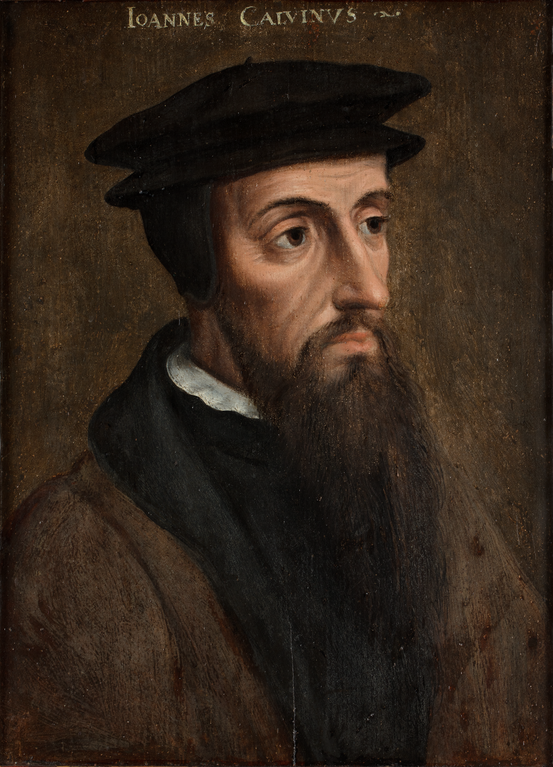
Photo credit: portrait of John Calvin, c. 1550 [public domain / Wikimedia Commons]
John Calvin (1509-1564) was the second most important early Protestant leader (aka “reformer”), but I would contend that he has had more historical influence on Protestantism than even Martin Luther. He added his own distinctive features to the development of justification in Protestantism. Anglican Church historian Alister McGrath explains:
Calvin’s insistence upon the distinctiveness yet inseparability of justification and sanctification must be taken very seriously, as must the analogies that Calvin uses in exploring this point – such as that of the sun and its radiance. ‘By its heat, the sun gives life to the earth and makes it fruitful; by its beams, it brightens and illumines it. There is a mutual and indivisible connection here. Yet it is clearly unacceptable to transfer the specific qualities of the one to the other.’ [Institutes, III.xi.6] . . . The importance of this point is perhaps best seen from one of Calvin’s responses [43] to Jacopo Sadoleto . . .
While we deny that good works have any role in justification, we recognize their proper place in the lives of the righteous. For someone who is justified possesses Christ . . . who as the Apostle teaches, (1 Corinthians 1:30), has been given to us for our justification and for sanctification. And where there is this righteousness of faith, which we maintain to be freely given, Christ is there as well. And wherever Christ is, there also is the Spirit of holiness, who gives new life to the soul. (Iustitia Dei: A History of the Christian Doctrine of Justification, Cambridge University Press, 4th edition, 2020, p. 223)
Calvin understands both justification and sanctification to be . . . bestowed simultaneously and inseparably upon believers . . . Sanctification is not the effect of justification; both justification and sanctification are effects of union with Christ. . . .
Like Luther . . . Calvin implicates Christ intrinsically . . . echoing Luther’s realist conception of justification as the personal encounter of the believer with God in Christ, while simultaneously retaining the extrinsicism of the Melanchthonian concept of justification. (p. 224)
Once again, the key phrase from Calvin is “we deny that good works have any role in justification.” He makes it very clear — as did Luther — that good works were a crucial, necessary part of the Christian life. Calvin was no antinomian (i.e., the view that works play no important role in the Christian life at all).
It’s interesting to note that William Farel (1489-1565), close associate of John Calvin, one of the four main figures of early Reformed Protestantism or Calvinism (Theodore Beza [1519-1605] and John Knox [c. 1514-1572] being the other two), and the biggest influence in the decision of Geneva to embrace Protestantism in 1536, held a more traditional (what I would call “Catholic”) view of justification. McGrath summarizes:
Guillaume Farel . . . played a significant role in the introduction of the reformation . . . in Geneva from 1532 onwards, as well as persuading Lausanne to adopt the Reformation in 1536. . . . Farel’s specific views on justification are set out [in] the seventh chapter of his Summaire [et briefve declaration] [1529; oldest extant edition, 1533]. For Farel, justification is about the restoration of ‘God’s true image which shines through the regeneration effected by God’s Word and is received by faith’ [b. 5v.]. Justification is clearly understood as something that is transformative, preparing and enabling the believer to do good works. In due course, Farel’s theology would be displaced as Calvin’s star rose, bringing with it a wider acceptance of more forensic approaches to justification. (pp. 284-285)
There is no reason to suggest that Farel deliberately chose to overlook the more forensic or declaratory approaches to justification gaining ground at Wittenberg; he does not seem to have been aware of them . . . (p. 285)
Presbyterian theologian Charles Hodge (1797-1878), principal of Princeton Theological Seminary between 1851 and 1878, was one of the most influential Calvinists of the 19th century. He reaffirmed what was by then long since the standard view of justification in confessional, traditional Reformed circles (as it remains today):
(1) Justification is an instantaneous act and not, like sanctification, a continued and progressive work.
(2) Justification is an act of grace to the sinner, who in himself deserves condemnation.
(3) . . . It does not produce any subjective change in the person justified. It does not effect a change of character, making those good who were bad, those holy who were unholy. That is done in regeneration and sanctification . . . It is a forensic or judicial act . . . It is a declarative act in which God pronounces the sinner just or righteous . . .
(4) The meritorious ground of justification is not faith; we are not justified on account of our faith, considered as a virtuous or holy act or state of mind. Nor are our works of any kind the ground of justification . . . The ground of justification is the righteousness of Christ . . . including His perfect obedience to the law as a covenant and His enduring the penalty of the law in our stead and in our behalf.
(5) The righteousness of Christ is in justification imputed to the believer. That is, it is set to his account, so that he is entitled to plead it at the bar of God, as though it were personally and inherently his own. (Systematic Theology, abridged one-volume edition by Edward N. Gross, Grand Rapids, Michigan: Baker Book House, 1988 [originally 1873, three volumes], p. 454)
Grace and works are antithetical . . . Grace of necessity excludes works of every kind, and more especially those of the highest kind, which might have some show of merit. But merit of any degree is of necessity excluded if our salvation be by grace . . .
The sins which are pardoned in justification include all sins, past, present, and future. (Ibid., 458, 461)
On the related question post-regenerative good works and sanctification, Hodge wrote:
On the subject of the necessity of good works there has never been any real difference of opinion among Protestants. First, it is universally admitted that good works are not necessary to our justification; they are consequences and indirectly the fruits of justification and, therefore, cannot be its ground . . . It is agreed that it is only a living faith, i.e., a faith which works by love and purifies the heart, that unites the soul to Christ and secures our reconciliation with God . . . It is universally admitted that an immoral life is inconsistent with a state of grace, that those who willfully continue in the practice of sin shall not inherit the kingdom of God . . . For sanctification is inseparable from justification, and the one is just as essential as the other.
Although Protestants deny the merit of good works and teach that salvation is entirely gratuitous – . . . solely on the grounds of the merits of the Lord Jesus Christ – they nevertheless teach that God does reward His people for their works . . . The Scriptures also teach that the happiness or blessedness which believers will experience in a future life will be greater or less in proportion to their devotion to the service of Christ in this life” (Ibid., 471-472)
Augustus Hopkins Strong (1836-1921) was a Reformed Baptist theologian, perhaps the most notable and influential one in the late 19th and early 20th centuries, and author of the widely used, three-volume Systematic Theology (1907). He was a “moderate” or “three-point” Calvinist. He rejected limited atonement and a less strict position on irresistible grace. Here is his definition of justification:
That initial act of God by which, on account of Christ, to whom the sinner is united by faith, he declares that sinner to be no longer exposed to the penalty of the law, but to be restored to his favor . . . Justification is the reversal of God’s attitude toward the sinner, because of the sinner’s new relation to Christ. God did condemn; he now acquits. He did repel; he now admits to favor.
Justification, as thus defined, is therefore a declarative act, as distinguished from an efficient act; an act of God external to the sinner, as distinguished from an act within the sinner’s nature and changing that nature; a judicial act, as distinguished from a sovereign act; an act based upon and logically presupposing the sinner’s union with Christ, as distinguished from an act which causes and is followed by that union with Christ. (Systematic Theology, Westwood, New Jersey: Fleming H. Revell, one-volume edition, 1967, p. 849)
His views on sanctification and good works were similar to those of Hodge and the standard Protestant “Melanchthonian” view: “we are saved . . . without merit on our own part” (one-volume second edition, 1889, p. 282).
Now we shall move on to some interaction with John Calvin’s reasoning (in effect a sort of back-and-forth “debate”), just as I did with Philip Melanchthon in the preceding chapter. Calvin’s words will be in blue. First, I’ll reply to his Acts of the Council of Trent with the Antidote (Nov. 1547), specifically his comments on the Sixth Session of the Council of Trent (Jan. 1547), regarding justification. The online treatise is taken from Selected Works of John Calvin: Tracts and Letters, Vol. 3: Tracts, Part 3; edited and translated by Henry Beveridge (Edinburgh: Calvin Translation Society, 1851). I have a hardcover copy of this volume in my own library: a reprint from Baker Book House (Grand Rapids, Michigan, 1983). Words from Trent will be in green.
When by the singular kindness of God, the impiety of Pelagius was repudiated with the common consent of the ancient Church, they no longer dared to talk so pertly of human merit.
Human merit, necessarily brought about by God’s grace (“God crowning His own gifts,” as St. Augustine described it) is not Pelagian works-salvation. This is the obnoxious fallacy always spouted by Calvin, and his Calvinist followers, and many other Protestants. If such works are simultaneously God’s and our own (1 Cor 15:10; cf. 3:9; Mk 16:20; Rom 15:17-19; 2 Cor 6:1; Eph 2:10; Phil 2:12-13; Titus 3:5-8), totally enabled by Him from the outset, that’s not mere human works. The Bible teaches that meritorious works are good, and required for salvation (see ch. 16).
Trent in its Chapter XVI on Justification, stated that “Jesus Christ Himself continually infuses his virtue into the said justified,-as the head into the members, and the vine into the branches,-and this virtue always precedes and accompanies and follows their good works, which without it could not in any wise be pleasing and meritorious before God . . .God forbid that a Christian should either trust or glory in himself, and not in the Lord, whose bounty towards all men is so great, that He will have the things which are His own gifts be their merits.” Canon XXXII reiterates that “the good works” of the justified person are those “which he performs through the grace of God and the merit of Jesus Christ.” Both/and.
Nay, their definition at length contains nothing else than the trite dogma of the schools: that men are justified partly by the grace of God and partly by their own works; thus only showing themselves somewhat more modest than Pelagius was.
It’s not either/or in this sense, because our works are at the same time, God’s (working with us, through grace and power). Calvin vainly tries to pretend that we teach that they are wholly and only our own works and divorced from the necessary connection to God’s 100% causal grace. We simply cooperate with Him. That can’t possibly be Pelagianism. Nor is it Semi-Pelagianism. But Protestants — stuck in the “either/or” hyper-rationalistic rut, have been falsely accusing us of those heresies for over 500 years, and, sadly, it won’t ever stop. Wikipedia, citing the Oxford Dictionary of the Christian Church, states:
A distinction is made between the beginning of faith and the increase of faith. Semi-Pelagian thought teaches that the latter half – growing in faith – is the work of God, while the beginning of faith is an act of free will, with grace supervening only later.
That’s emphatically not Catholic teaching, as was made crystal clear in Canons I-III of the Sixth Session of the Council of Trent. Later on in his reply, Calvin offers a rare note of agreement, in stating, “To Canons 1, 2, and 3:, I say, Amen.” So he reads those and agrees. But they clearly teach that we reject both Pelagianism and Semi-Pelagianism. Yet nevertheless, here he is accusing us of these heresies, anyway, either contradicting himself or showing that he has gotten the definitions of those heresies wrong. It’s one or the other.
they certainly understand that the human will has still some power left to choose good. . . . let them say whether he who makes us to be willing simply assists the will.
The regenerate, grace-enabled will can choose good, but not the unregenerate will, per Canons I-III alluded to and linked above. Calvin confuses the two categories. That’s where he goes astray and starts misrepresenting Catholic theology. Alas, his prodigious powers of rationality fail him. Moreover, Trent’s Chapter V on Justification is quite plain when it declares that unregenerate man is “not able, by his own free will, without the grace of God, to move himself unto justice in His sight.”
Is this the doctrine delivered by Augustine, when he says, “Men labor to find in our will some good thing of our own not given us of God; what they can find I know not?” (Aug. Lib. de Precator. Merit. et Remiss. 2.)
Exactly. Chapter XVI on Justification teaches the same: “Jesus Christ Himself continually infuses his virtue into the said justified,-as the head into the members, and the vine into the branches,-and this virtue always precedes and accompanies and follows their good works, which without it could not in any wise be pleasing and meritorious before God”. Canon IV teaches that our “free will” is “moved and excited by God.”
The hallucination of these Fathers is in dreaming that we are offered a movement which leaves us an intermediate choice, while they never think of that effectual working by which the heart of man is renewed from pravity to rectitude.
Catholics believe in the predestination of the elect, just as Calvinists and other Protestants do. What we deny over against Calvinists (in this instance, in agreement with most Protestants) is predestination to hell.
The whole may be thus summed up — Their error consists in sharing the work between God and ourselves, so as to transfer to ourselves the obedience of a pious will in assenting to divine grace, whereas this is the proper work of God himself.
Calvin badly distorts our teaching. Canons I-III obviously agree with this and Calvin agreed with them, so he is again fighting with other statements he has made, which were accurate as to our view.
Let them produce evidence from Scripture, if they have any, to convince us of their doctrine. . . .
Scripture, . . . opposes faith to works . . .
That’s precisely what this book is about! Delighted to satisfy Calvin’s desire and demand.
Lest they should not be liberal enough in preaching up the powers of man, they again repeat, under this head, that the Spirit of God acts in us according to the proper disposedness and co-operation of each. What disposedness, pray, will the Spirit of God find in stony hearts? Are they not ashamed to feign a disposedness, when the Spirit himself uniformly declares in Scripture that all things are contrary? For the commencement of grace is to make those willing who were unwilling, and therefore repugnant; so that faith, as well in its beginnings as its increase, even to its final perfection, is the gift of God;
This is exactly what Trent in its Sixth Session taught:
CANON III.-If any one saith, that without the prevenient inspiration of the Holy Ghost, and without his help, man can believe, hope, love, or be penitent as he ought, so as that the grace of Justification may be bestowed upon him; let him be anathema.
Calvin ends up preaching to the choir. As I have already noted, he is on record agreeing with the first three canons on justification. So why does he continue to quixotically argue as if we didn’t believe what we clearly do, and which he himself agreed with?
“God hath blessed us with all spiritual blessings, according as he hath chosen us in Christ, according to the good pleasure of his will.” (Ephesians 1:3.)
By these words he certainly restrains us, while receiving so great a blessing from God, from glorying in the decision of our will, as Augustine again says. (Ibid. c. 8.) This which man ought to receive as at the hands of God, is he to oppose to him as a merit of his own?
Paul constantly boasted in his accomplishments and those of others; while giving God all the glory. It’s not contradictory; it’s not opposition to God. Rather, it’s the biblical and Hebraic “both/and” outlook, which Calvin is too rationalistic and caught up in men’s philosophies and traditions to grasp. It’s sad, since it is repeated and explicit biblical teaching. As for “glorying,” St. Paul even wrote, utterly contrary to Calvin’s argument above: “to those who by patience in well-doing seek for glory and honor and immortality, he will give eternal life . . . glory and honor and peace for every one who does good” (Rom 2:7, 10) and “we rejoice in our hope of sharing the glory of God” (Rom 5:2).
I am ashamed to debate the matter, as if it were doubtful, with men who call themselves Christians. The doctrine of Scripture is clear. “We know,” says John, (1 John 4:6,) “that we are the children of God.”
Indeed, but how does John say that we know this?:
1 John 2:3-5 And by this we may be sure that we know him, if we keep his commandments. [4] He who says “I know him” but disobeys his commandments is a liar, and the truth is not in him; [5] but whoever keeps his word, in him truly love for God is perfected. By this we may be sure that we are in him:
1 John 3:24 All who keep his commandments abide in him, and he in them. And by this we know that he abides in us, by the Spirit which he has given us.
He doesn’t teach, “we’re absolutely sure because we have faith!” He wasn’t a Calvinist and would have — along with Paul and James and Peter — flunked out of their seminaries. Rather, good works and obeying commandments are how we know, and “knowing” doesn’t mean that it is for all time, into eternity. We can know in the present, because we’re in the present and there is no required speculation about what is to come. *That’*s Paul’s and John’s teaching. That’s why Paul refers to “lest after preaching to others I myself should be disqualified” (1 Cor 9:27) and “let anyone who thinks that he stands take heed lest he fall” (1 Cor 10:12) and “if possible I may attain the resurrection from the dead. Not that I have already obtained this or am already perfect; but I press on to make it my own. Brethren, I do not consider that I have made it my own . . . ” (Phil 3:11-13).
And, indeed, they are ignorant of the whole nature of faith who mingle doubt with it.
Again; it’s not doubt per se; rather, it’s a common sense acknowledgment that we don’t know the future. Jesus said, “he who endures to the end will be saved” (Mt 10:22). We don’t know that we’ll do that. But we have a strong faith that God’s enabling power will give us the strength and perseverance to do that, provided we are willing the whole way and don’t “fall away” (Gal 5:4; cf. Mt 13:6-7: parable of the sower). Paul condemns doubt (Rom 14:23), but he still warns about a possible falling away, if one isn’t vigilant and doesn’t “press on” like he does, or as James describes: “he who . . . perseveres, being no hearer that forgets but a doer that acts, he shall be blessed in his doing” (Jas 1:25).
Next I will interact with Calvin’s words in his Commentaries, concerning biblical texts that Catholics contend work against faith alone:
Matthew 10:22 (cf. Mt 24:13; Mk 13:13) . . . But he who endures to the end will be saved.
Here, Calvin is brief. I cite his entire commentary:
This single promise ought sufficiently to support the minds of the godly, though the whole world should rise against them: for they are assured that the result will be prosperous and happy. If those who fight under earthly commanders, and are uncertain as to the issue of the battle, are carried forward even to death by steadiness of purpose, shall those who are certain of victory hesitate to abide by the cause of Christ to the very last?
It’s simply wrongheaded. This is not primarily a promise. Rather, it’s an exhortation to be vigilant. Nor is it an instance of assurance, for no one knows the future; hence, we don’t know with absolute certainty if we will endure to the end. St. Paul certainly exhibited no such faux-certainty, even about his own final state in the afterlife (Phil 3:10-14, 16; 1 Cor 9:25-27; 10:12). St. Peter casually assumes the possibility of falling away from grace and salvation and teaches that we don’t and won’t allow that to happen by engaging in numerous good works (2 Peter 1:5-7, 10-11). Likewise, St. John:
2 John 1:8 Look to yourselves, that you may not lose what you have worked for, but may win a full reward.
In the context of the parallel verse in Matthew 24:13, Jesus taught:
Matthew 24:4-5 . . . “Take heed that no one leads you astray. [5] For many will come in my name, saying, ‘I am the Christ,’ and they will lead many astray.”
Why is He warning His disciples about a thing that supposedly can’t happen? Who knows? Calvin’s theology requires him to believe in the unbiblical notion of believers being eternally secure (irresistible grace). Similarly, Jesus stated:
Luke 21:8, 34-36 “Take heed that you are not led astray; . . . [34] But take heed to yourselves lest your hearts be weighed down with dissipation and drunkenness and cares of this life, and that day come upon you suddenly like a snare; [35] for it will come upon all who dwell upon the face of the whole earth. [36] But watch at all times, praying that you may have strength to escape all these things that will take place, and to stand before the Son of man.”
Again, Jesus says:
Revelation 2:5 Remember then from what you have fallen, repent and do the works you did at first. If not, I will come to you and remove your lampstand from its place, unless you repent.
In Revelation 2:10, Jesus says, “Be faithful unto death, and I will give you the crown of life.” It seems to me that if Calvin’s doctrine were true, He would have said something like, “you will be faithful unto death, at which time I will give you the crown of life.” But instead, the reward comes as a result of our faithful works and endurance. As always, it’s “both/and”: God’s grace enabling us to do good works, which He in turn rewards. But our works can’t be left out of it, as of no relevance whatsoever, and that’s what Calvin futilely attempts to do, because he is beholden to a false tradition of men, rather than to the Bible in this instance.
how comes it that God confers so great honor on imperfect and sinful works but because, after having by free grace reconciled us to himself, He accepts our works without any regard to merit, by not imputing the sins which cleave to them?
This is not an argument; it’s a false assumption. The Bible never teaches that every single work is imperfect and sinful, nor that God supposedly doesn’t impute these “sins” that “cleave” to them: as Calvin mistakenly believes. God thinks they are altogether good enough to not only receive merit but also to help bring about salvation. This book massively proves that in its Part Three.
God, of his own good pleasure, bestows on our works a reward which we did not deserve.
The Bible says that they are worthy. That’s why Paul stated that he was “proud” of his own works, and boasted about them, and boasted about works of his followers, too. If we want to find the notion of works “deserving” reward, we can find that, too:
Matthew 10:10 . . . the laborer deserves his food.
Luke 10:7 . . . the laborer deserves his wages . . .
These two passages refer to the disciples going out and evangelizing and performing miracles.
1 Timothy 5:18 for the scripture says, “You shall not muzzle an ox when it is treading out the grain,” and, “The laborer deserves his wages.”
Revelation 2:23 . . . I will give to each of you as your works deserve.
Scripture knows nothing of the false doctrine of every good work inevitably being tainted by sin and corruption. God gives rewards that we have merited and deserve. Calvin gets it exactly backwards.
Matthew 19:29 And every one who has left houses or brothers or sisters or father or mother or children or lands, for my name’s sake, will receive a hundredfold, and inherit eternal life. (cf. Mk 10:29-30)
After having raised the expectation of his followers to the hope of a future life,
Indeed, Jesus said in v. 28: “you who have followed me will also sit on twelve thrones . . .”
he supports them by immediate consolations, and strengthens them for bearing the cross. For though God permit his people to be severely afflicted, he never abandons them, so as not to recompense their distresses by his assistance. And here he does not merely address the apostles, but takes occasion to direct his discourse generally to all the godly. The substance of it is this: Those who shall willingly lose all for the sake of Christ, will be more happy even in this life than if they had retained the full possession of them; but the chief reward is laid up for them in heaven.
Jesus expresses the thought, “If you do x, you inherit eternal life.” That’s much different from “if you believe in me and have faith, you receive possibility of having a connection to salvation.” They don’t fit the “plan” and so they are either totally ignored, or else this obvious aspect is simply not addressed. Calvin noted that Jesus went beyond the disciples to “all the godly.”
But Calvin does a clever and not altogether honest thing. Rather than assert that their reward is heaven itself, as the passage does (“everyone who has [done any of these self-sacrificing things] . . . will . . . inherit eternal life”), he claims that “the chief reward is laid up for them in heaven”: that is, the person who does these things will be more greatly rewarded in heaven (the differential rewards that we all agree upon). But that’s not what the text teaches. It doesn’t say that the reward in heaven is a “hundredfold.” The “hundredfold” is referring to this life. The cross-references in Mark and Luke make this absolutely clear:
Mark 10:30 . . . receive a hundredfold now in this time, houses and brothers and sisters and mothers and children and lands, with persecutions, and in the age to come eternal life.
Luke 18:30 . . . receive manifold more in this time, and in the age to come eternal life.”
This is utterly contrary to the doctrine of “faith alone.” Calvin alludes to rewards in this life (“will be more happy even in this life”) but he doesn’t acknowledge that heaven itself is a reward, too. To sum up, the text (most undeniably in Mark and Luke) is in the following logical form: “whoever does x, will receive y and z“: as opposed to, “whoever does x, will receive y as part of z“.
Calvin simply ignores the central teaching of the text itself. And that won’t do. If we are serious about following the Bible as God’s inspired revelation, we must follow it wherever it leads, rather than trying to force-fit it into our preconceived theology, when in fact it does not harmonize with the latter (what is called eisegesis, or “reading into” a biblical text things that aren’t present). It’s an even more serious error when one is “messing around” with the words of Our Lord Jesus Himself.
Luke 6:35 But love your enemies, and do good, and lend, expecting nothing in return; and your reward will be great, and you will be sons of the Most High; . . .
In his commentary on this passage, Calvin completely ignores the fact that in this passage being “sons of the Most High” (being justified, saved, attaining heaven) is a result of loving enemies, doing good, and lending, expecting nothing back (two of these being good works, plus love that is proven by outward good works: “love is kind” after all [1 Cor 13:4], and kindness is a good action).
Acts 26:18 to open their eyes, that they may turn from darkness to light and from the power of Satan to God, that they may receive forgiveness of sins and a place among those who are sanctified by faith in me. [Phillips: “made holy by their faith in me”]
Some do read it falsely in one text, among those who are sanctified by faith, because this word is extended unto the whole period. Therefore, the meaning thereof is, that by faith we come unto the possession of all those good things which are offered by the gospel. And faith is properly directed unto Christ because all the parts of our salvation are included in him.
True to form, Calvin skips over the main striking point: “sanctified by faith in me.” In other words, the same faith that brings about justification includes sanctification at the same time. In exercising faith, we are sanctified: the very thing that Calvin and Protestants generally try to make out is completely separate from justification. It’s impossible to do because this passage and Romans 6:22 (“. . . sanctification and its end, eternal life”) organically connect the two in a way that is rather difficult to explain away. Thus, since sophistry wouldn’t explain away this passage, Calvin opted for his other frequent dubious method: ignoring the obviously “Catholic” implications of it.
Romans 2:6-10 For he will render to every man according to his works: [7] to those who by patience in well-doing seek for glory and honor and immortality, he will give eternal life; [8] but for those who are factious and do not obey the truth, but obey wickedness, there will be wrath and fury. [9] There will be tribulation and distress for every human being who does evil, the Jew first and also the Greek, [10] but glory and honor and peace for every one who does good, the Jew first and also the Greek.
There is not so much difficulty in this verse [2:6], as it is commonly thought. For the Lord, by visiting the wickedness of the reprobate with just vengeance, will recompense them with what they have deserved: and as he sanctifies those whom he has previously resolved to glorify, he will also crown their good works, but not on account of any merit: nor can this be proved from this verse; for though it declares what reward good works are to have, it does yet by no means show what they are worth, or what price is due to them. And it is an absurd inference, to deduce merit from reward.
But this completely ignores — with boilerplate rhetoric –, the entire thrust of 2:6 combined with 2:7: where “well-doing” is assumed to be a cause of “eternal life”: a thing that simply can’t be in Calvin’s soteriology, because it would entail the dreaded, despised merit.
And when he says, that the faithful, by continuing in good works, seek glory and honour, he does not mean that they aspire after any thing else but the favor of God, or that they strive to attain any thing higher, or more excellent: but they can not seek him, without striving, at the same time, for the blessedness of his kingdom, the description of which is contained in the paraphrase given in these words. The meaning then is, — that the Lord will give eternal life to those who, by attention to good works, strive to attain immortality.
Here, Calvin is essentially making our argument for us, since he seems to be saying that good works and striving have to do with immortality (i.e., justification and salvation). But that’s our view, so he appears to be internally incoherent and inconsistent, which is not all that uncommon in Calvin, though much less so than with Luther.
Calvin then completely skips over v. 10. I guess I would, too, if I held his view, since Paul is saying that salvation comes to “every one who does good” as opposed to everyone having faith alone in Jesus.
Romans 2:13 For it is not the hearers of the law who are righteous before God, but the doers of the law who will be justified.
How does Calvin attempt to explain away such a clear “Catholic” verse? He does so by eisegesis (reading into it what isn’t there) and sophistry:
They who pervert this passage for the purpose of building up justification by works, deserve most fully to be laughed at even by children. It is therefore improper and beyond what is needful, to introduce here a long discussion on the subject, with the view of exposing so futile a sophistry: for the Apostle only urges here on the Jews what he had mentioned, the decision of the law, — That by the law they could not be justified, except they fulfilled the law, that if they transgressed it, a curse was instantly pronounced on them. Now we do not deny but that perfect righteousness is prescribed in the law: but as all are convicted of transgression, we say that another righteousness must be sought. Still more, we can prove from this passage that no one is justified by works; for if they alone are justified by the law who fulfill the law, it follows that no one is justified; for no one can be found who can boast of having fulfilled the law.
In my opinion, this is obviously self-refuting. He’s not dealing straightforwardly with the text, because if he did, he’d be unable to avoid to a “Catholic” conclusion, and he can never do that, so . . .
Romans 6:22 But now that you have been set free from sin and have become slaves of God, the return you get is sanctification and its end, eternal life.
We now gather the fruit of righteousness, even holiness; we hope in future to gain eternal life. These things, unless we are beyond measure stupid, ought to generate in our minds a hatred and horror of sin, and also a love and desire for righteousness. Some render τελος, “tribute” or reward, and not “end,” but not, as I think, according to the meaning of the Apostle; for though it is true that we bear the punishment of death on account of sin, yet this word is not suitable to the other clause, to which it is applied by Paul, inasmuch as life cannot be said to be the tribute or reward of righteousness.
Here he simply denies what the text says: a form of sophistry, especially in his last clause. It can’t be, so it isn’t, despite the fact that Holy Scripture plainly asserts it. Man-made tradition trumps God’s inspired, infallible revelation. What a cynical and sad view: to treat God’s Word in such a cavalier fashion.
Romans 8:13 for if you live according to the flesh you will die, but if by the Spirit you put to death the deeds of the body you will live.
This is a classic Hebraic, biblical “if . . . then” contract-like conditional: “if you do [bad thing] x, you’ll die, but if you do [good thing] y, you will live.” It’s undeniably direct causation. Here, a carnal, worldly life brings spiritual death, but a Spirit-filled life brings eternal life. This, of course, goes against the Calvinist doctrine that one is justified once-and-for all in one moment, by faith, and that, thereafter, good works, while beneficial and encouraged by Calvin, have nothing to do with salvation whatsoever. The problem is that the biblical text — like many others I have found — doesn’t read like one would expect it to read, were Calvin’s doctrine true. So let’s see how he tries to evade that fact.
He adds a threatening, in order more effectually to shake off their torpor; by which also they are fully confuted who boast of justification by faith without the Spirit of Christ, though they are more than sufficiently convicted by their own conscience; for there is no confidence in God, where there is no love of righteousness. It is indeed true, that we are justified in Christ through the mercy of God alone; but it is equally true and certain, that all who are justified are called by the Lord, that they may live worthy of their vocation. Let then the faithful learn to embrace him, not only for justification, but also for sanctification, as he has been given to us for both these purposes, lest they rend him asunder by their mutilated faith.
What Calvin does is apply his doctrine of irresistible grace: those who are justified by faith will inevitably live righteous lives — in a broad sense — and are incapable of doing otherwise. This flies in the face, of course, of at least 150 Bible passages that explicitly describe true believers falling away (committing apostasy). That’s an awful lot of Scripture to have to rationalize away or ignore.
He [in 8:13b] . . . moderates his address, that he might not deject the minds of the godly, who are still conscious of much infirmity; for however we may as yet be exposed to sins, he nevertheless promises life to us, provided we strive to mortify the flesh: for he does not strictly require the destruction of the flesh, but only bids us to make every exertion to subdue its lusts.
This is deviously clever. Calvin invents a “saving distinction” not found in the text itself, by asserting that Paul doesn’t “require” a renunciation and resolve to “put to death the deeds of the body”; he only demands an “e for effort”: the good ol’ college try. Nice try at smuggling in a desperate eisegetical ploy. The passage, as already noted, makes a one-on-one causal scenario: far from being optional, denouncing sin is required for salvation. To make the point crystal-clear, St. Paul reiterates it four verses later, with a reversed “if then” (“then if”) condition:
Romans 8:17 . . . heirs of God and fellow heirs with Christ, provided we suffer with him in order that we may also be glorified with him.
If we “suffer with him” then we will be “heirs of God and fellow heirs with Christ” and will be “glorified with him.” The suffering isn’t optional. This is one of the most ignored verses in the New Testament. It fits perfectly into Catholic soteriology and not at all into most Protestant — particularly Calvinist — versions.
It is however the design of Paul, as it will presently appear more fully, highly to extol this inheritance promised to us, that we may be contented with it, and manfully despise the allurements of the world, and patiently bear whatever troubles may press on us in this life.
But that’s not what Paul wrote. He wasn’t merely expressing the notion that we are “contented” with whatever struggles come our way, but rather, that the sufferings have a direct bearing on whether we will be saved and attain eternal life. Calvin sidesteps this crucial factor by ignoring it. It’s his “time-honored” method.
“God’s inheritance is ours, because we have by his grace been adopted as his children; and that it may not be doubtful, its possession as been already conferred on Christ, whose partners we are become: but Christ came to it by the cross; then we must come to it in the same manner.” Nor is that to be dreaded which some fear, that Paul thus ascribes the cause of our eternal glory to our labours; for this mode of speaking is not unusual in Scripture. He denotes the order, which the Lord follows in dispensing salvation to us, rather than the cause; for he has already sufficiently defended the gratuitous mercy of God against the merits of works. When now exhorting us to patience, he does not show whence salvation proceeds, but how God governs his people.
This is pure sophistry. Having basically explicated the actual meaning in the first part of his above statement, he then proceeds to explain it away as if it has no imperative importance, by drawing a sophistical and unbiblical dichotomy between “order” and “cause.” It won’t do. The text is too clear. It goes far beyond mere “order” or chronology, to causation. It’s not descriptive (what in fact happened), but prescriptive (what we ought to do).
Romans 10:16 But they have not all obeyed the gospel; for Isaiah says, “Lord, who has believed what he has heard from us?”
Calvin completely ignores, in his commentary on this passage, the aspect of “obeyed the gospel”: which conjoins faith and works in a way that he doesn’t like. Instead, he uses the passage as an opportunity to express his false doctrine of limited atonement. He doesn’t even attack universal atonement, but rather, universalism, which, of course, neither Catholics nor Orthodox, nor the great majority of Protestants who hold to universal atonement, believe:
It is hence evident, how foolishly some maintain, that all are indiscriminately the elect, because the doctrine of salvation is universal, and because God invites all indiscriminately to himself. But the generality of the promises does not alone and by itself make salvation common to all: on the contrary, the peculiar revelation, mentioned by the Prophet, confines it to the elect.
Fighting straw men, ignoring inspired revelation that he foolishly disagrees with, and topic-switching advance his own erroneous view not a whit.
*****
Photo credit: portrait of John Calvin, c. 1550 [public domain / Wikimedia Commons]

Summary: I summarize John Calvin’s contribution to the new Protestant doctrine of imputed, extrinsic justification, note a few other Calvinist views, & interact with Calvin’s arguments.
[24 pages]
Calvinism & General Protestantism
Previous Post

April 28, 2026
Philip Melanchthon & Imputed Justification
Next Post
April 29, 2026 John Wesley vs. Extrinsic Justification & “Faith Alone”
Recent Comments
"And lastly, I belong to no denomination and am free to serve God as He ..."
Is Venerating Men & Angels Worship? ..."
"And obeisance doesn't mean "worship". It means "respect", "obey", or "submission". Very weird that you ..."
Is Venerating Men & Angels Worship? ..."
"Many of these scriptures you have noted have been taken out of context. With Daniel, ..."
Is Venerating Men & Angels Worship? ..."
""Protestants often point out that Jesus is now triumphant in heaven and object to Catholics ..."
Three More Anti-Catholic Lies About Catholicism ..."
Browse Our Archives
Select a Category & Last Things About Me Anti-Catholicism Atheism & Agnosticism Baptism and Sacramentalism Bible and Tradition Blessed Virgin Mary Books by Dave Armstrong C. S. Lewis Calvinism & General Protestantism Catholic Apologetics Catholic Apologists Catholic conversion Catholic converts Christmas Church (Ecclesiology) Church History Conversion and Converts Development of Doctrine Eastern Orthodoxy Ecumenism & Christian Unity Eucharist & Liturgy Fathers of the Church French Translations G. K. Chesterton Hell Hell & Satan Hell & Satan & Last Things Heresies & Comparative Religion Holistic Health Inquisition & Crusades & Scandals James White Jews & Judaism & Old Testament John Calvin John Henry Newman Liberal / Modernist Theology Life Issues Literary Resume Lutheranism Mariology Martin Luther Music Orthodoxy Papacy & Infallibility Personal Page Philosophy & Science Political & Ethical & Moral Issues Protestant Persecution & Intolerance Protestantism Purgatory Purgatory & Penance Romantic & Imaginative Theology Saints & Purgatory & Penance Salvation Salvation & Justification Satan & Last Things Sexuality and Gender Issues Spanish Translations Traditionalism vs. Radical Catholic Reactionaries Traducciones al español / tradução para português Trinitarianism & Christology Uncategorized Videos
Select a Month October 2026 September 2026 August 2026 July 2026 June 2026 May 2026 April 2026 March 2026 February 2026 January 2026 December 2025 November 2025 October 2025 September 2025 August 2025 July 2025 June 2025 May 2025 April 2025 March 2025 February 2025 January 2025 December 2024 November 2024 October 2024 September 2024 August 2024 July 2024 June 2024 May 2024 April 2024 March 2024 February 2024 January 2024 December 2023 November 2023 October 2023 September 2023 August 2023 July 2023 June 2023 May 2023 April 2023 March 2023 February 2023 January 2023 December 2022 November 2022 October 2022 September 2022 August 2022 July 2022 June 2022 May 2022 April 2022 March 2022 February 2022 January 2022 December 2021 November 2021 October 2021 September 2021 August 2021 July 2021 June 2021 May 2021 April 2021 March 2021 February 2021 January 2021 December 2020 November 2020 October 2020 September 2020 August 2020 July 2020 June 2020 May 2020 April 2020 March 2020 February 2020 January 2020 December 2019 November 2019 October 2019 September 2019 August 2019 July 2019 June 2019 May 2019 April 2019 March 2019 February 2019 January 2019 December 2018 November 2018 October 2018 September 2018 August 2018 July 2018 June 2018 May 2018 April 2018 March 2018 February 2018 January 2018 December 2017 November 2017 October 2017 September 2017 August 2017 July 2017 June 2017 May 2017 April 2017 March 2017 February 2017 January 2017 December 2016 November 2016 October 2016 September 2016 August 2016 July 2016 June 2016 May 2016 April 2016 March 2016 February 2016 January 2016 December 2015 November 2015 October 2015 September 2015 August 2015 July 2015 June 2015 May 2015 April 2015 March 2015 February 2015 January 2015 December 2014 November 2014 October 2014 September 2014 August 2014 July 2014 June 2014 April 2014 March 2014 February 2014 January 2014 December 2013 November 2013 October 2013 September 2013 August 2013 July 2013 June 2013 April 2013 March 2013 February 2013 January 2013 December 2012 November 2012 October 2012 September 2012 August 2012 July 2012 June 2012 May 2012 April 2012 March 2012 February 2012 January 2012 December 2011 November 2011 October 2011 September 2011 August 2011 July 2011 June 2011 April 2011 March 2011 February 2011 October 2010 September 2010 August 2010 July 2010 April 2010 March 2010 December 2009 October 2009 August 2009 July 2009 June 2009 May 2009 March 2009 February 2009 October 2008 September 2008 April 2008 March 2008 February 2008 January 2008 December 2007 November 2007 October 2007 May 2007 March 2007 February 2007 January 2007 November 2006 October 2006 September 2006 August 2006 July 2006 June 2006 May 2006 April 2006 March 2006 February 2006 October 2005 June 2005 April 2005 February 2005 July 2004 May 2004 April 2004
Follow Us!
TAKE THE
Religious Wisdom Quiz
Who prayed for rain after a long drought and sent his servant to look seven times?
Select your answer to see how you score.
Elijah Isaiah Samuel Hosea
Books by This Author Books by Dave Armstrong
Related posts from Biblical Evidence for Catholicism

On Protestant Explanations of Catholic Conversion
Biblical Evidence for Catholicism

Bible & Catholicism on Mortal Sin (vs. John...
Biblical Evidence for Catholicism

Dialogue on Eternal Security / Absolute Assurance
Biblical Evidence for Catholicism

Protestant Confessions & "Ever-Virgin" Mary
Biblical Evidence for Catholicism
TRENDING AT PATHEOS Catholic

I was strolling through the top floor of the brand new Parthenon...

What Does Gêvâh Mean For Kimberley Guifoyle &...
This week, a lot of the news is focused on Kimberly Guilfoyle....

INNER CIRCLE: Profound Mystery (Of Christ In All...
Ephesians 5:31-32 “For this reason, a man will leave his father and...

Do Not Rejoice When Your Enemy Falls: The...
Turning an execution into a public spectacle is a disturbing expression of...

'The Chosen' S6 Trailer: The Passion Gets Very...
Not many watching 'The Chosen' worry about spoilers, but just because they...

The purpose-driven labor priest
A labor activist reads Rick Warren and it gets me wondering about...
view all Catholic blogs
What Are Your Thoughts?leave a comment
Ad-Free & Subscriber Log-In Subscription Support
- About Us
- 2026 Calendar
- Videos
- Podcasts
- Library of World Religions
- Faith In Media Tracker
- Advertise With Us
- Write for Us
- Privacy Policy
- Terms of Service
- Do Not Sell My Data
- Contact Us
- Radiant Digital
- Manage Newsletter Subscriptions
- Unsubscribe From Notifications
- Sitemap
Copyright 2008-2026, Patheos. All rights reserved.
Subscription Support Ad-Free & Subscriber Log-In
Follow Patheos