
BuddhistCatholicContemplativeEvangelicalGeneral ChristianHinduJewishLatter-day SaintMuslimNew VisionsProgressive Christian
Beliefs
- Buddhist
- Catholic
- Contemplative
- Evangelical
- General Christian
- Hindu
- Jewish
- Latter-day Saint
- More Voices
- Muslim
- New Visions
- Pagan
- Progressive Christian
Topics
- Religion News
- Food and Religion
- Sports and Religion
- Religious Art
- Religious Music and Entertainment
- Religious Events
- History and Religion
- Style and Religion
- Politics and Religion
- Women in Religion
- Recreation Outdoors and Religion
- Business Finance and Religion
- Careers Workplace and Religion
- Education and Religion
- Family Parenting and Religion
- Health Fitness and Religion
- Home and Religion
- Relationships and Religion
- Technology and Religion
- Travel and Religion
Columnists
- Buddhist Columnists
- Business Finance and Religion Columnists
- Careers Workplace and Religion Columnists
- Catholic Columnists
- Contemplative Columnists
- Education and Religion Columnists
- Evangelists Columnists
- Family Parenting and Religion Columnists
- General Christian Columnists
- Health Fitness and Religion Columnists
- Hindu Columnists
- History and Religion Columnists
- Home and Religion Columnists
- Jewish Columnists
- More Voices Columnists
- Latter Day Columnists
- Muslim Columnists
- New Visions Columnists
- Nonreligious Columnists
- Pagan Columnists
- Politics and Religion Columnists
- Progressive Columnists
- Recreation Outdoors and Religion Columnists
- Relationships and Religion Columnists
- Religion News Columnists
- Religious Art Columnists
- Religious Events Columnists
- Religious Music and Entertainment Columnists
- Sports and Religion Columnists
- Style and Religion Columnists
- Technology and Religion Columnists
- Travel and Religion Columnists
- Women in Religion Columnists
Resource Library
- 2026 Calendar
- Library of World Religions
- The 100 Most Holy Places on Earth
- Patheos Answers
- Podcasts
- Videos
- Faith Leaders Database
- Anglican Episcopalian
- Bahai
- Baptist
- Buddhism
- Christianity
- Confucianism
- Eastern Orthodoxy
- Hinduism
- Holiness and Pentecostal
- ISKCON
- Islam
- Judaism
- Lutheran
- Methodist
- The Church of Jesus Christ of Latter-day Saints
- New Age
- Paganism
- Presbytarian and Reformed
- Protestantism
- Religion Behind the Scenes
- Roman Catholic
- Scientology
- Shia Islam
- Sikhism
- Sufism
- Sunni Islam
- Taoism
- Zen
- See all religions
Research Tools
 Ad-Free & Subscriber Log-In Subscription Support
Ad-Free & Subscriber Log-In Subscription Support
Follow Patheos 

- Trending:
- Forgiveness
- |
- Marriage
- |
- Consciousness
- |
- Death Penalty
- |
- Election
- |
- Halloween

-
About
-
Catholic Apologetics
-
Church History
-
Great Apologists
-
Christian Worldview
-
Protestantism & Misc.
- Home
- Catholic
- History and Religion
- Confirmation: Biblical Evidences (vs. Patrick O’Brien)
Confirmation: Biblical Evidences (vs. Patrick O’Brien)
Last updated on: April 16, 2026 at 10:53 am by Dave Armstrong
Confirmation: Biblical Evidences (vs. Patrick O’Brien) 2026-04-16T10:53:37-04:00 Dave Armstrong
Patheos Explore the world's faith through different perspectives on religion and spirituality! Patheos has the views of the prevalent religions and spiritualities of the world.
Including Documentation of Protestant Espousal of the Rite of Confirmation & Brief Clarification of Anathemas
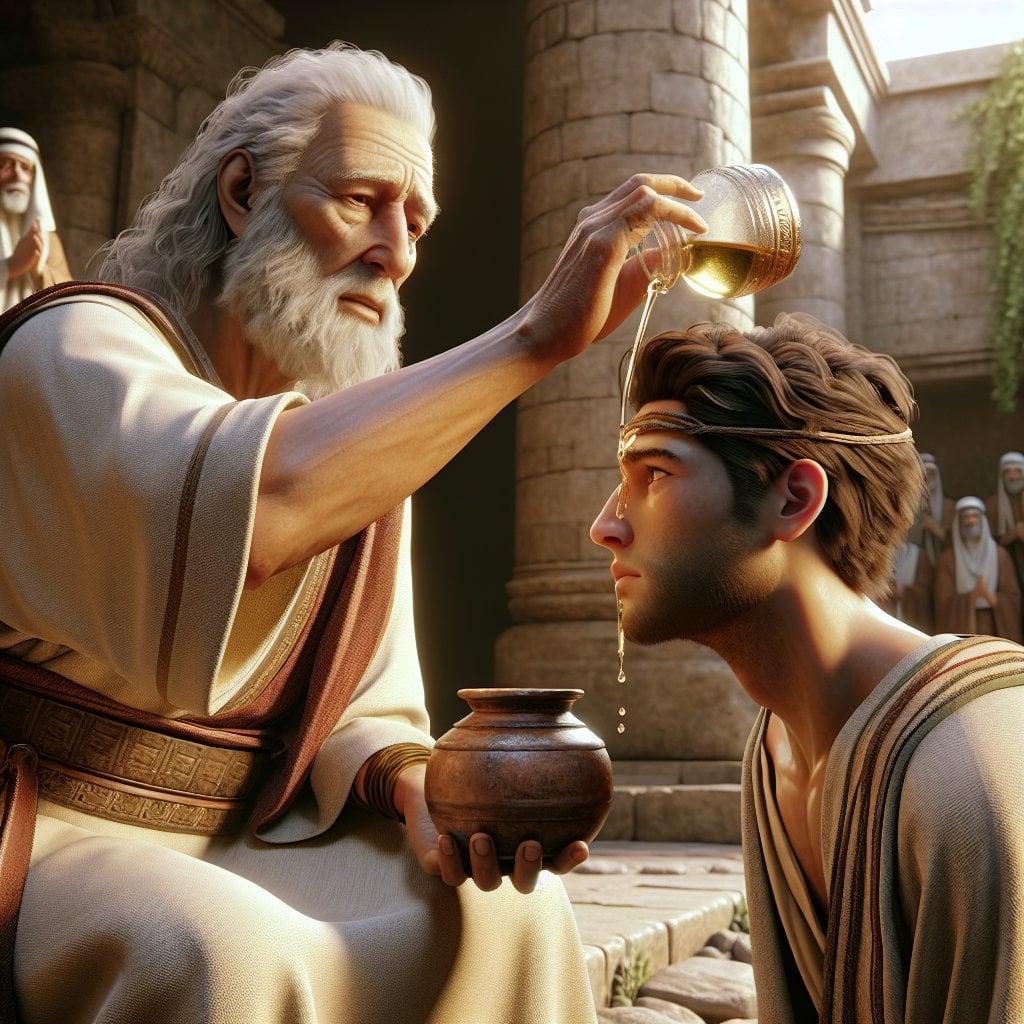
Photo credit: The prophet Samuel anoints King David (1 Sam 10:1) [Bible Art / Free to use for non-commercial purposes with attribution]
Patrick O’Brien is a former Catholic Protestant anti-Catholic apologist, who obtained a Masters of Divinity degree from Liberty University. He runs the Philippians 1:9 Ministries YouTube channel, that has 11,800 subscribers. Today we’ll be critiquing his video called, “Sacrament of Confirmation Examined: Is It a Biblical Practice?” (dated 12-18-25). His words from the video will be in blue.
*****
0:48 this sacrament of confirmation is not in the Bible. And really, it doesn’t make any sense. And this is why I say that Roman Catholicism just makes up, invents things, and makes up sacraments.
1:21 when we did our confirmation, we had the bishop come and it was a whole big to-do and you had to have a sponsor, which is weird. That’s not in the Bible either.
The word “sponsor” may not be there, but so what? The word “Trinity” isn’t in the Bible. Nor is “altar call” or “Bible Alone” or a host of other things that Protestants and other Christians believe. The phrase “faith alone” appears exactly once, and it’s condemned (“You see that a man is justified by works and not by faith alone” – James 2:24 [RSV]). What matters is whether a belief or concept or practice is present in the Bible. Its name is a secondary thing.
Here’s a notable biblical example of sponsorship, or vouching for the sincerity and qualifications of a person to become a Christian, or having passed some other qualification, such as readiness to be confirmed:
Acts 9:26-27 And when he [i.e., Paul] had come to Jerusalem he attempted to join the disciples; and they were all afraid of him, for they did not believe that he was a disciple. [27] But Barnabas took him, and brought him to the apostles, and declared to them how on the road he had seen the Lord, who spoke to him, and how at Damascus he had preached boldly in the name of Jesus.
The idea was also present in the early Church, where sponsors (the beginning of “godparents” – something most Protestants agree with) stood with the new convert and vouched for them as proper members of the Christian community, getting ready for baptism. Tertullian (c. 160-c. 225) mentioned a “sponsor” with regard to new converts seeking baptism in his treatise On Baptism. Paul himself functioned as a sponsor of sorts with Timothy, referring to him as “my true child in the faith” (1 Tim 1:2; cf. Phil 2:22). St. Paul reflects this understanding in writing to the Corinthians:
1 Corinthians 4:14-17 I do not write this to make you ashamed, but to admonish you as my beloved children. [15] For though you have countless guides in Christ, you do not have many fathers. For I became your father in Christ Jesus through the gospel. [16] I urge you, then, be imitators of me. [17] Therefore I sent to you Timothy, my beloved and faithful child in the Lord, to remind you of my ways in Christ, as I teach them everywhere in every church. (cf. 1 Thess 2:11)
Luther and Calvin believed in infant baptism, including sponsors during the ceremony. The Orthodox, Anglicans, Lutherans, and Methodists, among others, all retained the belief in godparents. The Reformed and Presbyterians did also, often referring to the godparents as “sponsors.” Wikipedia’s article, “Confirmation” – citing appropriate sources — describes the belief in confirmation – even though they don’t regard it as a sacrament — by many Protestant groups as follows:
In Christian denominations that practice infant baptism, confirmation is seen as the sealing of the covenant created in baptism. Those being confirmed are known as confirmands. The ceremony typically involves laying on of hands. . . .
In many Protestant denominations, such as the Lutheran, Reformed, Anglican and Methodist traditions, confirmation is a rite that often includes a profession of faith by an already baptized person. Confirmation is required by Lutherans, Anglicans and other traditional Protestant denominations for full membership in the respective church; the covenant theology of Reformed churches considers baptized infants members of the church, while confirmation or “profession of faith” is required for admittance to the Lord’s Table. . . .
Confirmation is not practiced in Baptist, Anabaptist and other groups that teach believer’s baptism.
The Methodist Worship Book affirms: “In Confirmation, those who have been baptized declare their faith in Christ and are strengthened by the Holy Spirit for continuing discipleship.” Anglicanism believes essentially the same thing (Methodism having derived from Anglicanism). The Lutheran Book of Worship also has a section concerning “Affirmation of Baptism” (also described as “confirmation” in the same document). It states that “A representative of the congregation presents the candidates to the minister” – this is the “sponsor” — and then the person being confirmed affirms basic tenets of Christianity. The pastor prays, “Continue to strengthen her / him with the Holy Spirit” and then lays hands on the person and prays that God the Father would “stir up . . . the gift of your Holy Spirit.”
In other words, confirmation or something very similar to it, is mainstream and majority Protestant belief and practice. Patrick, as a Baptist, is in a small minority, since belief in adult, believer’s adult baptism is small minority position among all Christians. In other words, he’s not representing even a majority of Protestants, who basically agree with us about this. By not noting all of these factors, he presents a view that doesn’t fully address the entire reality of who practices confirmation, or why they do. It’s an inadequate selective presentation, that we have now exposed and corrected. He’s dead wrong in implying that Catholics are unique in this respect and supposedly made it up out of nowhere.
St. John Henry Cardinal Newman, writing as an Anglican, eight years before he was received into the Catholic Church, made a helpful observation:
The Ancient Church seems to have believed as follows – that the Holy Ghost, who is the present Lord and animating Principle (Power) of the Church, communicates Himself variously to its members; – first in Baptism, in another way in Confirmation, in another way in the Holy Eucharist. His first gift or communication is forgiveness, justification, acceptance – and this is the distinguishing gift of Baptism. . . .
’Confirmation;’ . . . [is] a deep fixing, establishing, rooting in of that grace which was first given in Baptism. . . . confirmation seals in their fulness, winds up and consigns, completes the entire round of those sanctifying gifts which are begun, which are given inchoately. in Baptism. . . . If it be asked, what is the peculiar grace of Confirmation, I answer it seems as the Greek name implies to be a Perfecting, or man-making. We in it become men in Christ Jesus. The baptismal grace is principally directed towards the abolition of existing guilt, e.g. original sin – the child is comparatively speaking incapable of actual. The grace of Confirmation is directed to arm the Christian against his three great enemies, which, when entering into his field of trial, he at once meets. (Letter to his sister, Jemima Mozley, 4 June 1837)
Now, we’ll be addressing the biblical basis for why so many Christians practice the rite of confirmation. Patrick cites The Catechism of the Catholic Church, #1303:
From this fact, Confirmation brings an increase and deepening of baptismal grace:
– it roots us more deeply in the divine filiation which makes us cry, “Abba! Father!”;
– it unites us more firmly to Christ; – it increases the gifts of the Holy Spirit in us;
– it renders our bond with the Church more perfect;
– it gives us a special strength of the Holy Spirit to spread and defend the faith by word . . .
Then Patrick gives his opinion of the above:
4:42 they’re painting this picture that it makes you better, makes you greater, more useful. You get more gifts. Again, none of that’s taught in the scripture. Mind you, this is an invention of men.
5:29 from what I can tell, they believe that from baptism, you get the Holy Spirit because you become a temple of the Holy Spirit in paragraph 1265. But then you get this filling or outpouring of the Holy Spirit more so like a completion with this confirmation thing. Again, this is not scriptural. This is an invention from Rome.
Jordan Cooper, the Lutheran pastor with a big YouTube channel, also tried to make the argument that the idea of obtaining “more grace” isn’t biblical. I replied with a three-minute video entitled, “Degrees of Grace in the Bible” (dated 1-7-26). Acts 4:33 states that “great grace was upon them all.” Paul wrote that “grace was given to each of us according to the measure of Christ’s gift” (Ephesians 4:7). James 4:6 asserts that God “gives more grace.” 1 Peter 1:2 and 2 Peter 1:2 both state that “grace” can be “multiplied.”
Peter commands us in 2 Peter 3:18 to “grow in the grace and knowledge of our Lord and Savior Jesus Christ.” Paul in 1 Corinthians 12:31 (cf. 14:1) says that we ought to “earnestly desire the higher gifts”. This means that there is a possibility to obtain greater gifts, and – as Patrick refers to – “more” gifts. Confirmation is perfectly consistent with that. Paul in Romans 12:6 refers to “gifts that differ according to the grace given to us”.
What about receiving more of the Holy Spirit? God “took some of the spirit that was upon” Moses and “put it upon the seventy elders; and when the spirit rested upon them, they prophesied” (Numbers 11:25). Many passages in the New Testament speak of being “filled with” or “full of” the Holy Spirit. That implies – at least in some cases — that they may have had a measure of the Holy Spirit before, but now have more. In Ephesians 3:9 Paul hopes that the Ephesians would be “filled with all the fulness of God” and he hopes that the Colossians would also “be filled with the knowledge of his will in all spiritual wisdom and understanding” (Colossians 1:9). He wants the Ephesians to “be filled with the Spirit” (5:18).
Matthew Poole’s Commentary expressed the opinion that the latter verse meant, “Be not satisfied with a little of the Spirit, but seek for a greater measure, so as to be filled with the Spirit.”
Gill’s Exposition of the Entire Bible thinks that it means the following:
be filled with the Spirit; that is, “with the Holy Spirit”, . . . with the gifts and graces of the Spirit: some have been filled with them in an extraordinary way, as the apostles on the day of Pentecost; and others in an ordinary manner, as common believers; . . . they are filled with the Spirit, in whom his grace is a well of living water, and out of whose belly flow rivers of it; and who have a large measure of spiritual peace and joy, . . .
Cambridge Bible for Schools and Colleges delightfully opines:
Thus, “be ye filled in (the) Spirit,” may be lawfully paraphrased, “Let in the holy atmosphere to your inmost self, to your whole will and soul. Let the Divine Spirit, in Whom you, believing, are, pervade your being, as water fills the sponge.”
John Calvin in his Commentaries thought that Paul was referring to joy in the Holy Spirit:
Such carnal excitement is contrasted with that holy joy of which the Spirit of God is the Author, and which produces entirely opposite effects. . . . to what does spiritual joy lead, when it is most strongly excited? To psalms, and hymns, and spiritual songs. [alluded to in 5:19] These are truly pleasant and delightful fruits. The Spirit means “joy in the Holy Ghost,” (Romans 14:17) and the exhortation, be ye filled, (ver. 18) alludes to deep drinking, with which it is indirectly contrasted.
Following this theme of “joy” and fullness in the Holy Spirit, we see other related passages:
Acts 13:52 And the disciples were filled with joy and with the Holy Spirit.
Romans 15:13 May the God of hope fill you with all joy and peace in believing, so that by the power of the Holy Spirit you may abound in hope.
Galatians 5:22 But the fruit of the Spirit is love, joy, peace, patience, kindness, goodness, faithfulness,
1 Thessalonians 1:6 And you became imitators of us and of the Lord, for you received the word in much affliction, with joy inspired by the Holy Spirit;
All of this is perfectly consistent with what we believe happens in the sacrament of confirmation. See how many Bible verses I have provided in support? Patrick gave none in his analysis. He simply expressed the sweeping universal negative: “none of that’s taught in the scripture.” Whenever I’m around, that won’t be nearly good enough. I exhort people in love and with biblical example to dig a lot deeper into the Bible than that.
But Patrick did agree with us and how we view confirmation in a statement at 13:59: “through our sanctification, we are filled with the spirit multiple times through our life as we walk by faith and truth and obedience to Christ.” Exactly. If that’s true, then certainly it’s also consistent and biblical to be given a significant increase of the fullness of the Spirit in one extraordinary instance involving a bishop, per biblical examples.
7:58 we don’t see this kind of thing taught or spoken of anywhere else in the entire scripture. It’s not there. It’s not mentioned anywhere. So when we look at it, confirmation is a hoax.
It doesn’t have to be all in one place. It simply has to be in harmony with what we know in the Bible. So, for example, we also find the Holy Spirit being sent to persons as a result of anointing and the laying on of the hands of authoritative spiritual leaders:
1 Samuel 16:13 Then Samuel took the horn of oil, and anointed him in the midst of his brothers; and the Spirit of the LORD came mightily upon David from that day forward. . . .
Acts 19:6 And when Paul had laid his hands upon them, the Holy Spirit came on them; and they spoke with tongues and prophesied. (cf. Acts 8:17; 9:17)
Patrick then cites Trent’s proclamation about the sacrament of confirmation and its anathema against those who deny it:
10:12 Now it’s interesting to see little Catholics and apologists and things online say “no, anathema doesn’t mean that you’re not saved. It just means that you’re taken out of the Church. You’re removed. You’re excommunicated from the church, you know, and that really all it means.” That’s a lie. That’s a lie.
A little melodramatic there, are we? In one of my articles — linked below — I cite many Protestant and Catholic reference sources that deny that “anathema” means condemnation to hell, or damnation. Here are two Protestant sources. The Oxford Dictionary of the Christian Church, “Anathema” (2nd edition, edited by F. L. Cross and E. A. Livingstone, New York: Oxford University Press, 1983, p. 50):
St. Paul uses the word to denote separation from the Christian community inflicted for sins such as preaching a gospel other than his (Gal. 1.8 f.) or for not loving the Lord (1 Cor. 16.22), whereas in other passages it simply means malediction (e.g. 1 Cor. 12.3).
In the post-Apostolic Church the earliest recorded instance of anathematizing offenders is at the Council of Elvira (c. 306). It soon became the regular procedure against heretics. . . . From the 5th cent. anathematization began to be distinguished from excommunication. Gratian explained that the latter involved only exclusion from the Sacraments and worship, whereas the former was complete separation from the Body of the faithful (Decretum, Bk. ii, can. 106), a distinction which was closely akin to Gregory IX’s distinction of ‘Major’ and ‘Minor’ Excommunication. In practice, the distinction lost its meaning, apart from the solemn ceremony which is used for anathemas.
The New International Dictionary of the Christian Church, “Anathema” (edited by J. D. Douglas, Grand Rapids, Michigan: Zondervan Publishing House, 1974, p. 39):
The NT use of the word implies exclusion, being banned, rather than complete extinction (Rom. 9:3; 1 Cor. 16:22, lect. vid.; Gal. 1:8f.; cf. 1 Cor. 12:3; Acts 23:14). The early church expanded the biblical meaning to make it synonymous with excommunication . . . From the sixth century onward, anathematizing (as complete banning from the church) is distinguished from excommunication (as exclusion from worship and the sacraments).
The Catholic Church sentences no one to hell, and indeed, it doesn’t even claim to have the power to do so. For more on this, see the excellent article by Catholic apologist Jimmy Akin, linked in the description.
***
Related Articles
Anathemas of Trent & Excommunication: An Explanation
“Anathema” (Jimmy Akin, Catholic Answers Magazine, 4-1-00)
Related Web Page
Baptism and Sacramentalism (section IV)
***
Photo credit: The prophet Samuel anoints King David (1 Sam 10:1) [Bible Art / Free to use for non-commercial purposes with attribution]
Summary: I discuss the purpose and biblical support for the sacrament of confirmation, as Catholics understand it. Many Protestant denominations, to various degrees, also adhere to it.
Previous Post

April 14, 2026
1 Thessalonians 4 = Rapture? (vs. Patrick O'Brien)
Next Post
April 17, 2026 "Reformation" Debate (vs. Lutheran Nathan Rinne)
Recent Comments
"Special pleading, and not a serious response to my arguments . . ."
Is Venerating Men & Angels Worship? ..."
""no man needs to teach us."Didn't you just teach us?"
Is Venerating Men & Angels Worship? ..."
""Catholics say they are the only church that can lead people into heaven."In fact, we ..."
Is Venerating Men & Angels Worship? ..."
"And lastly, I belong to no denomination and am free to serve God as He ..."
Is Venerating Men & Angels Worship? ..."
Browse Our Archives
Select a Category & Last Things About Me Anti-Catholicism Atheism & Agnosticism Baptism and Sacramentalism Bible and Tradition Blessed Virgin Mary Books by Dave Armstrong C. S. Lewis Calvinism & General Protestantism Catholic Apologetics Catholic Apologists Catholic conversion Catholic converts Christmas Church (Ecclesiology) Church History Conversion and Converts Development of Doctrine Eastern Orthodoxy Ecumenism & Christian Unity Eucharist & Liturgy Fathers of the Church French Translations G. K. Chesterton Hell Hell & Satan Hell & Satan & Last Things Heresies & Comparative Religion Holistic Health Inquisition & Crusades & Scandals James White Jews & Judaism & Old Testament John Calvin John Henry Newman Liberal / Modernist Theology Life Issues Literary Resume Lutheranism Mariology Martin Luther Music Orthodoxy Papacy & Infallibility Personal Page Philosophy & Science Political & Ethical & Moral Issues Protestant Persecution & Intolerance Protestantism Purgatory Purgatory & Penance Romantic & Imaginative Theology Saints & Purgatory & Penance Salvation Salvation & Justification Satan & Last Things Sexuality and Gender Issues Spanish Translations Traditionalism vs. Radical Catholic Reactionaries Traducciones al español / tradução para português Trinitarianism & Christology Uncategorized Videos
Select a Month October 2026 September 2026 August 2026 July 2026 June 2026 May 2026 April 2026 March 2026 February 2026 January 2026 December 2025 November 2025 October 2025 September 2025 August 2025 July 2025 June 2025 May 2025 April 2025 March 2025 February 2025 January 2025 December 2024 November 2024 October 2024 September 2024 August 2024 July 2024 June 2024 May 2024 April 2024 March 2024 February 2024 January 2024 December 2023 November 2023 October 2023 September 2023 August 2023 July 2023 June 2023 May 2023 April 2023 March 2023 February 2023 January 2023 December 2022 November 2022 October 2022 September 2022 August 2022 July 2022 June 2022 May 2022 April 2022 March 2022 February 2022 January 2022 December 2021 November 2021 October 2021 September 2021 August 2021 July 2021 June 2021 May 2021 April 2021 March 2021 February 2021 January 2021 December 2020 November 2020 October 2020 September 2020 August 2020 July 2020 June 2020 May 2020 April 2020 March 2020 February 2020 January 2020 December 2019 November 2019 October 2019 September 2019 August 2019 July 2019 June 2019 May 2019 April 2019 March 2019 February 2019 January 2019 December 2018 November 2018 October 2018 September 2018 August 2018 July 2018 June 2018 May 2018 April 2018 March 2018 February 2018 January 2018 December 2017 November 2017 October 2017 September 2017 August 2017 July 2017 June 2017 May 2017 April 2017 March 2017 February 2017 January 2017 December 2016 November 2016 October 2016 September 2016 August 2016 July 2016 June 2016 May 2016 April 2016 March 2016 February 2016 January 2016 December 2015 November 2015 October 2015 September 2015 August 2015 July 2015 June 2015 May 2015 April 2015 March 2015 February 2015 January 2015 December 2014 November 2014 October 2014 September 2014 August 2014 July 2014 June 2014 April 2014 March 2014 February 2014 January 2014 December 2013 November 2013 October 2013 September 2013 August 2013 July 2013 June 2013 April 2013 March 2013 February 2013 January 2013 December 2012 November 2012 October 2012 September 2012 August 2012 July 2012 June 2012 May 2012 April 2012 March 2012 February 2012 January 2012 December 2011 November 2011 October 2011 September 2011 August 2011 July 2011 June 2011 April 2011 March 2011 February 2011 October 2010 September 2010 August 2010 July 2010 April 2010 March 2010 December 2009 October 2009 August 2009 July 2009 June 2009 May 2009 March 2009 February 2009 October 2008 September 2008 April 2008 March 2008 February 2008 January 2008 December 2007 November 2007 October 2007 May 2007 March 2007 February 2007 January 2007 November 2006 October 2006 September 2006 August 2006 July 2006 June 2006 May 2006 April 2006 March 2006 February 2006 October 2005 June 2005 April 2005 February 2005 July 2004 May 2004 April 2004
Follow Us!
TAKE THE
Religious Wisdom Quiz
Who was Jacob's first wife?
Select your answer to see how you score.
Rachel Dinah Leah Rebekah
Books by This Author Books by Dave Armstrong
Related posts from Biblical Evidence for Catholicism

Three More Anti-Catholic Lies About Catholicism (#6-4)
Biblical Evidence for Catholicism

Top Ten Anti-Catholic Lies (#10-7)
Biblical Evidence for Catholicism

A Few "Worst" & "Best" Arguments vs. Protestantism
Biblical Evidence for Catholicism

"Baptism" & Romans 10 (Engwer's Silly Word Games)
Biblical Evidence for Catholicism
TRENDING AT PATHEOS Catholic

The Sermon on the Mount, Part I: Matthew...
The Sermon on the Mount, Part I (Matthew 4:12-5:12) St. Matthew moves...

What's up from Crossway: Reviewing some of their latest A few weeks...

Janie Learns the Way of the Cross: A...
Teaching children about Jesus' Passion can be challenging. Many parents and educators...

Looking For Good Catholic Writing - October 2026
He alone extends the heavens, and he walks upon the waves of...

In "Irreplaceable," our book on vocation and technology, Trevor Sutton and I...

I was strolling through the top floor of the brand new Parthenon...
view all Catholic blogs
What Are Your Thoughts?leave a comment
Ad-Free & Subscriber Log-In Subscription Support
- About Us
- 2026 Calendar
- Videos
- Podcasts
- Library of World Religions
- Faith In Media Tracker
- Advertise With Us
- Write for Us
- Privacy Policy
- Terms of Service
- Do Not Sell My Data
- Contact Us
- Radiant Digital
- Manage Newsletter Subscriptions
- Unsubscribe From Notifications
- Sitemap
Copyright 2008-2026, Patheos. All rights reserved.
Subscription Support Ad-Free & Subscriber Log-In
Follow Patheos