
BuddhistCatholicContemplativeEvangelicalGeneral ChristianHinduJewishLatter-day SaintMuslimNew VisionsProgressive Christian
Beliefs
- Buddhist
- Catholic
- Contemplative
- Evangelical
- General Christian
- Hindu
- Jewish
- Latter-day Saint
- More Voices
- Muslim
- New Visions
- Pagan
- Progressive Christian
Topics
- Religion News
- Food and Religion
- Sports and Religion
- Religious Art
- Religious Music and Entertainment
- Religious Events
- History and Religion
- Style and Religion
- Politics and Religion
- Women in Religion
- Recreation Outdoors and Religion
- Business Finance and Religion
- Careers Workplace and Religion
- Education and Religion
- Family Parenting and Religion
- Health Fitness and Religion
- Home and Religion
- Relationships and Religion
- Technology and Religion
- Travel and Religion
Columnists
- Buddhist Columnists
- Business Finance and Religion Columnists
- Careers Workplace and Religion Columnists
- Catholic Columnists
- Contemplative Columnists
- Education and Religion Columnists
- Evangelists Columnists
- Family Parenting and Religion Columnists
- General Christian Columnists
- Health Fitness and Religion Columnists
- Hindu Columnists
- History and Religion Columnists
- Home and Religion Columnists
- Jewish Columnists
- More Voices Columnists
- Latter Day Columnists
- Muslim Columnists
- New Visions Columnists
- Nonreligious Columnists
- Pagan Columnists
- Politics and Religion Columnists
- Progressive Columnists
- Recreation Outdoors and Religion Columnists
- Relationships and Religion Columnists
- Religion News Columnists
- Religious Art Columnists
- Religious Events Columnists
- Religious Music and Entertainment Columnists
- Sports and Religion Columnists
- Style and Religion Columnists
- Technology and Religion Columnists
- Travel and Religion Columnists
- Women in Religion Columnists
Resource Library
- 2026 Calendar
- Library of World Religions
- The 100 Most Holy Places on Earth
- Patheos Answers
- Podcasts
- Videos
- Faith Leaders Database
- Anglican Episcopalian
- Bahai
- Baptist
- Buddhism
- Christianity
- Confucianism
- Eastern Orthodoxy
- Hinduism
- Holiness and Pentecostal
- ISKCON
- Islam
- Judaism
- Lutheran
- Methodist
- The Church of Jesus Christ of Latter-day Saints
- New Age
- Paganism
- Presbytarian and Reformed
- Protestantism
- Religion Behind the Scenes
- Roman Catholic
- Scientology
- Shia Islam
- Sikhism
- Sufism
- Sunni Islam
- Taoism
- Zen
- See all religions
Research Tools
 Ad-Free & Subscriber Log-In Subscription Support
Ad-Free & Subscriber Log-In Subscription Support
Follow Patheos 

- Trending:
- Forgiveness
- |
- Marriage
- |
- Consciousness
- |
- Death Penalty
- |
- Election
- |
- Halloween

-
About
-
Catholic Apologetics
-
Church History
-
Great Apologists
-
Christian Worldview
-
Protestantism & Misc.
- Home
- Catholic
- History and Religion
- Catholics R Christians! DUH! (vs. Steve Christie)
Catholics R Christians! DUH! (vs. Steve Christie)
Last updated on: June 6, 2026 at 12:11 am by Dave Armstrong
Catholics R Christians! DUH! (vs. Steve Christie) 2026-06-06T00:11:37-04:00 Dave Armstrong
Patheos Explore the world's faith through different perspectives on religion and spirituality! Patheos has the views of the prevalent religions and spiritualities of the world.
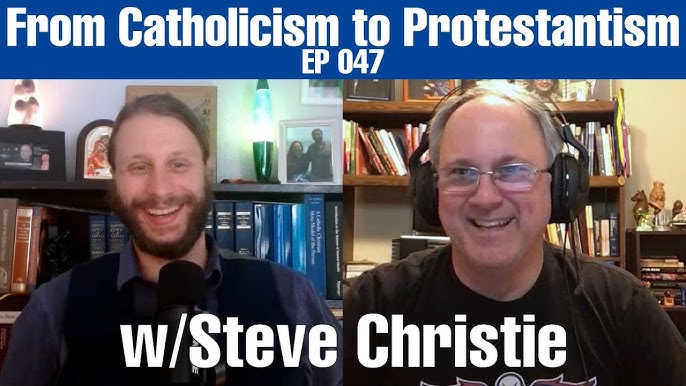
Photo credit: Steve Christie (right); image for the video, “Justification by Faith: From Catholicism to Protestantism | Steve Christie, RN | #047” (9-22-24), on Kyle Dean’s YouTube channel.
Protestant anti-Catholic apologist Steve Christie runs the BornAgainRN YouTube channel, where he produced the video, A Response to Dr. Gavin Ortlund @TruthUnites: “Are Catholics Christians?” (12-20-24). As of 4-6-26, it has 3,748 views and 671 comments. I think it deserves a thorough refutation, and so this is my reply. His words will be in blue.
*****
As a former devout Roman Catholic, who was raised & educated Catholic through college & converted to being Protestant, I would respectfully & adamantly disagree with Dr. Ortlund that Catholics are Christians, based on the authority of God-breathed Scripture, which I provide examples from Scripture in this video response to back up this assertion.
We’ll see what he comes up with.
0:33 It was towards the end of my college education that I got saved and I converted to being a Protestant [sic], and I got saved because I believed in the biblical gospel and became part of the family of Christ, which I later realized that I wasn’t [sic] at the time prior to this moment.
Steve will have to redefine and distort the biblical gospel in order to make such a claim, and that’s the fundamental self-contradiction that runs through anti-Catholicism.
1:15 A Christian is someone who follows the true Christ and the true gospel.
Of course. We have to define our terms. Steve won’t be able to sustain the notion that Protestants are Christians and Catholics somehow aren’t. But it’s important to observe and understand the claims that anti-Catholics (i.e., those who deny that Catholicism is a species of Christianity) make.
1:22 [This] is the reason why Jehovah’s Witnesses and Mormons and others are not actually Christians.
Those two groups are Christological heretics and blasphemers who don’t believe that Jesus is God in the flesh, nor believe in the Holy Trinity. Of course, Catholics do believe exactly as Protestants believe about those things. So Steve’s task will be to demonstrate and document that we believe in a false Christ. Good luck in that endeavor! You can’t make a silk purse out of a sow’s ear.
3:37 Catholics believe in initial justification which happens at the moment of water baptismal regeneration while Protestants believe in an eternal justification which happens at the moment of the profession of faith.
That’s untrue as a blanket statement. In his Large Catechism (1529), Martin Luther, the founder of Protestantism, wrote:
The power, the effect, the benefit, the fruit and the purpose of baptism is to save. . . . to be saved, we know very well, is to be delivered from sin, death, and Satan, and to enter Christ’s kingdom and live forever with him . . . Through the Word, baptism receives the power to become the washing of regeneration, as St. Paul calls it in Titus 3:5 . . . Faith clings to the water and believes it to be baptism which effects pure salvation and life . . . When sin and conscience oppress us . . . you may say: It is a fact that I am baptized, but, being baptized, I have the promise that I shall be saved and obtain eternal life for both soul and body . . . Hence, no greater jewel can adorn our body or soul than baptism; for through it perfect holiness and salvation become accessible to us . . . (Augsburg Publishing House [Minneapolis], 1935, sections 223-224, 230, pages 162, 165)
This included infants:
Little children . . . are free in every way, secure and saved solely through the glory of their baptism . . . Through the prayer of the believing church which presents it, . . . the infant is changed, cleansed, and renewed by inpoured faith. Nor should I doubt that even a godless adult could be changed, in any of the sacraments, if the same church prayed for and presented him, as we read of the paralytic in the Gospel, who was healed through the faith of others (Mark 2:3-12). I should be ready to admit that in this sense the sacraments of the New Law are efficacious in conferring grace, not only to those who do not, but even to those who do most obstinately present an obstacle. (The Babylonian Captivity of the Church, 1520, from the translation of A. T. W. Steinhauser, Philadelphia: Fortress Press, revised edition, 1970, 197)
Luther, in fact, took an even stronger view of baptism than Catholics do, believing that no one could ever undo its effects by a later rejection and/or serious sin. Lutherans adhere to Luther’s Large Catechism as part of their confessional Book of Concord. Steve might quibble that regeneration is different from justification. It wasn’t in Luther’s mind. D. Patrick Ramsey, pastor of Christ Presbyterian Church (OPC) in London, Kentucky, examined the issue in his article, “Sola Fide Compromised? Martin Luther and the Doctrine of Baptism” (Thermelios, Vol. 34, Issue 2, July 2009), and noted (against his own opinion, by the way):
One of the main burdens of Jonathan Trigg’s recent book on Luther’s theology of baptism, which is based upon his doctoral dissertation, is to demonstrate that “the doctrine of justification by faith is intimately related to—indeed predicated upon—Luther’s understanding of the abiding covenant of baptism” [Baptism in the Theology of Martin Luther (Leiden: Brill, 2001), p. 2]. Although it may appear that there are tensions in his thought, “Luther’s baptismal doctrine, properly understood, is one of his sharpest expressions of justification by faith” [Ibid., 226; see also 151]. Similarly, Paul Althaus maintains that Luther’s “doctrine of baptism is basically nothing else than his doctrine of justification in concrete form.” [The Theology of Martin Luther (trans. Robert C. Schultz; Philadelphia: Fortress, 1966), 356].
Further support comes from Anthony Lane. In his discussion of baptism, one of the key issues involved in the Catholic-Protestant dialogue, Lane faults R. C. Sproul for interpreting the sola fide formula as directed against baptism. After noting that sola fide, as understood by Luther and the other Reformers, was directed against works but not word or sacrament, Lane bids us to remember that “Lutherans believing in baptismal regeneration are some of the most ardent proponents of justification by faith alone.” Justification and baptismal efficacy are two separate issues and therefore belief in baptismal regeneration need not conflict with one’s doctrine of sola fide [Justification by Faith in Catholic-Protestant Dialogue: An Evangelical Assessment (London: T&T Clark, 2002), 187].
Anglicans also affirm baptismal regeneration, as do the Churches of Christ and Disciples of Christ, who believe in adult baptismal regeneration. John Wesley, the founder of Methodism (who never technically left Anglicanism), believed that baptism brought about both regeneration and justification (I compiled a book of his quotations, published by a Methodist / Wesleyan house in 2014):
But “as by the offense of one, judgment came upon all men to condemnation, so by the righteousness of one, the free gift came upon all men, to justification of life.” And the virtue of this free gift, the merits of Christ’s life and death, are applied to us in baptism. “He gave himself for the Church, that he might sanctify and cleanse it with the washing of water by the word” (Eph. v, 25, 26); namely, in baptism, the ordinary instrument of our justification. Agreeably to this, our [Anglican] Church prays in the baptismal office that the person to be baptized may be “washed and sanctified by the Holy Ghost, and, being delivered from God’s wrath, receive remission of sins, and enjoy the everlasting benediction of his heavenly washing.” (A Treatise on Baptism; in Coll. iii, 226; 11 Nov. 1756)
So this is the dilemma that Steve already has created for himself, in the first four minutes of his video: one that I pointed out to Reformed Baptist anti-Catholic apologist James White in our very extensive written debate on this same issue, way back in May 1995 (that he prematurely departed from: ignoring my last 36 single-spaced pages of reply), and he’s considered by many other anti-Catholics to be the best anti-Catholic debater. It’s a reductio ad absurdum.
If Steve wants to contend that Catholicism is not Christian, in part based on this criterion, having to do with baptism, then Luther and Lutheranism, Anglicanism (the church of C. S. Lewis), Wesley and Methodism, Churches of Christ, and Disciples of Christ, all fail the test of true Christianity as well. But anti-Catholics almost never claim that other fellow Protestants aren’t Christians. That would be bad “PR” and bad form, after all.
In the end it reduces to an exceedingly unlikely scenario where only Calvinists, Baptists, fundamentalists, and low church non-denominationalists are Christians, whereas the vast majority of Christians today and throughout history (including the above-mentioned groups) supposedly are not, and were and are hellbound (Luther, Wesley, and C. S. Lewis would be in hell, having denied the gospel, so Steve would have to consistently argue). It’s simply not convincing reasoning, to put it mildly.
4:17 Catholics tend to combine justification and sanctification . . .
We not only “tend” to, we do, period, because the Bible combines them. See:
50 Unanswerable NT Passages Against “Faith Alone” [2-21-26]
NT: 70 Specific Good Works Contribute to Salvation [3-6-26]
*
Bible vs. “Faith Alone”: 120 NT & 30 OT Proofs [from 26 out of the 27 NT Books] [8-26-24; revised and expanded on 1-18-26]
*
*
*
4:32 . . . which is why they believe that that salvation can be lost and and justification can be lost . . .
Indeed, because, again, the Bible teaches it (start to see the common theme here?):
Falling Away (Apostasy): 150 Biblical Passages (+ Catalogue of Sixty Traits That Apostates Formerly Possessed When They Were in God’s Good Graces) [11-19-24]
And of course, most Protestants now and throughout history believed that one could lose their salvation, as well (Arminians and Wesleyans and many other groups). Are they all suspect as being counterfeit Christians on this basis, too?
4:41 Catholics don’t believe in being able to earn salvation . . .
I sincerely thank Steve for this true statement. We believe that all is by God’s grace, through our faith, which then organically and inevitably leads to grace-filled good works, done in faith, per the teaching of the book of James:
Justification in the Book of James (Different from Paul?) [8-30-23]
Reply to James White’s Exegesis of James 2 in Chapter 20 of His Book, The God Who Justifies [10-9-13]
4:59 If you read Romans chap 7 and 8 justification is a moment of salvation while sanctification is a long life process . . .
That’s not true even in those chapters, since Paul writes,
Romans 8:15-17 (RSV) For you did not receive the spirit of slavery to fall back into fear, but you have received the spirit of sonship. When we cry, “Abba! Father!” [16] it is the Spirit himself bearing witness with our spirit that we are children of God, [17] and if children, then heirs, heirs of God and fellow heirs with Christ, provided we suffer with him in order that we may also be glorified with him.
Justification and salvation are processes, too, according to the Bible. See, especially, Abraham’s several justifications:
Salvation as a Process: 75 NT Passages [11-16-24]
Abraham: Justified Twice by Works & Once by Faith [8-30-23]
5:30 Romans chap 1:16 the Apostle Paul writes “for I am not ashamed of the gospel for it is a power of God for salvation to everyone who believes to the Jew first and also to the Greek.” So it is a gospel that saves and those of us who are in the family of Christ when we believe the the gospel we realize that the gospel that Jesus Christ died on the cross for our sins and rose from the dead which proved you know, his atonement was sufficient that that is what actually saves us. And he reiterates this later in his epistle to the Ephesians 1:13 when he writes, “the gospel of your salvation having also believed you were sealed in him with the Holy Spirit of Promise” so here even emphasize the gospel that saves is seals and this supports the idea of eternal salvation that salvation cannot be lost because it’s entirely the work of God.
The Catholic Church teaches all of this, too, of course, excepting the false doctrine that salvation and grace can’t be rejected and lost by a rebellious person. This idea is not a necessary component of the saving gospel and saving grace, since the Bible contradicts it at least 150 times, and inspired, inerrant revelation can’t contradict itself. St. Paul strongly teaches the same thing, refuting the error. Here are fifteen proofs:
Romans 11:20-22 . . . They were broken off because of their unbelief, but you stand fast only through faith. So do not become proud, but stand in awe. [21] For if God did not spare the natural branches, neither will he spare you. [22] Note then the kindness and the severity of God: severity toward those who have fallen, but God’s kindness to you, provided you continue in his kindness; otherwise you too will be cut off.
1 Corinthians 9:27 but I pommel my body and subdue it, lest after preaching to others I myself should be disqualified.
1 Corinthians 10:5-6 Nevertheless with most of them God was not pleased; for they were overthrown in the wilderness. [6] Now these things are warnings for us, not to desire evil as they did.
1 Corinthians 10:12 Therefore let any one who thinks that he stands take heed lest he fall.
Galatians 1:6 I am astonished that you are so quickly deserting him who called you in the grace of Christ and turning to a different gospel
Galatians 5:4 You are severed from Christ, you who would be justified by the law; you have fallen away from grace.
Philippians 3:11-13 that if possible I may attain the resurrection from the dead. [12] Not that I have already obtained this or am already perfect; but I press on to make it my own, because Christ Jesus has made me his own. [13] Brethren, I do not consider that I have made it my own; . . .
Colossians 1:22-23 he has now reconciled in his body of flesh by his death, in order to present you holy and blameless and irreproachable before him, [23] provided that you continue in the faith, stable and steadfast, not shifting from the hope of the gospel which you heard, . . .
1 Timothy 1:19 . . . By rejecting conscience, certain persons have made shipwreck of their faith,
1 Timothy 4:1 Now the Spirit expressly says that in later times some will depart from the faith by giving heed to deceitful spirits and doctrines of demons.
1 Timothy 5:8 If any one does not provide for his relatives, and especially for his own family, he has disowned the faith and is worse than an unbeliever.
1 Timothy 5:15 For some have already strayed after Satan.
1 Timothy 6:10 For the love of money is the root of all evils; it is through this craving that some have wandered away from the faith and pierced their hearts with many pangs.
2 Timothy 2:12 . . . if we deny him, he also will deny us;
2 Timothy 4:3-4 For the time is coming when people will not endure sound teaching, but having itching ears they will accumulate for themselves teachers to suit their own likings, [4] and will turn away from listening to the truth and wander into myths.
Eternal security or perseverance of the saints is not part of the biblical gospel. But if Steve is right and it is, then the great majority of Protestants, who agree with Catholics on this, ain’t Christians, either.
6:22 that’s the difference between Catholics and Protestants. Catholics do not have that assurance. At any moment they could lose their their salvation.
Again, this is false as a blanket statement, since only a minority of Protestants believe in eternal security. And this is a caricature of the Catholic view, too, as I explained in a recent article:
The “hope” and “confidence” we have in Christ are not the same thing as “absolute assurance” or “eternal security.” Elsewhere I . . . have written about the Catholic notion of a very strong moral assurance or confidence of salvation, provided we persevere and repent if in mortal sin, and the related notion of examination of conscience (1 Jn 3:21: “if our hearts do not condemn us, we have confidence before God”).
We’re very confident, for example, and have every hope that tomorrow we will continue to breathe and that our hearts will be beating as they are today. But we’re not absolutely certain of that. We could suddenly die tonight, after all.
Catholics view salvation in the same way: we have a very strong confidence in that, provided that we examine ourselves and determine that we aren’t in mortal sin. But since we don’t infallibly know the future, short of a direct revelation of God, we can’t be certain that we won’t ever fall away (nor can any Protestant who makes the claim of absolute assurance or eternal security). But an examination of conscience can make us abundantly assured, confident, and hopeful that right now, in this moment of time, we are in God’s good graces, and would be saved if we were to die.
I wrote similarly in another article:
The degree of moral assurance of salvation we can attain to is very high. The point is to examine ourselves to see if we are mired in serious sin, and to repent of it. If we do that, and know that we are not subjectively guilty of mortal sin, then we can have a joyful assurance that we are on the right road.
I always use my own example by noting that when I was an evangelical Protestant, I felt very assured of salvation, though I also believed (as an Arminian) that one could fall away if one rejected Jesus outright.
Now as a Catholic — these past 34 years — I feel hardly any different than I did as an evangelical. I don’t worry about salvation. I assume that I will go to heaven one day, if I keep serving God. I trust in God’s mercy, and know that if I fall into deep sin, his grace will cause me to repent of it (and I will go along in my own free will) so that I can be restored to a relationship with him.
We observe St. Paul being very confident and not prone to a lack of trust in God at all. He had a robust faith and confidence, yet he still had a sense of the need to persevere and to be vigilant. He didn’t write as if it were a done deal — that he got “saved” one night in Damascus and signed on the dotted line, made an altar call and gave his life to Jesus, saying the Sinner’s Prayer or reciting John 3:16. . . .
We see that the biblical record gives us what is precisely the Catholic position — neither the supposed “absolute assurance” of the evangelical Protestant or Calvinist, nor the legalistic, Pharisaical, mechanical caricature of what outsider, non-experienced critics of Catholicism think Catholicism is, where a person lives a “righteous” life for 70 years, then falls into lust for three seconds, gets hit by a car, and goes to hell (as if either Catholic teaching or God operate in such a superficial fashion).
One can have a very high degree of moral assurance and trust in God’s mercy. St. Paul shows this. He doesn’t appear worried at all about his salvation, but on the other hand, he doesn’t make out that he is absolutely assured of it and has no need of persevering. He can’t “coast.” The only thing a Catholic must absolutely avoid in order to not be damned is a subjective commission of mortal sin that is unrepented of. We have to be vigilant to avoid falling into serious sins that will bar us from heaven (1 Corinthians 6:9-11; Galatians 5:19-21; Ephesians 5:3-6; Revelation 21:8; 22:15). . . .
Holy Scripture backs up Catholic claims at every turn. We have a very strong assurance and faith and hope, yet this is understood within a realistic paradigm of perseverance and constant vigilance in avoiding sin, that could potentially lead us to damnation.
6:43 Catholics actually believe in a different gospel than Protestants do . . .
We do not. We follow the gospel that the Bible actually teaches. The Bible defines the gospel, and we know what it is because we have a record of the apostles preaching it immediately after Pentecost. St. Peter’s first sermon in the upper room (Acts 2:22-40) is certainly the gospel, since 3000 people became Christians upon hearing it (2:41)! In it he utters not a word about “faith alone.” He preached:
Acts 2:32-36 This Jesus God raised up, and of that we all are witnesses. [33] Being therefore exalted at the right hand of God, and having received from the Father the promise of the Holy Spirit, he has poured out this which you see and hear. [34] For David did not ascend into the heavens; but he himself says, ‘The Lord said to my Lord, Sit at my right hand, [35] till I make thy enemies a stool for thy feet.’ [36] Let all the house of Israel therefore know assuredly that God has made him both Lord and Christ, this Jesus whom you crucified.”
He instructed the hearers, rather, to “Repent, and be baptized every one of you in the name of Jesus Christ for the forgiveness of your sins; and you shall receive the gift of the Holy Spirit” (2:38). So, immediately after the resurrection, at the very outset of the “Church Age,” an apostle teaches sacramentalism and baptismal regeneration: anathema to most evangelicals. He also says, “Save yourselves from this crooked generation.” That’s the gospel! St. Paul defines the gospel in Acts 13:16-41 as the resurrection of Jesus:
Acts 13:30-33 But God raised him from the dead; [31] and for many days he appeared to those who came up with him from Galilee to Jerusalem, who are now his witnesses to the people. [32] And we bring you the GOOD NEWS that what God promised to the fathers, [33] this he has fulfilled to us their children by raising Jesus; as also it is written in the second psalm, ‘Thou art my Son, today I have begotten thee.’
And to the Corinthians Paul reiterates that the gospel is His death, burial, and resurrection:
1 Corinthians 15:1-8 Now I would remind you, brethren, in what terms I preached to you THE GOSPEL, which you received, in which you stand, [2] by which you are saved, if you hold it fast — unless you believed in vain. [3] For I delivered to you as of first importance what I also received, that Christ died for our sins in accordance with the scriptures, [4] that he was buried, that he was raised on the third day in accordance with the scriptures, [5] and that he appeared to Cephas, then to the twelve. [6] Then he appeared to more than five hundred brethren at one time, most of whom are still alive, though some have fallen asleep. [7] Then he appeared to James, then to all the apostles. [8] Last of all, as to one untimely born, he appeared also to me.
This is why it’s so absurd when anti-Catholic Protestants accuse Catholics of denying the gospel. We completely agree with them on all the things that the Bible itself proclaims as the gospel. It’s not a mere [novel Protestant] soteriological theory. It has to do with what God did for us, so that we can be saved, and about how we must necessarily receive it and respond to it. The explicit scriptural proclamations and definitions of the gospel strikingly exclude “faith alone,” while other actions by Jesus and the apostles contradict it by force of example.
*
Conclusion?: The gospel is – as Paul teaches – the death, burial and resurrection of Jesus. This is the “good news.” The prophets foretold these events, not a fine-tuned theory of application of those events to the believer. How could a mere theological abstract reasonably be called “good news”?
*
8:50 So the answer to this question, “would I excommunicate Augustine?” [is] yes, but only insofar [as] he was preaching a false gospel such as water baptism or regeneration with the idea that in order to be saved you have to be water baptized, in order to receive the Holy Spirit and if you don’t, then you spend eternity in hell, because this actually adds to the gospel of believing in the atonement of Christ and and Jesus’s resurrection from the dead.
*
Well, I compiled the book, The Quotable Augustine, too, in 2012, so the answer will be easy to locate there (I went through this same argument with James White 31 years ago), and St. Augustine will now end up in hell — along with pretty much all of the Church fathers — as the result of his supposedly unbiblical and non-Christian sacramental beliefs, since he wrote the following:
. . . born again by baptism; the generation by which we shall rise again from the dead, and shall live with the Angels for ever. (Explanations of the Psalms, 135:13 [135, 11])
As regards the question of baptism, that our being born again, cleansed, justified by the grace of God, should not be ascribed to the man who administered the sacrament, . . . (Against the Letters of Petilian the Donatist, iii, 50, 62)
Born again, however, a man must be, after he has been born; because, “Unless a man be born again, he cannot see the kingdom of God” [John 3:3] Even an infant, therefore, must be imbued with the sacrament of regeneration, lest without it his would be an unhappy exit out of this life; and this baptism is not administered except for the remission of sins. (On Merit and the Forgiveness of Sins and on Infant Baptism ii, 43 [XXVII] )
. . . that life of the Spirit, in the newness of which they who are baptized are through God’s grace born again . . . (On Merit and the Forgiveness of Sins and on Infant Baptism ii, 45 [XXVIII])
. . . the question of baptism, . . . justified by the grace of God, . . . (Against the Letters of Petilian the Donatist, iii, 50, 62)
By all these considerations it is proved that the sacrament of baptism is one thing, the conversion of the heart another; but that man’s salvation is made complete through the two together. (On Baptism, Against the Donatists, iv, 25, 33)
The form of the sacrament is given through baptism, the form of righteousness through the gospel. Neither one without the other leads to the kingdom of heaven. (Against the Letters of Petilian the Donatist, iii, 56, 68)
. . . that sacrament, namely, of baptism, which brings salvation . . . (Epistle 98 [1]: to Boniface [408] )
The Christians of Carthage have an excellent name for the sacraments, when they say that baptism is nothing else than “salvation,” and the sacrament of the body of Christ nothing else than life. . . . For wherein does their opinion, who designate baptism by the term salvation, differ from what is written: “He saved us by the washing of regeneration?” [Titus 3:5] or from Peter’s statement: “The like figure whereunto even baptism does also now save us?” [1 Peter 3:21] (On Merit and the Forgiveness of Sins and on Infant Baptism i, 34 [XXIV] )
. . . the baptism of infants . . . is given to them not only for entrance into the kingdom of God, but also for attaining salvation and eternal life, which none can have without the kingdom of God, or without that union with the Saviour Christ, wherein He has redeemed us by His blood. (On Merit and the Forgiveness of Sins and on Infant Baptism ii, 1 [I] )
Steve’s position entails claiming that Martin Luther, Lutherans, Methodists, John Wesley, Anglicans, people in the Churches of Christ and Disciples of Christ, St. Augustine, virtually all of the Church fathers, and C. S. Lewis are non-Christians, and likely went to hell.
13:04 Luther and Calvin . . . began to see that there were things that were wrong about them including the Church of Rome rejecting the gospel of justification by faith alone . . .
Luther didn’t think that the Catholic Church had rejected the gospel. He wrote:
The Christendom that now is under the papacy is truly the body of Christ and a member of it. If it is his body, then it has the true spirit, gospel, faith, baptism, sacrament, keys, the office of the ministry, prayer, holy Scripture, and everything that pertains to Christendom. So we are all still under the papacy and therefrom have received our Christian treasures. (Concerning Rebaptism, written against the Anabaptists in January 1528; translated by Conrad Bergendoff and published in Luther’s Works, Vol. 40, pp. 229-262; this section from p. 232)
John Calvin thought that baptism regenerated and was altogether necessary to be a Christian and enter the kingdom of God, and he also believed in and practiced infant baptism (Institutes, Book IV, 16:3, 5-7, 11, 17, 22). Therefore, he, too, is a non-Christian and probably went to hell, by Steve’s reasoning:
We ought to consider that at whatever time we are baptised, we are washed and purified once for the whole of life. Wherefore, as often as we fall, we must recall the remembrance of our baptism, and thus fortify our minds, so as to feel certain and secure of the remission of sins. (Inst., IV, 15:3)
Paul proves us to be the sons of God, from the fact that we put on Christ in baptism (Gal. 3:27). (Inst., IV, 15:6)
All who are clothed with the righteousness of Christ are at the same time regenerated by the Spirit, . . . we have an earnest of this regeneration in baptism. (Inst., IV, 15:12)
Baptism . . . certainly included in it the promise of forgiveness of sin, mortification of the flesh, quickening of the Spirit, and communion with Christ. (Inst., IV, 15:16)
God, regenerating us in baptism, ingrafts us into the fellowship of his Church, and makes us his by adoption, so we have said that he performs the office of a provident parent, in continually supplying the food by which he may sustain and preserve us in the life to which he has begotten us by his word. (Inst., IV, 17:1)
Baptism being a kind of entrance into the Church, an initiation into the faith, . . . (Inst., IV, 18:19)
There never can be a sacrament without a promise of salvation. (Institutes of the Christian Religion, Book IV, 18:19)
Calvin accepted the validity of Catholic baptism, as did Luther (which is why neither got “re-baptized”):
In the present day we deny not to the Papists those vestiges of a Church which the Lord has allowed to remain among them amid the dissipation. . . . baptism, which, consecrated by his lips, retains its power in spite of human depravity; secondly, He provided by his providence that there should be other remains also to prevent the Church from utterly perishing. (Inst., IV, 2:11)
Such in the present day are our Catabaptists, who deny that we are duly baptised, because we were baptised in the Papacy by wicked men and idolaters; hence they furiously insist on anabaptism. Against these absurdities we shall be sufficiently fortified if we reflect that by baptism we were initiated not into the name of any man, but into the name of the Father, and the Son, and the Holy Spirit; and, therefore, that baptism is not of man, but of God, by whomsoever it may have been administered. (Inst., IV, 15:16)
And he thought that whether a person was baptized by immersion or sprinkling, was “not of the least consequence” (Inst., IV, 15:19). So if Calvin was one of Steve’s heroes, he ain’t gonna be any longer after all of this, since a good Christian like Steve can’t have pagan, nonbelieving, hellbound, Bible-despising people like Luther and Calvin as heroes and examples.
13:28 Faith alone, which Luther and Calvin and the other reformers accepted . . . was later anathematized at the council Trent in 1546.
Faith alone was, because it’s unbiblical, and hence was never taught by anyone since Augustine or since Paul, respectively, until Philip Melanchthon came up with it by pulling a rabbit out of a hat in the 1530s, according to Protestants Alister McGrath and Norman Geisler, but the gospel as biblically defined was not. And monergism in God’s initial justification was definitely proclaimed:
CANON I.-If any one saith, that man may be justified before God by his own works, whether done through the teaching of human nature, or that of the law, without the grace of God through Jesus Christ; let him be anathema.
CANON II.-If any one saith, that the grace of God, through Jesus Christ, is given only for this, that man may be able more easily to live justly, and to merit eternal life, as if, by free will without grace, he were able to do both, though hardly indeed and with difficulty; let him be anathema.
CANON III.-If any one saith, that without the prevenient inspiration of the Holy Ghost, and without his help, man can believe, hope, love, or be penitent as he ought, so as that the grace of Justification may be bestowed upon him; let him be anathema.
John Calvin lived through the entire Council of Trent, and assuredly he disagreed with a lot of it, as he wrote about in his Antidote to Trent. But when he read the three canons above, he wrote in this treatise, “To Canons 1, 2, and 3:, I say, Amen.” He also responded to Canon XIX (“If any one saith, that nothing besides faith is commanded in the Gospel; that other things are indifferent, neither commanded nor prohibited, but free; or, that the ten commandments nowise appertain to Christians; let him be anathema”) with “Amen.”
And to Canon XXII (“If any one saith, that the justified, either is able to persevere, without the special help of God, in the justice received; or that, with that help, he is not able; let him be anathema”) he gave another “Amen.” It takes a lot for Calvin to not have anything to say in disagreement, concerning any Catholic statement!
14:19 [Catholic apologist] Jimmy Akin earlier this year said that there’s no more anathemas. I don’t think that’s something that’s infallibly been declared by Rome . . .
As Jimmy wrote in his superb article entitled “Anathema” (This Rock, 4-1-00), 26 years ago
Vatican II did not use the term anathema in any of its documents. . . .
The penalty was used so seldom that it was removed from the 1983 Code of Canon Law. This means that today the penalty of anathema does not exist in Church law. . . .
1. An anathema sentenced a person to hell. This is not the case. Sentencing someone to hell is a power that is God’s alone, and the Church cannot exercise it.
2. An anathema was a sure sign that a person would go to hell. Again, not true. Anathemas were only warranted by very grave sins, but there was no reason why the offender could not repent, and those who repent aren’t damned.
3. An anathema was a sure sign that a person was not in a state of grace.
So yes, the Church did authoritatively remove them, 43 years ago now, in its canon law (this is not dogma, and so can change), and it was implied 61 years ago by their total absence in Vatican II. So we’re not doing that. Rather, it’s anti-Catholics like Steve and James White who consign Catholics, the Church fathers en masse, the Orthodox, millions of Protestants, including Luther, Calvin, Wesley, and C. S. Lewis, to non-Christian status and presumably an eternity in hell (or at the least a distinct danger of same).
He understands that we don’t do that, but mocks it as a sort of wishy-washy, relativistic “inclusion” (14:19) and being allegedly theologically “liberal” (14:28). So we can’t win for losing. For much more on this issue of anathemas, see:
Dialogue: Definition of “Christian” (vs. Reformed Pastor) (+ Did Trent Anathematize all Protestants?) [6-5-10]
Bible on Authority to Anathematize & Excommunicate [2009]
Anathemas of Trent & Excommunication: An Explanation [5-20-03, incorporating portions from 1996 and 1998; abridged on 7-30-18]
Only Catholics Issue Anathemas Against Dissenters? (vs. James White) [3-12-04]
17:45 Scripture doesn’t support that [sic] Catholics are are Christians . . .
He goes on to talk about faith alone, which I have already refuted with 150 Bible passages, linked above.
23:49 What happens is when you become a genuine believer in Christ it’s not just saying, “well I believe Jesus died for my sins”; rather, you are divided and removed from the rest of the world and then you’re reunited with the rest of the body of Christ and that’s when you become a Christian. But in Roman Catholic theology this happens at the moment when an individual is baptized in in water and if you’re not you’re not part of that body of Christ you are not you’re not a brother and sister of Christ.
Also according to the Church fathers, the Orthodox, Luther, Calvin, Anglicanism, Methodism . . . So again, if we’re kicked out of Christianity, all of them must go with us, following Steve’s reasoning. I didn’t make the rules of logic what they are.
24:19 Vatican II doesn’t even say that we’re brothers and sisters in Christ.
Really?:
In subsequent centuries much more serious dissensions appeared . . . for which, often enough, men of BOTH SIDES were to blame. However, one CANNOT CHARGE WITH THE SIN OF SEPARATION those who at present are born into these communities and in them are brought up in the faith of Christ, and the Catholic Church accepts them with RESPECT and AFFECTION as BROTHERS. For men who believe in Christ and have been properly baptized are put in some, though imperfect, communion with the Catholic Church. . . .
All who have been justified by faith in baptism are INCORPORATED INTO CHRIST [footnote cites Council of Florence, Session 8, from the year 1439]; they therefore have a right to be called CHRISTIANS, and with good reason are accepted as BROTHERS by the children of the Catholic Church. (Decree on Ecumenism [Unitatis Redintegratio, 21 November 1964, section 3)
It’s the Council of Trent, in its Session VII [March 3, 1547], Decree on the Sacraments, Canon III (“If any one saith, that in the Roman church, which is the mother and mistress of all churches, there is not the true doctrine concerning the sacrament of baptism; let him be anathema.”) — not Vatican II — that taught that Protestants are incorporated into the Body of Christ through baptism. See along these lines:
How Catholics View Protestants [9-4-03; rev. 10-9-03 and 1-5-05; abridged on 11-14-16]
Baptismal Ecumenism: A New Evangelistic Paradigm (Rod Bennett) [8-11-17]
This is the familiar tactic of trying to wrongly make out that we are so against Protestants, so therefore, they are all the more justified in denying that we are Christians. But we’ve never denied that they are Christians, going back at least as far as Trent in 1547. Anti-Catholic Protestants (a tiny minority among all Protestants, by the way) wrongly project their anti-Catholic attitudes onto us. Thus, even this tack is based on a demonstrable historical falsehood.
24:42 [Catholics think] Protestants are brothers and separated brethren who are heretics and schismatics at the same time,
*
Yes, precisely as most Protestants think about us and about fellow Protestants with whom they disagree: the others are Christians and brothers and sisters in Christ, but we think they have some errors within that Christian status, which might be called “heresies.” It’s not mutually exclusive.
and yet we’re supposed to say that that Protestants and and Catholics are both Christians.
Indeed, because the biblical and historical evidence doesn’t permit any other possible conclusion, as I have been showing. It’s simply impossible to maintain that only a small minority of Protestants are Christians (I’ve shown how Steve’s reasoning excludes the majority of historical and present-day Protestants from Christianity) and that the vast majority of Protestants and all Orthodox and all Catholics are not.
25:36 Catholics can be Christians, but in spite of being Catholic not because they are Catholic, so I want to emphasize that point . . .
Yes, of course. This is the classic playbook canard of “to be a Christian you gotta be a bad Catholic (i.e., disbelieve several things in Catholicism). But if you are a good Catholic (i.e., believe all that the Catholic Church teaches) you can’t be a Christian or be saved.” This is wrongheaded and false.
27:30 Roman Catholics based on Scripture, they’re not Christians because they believe in a different Christ since they believe in a different gospel.
None of this has been even remotely shown — not to the slightest degree, and it never can be because it’s a falsehood. We believe in the biblical, historical person of Jesus Christ and the biblical gospel. Jesus flatly denied faith alone (which is not the gospel, anyway) on many occasions; particularly in His exchange with the rich young ruler and in the judgment scene of the sheep and the goats in Matthew 25.
32:10 (directed towards Gavin Ortlund) Catholics are not Christians. They’re not our brothers and sisters in Christ, and if you would like to discuss this further, I would be happy to and open with it . . .
We’ll see how “open” he is to discuss it with me.
***
Steve commented in his combox:
Dave, once again, I think you’re misunderstanding the purpose and context of my response to Dr. Gavin Ortlund, which isn’t strictly that Roman Catholics aren’t Christians, but more specifically that as a Protestant, it would be incorrect of Dr. Ortlund to believe that Protestants AND Roman Catholics are BOTH Christians BECAUSE they belong to different spiritual families, since they believe in different gospels. If I get a chance, I will take a look at your blog, and hopefully it doesn’t misrepresents the context and purpose of why this video. [sic]
However you define the purpose and context, it doesn’t affect my argument. The fact remains that you don’t believe Catholicism is Christianity, and Dr. Ortlund does. We do not believe in a different gospel, if that is defined by the Bible: not Protestants 1500 years after Christ, with a different slant on it (faith alone) than what ever came came before. I say that we believe in the same gospel (as properly defined), but that the add-on Protestant novel tradition of faith alone is massively unbiblical and anti-biblical (I provided several hundred Bible passages proving that).
*****
Photo credit: Steve Christie (right); image for the video, “Justification by Faith: From Catholicism to Protestantism | Steve Christie, RN | #047″ (9-22-24), on Kyle Dean’s YouTube channel.
Summary: I systematically dismantle the claims of anti-Catholic Steve Christie that Catholicism isn’t Christian, utilizing the Bible, Church history, and many Protestant counter-examples.
Previous Post
April 4, 2026
Venerating Men & Angels: Worship? 20 Bible Passages
Next Post
April 11, 2026 God, Modern Physics, & Dark Energy: An Analogy
Recent Comments
"Special pleading, and not a serious response to my arguments . . ."
Is Venerating Men & Angels Worship? ..."
""no man needs to teach us."Didn't you just teach us?"
Is Venerating Men & Angels Worship? ..."
""Catholics say they are the only church that can lead people into heaven."In fact, we ..."
Is Venerating Men & Angels Worship? ..."
"And lastly, I belong to no denomination and am free to serve God as He ..."
Is Venerating Men & Angels Worship? ..."
Browse Our Archives
Select a Category & Last Things About Me Anti-Catholicism Atheism & Agnosticism Baptism and Sacramentalism Bible and Tradition Blessed Virgin Mary Books by Dave Armstrong C. S. Lewis Calvinism & General Protestantism Catholic Apologetics Catholic Apologists Catholic conversion Catholic converts Christmas Church (Ecclesiology) Church History Conversion and Converts Development of Doctrine Eastern Orthodoxy Ecumenism & Christian Unity Eucharist & Liturgy Fathers of the Church French Translations G. K. Chesterton Hell Hell & Satan Hell & Satan & Last Things Heresies & Comparative Religion Holistic Health Inquisition & Crusades & Scandals James White Jews & Judaism & Old Testament John Calvin John Henry Newman Liberal / Modernist Theology Life Issues Literary Resume Lutheranism Mariology Martin Luther Music Orthodoxy Papacy & Infallibility Personal Page Philosophy & Science Political & Ethical & Moral Issues Protestant Persecution & Intolerance Protestantism Purgatory Purgatory & Penance Romantic & Imaginative Theology Saints & Purgatory & Penance Salvation Salvation & Justification Satan & Last Things Sexuality and Gender Issues Spanish Translations Traditionalism vs. Radical Catholic Reactionaries Traducciones al español / tradução para português Trinitarianism & Christology Uncategorized Videos
Select a Month October 2026 September 2026 August 2026 July 2026 June 2026 May 2026 April 2026 March 2026 February 2026 January 2026 December 2025 November 2025 October 2025 September 2025 August 2025 July 2025 June 2025 May 2025 April 2025 March 2025 February 2025 January 2025 December 2024 November 2024 October 2024 September 2024 August 2024 July 2024 June 2024 May 2024 April 2024 March 2024 February 2024 January 2024 December 2023 November 2023 October 2023 September 2023 August 2023 July 2023 June 2023 May 2023 April 2023 March 2023 February 2023 January 2023 December 2022 November 2022 October 2022 September 2022 August 2022 July 2022 June 2022 May 2022 April 2022 March 2022 February 2022 January 2022 December 2021 November 2021 October 2021 September 2021 August 2021 July 2021 June 2021 May 2021 April 2021 March 2021 February 2021 January 2021 December 2020 November 2020 October 2020 September 2020 August 2020 July 2020 June 2020 May 2020 April 2020 March 2020 February 2020 January 2020 December 2019 November 2019 October 2019 September 2019 August 2019 July 2019 June 2019 May 2019 April 2019 March 2019 February 2019 January 2019 December 2018 November 2018 October 2018 September 2018 August 2018 July 2018 June 2018 May 2018 April 2018 March 2018 February 2018 January 2018 December 2017 November 2017 October 2017 September 2017 August 2017 July 2017 June 2017 May 2017 April 2017 March 2017 February 2017 January 2017 December 2016 November 2016 October 2016 September 2016 August 2016 July 2016 June 2016 May 2016 April 2016 March 2016 February 2016 January 2016 December 2015 November 2015 October 2015 September 2015 August 2015 July 2015 June 2015 May 2015 April 2015 March 2015 February 2015 January 2015 December 2014 November 2014 October 2014 September 2014 August 2014 July 2014 June 2014 April 2014 March 2014 February 2014 January 2014 December 2013 November 2013 October 2013 September 2013 August 2013 July 2013 June 2013 April 2013 March 2013 February 2013 January 2013 December 2012 November 2012 October 2012 September 2012 August 2012 July 2012 June 2012 May 2012 April 2012 March 2012 February 2012 January 2012 December 2011 November 2011 October 2011 September 2011 August 2011 July 2011 June 2011 April 2011 March 2011 February 2011 October 2010 September 2010 August 2010 July 2010 April 2010 March 2010 December 2009 October 2009 August 2009 July 2009 June 2009 May 2009 March 2009 February 2009 October 2008 September 2008 April 2008 March 2008 February 2008 January 2008 December 2007 November 2007 October 2007 May 2007 March 2007 February 2007 January 2007 November 2006 October 2006 September 2006 August 2006 July 2006 June 2006 May 2006 April 2006 March 2006 February 2006 October 2005 June 2005 April 2005 February 2005 July 2004 May 2004 April 2004
Follow Us!
TAKE THE
Religious Wisdom Quiz
Which book of the Bible contains the most direct prophecies about the Messiah?
Select your answer to see how you score.
Micah Isaiah Zechariah Psalms
Books by This Author Books by Dave Armstrong
Related posts from Biblical Evidence for Catholicism

Three More Anti-Catholic Lies About Catholicism (#6-4)
Biblical Evidence for Catholicism

Top Ten Anti-Catholic Lies (#10-7)
Biblical Evidence for Catholicism

Mary Wife of Clopas (Jn 19:25): Mary's Sister-in-Law?
Biblical Evidence for Catholicism

Jesus Had Four Brothers? The Bible Sez No!
Biblical Evidence for Catholicism
TRENDING AT PATHEOS Catholic

The Sermon on the Mount, Part I: Matthew...
The Sermon on the Mount, Part I (Matthew 4:12-5:12) St. Matthew moves...

What's up from Crossway: Reviewing some of their latest A few weeks...

Janie Learns the Way of the Cross: A...
Teaching children about Jesus' Passion can be challenging. Many parents and educators...

Looking For Good Catholic Writing - October 2026
He alone extends the heavens, and he walks upon the waves of...

In "Irreplaceable," our book on vocation and technology, Trevor Sutton and I...

I was strolling through the top floor of the brand new Parthenon...
view all Catholic blogs
What Are Your Thoughts?leave a comment
Ad-Free & Subscriber Log-In Subscription Support
- About Us
- 2026 Calendar
- Videos
- Podcasts
- Library of World Religions
- Faith In Media Tracker
- Advertise With Us
- Write for Us
- Privacy Policy
- Terms of Service
- Do Not Sell My Data
- Contact Us
- Radiant Digital
- Manage Newsletter Subscriptions
- Unsubscribe From Notifications
- Sitemap
Copyright 2008-2026, Patheos. All rights reserved.
Subscription Support Ad-Free & Subscriber Log-In
Follow Patheos