
BuddhistCatholicContemplativeEvangelicalGeneral ChristianHinduJewishLatter-day SaintMuslimNew VisionsProgressive Christian
Beliefs
- Buddhist
- Catholic
- Contemplative
- Evangelical
- General Christian
- Hindu
- Jewish
- Latter-day Saint
- More Voices
- Muslim
- New Visions
- Pagan
- Progressive Christian
Topics
- Religion News
- Food and Religion
- Sports and Religion
- Religious Art
- Religious Music and Entertainment
- Religious Events
- History and Religion
- Style and Religion
- Politics and Religion
- Women in Religion
- Recreation Outdoors and Religion
- Business Finance and Religion
- Careers Workplace and Religion
- Education and Religion
- Family Parenting and Religion
- Health Fitness and Religion
- Home and Religion
- Relationships and Religion
- Technology and Religion
- Travel and Religion
Columnists
- Buddhist Columnists
- Business Finance and Religion Columnists
- Careers Workplace and Religion Columnists
- Catholic Columnists
- Contemplative Columnists
- Education and Religion Columnists
- Evangelists Columnists
- Family Parenting and Religion Columnists
- General Christian Columnists
- Health Fitness and Religion Columnists
- Hindu Columnists
- History and Religion Columnists
- Home and Religion Columnists
- Jewish Columnists
- More Voices Columnists
- Latter Day Columnists
- Muslim Columnists
- New Visions Columnists
- Nonreligious Columnists
- Pagan Columnists
- Politics and Religion Columnists
- Progressive Columnists
- Recreation Outdoors and Religion Columnists
- Relationships and Religion Columnists
- Religion News Columnists
- Religious Art Columnists
- Religious Events Columnists
- Religious Music and Entertainment Columnists
- Sports and Religion Columnists
- Style and Religion Columnists
- Technology and Religion Columnists
- Travel and Religion Columnists
- Women in Religion Columnists
Resource Library
- 2026 Calendar
- Library of World Religions
- The 100 Most Holy Places on Earth
- Patheos Answers
- Podcasts
- Videos
- Faith Leaders Database
- Anglican Episcopalian
- Bahai
- Baptist
- Buddhism
- Christianity
- Confucianism
- Eastern Orthodoxy
- Hinduism
- Holiness and Pentecostal
- ISKCON
- Islam
- Judaism
- Lutheran
- Methodist
- The Church of Jesus Christ of Latter-day Saints
- New Age
- Paganism
- Presbytarian and Reformed
- Protestantism
- Religion Behind the Scenes
- Roman Catholic
- Scientology
- Shia Islam
- Sikhism
- Sufism
- Sunni Islam
- Taoism
- Zen
- See all religions
Research Tools
 Ad-Free & Subscriber Log-In Subscription Support
Ad-Free & Subscriber Log-In Subscription Support
Follow Patheos 

- Trending:
- Forgiveness
- |
- Marriage
- |
- Consciousness
- |
- Death Penalty
- |
- Election
- |
- Halloween

-
About
-
Catholic Apologetics
-
Church History
-
Great Apologists
-
Christian Worldview
-
Protestantism & Misc.
- Home
- Catholic
- History and Religion
- Sola Scriptura: Self-Defeating, Unworkable, Unbiblical
Sola Scriptura: Self-Defeating, Unworkable, Unbiblical
Last updated on: March 29, 2026 at 9:10 am by Dave Armstrong
Sola Scriptura: Self-Defeating, Unworkable, Unbiblical 2026-03-29T09:10:08-04:00 Dave Armstrong
Patheos Explore the world's faith through different perspectives on religion and spirituality! Patheos has the views of the prevalent religions and spiritualities of the world.
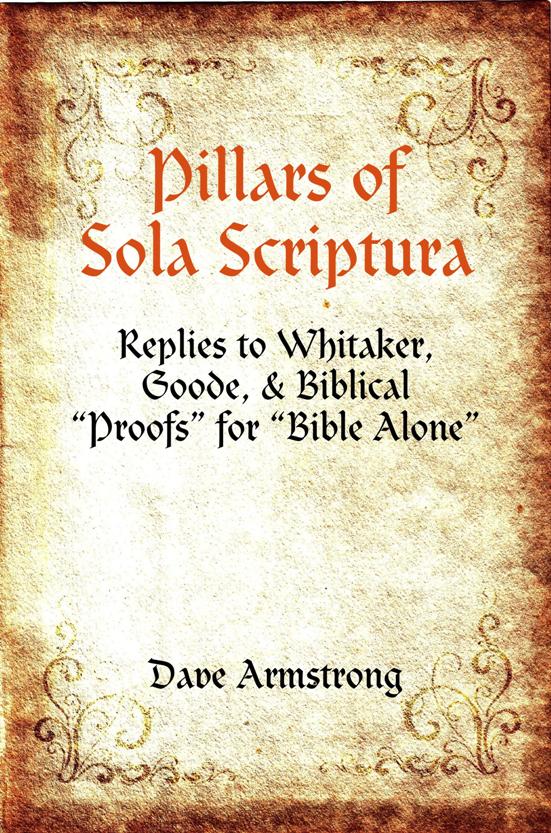
Photo credit: self-designed cover of my book (Lulu: 2012).
This is an abridgment with a few minor additions and changes, of a 2003 article of mine, entitled, “Protestantism: Is it Logically Self-Defeating?” It’s my argument against sola Scriptura in a nutshell.
Protestantism cannot settle its internal differences; each branch or sect can only (ultimately arbitrarily) assert its own authority. It has no way of resolving these denominational differences because sola Scriptura doesn’t allow that to happen and cannot, because it provides no remedy for the intrinsic problem of Protestant division. The simultaneous appeal to the Bible from many contradictory parties can never be resolved.
How does that give the man on the street theological truth, if he has to choose between competing factions? On what basis does he determine who is right and who is wrong? I asked the Presbyterian online apologist Matt why I should believe his view of baptism (Presbyterian: infant, non-regenerative), over against that of Martin Luther (infant, regenerative) and Reformed Baptist James White (adult, non-regenerative)?
He replied: “don’t go to people, go to the Bible.” But this simply begs the question, since obviously all these folks have gone to the Bible and that solution has not worked. A person ultimately, epistemologically, has no assurance or certainty in the Protestant system. I was asking how a person could arrive at truth.
One either believes there is one truth on baptism (whatever it is) — and any other doctrine — or they adopt a (when all is said and done) relativist or indifferentist position, where contradictories are fine or where the doctrine is so minor that it doesn’t matter what opinion one holds concerning it (the unbiblical “primary vs. secondary” canard).
Reformed theologian G. C. Berkouwer practically concedes the problem here examined:
Such a variety of differing and mutually exclusive interpretations arose – all appealing to the same Scripture – that serious people began to wonder whether an all-pervasive . . . influence of subjectivism in the understanding of Scripture is not the cause of the plurality of confessions in the church. Do not all people read Scripture from their own current perspectives and presuppositions . . . with all kinds of conscious or subconscious preferences? . . . Is it indeed possible for us to read Scripture with free, unbiased, and listening attention? . . . We should never minimize the seriousness of these questions . . .
‘Pre-understanding’ cannot be eliminated. The part which subjectivity plays in the process of understanding must be recognized . . . The interpreter . . . does not approach the text of Scripture with a clean slate. (Studies in Dogmatics: Holy Scripture, Grand Rapids, Michigan: Eerdmans, 1975, translated from Dutch edition of 1967 by Jack B. Rogers, 106-107, 119)
According to Bavinck . . . it may not be overlooked that, according to Rome . . . Scripture is not regarded as a completely obscure and inaccessible book, written, so to speak, in secret language . . . Instead, Rome is convinced that an understanding of Scripture is possible – a clear understanding. But Rome is at the same time deeply impressed by the dangers involved in reading the Bible. Their desire is to protect Scripture against all arbitrary and individualistic exegesis . . . (Ibid., 270-271)
This being the case, the Protestant is forced to appeal to an insufficient and most unsatisfactory solution, that is, claim (on no persuasive or compelling grounds, once adequately scrutinized) that their own brand of Protestantism is the true one and to be believed above all others. This was, of course, the standard approach taken by virtually all the early Protestant factions.
Protestant divisions are not merely ones of inconsistent practitioners who go against and dissent from known official teaching, but ones which are institutionalized and made the basis of actual institutional separation. There are competing denominations, confessions, and creeds, and this is no matter of Hans Kung-like dissent (the usual liberal dishonesty and subterfuge in both Catholic and Protestant circles) but of principled differences of men who believe their theologies so strongly that they are willing to institutionalize them over against other Protestants.
Simply put, the system and status quo of Protestant denominationalism was never envisioned by either the Bible (that is, the apostles who wrote the New Testament) or the early Church and the Fathers. All the Protestant — i.e., the rare one who thinks historically — can show is that Protestantism has maintained many things in agreement with Catholicism (as I would wholeheartedly agree). That’s a far cry from showing that Protestantism is the legatee of the fathers and early Church over against either Catholicism or Orthodoxy, in terms of theology and the rule of faith, and fundamentally superior to Catholicism (and/or Orthodoxy), on both a biblical and historical basis.
Martin Luther at the Diet of Worms in 1521 — having already dissented against at least fifty Catholic doctrines and practices, as I have documented — undercut the authority of councils as well as popes, by adopting his new principle of sola Scriptura:
Unless I am convicted by Scripture and plain reason — I do not accept the authority of popes and Councils, for they have contradicted each other — my conscience is captive to the Word of God.
Since [even ecumenical] councils can err, according to Luther, then he could have also dissented against the Jerusalem Council (Acts 15:6-30), where we see Peter and James speaking with authority. This council made an authoritative pronouncement (citing the Holy Spirit — 15:28; thus we see the protection of the Holy Spirit and infallibility) which was binding on all Christians (15:29), and was “delivered . . . for observance” by St. Paul all around Asia Minor.
If he were consistent (not a leading trait of his!), Luther wouldn’t and couldn’t have done this. He would go around preaching that the Jerusalem Council was not only not binding, but could be judged by any “plowboy” as to whether it was “biblical” or not, and thus accepted or rejected on that basis. Even the great Apostle Paul considered himself bound to it, yet Martin Luther was “above” 1500 years of conciliar decrees; in effect reserving more authority for himself than St. Paul himself did.
Matters are now decided by Protestants based on which council was more “biblical” (of course). But we’ve seen how that is an argument in a vicious circle, when scrutinized. Human authority must intervene at some point, and that authority must be non-arbitrary and based on the Bible and the notion of apostolic succession (the necessary historical continuity element which makes the argument non-circular and self-consistent), which is also eminently biblical. Luther and Calvin and all the rest of the Protestants cannot succeed in doing this. We see the circular argument and Protestant conundrum in the Second Helvetic Confession:
We hold that interpretation of the Scripture to be orthodox and genuine which is gleaned from the Scriptures themselves . . .
Interpretations of the Holy Fathers. . . . we modestly dissent from them when they are found to set down things differing from, or altogether contrary to, the Scriptures . . .
Councils. . . . we do not admit any other judge than God himself, who proclaims by the Holy Scriptures what is true, what is false, what is to be followed, or what to be avoided. So we do assent to the judgments of spiritual men which are drawn from the Word of God . . . (Chapter II)
But this is as silly as people on two sides of a legal, constitutional debate both saying, “well, we go by what is constitutional, whereas you guys don’t.” It’s the same old story. Like appeals to the Bible as proof of contradictory views, so appeals to the secular legal document: the U.S. Constitution are not sufficient in and of themselves to resolve differing interpretations. That’s where judges and courts come in, and their decrees are binding (short of an appeal, which simply sends the determination to a higher-level court).
The Supreme Court rulings cannot be overturned except by a future Supreme Court or by constitutional amendment. In any event, there is always a final appeal which settles the matter. But Protestantism lacks this because it appeals to a self-defeating principle and a book (which must always be interpreted by human beings).
The individual ultimately remains the “king” in terms of epistemology and the rule of faith in Protestantism. Every Protestant (within his own system) has much more power and de facto or “practical” infallibility than any pope ever dreamt of. I have often stated this, and it is not simply for rhetorical effect, or to tweak. I believe that it’s literally true.
Each Protestant can theoretically come up with a new brand of Christianity if he so chooses. He can start a new denomination. He can declare that historical precedents for doctrines x, y, and z are meaningless and hopelessly corrupt and “unbiblical” and discard them at will (even in extreme cases, doing so with full knowledge that virtually all the fathers and/or the entire history of Christianity between Jesus and 1517 held something quite otherwise). No one can deny this is possible because it is precisely what Luther and Calvin, the founders of the very system, themselves did. Note I said “new brand” — it’s still Christian (minus non-trinitarian cults), but it ain’t Catholicism and the received faith, via apostolic succession.
Each Protestant can even choose to become completely a-historical, as Dave Hunt did, when in debate with Karl Keating on whether the early Church was Catholic, he took the position that it was irrelevant to the discussion what Church fathers believed –only the Bible could resolve the question (I clarified this by writing to him). Popes can’t do this. They are strictly limited by precedent. But the individual Protestant has almost unlimited freedom in practice, and it follows from the principle and rule of faith that Protestants have adopted: sola Scriptura.
Protestants don’t like the consequences that — I contend — flow logically (and often historically in fact) from their premises, so when a provocative “big-mouth” like me is brash enough to point such consequences out to them, they must be immediately dismissed as engaging in the fighting of straw men and merely “bashing Protestants” — rather than the Protestant actually examining the argument logically to see if in fact it flows from their own premise without contradiction; thus bringing into possible question that premise, if the conclusion is unacceptable (reductio ad absurdum).
If Protestants want to be “historical” they have to accept the record of what Christians believed all those years before 1517, and the great majority of it cannot be squared with Luther or Calvin or any other Protestant system without profound and relentless contradiction, whereas it can easily be squared with Catholicism (once development of doctrine is correctly understood, but alas, it rarely is).
My critique holds against all Protestants, because they all accept sola Scriptura and they all reject the notion of an infallible council and Church (and, of course, pope). I continue to assert that even the very best version of Protestantism (in my book, Oxford Movement-type Anglicanism and LCMS-type Lutheranism) suffers from the serious, insurmountable flaws which I have outlined.
Protestantism cannot resolve its internal divisions. It never has these past 509 years, and there isn’t the slightest sign that it ever will. I would argue that it’s impossible to do so, too, as long as sola Scriptura is adhered to. It’s de facto theological relativism and ecclesiological chaos and private judgment raised to the point of it being self-defeating in principle and (usually) ahistorical or tending to theological liberalism or agnostic-leaning nominalism in one direction or cultic-like departures in the other direction, in practice.
Lastly, I don’t disrespect Protestantism. In fact, I have great respect for it; am grateful for its crucial role in my own life. I came out of [Arminian] “Jesus People” evangelicalism and I know what I learned and how I spiritually grew there, which was a great deal. I came to Jesus in that environment, and became an apologist and evangelist and pro-lifer and came to love the Bible. I have no animus at all against individual Protestants, and have the greatest respect for many that I know personally as friends and historical figures like John Wesley, Billy Graham, Bonhoeffer, C. S. Lewis, etc. This is strictly a critique of what I regard as insuperable problems within a system of thought and a worldview and a rule of faith: sola Scriptura. It isn’t a reflection on any individual’s soul or worth as a committed Protestant.
Thanks to all Protestants for reading!
***
Photo credit: self-designed cover of my book (Lulu: 2012).
Summary: Abridgment with a few minor changes, of a 2003 article of mine, entitled, “Protestantism: Is it Logically Self-Defeating?” It’s my argument against sola Scriptura in a nutshell.
Previous Post
March 28, 2026
Inspired Prophets: An Analogy to Infallible Popes
Next Post

April 4, 2026 Proof That Calvin Affirmed Mary's Perpetual Virginity
Recent Comments
"Special pleading, and not a serious response to my arguments . . ."
Is Venerating Men & Angels Worship? ..."
""no man needs to teach us."Didn't you just teach us?"
Is Venerating Men & Angels Worship? ..."
""Catholics say they are the only church that can lead people into heaven."In fact, we ..."
Is Venerating Men & Angels Worship? ..."
"And lastly, I belong to no denomination and am free to serve God as He ..."
Is Venerating Men & Angels Worship? ..."
Browse Our Archives
Select a Category & Last Things About Me Anti-Catholicism Atheism & Agnosticism Baptism and Sacramentalism Bible and Tradition Blessed Virgin Mary Books by Dave Armstrong C. S. Lewis Calvinism & General Protestantism Catholic Apologetics Catholic Apologists Catholic conversion Catholic converts Christmas Church (Ecclesiology) Church History Conversion and Converts Development of Doctrine Eastern Orthodoxy Ecumenism & Christian Unity Eucharist & Liturgy Fathers of the Church French Translations G. K. Chesterton Hell Hell & Satan Hell & Satan & Last Things Heresies & Comparative Religion Holistic Health Inquisition & Crusades & Scandals James White Jews & Judaism & Old Testament John Calvin John Henry Newman Liberal / Modernist Theology Life Issues Literary Resume Lutheranism Mariology Martin Luther Music Orthodoxy Papacy & Infallibility Personal Page Philosophy & Science Political & Ethical & Moral Issues Protestant Persecution & Intolerance Protestantism Purgatory Purgatory & Penance Romantic & Imaginative Theology Saints & Purgatory & Penance Salvation Salvation & Justification Satan & Last Things Sexuality and Gender Issues Spanish Translations Traditionalism vs. Radical Catholic Reactionaries Traducciones al español / tradução para português Trinitarianism & Christology Uncategorized Videos
Select a Month October 2026 September 2026 August 2026 July 2026 June 2026 May 2026 April 2026 March 2026 February 2026 January 2026 December 2025 November 2025 October 2025 September 2025 August 2025 July 2025 June 2025 May 2025 April 2025 March 2025 February 2025 January 2025 December 2024 November 2024 October 2024 September 2024 August 2024 July 2024 June 2024 May 2024 April 2024 March 2024 February 2024 January 2024 December 2023 November 2023 October 2023 September 2023 August 2023 July 2023 June 2023 May 2023 April 2023 March 2023 February 2023 January 2023 December 2022 November 2022 October 2022 September 2022 August 2022 July 2022 June 2022 May 2022 April 2022 March 2022 February 2022 January 2022 December 2021 November 2021 October 2021 September 2021 August 2021 July 2021 June 2021 May 2021 April 2021 March 2021 February 2021 January 2021 December 2020 November 2020 October 2020 September 2020 August 2020 July 2020 June 2020 May 2020 April 2020 March 2020 February 2020 January 2020 December 2019 November 2019 October 2019 September 2019 August 2019 July 2019 June 2019 May 2019 April 2019 March 2019 February 2019 January 2019 December 2018 November 2018 October 2018 September 2018 August 2018 July 2018 June 2018 May 2018 April 2018 March 2018 February 2018 January 2018 December 2017 November 2017 October 2017 September 2017 August 2017 July 2017 June 2017 May 2017 April 2017 March 2017 February 2017 January 2017 December 2016 November 2016 October 2016 September 2016 August 2016 July 2016 June 2016 May 2016 April 2016 March 2016 February 2016 January 2016 December 2015 November 2015 October 2015 September 2015 August 2015 July 2015 June 2015 May 2015 April 2015 March 2015 February 2015 January 2015 December 2014 November 2014 October 2014 September 2014 August 2014 July 2014 June 2014 April 2014 March 2014 February 2014 January 2014 December 2013 November 2013 October 2013 September 2013 August 2013 July 2013 June 2013 April 2013 March 2013 February 2013 January 2013 December 2012 November 2012 October 2012 September 2012 August 2012 July 2012 June 2012 May 2012 April 2012 March 2012 February 2012 January 2012 December 2011 November 2011 October 2011 September 2011 August 2011 July 2011 June 2011 April 2011 March 2011 February 2011 October 2010 September 2010 August 2010 July 2010 April 2010 March 2010 December 2009 October 2009 August 2009 July 2009 June 2009 May 2009 March 2009 February 2009 October 2008 September 2008 April 2008 March 2008 February 2008 January 2008 December 2007 November 2007 October 2007 May 2007 March 2007 February 2007 January 2007 November 2006 October 2006 September 2006 August 2006 July 2006 June 2006 May 2006 April 2006 March 2006 February 2006 October 2005 June 2005 April 2005 February 2005 July 2004 May 2004 April 2004
Follow Us!
TAKE THE
Religious Wisdom Quiz
Which name means "the mother of all living" in Genesis?
Select your answer to see how you score.
Sarah Eden Mary Eve
Books by This Author Books by Dave Armstrong
Related posts from Biblical Evidence for Catholicism

A Few "Worst" & "Best" Arguments vs. Protestantism
Biblical Evidence for Catholicism

Jerusalem Council vs. James White & Sola Scriptura
Biblical Evidence for Catholicism

Biblical Perspicuity: Absurd Anti-Catholic "Defense"
Biblical Evidence for Catholicism

50 Biblical Disproofs of "Evident Clearness" of the...
Biblical Evidence for Catholicism
TRENDING AT PATHEOS Catholic

Swimfan: Forgotten Aughts Pleasures
This is a recovery effort. In 2002, My Big Fat Greek Wedding...

Top Three Anti-Catholic Lies About Catholicism
This is my initial transcript for the video, "THE 3 WORST...

Pope Leo Celebrates Mass for Nurses & Docs...
I don't have any idea how he did it, but Pope Leo...

The Sermon on the Mount, Part I: Matthew...
The Sermon on the Mount, Part I (Matthew 4:12-5:12) St. Matthew moves...

What's up from Crossway: Reviewing some of their latest A few weeks...

Janie Learns the Way of the Cross: A...
Teaching children about Jesus' Passion can be challenging. Many parents and educators...
view all Catholic blogs
What Are Your Thoughts?leave a comment
Ad-Free & Subscriber Log-In Subscription Support
- About Us
- 2026 Calendar
- Videos
- Podcasts
- Library of World Religions
- Faith In Media Tracker
- Advertise With Us
- Write for Us
- Privacy Policy
- Terms of Service
- Do Not Sell My Data
- Contact Us
- Radiant Digital
- Manage Newsletter Subscriptions
- Unsubscribe From Notifications
- Sitemap
Copyright 2008-2026, Patheos. All rights reserved.
Subscription Support Ad-Free & Subscriber Log-In
Follow Patheos