
BuddhistCatholicContemplativeEvangelicalGeneral ChristianHinduJewishLatter-day SaintMuslimNew VisionsProgressive Christian
Beliefs
- Buddhist
- Catholic
- Contemplative
- Evangelical
- General Christian
- Hindu
- Jewish
- Latter-day Saint
- More Voices
- Muslim
- New Visions
- Pagan
- Progressive Christian
Topics
- Religion News
- Food and Religion
- Sports and Religion
- Religious Art
- Religious Music and Entertainment
- Religious Events
- History and Religion
- Style and Religion
- Politics and Religion
- Women in Religion
- Recreation Outdoors and Religion
- Business Finance and Religion
- Careers Workplace and Religion
- Education and Religion
- Family Parenting and Religion
- Health Fitness and Religion
- Home and Religion
- Relationships and Religion
- Technology and Religion
- Travel and Religion
Columnists
- Buddhist Columnists
- Business Finance and Religion Columnists
- Careers Workplace and Religion Columnists
- Catholic Columnists
- Contemplative Columnists
- Education and Religion Columnists
- Evangelists Columnists
- Family Parenting and Religion Columnists
- General Christian Columnists
- Health Fitness and Religion Columnists
- Hindu Columnists
- History and Religion Columnists
- Home and Religion Columnists
- Jewish Columnists
- More Voices Columnists
- Latter Day Columnists
- Muslim Columnists
- New Visions Columnists
- Nonreligious Columnists
- Pagan Columnists
- Politics and Religion Columnists
- Progressive Columnists
- Recreation Outdoors and Religion Columnists
- Relationships and Religion Columnists
- Religion News Columnists
- Religious Art Columnists
- Religious Events Columnists
- Religious Music and Entertainment Columnists
- Sports and Religion Columnists
- Style and Religion Columnists
- Technology and Religion Columnists
- Travel and Religion Columnists
- Women in Religion Columnists
Resource Library
- 2026 Calendar
- Library of World Religions
- The 100 Most Holy Places on Earth
- Patheos Answers
- Podcasts
- Videos
- Faith Leaders Database
- Anglican Episcopalian
- Bahai
- Baptist
- Buddhism
- Christianity
- Confucianism
- Eastern Orthodoxy
- Hinduism
- Holiness and Pentecostal
- ISKCON
- Islam
- Judaism
- Lutheran
- Methodist
- The Church of Jesus Christ of Latter-day Saints
- New Age
- Paganism
- Presbytarian and Reformed
- Protestantism
- Religion Behind the Scenes
- Roman Catholic
- Scientology
- Shia Islam
- Sikhism
- Sufism
- Sunni Islam
- Taoism
- Zen
- See all religions
Research Tools
 Ad-Free & Subscriber Log-In Subscription Support
Ad-Free & Subscriber Log-In Subscription Support
Follow Patheos 

- Trending:
- Forgiveness
- |
- Marriage
- |
- Consciousness
- |
- Death Penalty
- |
- Election
- |
- Halloween

-
About
-
Catholic Apologetics
-
Church History
-
Great Apologists
-
Christian Worldview
-
Protestantism & Misc.
- Home
- Catholic
- History and Religion
- Reply to Protestants: Invalid Catholic Authority?
Reply to Protestants: Invalid Catholic Authority?
Last updated on: March 14, 2026 at 1:17 pm by Dave Armstrong
Reply to Protestants: Invalid Catholic Authority? 2026-03-14T13:17:34-04:00 Dave Armstrong
Patheos Explore the world's faith through different perspectives on religion and spirituality! Patheos has the views of the prevalent religions and spiritualities of the world.
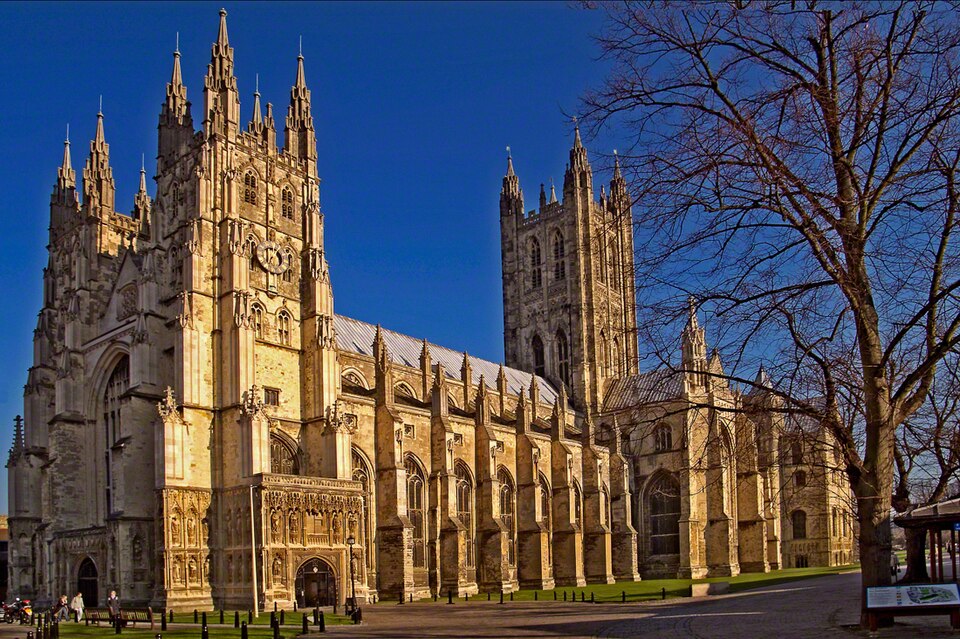
Photo credit: Canterbury Cathedral UK from the south-west (http://www.wyrdlight.com; Author: Antony McCallum) [Wikimedia Commons / Creative Commons Attribution-Share Alike 4.0 International license]
Sean Luke, who runs the YouTube channel, Anglican Aesthetics, made a video, “This ONE Issue Debunks Roman Catholicism” (7-1-25), in which he made the gigantic claim that certain proclamations and practices of a local council in 1022 and some other related ones, brought about binding Catholic proclamations that were intrinsically evil, which in turn inexorably leads — so he argued — to the conclusion that Catholic authority is null and void.
I critiqued it in my article, “History of Required Celibacy Disproves Catholicism?” (3-11-26). He quickly counter-replied with a Substack article entitled, “The History of Clerical Celibacy Still Refutes Roman Catholicism: A Reply to David Armstrong” (3-12-26). I in turn replied again in my blog article, “2nd Reply to Anglican Sean Luke on Catholicism & Celibacy” (3-12-26).
Discussion then began on Sean’s Substack between him and fellow Anglican Austin Suggs, who runs the Gospel Simplicity YouTube channel (99K subscribers and 669 videos). Sean’s words will be in blue; Austin’s in green. Non-denom Tom Alberto also joined in with some great comments and questions for me. His words are in purple.
*****
See the entire four-part debate:
History of Required Celibacy Disproves [the Authority of] Catholicism? [3-11-26]
*
2nd Reply to Anglican Sean Luke on Catholicism & Celibacy [3-12-26]
*
Reply to Protestants: Invalid Catholic Authority? [3-12-26]
*
Catholic “Wicked Married Sex”?: 4th Reply to Sean Luke [3-14-26]
*
*****
This was really good! I will say, however, while I think your argument is quite sound here, I get the sense that the modern magisterium would be comfortable shrugging it’s shoulders and saying, “yeah, but we’ve decided that’s not magisterial anymore (and never was but also was in a qualified sense. No, don’t send a dubia). Sorry for any confusion!” Which brings me back to my fundamental point about papal infallibility/magisterial authority, that is, it generally either becomes manifestly incorrect (i.e., if one can just look at documents that seem to imply binding authority and determine they did in fact mean to be binding and their meaning is tied to the author’s seeming intention, then there’s obvious falsehoods, like this) or functionally meaningless (i.e., irreformable means reformable, binding means temporarily suggestive, infallible means that the truth is true and error is erroneous so whatever is true in the infallible statement is true).
The discussion of “magisterial” and “levels of infallibility” and all that gets very complex. You guys see that as after-the-fact special pleading or rationalization on our part. We see it as “thinking man’s religion.” We don’t claim to have a simple system, thrust along to the public by slogans. God’s not simple to understand, neither is Christianity in all its fullness. So yeah, it’s complex, and it is for any non-canon lawyer. It is for me, too, and I’ve been a Catholic apologist for 35 years.
But Sean was defending the thesis that “the Roman Church demanded religious submission of mind and will to two objectively evil decrees.” This means that he has to establish that they were indeed evil. He merely assumed it. What I did was, I think, to show that they were not (magisterial or not, and I conceded that they were), and I did so from the Bible, with several arguments. But Sean chose to completely ignore all of my biblical argumentation (as well as most of my non-biblical argumentation).
So what can I say? I think the Bible is where all Christians can meet and interpret and exegete the texts. But that’s how I think his argument fails, by reductio ad absurdum (i.e., his argument would implicate God Himself, therefore, it can’t be true).
I imagine you have an article on this (you’ve got so many!), but have you addressed Veritatis Splendor listing slavery under the category of things that are intrinsically evil? The responses I’ve seen in the past (not from you, I haven’t seen yours) essentially amount to, “Pope St. John Paul II couldn’t have meant slavery was intrinsically evil because it would be wrong to teach that slavery is intrinsically evil, and since he wouldn’t (or couldn’t) teach wrong things in Veritatis Splendor, he must not have meant that slavery was intrinsically evil when he appeared to say that.”
Here’s what he taught in this 1993 encyclical:
- Reason attests that there are objects of the human act which are by their nature “incapable of being ordered” to God, because they radically contradict the good of the person made in his image. These are the acts which, in the Church’s moral tradition, have been termed “intrinsically evil” (intrinsece malum): they are such always and per se, in other words, on account of their very object, and quite apart from the ulterior intentions of the one acting and the circumstances. Consequently, without in the least denying the influence on morality exercised by circumstances and especially by intentions, the Church teaches that “there exist acts which per se and in themselves, independently of circumstances, are always seriously wrong by reason of their object”. The Second Vatican Council itself, in discussing the respect due to the human person, gives a number of examples of such acts: “Whatever is hostile to life itself, such as any kind of homicide, genocide, abortion, euthanasia and voluntary suicide; whatever violates the integrity of the human person, such as mutilation, physical and mental torture and attempts to coerce the spirit; whatever is offensive to human dignity, such as subhuman living conditions, arbitrary imprisonment, deportation, slavery, prostitution and trafficking [or, “selling of” in other translations] in women and children; degrading conditions of work which treat labourers as mere instruments of profit, and not as free responsible persons: all these and the like are a disgrace, . . .
I think this goes back to a distinction I made early on in this debate, between chattel slavery (such as the hideous American version) with its slave trade, and indentured servitude or serfdom. I think JPII (directly citing Vatican II, Gaudium et Spes), is referring to the former as intrinsically evil, as strongly indicated by other elements he condemns here, of the same nature: “physical and mental torture”; “attempts to coerce the spirit”; “subhuman living conditions”; “selling of women and children”; and “degrading conditions of work which treat labourers as mere instruments of profit.”
All of these things characterize that kind of slavery, which is, I believe, typical of the overwhelming instances of slavery that remain today, such as in the Sudan and China and North Korea, etc. The Bible (including the NT) plainly refers to the second kind and doesn’t condemn it, so there must be some kind of slavery that isn’t intrinsically evil, lest the Bible be in error. This is a “problem” all Christians have to grapple with, not just Catholics. I have collected many articles by Protestants making this same general point.
Steve Weidenkopf wrote an article, “Did the Church Ever Support Slavery?” for Catholic Answers Magazine (9-18-17). He wrote:
Scholars have routinely failed to distinguish between different types of slavery. The Church has consistently and constantly condemned the practice of “unjust servitude,” which usually entailed the enslavement of a certain race or for economic gain. But Western society since ancient times permitted just title servitude; that is, the involuntary servitude imposed on criminals or prisoners of war. Just title servitude was considered permissible as recently as 1949, when the Geneva Convention allowed nations at war to conscript prisoners of war for labor. In this case the Church has always demanded humane treatment of slaves by their masters and even encouraged their emancipation. The failure to recognize these distinctions between types of servitude has led many scholars to declare falsely that the Church failed to condemn slavery. . . .
Unfortunately, slavery returned to European society in the fifteenth century, with the conquest of the Canary Islands and the discovery of the New World. But from 1435 to 1890, a succession of popes condemned the slave trade and slavery in no uncertain terms. The first pope to do so was Eugenius IV (r. 1431-1447), who in his 1435 bull Sicut Dudum demanded that Christians free all enslaved natives of the Canary Islands within fifteen days; failure to do so would incur automatic excommunication. Thus, fifty-seven years before Columbus’s first voyage, the Roman pontiff unequivocally prohibited the enslavement of native peoples.
In 1537, Pope Paul III (r. 1534-1549) issued a bull, Sublimus Dei, which taught that native peoples were not to be enslaved. In 1591, Gregory XIV (r. 1590-1591) promulgated Cum Sicuti, which was addressed to the bishop of Manila in the Philippines and reiterated his predecessors’ prohibitions against enslaving native peoples. In the seventeenth century, Urban VIII (r. 1623-1644) promulgated Commissum Nobis (1639) in support of the Spanish king’s (Philip IV) edict prohibiting enslavement of the Indians in the New World.
The need for cheap and abundant labor in the colonies is what led to the African slave trade. This new form of bondage was also condemned by the popes, beginning with Innocent XI (r. 1676-1689). In 1741, Benedict XIV (r. 1740-1758) issued Immensa Pastorum, which reiterated that the penalty for enslaving Indians was excommunication. In 1839, Gregory XVI (r. 1831-1846) issued In Supremo to condemn the enslavement of Africans. Pope Leo XIII (r. 1878-1903) promulgated two bulls condemning slavery in 1888 and 1890.
Is that a satisfactory answer for ya?
***
This is a perennial meta issue I have with Rome.
Believe me, we have many “meta issues” with all forms of Protestantism, too.
How does this not ultimately collapse into fideism eventually?
Because the Catholic system it’s based on the Bible, Church history, tradition, and reason, not blind faith. Mere complexity does not reduce to despair and fideism. St. Thomas Aquinas is thought to be very complex. But his Summa Theologica was actually written as a theological guide for beginners.
A kind of “Rome said it, I believe it, that settles it” without any deeper wrestling?
Neither my current reply nor my conversion are / were of that simplistic nature. I came to the topic from all sorts of angles. As I said, my reasoning was not interacted with. The main thing that was any interaction at all with my actual argument from you were comments about the nature of Denzinger and what is “magisterial” — and I conceded the point that what he you brought up was magisterial, and publicly retracted and corrected two admitted instances of self-contradiction on my part. But as I noted in my second reply, that doesn’t wipe out my overall point of view at all, which works, whether the decrees in question are magisterial or not, because I attack — from the Bible — the assumption that they are intrinsically immoral. If I succeed there, your argument collapses, because that’s the foundation of it.
And if one says “well I could apply the same logic to the Bible”, does that not betray a fear that if you wrestle with Scripture it will collapse?
I say, “the Bible teaches it, that settles it”, which is precisely why I centered on biblical argumentation to overcome your objection to the authority of the Catholic Church. I’ve never for a nanosecond worried about the Bible collapsing, nor have I ever worried that long about the Catholic system collapsing, these past 35 years that I have been an adherent of it. Weak and fallacious arguments like yours only ever strengthen my heartfelt religious beliefs. It’s the blessing of the apologist. I now have a stronger belief in the profound authority of the Catholic Church than I did before I wrote these three replies to you and Austin, and it’s because I bolstered the Catholic Church with the Bible. That’s how I defended it.
On a deeper level, I really worry that many of the conversions to RC or EO are driven by an attempt to stave off deconstruction via staving off the need to make sense of Divine Revelation
I haven’t seen this all that much, and I’ve read and talked about many conversions. Protestants have to explain these conversions somehow, and it makes for endlessly fascinating and sometimes quite amusing reading to see what they have to say. James White, who utterly despises me personally, once tried to claim that I became a Catholic because I was profoundly ignorant of Protestant teaching. Then I produced a long list of what I had read as a Protestant (including many of his Reformed heroes). Without skipping a beat, he immediately explained my conversion as “knowing deception” because I knew too much to be ignorant.
We simply say — probably more than anything else — that we believe we have found, with the help of God’s grace, “the fullness of theological and spiritual truth.” Most of what Protestantism taught me was great. I am very grateful for that and I use that knowledge every day in my work (especially the love for the Bible and studying and exegeting it). But I discovered that there was much more to Christianity, even biblical theology alone, than what I had ever learned before. In any event, what you highlight had absolutely nothing to do with my reasoning in my conversion. It came mainly from three things:
- Reading St. Cardinal Newman’s Essay on the Development of Christian Doctrine (before that I had been a zealous fan of George Salmon and ferocious objector to the Inquisition and infallibility itself; tormenting and provoking my Catholic friends that I met in the pro-life rescue movement to no end).
- Learning that no Christian body ever regarded contraception as a permissible and moral act till 1930, in the Lambeth Conference for “hard cases” only. As a pro-life activist, that struck me like a thunderbolt and I changed my mind on that issue while still a Protestant. I also greatly admire other moral stances of Catholicism such as pro-life and opposition to divorce, that I had already come to firmly believe as an evangelical, based mainly on the Bible.
- Studying the Protestant Revolt from a Catholic perspective, too, instead of all one-sided Protestant “hagiographic”-type / extremely selective portrayals. I had read Bainton, Here I Stand in 1984 as a Protestant, and Luther was my hero. But when one reads Catholic accounts of that period, one gets a vastly different perspective. When I read both sides, it was clear to me which one was more so in the right and more in accord with prior Christian tradition than the other.
Note that none of that is biblical stuff. That came after my conversion, in explaining why I converted to my Protestant friends. But the drivers of my conversion were historical and moral.
I’m sure that isn’t everyone’s story.
I don’t think it’s the story of many at all. But you can always find some.
But if someone is looking for a baseline anchor from which to wrestle…man I just go back to the risen Christ again and again. I’d stake everything on the resurrection of Jesus as my anchor; Jesus is solid, and I can say with dogmatic confidence “Jesus said it, I believe it, that settles it.”
Amen! Of course we believe the same. We still all have to choose which church to attend and which set of doctrines to give our allegiance to.
And then from there, establishing what Jesus actually established in the Church is, I think, possible (or I wouldn’t be so taken with the Caroline divines!).
I respect anyone who can give a reason for what he or she believes about theology, agree or disagree. That’s why I love being an apologist. I think it’s desperately needed among Christians, both in a general sense and in particulars of which belief-system to choose, etc. We have to use our minds, and that’s biblical teaching, too.
But I digress. I think that if RCs want to say it isn’t magisterial even though it meets all the criteria, they have a real arbitrariness problem on their hands.
My position doesn’t have to deny that these things were magisterial in order to refute what you contend. And your counter-reply to me didn’t give me any reason whatsoever to believe otherwise, because you didn’t interact with my reasoning, and that’s how I generally am persuaded and change my mind, when I do those things. Hence, in the one limited area where you actually interacted with what I wrote, I was persuaded and retracted and corrected my first reply.
***
My critique was not built on the notion that slavery is per se wrong, Dave. My critique was built on the fact that declaring children conceived in a valid marriage as bastards and enslaving them on that ground is wrong. Nor is that an opposition to annulment. Annulment is the judgment that the marriage was never valid, not that a valid marriage is now made invalid. That doesn’t work if the Priests were validly married prior to ordination, as many were.
Yes, I’m fully aware of the definition of an annulment. I defended it from the Bible in The New Catholic Answer Bible apologetics inserts in 2002: my best-selling book. I’ve clarified why I brought it up in the first place. It was in direct response to one of your comments about “retroactive” judgments. It’s not my only biblical grounds for objecting to your argument.
So now your argument is that because the Catholic Church called these children “bastards” (assuming that is true, but that has happened on a widespread scale in Christian countries on many grounds) and made them serfs to the Church (cleaning churches, etc. as the pope you cited referred to): a thing you have now clarified that you don’t think is intrinsically evil, that therefore, the Catholic Church has forfeited all authority and those of us who want a consistent Christian system are thus forced to choose Anglicanism or Orthodoxy or perhaps my former affiliation of non-denominational Arminian evangelical?
Your argument gets weirder and weaker, the more I learn about it.
Ideas have consequences . . .
***
Many thanks to Sean, by the way, for letting me comment here! So many Protestants through the years have banned me from their venues (while most still critiqued me, not allowing me to reply in the same place), that it’s quite refreshing to find one who doesn’t! :-)
***
One can see exactly this “meta issue” play out in every twitter thread between Ed Feser and Mike Lewis (Where Peter Is) on the subject of the death penalty.
In effect, Lewis says that whatever was taught in the past must be interpreted through the lens of what the present Pope teaches, lest one becomes his own Pope like those Protestants.
Feser on the other hand thinks it is possible to determine what the Fathers, Councils, and Popes have taught historically and holds the current Pope up to that standard.
Great article Sean. I really appreciate the research. I didn’t know the Cluniac reforms had such a dark side to them.
Mike Lewis defends the authority of popes, and Ed Feser blasts them as he sees fit, and denies the Catholic doctrine of papal indefectibility, which was magisterially taught at Vatican I in 1870 alongside papal infallibility. Feser thought that Pope Francis was one of the worst popes ever. I interacted with him myself on that issue. Which one sounds more like an orthodox Catholic to you? A strong emphasis against capital punishment was also present in Pope St. John Paul II and Pope Benedict XVI.
Capital punishment for heresy is not intrinsically evil, and virtually all types of Christians believed in it in the past (and it has a certain rationale: murder of souls through heresy is at least as bad as murder of bodies). It’s a lot like the present debate about slavery. It’s ethically and morally complex, the closer one examines it.
So the current Catholic thinking or Mind of the Church is that capital punishment is no longer necessary to preserve society and is insufficiently pro-life, not that it is intrinsically evil. Feser misrepresents his opponents on this issue by making out that they are saying that capital punishment is intrinsically evil. They’re not. And that’s why the position of the Catholic Church on this could change through the years, just as it has in Protestantism.
Read, for example, the material on this topic by my friend, Dr. Robert Fastiggi, who is a systematic theologian who specializes in the history of Catholic dogmas and doctrines (editor and translator of the latest edition of Denzinger).
He has interacted with Dr. Feser (a philosopher, not a theologian) on this several times. I’ve hosted some of that material on my blog, Biblical Evidence for Catholicism and some of it is also on the Where Peter Is blog.
Yes I’m familiar with the back-and-forth on this, though I appreciate your comments here.
I think you are completely misrepresenting Feser when you say he denies papal infallibility. He distinguishes (and points to Magisterial documents which themselves distinguish) kinds of Papal teaching and doesn’t think that Francis taught something false Ex Cathedra.
When you say “Mike Lewis defends the authority of popes” you are smuggling in presuppositions about that authority. Feser agrees that popes have authority, but not the authority to contradict previous Popes speaking with sufficient authority.
So when you ask “which one sounds more like an Orthodox Catholic to you?” honestly, my answer as an outsider looking in at the debate between Feser and Lewis, is that Feser seems to be the more orthodox. I mean that sincerely. There is a category within Catholic ecclesiology for “bad popes” who teach false things, and the manner in which Lewis interacts with Francis as though he could have taught nothing wrong seems to me to be sub-orthodox because it implicitly denies that this category of Pope can exist.
I didn’t claim that Feser denied papal infallibility, but rather, papal indefectibility. I even distinguished between the two in my previous reply. I’ve written about it many times on my blog. It’s greatly misunderstood, even by many orthodox Catholics. In fact, I recently lost a Catholic friend over that very issue, just as I lost one in 2005 when I condemned the nuclear bombings of Japan, just as the Catholic Church has repeatedly done. They both turned against me in a very ugly — and public — fashion. Sometimes it happens.
Whereas Feser wants to know what the Magisterium as a whole has taught by which he can judge even Popes when they step out of line, just as those Magisterial documents say they can do.
They do not say that, per the citations I provided from Vatican I. If you are reflecting his views accurately, that would be the conciliarist heresy, which holds that councils are above the pope. Vatican I determined once and for all that this is not true (and it only developed and finalized what had been taught for hundreds of years). No one can judge the pope, who is the supreme authority and who alone, by himself, can produce infallible statements.
Bishops gathered in ecumenical council are only infallible when the pope agrees with them, and even then there are certain stringent conditions that must be met. Without the pope’s ratification they aren’t good enough by themselves. This is all orthodox Catholic ecclesiology. But I suspect that Feser doesn’t go that far. You may be misunderstanding him a bit there.
The reactionaries have become so anti-papal (and hence, unCatholic and pseudo-Protestant) that they are actually starting to deny the Vatican I ex cathedra proclamation on the infallibility of popes, even before they get to indefectibility, which in effect they are denying, too, though perhaps largely out of mere ignorance and not deliberate dissent. A fool named Peter Kwasniewski is one loudmouthed reactionary who is advocating this. It’s flat-out heresy, from a faithful Catholic perspective. He writes a lot for a reactionary site called One Peter Five (I’ve had several friendly dialogues with the main guy there, Timothy Flanders).
Feser agrees that popes have authority, but not the authority to contradict previous Popes speaking with sufficient authority.
That’s where the heart of the matter lies. Mike Lewis and I (and Dr. Fastiggi and virtually all Catholic apologists I know of) believe in faith as Catholics — supported by historical argumentation, such as I am engaging in presently with Sean — that popes will not contradict previous popes or otherwise magisterial teaching.
That gets into indefectibility and God’s protection of His Church from error. But Dr. Feser obviously thinks this can happen (since he jumped on the fashionable anti-Francis bandwagon). That’s the position that I have categorized as a “radical Catholic reactionary”: a form of what is known as Catholic traditionalism.
I’ve written two books about that and have a large web page devoted to it as well. I argue that this sort of thinking is both reminiscent of Catholic theological liberalism and also of Protestantism (which also, of course, criticizes popes and denies their authority).
In short, Dr. Feser is not thinking like an orthodox Catholic when he does this. He’s a dissident and a quasi-schismatic. He’ll fight that till his dying day. I don’t care. It is an accurate description of his position, and I’ve clashed with him over these things. I stopped when he made it personal and descended into childish insults. Blessedly, he hasn’t done that with Dr. Fastiggi: a far more gentle soul than I am. :-) So they keep debating back-and-forth.
Yes, there are “bad popes.” I’ve written about that, too, along with everything else (>5,000 articles and 56 books). Almost always, that term applies to morally reprobate popes, not heterodox ones. Fortunately, the worst “bad popes” (indeed, all of them) were too involved with prostitutes and greed to care about doctrine. So they didn’t proclaim binding heresy.
With Pope Francis, the claim from reactionaries, and even a lot of otherwise orthodox Catholics, is that he taught theological error. I have never found that to be the case, and even virulent critics like Phil Lawler concede that he never taught heresy. I defended Pope Francis 242 times and collected 321 additional articles that defended him, so I would be in a position to know what he taught, having examined it that deeply (perhaps more than anyone else has done). But I stopped doing all that about four years ago, because I have many other things to write about, as an apologist. This is only a temporary exception. :-)
I want to reiterate my own appreciation for Sean for letting conversations like this happen. I want to engage in the most productive ways with Catholics and other groups without them being shut out.
Excellent. Delighted to hear that. Sean has been the first YouTuber willing to interact with me. Gavin Ortund and Jordan Cooper won’t and don’t. I’ve critiqued them, combined, over sixty times, with, I think, total civility and respect. I appreciate them because they’re deep thinkers and not anti-Catholics (i.e., they don’t deny that Catholicism is a species of Christianity, as James White and many others do). Gavin partially replied once. That’s it. We’ve responded to several other Protestants, too, on our channel, with no replies back.
So Sean and you and Austin have gained my respect, for having the courage of your convictions, and being willing to interact with a Catholic in an Anglican venue like this, minus all insults and condescension. Sean reminds me very much of myself in 1990, when I fought vigorously against Catholicism before being persuaded by it that same year. So I can’t help but have a soft spot for that.
I didn’t claim that Feser denied papal infallibility, but rather, papal indefectibility. I even distinguished the two in my previous reply.
Fair enough, I see that you did distinguish the two. My misreading here surprises me, because I googled “papal indefectibility” before writing my comment as I wondered if you meant something other than “infallibility”. I know you did edit the comment to add your kudos to Sean, is there any chance you added that distinction while I was drafting my comment? The alternative is I did not read you carefully. Apologies, if so.
The distinction I made between infallibility and indefectibility was in the original comment. We all misread at times. No biggie.
I grasp your definition of “indefectibility” from what you write here. In fact, this is an incredibly helpful term which I will be employing when I try to explain the distinction between your camp and Feser. Thanks for that.
But now this comes back to the point I was making to Sean and Austin at the start of this thread. The “meta issue” is that in your view the Pope can never teach falsehood
Technically, he can never bind the faithful to falsehood in a magisterial way. Errors might be made in some respects. It’s the binding and the highly authoritative stuff that is protected with the gift of indefectibility (which the Church also possesses, as most Protestants would agree). The pope as the leader and primary spokesman of the Church in effect partakes of the same protection.
So, e.g., in one famous example, Pope John XXII (not 23rd!) temporarily denied the beatific vision. Thus, he made an error there, but he didn’t promulgate it in a binding way for all to believe. This is what is also involved in the attempted defeaters of the supposedly “heretical” or “infamous” Popes Vigilius, Honorius, and Liberius (whom I jokingly refer to as “The Three Stooges”).
and so whenever the Pope disagrees with his predecessors (in my opinion), you are forced to reinterpret what he or they said to the point where your viewpoint can never be refuted or falsified.
The attempt is to make out that we engage in circular reasoning or vicious self-defeating ideas. It’s not true. We [apologists] back up what we say with historical, factual argumentation, so that it’s not mere blind faith propositions. Rightly understood, the Catholic system is not self-contradictory, even in historical details, beyond theology. I know this is very difficult to grasp and believe.
It was for me, too, very much so, because infallibility was my #1 most objected-to belief. I thought it was self-evidently ridiculous and absurd. I was a 100% gung-ho Protestant, though never anti-Catholic. I read George Salmon and Hans Kung’s and Dollinger’s error- and fallacy-filled rants against infallibility and drove my Catholic friends crazy. Then I read Cdl. Newman and discovered how very little I truly knew about it. Salmon compared to Newman is sort of like Ed Feser being put on the level of Socrates and Plato.
Even though John Paul II said that priests could never be female, if Leo turned around and made an allowance for it, then you would find a way to show that this is all in line with indefectibility. Hence the meta problem. Our criticisms can never stick to you. Feser calls this “fideism” somewhere.
That’s not a “problem” itself; it’s a hypothetical that has never in fact happened, and shows no signs of happening in the future. If it does, come back to me and I’ll give you my opinion then. You guys simply extrapolate these hypotheticals times 100 and then conclude that we have a circular, fideistic system. I, on the other hand, actually tackle the historical alleged “difficulties” that are brought up. I back up my views with facts and reason: just as I am doing in this present debate with Sean.
I don’t want to follow an inconsistent or circular system. I didn’t as a Protestant (I was doing apologetics then, too). If I ever conclude that Catholicism is what you claim, I will leave it, just as I left Protestantism. I follow truth wherever it leads, to the best of my ability, with the necessary help, always. of God’s grace and guidance from the Holy Spirit, Who leads us into all truth.
By the way, you say indefectibility is “greatly misunderstood, even by many orthodox Catholics”. In truth, I have only ever heard Catholic apologists deny this indefectibility. Many of the Catholic apologists who I read (Ybarra, J Likoudis, etc) have held that the Pope can teach error when not speaking from the throne and point to many times in history where he in fact did (or might have).
I believe the same, as I stated in my last reply to you. It’s about binding, magisterial statements that apply to all Catholics.
I gather from you pointing to your large body of writings on this subject that you deny those cases (Honorius, John, etc) are real examples of bad teaching.
I deny that those cases violated indefectibility, properly understood and defined. I don’t deny that any errors were made, period.
Fine, but it seems to me you’re in the minority. Where do you see V1 teaching this doctrine?
Here’s what it teaches:
First Dogmatic Constitution Pastor aeternus on the Church of Christ: Session 4: July 18, 1870: the same magisterial proclamation that declared papal infallibility to be a dogma:
ch. 4: in the Apostolic See the Catholic religion has always been kept undefiled, and her well-known doctrine has been kept holy. [Denzinger #3066: “. . . has always been preserved immaculate and sacred doctrine honored”: p. 614]
this Apostolic See . . . there the losses of faith might be most effectually repaired where the faith cannot fail. [“where the faith cannot suffer impairment, the injuries to the faith might be repaired”: p. 615: Denzinger #3069]
For the Holy Spirit was not promised to the successors of Peter, that by His revelation they might make known new doctrine, but that by His assistance they might inviolably keep and faithfully expound the revelation or deposit of faith delivered through the Apostles. And indeed all the venerable Fathers have embraced and the holy orthodox Doctors have venerated and followed their apostolic doctrine; knowing most fully that this See of Saint Peter remains ever free from all blemish of error, according to the divine promise of the Lord our Saviour made to the Prince of His disciples: “I have prayed for thee that thy faith fail not; and when thou art converted, confirm thy brethren.” [“this See of Peter always remains untainted by any error . . .”: p. 615: D #3070]
This gift, then, of truth and never-failing faith was conferred by heaven upon Peter and his successors in this Chair, that they might perform their high office for the salvation of all; that the whole flock of Christ, kept away by them from the poisonous food of error, . . .
Look up Emmett O’Regan. He just did his doctoral dissertation on papal indefectibility.
St. Robert Bellarmine taught: “It is probable and may piously be believed that not only as ‘Pope’ can the Supreme Pontiff not err, but he cannot be a heretic even as a particular person by pertinaciously believing something false against the faith.”
O’Regan in one of his articles, commented on this:
It should be noted in this fourth proposition [the above], St. Bellarmine did not mean that a Roman Pontiff could not hold to material heresy in his capacity as a private teacher through ignorance (since we have noted that this reality was widely accepted), but he was rather arguing that God would never allow the Successors of St. Peter to fall into formal heresy or bind the Church to such heretical teaching in the papal Magisterium, in accordance with Christ’s prayer for Peter’s never failing faith. This can be summarized by Bellarmine’s maxim: “it is gathered correctly that the Pope by his own nature can fall into heresy, but not when we posit the singular assistance of God which Christ asked for him by his prayer”.
This was the opinion taken at Vatican I in 1870: precisely what I have expressed here as my own opinion, as I always want to be in accord with the teaching of the Catholic Church. Thanks for allowing me to explain and defend!
As Feser has pointed out, Donum Veritatis teaches “It can happen, however, that a theologian may, according to the case, raise questions regarding … the contents of magisterial interventions.” This doesn’t sit well with indefectibility as you’ve stated it.
But I stopped doing all that about four years ago, because I have many other things to write about, as an apologist. This is only a temporary exception. :-)
I am honoured and appreciate the exception.
So Sean and you and Austin have gained my respect, for having the courage of your convictions, and being willing to interact with a Catholic in an Anglican venue like this, minus all insults and condescension.
Thank you. My own journey involved closely considering Catholicism for a 2 year period in 2021-2 and nearly being convinced, but ultimately I was not persuaded. I still enjoy these conversations and continue to learn new things. There is much to be humble about.
***
I’m afraid you’ve misunderstood what I was saying there. I was not referring to Conciliarism, but to earlier teachings by Popes as well as Councils. If Francis in his teaching on the DP [death penalty] contradicts previous authoritative teachings of Popes (as Feser contends in his book), Feser says that the Pope’s teaching can be judged by that.
Thanks for the clarification, and apologies if I misunderstood you.
It has become clear to me in our conversation that the reason you disagree with this has more to do with “indefectibility” than anything else.
This is why from my viewpoint I think Feser’s view is more in line with right reason than yours and Lewis’s. His Catholicism actually seems to be falsifiable, whereas yours morphs (or at least is open to the possibility of morphing) into whatever shape it needs to be to avoid problems.
That’s the stereotype of Catholic authority (and what I used to argue, myself, as a Protestant): we are supposedly (even those who are relatively more educated and informed) simply “defining problems away” by prior commitments to infallibility and indefectibility and so we have a fideistic system built upon blind faith and blindness to real historical problems.
As to the death penalty, we’re not blind to anything. The Church used to apply it to heretics and murderers. Now it applies it to neither. That can change because it was an application of discipline, not a dogma. Whether someone is put to death and why is not a question of theology, though it can be indirectly related to it if he is a heretic. But it can be applied differently at different times, just as the celibacy requirement has been.
It may not mean much to you coming from the perspective of a non-Catholic, but I have seen some of Kwasniewski and I think this description of him is both incorrect and beneath you.
It’s Ed Feser who is being inconsistent. He feels confident and assured enough to disagree with now four straight popes, who have all opposed the death penalty, and also the Catechism, which was affirmed by Pope St. John Paul II in his 1997 Apostolic Letter Laetamur Magnopere, where he stated:
The Church now has at her disposal this new, authoritative exposition of the one and perennial apostolic faith, and it will serve as a “valid and legitimate instrument for ecclesial communion” and as a “sure norm for teaching the faith,” . . . Catechesis will find in this genuine, systematic presentation of the faith and of Catholic doctrine a totally reliable way to present, with renewed fervor, each and every part of the Christian message . . . [my italics]
Feser opposes all of that and places himself as a judge over them, which is most unCatholic. Yet you think he’s being more consistently Catholic than we are. We’re supposed to receive his judgment over and above that of the Church we are all members of. And it’s all because he doesn’t grasp the fact that the opposition to the death penalty is not because it is intrinsically immoral. That’s not the basis of it. That’s why he thinks the present view is a contradiction, when it’s not at all.
You say that is simply applying blind faith, etc. It’s not, because we give reasons for it. Read Dr. Fastiggi on this. He thoroughly refutes Feser and he’s in line with the last four popes (since 1978) and the Catechism. I’ve written about it, too, but I have no authority or doctorate in theology as Dr. Fastiggi does.
Both Dr. Feser and Dr. Kwasniewski (the latter, far worse) are presenting a quasi-schismatic and deficient version of Catholicism, that you have accepted. They will be responsible before God as teachers for that (Jas. 3:1). Part of apologetics is correcting those who are wrong, and who are misrepresenting Catholic teaching. If I catch hell for it, I do (so be it). It’s all part of my job and never stops me from saying what I believe I am duty-bound to say.
But this is one of the reasons why I stopped critiquing reactionaries and defending popes against their endless dissensions, some four years ago. It always comes back to blaming us when we correct someone or something. Apologists are like umpires: always unpopular with somebody, no matter what we do.
So please don’t ask me about any of these people, if we continue. I’ve said my piece. But if you bring up something they say that I firmly believe is a falsehood and not Catholic teaching, I’m still duty-bound to respond, because God is holding me accountable too, for what I teach, and errors — from a Catholic perspective, and/or biblical, as the case may be — that I fail to correct as an apologist (sins of omission, as it were).
***
You say that is simply applying blind faith, etc. It’s not, because we give reasons for it.
I didn’t say this, and I definitely don’t believe it. I know you offer reasons.
Thanks.
This ends up being a weird conversation. Both you and Feser believe that the Church itself is indefectible. Feser believes that if the Pope begins authoritatively teaching that the DP is intrinsically evil, then it has either falsified the unique claims of the RCC or else has shown that the Pope can teach heresy.
That’s exactly my point. Neither the popes nor Dr. Fastiggi, nor the Catechism, nor (way least of all) myself are teaching that it’s intrinsically evil. It literally cannot be, since many saints have taught it, including St. Thomas Aquinas, and God Himself expressly commanded it for several offenses against the Mosaic Law. So any argument against it can’t possibly proceed on the false premise that it’s intrinsically evil. This is what I’ve been trying to explain. Ed Feser — for whatever reason; heaven knows why — seems literally unable to grasp this fact in the views of his opponents (and I would say, the current Mind of the Church).
But me? I think the RCC is not indefectible at all. I think it has taught error. So don’t worry too much about what I think is the more consistent or better position for a Catholic to take!
I’m not worried at all! But several times now you have either stated or implied that what Ed Feser is saying makes more sense and seems more “Catholic” to you than what I’m saying. So you’re not entirely neutral in this. You give preference to his side in that debate. This is what I am protesting. Flat-out dissent against four popes and the Catechism and making out that one knows better than all of them is not orthodox, obedient Catholicism.
Sean understands the point about Catholics being bound to give “assent” to magisterial teachings. The Catechism is magisterial. Ed Feser isn’t doing that in this regard. So even Sean understands that that is not being an obedient Catholic.
[Feser] feels confident and assured enough to disagree with now four straight popes, who have all opposed the death penalty
I don’t think that’s fair. He utilises JP2 and Benedict to show that Francis contradicts them.
The development of this position has consistently proceeded with these four popes. They all opposed it, but it did become a stronger opposition from pope to pope, which is how development characteristically proceeds. So Francis was relatively stronger about it than was John Paul II. But the latter is the one who strongly introduced this thinking in the first place, so he’s certainly more in agreement with Francis than not. I think the AI Overview of Pope John Paul the Great’s views is accurate:
Pope John Paul II strongly advocated for the abolition of the death penalty, calling it “cruel and unnecessary” and promoting a “culture of life”. While not declaring it intrinsically evil, his 1995 encyclical Evangelium Vitae restricted its use to cases of “absolute necessity” where society could not otherwise be defended, which he deemed “very rare, if not practically non-existent”.
Key details regarding Pope John Paul II and the death penalty:
-
-
Evangelium Vitae (1995): The encyclical significantly restricted the acceptable, traditional use of capital punishment to only those cases where it is the only way to defend society, arguing that modern prison systems make such cases rare.
-
“Culture of Life”: He advocated for the sanctity of life from conception to natural death, arguing that the death penalty violates this principle.
-
Direct Appeals: He frequently called for the abolition of the death penalty, including a notable appeal during his 1999 visit to St. Louis, Missouri.
-
See also the AI Overviews of Pope Benedict XVI and Pope Francis and Pope Leo XIV on this issue.
See how Pope John Paul II didn’t declare it “intrinsically evil”? This is the point I keep making, and which Feser doesn’t grasp. He can keep misrepresenting his opponents if he likes, and fighting straw men. It’s not a very admirable trait in a professional philosopher.
Now can we please stop talking about Feser? This isn’t even on-topic (though I was glad to engage it a bit). I expect Protestants to critique the Catholic Church and popes. I’m sick and tired of Catholics doing so (i.e., when it’s unwarranted). I want to get back to Sean’s topic.
***
I’m not actually trying to make a point about vicious circularity. I’m sure that’s something non-Catholics have thrown at you before, but in the context of this conversation I’m just reiterating an observation that Austin Suggs made about an issue he runs into when disagreeing with Catholic apologists and which I have run into as well, namely that your defence of the Catholic faith often (seems to us to) morph into whatever shape it needs to in order to avoid falsification as the contingent events of history unfold.
To me, that sounds like an accusation of intellectual dishonesty and holding to a particularly unappealing or unpersuasive — even simplistic – point of view. But I think also that Protestants too often project that onto Catholics when it’s not there (which has happened to me literally hundreds of times in 35 years). It’s surely not what I believe I am doing in my own apologetics. Others may in fact do that (of course), but I do not. And maybe you’re saying I’m not, and just making general observations (which I often do, and have in this discussion), which is fine, if that’s the case.
The classic — and influential example of this, is from the 19th century Irish Anglican anti-Catholic polemicist George Salmon and his book, The Infallibility of the Church (which I loved when I was warring against Catholicism). I’ve since refuted it many times. It’s atrociously and outrageously and slanderously argued. But here’s his famous quotation:
‘The Romish champions, beaten out of the open field, have shut themselves up in the fortress of infallibility’ (page 46). But while retreating ‘the first strategic movement towards the rear was the doctrine of development, which has seriously modified the old theory of tradition’ (page 31). . . . ‘The starting of this theory,’ he says, ‘exhibits plainly the total rout which the champions of the Romish Church experienced in the battle they attempted to fight on the field of history . . . it is, in short, an attempt to enable men beaten off the platform of history to hang on to it by the eyelids.’
Development of doctrine is my favorite theological topic, and Cdl. Newman is my “theological hero” and biggest influence on my conversion (I have edited three books of his quotations and used to host the biggest Newman web page on the Internet), so those are ‘fightin’ words. But I have found virtually no Protestants who understand development of doctrine in its classic formulation by Newman. It’s relentless caricature, and Salmon is one of the worst. If a Protestant can’t understand and grasp development of doctrine I think it’s not likely that they will ever understand Catholicism, let alone join it.
It flipped my view, because Newman absolutely pulverized Salmon, who I was relying on as my “go to” person to bring up all of the alleged “contradictions” in Catholic history. It was like killing an ant with a hammer. If those two had ever debated in person, Salmon would have melted into the ground like the wicked witch of the west. I would have donated my right arm to see that debate. I think Newman is the most brilliant Catholic I’ve ever read. I had been saying that he should be a saint and a doctor since 1990. Now he is both. Bravo!
I then gave the example of the ongoing disagreement between you, Mike Lewis, and Ed Feser on the death penalty. It seems like a good example to me, and Feser has even said this himself (from within the vantage point of Catholicism) by calling your side “fideists”. I quite like “indefectibilists” now as an alternate term, thanks due you.
I’ve given my side.
But my point isn’t that your arguments are circular. I have read several books showing laudable command of history attempting to show the continuity of Catholic doctrine. My point is that the Church’s teaching seems to emerge from out of what it receives from history, believing that whatever it has received must be true and consistent. Very intelligent theologians then make something out of the messy contents of what they’ve received. The “meta point” remains: this looks like an attempt to concoct a story that cannot be falsified.
It may look that way (it did to me in the past, too): all the more if a person is inclined to think that or is biased towards that conclusion, over against Protestant alternatives. I don’t believe it to be the case, and I’ve been defending the Catholic Church for 35 years. I can only express my heartfelt view, based on long experience debating this very thing and a million others. It requires faith to believe, as well as acceptance of the reasoning. Faith is not philosophy, as I often say. Any Christian view necessarily entails faith and will not be able to absolutely prove itself. Science is the same way, so this doesn’t bother me. All systems of thought — including science — start with [unproven and unprovable] axioms.
I think examples of things that proponents think literally can’t be falsified are things like the “two pillars” of Protestantism: sola fide and sola Scriptura. I recently compiled 70 biblical proofs of salvation being directly, expressly tied to as many works. And what is the Protestant response? Well, it must be fifty people by now who came onto my Facebook page, mightily protesting this. Invariably they spout the usual Protestant biblical prooftexts for their view. I say, “that’s well and good” and “I know about all those; used to think the same thing about them as you do” and then immediately ask them, “okay, what’s your exegesis of the 70 Bible passages I have produced?”
At that point they — every time so far! (It drives me absolutely nuts) — simply offered more of their own prooftexts or disappeared. They wanted no part of even looking at what we think decisively refutes their view. Does that sound to you like it is the behavior of people confident in their view and open to falsification? It doesn’t to me. I think they are — these particular people — acting like brainwashed cowards, afraid of the Bible that they always say they are the big champions of, over against us Catholics. This is my frustration. The ones who would be able to have a constructive discussion about that would be people with doctorates in theology, like Ortlund and Cooper, but they’re the very ones who refuse to do so.
You have been a great dialogue partner / theological opponent. You’re engaging my points and raising interesting ones of your own. You know how to do it, and are willing to. It’s a breath of fresh air, and I thank you for it. I’m having a great time. I’ve literally sat here all day today (at least ten straight hours) participating in this discussion. I was gonna do my taxes today. LOL
By the way, this isn’t the same thing as disliking complexity. I like the complexity of Roman Catholic theology, it was one of the things that drew me in towards the Church. My Franciscan friend says my name is the combination of Thomas Aquinas and his teacher Albertus Magnus. I wear that a badge of honour! But the meta-point is that this goes beyond mere complexity.
Good!
I’m curious how you’d respond to this story I’ve painted. It’s a “meta-point” so we’re not really having a conversation about Catholicism. We’re having a conversation about conversations about Catholicism. Which is harder to wrap one’s head around. I only hammer the point into you so much because you gave me such a great point about “indefectibility” being the key point of disagreement between you and Feser. When you dogmatically believe that the Pope is indefectible, everything he teaches (outside of the exceptions made by Bellarmine as you repeat above) must “fit” somehow, no matter how many Popes seem to contradict it.
I don’t see that they have contradicted indefectibility, as we construe it. In this example that we have been discussing, capital punishment, Feser’s objection is based on a simple unwillingness to grasp a key fact: that opponents are not opposing it because it’s intrinsically evil, but because it’s insufficiently pro-life in this day and age, and unnecessary, whereas it was necessary in the past. There is conflict there, not because popes contradict, but because he is engaging the discussion starting with a wrong and mistaken premise. The house is no better than the foundation it’s built upon and his foundation is of sand. So in my opinion, that’s the key issue under dispute there, not indefectibility.
I’d have to discuss other proposed historical “contradictions” individually. I’m saying that in all my studies and apologetics, I’ve never seen a supposed “contradiction” in Catholic magisterial teaching that can hold up under scrutiny, including this attempt by Sean, that gets weaker by the minute, in my opinion, the closer we examine it. Maybe I will one day and will have to agonize over it. Thus far, I’ve never had to agonize over anything in my Catholic belief, and when I defend Catholicism, invariably my views and my faith become stronger because of the weakness of opposing positions.
That’s not because of me, I would say. It’s because Catholicism is true, and the truth is always easier to defend, in the final analysis. It’s falsehood that is very difficult to defend, because it lacks the inherent power that truth has.
It’s interesting discussion, so feel free. I’ll also be replying to Sean’s further installments. But I won’t pass up discussion as good as this, and this is my occupation, so I have the time.
***
Photo credit: Canterbury Cathedral UK from the south-west (http://www.wyrdlight.com; Author: Antony McCallum) [Wikimedia Commons / Creative Commons Attribution-Share Alike 4.0 International license]

Summary: Continuing discussion with two Anglicans & a non-denom Protestant: about sublime Catholic authority and whether two “evil” (?) decrees on celibacy in the 11th c. destroy it.
eunuchs for the sake of the kingdom
undistracted devotion to the Lord
Previous Post
March 12, 2026
2nd Reply to Anglican Sean Luke on Catholicism & Celibacy
Next Post
March 14, 2026 Purgatory & Scripture vs. Jeff Durbin
Recent Comments
Browse Our Archives
Select a Category & Last Things About Me Anti-Catholicism Atheism & Agnosticism Baptism and Sacramentalism Bible and Tradition Blessed Virgin Mary Books by Dave Armstrong C. S. Lewis Calvinism & General Protestantism Catholic Apologetics Catholic Apologists Catholic conversion Catholic converts Christmas Church (Ecclesiology) Church History Conversion and Converts Development of Doctrine Eastern Orthodoxy Ecumenism & Christian Unity Eucharist & Liturgy Fathers of the Church French Translations G. K. Chesterton Hell Hell & Satan Hell & Satan & Last Things Heresies & Comparative Religion Holistic Health Inquisition & Crusades & Scandals James White Jews & Judaism & Old Testament John Calvin John Henry Newman Liberal / Modernist Theology Life Issues Literary Resume Lutheranism Mariology Martin Luther Music Orthodoxy Papacy & Infallibility Personal Page Philosophy & Science Political & Ethical & Moral Issues Protestant Persecution & Intolerance Protestantism Purgatory Purgatory & Penance Romantic & Imaginative Theology Saints & Purgatory & Penance Salvation Salvation & Justification Satan & Last Things Sexuality and Gender Issues Spanish Translations Traditionalism vs. Radical Catholic Reactionaries Traducciones al español / tradução para português Trinitarianism & Christology Uncategorized Videos
Select a Month October 2026 September 2026 August 2026 July 2026 June 2026 May 2026 April 2026 March 2026 February 2026 January 2026 December 2025 November 2025 October 2025 September 2025 August 2025 July 2025 June 2025 May 2025 April 2025 March 2025 February 2025 January 2025 December 2024 November 2024 October 2024 September 2024 August 2024 July 2024 June 2024 May 2024 April 2024 March 2024 February 2024 January 2024 December 2023 November 2023 October 2023 September 2023 August 2023 July 2023 June 2023 May 2023 April 2023 March 2023 February 2023 January 2023 December 2022 November 2022 October 2022 September 2022 August 2022 July 2022 June 2022 May 2022 April 2022 March 2022 February 2022 January 2022 December 2021 November 2021 October 2021 September 2021 August 2021 July 2021 June 2021 May 2021 April 2021 March 2021 February 2021 January 2021 December 2020 November 2020 October 2020 September 2020 August 2020 July 2020 June 2020 May 2020 April 2020 March 2020 February 2020 January 2020 December 2019 November 2019 October 2019 September 2019 August 2019 July 2019 June 2019 May 2019 April 2019 March 2019 February 2019 January 2019 December 2018 November 2018 October 2018 September 2018 August 2018 July 2018 June 2018 May 2018 April 2018 March 2018 February 2018 January 2018 December 2017 November 2017 October 2017 September 2017 August 2017 July 2017 June 2017 May 2017 April 2017 March 2017 February 2017 January 2017 December 2016 November 2016 October 2016 September 2016 August 2016 July 2016 June 2016 May 2016 April 2016 March 2016 February 2016 January 2016 December 2015 November 2015 October 2015 September 2015 August 2015 July 2015 June 2015 May 2015 April 2015 March 2015 February 2015 January 2015 December 2014 November 2014 October 2014 September 2014 August 2014 July 2014 June 2014 April 2014 March 2014 February 2014 January 2014 December 2013 November 2013 October 2013 September 2013 August 2013 July 2013 June 2013 April 2013 March 2013 February 2013 January 2013 December 2012 November 2012 October 2012 September 2012 August 2012 July 2012 June 2012 May 2012 April 2012 March 2012 February 2012 January 2012 December 2011 November 2011 October 2011 September 2011 August 2011 July 2011 June 2011 April 2011 March 2011 February 2011 October 2010 September 2010 August 2010 July 2010 April 2010 March 2010 December 2009 October 2009 August 2009 July 2009 June 2009 May 2009 March 2009 February 2009 October 2008 September 2008 April 2008 March 2008 February 2008 January 2008 December 2007 November 2007 October 2007 May 2007 March 2007 February 2007 January 2007 November 2006 October 2006 September 2006 August 2006 July 2006 June 2006 May 2006 April 2006 March 2006 February 2006 October 2005 June 2005 April 2005 February 2005 July 2004 May 2004 April 2004
Follow Us!
TAKE THE
Religious Wisdom Quiz
What does "Bartholomew" mean in Aramaic?
Select your answer to see how you score.
Servant of God The Lord is my Shepherd Fisher of Men Son of Talmai
Books by This Author Books by Dave Armstrong
Related posts from Biblical Evidence for Catholicism

Top Ten Anti-Catholic Lies (#10-7)
Biblical Evidence for Catholicism

Jesus Founded the [Catholic] Church. If Not Him,...
Biblical Evidence for Catholicism

Jerusalem Council vs. James White & Sola Scriptura
Biblical Evidence for Catholicism

Apostolic Succession: 40 Biblical Arguments
Biblical Evidence for Catholicism
TRENDING AT PATHEOS Catholic

Pope Leo Celebrates Mass for Nurses & Docs...
I don't have any idea how he did it, but Pope Leo...

The Sermon on the Mount, Part I: Matthew...
The Sermon on the Mount, Part I (Matthew 4:12-5:12) St. Matthew moves...

What's up from Crossway: Reviewing some of their latest A few weeks...

Janie Learns the Way of the Cross: A...
Teaching children about Jesus' Passion can be challenging. Many parents and educators...

Looking For Good Catholic Writing - October 2026
He alone extends the heavens, and he walks upon the waves of...

In "Irreplaceable," our book on vocation and technology, Trevor Sutton and I...
view all Catholic blogs
What Are Your Thoughts?leave a comment
Ad-Free & Subscriber Log-In Subscription Support
- About Us
- 2026 Calendar
- Videos
- Podcasts
- Library of World Religions
- Faith In Media Tracker
- Advertise With Us
- Write for Us
- Privacy Policy
- Terms of Service
- Do Not Sell My Data
- Contact Us
- Radiant Digital
- Manage Newsletter Subscriptions
- Unsubscribe From Notifications
- Sitemap
Copyright 2008-2026, Patheos. All rights reserved.
Subscription Support Ad-Free & Subscriber Log-In
Follow Patheos