
BuddhistCatholicContemplativeEvangelicalGeneral ChristianHinduJewishLatter-day SaintMuslimNew VisionsProgressive Christian
Beliefs
- Buddhist
- Catholic
- Contemplative
- Evangelical
- General Christian
- Hindu
- Jewish
- Latter-day Saint
- More Voices
- Muslim
- New Visions
- Pagan
- Progressive Christian
Topics
- Religion News
- Food and Religion
- Sports and Religion
- Religious Art
- Religious Music and Entertainment
- Religious Events
- History and Religion
- Style and Religion
- Politics and Religion
- Women in Religion
- Recreation Outdoors and Religion
- Business Finance and Religion
- Careers Workplace and Religion
- Education and Religion
- Family Parenting and Religion
- Health Fitness and Religion
- Home and Religion
- Relationships and Religion
- Technology and Religion
- Travel and Religion
Columnists
- Buddhist Columnists
- Business Finance and Religion Columnists
- Careers Workplace and Religion Columnists
- Catholic Columnists
- Contemplative Columnists
- Education and Religion Columnists
- Evangelists Columnists
- Family Parenting and Religion Columnists
- General Christian Columnists
- Health Fitness and Religion Columnists
- Hindu Columnists
- History and Religion Columnists
- Home and Religion Columnists
- Jewish Columnists
- More Voices Columnists
- Latter Day Columnists
- Muslim Columnists
- New Visions Columnists
- Nonreligious Columnists
- Pagan Columnists
- Politics and Religion Columnists
- Progressive Columnists
- Recreation Outdoors and Religion Columnists
- Relationships and Religion Columnists
- Religion News Columnists
- Religious Art Columnists
- Religious Events Columnists
- Religious Music and Entertainment Columnists
- Sports and Religion Columnists
- Style and Religion Columnists
- Technology and Religion Columnists
- Travel and Religion Columnists
- Women in Religion Columnists
Resource Library
- 2026 Calendar
- Library of World Religions
- The 100 Most Holy Places on Earth
- Patheos Answers
- Podcasts
- Videos
- Faith Leaders Database
- Anglican Episcopalian
- Bahai
- Baptist
- Buddhism
- Christianity
- Confucianism
- Eastern Orthodoxy
- Hinduism
- Holiness and Pentecostal
- ISKCON
- Islam
- Judaism
- Lutheran
- Methodist
- The Church of Jesus Christ of Latter-day Saints
- New Age
- Paganism
- Presbytarian and Reformed
- Protestantism
- Religion Behind the Scenes
- Roman Catholic
- Scientology
- Shia Islam
- Sikhism
- Sufism
- Sunni Islam
- Taoism
- Zen
- See all religions
Research Tools
 Ad-Free & Subscriber Log-In Subscription Support
Ad-Free & Subscriber Log-In Subscription Support
Follow Patheos 

- Trending:
- Forgiveness
- |
- Marriage
- |
- Consciousness
- |
- Death Penalty
- |
- Election
- |
- Halloween

-
About
-
Catholic Apologetics
-
Church History
-
Great Apologists
-
Christian Worldview
-
Protestantism & Misc.
- Home
- Catholic
- History and Religion
- 2nd Reply to Anglican Sean Luke on Catholicism & Celibacy
2nd Reply to Anglican Sean Luke on Catholicism & Celibacy
Last updated on: March 15, 2026 at 2:35 pm by Dave Armstrong
2nd Reply to Anglican Sean Luke on Catholicism & Celibacy 2026-03-15T14:35:47-04:00 Dave Armstrong
Patheos Explore the world's faith through different perspectives on religion and spirituality! Patheos has the views of the prevalent religions and spiritualities of the world.
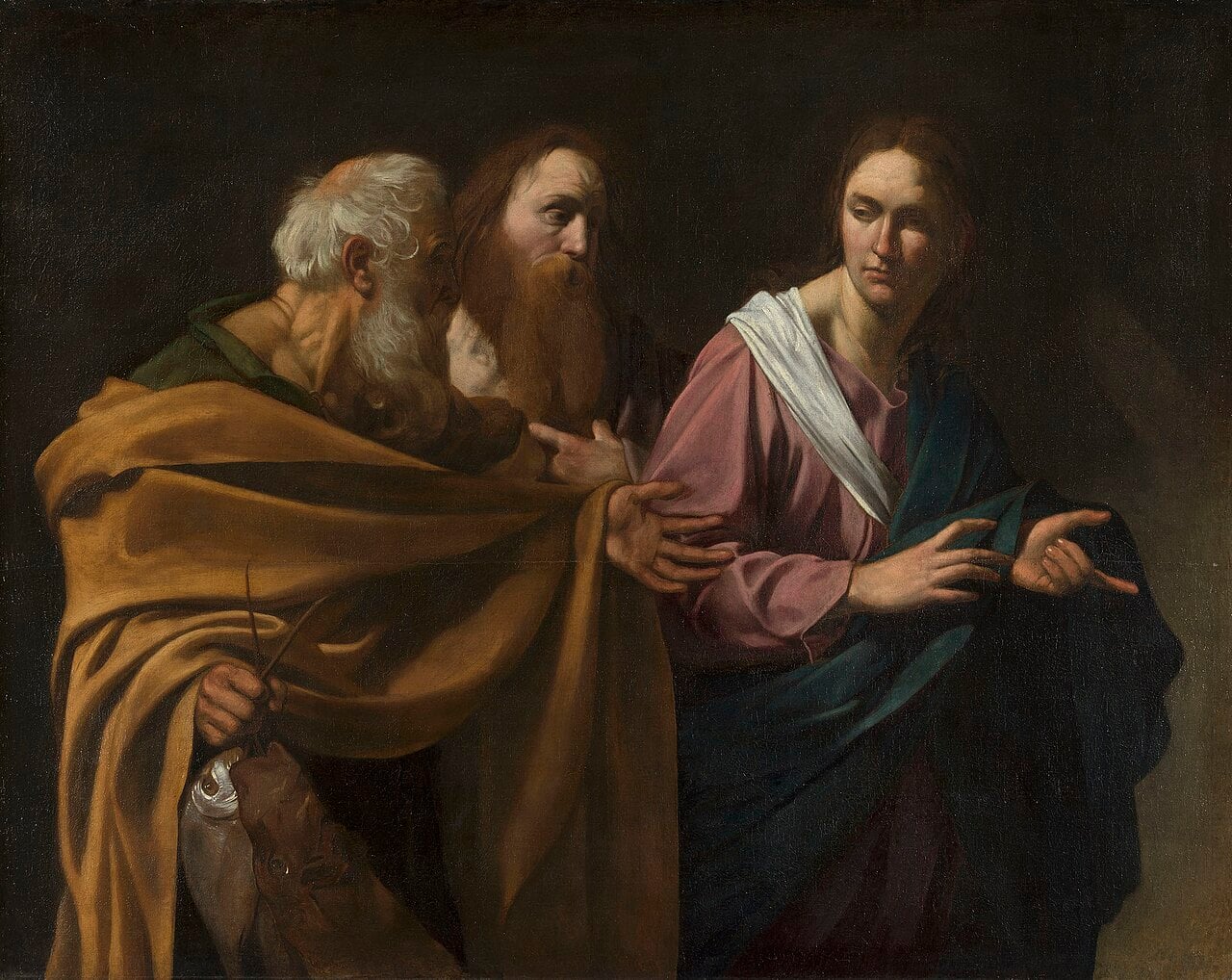
Photo credit: The Calling of Saints Peter and Andrew (c. 1603-1606), by Caravaggio (1571-1610), which entailed Peter leaving his wife [public domain / Wikimedia Commons]
Sean Luke obtained Masters of Divinity and Masters of Systematic Theology degrees from Trinity Evangelical Divinity School. He runs the YouTube channel, Anglican Aesthetics, which includes a video, “This ONE Issue Debunks Roman Catholicism” (7-1-25), in which he made the gigantic claim that certain proclamations and practices of a local council in 1022 and some other related ones, brought about binding Catholic proclamations that were intrinsically evil, which in turn inexorably leads — so he argued — to the conclusion that Catholic authority is null and void.
I critiqued it in my article, “History of Required Celibacy Disproves Catholicism?” (3-11-26). He quickly counter-replied with a Substack article entitled, “The History of Clerical Celibacy Still Refutes Roman Catholicism: A Reply to David Armstrong” (3-12-26). I now reply to that.
His words from the Substack article will be in blue; if I cite his words from his initial video and an earlier one on the same topic, they’ll be in green, so readers will quickly know where each citation came from. Citations of my own words from my previous critique will be in purple.
*****
See the entire four-part debate:
History of Required Celibacy Disproves [the Authority of] Catholicism? [3-11-26]
*
2nd Reply to Anglican Sean Luke on Catholicism & Celibacy [3-12-26]
*
Reply to Protestants: Invalid Catholic Authority? [3-12-26]
*
Catholic “Wicked Married Sex”?: 4th Reply to Sean Luke [3-14-26]
*
*****
First, a word on what I regard as some questionable argumentative methods in Sean’s reply. Near the beginning he wrote:
He intersperses his rebuttal with assorted comments of how “frequently Protestants sadly misrepresent things” or “the sexual perversions in Protestantism is why I left” . . . I will ignore these parts and refer readers to the video above and elsewhere. If you’d like me to address Dave’s irrelevant rambles about the woes of Protestantism, I can below. Here, I will focus on the argument.
Does it look like he was actually quoting me, above? Some readers might interpret it that way, though it’s not absolutely necessary to do so and it could be taken as an expression of paraphrase. But even his descriptions of what I wrote in this regard are inaccurate. This is always the danger of summarizing opponents’ arguments as opposed to simply citing them and letting readers draw their own conclusions. The words “frequently” and “misrepresent” and “perversions” never appear in my article. Nor were these passing remarks about Protestantism “irrelevant rambles.”
They were directly on-point because Sean is attempting to maintain that Catholicism collapses — yes, that is his contention — due to one or two statements it made in local councils as long as ten centuries ago, that he regards as “intrinsically sinful” (his words at 2:39 of his video). I merely pointed out — in a “turn-the-tables” sort of way — that there are many such decrees in larger Protestantism. Now, here’s what I actually wrote (!):
Those sort of things are rampant within Protestantism, especially regarding any sexual-related issue, like divorce, abortion, contraception, cohabitation, homosexual issues, etc. All kinds of things that are intrinsically sinful — and were formerly regarded as such by the vast majority of Protestants — are now massively fine and dandy among them. It’s very sad. And it’s a big reason why I left evangelicalism.
Of course all of that can be debated (feel free, but it won’t go well!), but it’s not irrelevant to the discussion. If someone says, “I disbelieve in your Christian authority x because of its objectively sinful proclamations a and b” it’s perfectly relevant to reply with, “oh, by the way, I disbelieve in your Christian authority y because of its objectively sinful proclamations [in light of the Bible and apostolic, patristic Christianity] c, d, e, f, and g.” All the points can be discussed, of course, but it’s neither “irrelevant” nor a “ramble” to make the point that I made. I also made the related remark:
Nowadays, Anglicans have no use for annulments, since they have caved on the biblical teaching prohibiting divorce. This is one of several moral reasons why I moved from evangelical Protestantism to Catholicism in 1990, because I wanted primal, apostolic, biblical morality, not compromises with the modern zeitgeist and calling evil good, which we see (institutionally, not just in practice) in the mainline Protestant denominations, increasingly in evangelicalism, and even in Eastern Orthodoxy, when it comes to contraception and divorce.
In other words, the form or overall thrust of my argument in statements like these is, “you object to a decree of Catholicism ten centuries ago and disbelieve in Catholicism as a result. By the same token, I object to five major teachings regarding morality that are widely promulgated by almost all Protestants today, and as a result, I left evangelicalism for Catholicism.” The other related remark I made was in direct response to an old, tired whopper from Sean:
21:54 And the logic, as we just saw, of the second Lateran Council is that marriage and sex mark you with a kind of impurity that make you unfit to celebrate the mass.
That’s not what it stated. It’s simply read into it with the usual Protestant prejudice and anti-factual mentality that the Catholic Church is somehow against sex and marriage as “dirty” and sinful things. Of course it isn’t. We’re the ones that regard a valid marriage as a sacrament and indissoluble (both things denied by virtually all Protestants). It gives grace (as all sacraments do). It even helps to save a person in some cases (1 Pet 3:1; 1 Cor 7:13-14, 16). . . . The Catholic Church had long taught that marriage was holy and good and not sinful . . . [I go on to document that] . . . If Sean thinks that the Catholic Church taught differently, then let him prove it through official documents.
This wasn’t a statement about how [his presentation of my supposed thought] “frequently Protestants sadly misrepresent things” but a protest against a very common theme in contra-Catholic polemics and in secular impressions of Catholicism and Catholics: that we supposedly think all sex — even moral marital sex — is “dirty” and “evil”. Sean repeats that, and I would have none of it. So I was saying that this theme is a “usual Protestant prejudice” because it demonstrably is (I would know that, as a catholic apologist these past 35 years, who constantly deals with Protestant objections), and Sean gave us a classic example of it. It wasn’t a sweeping, general accusation; only about this specific thing.
This “Catholicism hates sex and teaches that it is dirty” theme (and I’m not directly quoting him there; but I will below!) is more prominent in his first video on the same topic (5-14-24):
13:15 Pope Gregory’s rationale is explicitly rooted . . . in the idea that somehow sex is a bad thing; sex and marriage is [sic] bad. It’s somehow dirty . . . sex in marriage is for the immature . . .
14:28 it was premised on this idea that sex and even sex in marriage is somehow defiling, such that a priest can’t have sex with his wife the night before the mass . . .
15:35 . . . sex is somehow intrinsically defiling . . .
The first statement is ridiculous and self-refuting (we’ve never officially, magisterially taught that, which is why he never documents that we did, whereas I documented that we do not believe this nonsense), but the second is, in a way, even more surprising and remarkable, in that Sean seems unaware of the basic Christian and biblical idea and practice of asceticism: which is the giving up — temporarily or permanently — , not of bad and evil things, but of good things. Fasting and abstinence and Lenten practices are examples. Paul is a supreme example of this practice:
Philippians 3:7-8 (RSV, as throughout) But whatever gain I had, I counted as loss for the sake of Christ. [8] Indeed I count everything as loss because of the surpassing worth of knowing Christ Jesus my Lord. For his sake I have suffered the loss of all things, and count them as refuse, in order that I may gain Christ
Does it follow that Paul is saying that all these “things” that he willingly gave up are “bad” and that he gave them up because they were “bad”? No! Priestly celibacy is, of course, one of the many examples of heroic self-sacrifice or what Catholics call “the evangelical counsels” — and Sean himself acknowledges it to some extent by writing, “It is not that the canonical requirement of clerical celibacy contradicts Scripture or anything like this.” Moreover, St. Paul actually teaches exactly the same principle, of temporarily abstaining from sex for spiritual reasons:
1 Corinthians 7:5 Do not refuse one another except perhaps by agreement for a season, that you may devote yourselves to prayer; but then come together again, lest Satan tempt you through lack of self-control.
The Orthodox and Eastern Catholics, who have married priests, practice this temporary abstention from sex in conjunction with the Divine Liturgy (and their bishops are totally celibate). It’s obviously not an “anti-sex” thing in these instances; it’s asceticism. But Sean doesn’t appear to understand this. In his mind, it was antipathy to sex as evil that must have been in Pope Gregory’s mind, not these quite biblical principles. He doesn’t know that; he didn’t prove it. He merely assumed it, due to his existing misconceptions. Many Protestants — including Sean’s Anglicans, Lutherans, etc. observe Lent and fast. I used to fast when I was an evangelical Protestant. I understood the spiritual principle of self-sacrifice.
If Sean does understand this, he apparently temporarily forgets it when he is analyzing historical Catholics, and attributes to them low and sinful motives. This judgment and slander is itself sinful. He may take that as a personal attack or as “irrelevant.” But it’s not. In my opinion (and motivation), it’s an example of what Paul says ought to typify “Lord’s servant”: “correcting his opponents with gentleness” (2 Tim 2:24-25).
The other absurd tactic that Sean employs is to utterly ignore the many biblical passages that I brought to bear on the topic. I need not summarize them (why should I have to?). Readers can go see for themselves. I was backing up Catholic teachings and proclamations with Scripture that justified it. I used the Bible because that is the common ground between Catholics and Protestants. We can have discussions about that. It’s the common premise: upon which any constructive dialogue must build upon and start from. But if a dialogical opponent simply ignores all of that, as if it doesn’t exist, that is not a legitimate counter-reply. He’s not interacting — at all — with the very heart and essence of my reply. It’s yet more mutual monologue.
What Sean does is — whether he is consciously aware of it or not — an old tactic in sophistical pseudo-debate: ignore the opponent’s critiques of your argument and simply repeat it over and over, as if there was no counter to it, and as if that makes an argument stronger, in and of itself, and dig in and reassert – -rather than defend — the original argument with more quotes (in this instances, from local Church councils). This is not legitimate back-and-forth debate. It’s not debate at all, and Sean would fail a 6th grade debate class if he tried to pull this nonsense there. No one in debate class is told to ignore the opponents’ arguments. They’re taught to know it better than the opponent knows it, and to interact with it in order to show how it’s wrong and refute it.
Sean, in fact, scarcely interacts with anything I wrote. I guess that’s how he could respond in lightning-quick fashion. He cites exactly two paragraphs of my reply (regarding a relatively minor point). That’s it! My reply was almost 4500 words long. Yet he made the statement, “We will address Dave’s comments below.” He directly quoted 161 words from my article, or 3.6% of it, and absolutely none of the biblical arguments or citations. I’m thankful that at least he did link to my article, so folks can read it if they wish. But he certainly hasn’t made a serious critique. Now on to what he does write:
He summarizes the thesis that he is presenting:
The Roman magisterium forced lawfully married Priests, by a magisterial act, to leave their wives. Given that the magisterium—even the non-infallible magisterium—is owed religious submission of mind and will, this would imply the absurdity that Priests were obligated to give religious submission of mind and will to forsake their God-hallowed covenant with their spouses and all the attendant obligations.
I gave several Bible passages that justified this or something akin to it (in the cases of annulment), but Sean ignored them all. Maybe he’ll decide that it’s worthwhile to discuss relevant inspired revelation if he replies again. I sure hope so. If not, then I’ll interpret that as forfeiting the argument by default. Scripture isn’t scary or something to ignore. It’s truth, has something to say (if only at times deductively or indirectly or implicitly) about any topic we could come up with. As Protestants love to cite regarding supposed defense of sola Scriptura, it’s “profitable for teaching, for reproof, for correction, and for training in righteousness, that the man of God may be complete, equipped for every good work” (2 Tim 3:16-17).
I proved from the Bible (Abraham, God the Father, Ezra, Jesus, Paul) that what the Catholic Church decreed about married priests who violated the newly adopted rule of celibacy is thoroughly biblical and not “intrinsically sinful” at all. Jesus not only taught that Peter as a married man would receive a “hundredfold” back in this life, for leaving his wife and following Jesus, but also that he would receive eternal life for it (Mt 19:27-29; Lk 18:29-30). God sanctioned Abraham sending away his concubine and his own son, Ishmael (Gen 21:9-21).
If the Catholic Church was gravely sinful in doing the same thing, then so is God Himself, per inspired, inerrant revelation. That’s what’s called a reductio ad absurdum in logic, folks . . . I guess it’s because I completely exploded his argument from the Bible, that Sean chose to absolutely ignore all of my biblical arguments. “Hear no evil, see no evil . . .” / head in the sand etc. That’s a way for him not to deal with the relevant biblical data, but it’s not rational argumentation or debate, and it’s a strange and ironic “anti-biblical” approach, especially coming from a Protestant.
The claim seems to be that because the Council of Pavia is not in Denzinger, it isn’t magisterial. But this is an absurd claim. Literally no magisterial scholar—Francis Sullivan, Cardinal Avery Dulles, etcetera—has ever claimed Denzinger to be exhaustive. Just because some act isn’t found in Denzinger does not mean it is not magisterial.
I did write in the two paragraphs — the only two — that Sean cited from me: “Enchiridion symbolorum (Denzinger) is the standard compendium of the most important Catholic magisterial documents.” That’s not all of them. If the local council of Pavia in 1022 is “magisterial” it wasn’t, nevertheless, considered significant enough to be included in Denzinger. In the Introduction to the 37th edition (included in the 43rd edition — my own copy — , on p. 1), a reviewer was approvingly cited noting that “this collection makes no claim to absolute comprehensiveness . . .” The same Introduction stated that “Denzinger wanted to cover the essential stages in the development of the Church’s doctrine” (p. 1). In another introductory section, mention is made of a 1971 article about Denzinger by Yves Congar. Summarizing his thought, it stated:
The succession of texts [in Denzinger] . . . are in themselves of widely differing importance . . .
There are many ways in which the faith can be protected and interpreted . . . Tradition cites the Fathers as well as the liturgy, the great theologians, and so on, Magisterial documents represent merely one of the forms of this interpretation by which the faith is protected. (p. 9)
But Sean does have a legitimate point that I will now concede. I contradicted myself because after noting that Denzinger wasn’t comprehensive, I still went on to state that:
although the 1022 council in Pavia might be interesting and relevant in terms of the historical background of the Catholic celibacy requirement, it’s not what one would describe as a “magisterial” document. It doesn’t carry the authority that Sean seems to think it does.
. . . it’s not “magisterial” in the first place. Otherwise, it would have been included in Denzinger.
I now retract those statements and will remove the second excerpt and modify the rest of the above to the following (while preserving my former error here, for the sake of the record):
The 1022 council in Pavia is interesting and relevant in terms of the historical background of the Catholic celibacy requirement, but it’s not nearly as historically or canonically influential or important or “universal” in significance, as Sean seems to think it is, even if technically “magisterial.” Magisterial authority, like the very complex levels of infallibility, has differential importance and application.
Why even bring this point [about Denzinger] up?
To show its relatively lesser importance in the overall scheme of things. It’s already a disciplinary matter in the first place, which as Sean knows, is a different category altogether from dogmas and doctrines. Knowing this, he then emphasizes the obligation of assent. Sure; every religious authority requires assent. That’s what creeds and confessions are about. But Sean’s goal is much more grandiose; he holds that Catholic magisterial authority collapses because of a few statements in a local council in 1022, since they supposedly commanded an immoral thing (they did not, as I proved from the Bible and God Himself). It’s also quite unclear whether these decrees were promulgated or observed very widely at all, as I showed by the citation of a scholarly article specifically about it. Here is that portion again:
Rafał Marek, in his article, “Some Remarks about the Legislative Provisions of the Pavia Council of 1022″, observed in his abstract that its “provisions” were “quite vague and not (at least directly) implemented in Italy” and that “the synodal statute was not received as a binding law and we have no traces of its use by bishops or secular judges.” And in his conclusion he was inclined to believe that the “resolutions of 1022 had minimal effect or even no application at all.”
I submit, then, that this council has very little importance in either the Catholic disciplinary rule of celibacy that was required not long afterwards, nor in Sean’s particular argument concerning Catholic magisterial authority.
Now, if he is trying to argue that it isn’t magisterial from the article he cites, he should note that the article he cites never says it isn’t magisterial.
l cited that to show — I think it was made clear — that it had little lasting importance at all: so much so that it wasn’t implemented even locally, let alone universally in a binding fashion. Yet this is the council and the topic that Sean thinks will bring down the entire Catholic Church as an institution commanding and requiring immorality (which itself is a notion that I thoroughly refuted from the Bible)? It’s absurd and desperate, and what we call in debate “special pleading.”
The fact that it had a minimal effect in implementation is simply irrelevant to identifying whether it expresses the mind of the Pontiff.
That’s correct, but the bottom line is if the decrees are intrinsically immoral (because that‘s what Sean’s argument depends on). I have argued, and will continue to argue that they are not. Sean proceeds to cite at length the decrees of Pavia 1022. I will cite the key portions, as he sees them (retaining his bolding):
According to the law of Justinian, both father and children become slaves of the curia; thus fathers will serve in the civic curia with their sons, that is, they will become servants of the curial administration. . . .
Thus the sons of such men are servants of the Church, since they inherit their servile condition from head to foot.
However, lest these sons of clerics think that they may escape all bonds of servitude and flee freely as fugitives, we grant them this provision: that they shall be treated like the Gibeonites (the Nethinim), who received life from Joshua. Therefore we assign them the service of the temple, so that they may perform tasks they cannot escape—drawing water, cutting wood, and performing other such duties for the Church.
Therefore it must be judged that the sons and daughters of all clerics belonging to the household of the Church—no matter from what women they are born or how they are joined to them—are the proper servants of their church. For the servitude of their fathers accuses them, and the adultery of their mothers disgraces and condemns them.
Thus the sons of clerics who belong to the Church’s household will themselves be servants of that Church, whether born from free women or from slaves: if they follow their father they will serve as he served; if they follow their mother, as some judges claim, they will serve as she served.
The reference to Joshua and the Gibeonites is interesting. They had deceived Joshua (Josh 9:22) as to their identity, for fear of being killed, per the Lord’s instructions) and entered into a covenant with the Israelites (Josh 9:3-16). They couldn’t kill them because of the covenant they made, but Joshua said, “Now therefore you are cursed, and some of you shall always be slaves, hewers of wood and drawers of water for the house of my God” (9:23). The false pretenses entailed there have some similarity to what was going on with clandestine marriages of priests and property rights of children therefrom. Rafał Marek, in his article, elaborates (most Latin excerpts omitted):
The pope laments the destruction and dissipation of ecclesiastical property: Clergy who have illegitimate offspring use apparently permitted legal deeds or fabricated documents to illicitly appropriate substantial ecclesiastical property of economic importance for their families, especially children. . . .
[footnote 30: Papal complaints of economical character are not unsubstantiated. Endowment of priests’ offspring with ecclesiastical property caused pauperization of local churches, as it is witnessed by Adam of Bremen.]
Papal praefatio gives insight into local legal practice used by the accused clergy. Fures ecclesiae, that is clergymen having children with free women in spite of canonical prohibition, invoke legal argumentation stating that the offspring follows the legal status of their mother – . . .
Still, the pope argues that this rule cannot be applied to the clergy, thus he contradicts „fraudulent” attempts to use the Roman law to the detriment of the Church. (p. 69)
The direct aim of papal argument is to accentuate that illegitimate offspring of the clergy cannot be free and that such children share the servile status of their father. Such status is reasonable and acceptable as it is established ecclesiae propter utilitatem et necessitatem. . . . The pope speaks in favor of the doctrine of strict correspondence between violation of ecclesiastical property and blasphemy . . . (pp. 70-71)
One cannot find any direct repetition or quotations from the Pavian law of 1022. Still, some traces of inspiration can be noticed in local legislation. Apart from the already mentioned instances, the Aquitanian council of Bourges of 1031 contains regulations similar to the provisions promulgated at Pavia in 1022, which were directed against establishment of the so called „hereditary priesthood” or „dynasties of priest” due to clerical marriage
and prevalent understanding of churches together with their property as sources of wealth for the family of the priest and a kind of assurance of social position of his relatives (especially offspring) due to control over ecclesiastical landed property. (p. 75)
Seen in this light, one can understand at least part of the motivation of this establishment of enforced servanthood of the sons of these priests. It was a particular period of transition. The question of slavery itself and the Bible and Christianity is extremely complex. I’ve written about it several times:
Dialogue on the Crusades, the Inquisition[s], & Slavery [1998; 11-2-03]
*
Biblical Inspiration & Cultural Influences: Contradictory? (emphasis on slavery) [8-10-18]
*
Slavery in the Old Testament [8-20-18]
*
Slavery & the New Testament [8-20-18]
*
And I’ve collected other resources:
*
The Bible, Church History, & Slavery (Resources) [2-11-11]
*
A Response to John Noonan, Jr. Concerning the Development of Catholic Moral Doctrine (Usury, Marriage, Slavery, Religious freedom) (Patrick M. O’Neil)
*
Catholic Encyclopedia: SLAVERY AND CHRISTIANITY
*
Catholic Encyclopedia: ETHICAL ASPECT OF SLAVERY
*
Intra Arcana and Pope Clement VII: Did the Church “OK” Forced Conversions of Native Americans? (The Not-So Angelic Doctor, 10-18-15)
*
Did the Church Ever Support Slavery? (Steve Weidenkopf, Catholic Answers Magazine, 9-18-17)
*
Suffice it to say that there are many different kinds of slavery (many vastly different from the brutally sinful chattel slavery of the American South in the 19th century): many if not most — at least in some places and times — amounting to an indentured servanthood, scarcely different from (involuntary) gainful employment with room and board. It’s impossible to absolutely condemn it outright or in every case, because God Himself sanctioned it. “Slave[s]” appears 100 times in RSV in the Protestant Old Testament. Here are some examples:
Genesis 17:23 Then Abraham took Ish’mael his son and all the slaves born in his house or bought with his money, every male among the men of Abraham’s house, and he circumcised the flesh of their foreskins that very day, as God had said to him.
Genesis 21:12-13 But God said to Abraham, “Be not displeased because of the lad and because of your slave woman; whatever Sarah says to you, do as she tells you, for through Isaac shall your descendants be named. [13] And I will make a nation of the son of the slave woman also, because he is your offspring.”
Isaiah 14:1-2 The LORD will have compassion on Jacob and will again choose Israel, and will set them in their own land, and aliens will join them and will cleave to the house of Jacob. [2] And the peoples will take them and bring them to their place, and the house of Israel will possess them in the LORD’s land as male and female slaves; they will take captive those who were their captors, and rule over those who oppressed them.
The New Testament casually assumes the existence of slavery and doesn’t condemn all forms of it. Sean can make of that what he will, but the fact remains that it’s not an absolute condemnation:
Matthew 8:9-10 For I am a man under authority, with soldiers under me; and I say to one, `Go,’ and he goes, and to another, `Come,’ and he comes, and to my slave, `Do this,’ and he does it.” [10] When Jesus heard him, he marveled, and said to those who followed him, “Truly, I say to you, not even in Israel have I found such faith.
1 Corinthians 7:21 Were you a slave when called? Never mind. But if you can gain your freedom, avail yourself of the opportunity.
1 Corinthians 12:13 For by one Spirit we were all baptized into one body — Jews or Greeks, slaves or free — and all were made to drink of one Spirit.
Ephesians 6:5-8 Slaves, be obedient to those who are your earthly masters, with fear and trembling, in singleness of heart, as to Christ; [6] not in the way of eye-service, as men-pleasers, but as servants of Christ, doing the will of God from the heart, [7] rendering service with a good will as to the Lord and not to men, [8] knowing that whatever good any one does, he will receive the same again from the Lord, whether he is a slave or free.
Colossians 3:22 Slaves, obey in everything those who are your earthly masters, not with eyeservice, as men-pleasers, but in singleness of heart, fearing the Lord.
Colossians 4:1 Masters, treat your slaves justly and fairly, knowing that you also have a Master in heaven.
1 Timothy 6:1 Let all who are under the yoke of slavery regard their masters as worthy of all honor, so that the name of God and the teaching may not be defamed.
Titus 2:9 Bid slaves to be submissive to their masters and to give satisfaction in every respect; they are not to be refractory,
In fact, the Preface of Pope Benedict VIII (r. 1012-1024), that Sean cited, gave an indication of what this servanthood (aka “slavery”) would be like: they would have the job of “service of the temple . . . drawing water, cutting wood, and performing other such duties for the Church”: similar to the ancient Gibeonites. In other words, provisions were made for them. This is not intrinsically evil, because the Bible teaches us that it isn’t.
*
Nor is it intrinsically evil in all cases to leave one’s wife or children. God commanded or didn’t disapprove of it in some cases (Abraham and Ishmael), Mosaic Law commanded it in the case of corrupting, idolatrous “foreign women” and Jesus commended disciples like Peter who left wives and families and siblings and parents and land to serve Him, saying that they would attain eternal life as a reward for it (so how could it be a bad thing in those instances?!).
*
These are the two grounds that Sean uses to try to affirm an intrinsically sinful binding, magisterial Catholic example, in order to discount the entire authority of the Church. Both are annihilated by Holy Scripture. He has nothing left. He can cite these harsh-sounding decrees (to our modern oh-so-“enlightened” and superior ears) all he wants, but it won’t salvage his failed, shortsighted and woefully insufficient critical argument.
*
Now, one would understand why Dave would want to excise this from the magisterium. The picture is not pretty.
*
I don’t have to, to defeat his argument. I clarified and retracted a few erroneous statements that I made, but it had no bearing on the heart and essence of my counter-argument. It still succeeds. All I had to do — my “burden” — was show that the things expressed by the pope and Church in this area were not intrinsically evil, and I’ve done that from the Bible. Sean has utterly ignored the argument in this debate, except for citing Pope Benedict VIII, who drew a biblical analogy, precisely as I have done.
*
. . . the claim that the Council makes here is that these marriages can be implicitly dissolved retroactively. Dave tries to defend this by pointing to “annulment”. But an annulment would be a recognition that the marriage was never valid in the first place. This doesn’t make sense, however.
*
I use biblical proofs to establish very particular things, not (usually) everything all at once. Annulments are not an exact analogy to this particular situation of declaring priests’ marriages null and void because of the new celibacy requirement, but it’s similar. I first brought up annulments in response to this statement from Sean:
8:17 How is it that Rome could declare a marriage retroactively invalid any more than she can declare a tree not a tree? Marriage, remember, is a structure of nature. It was instituted at creation.
Here Sean — not surprisingly — expresses his opposition to annulments altogether, but I showed that it’s a concept in secular law and that there are strong analogies in the Bible as well. More directly analogous are the examples of Jesus in effect requiring Peter to leave his wife for the sake of following Him (that was a legitimate marriage) and sanctioning and rewarding others who do so (including the leaving of children), and Abraham ceasing to take care of his son Ishmael, legitimately conceived through permitted concubinage in cases of a barren wife. If priests married knowing that it was forbidden, then these remedies would apply all the more so, and be more — almost perfectly — analogous to annulment.
*
Obviously the Eastern Churches repudiated this, and did not share that understanding with Rome.
*
Yes, and they also repudiated the apostolic, ancient and biblical view on the prohibition of divorce and the indissolubility of marriage. Nothing new there. They were consistently in error in cases where they disagreed with the Apostolic See: Rome, just as they were over and over (by their own admission now — including several lengthy wrongheaded and unjustifiable schisms) in the matter of early Christological heresies. Now the latest Orthodox fascination is acceptance of contraception, which they had never done until the last sixty years ago, and which no Christian body ever did until the good ol’ Anglicans started calling evil good in 1930, allowing for “hard cases” only. No thanks. I’ll stay in the bark of Peter, where biblical and apostolic morality is uniquely — sometimes even exclusively — sustained and cherished.
*
Most of Sean’s lengthy quotations are perfectly irrelevant as to the burden that he has to defend: an intrinsically sinful magisterial proclamation that bound all Catholics (which is why I’m not dealing with them; they’re not immediately relevant, and I want to get down to brass tacks in this second lengthy reply). The issue, for example, of protest against and resistance to the celibacy requirement when it began is perfectly irrelevant to Sean’s overall thesis. He simply hasn’t successfully defended his thesis and claim; hasn’t come to within a million miles of it, in fact. But all those words look impressive, don’t they? Well, they will to those unfamiliar with how proper debate ought to proceed and how one goes about proving and defending a grandiose, sweeping claim such as the one he has made.
*
Sean himself reiterated what he is trying to do near the end:
*
Now, the point of all this is to point out that the Roman Church demanded religious submission of mind and will to two objectively evil decrees.
*
Isn’t it obvious that he has to prove that they are “objectively evil” in order for his point to stand? But he hasn’t done that at all. He has simply repeated the claims over and over and assumed that they were evil, without proof. This is actually a fallacy. AI summarizes it, citing Wikipedia:
The fallacy of repeat, known as argumentum ad nauseam or proof by assertion, is an informal fallacy where a claim is repeatedly stated, rather than supported with evidence, until listeners accept it as true. It relies on the illusory truth effect, where familiarity makes false information seem credible.
I tried to bring in the Bible (as I always do with Protestants): i.e., an objective — and inspired, inerrant — authority we both accept, to see what it has to say on the matter, but he absolutely ignored all of that. So there’s really nowhere else to go. Sean is the classic case of someone with brainpower and a ton of zeal (I do appreciate the fact that he replied at length to me: something that virtually no Protestants are willing to do), but only a dim comprehension of how to engage in a back-and-forth, point-by-point, rigorous, constructive debate / dialogue. At the very least he must interact with the biblical texts I have brought to bear, but I made many more arguments that he also totally ignored. That’s simply not debate.
*
some have tried to argue that the Roman magisterium only declared marriages contracted after ordination to the Priesthood invalid. But this is simply false,
*
I didn’t make that argument, but I did argue that it seemed to me at first glance, that the decrees could plausibly be seen as largely directed towards those who knew they were doing something against Church rules by getting married.
*
If the marriage was valid prior to ordination, then it does not become an invalid marriage after ordination.
*
It can be in this case, because a new rule against it was instituted. Now I would even agree with Sean that, in my opinion, exceptions should have been granted, just as they are today, until that generation at the time of the new rule died out. But that’s not what was done, as far as we can tell. In any event, a biblical argument can be made based on Abraham and Ishmael and Peter leaving his wife to follow Jesus. They were a legitimate son and wife, but other factors were involved, bringing about a sanctioned separation.
*
Remember, annulment is the decree that the marriage was never valid to begin with, and so a marriage that was in fact a true marriage cannot be properly annulled.
*
That’s correct, but on the other hand, the Church has the prerogative to say, “the requirement now is that you can’t be married and be a Catholic priest, so you have to choose between marriage and the priesthood. If you want to be married, then you can’t be a Catholic priest.”
*
So Dave’s attempt to file this away under the category of “annulment” simply doesn’t work.
*
That wasn’t my entire argument; not even my primary one, as explained above. But it does have some relation to the discussion. All analogies are imperfect. That’s understood: at least by those who understand analogical argument, and many many people do not. I go through that all the time, as an apologist-debater and one who absolutely loves analogical argumentation. I’m constantly told that my examples are irrelevant to the discussion or “off-topic.”
*
Now, Dave objected to me citing Sperry’s work. Fine.
*
Technically, I objected to Sean concealing or being unaware of his lack of historical credentials and his authorship of an outrageous anti-German nativist pamphlet. But it’s all good if it’s against bad ol’ Rome, right? It’s a “my enemy’s enemy is my friend” sort of thing . . .
*
Here, I’ve cited the primary source texts themselves and Helen Parish who is a Tutor at Oxford.
*
The relevant question is: why wasn’t that done from the outset? But at least he more or less concedes this objection, so that’s good.
*
***
Photo credit: The Calling of Saints Peter and Andrew (c. 1603-1606), by Caravaggio (1571-1610), which entailed Peter leaving his wife [public domain / Wikimedia Commons]

*
Summary: This is my second reply to Anglican Sean Luke, who argues that the way in which priestly celibacy was implemented in the 11th century disproves Catholic legitimacy & authority.
Inquisition & Crusades & Scandals
eunuchs for the sake of the kingdom
undistracted devotion to the Lord
Previous Post

March 11, 2026
History of Required Celibacy Disproves Catholicism?
Next Post
March 12, 2026 Reply to Protestants: Invalid Catholic Authority?
Recent Comments
"Special pleading, and not a serious response to my arguments . . ."
Is Venerating Men & Angels Worship? ..."
""no man needs to teach us."Didn't you just teach us?"
Is Venerating Men & Angels Worship? ..."
""Catholics say they are the only church that can lead people into heaven."In fact, we ..."
Is Venerating Men & Angels Worship? ..."
"And lastly, I belong to no denomination and am free to serve God as He ..."
Is Venerating Men & Angels Worship? ..."
Browse Our Archives
Select a Category & Last Things About Me Anti-Catholicism Atheism & Agnosticism Baptism and Sacramentalism Bible and Tradition Blessed Virgin Mary Books by Dave Armstrong C. S. Lewis Calvinism & General Protestantism Catholic Apologetics Catholic Apologists Catholic conversion Catholic converts Christmas Church (Ecclesiology) Church History Conversion and Converts Development of Doctrine Eastern Orthodoxy Ecumenism & Christian Unity Eucharist & Liturgy Fathers of the Church French Translations G. K. Chesterton Hell Hell & Satan Hell & Satan & Last Things Heresies & Comparative Religion Holistic Health Inquisition & Crusades & Scandals James White Jews & Judaism & Old Testament John Calvin John Henry Newman Liberal / Modernist Theology Life Issues Literary Resume Lutheranism Mariology Martin Luther Music Orthodoxy Papacy & Infallibility Personal Page Philosophy & Science Political & Ethical & Moral Issues Protestant Persecution & Intolerance Protestantism Purgatory Purgatory & Penance Romantic & Imaginative Theology Saints & Purgatory & Penance Salvation Salvation & Justification Satan & Last Things Sexuality and Gender Issues Spanish Translations Traditionalism vs. Radical Catholic Reactionaries Traducciones al español / tradução para português Trinitarianism & Christology Uncategorized Videos
Select a Month October 2026 September 2026 August 2026 July 2026 June 2026 May 2026 April 2026 March 2026 February 2026 January 2026 December 2025 November 2025 October 2025 September 2025 August 2025 July 2025 June 2025 May 2025 April 2025 March 2025 February 2025 January 2025 December 2024 November 2024 October 2024 September 2024 August 2024 July 2024 June 2024 May 2024 April 2024 March 2024 February 2024 January 2024 December 2023 November 2023 October 2023 September 2023 August 2023 July 2023 June 2023 May 2023 April 2023 March 2023 February 2023 January 2023 December 2022 November 2022 October 2022 September 2022 August 2022 July 2022 June 2022 May 2022 April 2022 March 2022 February 2022 January 2022 December 2021 November 2021 October 2021 September 2021 August 2021 July 2021 June 2021 May 2021 April 2021 March 2021 February 2021 January 2021 December 2020 November 2020 October 2020 September 2020 August 2020 July 2020 June 2020 May 2020 April 2020 March 2020 February 2020 January 2020 December 2019 November 2019 October 2019 September 2019 August 2019 July 2019 June 2019 May 2019 April 2019 March 2019 February 2019 January 2019 December 2018 November 2018 October 2018 September 2018 August 2018 July 2018 June 2018 May 2018 April 2018 March 2018 February 2018 January 2018 December 2017 November 2017 October 2017 September 2017 August 2017 July 2017 June 2017 May 2017 April 2017 March 2017 February 2017 January 2017 December 2016 November 2016 October 2016 September 2016 August 2016 July 2016 June 2016 May 2016 April 2016 March 2016 February 2016 January 2016 December 2015 November 2015 October 2015 September 2015 August 2015 July 2015 June 2015 May 2015 April 2015 March 2015 February 2015 January 2015 December 2014 November 2014 October 2014 September 2014 August 2014 July 2014 June 2014 April 2014 March 2014 February 2014 January 2014 December 2013 November 2013 October 2013 September 2013 August 2013 July 2013 June 2013 April 2013 March 2013 February 2013 January 2013 December 2012 November 2012 October 2012 September 2012 August 2012 July 2012 June 2012 May 2012 April 2012 March 2012 February 2012 January 2012 December 2011 November 2011 October 2011 September 2011 August 2011 July 2011 June 2011 April 2011 March 2011 February 2011 October 2010 September 2010 August 2010 July 2010 April 2010 March 2010 December 2009 October 2009 August 2009 July 2009 June 2009 May 2009 March 2009 February 2009 October 2008 September 2008 April 2008 March 2008 February 2008 January 2008 December 2007 November 2007 October 2007 May 2007 March 2007 February 2007 January 2007 November 2006 October 2006 September 2006 August 2006 July 2006 June 2006 May 2006 April 2006 March 2006 February 2006 October 2005 June 2005 April 2005 February 2005 July 2004 May 2004 April 2004
Follow Us!
TAKE THE
Religious Wisdom Quiz
Who said, "Though he slay me, yet will I hope in him"?
Select your answer to see how you score.
David Job Isaiah Peter
Books by This Author Books by Dave Armstrong
Related posts from Biblical Evidence for Catholicism

Top Ten Anti-Catholic Lies (#10-7)
Biblical Evidence for Catholicism

Jesus Founded the [Catholic] Church. If Not Him,...
Biblical Evidence for Catholicism

Jerusalem Council vs. James White & Sola Scriptura
Biblical Evidence for Catholicism

Apostolic Succession: 40 Biblical Arguments
Biblical Evidence for Catholicism
TRENDING AT PATHEOS Catholic

Swimfan: Forgotten Aughts Pleasures
This is a recovery effort. In 2002, My Big Fat Greek Wedding...

Top Three Anti-Catholic Lies About Catholicism
This is my initial transcript for the video, "THE 3 WORST...

Pope Leo Celebrates Mass for Nurses & Docs...
I don't have any idea how he did it, but Pope Leo...

The Sermon on the Mount, Part I: Matthew...
The Sermon on the Mount, Part I (Matthew 4:12-5:12) St. Matthew moves...

What's up from Crossway: Reviewing some of their latest A few weeks...

Janie Learns the Way of the Cross: A...
Teaching children about Jesus' Passion can be challenging. Many parents and educators...
view all Catholic blogs
What Are Your Thoughts?leave a comment
Ad-Free & Subscriber Log-In Subscription Support
- About Us
- 2026 Calendar
- Videos
- Podcasts
- Library of World Religions
- Faith In Media Tracker
- Advertise With Us
- Write for Us
- Privacy Policy
- Terms of Service
- Do Not Sell My Data
- Contact Us
- Radiant Digital
- Manage Newsletter Subscriptions
- Unsubscribe From Notifications
- Sitemap
Copyright 2008-2026, Patheos. All rights reserved.
Subscription Support Ad-Free & Subscriber Log-In
Follow Patheos