
BuddhistCatholicContemplativeEvangelicalGeneral ChristianHinduJewishLatter-day SaintMuslimNew VisionsProgressive Christian
Beliefs
- Buddhist
- Catholic
- Contemplative
- Evangelical
- General Christian
- Hindu
- Jewish
- Latter-day Saint
- More Voices
- Muslim
- New Visions
- Pagan
- Progressive Christian
Topics
- Religion News
- Food and Religion
- Sports and Religion
- Religious Art
- Religious Music and Entertainment
- Religious Events
- History and Religion
- Style and Religion
- Politics and Religion
- Women in Religion
- Recreation Outdoors and Religion
- Business Finance and Religion
- Careers Workplace and Religion
- Education and Religion
- Family Parenting and Religion
- Health Fitness and Religion
- Home and Religion
- Relationships and Religion
- Technology and Religion
- Travel and Religion
Columnists
- Buddhist Columnists
- Business Finance and Religion Columnists
- Careers Workplace and Religion Columnists
- Catholic Columnists
- Contemplative Columnists
- Education and Religion Columnists
- Evangelists Columnists
- Family Parenting and Religion Columnists
- General Christian Columnists
- Health Fitness and Religion Columnists
- Hindu Columnists
- History and Religion Columnists
- Home and Religion Columnists
- Jewish Columnists
- More Voices Columnists
- Latter Day Columnists
- Muslim Columnists
- New Visions Columnists
- Nonreligious Columnists
- Pagan Columnists
- Politics and Religion Columnists
- Progressive Columnists
- Recreation Outdoors and Religion Columnists
- Relationships and Religion Columnists
- Religion News Columnists
- Religious Art Columnists
- Religious Events Columnists
- Religious Music and Entertainment Columnists
- Sports and Religion Columnists
- Style and Religion Columnists
- Technology and Religion Columnists
- Travel and Religion Columnists
- Women in Religion Columnists
Resource Library
- 2026 Calendar
- Library of World Religions
- The 100 Most Holy Places on Earth
- Patheos Answers
- Podcasts
- Videos
- Faith Leaders Database
- Anglican Episcopalian
- Bahai
- Baptist
- Buddhism
- Christianity
- Confucianism
- Eastern Orthodoxy
- Hinduism
- Holiness and Pentecostal
- ISKCON
- Islam
- Judaism
- Lutheran
- Methodist
- The Church of Jesus Christ of Latter-day Saints
- New Age
- Paganism
- Presbytarian and Reformed
- Protestantism
- Religion Behind the Scenes
- Roman Catholic
- Scientology
- Shia Islam
- Sikhism
- Sufism
- Sunni Islam
- Taoism
- Zen
- See all religions
Research Tools
 Ad-Free & Subscriber Log-In Subscription Support
Ad-Free & Subscriber Log-In Subscription Support
Follow Patheos 

- Trending:
- Forgiveness
- |
- Marriage
- |
- Consciousness
- |
- Death Penalty
- |
- Election
- |
- Halloween

-
About
-
Catholic Apologetics
-
Church History
-
Great Apologists
-
Christian Worldview
-
Protestantism & Misc.
- Home
- Catholic
- History and Religion
- Catholic Salvation: Explanation for Protestants
Catholic Salvation: Explanation for Protestants
Last updated on: June 6, 2026 at 12:11 am by Dave Armstrong
Catholic Salvation: Explanation for Protestants 2026-06-06T00:11:18-04:00 Dave Armstrong
Patheos Explore the world's faith through different perspectives on religion and spirituality! Patheos has the views of the prevalent religions and spiritualities of the world.
. . . With Many Links for Further Study, and Clarification That Catholic Anathemas Against Fellow Christian Protestants Are No Longer in Force
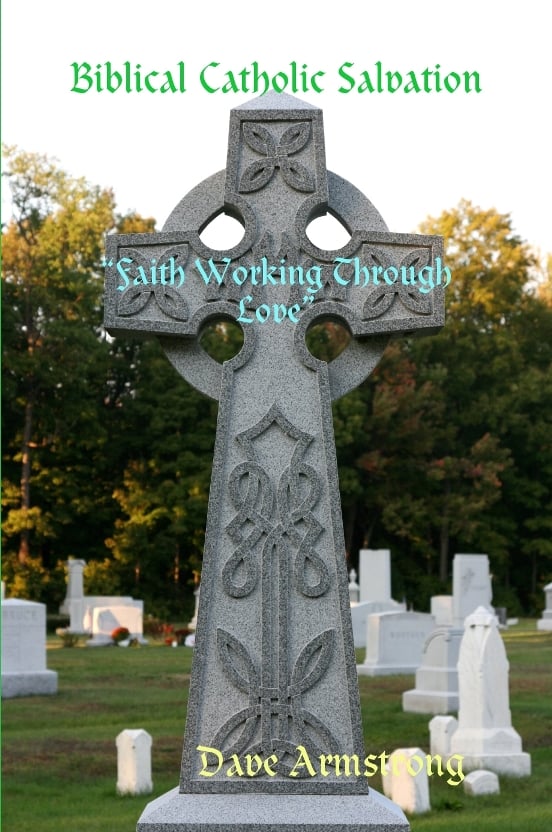
Photo credit: self-designed cover of my book (Lulu, 2010).
Catholics believe in an initial justification that comes entirely by God’s grace (apart from our doing anything, at this stage). It’s given to those (above the age of reason) who accept the free grace of God in their free will (the acceptance itself being caused by God). It regenerates us (particularly, baptism does this, including even for infants), justifies us, and removes the worst effects of original sin. For more on this, see:
Trent Doesn’t Utterly Exclude Imputation (Kenneth Howell) [July 1996]
Council of Trent: Canons on Justification (with a handy summary of Tridentine soteriology) [12-29-03]
Initial Justification & “Faith Alone”: Harmonious? [5-3-04]
Monergism in Initial Justification is Catholic Doctrine [1-7-10]
Catholics & Justification by Faith Alone: Is There a Sense in Which Catholics Can Accept “Faith Alone” and/or Imputed Justification (with Proper Biblical Qualifications)? [9-28-10]
Salvation: By Grace Alone, Not Faith Alone or Works [19 passages] [2013]
Baptismal Regeneration and Justification (vs. Jason Engwer) [6-4-20]
14 Bible Verses That Show We’re Saved Through Baptism [National Catholic Register, 11-30-21]
Biblical Infant Baptism [9-19-25]
Justification by Faith: Ten Bible Proofs [1-15-26]
Catholic and Protestant Views on Justification and Sanctification (Tom Nash, Catholic Answers)
The best description of what we receive in baptism I’ve ever seen was in the Modern Catholic Dictionary (Garden City, New York: Doubleday & Co, Inc., 1980) by Servant of God Fr. John A. Hardon, S. J. (who received me into the Catholic Church in 1991):
The supernatural effects of the sacrament of baptism. They are: 1. removal of all guilt of sin, original and personal; 2. removal of all punishment due to sin, temporal and eternal; 3. infusion of sanctifying grace along with the theological virtues of faith, hope, and charity, and the gifts of the Holy Spirit; 4. incorporation into Christ; and 5. entrance into the Mystical Body, which is the Catholic Church; 6. imprinting of the baptismal character, which enables a person to receive the other sacraments, to participate in the priesthood of Christ through the sacred liturgy, and to grow in the likeness of Christ through personal sanctification. Baptism does not remove two effects of original sin, namely concupiscence and bodily mortality. However, it does enable a Christian to be sanctified by his struggle with concupiscence and gives him the title to rising in a glorified body on the last day. (p. 53)
Catholics believe that Protestant baptisms (trinitarian formula) are valid, and thus that Protestants receive all of the above gifts and are ushered into the kingdom of God and the Church as our Christian brothers and sisters in Christ. Canon IV on baptism from the Council of Trent (Session VII: March 3, 1547) held that Protestant baptism was valid:
If any one says that the baptism which is even given by heretics in the name of the Father, and of the Son, and of the Holy Ghost, with the intention of doing what the Church does, is not true baptism; let him be anathema.
So Protestants are our brethren in Christ on that basis. Vatican II, in its Decree on Ecumenism from 1964, is very clear:
Men who believe in Christ and have been properly baptized are put in some, though imperfect, communion with the Catholic Church. . . . All who have been justified by faith in baptism are incorporated into Christ; they therefore have a right to be called Christians, and with good reason are accepted as brothers by the children of the Catholic Church. . . . [Protestant] liturgical actions most certainly can truly engender a life of grace, and . . . give access to the communion of salvation. (3)
The Council of Florence proclaimed in its Decree for the Armenians (Nov. 22, 1439), that by baptism “we are made members of Christ and belong to his body, the Church”. That’s from Heinrich Denzinger, Enchiridion Symbolorum: A Compendium of Creeds, Definitions and Declarations of the Catholic Church, #1314, p. 339 in the 2012 edition. This is the standard collection of and reference source for Catholic dogmas and doctrines. In the same work is a related statement from the Fourth Lateran Council in 1215 (“Chapter 1. The Catholic Faith”):
The sacrament of baptism (which is celebrated in water at the invocation of God and of the undivided Trinity, that is, the Father, the Son, and the Holy Spirit) conduces to the salvation of children as well as of adults when duly conferred by anyone according to the Church’s form. (#802, p. 267)
In sum, Protestants who analyze Catholic soteriology and our views of Protestantism, often are disagreeing with straw men, rather than our authentic doctrines. They often say that Catholics started regarding Protestants as “separated brethren” only in the 1960s, but as we just demonstrated, the same view was already present in ecumenical councils in 1215 and 1439 and moreover, it goes back at least as far as St. Augustine, who contended that Donatist baptism was valid.
Related to this are issues discussed in this lengthy article of mine: Anathemas of Trent & Excommunication: An Explanation [5-20-03, incorporating portions from 1996 and 1998; abridged on 7-30-18]. It explains, among many other things, that at least some of the anathemas of Trent — some of the ones most objected to by Protestant — no longer apply to Protestants today. This is explained at length in an excellent 1996 article by Catholic apologist Jimmy Akin, cited at length in the above article: “Justification by Faith Alone.” In this article, Akin refers to
a document written a few years ago under the auspices of the (Catholic) German Conference of Bishops and the bishops of the Council of the Evangelical Church in Germany (the Lutheran church). The purpose of the document, titled The Condemnations of the Reformation Era: Do They Still Divide?, was to determine which of the sixteenth-century Catholic and Protestant condemnations are still applicable to the other party. Thus the joint committee which drafted the document went over the condemnations from Trent and assessed which of them no longer applied to Lutherans and the condemnations of the Augsburg Confession and the Smalcald Articles, etc., and assesses which of them are not applicable to Catholics.
When it came to the issue of justification by faith alone, the document concluded:
Today the difference about our interpretation of faith is no longer a reason for mutual condemnation . . . even though in the Reformation period it was seen as a profound antithesis of ultimate and decisive force. By this we mean the confrontation between the formulas ‘by faith alone,’ on the one hand, and ‘faith, hope, and love,’ on the other.
We may follow Cardinal Willebrand and say: ‘In Luther’s sense the word ‘faith’ by no means intends to exclude either works or love or even hope. We may quite justly say that Luther’s concept of faith, if we take it in its fullest sense, surely means nothing other than what we in the Catholic Church term love’ (1970, at the General Assembly of the World Lutheran Federation in Evian).
If we take all this to heart, we may say the following: If we translate from one language to another, then Protestant talk about justification through faith corresponds to Catholic talk about justification through grace; and on the other hand, Protestant doctrine understands substantially under the one word ‘faith’ what Catholic doctrine (following 1 Cor. 13:13) sums up in the triad of ‘faith, hope, and love.’ But in this case the mutual rejections in this question can be viewed as no longer applicable today
According to [Lutheran] Protestant interpretation, the faith that clings unconditionally to God’s promise in Word and Sacrament is sufficient for righteousness before God, so that the renewal of the human being, without which there can be no faith, does not in itself make any contribution to justification. Catholic doctrine knows itself to be at one with the Protestant concern in emphasizing that the renewal of the human being does not ‘contribute’ to justification, and is certainly not a contribution to which he could make any appeal before God. Nevertheless it feels compelled to stress the renewal of the human being through justifying grace, for the sake of acknowledging God’s newly creating power; although this renewal in faith, hope, and love is certainly nothing but a response to God’s unfathomable grace. Only if we observe this distinction can we say
In addition to concluding that canons 9 and 12 of the Decree on Justification did not apply to modern Protestants, the document also concluded that canons 1-13, 16, 24, and 32 do not apply to modern Protestants (or at least modern Lutherans).
During the drafting of this document, the Protestant participants asked what kind of authority it would have in the Catholic Church, and the response given by Cardinal Ratzinger (who was the Catholic corresponding head of the joint commission) [the future Pope Benedict XVI] was that it would have considerable authority. . . .
Before the joint commission met, Cardinal Ratzinger and Lutheran Bishop Eduard Lohse (head of the Lutheran church in Germany) issued a letter expressing the purpose of the document, stating:
Our common witness is counteracted by judgments passed by one church on the other during the sixteenth century, judgments which found their way into the Confession of the Lutheran and Reformed churches and into the doctrinal decisions of the Council of Trent. According to the general conviction, these so-called condemnations no longer apply to our partner today. But this must not remain a merely private persuasion. It must be established in binding form.
I say this as a preface to noting that the commission concluded that canon 9 of Trent’s Decree on Justification is not applicable to modern Protestants (or at least those who say saving faith is Galatians 5 faith). This is important because canon 9 is the one dealing with the “faith alone” formula (and the one R.C. Sproul is continually hopping up and down about). It states:
If anyone says that the sinner is justified by faith alone, so as to understand that nothing else is required to cooperate in the attainment of the grace of justification . . . let him be anathema.
The reason this is not applicable to modern Protestants is that Protestants (at least the good ones) do not hold the view being condemned in this canon.
Jimmy Akin wrote another superb article entitled “Anathema” (This Rock, 4-1-00), which offers basically “everything you ever wanted to know about anathemas and excommunication.” Among many other helpful things, he noted:
Vatican II did not use the term anathema in any of its documents. . . .
The 1917 Code of Canon Law, . . . provided that, “Excommunication . . . is called anathema especially when it is imposed with the solemnities that are described in the Roman Pontifical” (CIC [1917] 2257 §§ 1–2).
Yet the penalty was used so seldom that it was removed from the 1983 Code of Canon Law. This means that today the penalty of anathema does not exist in Church law. . . .
1. An anathema sentenced a person to hell. This is not the case. Sentencing someone to hell is a power that is God’s alone, and the Church cannot exercise it.
2. An anathema was a sure sign that a person would go to hell. Again, not true. Anathemas were only warranted by very grave sins, but there was no reason why the offender could not repent, and those who repent aren’t damned.
3. An anathema was a sure sign that a person was not in a state of grace. This is not true for two reasons: (a) The person may have repented since the time the anathema was issued, and (b) the person may not have been in a state of mortal sin at the time the anathema was issued. . . .
6. Anathemas applied to all Protestants. The absurdity of this charge is obvious from the fact that anathemas did not take effect automatically. The limited number of hours in the day by itself would guarantee that only a handful of Protestants ever could have been anathematized. In practice the penalty tended to be applied only to notorious Catholic offenders who made a pretense of staying within the Catholic community.
7. Anathemas are still in place today. This is the single most common falsehood one encounters regarding anathemas in the writings of anti-Catholics. They aren’t in place today. The penalty was employed so infrequently over the course of history that it is doubtful that anyone under an anathema was alive when the new Code of Canon Law came out in 1983, when even the penalty itself was abolished.
8. The Church cannot retract its anathemas. Anti-Catholics love to repeat this falsehood for rhetorical flourish. But again, it isn’t true. The Church is free to abolish any penalty of ecclesiastical law it wants to, and it did abolish this one. . . .
Unfortunately, there is little likelihood that passionate anti-Catholics such as [Mike] Gendron, [James] White, and numerous others will get the facts straight, openly admit their error, and actively work to counteract the damage they have done by spreading so much misinformation on this subject. But one day it will all get straightened out—by God.
See another related article by Jimmy Akin, “Are YOU ‘Anathema’? How about Your Protestant Friend?” (6-8-11).
Protestants often object to the Catholic teaching of “outside the Catholic Church is no salvation.” Both Luther and Calvin taught the same thing, about the Christian Church as they conceived it:
He who would find Christ must first find the Church. . . . For outside of the Christian church there is no truth, no Christ, no salvation. (Martin Luther, Sermon: The Gospel for the Early Christmas Service, 25 December 1521, in Luther’s Works, vol. 52, pp. 39-40)
There is no other means of entering into life . . . beyond the pale of the Church no forgiveness of sins, no salvation, can be hoped for,) . . . the abandonment of the Church is always fatal. (John Calvin, Institutes of the Christian Religion, 1559, Book IV, 1:4) . . .
For much more on this, see an excellent article by my friend, Rod Bennett, hosted on my blog: Baptismal Ecumenism: A New Evangelistic Paradigm [8-11-17]; also my very in-depth article, Catholicism & Non-Catholic Salvation (Vs. Gavin Ortlund) + How Early Protestants Widely Damned Other Protestants Who Held Different Theological Views [2-9-24]
Referring to the period of time after this initial phase of regeneration and justification, the Bible speaks of being vigilant and standing fast, etc. I’ve collected 75 passages about salvation as a process and 150 about the possibility of apostasy. Protestants believe that good works inevitably flow from a genuine faith. We agree, but we also add that these post-regenerative works are organically connected to grace and faith and hence are said to be part of the overall equation of justification and salvation (and this gets to my articles that collect Bible verses against faith alone). We don’t separate sanctification from justification and regard it as non-salvific. Faith contains good works within itself, by definition. James is the most explicit about this, but there is plenty in Paul, too.
Baptist apologist Norman Geisler has stated that this was the view of the Christian Church from the time of Paul and up until Luther, and Anglican historian of justification Alister McGrath states that it was the view of St. Augustine up till Luther and Calvin. See my article, Sola Fide (Faith Alone) Nonexistent Before the Protestant Revolt in 1517 (Geisler & McGrath) [Catholic365, 10-31-23]
We believe that Christians and disciples of Jesus can fall out of the grace of God and that it can happen through committing objectively mortal [serious, grave] sin and being subjectively aware with full knowledge and full consent of the will. It’s rectified through an examination of conscience, repentance, formal confession, and absolution. Apart from this, we have a moral assurance of salvation, that I argue is as “assured” as any Protestant view. I certainly feel as assured of my ultimate salvation as I ever did as a Protestant.
Grace-enabled, post-regeneration good works are the outward expression of infused justification and God transforming our lives through the Holy Spirit and His grace and power, but of course it’s also an internal thing, of the heart: being more and more holy and righteous. Good works are also meritorious, and are rewarded by God. I have 50 passages about that, too. St. Augustine wrote that merit was “God crowning His own gifts.” Works play a role in salvation, caused by grace and through faith. All three must be together, otherwise, it becomes heretical antinomianism (no works at all are necessary either in the Christian life, or to be saved) or Pelagianism (works can save without God’s grace).
We don’t apply “saved” (let alone “re-saved”) so much to the current life. We stress what Protestants call “eschatological salvation”: being saved in the end, found to be in the elect, and heaven-bound. But we do talk about a “moral assurance of [final] salvation”. Losing that status comes through direct rebellion against God or other mortal sins, serious enough to exclude on from heaven, as the Bible refers to several times (1 Cor 6:9-10; Gal 5:19-21; Eph 5:5; Heb 12:14; Rev 21:27; 22:15).
Ideally, if we follow God wholeheartedly, we will become increasingly sanctified as time goes on, though not perfect. Our belief here is similar to that of John Wesley and the early Methodists and the various “holiness” movements that derived from that. Baptism is the normative way that we receive regeneration and also the Holy Spirit, so we speak of it as being salvific: not unlike the view of Lutherans and traditional Anglicans. We argue that Jesus also spoke of receiving Him in the Holy Eucharist is directly tied to salvation. Two sacraments, in other words.
Here is another brief summary of how Catholics view soteriology (particularly as regards faith and works), from one of my articles, Sanctification and Works Are Tied to Salvation [National Catholic Register, 9-26-24]:
Protestants believe that we are justified in a one-time occurrence and that it is imputed (we are declared righteous by God). They call this “faith alone.”
Catholics agree that initial justification is a purely gratuitous act of God alone — wholly by his grace — without any participation or works on our part; but only faith (over against Pelagianism, or “works salvation”). We disagree about sanctification, manifested by good works. Catholics believe it is a direct contributing cause of salvation, in conjunction with — organically connected to — justification (faith and works).
Jesus taught that “Every tree that does not bear good fruit is cut down and thrown into the fire” (Matthew 7:19. RSV), and when directly asked about how one obtains eternal life, he said, “Keep the commandments” and, “If you would be perfect, go, sell what you possess and give to the poor” (Matthew 19:16-17, 21). Jesus stated that his disciples who had done the good, self-sacrificing works of leaving “houses or brothers or sisters or father or mother or children or lands” for his sake, would “inherit eternal life” as a reward (Matthew 19:29).
Jesus said that those who would receive “eternal life” (Matthew 25:46) would receive it because “I was hungry and you gave me food, I was thirsty and you gave me drink, I was a stranger and you welcomed me” (Matthew 25:35), and then he clarified that if they “did it to one of the least of these my brethren” they “did it” to him (Matthew 25:40).
He also said, “Love your enemies, and do good … and you will be sons of the Most High” (Luke 6:35) and that “those who have done good” will be saved (John 5:29) and “do the works you did at first. If not, I will come to you and remove your lampstand” (Revelation 2:5). Jesus stated that the saved were those who were “sanctified by faith in me” (Acts 26:18).
St. Paul taught the same: “As it is written, ‘He who through faith is righteous shall live.’” (Romans 1:17); “To those who by patience in well-doing seek for … immortality, he will give eternal life … glory and honor and peace for everyone who does good” (Romans 2:7, 10); “the doers of the law … will be justified” (Romans 2:13). The “end” of “sanctification” is “eternal life” (Romans 6:22), and indeed we are “saved, through sanctification” (2 Thessalonians 2:13); we’re “fellow heirs with Christ, provided we suffer with him in order that we may also be glorified with him” (Romans 8:17; cf. 1 Peter 4:13).
He taught that we must do many good things and be fruitful in order to be saved:
Galatians 5:14, 19, 21-23 For the whole law is fulfilled in one word, “You shall love your neighbor as yourself.” … Now the works of the flesh are plain … those who do such things shall not inherit the kingdom of God. But the fruit of the Spirit is love, joy, peace, patience, kindness, goodness, faithfulness, gentleness, self-control; against such there is no law.
2 Thessalonians 1:8, 11 … inflicting vengeance … upon those who do not obey the gospel of our Lord Jesus. … To this end we always pray for you, that our God may make you worthy of his call, and may fulfill every good resolve and work of faith by his power …
1 Timothy 4:12, 15-16 … set the believers an example in speech and conduct, in love, in faith, in purity. … Practice these duties, … Take heed to yourself and to your teaching; hold to that, for by so doing you will save both yourself and your hearers.
Paul frequently makes many similar points in his letters: “Work out your own salvation with fear and trembling; for God is at work in you, both to will and to work for his good pleasure” (Philippians 2:12-13); “work heartily, … knowing that from the Lord you will receive the inheritance as your reward” (Colossians 3:23-24); “woman will be saved through bearing children, if she continues in faith and love and holiness” (1 Timothy 2:15); “aim at righteousness, godliness, faith, love, steadfastness, gentleness. Fight the good fight of the faith; take hold of the eternal life to which you were called” (1 Timothy 6:11-12); “keep the commandment … do good … be rich in good deeds … so that they may take hold of the life which is life indeed” (1 Timothy 6:14, 18-19).
Other biblical writers agree: Peter wrote concerning saved Gentiles, that God “cleansed their hearts by faith” (Acts 15:9). “He became the source of eternal salvation to all who obey him” (Hebrews 5:9); “your work and the love which you showed for his sake … show the same earnestness in realizing the full assurance of hope until the end” (Hebrews 6:10-11); “so that you may do the will of God and receive what is promised” (Hebrews 10:36); “What does it profit, my brethren, if a man says he has faith but has not works? Can his faith save him? … a man is justified by works and not by faith alone” (James 2:14, 24); “And the dead were judged by what was written in the books, by what they had done. … and all were judged by what they had done” (Revelation 20:12-13). God “saves the upright in heart” (Psalm 7:10) and “he who walks righteously” (Isaiah 33:15-16).
All of this contradicts the erroneous Protestant “pillar” of “faith alone,” where works are — although highly urged — optional in the sense that they supposedly have nothing whatsoever to do with salvation.
*****
Further Sources
*
Book
*
Biblical Catholic Salvation: “Faith Working Through Love” (Oct. 2010, 187 pages)
*
Web Pages
*
Salvation, Justification, & “Faith Alone”
*
*
Eucharist, Sacrifice of the Mass, & Liturgical Issues
*
The [Catholic] Church and Ecclesiology
*
Bible, Tradition, Canon, & “Sola Scriptura”
*
Saints, Purgatory, and Penance
*
*
***
*
Practical Matters: I run the most comprehensive “one-stop” Catholic apologetics site: rated #1 for Christian sites by leading AI tool, ChatGPT — endorsed by popular Protestant blogger Adrian Warnock. Perhaps some of my 5,000+ free online articles or fifty-six books have helped you (by God’s grace) to decide to become a Catholic or to return to the Catholic Church, or better understand some doctrines and why Catholics believe them. If you believe my full-time apostolate is worth supporting, please seriously consider a much-needed monthly or one-time financial contribution. “The laborer is worthy of his wages” (1 Tim 5:18, NKJV).
*
PayPal donations are the easiest: just send to my email address: [email protected]. Here’s also a second page to get to PayPal. You’ll see the term “Catholic Used Book Service”, which is my old side-business. To learn about the different methods of contributing (including Zelle and 100% tax-deductible donations if desired), see my page: About Catholic Apologist Dave Armstrong / Donation Information.
*
You can support my work a great deal in non-financial ways, if you prefer; by subscribing to, commenting on, liking, and sharing videos from my two YouTube channels, Catholic Bible Highlights and Lux Veritatis, in partnership with Kenny Burchard (see my own videos), and/or by signing up to receive notice for new articles on this blog. Just type your email address on the sidebar to the right (scroll down quite a bit), where you see, “Sign Me Up!” Thanks a million!
*
***
*
Photo credit: self-designed cover of my book (Lulu, 2010).
*
Summary: Concise summary of Catholic soteriology, with links to many related in-depth articles. I also explain how the anathemas of Trent against Protestants are no longer applicable.
Previous Post
February 24, 2026
Defense of My 50 Bible Passages Against “Faith Alone” (II)
Next Post
February 25, 2026 Mortal Sin & the Classic Protestant Criticism
Recent Comments
"Special pleading, and not a serious response to my arguments . . ."
Is Venerating Men & Angels Worship? ..."
""no man needs to teach us."Didn't you just teach us?"
Is Venerating Men & Angels Worship? ..."
""Catholics say they are the only church that can lead people into heaven."In fact, we ..."
Is Venerating Men & Angels Worship? ..."
"And lastly, I belong to no denomination and am free to serve God as He ..."
Is Venerating Men & Angels Worship? ..."
Browse Our Archives
Select a Category & Last Things About Me Anti-Catholicism Atheism & Agnosticism Baptism and Sacramentalism Bible and Tradition Blessed Virgin Mary Books by Dave Armstrong C. S. Lewis Calvinism & General Protestantism Catholic Apologetics Catholic Apologists Catholic conversion Catholic converts Christmas Church (Ecclesiology) Church History Conversion and Converts Development of Doctrine Eastern Orthodoxy Ecumenism & Christian Unity Eucharist & Liturgy Fathers of the Church French Translations G. K. Chesterton Hell Hell & Satan Hell & Satan & Last Things Heresies & Comparative Religion Holistic Health Inquisition & Crusades & Scandals James White Jews & Judaism & Old Testament John Calvin John Henry Newman Liberal / Modernist Theology Life Issues Literary Resume Lutheranism Mariology Martin Luther Music Orthodoxy Papacy & Infallibility Personal Page Philosophy & Science Political & Ethical & Moral Issues Protestant Persecution & Intolerance Protestantism Purgatory Purgatory & Penance Romantic & Imaginative Theology Saints & Purgatory & Penance Salvation Salvation & Justification Satan & Last Things Sexuality and Gender Issues Spanish Translations Traditionalism vs. Radical Catholic Reactionaries Traducciones al español / tradução para português Trinitarianism & Christology Uncategorized Videos
Select a Month October 2026 September 2026 August 2026 July 2026 June 2026 May 2026 April 2026 March 2026 February 2026 January 2026 December 2025 November 2025 October 2025 September 2025 August 2025 July 2025 June 2025 May 2025 April 2025 March 2025 February 2025 January 2025 December 2024 November 2024 October 2024 September 2024 August 2024 July 2024 June 2024 May 2024 April 2024 March 2024 February 2024 January 2024 December 2023 November 2023 October 2023 September 2023 August 2023 July 2023 June 2023 May 2023 April 2023 March 2023 February 2023 January 2023 December 2022 November 2022 October 2022 September 2022 August 2022 July 2022 June 2022 May 2022 April 2022 March 2022 February 2022 January 2022 December 2021 November 2021 October 2021 September 2021 August 2021 July 2021 June 2021 May 2021 April 2021 March 2021 February 2021 January 2021 December 2020 November 2020 October 2020 September 2020 August 2020 July 2020 June 2020 May 2020 April 2020 March 2020 February 2020 January 2020 December 2019 November 2019 October 2019 September 2019 August 2019 July 2019 June 2019 May 2019 April 2019 March 2019 February 2019 January 2019 December 2018 November 2018 October 2018 September 2018 August 2018 July 2018 June 2018 May 2018 April 2018 March 2018 February 2018 January 2018 December 2017 November 2017 October 2017 September 2017 August 2017 July 2017 June 2017 May 2017 April 2017 March 2017 February 2017 January 2017 December 2016 November 2016 October 2016 September 2016 August 2016 July 2016 June 2016 May 2016 April 2016 March 2016 February 2016 January 2016 December 2015 November 2015 October 2015 September 2015 August 2015 July 2015 June 2015 May 2015 April 2015 March 2015 February 2015 January 2015 December 2014 November 2014 October 2014 September 2014 August 2014 July 2014 June 2014 April 2014 March 2014 February 2014 January 2014 December 2013 November 2013 October 2013 September 2013 August 2013 July 2013 June 2013 April 2013 March 2013 February 2013 January 2013 December 2012 November 2012 October 2012 September 2012 August 2012 July 2012 June 2012 May 2012 April 2012 March 2012 February 2012 January 2012 December 2011 November 2011 October 2011 September 2011 August 2011 July 2011 June 2011 April 2011 March 2011 February 2011 October 2010 September 2010 August 2010 July 2010 April 2010 March 2010 December 2009 October 2009 August 2009 July 2009 June 2009 May 2009 March 2009 February 2009 October 2008 September 2008 April 2008 March 2008 February 2008 January 2008 December 2007 November 2007 October 2007 May 2007 March 2007 February 2007 January 2007 November 2006 October 2006 September 2006 August 2006 July 2006 June 2006 May 2006 April 2006 March 2006 February 2006 October 2005 June 2005 April 2005 February 2005 July 2004 May 2004 April 2004
Follow Us!
TAKE THE
Religious Wisdom Quiz
Proverbs warns against what kind of woman as a symbol of temptation?
Select your answer to see how you score.
Widow Mother-in-law Queen Adulterous woman
Books by This Author Books by Dave Armstrong
Related posts from Biblical Evidence for Catholicism

Bible & Catholicism on Mortal Sin (vs. John...
Biblical Evidence for Catholicism

Dialogue on Eternal Security / Absolute Assurance
Biblical Evidence for Catholicism

"Faith Alone" Dialogue with a Calvinist
Biblical Evidence for Catholicism

Exegesis of 75 NT Faith [Alone?] & Works...
Biblical Evidence for Catholicism
TRENDING AT PATHEOS Catholic

The Sermon on the Mount, Part I: Matthew...
The Sermon on the Mount, Part I (Matthew 4:12-5:12) St. Matthew moves...

What's up from Crossway: Reviewing some of their latest A few weeks...

Janie Learns the Way of the Cross: A...
Teaching children about Jesus' Passion can be challenging. Many parents and educators...

Looking For Good Catholic Writing - October 2026
He alone extends the heavens, and he walks upon the waves of...

In "Irreplaceable," our book on vocation and technology, Trevor Sutton and I...

I was strolling through the top floor of the brand new Parthenon...
view all Catholic blogs
What Are Your Thoughts?leave a comment
Ad-Free & Subscriber Log-In Subscription Support
- About Us
- 2026 Calendar
- Videos
- Podcasts
- Library of World Religions
- Faith In Media Tracker
- Advertise With Us
- Write for Us
- Privacy Policy
- Terms of Service
- Do Not Sell My Data
- Contact Us
- Radiant Digital
- Manage Newsletter Subscriptions
- Unsubscribe From Notifications
- Sitemap
Copyright 2008-2026, Patheos. All rights reserved.
Subscription Support Ad-Free & Subscriber Log-In
Follow Patheos