
BuddhistCatholicContemplativeEvangelicalGeneral ChristianHinduJewishLatter-day SaintMuslimNew VisionsProgressive Christian
Beliefs
- Buddhist
- Catholic
- Contemplative
- Evangelical
- General Christian
- Hindu
- Jewish
- Latter-day Saint
- More Voices
- Muslim
- New Visions
- Pagan
- Progressive Christian
Topics
- Religion News
- Food and Religion
- Sports and Religion
- Religious Art
- Religious Music and Entertainment
- Religious Events
- History and Religion
- Style and Religion
- Politics and Religion
- Women in Religion
- Recreation Outdoors and Religion
- Business Finance and Religion
- Careers Workplace and Religion
- Education and Religion
- Family Parenting and Religion
- Health Fitness and Religion
- Home and Religion
- Relationships and Religion
- Technology and Religion
- Travel and Religion
Columnists
- Buddhist Columnists
- Business Finance and Religion Columnists
- Careers Workplace and Religion Columnists
- Catholic Columnists
- Contemplative Columnists
- Education and Religion Columnists
- Evangelists Columnists
- Family Parenting and Religion Columnists
- General Christian Columnists
- Health Fitness and Religion Columnists
- Hindu Columnists
- History and Religion Columnists
- Home and Religion Columnists
- Jewish Columnists
- More Voices Columnists
- Latter Day Columnists
- Muslim Columnists
- New Visions Columnists
- Nonreligious Columnists
- Pagan Columnists
- Politics and Religion Columnists
- Progressive Columnists
- Recreation Outdoors and Religion Columnists
- Relationships and Religion Columnists
- Religion News Columnists
- Religious Art Columnists
- Religious Events Columnists
- Religious Music and Entertainment Columnists
- Sports and Religion Columnists
- Style and Religion Columnists
- Technology and Religion Columnists
- Travel and Religion Columnists
- Women in Religion Columnists
Resource Library
- 2026 Calendar
- Library of World Religions
- The 100 Most Holy Places on Earth
- Patheos Answers
- Podcasts
- Videos
- Faith Leaders Database
- Anglican Episcopalian
- Bahai
- Baptist
- Buddhism
- Christianity
- Confucianism
- Eastern Orthodoxy
- Hinduism
- Holiness and Pentecostal
- ISKCON
- Islam
- Judaism
- Lutheran
- Methodist
- The Church of Jesus Christ of Latter-day Saints
- New Age
- Paganism
- Presbytarian and Reformed
- Protestantism
- Religion Behind the Scenes
- Roman Catholic
- Scientology
- Shia Islam
- Sikhism
- Sufism
- Sunni Islam
- Taoism
- Zen
- See all religions
Research Tools
 Ad-Free & Subscriber Log-In Subscription Support
Ad-Free & Subscriber Log-In Subscription Support
Follow Patheos 

- Trending:
- Forgiveness
- |
- Marriage
- |
- Consciousness
- |
- Death Penalty
- |
- Election
- |
- Halloween

-
About
-
Catholic Apologetics
-
Church History
-
Great Apologists
-
Christian Worldview
-
Protestantism & Misc.
- Home
- Catholic
- History and Religion
- Gavin Ortlund, Hus’s Burning, & Double Standards
Gavin Ortlund, Hus’s Burning, & Double Standards
Last updated on: June 6, 2026 at 12:05 am by Dave Armstrong
Gavin Ortlund, Hus’s Burning, & Double Standards 2026-06-06T00:05:36-04:00 Dave Armstrong
Patheos Explore the world's faith through different perspectives on religion and spirituality! Patheos has the views of the prevalent religions and spiritualities of the world.
+ several highly uncomfortable points of fact for those who deny that early Protestantism massively executed those it deemed to be heretics: mostly fellow Protestants
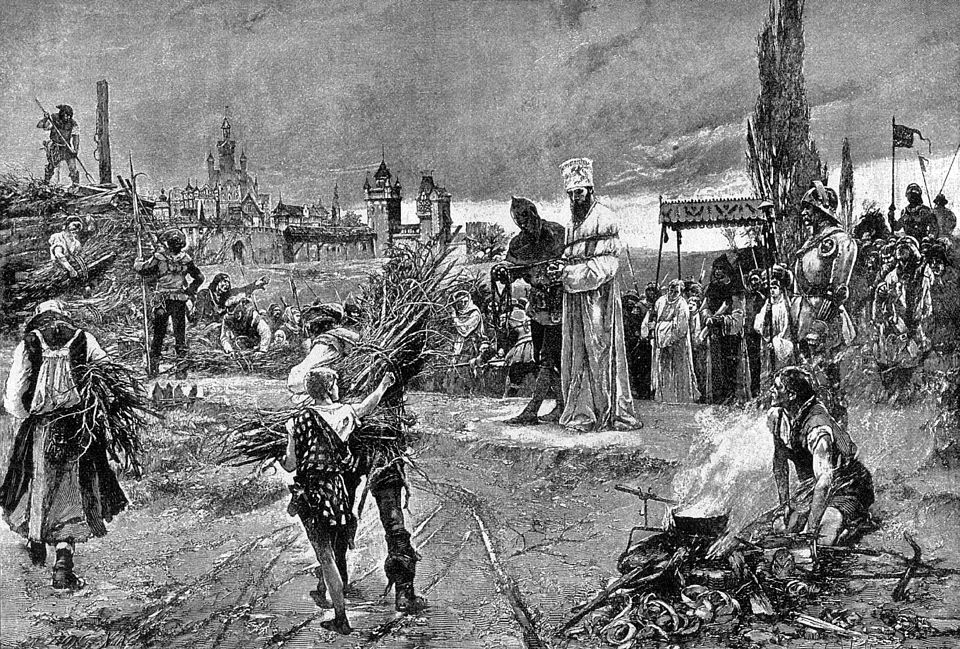
Photo credit: Burning of Jan Hus at the stake at council of Constance, by Carl Gustaf Hellqvist (1851–1890) [public domain / Wikimedia Commons]
In Gavin’s 2024 book, What it Means to be Protestant (I’m currently about a third of the way through it), he expressed dismay that Catholics were doing much better at online apologetics, and that many Protestants were becoming Catholics, leading him to step up his own efforts at apologetics and educating Protestants about their own heritage. I wrote about that yesterday in a Facebook post.
Perhaps largely because of this concern, I think he did something unsavory that was beneath his usually irenic and ecumenical spirit, in writing about the famous burning of Jan Hus in 1415 by the Catholic Church. He clearly wanted to “do it up” all he could for polemical, dramatic, and emotional effect. Certainly he is sharp enough to know how his mostly Protestant readers would react: the anti-Catholics reading would have a field day and the ecumenical Protestants would say, “see how utterly horrible those Catholics are, way way worse than Protestants?!” And so this fits in with the goal of keeping them Protestant.
He devoted 3 1/2 pages (pp. 47-50) to a description of Hus’s death in extreme and excruciating detail, as part of a 7 1/2 page treatment of his persecution. Yet he had the unmitigated gall or chutzpah to proclaim in the middle of it, “we should not exploit the grisly nature of Hus’s death for rhetorical purposes” (pp. 50-51). Now, to his credit, he did make a disclaimer about how “Protestants persecuted others as well” and concluded that “All of this is wrong” (p. 46). He also acknowledges on page 56, “Great sins are committed by true Christians and true churches.” But then he made the following dubious claim:
At the same time, it is also wrong to attempt to equalize the blame on both sides when they are not to scale. There is simply nothing on the Protestant side that compares to the quantity and organization of late medieval Catholic violence. Saying, “Yes, Roman Catholic persecution of dissident groups was bad, but Protestants persecuted others, too!” is like saying, “Yes, Texas may be large, but so is Rhode Island!” (pp. 46-47)
This is objectionable on so many levels. Here are four points I would make in response, that immediately come to mind:
Most of the “quantity” — and also “organization” — of Catholic persecution can be explained simply by the length of time that it went on, in the Middle Ages, when it was universally accepted that persecution of heresy was permissible, on the grounds that heresy was a “murder of the soul” every bit as punishable as the murder of the body (which has a certain inner consistency to it), and during which there were no Protestants at all. The First Crusade (if it is considered part of this, which is debatable) began in 1096, and the Inquisition might be said to have started in 1184 in France, with the persecution of the Cathars and Waldensians. Once Protestantism began, it institutionalized capital punishment for heresy, and persecuted just as much — and for the same reasons — as Catholicism. Very few of them did not; and they persecuted fellow Protestants as much as Catholics; often, even more so. Moreover, when the bulk of the religious persecution died down (arguably after the Peace of Westphalia in 1648), it was across the board. This means that Protestants persecuted for only about 130 years, before the growing consensus against such practices took hold.
Gavin completely ignored the English so-called “Reformation” (at least in what I have read so far, and what remains in the book seems to be devoted to theology, not history). This is absurd, because it’s likely that the entire enterprise of Protestantism wouldn’t have survived without England coming on board. I myself have documented by name 1375 Catholic martyrs of Butcher Henry VIII and “Bloody Queen Bess” between 1534 and all the way up to 1729. Below, I will get into the type of torture and execution involved in many of these.
It remains true to this day that Protestant persecution is rarely talked about — if known at all –by Protestants, and even when it is honestly acknowledged, it’s underplayed, minimized, and not presented in any remote semblance of its massive and widespread nature (precisely as Gavin did in his book, following the playbook to a tee). It’s a huge double standard, so that millions of Protestants believe that their religious heroes never participated in these activities, over against the terrible, wicked Catholics, who did, and which is always talked about, or that it’s an entirely “lopsided” comparison (Gavin’s approach). Then there are pathetic lying books such as Foxe’s Book of Martyrs that play up and distort what Catholics did. See also my article, Were “50-68 Million” People Killed in the Inquisition? [8-21-15].
4) There is also a large element of glaring hypocrisy in the widespread early Protestant persecution (as some secular historians like Will Durant have noted), insofar as Protestants perceived themselves — and continue to do so today — as the champions of religious freedom, primacy of conscience, and the bold innovators of unfettered private judgment, over against Big Bad Oppressive Murderous Rome. For them to nevertheless engage in persecution, given these supposed emphases and commitments — even against each other –, was rank hypocrisy. The subsequent massive lies, ultra-exaggerations, myths, and misrepresentations of anti-Catholic propaganda these past 500 years sought to maintain this false legend of supposedly “freedom-loving” and tolerant early Reformers” by ignoring that entire aspect of Protestant history.
I would love to not have to write about these matters at all. My view is that:
- we need to understand why many Christians of virtually all stripes used to widely believe in execution for heresy,
and
- since all kinds of Christians committed these acts, it’s a “wash” and ought to be put out to pasture as a sort of polemical attempt to “score points” against the other side and to pretend that our own was better.
I’ve also — let it be made clear — always opposed execution for heresy, both as a Protestant and as a Catholic (including the execution of Jan Hus). My view is that of the early Church: people who are wrong about theology ought to be loved and persuaded to adopt true doctrines, and I’ve devoted my life to doing just that. I believe that most theological error ultimately stems from ignorance and lack of education, not deliberate rebellion. I’m also against capital punishment altogether. I used to accept it only in cases of terrorism or serial murderers, etc., but a few years back changed my mind about that, too. I do accept just war and the use of lethal force by police, where warranted.
That said, because of the double standard continues (see #3 not far above), I continue to write (albeit reluctantly) about the topic, so as to “balance the score” and present another side to the usual one-sided propaganda. See my web page, Protestantism: Historic Persecution & Intolerance. Since Gavin — quite disappointingly — wants to join in this pitiful game and tactic, I’ll play along, too, since he insists on doing this. I already replied to Gavin at length regarding Hus’s execution, a year and ten months ago: Reply To Gavin Ortlund: Catholic Inquisitions; Hus [2-7-24], and also in a similar paper, Reply To Gavin Ortlund: Albigensian Crusade [2-6-24].
I’d like to compare burning as a method of torture and execution, to what routinely happened in England, as a result of Butcher Henry VIII proclaiming himself the head of the “church” there. This resulted in Catholic priests performing Masses (or folks who harbored or aided them) being branded as treasonous and thus subject to the punishment for that: hanging drawing, and quartering. How many reading know much about that method of execution, I wonder? Catholics can play the game of presenting gruesome accounts, too. According to a web page called “Capital Punishment UK: History of the Death Penalty in Britain, this is what was involved in this horrific and terrifying punishment (be forewarned; more sensitive, soft-hearted readers may want to skip the next three paragraphs)
That you be drawn on a hurdle to the place of execution where you shall be hanged by the neck and being alive cut down, your privy members shall be cut off and your bowels taken out and burned before you, your head severed from your body and your body divided into four quarters to be disposed of at the King’s pleasure.
The prisoner was often dragged by a horse, sometimes naked, leading to all sorts of abrasions and other injuries before he even got to the torture and execution place; including being pelted by the crowd with many objects, spit on, and who knows what else. The hanging proceeded till just before death, then the prisoner was pulled down or allowed to fall a distance, leading to more injuries and discomfort. Then the real fun began: disemboweling and emasculation (“privy members”): all with hundreds of men, women, and children watching.
The executioners were skilled in prolonging the ordeal and keeping the victim alive for as long as possible to maximize suffering. Some of these executions took over an hour to complete. The disemboweling itself was usually not fatal. Organs were removed and burned, and not infrequently, another nice civilized touch was added: the victim’s heart was cut out while he was still alive. Failing that, he would be subjected to quartering while still alive, too: arms and legs cut off one-by-one, sometimes with rusty blades and/or with multiple strokes. Another method was tying the martyr’s arms and legs to four horses, who then ran in four directions. By this point, beheading was surely welcome. But even then, multiple blows were common (even five or more) when the first did not sever cleanly.
All of this was for simply being a practicing Catholic priest or friend of same, in merrie olde England after 1534: in a country that had previously been maybe 85-90% Catholic. Now (getting back to Hus and others who suffered this fate), I was curious how long it takes to be burned alive, and how much suffering occurs. Certainly it’s a horrifying death, beyond words, but compared to the above, it’s actually quite preferable. One web page I found describes what happens (warning: not for the faint of heart):
The earliest stage of the process of death by burning begins as soon as flames come into contact with the victim’s body. When this happens, the fire quickly starts to burn and destroy the outermost layer of the skin known as the epidermis. Within five minutes, the thicker underlying layer of skin called the dermis will begin to shrink and split open, allowing fat to drain out of the body. At this point, the muscles will also start to contract. This part of the process is excruciatingly painful, but relatively brief. Although a person being burned to death initially feels immense pain as their body begins to burn, the pain eventually subsides once the skin and the nerve endings below are destroyed. Once that occurs, pain is no longer felt.
While a person being burned to death may survive the initial burning of their flesh, many people are already dead at this point. Victims who die before their flesh has been fully consumed often expire because of smoke inhalation, which leads to respiratory system failure and causes the person to suffocate. Death from suffocation may also occur if the lungs fill with fluid during the burning process. Thermal decomposition of vital organs and other parts of the body can lead to death as well. This happens when the heat of the fire causes the organs to shrink and ultimately shut down. Another possible cause of death during the burning process is loss of blood and other fluids. When the body suffers severe burns, an inflammatory response is triggered that leads capillaries to leak. Death will result if too much blood is lost in this manner. Death may also result if the victim’s body temperature rises above 105 degrees Fahrenheit, which causes the body’s enzymes to stop functioning properly and may also lead to organ failure and shock.
Note how in “many” cases, the victim dies within five minutes, from several possible causes, and if they go longer than that, they no longer feel pain. Compare this to the deliberately protracted torture of hanging, drawing, and quartering . . . so if we want to make comparisons, how about this one? Protestants want to bring up Hus? Then I’ll note the above, that happened to many Catholic saints.
Thankfully, Catholic women weren’t subjected to this. But St. Margaret Clitherow, during the reign of Queen Elizabeth I in 1586, was — for the “crime” of harboring Catholic priests and having Masses in her home — laid on a sharp rock, and a door was put on top of her and loaded with 700-800 pounds of rocks and stones, so that the sharp rock would break her back. It took about fifteen minutes for her to die. She was pregnant at the time.
Or we could recall the grisly death of Blessed Margaret Pole, age 67 and frail and ill at the time of her execution in 1541. She was accused in the usual kangaroo courts of those tragic times in England of “having “committed and perpetrated diverse and sundry other detestable and abominable treasons” and was sentenced to death, but was held in the Tower of London for two and a half years, and “tormented by the severity of the weather and insufficient clothing.”
Eustace Chapuys, ambassador to the Holy Roman Emperor, was an eyewitness of her abominable execution. The chief executioner had been sent north to deal with rebels, so the execution was performed by “a wretched and blundering youth who hacked her head and shoulders to pieces in the most pitiful manner”. It took eleven strokes of an axe for the executioner to remove her head. The first blow missed its mark, gashing her shoulder.
Gavin in his book thought it was terrible that Hus had to wait one month to learn when he was to be executed. He wrote:
The worst part of the whole ordeal relates to the simple fact that Hus was not informed when his execution would be. From the conclusion of his trial on June 8 till his execution on July 6, he waited. . . . It’s one thing to steel yourself to prepare for a dreaded day, but imagine waking up every morning knowing that at any moment you might face the flames!(pp. 52-53)
There are a host of examples, showing how Protestants — and the leaders of the Revolt — were just as “bloodthirsty” (if we want to call it that), as Catholics. It makes for scandalous, shocking, and outrageous reading, but again, if Gavin wants to present an emotional and one-sided account of such things, two can play at that game. I provide both sides, so that readers can learn that the whole thing amounts to a “wash” and is useless to talk about and make a bone of contention or accusation, as it were. Wouldn’t it be nice if we just stuck to theology and history of doctrine?
Martin Luther and his successor Philip Melanchthon favored capital punishment for Anabaptists. Gavin appears to think that this was only in cases of extreme “sedition and blasphemy” (p. 46). But this is untrue. Luther’s most famous Protestant biographer, Roland Bainton, in his famous book, Here I Stand (that I read in 1984 as a zealous Protestant), wrote:
In a memorandum of 1536, again composed by Melanchthon and signed by Luther, the distinction between the peaceful and the revolutionary Anabaptists was obliterated. Philip of Hesse had asked several cities and universities for advice as to what he should do with some thirty Anabaptists whom he was holding under arrest. He had steadfastly refused to inflict the death penalty and had resorted to no more than banishment. But this was ineffective because the Anabaptists argued that the earth is the Lord’s and refused to stay away. Of all the replies which Philip received those from the Lutherans were the most severe. Melanchthon this time argued that even the passive action of the Anabaptists in rejecting government, oaths, private property, and marriages outside of the faith was itself disruptive of the civil order and therefore seditious. The Anabaptist protest against the punishment of blasphemy was itself blasphemy. The discontinuance of infant baptism would produce a heathen society and separation from the Church, and the formation of sects was an offense against God.
Luther may not have been too happy about signing these memoranda. At any rate he appended postscripts to each. To the first [in 1531] he said, “I assent. Although it seems cruel to punish them with the sword, it is crueler that they condemn the ministry of the Word and have no well-grounded doctrine and suppress the true and in this way seek to subvert the civil order.” Luther’s addition to the second document was a plea that severity be tempered with mercy. In 1540 he is reported in his Table Talk to have returned to the position of Philip of Hesse that only seditious Anabaptists should be executed; the others should be merely banished. (pp. 376-377; my bolded italics).
This 1536 memorandum included the following language:
The Anabaptists hold tenets relating to infant baptism, original sin, and inspiration which have no connection with the Word of God, and are indeed opposed to it. . . . Concerning such tenets, this is our answer : As the secular authorities are bound to control and punish open blasphemy, so they are also bound to restrain and punish avowedly false doctrine, irregular Church services and heresies in their own dominions; . . .
Also when it is a case of only upholding some spiritual tenet, such as infant baptism, original sin, and unnecessary separation, then, because these articles are also important. . . we conclude that in these cases also the stubborn sectaries must be put to death. (cited in Johannes Janssen, History of the German People from the Close of the Middle Ages, 16 volumes, translated by A.M. Christie, St. Louis: B. Herder, 1910 [orig. 1891]; Vol. X, 222-223; my bolded italics)
Belief in adult, believer’s baptism was sufficient as a cause for execution. Thus, Gavin himself (a Baptist) could have conceivably been executed in Luther’s territories, with his express permission and consent (also in Calvin’s), whereas I, as a Catholic, would only be banished at worst. But I could have been executed when I was between the ages of 24 to 32, because I believed in adult believers’; baptism then, and even got “baptized” in a warm bath.
Luther went far beyond this, too, calling for, in 1522 (when he was supposedly completely “tolerant”), the execution of adulterers and even frigid wives:
The temporal sword and government should therefore still put adulterers to death. . . .
Notice that St. Paul forbids either party to deprive the other, for by the marriage vow each submits his body to the other in conjugal duty. When one resists the other and refuses the conjugal duty she is robbing the other of the body she had bestowed upon him. This is really contrary to marriage, and dissolves the marriage. For this reason the civil government must compel the wife, or put her to death. (The Estate of Marriage, 1522, translated by Walther I. Brandt, from Luther’s Works, Vol. 45, pp. 32, 34)
Nice guy, huh? In 1526, Luther preached that female sorcerers should be put to death (not sure if he thought the same about male sorcerers):
Concerning the female sorcerer. . . . Let them be killed. (Sermon on Exodus 22:18: “You shall not permit a female sorcerer to live,” 1526, WA [Weimar collection of Luther’s writings] XVI, p. 551; in Susan C. Karant-Nunn & Merry E. Wiesner-Hanks [editors and translators], Luther on Women: a Sourcebook, Cambridge University Press, 2003, p. 231)
In 1538, Luther advocated the burning of witches:
On that day (August 20, 1538), [Georg] Spalatin [good friend of Luther’s] related the tale of a witch’s insolence, . . . Luther answered: “One should hasten to put such witches to death. . . . an example should be made of them to terrify others.”
On August 25 (1538), they spoke much of witches who stole eggs from hens and milk and butter. Luther said: “No mercy is to be shown them. I myself would begin to burn them according to the law that the priests should begin to stone culprits.” (Conversations With Luther: Selections from Recently Published Sources of the Table Talk, translated and edited by Preserved Smith and Herbert Percival Gallinger, New York: The Pilgrim Press, 1915, pp. 163-164)
Smith and Gallinger commented in a footnote to this on page 164:
Such sayings as these fanned the flames of the horrible persecution of witches by which hundreds of thousands of harmless persons lost their lives in the sixteenth century. Four witches were executed at Wittenberg in 1540.
In another Table Talk excerpt from the period 1538-1540, drawn from the Weimar edition, deemed to be quite trustworthy by the editors of Luther’s Works (Vol. 54, Introduction), Luther advocated the torturing (and execution?) of witches:
If I were a judge, I would have such a poisonous, syphilitic whore tortured by being broken on the wheel and having her veins lacerated, for it is not to be denied what damage such a filthy whore does to young blood, so that it is unspeakably damaged before it is even fully grown and destroyed in the blood. (Table-Talk, WA, TR, IV, no. 4857, pp. 552-554; cited in Susan C. Karant-Nunn & Merry E. Wiesner-Hanks, ibid., pp. 157-158)
The standard 55-volume Luther’s Works chose to omit this entry, even though it is from impeccable sources, according to its own discussion of Table Talk in the Introduction to Volume 54. One must really “dig” to find Luther statements like these. Protestants don’t make it easy. They don’t want unpleasant facts like these to be known, because they don’t foster the carefully preserved myth.
Another myth is that John Calvin, sadly (as most Protestants freely admit) assented to the death of the heretic Michael Servetus, but that this was an exception to his usual rule (hence, Gavin briefly alludes to “Calvin’s involvement in the death of Michael Servetus” on page 46, and says nothing else about Calvin’s advocacy of the execution of heretics). It’s chilling (and sadly revealing) to read Calvin’s mocking account of how Servetus reacted to the announcement of his impending execution:
At first he was stunned and then sighed so as to be heard throughout the whole room; then he moaned like a madman and had no more composure than a demoniac. At length his cries so increased that he continually beat his breast and bellowed in Spanish, “Mercy! Mercy!” (in Bruce Gordon, Calvin, New Haven: Yale University Press, 2009, p. 223; cited from Roland H. Bainton, Hunted Heretic; the Life and Death of Michael Servetus“, 1511-1553, Boston: Beacon Press, 1960, p. 209)
To be fair, Calvin preferred that Servetus be beheaded. But he wrote in the year after he was executed:
Whoever shall now contend that it is unjust to put heretics and blasphemers to death will knowingly and willingly incur their very guilt. This is not laid down on human authority; it is God who speaks and prescribes a perpetual rule for his Church. . . . Many people have accused me of such ferocious cruelty that I would like to kill again the man that I have destroyed. Not only am I indifferent to their comments, but I rejoice in the fact that they spit in my face. (Defense of Orthodox Faith against the Prodigious Errors of the Spaniard Michael Servetus, written in 1554; in Philip Schaff, History of the Reformation [New York, 1892], vol. 2, p. 791; cited in Stanford Rives, Did Calvin Murder Servetus?, Infinity, 2008, pp. 348-349)
Calvin expressed his view on capital punishment for heresy in 1557:
I am called an incendiary for having taught that heretics are justly punished. Let the letter be read. It brings no other charge against me than that I teach that rulers are armed with the sword not less to punish impiety than other crimes. The only difference between me and Westphal is, that I say there is no room for severity unless the case has been previously discussed. Nay, as it is usual with the Papists in the present day to inflict cruelties on the innocent without any investigation, I justly condemn the barbarity, and recommend that no severe measure be ever adopted until after due cognizance; and I carefully warn them against being too credulous, lest they may defile their hands by indiscriminate slaughter. (From: Last Admonition of John Calvin to Joachim Westphal, Who, if He Heeds it Not, Must Henceforth be Treated in the Way Which Paul Prescribes for Obstinate Heretics (1557); in the source, Tracts Relating to the Reformation, Volume 2; Jean Calvin, Théodore de Bèze, Henry Beveridge (Calvin Translation Society, 1849), pp. 357-358)
Calvin expressly approved of torture as well, writing on 24 July 1555:
I am persuaded that it is not without the special will of God that, apart from any verdict of the judges, the criminals have endured protracted torment at the hands of the executioner.
We shall see in a couple of days, I hope, what the torture will wring from him.
Remember, these are the two big guys for Protestants: the two greatest and most influential leaders, and Luther was the Revolt’s initiator. Luther’s right-hand man Philip Melanchthon thought a denial of the real presence in the Eucharist, among other things, was worthy of death. Secularist historian Preserved Smith wrote about this:
He reckoned the denial of infant baptism, or of original sin, and the opinion that the eucharistic bread did not contain the real body and blood of Christ, as blasphemy properly punishable by death.
Ironically, Melanchthon, not long afterwards, rejected the real presence himself. Needless to say, he wasn’t executed for it. But Gavin Ortlund and Billy Graham could have been, in Melanchthon’s and Luther’s Saxony in the 1530s.
*
Ulrich Zwingli, another famous Protestant leader, wrote in 1528 about Catholic bishops: “if this same charity commands us to kill them for the well-being of the body, it is better to pluck out a blind eye than to run the risk of losing the whole body.”
*
“Reformer” Martin Bucer sanctioned the execution of adulterers. In his Dialogues of 1535, Bucer called on governments to exterminate by fire and sword all professing a false religion, and even their wives, children, and cattle.
*
Calvin’s successor Theodore Beza favored execution of “heretics” and wrote about them: “it would seem impossible to find a torture big enough to fit the enormity of such a misdeed.”
*
Secular historian Will Durant wrote about the Scottish “reformer” John Knox:
Every heretic was to be put to death, and cities predominantly heretical were to be smitten with the sword and utterly destroyed: “To the carnal man this may appear a . . . severe judgment . . . Yet we find no exception, but all are appointed to the cruel death. But in such cases God wills that all . . . desist from reasoning when commandment is given to execute his judgments.”
Queen Elizabeth burned two Dutch Anabaptists in 1575. During her reign (17 November 1558 – 24 March 1603), there were at least 312 executions (most involving horrible prolonged tortures) or confessors’ deaths rotting away or starving to death in prisons for the “treasonous crime” of being Catholic. I have documented them by name. But that’s counting English victims only. There were also about 210 Irish victims, for a grand total of 522 martyrs of the Catholic faith under “Good Queen Bess”. Many of these Catholic martyrs had been racked in the Tower of London (read the details of that horrible torture), and for months or sometimes years deprived of proper clothing, bedding, warmth, and food.
*
But all that Dr. Gavin Ortlund can manage to say on the general topic is, “There is simply nothing on the Protestant side that compares to the quantity and organization of late medieval Catholic violence.” That’s the highly biased and hyper-partisan language of the Protestant contra-Catholic polemicist; not the academic language of objective historical fact. What’s most pathetic is that Gavin’s doctorate from Fuller Theological Seminary, earned in 2016, was in the field of historical theology. He knows better than this. But the temptation to promulgate the Protestant Historical Myth is apparently too great for him to overcome. Once again, the actual truth of the matter is not only “stranger” than the common “fiction”, but also much more complex than the myths and legends that folks create — even if only subconsciously — for their own polemical purposes.
*
ADDENDUM: Beliefs of John Hus
*
Adopting most of Wycliffe’s teachings, Hus challenged Catholic doctrine on papal authority, advocated sola scriptura, and denied Sacred Tradition as an element of the Deposit of Faith. He also condemned the veneration of the saints and the granting of indulgences. Like Wycliffe, he viewed the hierarchy of the Church as ministers of Satan and denied the universal jurisdiction and primacy of the pope. Hus believed that the Church was built on the personal faith of St. Peter and that Jesus did not institute the Petrine Office. (Steve Weidenkopf, “The Protestants Who Came Before the Protestants,” Catholic Answers, 8-26-22)
Remember (to keep things in perspective): over a hundred years later, Luther, Calvin, and Zwingli all thought that Anabaptists could and should be put to death simply for believing in adult, believer’s baptism (just as Gavin Ortlund does). That’s why they often drowned them: as a mockery of adult baptism; just as both sides burned people to make them think of hellfire as they were dying. And there were many other grounds for executing people, according to them. Hus was guilty of many heresies, by the standards of Catholic theology.
*
Hus also agreed or partially agreed with the Catholic Church in several respects. He thought that charity played an instrumental role in justification, contrary to the Protestant “pillar” of faith alone. Timothy George, writing for Christian History Institute, observed:
Unlike many other reformers, Hus retained much of Catholic theology. He did not teach the doctrine of justification by faith alone, a fact Luther noted when he observed that, unlike himself, Hus had attacked only the life, not the doctrine, of late medieval Catholicism. . . .
Luther claimed continuity with Hus in many respects, although there was a theological chasm between the two on the doctrine of justification. (“The Reformation Connection”)
As for the Eucharist, according to an AI overview, he held a view very similar to that of Lutheranism:
Jan Hus held a nuanced view on transubstantiation, accepting the Real Presence (Christ’s body and blood are truly there) but rejecting the strict philosophical definition of transubstantiation as taught by the Church, especially its denial that the bread and wine remained as accidents (properties). He believed the bread and wine became Christ’s Body and Blood truly and substantially, yet argued that the bread and wine substances (underlying reality) still existed . . .
As to purgatory, the AI overview states:
Jan Hus accepted the concept of purgatory as a purification state for the saved but strongly opposed its corruption, especially the sale of indulgences that claimed to shorten time there. He believed living people could help souls in purgatory through prayers and good works, but he rejected the idea that indulgences or money could buy salvation or relief from purgatorial suffering.
Lastly, in his 18 December 1999 at a three-day symposium dedicated to Hus in Rome, Pope St. John Paul II praised Hus’s “moral courage” and expressed “deep regret for the cruel death inflicted.”
*
***
*
Practical Matters: I run the most comprehensive “one-stop” Catholic apologetics site: rated #1 for Christian sites by leading AI tool, ChatGPT — endorsed by popular Protestant blogger Adrian Warnock. Perhaps some of my 5,000+ free online articles or fifty-six books have helped you (by God’s grace) to decide to become a Catholic or to return to the Catholic Church, or better understand some doctrines and why Catholics believe them. If you believe my full-time apostolate is worth supporting, please seriously consider a much-needed monthly or one-time financial contribution. “The laborer is worthy of his wages” (1 Tim 5:18, NKJV).
*
PayPal donations are the easiest: just send to my email address: [email protected]. Here’s also a second page to get to PayPal. You’ll see the term “Catholic Used Book Service”, which is my old side-business. To learn about the different methods of contributing (including Zelle and 100% tax-deductible donations if desired), see my page: About Catholic Apologist Dave Armstrong / Donation Information.
*
You can support my work a great deal in non-financial ways, if you prefer; by subscribing to, commenting on, liking, and sharing videos from my two YouTube channels, Catholic Bible Highlights and Lux Veritatis, in partnership with Kenny Burchard (see my own videos), and/or by signing up to receive notice for new articles on this blog. Just type your email address on the sidebar to the right (scroll down quite a bit), where you see, “Sign Me Up!” Thanks a million!
*
***
*
Photo credit: Burning of Jan Hus at the stake at council of Constance, by Carl Gustaf Hellqvist (1851–1890) [public domain / Wikimedia Commons]

Summary: Protestant apologist Gavin Ortlund, in a book, described Jan Hus’ burning in 1415 in excruciating detail, while minimizing the equally sordid history of Protestant persecution.
Protestant Persecution & Intolerance
Catholic religious persecution
Protestant religious persecution
Previous Post

December 28, 2025
Romans 9: Unanswerable Calvinist Prooftext?
Next Post

December 31, 2025 Bible & Prayers to Mary (vs. Allie Beth Stuckey)
Recent Comments
"Special pleading, and not a serious response to my arguments . . ."
Is Venerating Men & Angels Worship? ..."
""no man needs to teach us."Didn't you just teach us?"
Is Venerating Men & Angels Worship? ..."
""Catholics say they are the only church that can lead people into heaven."In fact, we ..."
Is Venerating Men & Angels Worship? ..."
"And lastly, I belong to no denomination and am free to serve God as He ..."
Is Venerating Men & Angels Worship? ..."
Browse Our Archives
Select a Category & Last Things About Me Anti-Catholicism Atheism & Agnosticism Baptism and Sacramentalism Bible and Tradition Blessed Virgin Mary Books by Dave Armstrong C. S. Lewis Calvinism & General Protestantism Catholic Apologetics Catholic Apologists Catholic conversion Catholic converts Christmas Church (Ecclesiology) Church History Conversion and Converts Development of Doctrine Eastern Orthodoxy Ecumenism & Christian Unity Eucharist & Liturgy Fathers of the Church French Translations G. K. Chesterton Hell Hell & Satan Hell & Satan & Last Things Heresies & Comparative Religion Holistic Health Inquisition & Crusades & Scandals James White Jews & Judaism & Old Testament John Calvin John Henry Newman Liberal / Modernist Theology Life Issues Literary Resume Lutheranism Mariology Martin Luther Music Orthodoxy Papacy & Infallibility Personal Page Philosophy & Science Political & Ethical & Moral Issues Protestant Persecution & Intolerance Protestantism Purgatory Purgatory & Penance Romantic & Imaginative Theology Saints & Purgatory & Penance Salvation Salvation & Justification Satan & Last Things Sexuality and Gender Issues Spanish Translations Traditionalism vs. Radical Catholic Reactionaries Traducciones al español / tradução para português Trinitarianism & Christology Uncategorized Videos
Select a Month October 2026 September 2026 August 2026 July 2026 June 2026 May 2026 April 2026 March 2026 February 2026 January 2026 December 2025 November 2025 October 2025 September 2025 August 2025 July 2025 June 2025 May 2025 April 2025 March 2025 February 2025 January 2025 December 2024 November 2024 October 2024 September 2024 August 2024 July 2024 June 2024 May 2024 April 2024 March 2024 February 2024 January 2024 December 2023 November 2023 October 2023 September 2023 August 2023 July 2023 June 2023 May 2023 April 2023 March 2023 February 2023 January 2023 December 2022 November 2022 October 2022 September 2022 August 2022 July 2022 June 2022 May 2022 April 2022 March 2022 February 2022 January 2022 December 2021 November 2021 October 2021 September 2021 August 2021 July 2021 June 2021 May 2021 April 2021 March 2021 February 2021 January 2021 December 2020 November 2020 October 2020 September 2020 August 2020 July 2020 June 2020 May 2020 April 2020 March 2020 February 2020 January 2020 December 2019 November 2019 October 2019 September 2019 August 2019 July 2019 June 2019 May 2019 April 2019 March 2019 February 2019 January 2019 December 2018 November 2018 October 2018 September 2018 August 2018 July 2018 June 2018 May 2018 April 2018 March 2018 February 2018 January 2018 December 2017 November 2017 October 2017 September 2017 August 2017 July 2017 June 2017 May 2017 April 2017 March 2017 February 2017 January 2017 December 2016 November 2016 October 2016 September 2016 August 2016 July 2016 June 2016 May 2016 April 2016 March 2016 February 2016 January 2016 December 2015 November 2015 October 2015 September 2015 August 2015 July 2015 June 2015 May 2015 April 2015 March 2015 February 2015 January 2015 December 2014 November 2014 October 2014 September 2014 August 2014 July 2014 June 2014 April 2014 March 2014 February 2014 January 2014 December 2013 November 2013 October 2013 September 2013 August 2013 July 2013 June 2013 April 2013 March 2013 February 2013 January 2013 December 2012 November 2012 October 2012 September 2012 August 2012 July 2012 June 2012 May 2012 April 2012 March 2012 February 2012 January 2012 December 2011 November 2011 October 2011 September 2011 August 2011 July 2011 June 2011 April 2011 March 2011 February 2011 October 2010 September 2010 August 2010 July 2010 April 2010 March 2010 December 2009 October 2009 August 2009 July 2009 June 2009 May 2009 March 2009 February 2009 October 2008 September 2008 April 2008 March 2008 February 2008 January 2008 December 2007 November 2007 October 2007 May 2007 March 2007 February 2007 January 2007 November 2006 October 2006 September 2006 August 2006 July 2006 June 2006 May 2006 April 2006 March 2006 February 2006 October 2005 June 2005 April 2005 February 2005 July 2004 May 2004 April 2004
Follow Us!
TAKE THE
Religious Wisdom Quiz
I made a rash vow that cost me my only child after a military victory. Who am I?
Select your answer to see how you score.
Jephthah Samson Gideon Barak
Books by This Author Books by Dave Armstrong
Related posts from Biblical Evidence for Catholicism
Early Protestant Leaders Damning Each Other: 40 Examples
Biblical Evidence for Catholicism

Luther Favored Death for Heresy (Transcript)
Biblical Evidence for Catholicism
Did Catholics Kill 100 Million in the Inquisition?
Biblical Evidence for Catholicism
Calvin's Successor Theodore Beza & Execution of Heretics
Biblical Evidence for Catholicism
TRENDING AT PATHEOS Catholic

The Sermon on the Mount, Part I: Matthew...
The Sermon on the Mount, Part I (Matthew 4:12-5:12) St. Matthew moves...

What's up from Crossway: Reviewing some of their latest A few weeks...

Janie Learns the Way of the Cross: A...
Teaching children about Jesus' Passion can be challenging. Many parents and educators...

Looking For Good Catholic Writing - October 2026
He alone extends the heavens, and he walks upon the waves of...

In "Irreplaceable," our book on vocation and technology, Trevor Sutton and I...

I was strolling through the top floor of the brand new Parthenon...
view all Catholic blogs
What Are Your Thoughts?leave a comment
Ad-Free & Subscriber Log-In Subscription Support
- About Us
- 2026 Calendar
- Videos
- Podcasts
- Library of World Religions
- Faith In Media Tracker
- Advertise With Us
- Write for Us
- Privacy Policy
- Terms of Service
- Do Not Sell My Data
- Contact Us
- Radiant Digital
- Manage Newsletter Subscriptions
- Unsubscribe From Notifications
- Sitemap
Copyright 2008-2026, Patheos. All rights reserved.
Subscription Support Ad-Free & Subscriber Log-In
Follow Patheos