
BuddhistCatholicContemplativeEvangelicalGeneral ChristianHinduJewishLatter-day SaintMuslimNew VisionsProgressive Christian
Beliefs
- Buddhist
- Catholic
- Contemplative
- Evangelical
- General Christian
- Hindu
- Jewish
- Latter-day Saint
- More Voices
- Muslim
- New Visions
- Pagan
- Progressive Christian
Topics
- Religion News
- Food and Religion
- Sports and Religion
- Religious Art
- Religious Music and Entertainment
- Religious Events
- History and Religion
- Style and Religion
- Politics and Religion
- Women in Religion
- Recreation Outdoors and Religion
- Business Finance and Religion
- Careers Workplace and Religion
- Education and Religion
- Family Parenting and Religion
- Health Fitness and Religion
- Home and Religion
- Relationships and Religion
- Technology and Religion
- Travel and Religion
Columnists
- Buddhist Columnists
- Business Finance and Religion Columnists
- Careers Workplace and Religion Columnists
- Catholic Columnists
- Contemplative Columnists
- Education and Religion Columnists
- Evangelists Columnists
- Family Parenting and Religion Columnists
- General Christian Columnists
- Health Fitness and Religion Columnists
- Hindu Columnists
- History and Religion Columnists
- Home and Religion Columnists
- Jewish Columnists
- More Voices Columnists
- Latter Day Columnists
- Muslim Columnists
- New Visions Columnists
- Nonreligious Columnists
- Pagan Columnists
- Politics and Religion Columnists
- Progressive Columnists
- Recreation Outdoors and Religion Columnists
- Relationships and Religion Columnists
- Religion News Columnists
- Religious Art Columnists
- Religious Events Columnists
- Religious Music and Entertainment Columnists
- Sports and Religion Columnists
- Style and Religion Columnists
- Technology and Religion Columnists
- Travel and Religion Columnists
- Women in Religion Columnists
Resource Library
- 2026 Calendar
- Library of World Religions
- The 100 Most Holy Places on Earth
- Patheos Answers
- Podcasts
- Videos
- Faith Leaders Database
- Anglican Episcopalian
- Bahai
- Baptist
- Buddhism
- Christianity
- Confucianism
- Eastern Orthodoxy
- Hinduism
- Holiness and Pentecostal
- ISKCON
- Islam
- Judaism
- Lutheran
- Methodist
- The Church of Jesus Christ of Latter-day Saints
- New Age
- Paganism
- Presbytarian and Reformed
- Protestantism
- Religion Behind the Scenes
- Roman Catholic
- Scientology
- Shia Islam
- Sikhism
- Sufism
- Sunni Islam
- Taoism
- Zen
- See all religions
Research Tools
 Ad-Free & Subscriber Log-In Subscription Support
Ad-Free & Subscriber Log-In Subscription Support
Follow Patheos 

- Trending:
- Forgiveness
- |
- Marriage
- |
- Consciousness
- |
- Death Penalty
- |
- Election
- |
- Halloween

-
About
-
Catholic Apologetics
-
Church History
-
Great Apologists
-
Christian Worldview
-
Protestantism & Misc.
- Home
- Catholic
- History and Religion
- Defense of Sola Scriptura Critique, Part II
Defense of Sola Scriptura Critique, Part II
Last updated on: June 13, 2026 at 1:08 pm by Dave Armstrong
Defense of Sola Scriptura Critique, Part II 2026-06-13T13:08:56-04:00 Dave Armstrong
Patheos Explore the world's faith through different perspectives on religion and spirituality! Patheos has the views of the prevalent religions and spiritualities of the world.
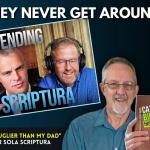
: cover of the new edition of my book, originally published in 2012; now published by Bridge Builders Press.
See Part I for background. Words of the Protestant Reformed critic, “His words are in blockquotes below, time-stamped to the video, so you can find each one.
*****
On Sola Scriptura, Implicit Proofs, and the Real Point of Dispute…
*
Dave, thank you for the substantive engagement. Let me respond carefully, because this exchange actually clarifies where the true fault line lies.
*
I. First Clarification (and Partial Concession). You are correct on one important point: Your position is not that doctrines must be explicitly stated in Scripture in propositional form. Your citations demonstrate—clearly and repeatedly—that you affirm: —implicit doctrines —deductive reasoning —indirect biblical warrant
*
On that point, I withdraw the claim that your argument depends on explicit-only proof. That would indeed be a straw man, and you have shown it is not your view.
*
Thanks very much for the retraction. That’s rare, anymore, and it reflects very well upon you. So I genuinely, happily accept it, but I do wonder why you made the two claims you have now retracted in the first place: on what were they based?: was it simply because many people don’t properly understand the definition and nature of sola Scriptura is, and/or what constitutes biblical support for a position, and you simply assumed that this would also be the case with me? I ask because nothing in the video itself suggested that I held these erroneous views. You clearly had not read much else of my writing on the general topic, either (perhaps nothing at all). As you can see, folks better be very well prepared if they want to wrangle with me.
*
This illustrates why it is so supremely important to document an opponent’s view that one is critiquing, so we don’t get mistakes like this, and straw men. It’s something that all apologists and all who dialogue need to constantly keep in mind. I’ve done it myself sometimes and have retracted it when corrected, just as you did.
*
Can I learn anything about you at all, or will you remain anonymous? If the latter, can you at least tell me if you are a professor or otherwise an expert on the topic, and what credentials and experience you have?
*
So let’s reset the discussion properly.
*
II. The Real Dispute (Now Clearly Identified). The disagreement is not about whether doctrines may be implicit. It is about what counts as a legitimate biblical deduction, and what level of biblical data is required to ground a doctrine of authority. Your claim is: Sola Scriptura is absent altogether from Scripture—explicitly, implicitly, deductively, structurally, or functionally—and is contradicted by contrary biblical data. The Reformed claim is: Sola Scriptura is necessarily entailed by the way Scripture describes itself, functions in redemptive history, and relates to all other authorities.
*
Good! I have concentrated on one element in particular that you mention: “the way Scripture describes itself, . . . and relates to all other authorities.”
*
That is the issue. Everything else is noise.
*
Delighted to “hear” you say that. The question then becomes: why did our three friends skirt around it the whole time in their video? And why haven’t we gotten to that yet? I hold out hope that you will at least make an attempt to present a positive apologetic for sola Scriptura from Scripture alone. You’re one of the very few Protestants who are even willing to discuss it with a catholic at all, and put up any sort of vigorous case. But, based on long experience, I won’t hold my breath, because I like being alive.
*
III. Why Descriptive Categories Are Not “Hand-Waving.”
*
You object that categories like pattern, function, divine logic, etc., are merely “descriptive words” unless concretely demonstrated. That’s fair. So here are clear biblical instantiations, tied directly to Sola Scriptura.
*
IV. Pattern: Scripture as the Supreme Norm that Judges All Else Biblical Pattern: —Prophets repeatedly appeal to prior revelation as the test of later claims (Deut. 13; Isa. 8:20) —Jesus adjudicates disputes with “It is written,” even against recognized authorities (Matt. 22:29) —Apostolic preaching is examined and tested by Scripture (Acts 17:11)
*
All of that can be — and is — true, without entailing the absence or prohibition of other infallible authorities, because infallibility is a lesser thing and much wider category than inspiration. I do this all the time myself, as a Catholic and strong critics of sola Scriptura. One could say that my entire career (24 years, full-time) centers around “biblical evidence for Catholicism” (my blog name). I’m doing it again now: arguing from the Bible, and providing much more of it than my Protestant opponents are bringing to the table. Protestants simply wrongly assume that the opposite is the case (that no non-Bible infallible authority exists), without truly establishing it. They draw the wrong conclusions to bolster up what is, from our perspective, arbitrary and unbiblical traditions of men.
*
Deduction: A pattern emerges in which: —God’s written word norms —God’s spoken or institutional authorities are normed —No text presents a parallel pattern in which an infallible extra-scriptural authority judges Scripture. That asymmetry is decisive.
*
It’s not at all. Again, our claim is not that anything else “judges” Scripture (more straw men being created . . .), but rather, that other things (tradition / Church) are infallible, as Scripture is; just not inspired. The debate is over whether other infallible sources of authority exist and are sanctioned by the Bible. So the debate is not over “judging Scripture” but whether anyone is bound by infallible authorities besides, and in harmony with, Scripture.
*
V. Function: What Scripture Is Said to Do (Uniquely). 2 Timothy 3:16–17 Scripture: — is God-breathed — equips the man of God for every good work This is not merely inspiration language—it is functional sufficiency language. No council, bishop, or tradition is ever said to: — proceed from God’s breath — equip for every good work — function as the final written norm If Scripture performs the full equipping function, then any additional infallible rule is, by definition, unnecessary and redundant.
*
I have replied to this already, citing the counter-example of Ephesians 4 and other arguments showing that this passage does nothing that is claimed for it, regarding sola Scriptura.
*
VI. Divine Logic: Infallibility Cannot Multiply Without Collapse. This is not rhetoric; it is epistemology. If there are: –multiple infallible authorities –that are materially distinguishable –that require interpretation, then one of two things follows: * A higher infallible arbiter must exist (leading to regress), or * Conflicts are resolved fallibly (nullifying infallibility in practice). Rome resolves this by asserting magisterial self-authentication—but Scripture nowhere teaches such a mechanism. Sola Scriptura avoids the regress by grounding infallibility in a fixed, completed, God-breathed deposit.
*
I’m still waiting for the biblical proofs for such a position. We can go round and round the mulberry bush endlessly, but the emperor is still naked . . .
*
VII. Negative Exclusion: What Scripture Never Grants. Your own method accepts negative argumentation (you use it constantly against Protestant doctrines). So note what Scripture never does: — Never attributes God-breathed status to tradition —
*
That’s false: Acts 15:28, where the Holy Spirit ratified the decree of the Jerusalem Council, does that, making that council inspired in its conclusions, as well as infallible (thus destroying sola Scriptura in one fell swoop). Tough to hear and grasp, I’m sure, but I didn’t write the Bible. I simply report what it teaches and defend it.
*
Never calls the Church the source of revelation —
*
We don’t, either, so that’s a red herring.
*
Never teaches an indefectible teaching office with guaranteed infallibility —
*
Sure it does:
*
Indefectibility of the One True Church (vs. Calvin #9) [5-16-09]
*
Indefectibility & Apostolic Succession (vs. Calvin #10) [5-18-09]
*
*
The Bible on the Indefectibility of the Church [2013]
*
Salesian Apologetics #1: Indefectibility of the Church [2-4-20]
*
1 Timothy 3:15 = Church Infallibility (vs. Steve Hays) [5-14-20]
*
Vs. Turretin #9: Church #2 (Indefectibility) [1-9-24]
*
Jesus’ Prayer for Peter (Luke 22) & Indefectibility [8-5-25]
*
Never describes doctrinal development as a mechanism of new dogma
*
Nonsense. See: Doctrinal Development: 80 Bible Passages [12-10-24]
*
These absences matter — especially when contrasted with Scripture’s positive self-claims.
*
Ah, but they are not absent, as shown, except for the “new revelation” schtick, which misrepresents our view, and is a non sequitur.
*
VIII. Redemptive-Historical Structure: Apostles Are Foundational, Not Perpetual. * Ephesians 2:20 The Church is built on the apostles and prophets—not continually ruled by successors of equal authority. * Revelation 21:14 The New Jerusalem has twelve foundation stones, not an ongoing foundation-laying process. Once the apostolic witness is inscripturated, the Church inherits: — the teaching — not the office — not the infallibility This is precisely why Scripture becomes the permanent norm. ‘
*
See my many articles about biblical proof for apostolic succession in section III of my Church web page.
*
IX. Where the Catholic Argument Ultimately Fails.
*
See how it works? You have yet to establish your view from Scripture, but you are already onto the “Catholic argument” (or caricatures of it, that I have been easily knocking down). That’s exactly why we did the video that you critique, that is, to the extent that you are even doing that; it’s more like the usual Protestant “Gish gallop” or what has been called in online terminology, “Brandolini’s Law”: which can be stated as follows: “The amount of energy needed to refute misinformation or disinformation is an order of magnitude bigger than that needed to produce it.”
*
You argue that sola Scriptura is contradicted by “contrary biblical statements.” But the passages typically cited: — affirm apostolic authority — affirm tradition (in the sense of teaching) —affirm the Church’s ministerial role None of them: — assert infallibility beyond the apostolic era — grant Scripture-equal authority to later institutions — establish a living magisterium as a rule of faith In short: they establish authority, not infallible parity.
*
This is untrue, as I demonstrate in many in-depth papers. I still await your positive defense of sola Scriptura from the Bible alone. Will it ever come, or will we keep playing this game of deflection till kingdom come?
*
X. The Core Impasse. We are not talking past each other anymore.
*
Only in relation to the two elements that you retracted; and even one of those you have already brought up again, as if you hadn’t retracted it. In my opinion, you are still avoiding or “talking past” the premise that you need to establish. Since no Protestant I’ve ever found has done that yet, I highly doubt that you will be the first. Your constant avoidance of doing it suggests that you are firing blanks and obfuscating.
*
The issue is this: You require Scripture to positively teach a plural, hierarchical infallibility model. Scripture never does. The Reformed position follows from Scripture’s self-presentation and exclusive attributes. Sola Scriptura is not a verse hunt. It is a doctrine of biblical ontology and epistemology. Closing Statement Dave, you are right about one thing: If Sola Scriptura were merely a Protestant slogan, it would fail. But it is not. It is the unavoidable conclusion drawn from: — what Scripture is — what Scripture does — and what Scripture never grants to anything else That is the argument—now fully on the table.
*
I still await your knockdown argument that overcomes our strong objection. At this point, I’m starting to suspect that you will never produce it or even any possible biblical argument that you mistakenly think does what is required for sola Scriptura to stand as a biblical teaching.
***
On Straw Men, Agreements, and Where the Dispute Actually Lies
*
Dave, this exchange has now clarified something important, and I want to acknowledge it explicitly before moving forward.
*
I. Retraction Where Retraction Is Due You are correct to object to the implication that you ‘personally’ attribute to Protestants the following claims: – that Scripture is the only authority – that tradition has no value – that teachers, councils, or interpretation are unnecessary – that interpretation is effortless or uniform You have consistently denied these caricatures for decades, including in the very citations you provide from your first book and elsewhere. On that point, you are right, and any suggestion otherwise should be withdrawn. So let’s be clear: you and I are now operating with the same definition of sola Scriptura, and we both acknowledge that.
*
Again, I thank you and admire the humility and class required to retract but truly wonder what the basis was, upon which you accused me of these things in the first pace. Was it based on anything besides a false assumption that I might be “like so many others”? If we don’t learn why we made mistakes — what flaws of thinking, logic, and/or botching of facts brought them about — we’ll repeat them. This is not solely a “Protestant problem” of course. It’s a widespread human shortcoming.
*
[I passed over reiterated areas where we agree]
*
V. Why Appealing to “The Video Didn’t Defend It” Is Insufficient
*
You continue to emphasize that the specific video under review failed to give a positive defense of sola Scriptura.
*
Yes, and now I have proven it all the more strongly (below), by debunking your specific examples form the video that you think refute what I am saying. They didn’t: to put it mildly and matter-of-factly. It’s not arguable. You need to give this up.
*
Even if we grant that point for the sake of argument, it does not advance the substantive question: Is sola Scriptura biblically true? A failure of presentation does not establish a failure of doctrine.
*
I never said that it did, so that’s neither here nor there. You want to make this a general discussion about sola Scriptura, that I’m always glad to enter into; but don’t try to pretend that your reply is directly related to what the video from the three men did. At least you have made some sustained, substantive arguments (albeit none, successfully), which they never did on the main topic. They simply mentioned a few Bible passages, much as folks drop names, thinking that is impressive and proves anything.
*
The question before us is not whether Ortlund, Cooper, or Horton argued perfectly, but whether Scripture itself supports the principle they affirm.
*
Yeah; again, that is your question, that you have turned this debate into, for your own purpose. But you posted it underneath this particular video of ours. Presumably, then, it has some relation to the video. Our overwhelming purpose in our reply-video was simply to show that they never proved what they had to prove (just as you haven’t, either, despite enormously more effort and labor), and simply moved into Catholic-bashing. It was a critique of their utterly inadequate method: not of their arguments for sola Scriptura, because they never presented any. No one ever proves what’s needed to be proved in order for sola Scriptura to be a biblically supported principle, and that’s because — I submit — it doesn’t exist. It’s like the core of an onion: which is nothing; it has no core like an apple does.
*
The emperor [sola Scriptura] is naked [devoid of the necessary scriptural proof]. If I have to be unpopular for simply pointing that out, so be it.
*
[the next three sections again reiterate and need not be addressed. I take a dim view of repeating myself unnecessarily. Time is valuable, and there are lots of errors to be confronted. I do, however, want to preserve for the record your statement: “At this point, Dave, the debate is no longer about whether you ‘understand’ sola Scriptura. You plainly do.”]
***
I will reply to everything: at least to what remains on the original topic. I will continue to concentrate on that: did these three men ever prove sola Scriptura from the Bible, or even come close to doing so? That’s what our video was about: a searing and semi-humorous criticism of very common Protestant evasive techniques, that attempt to switch the topic, in the effort to avoid having to prove initial premises and foundations of sand. If you claim that you can establish the actual position of sola Scriptura from the Bible, then make the attempt, but I’m not gonna argue about everything under the sun.
*
You — and all Protestants — need to establish the premise upon which this entire outlook is based. If you don’t / can’t do that, then I won’t be led down a hundred rabbit trails, which amount to the same failed evasive technique in the video. The “technique” never works with me, and it shouldn’t with any Catholic, which is what we’re trying to achieve in our video: to help Catholics know how to counter the “uglier dad” / “woogity boogity Big Bad Catholicism” attempt to deflect the topic away from where it must go: the Bible itself; and to challenge Protestants to ponder why these tactics are so often employed if in fact, sola Scriptura is so profoundly biblical, as is claimed. On this point I am as “socratic” as I am biblical: “laser-focused”!
*
One clarification matters here. You keep saying Ortlund / Cooper / Horton “never defended sola Scriptura, only attacked Catholic doctrines.” But the video doesn’t support that claim. From 1:43–3:52, they explicitly define sola Scriptura positively as:
– an issue of infallible authority
– Scripture as uniquely infallible by nature and character
– sufficient for faith and practice
– with other authorities real but fallible.
That’s a doctrinal definition, not a Catholic critique. They then argue from Scripture’s nature (2 Tim 3:16–17; Jesus’ doctrine of Scripture; 2 Pet 1:20–21) and only afterward test Rome’s alternative authority claims to show the practical consequences.
You may disagree with their conclusions — fair enough — but it’s simply not accurate to say no positive defense was offered. The disagreement is over whether the argument succeeds, not whether it was made.
Let’s take a look at what you reference. First, let’s revisit what I claimed in my original transcript and in our video:
It seems to me the most self-evident thing in the world that if the Bible were in fact the only infallible authority in the Christian faith (that’s what sola Scriptura means), the Bible itself would make this clear beyond all dispute. Yet we find again and again, that when Protestant apologists attempt to defend sola Scriptura: . . . they often wind up presenting either irrelevant Bible passages that prove no such thing.
It does nothing whatever to prove that no infallible authorities exist other than the Bible.
. . . three Protestant professors and Bible experts have given us zero evidence from the Bible that it’s the only infallible authority.
. . . not a word about how Holy Scripture supposedly teaches that it only is infallible and nothing else is.
I made all of this crystal clear and unable to be misunderstood. In other words, to prove sola Scriptura, one must show that the Bible teaches that it — and it ONLY — is the infallible authority in the Christian life. We reply that it never teaches this, and that it DOES present the Church and tradition as also possessing infallible authority: which means that sola Scriptura can’t be maintained if one accepts all of the Bible as inspired revelation. It collapses as an unbiblical, even an anti-biblical falsehood.
But you claim that the three men did do this, at least for a few minutes in a 40-minute video (which itself is clearly silly: it should have been attempted the entire time). Defining a thing is not the same as defending it and showing why it ought to be believed. That’s all they did from from 1:43 to 3:52. Not a single Bible verse is even presented there, so obviously they couldn’t possibly be doing what we claim they never did: prove from the Bible that no infallible authorities exist other than the Bible.
2 Timothy 3:16 is mentioned once at 22:05. But they don’t even get into that: the one passage used ALWAYS to defend sola Scriptura, but which in fact does no such thing. It never asserts that only the Bible is infallible. All it does is say a bunch of things about Scripture that are fully accepted by all observant, serious, informed Christians, and which do not prove sola Scriptura or disprove the Catholic “three-legged stool” rule of faith.
In the same sentence they say that this has to do with “the nature of scripture.” Again, what Scripture is, is a different proposition from saying, “Scripture forbids any infallible authority or formal rule of faith besides itself.” It’s not within a million miles of proving sola Scriptura from Scripture. Yet it’s casually assumed to be compelling in and of itself, which is the amazing thing. It’s sort of a mass delusion or declaration that logic and the meanings of words aren’t what they are.
At 22:12 they say, “second Peter 1:20 and 21 is an important one.” That’s it! They don’t go any further. All Peter says is that “no prophecy of scripture is a matter of one’s own interpretation.” How that supposedly proves sola Scriptura, or addresses it at all, is, I confess, utterly beyond my powers of comprehension. It’s as if we live in different universes.
Here’s what they say about Jesus:
15:46 I think one of the strongest is to go to Jesus himself and his ways of uh describing the Old Testament
17:59 Jesus, you know, says thy word is truth, right?
22:18 Jesus’s language for scripture is important one
39:26 if Jesus himself works on that principle with the Old Testament, it seems perfectly sensible to say that we could do the same thing with the New Testament. Yeah, the way Jesus’s attitude toward the Old Testament is a great starting point for for us on this question if we want to keep working on this. So uh I wish we could keep talking about this.
They never actually explain what the argument is there (three professors!). They just throw it out. It’s lousy teaching. It has little content, and what little may be there underneath is not explained to the poor, pitiable viewers, so they can learn anything. Contrast that with my reply to you about Jesus’ view of the Bible and tradition. I gave many concrete examples from the Bible and also a lot of indications that He was expressly citing Jewish oral tradition from (ultimately) the oral Torah. I gave substance and biblical examples. The three men do almost none of that.
In any event, what they did present about Jesus’ views does NOT prove that only the Bible is an infallible and binding authority. So our point stands, completely unaffected, let alone refuted, by these flimsy little arguments presented by them, and regurgitated by you. They offered viewers nothing but the usual Protestant platitudes and slogans, in-between the 90% of the video that was taken up with Catholic bashing, and mostly — as always — bashing caricatures of Catholicism, not the real thing, like, e.g., Dr. Horton’s ludicrous claim that popes presume to be offering new “revelations”: that even Gavin Ortlund had to jump in and clarify: that it was an inaccurate understanding of Catholicism.
You gave it the old college try but it’s an impossible hill to climb. You’re just making it look all the more ridiculous, the more closely we examine what they did here; especially given the stated purpose of the video, as given by Gavin at 1:26: “The focus here is on scripture and the Protestant emphasis upon scripture, specifically the doctrine of sola Scriptura.” It’s embarrassing and laughable, and Catholics are sick and tired of this tactic being used over and over. It’s an insult to everyone’s intelligence, and it must be exposed and refuted for what it is, which is exactly why I chose this video to critique.
Lastly, why is it that you are here defending their video? Why aren’t they willing to do so themselves? You see the effort I am putting into defending our video and replying to your critiques (I’m sitting here the day after Christmas, doing this, with a terrible cold, too). But of course this is nothing new. Gavin has replied (semi-completely) ONE time in 3 1/2 years, to 36 of my written and video critiques of his work. Jordan has NEVER replied to any of my 22 lengthy, substantive rebuttals of his work over the same time-period. So I have no expectations at all that they are willing to defend their work (at least against me), but of course I keep replying for the sake of my readers and our viewers at the YouTube channel with Kenny Burchard. I want them to know why efforts such as these are spectacular failures and exponentially less biblical than the replies we are providing.
***
Dave — you’re trying to turn this into “find a verse that says ‘only’ or SS fails.”
But you yourself accept implicit/deductive doctrine.
We’ve already been through that and you conceded the point. So why do you bring up the same tired objection again?
So the real question is whether Scripture’s unique God-breathed, fixed, normative role entails that no post-apostolic authority shares Scripture’s infallible status.
Acts 15:28 doesn’t refute SS. SS never denies Spirit-guided, even infallible apostolic decisions/prophecy in the apostolic era. It denies a continuing magisterial infallibility after the apostolic foundation. Acts 15 contains apostles/prophets (Acts 15:2,6; 15:32).
You still have to prove institutional perpetuity.
See my article from two weeks ago: “Jerusalem Council & Ecclesial Infallibility: 50 Proofs”.
Eph 4 vs 2 Tim 3 is a category error. Eph 4 teaches Christ gives teachers as means of ministry; it never grants them God-breathed/infallible status or a conscience-binding rule independent of Scripture.
2 Tim 3 speaks to Scripture’s nature and norming function. Matt 23 (Moses’ seat) establishes a teaching office, not an infallible one; Jesus repeatedly judges them by Scripture (“Have you not read…?”) and condemns their leadership in the same chapter. Bereans: the point isn’t “they had no rabbi,” but that they’re praised for testing even apostolic preaching by Scripture (Acts 17:11). That supports Scripture as court of appeal. If your thesis is that a perpetual infallible magisterium exists, you need a text that gives the post-apostolic Church what Scripture gives Scripture: God-breathed, indefectible, conscience-binding infallibility.
You’re already trying to deflect to our arguments before having established your own premise. So — apart from my two short replies above — I ain’t taking this bait. I’ve already written at great length about all these topics anyway. See my Bible & Tradition web page and four books on sola Scriptura.
*
***
*
Practical Matters: I run the most comprehensive “one-stop” Catholic apologetics site: rated #1 for Christian sites by leading AI tool, ChatGPT — endorsed by popular Protestant blogger Adrian Warnock. Perhaps some of my 5,000+ free online articles or fifty-six books have helped you (by God’s grace) to decide to become a Catholic or to return to the Catholic Church, or better understand some doctrines and why Catholics believe them. If you believe my full-time apostolate is worth supporting, please seriously consider a much-needed monthly or one-time financial contribution. “The laborer is worthy of his wages” (1 Tim 5:18, NKJV).
*
PayPal donations are the easiest: just send to my email address: [email protected]. Here’s also a second page to get to PayPal. You’ll see the term “Catholic Used Book Service”, which is my old side-business. To learn about the different methods of contributing (including Zelle and 100% tax-deductible donations if desired), see my page: About Catholic Apologist Dave Armstrong / Donation Information.
*
You can support my work a great deal in non-financial ways, if you prefer; by subscribing to, commenting on, liking, and sharing videos from my two YouTube channels, Catholic Bible Highlights and Lux Veritatis, in partnership with Kenny Burchard (see my own videos), and/or by signing up to receive notice for new articles on this blog. Just type your email address on the sidebar to the right (scroll down quite a bit), where you see, “Sign Me Up!” Thanks a million!
*
***
*
Photo credit: cover of the new edition of my book [purchase link], originally published in 2012; now published by Bridge Builders Press.
Summary: I respond to a lengthy critique of our video from a Reformed Protestant. To his credit, he later retracted two major points of his critique, and I’ve responded accordingly in Part II.
Previous Post
December 26, 2025
Defense of Sola Scriptura Critique (vs. Reformed Critic)
Next Post

December 28, 2025 Romans 9: Unanswerable Calvinist Prooftext?
Recent Comments
"Special pleading, and not a serious response to my arguments . . ."
Is Venerating Men & Angels Worship? ..."
""no man needs to teach us."Didn't you just teach us?"
Is Venerating Men & Angels Worship? ..."
""Catholics say they are the only church that can lead people into heaven."In fact, we ..."
Is Venerating Men & Angels Worship? ..."
"And lastly, I belong to no denomination and am free to serve God as He ..."
Is Venerating Men & Angels Worship? ..."
Browse Our Archives
Select a Category & Last Things About Me Anti-Catholicism Atheism & Agnosticism Baptism and Sacramentalism Bible and Tradition Blessed Virgin Mary Books by Dave Armstrong C. S. Lewis Calvinism & General Protestantism Catholic Apologetics Catholic Apologists Catholic conversion Catholic converts Christmas Church (Ecclesiology) Church History Conversion and Converts Development of Doctrine Eastern Orthodoxy Ecumenism & Christian Unity Eucharist & Liturgy Fathers of the Church French Translations G. K. Chesterton Hell Hell & Satan Hell & Satan & Last Things Heresies & Comparative Religion Holistic Health Inquisition & Crusades & Scandals James White Jews & Judaism & Old Testament John Calvin John Henry Newman Liberal / Modernist Theology Life Issues Literary Resume Lutheranism Mariology Martin Luther Music Orthodoxy Papacy & Infallibility Personal Page Philosophy & Science Political & Ethical & Moral Issues Protestant Persecution & Intolerance Protestantism Purgatory Purgatory & Penance Romantic & Imaginative Theology Saints & Purgatory & Penance Salvation Salvation & Justification Satan & Last Things Sexuality and Gender Issues Spanish Translations Traditionalism vs. Radical Catholic Reactionaries Traducciones al español / tradução para português Trinitarianism & Christology Uncategorized Videos
Select a Month October 2026 September 2026 August 2026 July 2026 June 2026 May 2026 April 2026 March 2026 February 2026 January 2026 December 2025 November 2025 October 2025 September 2025 August 2025 July 2025 June 2025 May 2025 April 2025 March 2025 February 2025 January 2025 December 2024 November 2024 October 2024 September 2024 August 2024 July 2024 June 2024 May 2024 April 2024 March 2024 February 2024 January 2024 December 2023 November 2023 October 2023 September 2023 August 2023 July 2023 June 2023 May 2023 April 2023 March 2023 February 2023 January 2023 December 2022 November 2022 October 2022 September 2022 August 2022 July 2022 June 2022 May 2022 April 2022 March 2022 February 2022 January 2022 December 2021 November 2021 October 2021 September 2021 August 2021 July 2021 June 2021 May 2021 April 2021 March 2021 February 2021 January 2021 December 2020 November 2020 October 2020 September 2020 August 2020 July 2020 June 2020 May 2020 April 2020 March 2020 February 2020 January 2020 December 2019 November 2019 October 2019 September 2019 August 2019 July 2019 June 2019 May 2019 April 2019 March 2019 February 2019 January 2019 December 2018 November 2018 October 2018 September 2018 August 2018 July 2018 June 2018 May 2018 April 2018 March 2018 February 2018 January 2018 December 2017 November 2017 October 2017 September 2017 August 2017 July 2017 June 2017 May 2017 April 2017 March 2017 February 2017 January 2017 December 2016 November 2016 October 2016 September 2016 August 2016 July 2016 June 2016 May 2016 April 2016 March 2016 February 2016 January 2016 December 2015 November 2015 October 2015 September 2015 August 2015 July 2015 June 2015 May 2015 April 2015 March 2015 February 2015 January 2015 December 2014 November 2014 October 2014 September 2014 August 2014 July 2014 June 2014 April 2014 March 2014 February 2014 January 2014 December 2013 November 2013 October 2013 September 2013 August 2013 July 2013 June 2013 April 2013 March 2013 February 2013 January 2013 December 2012 November 2012 October 2012 September 2012 August 2012 July 2012 June 2012 May 2012 April 2012 March 2012 February 2012 January 2012 December 2011 November 2011 October 2011 September 2011 August 2011 July 2011 June 2011 April 2011 March 2011 February 2011 October 2010 September 2010 August 2010 July 2010 April 2010 March 2010 December 2009 October 2009 August 2009 July 2009 June 2009 May 2009 March 2009 February 2009 October 2008 September 2008 April 2008 March 2008 February 2008 January 2008 December 2007 November 2007 October 2007 May 2007 March 2007 February 2007 January 2007 November 2006 October 2006 September 2006 August 2006 July 2006 June 2006 May 2006 April 2006 March 2006 February 2006 October 2005 June 2005 April 2005 February 2005 July 2004 May 2004 April 2004
Follow Us!
TAKE THE
Religious Wisdom Quiz
What did Israel ask Samuel for despite his warnings?
Select your answer to see how you score.
A king A new Tabernacle A palace A prophet
Books by This Author Books by Dave Armstrong
Related posts from Biblical Evidence for Catholicism

A Few "Worst" & "Best" Arguments vs. Protestantism
Biblical Evidence for Catholicism

Jerusalem Council vs. James White & Sola Scriptura
Biblical Evidence for Catholicism

Biblical Perspicuity: Absurd Anti-Catholic "Defense"
Biblical Evidence for Catholicism

50 Biblical Disproofs of "Evident Clearness" of the...
Biblical Evidence for Catholicism
TRENDING AT PATHEOS Catholic

Pope Leo Celebrates Mass for Nurses & Docs...
I don't have any idea how he did it, but Pope Leo...

The Sermon on the Mount, Part I: Matthew...
The Sermon on the Mount, Part I (Matthew 4:12-5:12) St. Matthew moves...

What's up from Crossway: Reviewing some of their latest A few weeks...

Janie Learns the Way of the Cross: A...
Teaching children about Jesus' Passion can be challenging. Many parents and educators...

Looking For Good Catholic Writing - October 2026
He alone extends the heavens, and he walks upon the waves of...

In "Irreplaceable," our book on vocation and technology, Trevor Sutton and I...
view all Catholic blogs
What Are Your Thoughts?leave a comment
Ad-Free & Subscriber Log-In Subscription Support
- About Us
- 2026 Calendar
- Videos
- Podcasts
- Library of World Religions
- Faith In Media Tracker
- Advertise With Us
- Write for Us
- Privacy Policy
- Terms of Service
- Do Not Sell My Data
- Contact Us
- Radiant Digital
- Manage Newsletter Subscriptions
- Unsubscribe From Notifications
- Sitemap
Copyright 2008-2026, Patheos. All rights reserved.
Subscription Support Ad-Free & Subscriber Log-In
Follow Patheos