
BuddhistCatholicContemplativeEvangelicalGeneral ChristianHinduJewishLatter-day SaintMuslimNew VisionsProgressive Christian
Beliefs
- Buddhist
- Catholic
- Contemplative
- Evangelical
- General Christian
- Hindu
- Jewish
- Latter-day Saint
- More Voices
- Muslim
- New Visions
- Pagan
- Progressive Christian
Topics
- Religion News
- Food and Religion
- Sports and Religion
- Religious Art
- Religious Music and Entertainment
- Religious Events
- History and Religion
- Style and Religion
- Politics and Religion
- Women in Religion
- Recreation Outdoors and Religion
- Business Finance and Religion
- Careers Workplace and Religion
- Education and Religion
- Family Parenting and Religion
- Health Fitness and Religion
- Home and Religion
- Relationships and Religion
- Technology and Religion
- Travel and Religion
Columnists
- Buddhist Columnists
- Business Finance and Religion Columnists
- Careers Workplace and Religion Columnists
- Catholic Columnists
- Contemplative Columnists
- Education and Religion Columnists
- Evangelists Columnists
- Family Parenting and Religion Columnists
- General Christian Columnists
- Health Fitness and Religion Columnists
- Hindu Columnists
- History and Religion Columnists
- Home and Religion Columnists
- Jewish Columnists
- More Voices Columnists
- Latter Day Columnists
- Muslim Columnists
- New Visions Columnists
- Nonreligious Columnists
- Pagan Columnists
- Politics and Religion Columnists
- Progressive Columnists
- Recreation Outdoors and Religion Columnists
- Relationships and Religion Columnists
- Religion News Columnists
- Religious Art Columnists
- Religious Events Columnists
- Religious Music and Entertainment Columnists
- Sports and Religion Columnists
- Style and Religion Columnists
- Technology and Religion Columnists
- Travel and Religion Columnists
- Women in Religion Columnists
Resource Library
- 2026 Calendar
- Library of World Religions
- The 100 Most Holy Places on Earth
- Patheos Answers
- Podcasts
- Videos
- Faith Leaders Database
- Anglican Episcopalian
- Bahai
- Baptist
- Buddhism
- Christianity
- Confucianism
- Eastern Orthodoxy
- Hinduism
- Holiness and Pentecostal
- ISKCON
- Islam
- Judaism
- Lutheran
- Methodist
- The Church of Jesus Christ of Latter-day Saints
- New Age
- Paganism
- Presbytarian and Reformed
- Protestantism
- Religion Behind the Scenes
- Roman Catholic
- Scientology
- Shia Islam
- Sikhism
- Sufism
- Sunni Islam
- Taoism
- Zen
- See all religions
Research Tools
 Ad-Free & Subscriber Log-In Subscription Support
Ad-Free & Subscriber Log-In Subscription Support
Follow Patheos 

- Trending:
- Forgiveness
- |
- Marriage
- |
- Consciousness
- |
- Death Penalty
- |
- Election
- |
- Halloween

-
About
-
Catholic Apologetics
-
Church History
-
Great Apologists
-
Christian Worldview
-
Protestantism & Misc.
- Home
- Catholic
- History and Religion
- Mater Populi Fidelis: Themes & Highlights
Mater Populi Fidelis: Themes & Highlights
Last updated on: November 7, 2025 at 11:31 am by Dave Armstrong
Mater Populi Fidelis: Themes & Highlights 2025-11-07T11:31:06-04:00 Dave Armstrong
Patheos Explore the world's faith through different perspectives on religion and spirituality! Patheos has the views of the prevalent religions and spiritualities of the world.
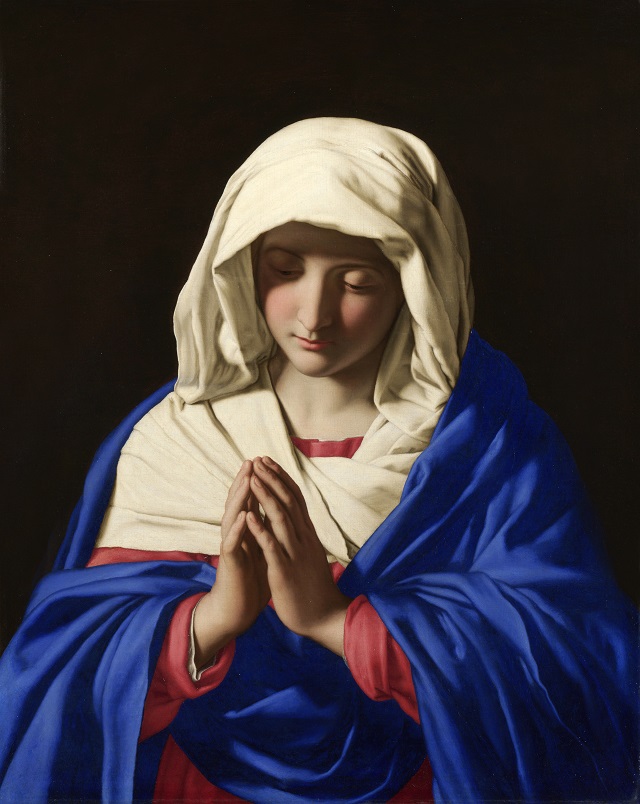
Photo credit: The Virgin in Prayer (bet. 1640-1650), by Giovanni Battista Salvi da Sassoferrato (1609–1685) [public domain / Wikipedia]
The document, Mater Populi Fidelis: Doctrinal Note on Some Marian Titles Regarding Mary’s Cooperation in the Work of Salvation, was released on 4 November 2025, by the Dicastery for the Doctrine of the Faith (Víctor Manuel Card. Fernández, Prefect); “approved” by Pope Leo XIV, who “ordered its publication.”
Needless to say (for anyone who has followed my work at all, or my extensive writings on the Blessed Virgin Mary and my orthodox obedience to Holy Mother Church), I enthusiastically endorse it, as a wonderful and eloquent manifestation of the development of Catholic Mariology, and indeed, I’ve been broadly teaching the same general notions all these years, though not, of course, in remotely the depth and richness seen in Mater Populi Fidelis.
I’m simply noting that what I have taught as a full-time professional lay Catholic apologist is not, as far as I can tell, in any conflict with what is in this document, and is quite harmonious with it. In any specific cases or sentences where — upon reflection or criticism –, it is seen to not be, I will wholeheartedly submit to the magisterium, as I always do, and make the necessary corrections and modifications.
I’ve addressed and endorsed the doctrine and concept of Mary’s unique intercession and secondary mediation (in a way, I believe, essentially consistent with this document), and wrote about it as far back as 1998 on my website. On my web page devoted to the Blessed Virgin Mary, one can see how much I have written, in sections XII: “Intercessor and Spiritual Mother” and XIII, “Mary’s Mediation”.
I would note also that, while I defended the general doctrine, I have always personally opposed the highest-level dogmatic declaration of Mary Mediatrix, and/or Co-Redemptrix (I’m what’s known as an “inopportunist” in this regard). I’ve also always made it very clear that I have thought that the use of Co-Redemptrix as a description of Mary was not particularly helpful, due to its being massively misunderstood (precisely as this document points out, as its basis for discouraging it). At the same time, I noted that Pope St. John Paul II had used it at least five times, as have other saints and respected Catholics, and I sought to explain its use in a sense that is consistent with Church teaching. As far as I can recall, I have never used it, myself. I only sought to explain it and why it was used.
My own views now being clear, I’d like to highlight what I believe to be many of the key insights in this document, in an effort to help readers better understand and accept them by means of the use of five categories below. I hope to make it easier for those who defend Catholic Mariology, to better utilize this wonderful document in explaining Catholic Mariology (particularly Mary’s intercession, motherhood, and mediation) to our Protestant brethren, but also, to aid fellow Catholics in better understanding it as well. For the reader’s convenience, when citations were made with footnotes, I will include the footnote in brackets (and in blue font) right after the citation.
Lastly, I would happily point out to our esteemed Protestant brothers and sisters that what might be called the “relentless Christocentrism” and overwhelming emphasis of this document — even while primarily addressing Mariology — (see Part I below) is indicated by the number of times the word Christ appears (200), and Jesus (44), Lord (39), and God (143): for a total of 426 times; far more than even Mary (235), Mother of God (13), and virgin (37): for a total of 285 times.
*****
I. Constant Christocentric Emphasis
II. Mary’s Proper Role in the Distribution of Grace that Always Originates with God
III. Mary’s Unique and Powerful Intercession to God as Our Spiritual Mother
IV. De-Emphasis of Certain Marian Terms That Have Been or Could be Misunderstood
V. Positive Encouragement of Certain Particular Descriptions of Mary’s Work and Role
*****
I. Constant Christocentric Emphasis
While clarifying in what sense certain titles and expressions referring to Mary are acceptable or not, this text also aims to deepen the proper foundations of Marian devotion by specifying Mary’s place in her relationship with believers in light of the Mystery of Christ as the sole Mediator and Redeemer. [Presentation]
Mary is not the object of a devotion that is placed next to Christ, but she is inserted into the mystery of Christ through the Incarnation. [Cf. Benedict XVI*, General Audience* (27 May 2009): L’Osservatore Romano, 28 May 2009, 1; Gregory of Narek, Prex 26 and 80: Ad Deiparam; SC 78, 160-164, 428-432.] She is the icon in which Christ is venerated. She is the Theotokos, the Virgin Mother who presents her Son, Jesus Christ, to us. At the same time, she is also the Odēgētria who points with her hand to show us the only Way, which is Christ. [11]
The dogma of the Immaculate Conception highlights the primacy and unicity of Christ in the work of Redemption, for it teaches that Mary — the first to be redeemed — was herself redeemed by Christ and transformed by the Spirit, prior to any possible action of her own. [Cf. Pius IX, Apostolic Constitution Ineffabilis Deus (8 December 1854): Pontificis Maximi Acta. Pars prima, Rome 1854, 616 (DH 2803): “[T]he Most Blessed Virgin Mary, at the first instant of her conception, by the singular grace and privilege of Almighty God and in view of the merits of Jesus Christ, the Savior of the human race, was preserved immune from all stain of Original Sin”; Second Vatican Ecumenical Council, Dogmatic Constitution Lumen Gentium, 53: AAS 57 (1965), 58: “Redeemed, in a more exalted fashion, by reason of the merits of her Son.”] [14]
Mary’s cooperation in the work of salvation has a Trinitarian structure, since it is the fruit of the Father’s initiative, who “looked upon the lowliness of his servant” (Lk 1:48); it springs from the kenōsis of the Son, who humbled himself by taking the form of a servant (cf. Phil 2:7-8); and it is the effect of the grace of the Holy Spirit (cf. Lk 1:28, 30), who prepared the heart of the young woman of Nazareth to respond at the Annunciation and throughout her life of communion with her Son. Saint Paul VI taught that “in the Virgin Mary, everything is in reference to Christ and dependent upon him. It was with a view to Christ that God the Father, from all eternity, chose her to be the all-holy Mother and adorned her with gifts of the Spirit granted to no one else.” [Paul VI, Apostolic Exhortation Marialis Cultus (2 February 1974), 25: AAS 66 (1974), 135.] [15]
The then Cardinal Ratzinger referred to the Letters to the Ephesians and to the Colossians, where the vocabulary and the theological dynamism of the hymns present the unique redemptive centrality of the incarnate Son in such a way as to leave no room to add any other form of mediation — for, “every spiritual blessing” is bestowed upon us “in Christ” (Eph 1:3); we are adopted as sons and daughters through him (cf. Eph 1:5); in him we have been graced (cf. Eph 1:6); “we have redemption through his blood” (Eph 1:7); and his grace has been “lavished on us” (Eph 1:8). “In him, we have obtained an inheritance, having been predestined” (Eph 1:11). In him “all the fullness of God was pleased to dwell” (Col 1:19) and for him and through him, God willed “to reconcile all things” (Col 1:20). Such praise for the unique place of Christ calls us to situate every creature in a clearly receptive position in relation to him and to exercise careful, reverent caution whenever proposing any form of possible cooperation with him in the realm of Redemption. [20]
On at least three occasions, Pope Francis expressed his clear opposition to using the title “Co-redemptrix,” arguing that Mary “never wished to appropriate anything of her Son for herself. She never presented herself as a co-Savior. No, a disciple.” [Francis, Homily on the Feast of Our Lady of Guadalupe (12 December 2019): AAS 112 (2020), 9.] Christ’s redemptive work was perfect and needs no addition; therefore, “Our Lady did not want to take away any title from Jesus… She did not ask for herself to be a quasi-redeemer or a co-redeemer: no. There is only one Redeemer, and this title cannot be duplicated.” [Francis, Daily Meditation on “Our Lady of Sorrows: Disciple and Mother” (3 April 2020): L’Osservatore Romano, 4 April 2020, 8.] Christ “is the only Redeemer; there are no co-redeemers with Christ.” [Francis, General Audience (24 March 2021): L’Osservatore Romano, 24 March 2021, 8.] For “the sacrifice of the Cross, offered in a spirit of love and obedience, presents the most abundant and infinite satisfaction.” [Pius XII, Encyclical Letter Haurietis Aquas (15 May 1956), 10: AAS 48 (1956), 321.] While we are able to extend its effects in the world (cf. Col 1:24), neither the Church nor Mary can replace or perfect the redemptive work of the incarnate Son of God, which was perfect and needs no additions. [21]
This title [Co-Redemptrix] risks obscuring Christ’s unique salvific mediation and can therefore create confusion and an imbalance in the harmony of the truths of the Christian faith, for “there is salvation in no one else, for there is no other name under heaven given among men by which we must be saved” (Acts 4:12). . . . In this case, the expression “Co-redemptrix” does not help extol Mary as the first and foremost collaborator in the work of Redemption and grace, for it carries the risk of eclipsing the exclusive role of Jesus Christ — the Son of God made man for our salvation, who was the only one capable of offering the Father a sacrifice of infinite value . . . [22]
The biblical statement about Christ’s exclusive mediation is conclusive. Christ is the only Mediator, “for there is one God, and there is one mediator between God and men, the man Christ Jesus, who gave himself as a ransom for all” (1 Tim 2:5-6). The Church has clarified this unique place of Christ in light of the fact that he is the eternal and infinite Son of God, hypostatically united with the humanity he assumed. This is exclusive to Christ’s humanity, and the consequences that derive from it can only be properly applied to him. In this precise sense, the Incarnate Word’s role is exclusive and unique. [24]
Strictly speaking, we cannot talk of any other mediation in grace apart from that of the incarnate Son of God. [ Cf. Francis, General Audience (24 March 2021): L’Osservatore Romano, 24 March 2021, 8.] Therefore, we must always recall, and never obscure, the Christian conviction that “must be firmly believed as a constant element of the Church’s faith” regarding “the truth of Jesus Christ, Son of God, Lord and only Savior, who through the event of his incarnation, death, and resurrection has brought the history of salvation to fulfillment, and which has in him its fullness and center.” [Congregation for the Doctrine of the Faith, Declaration Dominus Iesus (6 August 2000), par. 13: AAS 92 (2000), 754-755.] [27]
Mary’s participation in Christ’s work becomes evident when one begins from the conviction that the risen Lord promotes, transforms, and enables believers to collaborate with him in his work. This does not happen due to some weakness, incapacity, or need on Christ’s part but because of his glorious power, which is capable of taking us up, generously and freely, as collaborators in his work. What must be emphasized in this case is that when Christ allows us to accompany him and — under the impulse of his grace — to give our very best, it is ultimately his power and his mercy that are glorified. [29]
Believers united to the risen Christ, who has returned to the Father’s right hand, can accomplish deeds that surpass the wonders that were done by the earthly Jesus, but always thanks to their union through faith with the glorious Christ. [30]
All of this is not on account of her own merits but because Christ’s merits on the Cross were applied to her fully — in a particular and anticipatory way — for the glory of the one Lord and Savior. [Cf. Pius IX, Apostolic Constitution Ineffabilis Deus (8 December 1854): Pontificis Maximi Acta. Pars prima, Rome 1854, 616 (DH 2803): “by the singular grace and privilege of Almighty God and in view of the merits of Jesus Christ, the Savior of the human race.”] She is, in the end, a hymn to the efficacy of God’s grace such that any acknowledgment of her beauty immediately points back to the glorification of the original source of all good: the Trinity. Mary’s incomparable greatness lies in what she has received and in her trusting readiness to allow herself to be overtaken by the Spirit. When we strive to attribute active roles to her that are parallel to those of Christ, we move away from the incomparable beauty that is uniquely hers. The expression “participated mediation” can express a precise and valuable sense of Mary’s role, but if misunderstood, it could easily obscure or even contradict it. Christ’s mediation, which in some respects can be “inclusive” or shared, is in other respects exclusive and incommunicable. [33]
Mary’s maternal cooperation is in Christ, and it is, thus, participatory. In other words, it involves “a sharing in the one unique source that is the mediation of Christ himself.” [John Paul II, Encyclical Letter Redemptoris Mater (25 March 1987), 38: AAS 79 (1987), 411-412; cf. Second Vatican Ecumenical Council, Dogmatic Constitution Lumen Gentium, 62: AAS 57 (1965), 63.] Mary enters into Christ’s unique mediation in a thoroughly personal way. [Cf. John Paul II, GeneralAudience (9 April 1997), 2: L’Osservatore Romano, 10 April 1997, 4: “Mary… co-operated during the event itself and in the role of mother; thus her co-operation embraces the whole of Christ’s saving work.”] Her maternal role “in no way obscures or diminishes this unique mediation of Christ, but rather shows its power. All the Blessed Virgin’s salutary influence” on us springs from the “the superabundance of the merits of Christ, rests on his mediation, depends entirely on it and draws all its power from it.” [Second Vatican Ecumenical Council, Dogmatic Constitution Lumen Gentium, 60: AAS 57 (1965), 62; Catechism of the Catholic Church, par. 970.] In her motherhood, Mary is not an obstacle placed between human beings and Christ. On the contrary, her maternal role is indissolubly joined to Christ’s role and is directed toward him. Understood in this way, Mary’s motherhood does not seek to weaken the unique adoration due to Christ alone but, rather, seeks to enkindle it. [Cf. Francis, General Audience (24 March 2021): L’Osservatore Romano, 24 March 2021, 8: “[Mary] indicates the Mediator: she is the Odigitria. Her presence is everywhere in Christian iconography, sometimes very prominently, but always in relation to her Son and in connection with him. Her hands, her eyes, her behavior are a living ‘catechesis,’ always indicating the cornerstone, the center: Jesus. Mary is completely directed toward him (cf. CCC, 2674).”] Therefore, one must avoid titles and expressions that present Mary as a kind of “lightning rod” before the Lord’s justice, as if she were a necessary alternative before the insufficiency of God’s mercy. The Second Vatican Council reaffirmed how the devotion given to Mary should be, namely “a devotion directed to the Christological center of the Christian faith, in such a way that ‘when the Mother is honored, the Son… is duly known, loved, and glorified.’” [John Paul II, Apostolic Letter Rosarium Virginis Mariae (16 October 2002), 4, quoting Second Vatican Ecumenical Council, Dogmatic Constitution Lumen Gentium, 66: AAS 57 (1965), 65.] Ultimately, Mary’s motherhood is subordinate [Cf. Second Vatican Ecumenical Council, Dogmatic Constitution Lumen Gentium, 62: AAS 57 (1965), 63: “[T]his subordinate role of Mary.”] — to the Father’s election, to Christ’s work, and to the action of the Holy Spirit. [37]
Mary is sometimes portrayed as if she possessed a repository of grace separate from God. In such a notion, it is not so clear that it is the Lord who — in his generous and free omnipotence — willed to associate her with the sharing of that divine life which springs forth from the sole center that is the Heart of Christ, not that of Mary. [Cf. Second Vatican Ecumenical Council, Dogmatic Constitution Lumen Gentium, 8: AAS 57 (1965), 11; Francis, Encyclical Letter Dilexit Nos (24 October 2024), 96: AAS 116 (2024), 1398.] She is also frequently portrayed or imagined as a fountain from which all grace flows. If one considers the fact that the Trinitarian indwelling (uncreated grace) and our participation in the divine life (created grace) are inseparable, we cannot think that this mystery depends on a “passage” through Mary’s hands. Such notions elevate Mary so highly that Christ’s own centrality may disappear or, at least, become conditioned. [45]
Mary’s motherhood in the order of grace must be understood as a help in preparing us to receive God’s sanctifying grace. This can be seen in how, on the one hand, her maternal intercession [Cf. John Paul II, Encyclical Letter Redemptoris Mater (25 March 1987), 21: AAS 79 (1987), 389. This intercessory character of Mary’s maternal mediation is a constant teaching of recent Popes. Cf. Pius IX, Apostolic Constitution Ineffabilis Deus (8 December 1854): Pontificis Maximi Acta. Pars prima, Rome 1854, 597-619; Leo XIII, Encyclical Letter Adiutricem Populi (5 September 1895): ASS 28 (1895-1896), 129-136; Pius X, Encyclical Letter Ad Diem Illum (2 February 1904): AAS 36 (1903-1904), 455; Pius XII, Encyclical Letter Ad Caeli Reginam (11 October 1954), 17: AAS 46 (1954), 636.] is the expression of that “maternal help” [Second Vatican Ecumenical Council, Dogmatic Constitution Lumen Gentium, 62: AAS 57 (1965), 63.] which allows us to recognize Christ as the sole Mediator between God and humanity. [46]
Our salvation is solely the work of the saving grace of Christ and of no one else. Saint Augustine affirmed that “this reign of death is only destroyed in any man by the Savior’s grace,” [Augustine, De peccatorum meritis et remissione et de baptismo parvulorum, I, 11, 13: CSEL 60, 14.] . . . Thus, when Saint Thomas Aquinas asks whether anyone can merit for another, he answers that “no one can merit for another his first grace, save Christ alone.” [Thomas Aquinas, Summa Theologiae, I-II, q. 114, a. 6, co.] No other human being can merit it in the strict sense (de condigno), and on this point, there can be no doubt: “no one can be just unless the merits of the Passion of our Lord Jesus Christ are imparted to him.” [Council of Trent, Session VI. Decree on Justification, ch. 7: DH 1530.] Likewise, Mary’s fullness of grace exists because she received it freely, before any action on her own part, “in view of the merits of Jesus Christ, the Savior of the human race.” [Pius IX, Apostolic Constitution Ineffabilis Deus (8 December 1854): Pontificis Maximi Acta. Pars prima, Rome 1854, 616.] Only the merits of Jesus Christ, who gave himself up to the end, are applied to us for our justification — which, since it “ends in the eternal good of divine participation, is a greater work than the creation of heaven and earth.” [Thomas Aquinas, Summa Theologiae, I-II, q. 113, a. 9, co.] [47]
Mary listens, decides, and acts [Cf. Francis, Remarks of the Holy Father at the Prayer of the Holy Rosary (31 May 2013): L’Osservatore Romano, 2 June 2013, 8.] to help us open our lives to Christ and to his grace, [Cf. Second Vatican Ecumenical Council, Dogmatic Constitution Lumen Gentium, 61: AAS 57 (1965), 63.] because it is God alone who works in our innermost being. [49]
Indeed, only God reaches our innermost center to bring about elevation and transformation when he gives himself as a Friend, and thus, “no creature can confer grace.” [Cf. Thomas Aquinas*, Quaestiones disputatae de Veritate*, q. 27, a. 3, s.c. 5.] Saint Thomas reiterates this point when speaking about sacramental grace: as the principal cause, “only God produces the interior effect of the sacrament: first, because God alone can enter the soul wherein the sacramental effect takes place (and no agent can operate immediately where it is not): secondly, because the grace that is an interior effect of the sacrament comes from God alone.” [Thomas Aquinas, Summa Theologiae,III, q. 64, a. 1, co.] [50]
In the Incarnation, the eternal and natural Son of God [Cf. Thomas Aquinas, Summa Theologiae, I, q. 33, a. 3; ibid*., III, q. 23, a. 4.] assumed a human nature that occupies a unique place in the economy of salvation. Hypostatically united to the Son by a grace that is “undoubtedly infinite,” [Thomas Aquinas, Compendium theologiae, I, no. 215; cf. Summa Theologiae, III, q. 2, a. 10.] this humanity received grace “in the highest way; and therefore, from this preeminence of grace which he received, it is from him that this grace is bestowed on others, and this belongs to the nature of the Head.” [Thomas Aquinas, Summa Theologiae, III, q. 8, a. 5, co.; cf. ibid.*, q. 2, a. 12; a. 9; q. 48, a. 1.] [52]
No human person — not even the Apostles or the Blessed Virgin — can act as a universal dispenser of grace. Only God can bestow grace, [Cf. Thomas Aquinas, Summa Theologiae, I-II, q. 112, a. 1, co.] and he does so through the humanity of Christ [Cf. Thomas Aquinas, In Ioannes Evangelium, cap. 1, v. 16, lectio 10; Summa Theologiae, I-II, q. 112, a. 1, ad 1.] since “the man Christ possessed supreme fullness of grace, as being the only-begotten of the Father.” [Thomas Aquinas, Compendium theologiae, I, no. 214.] [53]
As the Second Vatican Council teaches, “the Blessed Virgin’s salutary influence… does not hinder in any way the immediate union of the faithful with Christ but, rather, fosters it.” [Second Vatican Ecumenical Council, Dogmatic Constitution Lumen Gentium, 60: AAS 57 (1965), 62.] For this reason, one should avoid any description that would suggest a Neoplatonic-like outpouring of grace by stages, as if God’s grace were descending through various intermediaries (such as Mary) while its ultimate source (God) remained disconnected from our hearts. Such interpretations carry a negative impact on a proper understanding of the intimate, direct, and immediate encounter that grace effects between the Lord and the believer’s heart. [Cf. Catechism of the Catholic Church, par. 2002.] The fact is that only God, the Triune God, justifies. [Cf. Thomas Aquinas, Summa Theologiae I, q. 25, a. 3, ad 4. Justification, like creation, “belongs to God alone to do immediately.”] Only God raises us to overcome the infinite disproportion that separates us from divine life; only he acts in us with his Trinitarian indwelling; only he enters into us and transforms us, making us sharers in his divine life. It does not honor Mary to attribute to her any mediation in the accomplishment of this work that belongs exclusively to God. [55]
We must reflect on how Mary fosters our “immediate union” [Second Vatican Ecumenical Council, Dogmatic Constitution Lumen Gentium, 60: AAS 57 (1965), 62; cf. Thomas Aquinas, Summa Theologiae, I, q. 25, a. 3, ad 4; Scriptum super Sententiis., II, d. 26, q. 1, a. 2, co.; ibid*.,* IV, d. 5, q. 1, a. 3, qc. 1, ad 1.] with the Lord — which the Lord himself produces by conferring grace and which we can receive only from God [Cf. Thomas Aquinas, Quaestiones disputatae de Veritate, q. 27, a. 3, s.c. 5. Once again, one can recall that: “Sed mentem, in qua est gratia, nulla creatura illabitur”.]— and not think of our union with Mary as being more immediate than our union with Christ. This risk is present, above all, in the notion that Christ gives us Mary as an instrument or as a secondary and perfecting cause in the communication of his grace. . . . The Second Vatican Council highlighted that “the Blessed Virgin’s salutary influence on men originates not in any inner necessity but in the disposition of God.” [Second Vatican Ecumenical Council, Dogmatic Constitution Lumen Gentium, 60: AAS 57 (1965), 62.] This influence can be thought of only in light of God’s free decision, who — although his own action is overflowing and superabundant — freely and gratuitously wills to associate Mary with his work. Therefore, it is not acceptable to present Mary’s action as if God needed her to accomplish salvation.[65]
All that has been said above does not offend or humiliate Mary because her entire being is oriented to the Lord: “My soul proclaims the greatness of the Lord” (Lk 1:46). For Mary, there is no other glory than God’s glory. As Mother, she rejoices all the more in seeing how Christ manifests the inexhaustible, superabundant beauty of his divine glory by healing, transforming, and filling the hearts of those children whom she has accompanied on their way to the Lord. Therefore, any gaze directed at her that distracts us from Christ or that places her on the same level as the Son of God would fall outside the dynamic proper to an authentically Marian faith. [66]
II. Mary’s Proper Role in the Distribution of Grace that Always Originates with God
The main problem in interpreting those titles as applied to the Virgin Mary is how one should understand her association with Christ’s work of Redemption — that is, “what is the meaning of Mary’s unique cooperation in the plan of salvation?” [John Paul II, General Audience (9 April 1997), par. 3: L’Osservatore Romano, 10 April 1997, 4.] The present document, without intending to be comprehensive or exhaustive, seeks to maintain the necessary balance that must be established within the Christian mysteries between Christ’s sole mediation and Mary’s cooperation in the work of salvation, and it seeks to show how this is expressed in various Marian titles. [3]
Saint Augustine calls the Virgin “cooperator” in Christ’s Redemption, thereby emphasizing both Mary’s action at Christ’s side as well as her subordination to him, for Mary cooperates with Christ so that “the faithful might be born in the Church.” [Augustine, De sancta virginitate, 6: PL 40, 399.] [9]
The cooperation of the Mother with her Son in the work of Salvation has been taught by the Magisterium of the Church. [In the Magisterium prior to the Second Vatican Council, the following stand out: Pius IX, Apostolic Constitution Ineffabilis Deus (8 December 1854): Pontificis Maximi Acta. Pars prima, Rome 1854, 597-619; Leo XIII, Encyclical Letter Iucunda Semper Expectatione (8 September 1894): ASS 27 (1894-1851), 177-184; Encyclical Letter Adiutricem Populi (5 September 1895): ASS 28 (1895-1896), 129-136; Pius X, Encyclical Letter Ad Diem Illum Laetissimum (2 February 1904): ASS 36 (1903-1904), 453; Benedict XV, Apostolic Letter Inter Sodalicia a la Cofradía de Ntra. Sra de la Buena Muerte (22 March 1918): AAS 10 (1918), 182; Pius XI, Encyclical Letter Miserentissimus Redemptor (8 May 1928): AAS 20 (1928), 165-178; Pius XII, Encyclical Letter Mystici Corporis Christi (29 June 1943): AAS 35 (1943), 193-248; Encyclical Letter Ad Caeli Reginam (11 October 1954): AAS 46 (1954), 634-635*.*] As the Second Vatican Council states, “rightly, therefore, the holy Fathers see Mary not merely as a passive instrument in the hands of God, but as freely cooperating in the work of human salvation through faith and obedience.” [Second Vatican Ecumenical Council, Dogmatic Constitution Lumen Gentium (21 November 1964), 56: AAS 57 (1965), 60.] [13]
On the one hand, we cannot ignore the fact that the word “mediation” is commonly used in many areas of everyday life, where it is understood simply as cooperation, assistance, or intercession. As a result, it is inevitable that the term would be applied to Mary in a subordinate sense. Used in this way, it does not intend to add any efficacy or power to the unique mediation of Jesus Christ, true God and true man. [25]
The Second Vatican Council’s terminology regarding mediation primarily refers to Christ; it sometimes also refers to Mary, but in a clearly subordinate manner. [Cf. Second Vatican Ecumenical Council, Dogmatic Constitution Lumen Gentium, 55-62: AAS 57 (1965), 59-63.] In fact, the Council preferred to use a different terminology for her: one centered on cooperation [Cf. ibid., 53, 56, 61, 63: AAS 57 (1965), 59; 60; 63; 64.] or maternal assistance. [Cf. ibid., 60, 62, 63, 65: AAS 57 (1965), 62; 63; 64; 65.] [27]
At the same time, we need to remember that the unicity of Christ’s mediation is “inclusive.” He enables various forms of participation in his salvific plan because, in communion with him, we can all become, in some way, cooperators with God and “mediators” for one another (cf. 1 Cor 3:9). Precisely because of Christ’s infinitely supreme power, he can elevate his brothers and sisters to make them capable of a genuine cooperation in the accomplishment of his plans. The Second Vatican Council affirmed that “the unique mediation of the Redeemer does not exclude but rather gives rise to a manifold cooperation which is but a sharing in one source.” [Second Vatican Ecumenical Council, Dogmatic Constitution Lumen Gentium, 62: AAS 57 (1965), 63.] For this reason, “the content of this participated mediation should be explored more deeply, but must remain always consistent with the principle of Christ’s unique mediation.” [Congregation for the Doctrine of the Faith, Declaration Dominus Iesus (6 August 2000), par. 14.] Indeed, the Church extends in time and communicates everywhere the effects of Christ’s Paschal Mystery, [Cf. Second Vatican Ecumenical Council, Dogmatic Constitution Lumen Gentium, 1: AAS 57 (1965), 5; Francis, Apostolic Exhortation Evangelii Gaudium (24 November 2013), 112: AAS 105 (2013), 1066.] and Mary holds a unique place in the heart of Mother Church. [Cf. Second Vatican Ecumenical Council, Dogmatic Constitution Lumen Gentium, 65: AAS 57 (1965), 64-65; Francis, Apostolic Exhortation Evangelii Gaudium (24 November 2013), 288: AAS 105 (2013), 1136.] [28]
. . . there is an infinite distance [Summa Theologiae, q. 114, a. 1, co.] between our nature and his divine life. Yet, God can bestow this gift, fulfilling the Mother’s desire, who thereby associates herself joyfully with God’s work as a humble servant. [48]
Although the Blessed Virgin Mary is preeminently “full of grace” and “Mother of God,” she, like us, is an adopted daughter of the Father and, as Dante Alighieri writes, “daughter of your Son.” [Divine Comedy, Paradiso, XXXIII, 1.] She cooperates in the economy of salvation by a derived and subordinate participation. Therefore, any expression about her “mediation” in grace must be understood as a distant analogy to Christ and his unique mediation. [Cf. Second Vatican Ecumenical Council, Dogmatic Constitution Lumen Gentium, 60, 62: AAS 57 (1965), 62-63; Thomas Aquinas, Summa Theologiae, III, q. 26.] [53]
In the perfect immediacy between a human being and God in the communication of grace, not even Mary can intervene. Neither friendship with Jesus Christ nor the Trinitarian indwelling can be conceived of as something that comes to us through Mary or the saints. In any case, what we can say is that Mary desires this good for us and she asks for it, together with us. . . . the liturgy of the Solemnity of the Immaculate Conception states that she became an “advocate of grace” [United States Conference of Catholic Bishops, Preface for the Solemnity of the Immaculate Conception of the Blessed Virgin Mary, The Roman Missal, Catholic Book Publishing, New Jersey 2011, 873.] — that is, she intercedes by asking God that we might receive the gift of grace. [54]
The fundamentally preparatory role that believers, and especially Mary, play when they cooperate with God in his communication of grace is expressed in the traditional interpretation of the “rivers of living water” that flow from the hearts of believers (cf. Jn 7:37-39). While this powerful image might be interpreted as if believers were channels of a perfecting transmission of sanctifying grace, the Fathers of the Church spoke of this outpouring of the rivers of the Spirit in the context of actions that prepare us to receive God’s sanctifying grace, such as preaching, teaching, and other ways of transmitting the gift of the revealed Word. [57]
This cooperation, made possible through Christ and stirred up by the Spirit’s action, is, in Mary’s case, distinguished from the cooperation of any other human being due to the maternal character that Christ himself conferred upon her while on the cross. [64]
We must understand Mary’s mediation not as a complementary aid that would enable God to work fully, with greater richness, and more beauty; instead, her mediation must be understood in such a way that “it neither takes away anything from nor adds anything to the dignity and efficacy of Christ, the one Mediator.” [Second Vatican Ecumenical Council, Dogmatic Constitution Lumen Gentium, 62: AAS 57 (1965), 63.] When explaining Mary’s mediation, it must be emphasized that God alone is our Savior and that it is God alone who applies the merits of Jesus Christ, the only merits that are necessary and entirely sufficient for our justification. Mary does not supplant the Lord in any action he has not already done (i.e., she does not take anything away from him) nor does she supplement him (i.e., she does not add to him). Since she does not add anything to Christ’s salvific mediation in the communication of grace, she should not be regarded as the instrumental agent of that free bestowal. [Cf.Thomas Aquinas, Summa contra Gentiles, II, ch. 21, par. 7. An instrumental agent contributes something of its own: “Omne agens instrumentale exequitur actionem principalis agentis per aliquam actionem propriam et connaturalem sibi.”] If she accompanies an action of Christ — by virtue of his own work — she should never be thought of as being parallel to him. Rather, being associated with Christ, Mary is the recipient of a gift from her Son that places her beyond herself, a gift that enables her to accompany the Lord’s work with her maternal character. [65]
III. Mary’s Unique and Powerful Intercession to God as Our Spiritual Mother
The Council’s teaching clearly formulates the perspective of Mary’s maternal intercession, using expressions such as *“*manifold intercession” and “maternal help.” [Lumen Gentium 62: AAS 57 (1965), 63.] These two aspects together define the specific nature of Mary’s cooperation in Christ’s action through the Spirit. [27]
It is grounded in the fact that she is the Mother of God and her motherhood is extended to Christ’s disciples [Cf. John Paul II, Encyclical Letter Redemptoris Mater (25 March 1987), 23: AAS 79 (1987), 391.] and even to all human beings. [Cf. Second Vatican Ecumenical Council, Dogmatic Constitution Lumen Gentium, 69: AAS 57 (1965), 66: “Mother of God and Mother of humanity.”] In this respect, Mary’s cooperation is singular and distinct from the cooperation of all “other creatures.” [John Paul II, Encyclical Letter Redemptoris Mater (25 March 1987), 38: AAS 79 (1987), 411; cf. Second Vatican Ecumenical Council, Dogmatic Constitution, Lumen Gentium, 61: AAS 57 (1965), 63. The content of Mary’s spiritual motherhood is present in the earliest patristic texts and has its biblical foundation primarily in the Gospel of John — specifically, in the account of the Cross.] Her intercession does not have the characteristic of priestly mediation (such as Christ’s), but is instead situated in the order and analogy of motherhood. [Cf. John Paul II, Encyclical Letter Redemptoris Mater (25 March 1987), 21: AAS 79 (1987), 388: “[T]he description of the Cana event outlines what is actually manifested as a new kind of motherhood according to the spirit and not just according to the flesh, that is to say Mary’s solicitude for human beings, her coming to them in the wide variety of their wants and needs.”] By associating Mary’s intercession with Christ’s work, the gifts given to us by the Lord are presented with a maternal aspect, imbued with the tenderness and closeness of the Mother [Cf. Francis, Homily on the Solemnity of Mary, Mother of God (1 January 2020): AAS 112 (2020), 19.] whom Jesus wanted to share with us (cf*. Jn* 19:27). [37]
She, who received in her womb the power of the Holy Spirit and became the Mother of God, by that same Spirit, becomes Mother of the Church. [Cf. Francis, General Audience (18 November 2020): L’Osservatore Romano, 18 November 2020, 11.] Because of this singular union in motherhood and in grace, her prayer for us has a value and an efficacy that cannot be compared to any other intercession. Saint John Paul II connected the title “Mediatrix” with this role of maternal intercession, noting that Mary “puts herself ‘in the middle,’ that is to say, she acts as a mediatrix not as an outsider, but in her position as mother. She knows that, as such, she can point out to her Son the needs of mankind.” [John Paul II, Encyclical Letter Redemptoris Mater (25 March 1987), 21: AAS 79 (1987), 388-389.] [38]
Mary, in heaven, loves the “rest of her offspring” (Rev 12:17), and so, as she once accompanied the Apostles’ prayer when they received the Holy Spirit (cf. Acts 1:14), she now accompanies our prayers from heaven with her maternal intercession. [41]
. . . the title “Mediatrix of All Graces” risks presenting Mary as the one who distributes spiritual goods or energies apart from our personal relationship with Jesus Christ. Nevertheless, the term “graces,” when seen in reference to Mary’s maternal help at various moments in our lives, can have an acceptable meaning. The plural form expresses all the aids — even material — that the Lord may grant us when he heeds his Mother’s intercession. These helps, in turn, prepare our hearts to open to God’s love. In this way, Mary, as Mother, has a presence in the daily lives of the faithful that is far greater than the closeness any other saint could have. [68]
Through her intercession, Mary can implore God to grant us those internal impulses of the Holy Spirit that are called “actual graces.” These are the aids given by the Holy Spirit that operate even in sinners to prepare them for justification, [What Saint Thomas Aquinas calls the “final disposition,” which occurs simultaneously with the outpouring of sanctifying grace, is itself the immediate work of grace. It is “the final disposition on which the form necessarily follows”: Thomas Aquinas, Sententia Metaphysicae, lib. 5, lect. 2, n. 5; cf. Scriptum super Sententiis, I, d. 17, q. 2, a. 3, co.; Summa contra gentiles, lib. 2, cap. 19, n. 6; Compendium theologiae, I, n. 105.] and that encourage those already justified by sanctifying grace to further growth. It is in this specific sense that the title “Mother of Grace” must be understood. She humbly cooperates so that we may open our hearts to the Lord, who alone can justify us through the action of sanctifying grace: that is, when God pours his Trinitarian life into us, dwells in us as a Friend, and makes us sharers in his divine life. This is exclusively the Lord’s own work. At the same time, it does not preclude the possibility that the words, images or various prompts that we receive through Mary’s maternal intercession might help us to persevere in life, to prepare our hearts for the grace that the Lord infuses, or to grow in the life of grace that we have freely received. [69]
IV. De-Emphasis of Certain Marian Terms That Have Been or Could be Misunderstood
Certain titles [In some of these phenomena, or apparitions, the Virgin Mary is referred to by titles such as “Co-redemptrix,” “Redemptrix,” “Priest,” “Mediatrix,” “Mediatrix of All Graces,” “Mother of Grace,” “Spiritual Mother,” etc.] and expressions referring to the Virgin Mary are frequently used in connection with such phenomena. Yet, these titles . . . are not always employed precisely, and their meanings are sometimes altered or misinterpreted. Beyond terminological issues, some titles pose significant difficulties regarding their content because they can often lead to a mistaken understanding of Mary’s role . . . [2]
Some Popes have used the title “Co-redemptrix” without elaborating much on its meaning. [Under the pontificate of Saint Pius X, the title “Co-redemptrix” appears in one document of the Sacred Congregation of Rites and two documents of the Holy Office. Cf. Sacred Congregation of Rites, Dolores Virginis Deiparae (13 May 1908): ASS 41 (1908), 409; Sacred Congregation of the Holy Office, Decree Sunt quos amor (26 June 1913): AAS 5 (1913), 364, which praises the custom of adding to the name of Jesus the name “of his mother, our Co-redemptrix, the Blessed Mary”; Oración indulgenciada (22 January 1914): AAS 6 (1914), 108, in which Mary is called “Co-redemptrix of the human race.” The first Pope to use the term “Co-redemptrix” was Pius XI in a Brief dated 20 July 1925 about the Queen of the Rosary of Pompeii: Pius XI, Ad B.V.M. a Sacratissimo Rosario in Valle Pompeiana, in Sacra Paenitentiaria Apostolica, Enchiridion indulgentiarum, Rome 1952, n. 628: “Remember also that at Calvary you became the Co-redemptrix, cooperating with the crucifixion of your heart for the salvation of the world, together with your crucified Son;” Cf. Allocution “Ecco di Nuovo” to Pilgrims from the Diocese of Vicenza (30 November 1933): L’Osservatore Romano, 1 December 1933, 1.] Generally, they have presented the title in two specific ways: in reference to Mary’s divine motherhood (insofar as she, as Mother, made possible the Redemption that Christ accomplished [Cf. Pius XI, Radio Message on the Occasion of the Closing of the Jubilee of the Redemption at Lourdes (28 April 1935): LʼOsservatore Romano 28/29 April 1935, 1.]) or in reference to her union with Christ at the redemptive Cross. [Cf. Pius XI, Ad B.V.M. a Sacratissimo Rosario in Valle Pompeiana,in Sacra Paenitentiaria Apostolica, Enchiridion indulgentiarum, Rome 1952, n. 628.] The Second Vatican Council refrained from using the title for dogmatic, pastoral, and ecumenical reasons. Saint John Paul II referred to Mary as “Co-redemptrix” on at least seven occasions, particularly relating this title to the salvific value of our sufferings when they are offered together with the sufferings of Christ, to whom Mary is united especially at the Cross. [Cf. John Paul II, General Audience (10 December 1980): Insegnamenti III/2 (1980), 1646; General Audience (8 September 1982): Insegnamenti V/3 (1982), 404; Angelus (4 November 1984): Insegnamenti VII/2 (1984), 1151; Homily at the Shrine of Our Lady of the Dawn in Guayaquil (Ecuador) (31 January 1985): Insegnamenti VIII/1 (1985), 319; Angelus (31 March 1985): Insegnamenti VIII/1 (1985), 890; Address to the Pilgrims of the “Opera Federativa Trasporto Ammalati a Lourdes” (24 March 1990): Insegnamenti XIII/1 (1990), 743; Angelus (6 October 1991): Insegnamenti XIV/2 (1991), 756. However, after the then Congregation for the Doctrine of the Faith’s Feria IV of 21 February 1996, Saint John Paul II stopped using the title “Co-redemptrix.” It is also important to note that this title does not appear in his Encyclical Redemptoris Mater of 25 March 1987 — the document par excellence in which Saint John Paul II explains Mary’s role in the work of Redemption.] [18]
In the Feria IV meeting on 21 February 1996, Cardinal Joseph Ratzinger, who was the Prefect of the then Congregation for the Doctrine of the Faith, was asked whether the request from the movement Vox Populi Mariae Mediatrici to define a dogma declaring Mary as the “Co-redemptrix” or “Mediatrix of All Graces” was acceptable. In his personal votum, he replied: “Negative. The precise meaning of these titles is not clear, and the doctrine contained in them is not mature. A defined doctrine of divine faith belongs to the Depositum Fidei — that is, to the divine revelation conveyed in Scripture and the apostolic tradition. However, it is not clear how the doctrine expressed in these titles is present in Scripture and the apostolic tradition.” [J. Ratzinger, Minutes of the Feria IV of 21 February 1996, in the Archives of the Dicastery for the Doctrine of the Faith.] Later, in 2002, he publicly voiced his opinion against the use of the title: “the formula ‘Co-redemptrix’ departs to too great an extent from the language of Scripture and of the Fathers and therefore gives rise to misunderstandings… Everything comes from Him [Christ], as the Letter to the Ephesians and the Letter to the Colossians, in particular, tell us; Mary, too, is everything that she is through Him. The word ‘Co-redemptrix’ would obscure this origin.” While Cardinal Ratzinger did not deny that there may have been good intentions and valuable aspects in the proposal to use this title, he maintained that they were “being expressed in the wrong way.” [J. Ratzinger – P. Seewald, God and the World: Believing and Living in Our Time: A Conversation with Peter Seewald, trans. H. Taylor, San Francisco 2002, 306.] [19]
Given the necessity of explaining Mary’s subordinate role to Christ in the work of Redemption, it would not be appropriate to use the title “Co-redemptrix” to define Mary’s cooperation. This title risks obscuring Christ’s unique salvific mediation and can therefore create confusion and an imbalance in the harmony of the truths of the Christian faith, for “there is salvation in no one else, for there is no other name under heaven given among men by which we must be saved” (Acts 4:12). When an expression requires many, repeated explanations to prevent it from straying from a correct meaning, it does not serve the faith of the People of God and becomes unhelpful. In this case, the expression “Co-redemptrix” does not help extol Mary as the first and foremost collaborator in the work of Redemption and grace, for it carries the risk of eclipsing the exclusive role of Jesus Christ — the Son of God made man for our salvation, who was the only one capable of offering the Father a sacrifice of infinite value — which would not be a true honor to his Mother. Indeed, as the “handmaid of the Lord” (Lk 1:38), Mary directs us to Christ and asks us to “do whatever he tells you” (Jn 2:5). [22]
Given this clarity in the revealed Word of God, special prudence is required when applying the term “Mediatrix” to Mary. In response to a tendency to broaden the scope of Mary’s cooperation through this title, it is helpful to specify the range of its value as well as its limits. [24]
Cardinal Ratzinger already affirmed that the title “Mary, Mediatrix of All Graces” was not clearly grounded in Revelation. [Cf. J. Ratzinger, Minutes of the Feria IV of 21 February 1996, in the Archives of the Dicastery for the Doctrine of the Faith.] In line with this conviction, we can recognize the difficulties this title poses, both in terms of theological reflection and spirituality. [45]
Some titles, such as “Mediatrix of All Graces,” have limits that do not favor a correct understanding of Mary’s unique place. In fact, she, the first redeemed, could not have been the mediatrix of the grace that she herself received. This is not a minor point since it reveals something central: even in Mary’s case, the gift of grace precedes her and comes from the absolutely free initiative of the Trinity in view of Christ’s merits. Like all of us, she did not merit her justification by a preceding action of her own, [Cf. Council of Trent, Sessio VI*.* Decretum de iustificatione, 8: DH 1532.] nor did she do so by any subsequent action. [Cf. Thomas Aquinas, Summa Theologiae, I-II, q. 114, a. 5, co.: “[W]hen anyone has grace, the grace already possessed is not merited.” Although the justified person can merit growth in the life of grace, the fact of being justified, of being a friend of God by grace, will always be absolutely gratuitous.] [67]
. . . the title “Mediatrix of All Graces” risks presenting Mary as the one who distributes spiritual goods or energies apart from our personal relationship with Jesus Christ. [68]
V. Positive Encouragement of Certain Particular Descriptions of Mary’s Work and Role
In that “hour,” Mary’s cooperation appears as she renews the “Yes” of the Annunciation. In that sacred moment, the Gospel moves from placing on Jesus’ lips the word “Woman” (Jn 19:26) to presenting her as “Mother” (Jn 19:27). When the Gospel explains that, in response, the disciple (who represents all of us) took her in, it uses a verb (lambanō) that, in this Gospel, carries the sense of “receiving” from faith (cf. Jn 1:11-12; 5:43; and 13:20). The fourth Gospel uses this same verb to convey that the Light came to his own and they did not “receive” him (Jn 1:11). In other words, the disciple who took our place beside Mary received her as a mother in faith. Only after entrusting us to Mary as our mother did Jesus acknowledge that “all was now fulfilled” (Jn 19:28). This solemn allusion to fulfillment prevents any superficial interpretation of the event. Mary’s motherhood in relation to us is part of the fulfillment of the divine plan, accomplished in Christ’s Paschal Mystery. In a similar sense, the Book of Revelation presents the “Woman” (Rev 12:1) as the mother of the Messiah (cf*. Rev* 12:5) and the mother of “the rest of her children” (Rev 12:17). [6]
. . . we can call her the Mother of the Faithful People of God. [9]
In Mary’s case, this mediation takes place in a maternal way, [Cf. John Paul II, Encyclical Letter Redemptoris Mater (25 March 1987), 38: AAS 79 (1987), 411.] just as she did at Cana [Cf. ibid*., 21: AAS 79 (1987), 387-389.] and as was confirmed at the cross. [Cf. ibid.,* 23: AAS 79 (1987), 390-391.] Pope Francis explained it in this way: “She is a Mother. And this is the title she received from Jesus, right there, at the moment of the cross (cf. Jn 19:26-27). Your children, you are Mother… She received the gift of being his Mother and the duty to accompany us as Mother, to be our Mother.” [Francis, Daily Meditations “Our Lady of Sorrows: Disciple and Mother” (3 April 2020).] [34]
The title “Mother” has its roots in Sacred Scripture and the Church Fathers. It is presented by the Magisterium, and its contents developed gradually up to the teaching of the Second Vatican Council [Cf. Dogmatic Constitution Lumen Gentium, 55-62: AAS 57 (1965), 59-63.] and the use of the term “spiritual motherhood” in the encyclical Redemptoris Mater. [Cf. John Paul II, Encyclical Letter Redemptoris Mater (25 March 1987), 4: AAS 79 (1987), 421.] Mary’s spiritual motherhood springs from her physical motherhood of the Son of God. By physically bearing Christ — through her free, believing acceptance of that mission — Mary also, in faith, gave birth to all Christians who are members of the Mystical Body of Christ. In other words, she gave birth to the total Christ: Head and members. [Cf. Paul VI, Address at the Closing of the Third Session of the Second Vatican Council (21 November 1964): AAS 56 (1964), 1015: “Mary, then, as the Mother of Christ, must also be considered the Mother of the faithful and of all pastors; that is, of the Church”; Catechism of the Catholic Church, par. 963.] [35]
The Virgin Mary’s participation, as Mother, in her Son’s life — from the Incarnation to the cross and Resurrection — imparts a unique and singular character to her cooperation in his redemptive work, especially for the Church, “when [the Church] contemplates Mary’s spiritual motherhood towards all members of the Mystical Body; in its trusting invocation [of her]; when it experiences the intercession of its advocate and helper.” [ Paul VI, Apostolic Exhortation Marialis Cultus (2 February 1974), 22: AAS 66 (1974), 133.] This maternal aspect characterizes the Virgin’s relationship to Christ and her collaboration at every moment of the work of salvation. In her mission as Mother, Mary has a singular relationship with the Redeemer and with those who have been redeemed, of whom she is the first: “Mary is the typos [model] of the Church and of the new birth that takes place in the Church”; indeed, she is the symbol and “epitome of the Church herself.” [H.U. von Balthasar, Theo-Drama: Theological Dramatic Theory: Dramatis Personae: Persons in Christ, vol. 3, trans. G. Harrison, San Francisco 1992, 333.] This motherhood is born of her total gift of self and her calling to be the servant of the mystery. [Cf. Second Vatican Ecumenical Council, Dogmatic Constitution Lumen Gentium, 56: AAS 57 (1965), 60: “[S]he devoted herself totally, as a handmaid of the Lord, to the person and work of her Son, under and with him, serving the mystery of redemption, by the grace of Almighty God.”] In Mary’s motherhood, all that we can say about motherhood according to grace and about her present place within the whole Church is synthesized. [36]
The Second Vatican Council preferred to call Mary our “Mother in the order of grace,” [Dogmatic Constitution Lumen Gentium, 61: AAS 57 (1965), 63.] which expresses well the universality of Mary’s maternal cooperation. This title is undeniable in a precise sense, for she is the Mother of Christ: he who is Grace par excellence and the Author of every grace. [71]
“Mary, the first disciple, is Mother.” [Francis, General Audience (16 February 2022): L’Osservatore Romano, 16 February 2022, 2.] On the Cross, Christ entrusts us to Mary, and so “he brought us to her because he did not want us to journey without a mother.” [Francis, Apostolic Exhortation Evangelii Gaudium (24 November 2013), 285: AAS 105 (2013), 1134-1135.] She is the believing Mother who has become the “Mother of all believers”; [Benedict XVI, Encyclical Letter Deus Caritas Est (25 December 2005), 42: AAS 98 (2006), 252.] at the same time, she is “Mother of the Church which evangelizes,” [Francis, Apostolic Exhortation Evangelii Gaudium (24 November 2013), 284: AAS 105 (2013), 1134.] who receives us as God willed to call us—that is, not only as isolated individuals but as a people on a journey [Cf. ibid., 113: AAS 105 (2013), 1067.]: “Our Mother Mary always wants to walk at our side, to remain close to us, to help us with her intercession and her love.” [Leo XIV, First Apostolic Blessing “Urbi et Orbi” (8 May 2025): L’Osservatore Romano, 9 May 2025, 3.] She is the Mother of the Faithful People of God, who “moves in the midst of her people by tender and loving care; she makes her own their anxieties and troubles.” [Francis, Message for the 37th World Youth Day (15 August 2022): AAS 114 (2022), 1255.] [76]
Let us contemplate the faith of the People of God, where multitudes of fellow believers spontaneously recognize Mary as Mother, just as Christ himself encouraged us to do from the cross. . . . Mother of the Faithful People of God, pray for us. [80]
***
Related Reading
Mary’s Mediation: How it Precisely Functions [11-5-25]
“Co-Redemptrix”: Collection of My Past Opinions [11-5-25]
Key to the Current “Marian Titles” Controversy: My Humble Opinion as an Apologist Who Has Observed and Critiqued Catholic Behavioral Trends for Many Years [Facebook, 11-7-25]
Mater Populi Fidelis: the “Ratzingerian” Non-Opportunist View Regarding Defining “Co-Redemptrix” as a Dogma Prevailed [Facebook, 11-7-25]
*
***
*
Practical Matters: I run the most comprehensive “one-stop” Catholic apologetics site: rated #1 for Christian sites by leading AI tool, ChatGPT — endorsed by popular Protestant blogger Adrian Warnock. Perhaps some of my 5,000+ free online articles or fifty-six books have helped you (by God’s grace) to decide to become a Catholic or to return to the Catholic Church, or better understand some doctrines and why Catholics believe them. If you believe my full-time apostolate is worth supporting, please seriously consider a much-needed monthly or one-time financial contribution. “The laborer is worthy of his wages” (1 Tim 5:18, NKJV).
*
PayPal donations are the easiest: just send to my email address: [email protected]. Here’s also a second page to get to PayPal. You’ll see the term “Catholic Used Book Service”, which is my old side-business. To learn about the different methods of contributing (including Zelle and 100% tax-deductible donations if desired), see my page: About Catholic Apologist Dave Armstrong / Donation Information.
*
You can support my work a great deal in non-financial ways, if you prefer; by subscribing to, commenting on, liking, and sharing videos from my two YouTube channels, Catholic Bible Highlights and Lux Veritatis, in partnership with Kenny Burchard (see my own videos), and/or by signing up to receive notice for new articles on this blog. Just type your email address on the sidebar to the right (scroll down quite a bit), where you see, “Sign Me Up!” Thanks a million!
*
***
*
Photo credit: The Virgin in Prayer (bet. 1640-1650), by Giovanni Battista Salvi da Sassoferrato (1609–1685) [public domain / Wikipedia]

Summary: I highlight five key aspects of the document, Mater Populi Fidelis, released on 4 November 2025, and devoted to fully explaining Mary’s mediation and motherhood.
Previous Post

November 3, 2025
Can Atheists Be Saved? Surprising Biblical Data
Next Post

November 5, 2025 Mary's Mediation: How it Precisely Functions
Recent Comments
"And lastly, I belong to no denomination and am free to serve God as He ..."
Is Venerating Men & Angels Worship? ..."
"And obeisance doesn't mean "worship". It means "respect", "obey", or "submission". Very weird that you ..."
Is Venerating Men & Angels Worship? ..."
"Many of these scriptures you have noted have been taken out of context. With Daniel, ..."
Is Venerating Men & Angels Worship? ..."
""Protestants often point out that Jesus is now triumphant in heaven and object to Catholics ..."
Three More Anti-Catholic Lies About Catholicism ..."
Browse Our Archives
Select a Category & Last Things About Me Anti-Catholicism Atheism & Agnosticism Baptism and Sacramentalism Bible and Tradition Blessed Virgin Mary Books by Dave Armstrong C. S. Lewis Calvinism & General Protestantism Catholic Apologetics Catholic Apologists Catholic conversion Catholic converts Christmas Church (Ecclesiology) Church History Conversion and Converts Development of Doctrine Eastern Orthodoxy Ecumenism & Christian Unity Eucharist & Liturgy Fathers of the Church French Translations G. K. Chesterton Hell Hell & Satan Hell & Satan & Last Things Heresies & Comparative Religion Holistic Health Inquisition & Crusades & Scandals James White Jews & Judaism & Old Testament John Calvin John Henry Newman Liberal / Modernist Theology Life Issues Literary Resume Lutheranism Mariology Martin Luther Music Orthodoxy Papacy & Infallibility Personal Page Philosophy & Science Political & Ethical & Moral Issues Protestant Persecution & Intolerance Protestantism Purgatory Purgatory & Penance Romantic & Imaginative Theology Saints & Purgatory & Penance Salvation Salvation & Justification Satan & Last Things Sexuality and Gender Issues Spanish Translations Traditionalism vs. Radical Catholic Reactionaries Traducciones al español / tradução para português Trinitarianism & Christology Uncategorized Videos
Select a Month October 2026 September 2026 August 2026 July 2026 June 2026 May 2026 April 2026 March 2026 February 2026 January 2026 December 2025 November 2025 October 2025 September 2025 August 2025 July 2025 June 2025 May 2025 April 2025 March 2025 February 2025 January 2025 December 2024 November 2024 October 2024 September 2024 August 2024 July 2024 June 2024 May 2024 April 2024 March 2024 February 2024 January 2024 December 2023 November 2023 October 2023 September 2023 August 2023 July 2023 June 2023 May 2023 April 2023 March 2023 February 2023 January 2023 December 2022 November 2022 October 2022 September 2022 August 2022 July 2022 June 2022 May 2022 April 2022 March 2022 February 2022 January 2022 December 2021 November 2021 October 2021 September 2021 August 2021 July 2021 June 2021 May 2021 April 2021 March 2021 February 2021 January 2021 December 2020 November 2020 October 2020 September 2020 August 2020 July 2020 June 2020 May 2020 April 2020 March 2020 February 2020 January 2020 December 2019 November 2019 October 2019 September 2019 August 2019 July 2019 June 2019 May 2019 April 2019 March 2019 February 2019 January 2019 December 2018 November 2018 October 2018 September 2018 August 2018 July 2018 June 2018 May 2018 April 2018 March 2018 February 2018 January 2018 December 2017 November 2017 October 2017 September 2017 August 2017 July 2017 June 2017 May 2017 April 2017 March 2017 February 2017 January 2017 December 2016 November 2016 October 2016 September 2016 August 2016 July 2016 June 2016 May 2016 April 2016 March 2016 February 2016 January 2016 December 2015 November 2015 October 2015 September 2015 August 2015 July 2015 June 2015 May 2015 April 2015 March 2015 February 2015 January 2015 December 2014 November 2014 October 2014 September 2014 August 2014 July 2014 June 2014 April 2014 March 2014 February 2014 January 2014 December 2013 November 2013 October 2013 September 2013 August 2013 July 2013 June 2013 April 2013 March 2013 February 2013 January 2013 December 2012 November 2012 October 2012 September 2012 August 2012 July 2012 June 2012 May 2012 April 2012 March 2012 February 2012 January 2012 December 2011 November 2011 October 2011 September 2011 August 2011 July 2011 June 2011 April 2011 March 2011 February 2011 October 2010 September 2010 August 2010 July 2010 April 2010 March 2010 December 2009 October 2009 August 2009 July 2009 June 2009 May 2009 March 2009 February 2009 October 2008 September 2008 April 2008 March 2008 February 2008 January 2008 December 2007 November 2007 October 2007 May 2007 March 2007 February 2007 January 2007 November 2006 October 2006 September 2006 August 2006 July 2006 June 2006 May 2006 April 2006 March 2006 February 2006 October 2005 June 2005 April 2005 February 2005 July 2004 May 2004 April 2004
Follow Us!
TAKE THE
Religious Wisdom Quiz
Who fell out of a window and was restored to life by Paul?
Select your answer to see how you score.
Silas Barnabas Eutychus Timothy
Books by This Author Books by Dave Armstrong
Related posts from Biblical Evidence for Catholicism

Holy Ground: Why Mary Had NO Other Children...
Biblical Evidence for Catholicism
Protestant Confessions & "Ever-Virgin" Mary
Biblical Evidence for Catholicism

Mary Wife of Clopas (Jn 19:25): Mary's Sister-in-Law?
Biblical Evidence for Catholicism

Jesus Had Four Brothers? The Bible Sez No!
Biblical Evidence for Catholicism
TRENDING AT PATHEOS Catholic

In "Irreplaceable," our book on vocation and technology, Trevor Sutton and I...

I was strolling through the top floor of the brand new Parthenon...

What Does Gêvâh Mean For Kimberley Guifoyle &...
This week, a lot of the news is focused on Kimberly Guilfoyle....

INNER CIRCLE: Profound Mystery (Of Christ In All...
Ephesians 5:31-32 “For this reason, a man will leave his father and...

Do Not Rejoice When Your Enemy Falls: The...
Turning an execution into a public spectacle is a disturbing expression of...

'The Chosen' S6 Trailer: The Passion Gets Very...
Not many watching 'The Chosen' worry about spoilers, but just because they...
view all Catholic blogs
What Are Your Thoughts?leave a comment
Ad-Free & Subscriber Log-In Subscription Support
- About Us
- 2026 Calendar
- Videos
- Podcasts
- Library of World Religions
- Faith In Media Tracker
- Advertise With Us
- Write for Us
- Privacy Policy
- Terms of Service
- Do Not Sell My Data
- Contact Us
- Radiant Digital
- Manage Newsletter Subscriptions
- Unsubscribe From Notifications
- Sitemap
Copyright 2008-2026, Patheos. All rights reserved.
Subscription Support Ad-Free & Subscriber Log-In
Follow Patheos