
BuddhistCatholicContemplativeEvangelicalGeneral ChristianHinduJewishLatter-day SaintMuslimNew VisionsProgressive Christian
Beliefs
- Buddhist
- Catholic
- Contemplative
- Evangelical
- General Christian
- Hindu
- Jewish
- Latter-day Saint
- More Voices
- Muslim
- New Visions
- Pagan
- Progressive Christian
Topics
- Religion News
- Food and Religion
- Sports and Religion
- Religious Art
- Religious Music and Entertainment
- Religious Events
- History and Religion
- Style and Religion
- Politics and Religion
- Women in Religion
- Recreation Outdoors and Religion
- Business Finance and Religion
- Careers Workplace and Religion
- Education and Religion
- Family Parenting and Religion
- Health Fitness and Religion
- Home and Religion
- Relationships and Religion
- Technology and Religion
- Travel and Religion
Columnists
- Buddhist Columnists
- Business Finance and Religion Columnists
- Careers Workplace and Religion Columnists
- Catholic Columnists
- Contemplative Columnists
- Education and Religion Columnists
- Evangelists Columnists
- Family Parenting and Religion Columnists
- General Christian Columnists
- Health Fitness and Religion Columnists
- Hindu Columnists
- History and Religion Columnists
- Home and Religion Columnists
- Jewish Columnists
- More Voices Columnists
- Latter Day Columnists
- Muslim Columnists
- New Visions Columnists
- Nonreligious Columnists
- Pagan Columnists
- Politics and Religion Columnists
- Progressive Columnists
- Recreation Outdoors and Religion Columnists
- Relationships and Religion Columnists
- Religion News Columnists
- Religious Art Columnists
- Religious Events Columnists
- Religious Music and Entertainment Columnists
- Sports and Religion Columnists
- Style and Religion Columnists
- Technology and Religion Columnists
- Travel and Religion Columnists
- Women in Religion Columnists
Resource Library
- 2026 Calendar
- Library of World Religions
- The 100 Most Holy Places on Earth
- Patheos Answers
- Podcasts
- Videos
- Faith Leaders Database
- Anglican Episcopalian
- Bahai
- Baptist
- Buddhism
- Christianity
- Confucianism
- Eastern Orthodoxy
- Hinduism
- Holiness and Pentecostal
- ISKCON
- Islam
- Judaism
- Lutheran
- Methodist
- The Church of Jesus Christ of Latter-day Saints
- New Age
- Paganism
- Presbytarian and Reformed
- Protestantism
- Religion Behind the Scenes
- Roman Catholic
- Scientology
- Shia Islam
- Sikhism
- Sufism
- Sunni Islam
- Taoism
- Zen
- See all religions
Research Tools
 Ad-Free & Subscriber Log-In Subscription Support
Ad-Free & Subscriber Log-In Subscription Support
Follow Patheos 

- Trending:
- Forgiveness
- |
- Marriage
- |
- Consciousness
- |
- Death Penalty
- |
- Election
- |
- Halloween

-
About
-
Catholic Apologetics
-
Church History
-
Great Apologists
-
Christian Worldview
-
Protestantism & Misc.
- Home
- Catholic
- History and Religion
- Mary’s Mediation: How it Precisely Functions
Mary’s Mediation: How it Precisely Functions
Last updated on: November 5, 2025 at 12:38 pm by Dave Armstrong
Mary’s Mediation: How it Precisely Functions 2025-11-05T12:38:48-04:00 Dave Armstrong
Patheos Explore the world's faith through different perspectives on religion and spirituality! Patheos has the views of the prevalent religions and spiritualities of the world.
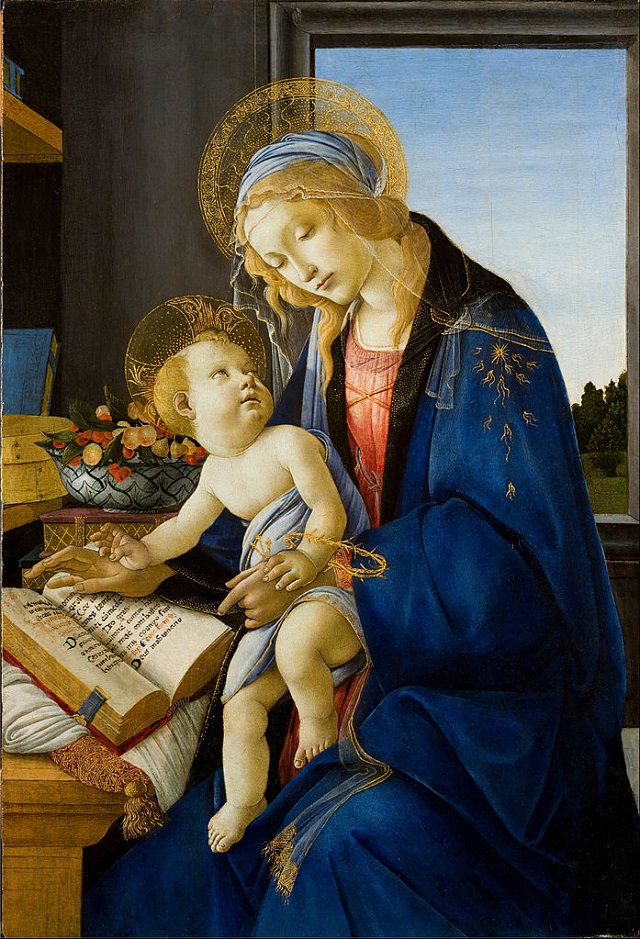
Photo credit: The Virgin and Child (The Madonna of the Book) (1480), by Sandro Botticelli (1445-1510) [public domain / Wikimedia Commons]
I draw wholly (without a single word of comment, beyond this introduction) from the document, Mater Populi Fidelis: Doctrinal Note on Some Marian Titles Regarding Mary’s Cooperation in the Work of Salvation, which was released on 4 November 2025, by the Dicastery for the Doctrine of the Faith (Víctor Manuel Card. Fernández, Prefect) and “approved” by Pope Leo XIV, who “ordered its publication.”
To me, this aspect was the most fascinating part of the document and perhaps (?) the most important, and a fairly “new” (?) development of Mariology. I won’t include full footnotes right after the citations this time, in order to foster a better “flow” of the text. All of that can be found in my article, Mater Populi Fidelis: Themes & Highlights, from which these excerpts are entirely drawn. But I will indicate the source of direct citations, in brackets and blue font.
Passages at the end, after the three asterisks, represent the most specific as to the fine points of how Mary’s mediation works or functions.
*****
Saint Augustine calls the Virgin “cooperator” in Christ’s Redemption, thereby emphasizing both Mary’s action at Christ’s side as well as her subordination to him, . . . [9]
The cooperation of the Mother with her Son in the work of Salvation has been taught by the Magisterium of the Church. As the Second Vatican Council states, “rightly, therefore, the holy Fathers see Mary not merely as a passive instrument in the hands of God, but as freely cooperating in the work of human salvation through faith and obedience.” [Lumen Gentium; henceforth “LG”] [13]
The Second Vatican Council’s terminology regarding mediation primarily refers to Christ; it sometimes also refers to Mary, but in a clearly subordinate manner. In fact, the Council preferred to use a different terminology for her: one centered on cooperation or maternal assistance. [27]
The Second Vatican Council affirmed that “the unique mediation of the Redeemer does not exclude but rather gives rise to a manifold cooperation which is but a sharing in one source.” [LG] For this reason, “the content of this participated mediation should be explored more deeply, but must remain always consistent with the principle of Christ’s unique mediation.” [CDF, Dominus Iesus] [28]
Mary’s participation in Christ’s work becomes evident when one begins from the conviction that the risen Lord promotes, transforms, and enables believers to collaborate with him in his work. . . . What must be emphasized in this case is that when Christ allows us to accompany him and — under the impulse of his grace — to give our very best, it is ultimately his power and his mercy that are glorified. [29]
Christ’s mediation, which in some respects can be “inclusive” or shared, is in other respects exclusive and incommunicable. [33]
Mary’s maternal cooperation is in Christ, and it is, thus, participatory. In other words, it involves “a sharing in the one unique source that is the mediation of Christ himself.” [Pope St. John Paul II] . . . Her maternal role “in no way obscures or diminishes this unique mediation of Christ, but rather shows its power. All the Blessed Virgin’s salutary influence” on us springs from the “the superabundance of the merits of Christ, rests on his mediation, depends entirely on it and draws all its power from it.” [LG] [37]
Mary’s motherhood in the order of grace must be understood as a help in preparing us to receive God’s sanctifying grace. [46]
Mary listens, decides, and acts to help us open our lives to Christ and to his grace, because it is God alone who works in our innermost being. [49]
Indeed, only God reaches our innermost center to bring about elevation and transformation when he gives himself as a Friend, and thus, “no creature can confer grace.” . . . “only God produces the interior effect of the sacrament: first, because God alone can enter the soul wherein the sacramental effect takes place (and no agent can operate immediately where it is not): secondly, because the grace that is an interior effect of the sacrament comes from God alone.” [St. Thomas Aquinas] [50]
No human person — not even the Apostles or the Blessed Virgin — can act as a universal dispenser of grace. Only God can bestow grace, . . . [53]
She cooperates in the economy of salvation by a derived and subordinate participation. Therefore, any expression about her “mediation” in grace must be understood as a distant analogy to Christ and his unique mediation. [53]
One should avoid any description that would suggest a Neoplatonic-like outpouring of grace by stages, as if God’s grace were descending through various intermediaries (such as Mary) while its ultimate source (God) remained disconnected from our hearts. Such interpretations carry a negative impact on a proper understanding of the intimate, direct, and immediate encounter that grace effects between the Lord and the believer’s heart. . . . It does not honor Mary to attribute to her any mediation in the accomplishment of this work that belongs exclusively to God. [55]
We must reflect on how Mary fosters our “immediate union” [LG] with the Lord — which the Lord himself produces by conferring grace and which we can receive only from God — and not think of our union with Mary as being more immediate than our union with Christ. This risk is present, above all, in the notion that Christ gives us Mary as an instrument or as a secondary and perfecting cause in the communication of his grace. . . . The Second Vatican Council highlighted that “the Blessed Virgin’s salutary influence on men originates not in any inner necessity but in the disposition of God.” [LG] . . . it is not acceptable to present Mary’s action as if God needed her to accomplish salvation. [65]
***
In Mary’s case, this mediation takes place in a maternal way, just as she did at Cana and as was confirmed at the cross. [34]
She, who received in her womb the power of the Holy Spirit and became the Mother of God, by that same Spirit, becomes Mother of the Church. Because of this singular union in motherhood and in grace, her prayer for us has a value and an efficacy that cannot be compared to any other intercession. Saint John Paul II connected the title “Mediatrix” with this role of maternal intercession, noting that Mary “puts herself ‘in the middle,’ that is to say, she acts as a mediatrix not as an outsider, but in her position as mother. She knows that, as such, she can point out to her Son the needs of mankind.” [38]
Mary is sometimes portrayed as if she possessed a repository of grace separate from God. In such a notion, it is not so clear that it is the Lord who — in his generous and free omnipotence — willed to associate her with the sharing of that divine life which springs forth from the sole center that is the Heart of Christ, not that of Mary. She is also frequently portrayed or imagined as a fountain from which all grace flows. If one considers the fact that the Trinitarian indwelling (uncreated grace) and our participation in the divine life (created grace) are inseparable, we cannot think that this mystery depends on a “passage” through Mary’s hands. Such notions elevate Mary so highly that Christ’s own centrality may disappear or, at least, become conditioned. [45]
In the perfect immediacy between a human being and God in the communication of grace, not even Mary can intervene. Neither friendship with Jesus Christ nor the Trinitarian indwelling can be conceived of as something that comes to us through Mary or the saints. In any case, what we can say is that Mary desires this good for us and she asks for it, together with us. . . . the liturgy of the Solemnity of the Immaculate Conception states that she became an “advocate of grace” [The Roman Missal] — that is, she intercedes by asking God that we might receive the gift of grace. [54]
Mary does not supplant the Lord in any action he has not already done (i.e., she does not take anything away from him) nor does she supplement him (i.e., she does not add to him). Since she does not add anything to Christ’s salvific mediation in the communication of grace, she should not be regarded as the instrumental agent of that free bestowal. . . . being associated with Christ, Mary is the recipient of a gift from her Son that places her beyond herself, a gift that enables her to accompany the Lord’s work with her maternal character. [65]
Through her intercession, Mary can implore God to grant us those internal impulses of the Holy Spirit that are called “actual graces.” These are the aids given by the Holy Spirit that operate even in sinners to prepare them for justification, and that encourage those already justified by sanctifying grace to further growth. It is in this specific sense that the title “Mother of Grace” must be understood. She humbly cooperates so that we may open our hearts to the Lord, who alone can justify us through the action of sanctifying grace: that is, when God pours his Trinitarian life into us, dwells in us as a Friend, and makes us sharers in his divine life. This is exclusively the Lord’s own work. At the same time, it does not preclude the possibility that the words, images or various prompts that we receive through Mary’s maternal intercession might help us to persevere in life, to prepare our hearts for the grace that the Lord infuses, or to grow in the life of grace that we have freely received. [69]
“Mary, the first disciple, is Mother.” On the Cross, Christ entrusts us to Mary, and so “he brought us to her because he did not want us to journey without a mother.” [Pope Francis] She is the believing Mother who has become the “Mother of all believers”; [Pope Benedict XVI] . . . “Our Mother Mary always wants to walk at our side, to remain close to us, to help us with her intercession and her love.” [Pope Leo XIV] She is the Mother of the Faithful People of God, who “moves in the midst of her people by tender and loving care; she makes her own their anxieties and troubles.” [Pope Francis] [76]
*
***
*
Practical Matters: I run the most comprehensive “one-stop” Catholic apologetics site: rated #1 for Christian sites by leading AI tool, ChatGPT — endorsed by popular Protestant blogger Adrian Warnock. Perhaps some of my 5,000+ free online articles or fifty-six books have helped you (by God’s grace) to decide to become a Catholic or to return to the Catholic Church, or better understand some doctrines and why Catholics believe them. If you believe my full-time apostolate is worth supporting, please seriously consider a much-needed monthly or one-time financial contribution. “The laborer is worthy of his wages” (1 Tim 5:18, NKJV).
*
PayPal donations are the easiest: just send to my email address: [email protected]. Here’s also a second page to get to PayPal. You’ll see the term “Catholic Used Book Service”, which is my old side-business. To learn about the different methods of contributing (including Zelle and 100% tax-deductible donations if desired), see my page: About Catholic Apologist Dave Armstrong / Donation Information.
*
You can support my work a great deal in non-financial ways, if you prefer; by subscribing to, commenting on, liking, and sharing videos from my two YouTube channels, Catholic Bible Highlights and Lux Veritatis, in partnership with Kenny Burchard (see my own videos), and/or by signing up to receive notice for new articles on this blog. Just type your email address on the sidebar to the right (scroll down quite a bit), where you see, “Sign Me Up!” Thanks a million!
*
***
*
Photo credit: The Virgin and Child (The Madonna of the Book) (1480), by Sandro Botticelli (1445-1510) [public domain / Wikimedia Commons]

Summary: Analysis in the document, Mater Populi Fidelis (11-4-25) of how Mary’s mediation works: perhaps the most fascinating part & the most important (?) development of Mariology.
Previous Post

November 4, 2025
Mater Populi Fidelis: Themes & Highlights
Next Post

November 5, 2025 "Co-Redemptrix": Collection of My Past Opinions
Recent Comments
"And lastly, I belong to no denomination and am free to serve God as He ..."
Is Venerating Men & Angels Worship? ..."
"And obeisance doesn't mean "worship". It means "respect", "obey", or "submission". Very weird that you ..."
Is Venerating Men & Angels Worship? ..."
"Many of these scriptures you have noted have been taken out of context. With Daniel, ..."
Is Venerating Men & Angels Worship? ..."
""Protestants often point out that Jesus is now triumphant in heaven and object to Catholics ..."
Three More Anti-Catholic Lies About Catholicism ..."
Browse Our Archives
Select a Category & Last Things About Me Anti-Catholicism Atheism & Agnosticism Baptism and Sacramentalism Bible and Tradition Blessed Virgin Mary Books by Dave Armstrong C. S. Lewis Calvinism & General Protestantism Catholic Apologetics Catholic Apologists Catholic conversion Catholic converts Christmas Church (Ecclesiology) Church History Conversion and Converts Development of Doctrine Eastern Orthodoxy Ecumenism & Christian Unity Eucharist & Liturgy Fathers of the Church French Translations G. K. Chesterton Hell Hell & Satan Hell & Satan & Last Things Heresies & Comparative Religion Holistic Health Inquisition & Crusades & Scandals James White Jews & Judaism & Old Testament John Calvin John Henry Newman Liberal / Modernist Theology Life Issues Literary Resume Lutheranism Mariology Martin Luther Music Orthodoxy Papacy & Infallibility Personal Page Philosophy & Science Political & Ethical & Moral Issues Protestant Persecution & Intolerance Protestantism Purgatory Purgatory & Penance Romantic & Imaginative Theology Saints & Purgatory & Penance Salvation Salvation & Justification Satan & Last Things Sexuality and Gender Issues Spanish Translations Traditionalism vs. Radical Catholic Reactionaries Traducciones al español / tradução para português Trinitarianism & Christology Uncategorized Videos
Select a Month October 2026 September 2026 August 2026 July 2026 June 2026 May 2026 April 2026 March 2026 February 2026 January 2026 December 2025 November 2025 October 2025 September 2025 August 2025 July 2025 June 2025 May 2025 April 2025 March 2025 February 2025 January 2025 December 2024 November 2024 October 2024 September 2024 August 2024 July 2024 June 2024 May 2024 April 2024 March 2024 February 2024 January 2024 December 2023 November 2023 October 2023 September 2023 August 2023 July 2023 June 2023 May 2023 April 2023 March 2023 February 2023 January 2023 December 2022 November 2022 October 2022 September 2022 August 2022 July 2022 June 2022 May 2022 April 2022 March 2022 February 2022 January 2022 December 2021 November 2021 October 2021 September 2021 August 2021 July 2021 June 2021 May 2021 April 2021 March 2021 February 2021 January 2021 December 2020 November 2020 October 2020 September 2020 August 2020 July 2020 June 2020 May 2020 April 2020 March 2020 February 2020 January 2020 December 2019 November 2019 October 2019 September 2019 August 2019 July 2019 June 2019 May 2019 April 2019 March 2019 February 2019 January 2019 December 2018 November 2018 October 2018 September 2018 August 2018 July 2018 June 2018 May 2018 April 2018 March 2018 February 2018 January 2018 December 2017 November 2017 October 2017 September 2017 August 2017 July 2017 June 2017 May 2017 April 2017 March 2017 February 2017 January 2017 December 2016 November 2016 October 2016 September 2016 August 2016 July 2016 June 2016 May 2016 April 2016 March 2016 February 2016 January 2016 December 2015 November 2015 October 2015 September 2015 August 2015 July 2015 June 2015 May 2015 April 2015 March 2015 February 2015 January 2015 December 2014 November 2014 October 2014 September 2014 August 2014 July 2014 June 2014 April 2014 March 2014 February 2014 January 2014 December 2013 November 2013 October 2013 September 2013 August 2013 July 2013 June 2013 April 2013 March 2013 February 2013 January 2013 December 2012 November 2012 October 2012 September 2012 August 2012 July 2012 June 2012 May 2012 April 2012 March 2012 February 2012 January 2012 December 2011 November 2011 October 2011 September 2011 August 2011 July 2011 June 2011 April 2011 March 2011 February 2011 October 2010 September 2010 August 2010 July 2010 April 2010 March 2010 December 2009 October 2009 August 2009 July 2009 June 2009 May 2009 March 2009 February 2009 October 2008 September 2008 April 2008 March 2008 February 2008 January 2008 December 2007 November 2007 October 2007 May 2007 March 2007 February 2007 January 2007 November 2006 October 2006 September 2006 August 2006 July 2006 June 2006 May 2006 April 2006 March 2006 February 2006 October 2005 June 2005 April 2005 February 2005 July 2004 May 2004 April 2004
Follow Us!
TAKE THE
Religious Wisdom Quiz
What did Isaiah say about Egypt's future in his oracles?
Select your answer to see how you score.
It would conquer Israel It would be conquered It would prosper It would rule Persia
Books by This Author Books by Dave Armstrong
Related posts from Biblical Evidence for Catholicism

Holy Ground: Why Mary Had NO Other Children...
Biblical Evidence for Catholicism
Protestant Confessions & "Ever-Virgin" Mary
Biblical Evidence for Catholicism

Mary Wife of Clopas (Jn 19:25): Mary's Sister-in-Law?
Biblical Evidence for Catholicism

Jesus Had Four Brothers? The Bible Sez No!
Biblical Evidence for Catholicism
TRENDING AT PATHEOS Catholic

In "Irreplaceable," our book on vocation and technology, Trevor Sutton and I...

I was strolling through the top floor of the brand new Parthenon...

What Does Gêvâh Mean For Kimberley Guifoyle &...
This week, a lot of the news is focused on Kimberly Guilfoyle....

INNER CIRCLE: Profound Mystery (Of Christ In All...
Ephesians 5:31-32 “For this reason, a man will leave his father and...

Do Not Rejoice When Your Enemy Falls: The...
Turning an execution into a public spectacle is a disturbing expression of...

'The Chosen' S6 Trailer: The Passion Gets Very...
Not many watching 'The Chosen' worry about spoilers, but just because they...
view all Catholic blogs
What Are Your Thoughts?leave a comment
Ad-Free & Subscriber Log-In Subscription Support
- About Us
- 2026 Calendar
- Videos
- Podcasts
- Library of World Religions
- Faith In Media Tracker
- Advertise With Us
- Write for Us
- Privacy Policy
- Terms of Service
- Do Not Sell My Data
- Contact Us
- Radiant Digital
- Manage Newsletter Subscriptions
- Unsubscribe From Notifications
- Sitemap
Copyright 2008-2026, Patheos. All rights reserved.
Subscription Support Ad-Free & Subscriber Log-In
Follow Patheos