
BuddhistCatholicContemplativeEvangelicalGeneral ChristianHinduJewishLatter-day SaintMuslimNew VisionsProgressive Christian
Beliefs
- Buddhist
- Catholic
- Contemplative
- Evangelical
- General Christian
- Hindu
- Jewish
- Latter-day Saint
- More Voices
- Muslim
- New Visions
- Pagan
- Progressive Christian
Topics
- Religion News
- Food and Religion
- Sports and Religion
- Religious Art
- Religious Music and Entertainment
- Religious Events
- History and Religion
- Style and Religion
- Politics and Religion
- Women in Religion
- Recreation Outdoors and Religion
- Business Finance and Religion
- Careers Workplace and Religion
- Education and Religion
- Family Parenting and Religion
- Health Fitness and Religion
- Home and Religion
- Relationships and Religion
- Technology and Religion
- Travel and Religion
Columnists
- Buddhist Columnists
- Business Finance and Religion Columnists
- Careers Workplace and Religion Columnists
- Catholic Columnists
- Contemplative Columnists
- Education and Religion Columnists
- Evangelists Columnists
- Family Parenting and Religion Columnists
- General Christian Columnists
- Health Fitness and Religion Columnists
- Hindu Columnists
- History and Religion Columnists
- Home and Religion Columnists
- Jewish Columnists
- More Voices Columnists
- Latter Day Columnists
- Muslim Columnists
- New Visions Columnists
- Nonreligious Columnists
- Pagan Columnists
- Politics and Religion Columnists
- Progressive Columnists
- Recreation Outdoors and Religion Columnists
- Relationships and Religion Columnists
- Religion News Columnists
- Religious Art Columnists
- Religious Events Columnists
- Religious Music and Entertainment Columnists
- Sports and Religion Columnists
- Style and Religion Columnists
- Technology and Religion Columnists
- Travel and Religion Columnists
- Women in Religion Columnists
Resource Library
- 2026 Calendar
- Library of World Religions
- The 100 Most Holy Places on Earth
- Patheos Answers
- Podcasts
- Videos
- Faith Leaders Database
- Anglican Episcopalian
- Bahai
- Baptist
- Buddhism
- Christianity
- Confucianism
- Eastern Orthodoxy
- Hinduism
- Holiness and Pentecostal
- ISKCON
- Islam
- Judaism
- Lutheran
- Methodist
- The Church of Jesus Christ of Latter-day Saints
- New Age
- Paganism
- Presbytarian and Reformed
- Protestantism
- Religion Behind the Scenes
- Roman Catholic
- Scientology
- Shia Islam
- Sikhism
- Sufism
- Sunni Islam
- Taoism
- Zen
- See all religions
Research Tools
 Ad-Free & Subscriber Log-In Subscription Support
Ad-Free & Subscriber Log-In Subscription Support
Follow Patheos 

- Trending:
- Forgiveness
- |
- Marriage
- |
- Consciousness
- |
- Death Penalty
- |
- Election
- |
- Halloween

-
About
-
Catholic Apologetics
-
Church History
-
Great Apologists
-
Christian Worldview
-
Protestantism & Misc.
- Home
- Catholic
- History and Religion
- Introduction: 100 Biblical Arguments Against Sola Scriptura
Introduction: 100 Biblical Arguments Against Sola Scriptura
Last updated on: June 6, 2026 at 12:53 am by Dave Armstrong
Introduction: 100 Biblical Arguments Against Sola Scriptura 2026-06-06T00:53:30-04:00 Dave Armstrong
Patheos Explore the world's faith through different perspectives on religion and spirituality! Patheos has the views of the prevalent religions and spiritualities of the world.
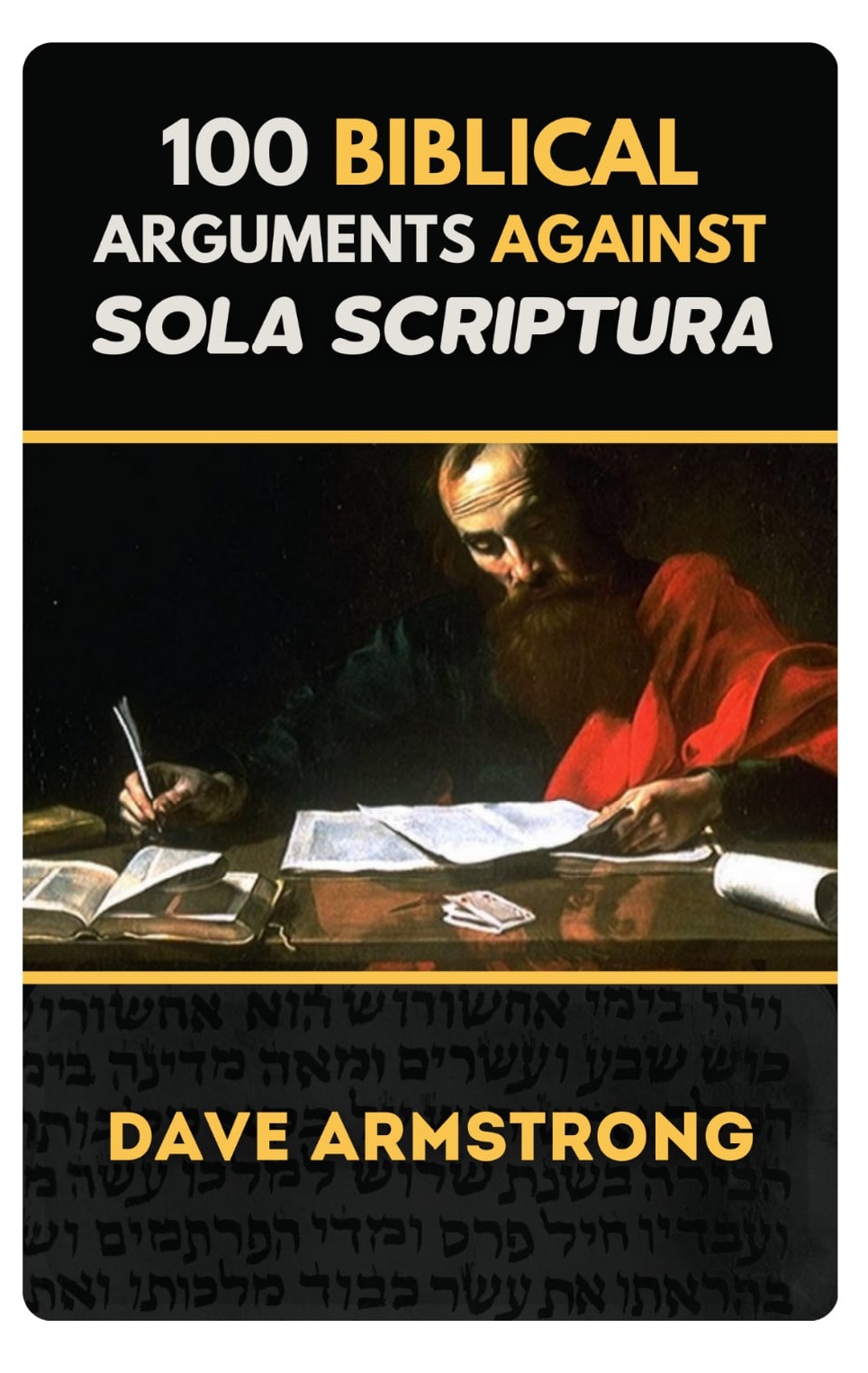
Photo credit: cover of my book, published by Bridge Builders Press, August 2025. Artwork by Kenny Burchard and Dave Armstrong.
For purchase ($12.99 paperback, $9.99 Kindle), see the Amazon page. For further information, Table of Contents, reviews, samples, etc., see my Book page for this title.
*****
Catholicism and Protestantism differ fundamentally with regard to authority — the “rule of faith,” the basis or standard Christians use to determine true (and false) doctrine and practice. Protestantism tends to see a divide between the “pure Word of God” in the Bible and what the Catholic Church calls sacred tradition – something Protestantism considers to be corrupted by “traditions of men” (Matt 15:3 6; Mk 7:8-13). For Protestants, Scripture alone is the source and rule of the Christian faith. It is the only infallible authority, sufficient in and of itself for a full exposition of Christianity and for the attainment of salvation. This is what sola scriptura means. In Catholicism, by contrast, Scripture and tradition — revealed Christian truths passed on outside of Scripture — are two fonts of the one spring of divine revelation. Without one or the other, revelation is incomplete.
Scripture frequently refers to the notion of tradition[s]: a body of knowledge or doctrine that existed prior to and is larger than Scripture itself. For example:
Acts 17:11, 13 (RSV)Now these Jews were more noble than those in Thessalonica, for they received the word with all eagerness, examining the scriptures daily to see if these things were so. . . . But when the Jews of Thessalonica learned that the word of God was proclaimed by Paul at Beroea also, they came there too, stirring up and inciting the crowds.
The “word” or “word of God” in this context is clearly not Scripture, because Scripture is compared with it): it is, rather, apostolic preaching, which is synonymous with sacred tradition. All true tradition, like the preaching that is examined in the above passage, is harmonious with Scripture. This is the biblical and Catholic teaching.
Other terms besides “word of God” are used in the Bible to refer to apostolic tradition, such as “the faith” (Eph 4:13; Col 1:23; 1 Tim 4:1; Jude 3), “the truth” (Rom 2:8; Gal 5:7; 1 Tim 2:4), “the commandment” (Mk 7:8; 2 Pet 2:21; 1 Jn 2:7-8), “the doctrine” (Rom 16:17; Titus 2:10; 2 Jn 1:9), and “the message” (1 Cor 2:4; 2 Cor 5:19; 2 Tim 4:15). The biblical data on this score is overwhelming. A concise Catholic definition of sacred tradition is found in the decrees of the First Vatican Council (1870), in the Dogmatic Constitution on the Catholic Faith:
This supernatural revelation, according to the universal belief of the Church, declared by the sacred Synod of Trent, is contained in the written books and unwritten traditions which, received by the Apostles from the mouth of Christ himself, or from the Apostles themselves, by the dictation of the Holy Spirit, transmitted, as it were, from hand to hand, have come down even to us. (Dogmatic Canons and Decrees [New York: Devin-Adair Company, 1912; reprinted: Rockford, Illinois: TAN Books and Publishers, Inc., 1977]; Session III, document dated 24 April 1870; this portion from p. 221)
There are many complexities and nuances involved in this discussion of Christian authority that will become apparent as we delve into it. Catholics and Protestants have misunderstood each other for centuries. Yet, although there are deeply held differences, there is also more common ground than one might suspect.
Before going any further, I should like to verify the preceding definitions of sola scriptura by citing three of its contemporary Protestant defenders. Norman Geisler, a very prominent evangelical Protestant apologist who has published many books, defines it as follows:
By sola scriptura orthodox Protestants mean that Scripture alone is the primary and absolute source of authority, the final court of appeal, for all doctrine and practice (faith and morals). It is important to repeat that Catholics often misunderstand the Protestant principle of sola scriptura to exclude any truth outside the Bible. This, of course, is untrue . . . What Protestants mean by sola scriptura is that the Bible alone is the infallible written authority for faith and morals. . . . Scripture is the sufficient and final written authority of God. As to sufficiency, the Bible—nothing more, nothing less, and nothing else—is all that is necessary for faith and practice . . . the Bible is clear (perspicuous). The perspicuity of Scripture does not mean that everything in the Bible is perfectly clear, but rather the essential teachings are. Popularly put, in the Bible the main things are the plain things and the plain things are the main things. This is not to say that Protestants obtain no help from the Fathers and early councils . . . this is not to say that there is no usefulness to Christian tradition, but only that it is of secondary importance. (Norman L. Geisler and Ralph E. Mackenzie, Roman Catholics and Evangelicals: Agreements and Differences [Grand Rapids, Michigan: Baker Books, 1995], p. 178)
Reformed Protestant writer Keith A. Mathison concurs, while emphasizing the role of the Church a little more strongly:
Scripture alone is inspired and inherently infallible. Scripture alone is the supreme normative standard. But Scripture does not exist in a vacuum. It was and is given to the Church within the doctrinal context of the apostolic gospel. Scripture alone is the only final standard, but it is a final standard that must be utilized, interpreted, and preached by the Church within its Christian context.
It is important to notice that sola scriptura, properly understood, is not a claim that Scripture is the only authority altogether. . . . There are other real authorities which are subordinate and derivative in nature. Scripture, however, is the only inspired and inherently infallible norm, and therefore Scripture is the only final authoritative norm. (The Shape of Sola Scriptura [Moscow, Idaho: Canon Press, 2001], pp. 259-260)
He adds, “It must be emphasized that the fallibility of the Church does not render her authority invalid.” (Ibid., p. 269).
Reformed Baptist James R. White, despite belonging to the extreme anti-Catholic fundamentalist wing of Protestantism, nevertheless agrees with Geisler and Mathison in this respect, as we see in his series of helpful expositions detailing first what sola scriptura is not:
First and foremost, sola scriptura is not a claim that the Bible contains all knowledge.
Sola scriptura is not a claim that the Bible is an exhaustive catalog of all religious knowledge. . . . It is obvious that the Bible does not need to be exhaustive to be sufficient as our source of divine truth.
Sola scriptura is not a denial of the authority of the Church to teach God’s truth . . . The Church, as the body of Christ, presents and upholds the truth, but she remains subservient to it . . . There is no warrant for the “Lone Ranger Christian Syndrome” so popular in Protestant circles these days.
Sola scriptura is not a denial that the Word of God has, at times, been spoken. Rather, it refers to the Scriptures as serving the Church as God’s final and full revelation . . . It is vitally important that the reader recognize that the Protestant position insists that all God intends for us to have that is infallible, binding, and authoritative today, He has already provided in the certain, clear, understandable, and reliable Scriptures.
Sola scriptura does not entail the rejection of every kind or form of “tradition.” There are some traditions that are God honoring and useful in the Church. Sola scriptura simply means that any tradition, no matter how ancient or venerable it might seem to us, must be tested by a higher authority, and that authority is the Bible.
Sola scriptura is not a denial of the role of the Holy Spirit in guiding and enlightening the Church.
White then proceeds to show what sola scriptura is:
The doctrine of sola scriptura, simply stated, is that the Scriptures alone are sufficient to function as the regula fidei, the infallible rule of faith for the Church.
All that one must believe to be a Christian is found in Scripture, and in no other source.
That which is not found in Scripture—either directly or by necessary implication—is not binding upon the Christian.
Scripture reveals those things necessary for salvation.
All traditions are subject to the higher authority of Scripture. (The Roman Catholic Controversy [Minneapolis: Bethany House Publishers, 1996], pp. 56-62; all italics in the original; some ellipses indicating text in-between the bullet points are eliminated for the sake of presentation)
In this book, I will be presupposing the above definitions of sola scriptura: good and clear definitions from three of its ablest defenders. Let the reader take note! For it is the almost-invariable practice of Protestants to accuse Catholics of not understanding what sola scriptura is in the first place. I’m sure there are many Catholics who don’t understand. But I do understand what sola scriptura is. I used to adhere to it myself, precisely in these terms, and I defended it, as a Protestant apologist and evangelist, for nine years. I know what it is, and I reject it as a falsehood.
Let me conclude with a word on my premises and methodology. The discussion of Christian authority is rife with miscomprehensions on both sides. People are used to reading unsophisticated and inadequate treatments of sola scriptura from both proponents and opponents.
It’s not enough, therefore, merely to cite biblical evidences of tradition or an authoritative Church. Those things are not, by their mere mention, sufficient to refute sola scriptura (as our three Protestant proponents cited above point out). The Catholic needs to go further than that and establish, based on unassailable biblical evidence, examples of tradition or of Church proclamations that were binding and obligatory upon all who heard and received them. Whether these were infallible is another, more complex question, but a binding decree is already either expressly contrary to sola scriptura, or, at the very least, casts considerable doubt on the formal principle.
Thus, one of my favorite counter-arguments is to point out that the Apostle Paul and his companions Silas and Timothy made their way “through the cities” and “delivered to them for observance the decisions which had been reached by the apostles and elders who were at Jerusalem” (Acts 16:4). This council at Jerusalem was described in the previous chapter as having reached its decisions by the direct aid or guidance of the Holy Spirit (15:28).
When we put all of that together we see an infallible council, presided over by bishops (Peter: 15:7-11, and James: 15:13 21), and proclaimed by an apostle (Paul). It was a development of tradition and Mosaic Law (about circumcision and what was proper to eat) and a binding exercise of Church authority at the highest levels; even seemingly infallible. All of this is a strong counter-indication of sola scriptura, which proclaims that no Church or council can bind the conscience of a Christian believer, or can claim to be infallible. For the Protestant, only Scripture can do that. Yet here the same Scripture seems to refute that very proposition.
This is how one goes about refuting sola scriptura: by demonstrating how biblical teaching makes the Protestant rule of faith collapse into endless self-contradictions and incoherence. It’s a death by a thousand qualifications (and worse).
*
***
*
Practical Matters: I run the most comprehensive “one-stop” Catholic apologetics site: rated #1 for Christian sites by leading AI tool, ChatGPT — endorsed by popular Protestant blogger Adrian Warnock. Perhaps some of my 5,000+ free online articles or fifty-six books have helped you (by God’s grace) to decide to become a Catholic or to return to the Catholic Church, or better understand some doctrines and why Catholics believe them. If you believe my full-time apostolate is worth supporting, please seriously consider a much-needed monthly or one-time financial contribution. “The laborer is worthy of his wages” (1 Tim 5:18, NKJV).
*
PayPal donations are the easiest: just send to my email address: [email protected]. Here’s also a second page to get to PayPal. You’ll see the term “Catholic Used Book Service”, which is my old side-business. To learn about the different methods of contributing (including Zelle and 100% tax-deductible donations if desired), see my page: About Catholic Apologist Dave Armstrong / Donation Information.
*
You can support my work a great deal in non-financial ways, if you prefer; by subscribing to, commenting on, liking, and sharing videos from my two YouTube channels, Catholic Bible Highlights and Lux Veritatis (featuring documentaries), in partnership with Kenny Burchard (see my own videos and documentaries), and/or by signing up to receive notice for new articles on this blog. Just type your email address on the sidebar to the right (scroll down quite a bit), where you see, “Sign Me Up!” Thanks a million!
*
***
*
Photo credit: cover of my book, published by Bridge Builders Press, August 2025. Artwork by Kenny Burchard and Dave Armstrong.
Summary: Introduction to my book, 100 Biblical Arguments Against Sola Scriptura: published by Catholic Answers Press in May 2012; 2nd edition from Bridge Builders Press, August 2025.
Calvinism & General Protestantism
100 Biblical Arguments Against Sola Scriptura
Previous Post
August 6, 2025
Biblical Evidences for the Oral Torah
Next Post

August 9, 2025 Interview: the Vocation of the Catholic Apologist
Recent Comments
"And lastly, I belong to no denomination and am free to serve God as He ..."
Is Venerating Men & Angels Worship? ..."
"And obeisance doesn't mean "worship". It means "respect", "obey", or "submission". Very weird that you ..."
Is Venerating Men & Angels Worship? ..."
"Many of these scriptures you have noted have been taken out of context. With Daniel, ..."
Is Venerating Men & Angels Worship? ..."
""Protestants often point out that Jesus is now triumphant in heaven and object to Catholics ..."
Three More Anti-Catholic Lies About Catholicism ..."
Browse Our Archives
Select a Category & Last Things About Me Anti-Catholicism Atheism & Agnosticism Baptism and Sacramentalism Bible and Tradition Blessed Virgin Mary Books by Dave Armstrong C. S. Lewis Calvinism & General Protestantism Catholic Apologetics Catholic Apologists Catholic conversion Catholic converts Christmas Church (Ecclesiology) Church History Conversion and Converts Development of Doctrine Eastern Orthodoxy Ecumenism & Christian Unity Eucharist & Liturgy Fathers of the Church French Translations G. K. Chesterton Hell Hell & Satan Hell & Satan & Last Things Heresies & Comparative Religion Holistic Health Inquisition & Crusades & Scandals James White Jews & Judaism & Old Testament John Calvin John Henry Newman Liberal / Modernist Theology Life Issues Literary Resume Lutheranism Mariology Martin Luther Music Orthodoxy Papacy & Infallibility Personal Page Philosophy & Science Political & Ethical & Moral Issues Protestant Persecution & Intolerance Protestantism Purgatory Purgatory & Penance Romantic & Imaginative Theology Saints & Purgatory & Penance Salvation Salvation & Justification Satan & Last Things Sexuality and Gender Issues Spanish Translations Traditionalism vs. Radical Catholic Reactionaries Traducciones al español / tradução para português Trinitarianism & Christology Uncategorized Videos
Select a Month October 2026 September 2026 August 2026 July 2026 June 2026 May 2026 April 2026 March 2026 February 2026 January 2026 December 2025 November 2025 October 2025 September 2025 August 2025 July 2025 June 2025 May 2025 April 2025 March 2025 February 2025 January 2025 December 2024 November 2024 October 2024 September 2024 August 2024 July 2024 June 2024 May 2024 April 2024 March 2024 February 2024 January 2024 December 2023 November 2023 October 2023 September 2023 August 2023 July 2023 June 2023 May 2023 April 2023 March 2023 February 2023 January 2023 December 2022 November 2022 October 2022 September 2022 August 2022 July 2022 June 2022 May 2022 April 2022 March 2022 February 2022 January 2022 December 2021 November 2021 October 2021 September 2021 August 2021 July 2021 June 2021 May 2021 April 2021 March 2021 February 2021 January 2021 December 2020 November 2020 October 2020 September 2020 August 2020 July 2020 June 2020 May 2020 April 2020 March 2020 February 2020 January 2020 December 2019 November 2019 October 2019 September 2019 August 2019 July 2019 June 2019 May 2019 April 2019 March 2019 February 2019 January 2019 December 2018 November 2018 October 2018 September 2018 August 2018 July 2018 June 2018 May 2018 April 2018 March 2018 February 2018 January 2018 December 2017 November 2017 October 2017 September 2017 August 2017 July 2017 June 2017 May 2017 April 2017 March 2017 February 2017 January 2017 December 2016 November 2016 October 2016 September 2016 August 2016 July 2016 June 2016 May 2016 April 2016 March 2016 February 2016 January 2016 December 2015 November 2015 October 2015 September 2015 August 2015 July 2015 June 2015 May 2015 April 2015 March 2015 February 2015 January 2015 December 2014 November 2014 October 2014 September 2014 August 2014 July 2014 June 2014 April 2014 March 2014 February 2014 January 2014 December 2013 November 2013 October 2013 September 2013 August 2013 July 2013 June 2013 April 2013 March 2013 February 2013 January 2013 December 2012 November 2012 October 2012 September 2012 August 2012 July 2012 June 2012 May 2012 April 2012 March 2012 February 2012 January 2012 December 2011 November 2011 October 2011 September 2011 August 2011 July 2011 June 2011 April 2011 March 2011 February 2011 October 2010 September 2010 August 2010 July 2010 April 2010 March 2010 December 2009 October 2009 August 2009 July 2009 June 2009 May 2009 March 2009 February 2009 October 2008 September 2008 April 2008 March 2008 February 2008 January 2008 December 2007 November 2007 October 2007 May 2007 March 2007 February 2007 January 2007 November 2006 October 2006 September 2006 August 2006 July 2006 June 2006 May 2006 April 2006 March 2006 February 2006 October 2005 June 2005 April 2005 February 2005 July 2004 May 2004 April 2004
Follow Us!
TAKE THE
Religious Wisdom Quiz
Who said, "As for me, I know that my redeemer lives"?
Select your answer to see how you score.
Job Abraham Moses Joseph
Books by This Author Books by Dave Armstrong
Related posts from Biblical Evidence for Catholicism

On Protestant Explanations of Catholic Conversion
Biblical Evidence for Catholicism

Protestant Confessions & "Ever-Virgin" Mary
Biblical Evidence for Catholicism

A Few "Worst" & "Best" Arguments vs. Protestantism
Biblical Evidence for Catholicism

Jerusalem Council vs. James White & Sola Scriptura
Biblical Evidence for Catholicism
TRENDING AT PATHEOS Catholic

I was strolling through the top floor of the brand new Parthenon...

What Does Gêvâh Mean For Kimberley Guifoyle &...
This week, a lot of the news is focused on Kimberly Guilfoyle....

INNER CIRCLE: Profound Mystery (Of Christ In All...
Ephesians 5:31-32 “For this reason, a man will leave his father and...

Do Not Rejoice When Your Enemy Falls: The...
Turning an execution into a public spectacle is a disturbing expression of...

'The Chosen' S6 Trailer: The Passion Gets Very...
Not many watching 'The Chosen' worry about spoilers, but just because they...

The purpose-driven labor priest
A labor activist reads Rick Warren and it gets me wondering about...
view all Catholic blogs
What Are Your Thoughts?leave a comment
Ad-Free & Subscriber Log-In Subscription Support
- About Us
- 2026 Calendar
- Videos
- Podcasts
- Library of World Religions
- Faith In Media Tracker
- Advertise With Us
- Write for Us
- Privacy Policy
- Terms of Service
- Do Not Sell My Data
- Contact Us
- Radiant Digital
- Manage Newsletter Subscriptions
- Unsubscribe From Notifications
- Sitemap
Copyright 2008-2026, Patheos. All rights reserved.
Subscription Support Ad-Free & Subscriber Log-In
Follow Patheos