
BuddhistCatholicContemplativeEvangelicalGeneral ChristianHinduJewishLatter-day SaintMuslimNew VisionsProgressive Christian
Beliefs
- Buddhist
- Catholic
- Contemplative
- Evangelical
- General Christian
- Hindu
- Jewish
- Latter-day Saint
- More Voices
- Muslim
- New Visions
- Pagan
- Progressive Christian
Topics
- Religion News
- Food and Religion
- Sports and Religion
- Religious Art
- Religious Music and Entertainment
- Religious Events
- History and Religion
- Style and Religion
- Politics and Religion
- Women in Religion
- Recreation Outdoors and Religion
- Business Finance and Religion
- Careers Workplace and Religion
- Education and Religion
- Family Parenting and Religion
- Health Fitness and Religion
- Home and Religion
- Relationships and Religion
- Technology and Religion
- Travel and Religion
Columnists
- Buddhist Columnists
- Business Finance and Religion Columnists
- Careers Workplace and Religion Columnists
- Catholic Columnists
- Contemplative Columnists
- Education and Religion Columnists
- Evangelists Columnists
- Family Parenting and Religion Columnists
- General Christian Columnists
- Health Fitness and Religion Columnists
- Hindu Columnists
- History and Religion Columnists
- Home and Religion Columnists
- Jewish Columnists
- More Voices Columnists
- Latter Day Columnists
- Muslim Columnists
- New Visions Columnists
- Nonreligious Columnists
- Pagan Columnists
- Politics and Religion Columnists
- Progressive Columnists
- Recreation Outdoors and Religion Columnists
- Relationships and Religion Columnists
- Religion News Columnists
- Religious Art Columnists
- Religious Events Columnists
- Religious Music and Entertainment Columnists
- Sports and Religion Columnists
- Style and Religion Columnists
- Technology and Religion Columnists
- Travel and Religion Columnists
- Women in Religion Columnists
Resource Library
- 2026 Calendar
- Library of World Religions
- The 100 Most Holy Places on Earth
- Patheos Answers
- Podcasts
- Videos
- Faith Leaders Database
- Anglican Episcopalian
- Bahai
- Baptist
- Buddhism
- Christianity
- Confucianism
- Eastern Orthodoxy
- Hinduism
- Holiness and Pentecostal
- ISKCON
- Islam
- Judaism
- Lutheran
- Methodist
- The Church of Jesus Christ of Latter-day Saints
- New Age
- Paganism
- Presbytarian and Reformed
- Protestantism
- Religion Behind the Scenes
- Roman Catholic
- Scientology
- Shia Islam
- Sikhism
- Sufism
- Sunni Islam
- Taoism
- Zen
- See all religions
Research Tools
 Ad-Free & Subscriber Log-In Subscription Support
Ad-Free & Subscriber Log-In Subscription Support
Follow Patheos 

- Trending:
- Forgiveness
- |
- Marriage
- |
- Consciousness
- |
- Death Penalty
- |
- Election
- |
- Halloween

-
About
-
Catholic Apologetics
-
Church History
-
Great Apologists
-
Christian Worldview
-
Protestantism & Misc.
- Home
- Catholic
- History and Religion
- Vs. Geisler on Catholicism #8: Papal Infallibility
Vs. Geisler on Catholicism #8: Papal Infallibility
Last updated on: June 6, 2026 at 12:53 am by Dave Armstrong
Vs. Geisler on Catholicism #8: Papal Infallibility 2026-06-06T00:53:30-04:00 Dave Armstrong
Patheos Explore the world's faith through different perspectives on religion and spirituality! Patheos has the views of the prevalent religions and spiritualities of the world.
Includes Anti-Infallibilist George Salmon; “Vicar of Christ”; “Holy Father”; “Supreme Pontiff”; Is Galileo a Catholic Difficulty?
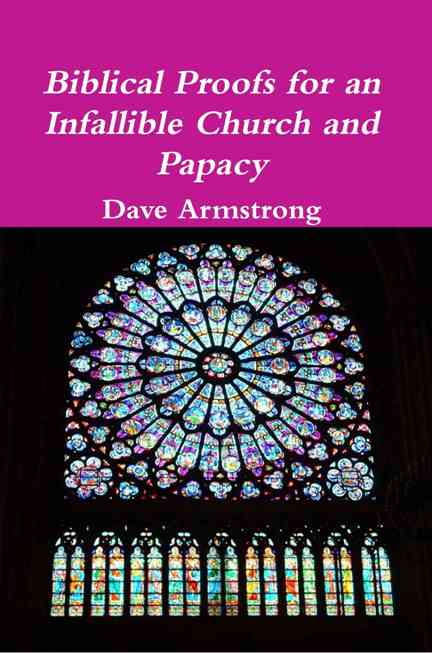
Photo credit: self-designed cover for my 2012 book.
Norman L. Geisler (1932 – 2019) was an American evangelical Protestant theologian, philosopher, and apologist. He obtained an M.A. in theology from Wheaton College and a Ph.D. in philosophy from Loyola University, and made scholarly contributions to the subjects of classical Christian apologetics, systematic theology, philosophy of religion, Calvinism, Catholicism, biblical inerrancy, Bible difficulties, biblical miracles, the resurrection of Jesus, ethics, and other topics. He wrote or edited more 90 books and hundreds of articles.
Dr. Geisler was the Chairman of Philosophy of Religion at Trinity Evangelical Divinity School (1970–79) and Professor of Systematic Theology at Dallas Theological Seminary (1979–88) and a key figure in founding the Evangelical Philosophical Society. He also co-founded Southern Evangelical Seminary. He was known as an evangelical Thomist and considered himself a “moderate Calvinist”. He was not an anti-Catholic (i.e., he didn’t deny that Catholicism was fully a species of Christianity).
This is one of a series of comprehensive replies to his book, Roman Catholics and Evangelicals: Agreements and Differences (co-author, Ralph E. MacKenzie, graduate of Bethel Theological Seminary-West; Grand Rapids, Michigan: Baker Academic, 1995). It’s available online in a public domain version, which has no page numbers, so I will utilize page numbers from my paperback copy, for the sake of full reference. I consider it the best Protestant critique of Catholicism (especially in terms of biblical arguments) that I have ever found, from any time period. The arguments are, for the most part, impressively presented, thought-provoking, respectful, respectable, and worthy of serious consideration (which I’m now giving them).
I’ll be concentrating on the eight sections of Part Two: “Areas of Doctrinal Differences” (202 pages). These installments will be listed and linked on my Calvinism & General Protestantism web page, in section XVII: “Catholics and Protestants” (second from the end). Dr. Geisler’s and Ralph MacKenzie’s words will be in blue. My biblical citations are from RSV.
*****
The classic refutation of papal infallibility was written by George Salmon, The Infallibility of the Church (1914). It has never really been answered by the
Catholic church. (p. 206)
Salmon’s pathetic anti-Catholic screed, in fact, has been roundly refuted at least twice: first, by Rev. Dr. Jeremiah Murphy in The Irish Ecclesiastical Record (March / May / July / September / November 1901 and January / March 1902): a response (see the original sources) — which I’ve now transcribed almost in its totality — which was more than 73,000 words, or approximately 257 pages; secondly, by Bishop Basil Christopher Butler (1902-1986) in his book, The Church and Infallibility: A Reply to the Abridged ‘Salmon’ (1954, 230 pages). So that’s almost 500 pages of refutation, written 92 and 41 years prior to Geisler’s vacuous claim that no Catholic has ever “really” done it. Here’s what I have compiled:
Irish Ecclesiastical Record vs. Anti-Catholic George Salmon, Pt. 1 [3-10-23]
Irish Ecclesiastical Record vs. Anti-Catholic George Salmon, Pt. 2 . . . In Which Dr. Salmon Accuses Cardinal Newman of Lying Through His Teeth in His Essay on Development, & Dr. Murphy Magnificently Defends Infallibility and Doctrinal Development Against Gross Caricature [3-12-23]
Irish Ecclesiastical Record vs. Anti-Catholic George Salmon, Pt. 3 . . . In Which Our Sophist-Critic Massively Misrepresents Cardinal Newman and Utterly Misunderstands the Distinction Between Implicit and Explicit Faith [3-12-23]
Irish Ecclesiastical Record vs. Anti-Catholic George Salmon, Pt. 4 . . . in which Dr. Salmon Sadly Reveals Himself to be a Hyper-Rationalistic Pelagian Heretic, and Engages in Yet More Misrepresentation of Development of Doctrine and Cardinal Newman’s Statements and Positions [3-15-23]
*
Irish Ecclesiastical Record vs. Anti-Catholic George Salmon, Pt. 5: Private Judgment, the Rule of Faith, and Dr. Salmon’s Weak Fallible Protestant “Church”: Subject to the Whims of Individuals; Church Fathers Misquoted [3-15-23]
*
Irish Ecclesiastical Record vs. Anti-Catholic George Salmon, Pt. 6: The Innumerable Perils of Perspicuity of Scripture and Private Judgment [3-16-23]
*
Irish Ecclesiastical Record vs. Anti-Catholic George Salmon, Pt. 7 [3-16-23]
*
*
*
*
In view of the New Testament titles used of Peter it is clear that he would never have accepted the terms used of the pope today: “Holy Father” (cf. Matt. 23:9) or “Supreme Pontiff” and “Vicar of Christ.” The only vicar of Christ on earth is the blessed Holy Spirit (John 14:16, 26). Jesus said this of the Holy Spirit of God, not of Peter (John 16:13-14). (p. 212)
*
Talk about “classic”! This is classic contra-Catholic boilerplate unfounded “argumentation”: easy dismantled from Holy Scripture. Apparently, for Geisler, if the exact term doesn’t appear in Scripture, then it is invalid (never mind “Trinity” and “altar call” and a host of other terms). But even here he is inconsistent. The phrase, “Vicar of Christ” never appears in the Bible, either, in that exact form, yet Geisler somehow “knows” that it can only describe the Holy Spirit.
*
RSV in John 14:16, 26 uses the term “Counselor” for the Holy Spirit. Dictionary.com defines “vicar” as “a person who acts in place of another; substitute[;] a person who is authorized to perform the functions of another; deputy.” The Holy Spirit isn’t acting in God’s place because He is God (a very important point, it seems to me!). Nor is He God the Father’s “deputy” because He is equal to the Father.
*
Again, Geisler applies John 16:13 to the Holy Spirit, thinking that it proves He is the “vicar” but it says that the Holy Spirit would “guide you into all the truth.” That quality is not unique to Him. It also describes St. Paul:
Romans 9:1 I am speaking the truth in Christ, . . .
1 Corinthians 2:13 And we impart this in words not taught by human wisdom but taught by the Spirit, interpreting spiritual truths to those who possess the Spirit.
Titus 1:1 Paul, a servant of God and an apostle of Jesus Christ, to further the faith of God’s elect and their knowledge of the truth which accords with godliness,
And other Christian teachers:
2 Timothy 2:24-25 And the Lord’s servant must not be quarrelsome but kindly to every one, an apt teacher, forbearing, [25] correcting his opponents with gentleness. God may perhaps grant that they will repent and come to know the truth,
And the one true Church:
1 Timothy 3:15 . . . the household of God, which is the church of the living God, the pillar and bulwark of the truth.
But a human being can function as a “vicar” or substitute or agent or ambassador for and of Jesus Christ because He said so:
Matthew 10:40 He who receives you receives me, and he who receives me receives him who sent me.
John 13:20 Truly, truly, I say to you, he who receives any one whom I send receives me; and he who receives me receives him who sent me.
We also see instances of radical identification with Jesus, such as the term “Body of Christ” for the Church, or St. Paul partaking in Christ’s afflictions (Col 2:8; cf. 2 Cor 1:5-7, 4:10, 11:23-30; Gal 6:17), or our “suffering with Christ” (Rom 8:17; 1 Cor 15:31; 2 Cor 6:9; Gal 2:20; Phil 3:10; 1 Pet 4:1, 13).
*
Where’s the beef, then? Jesus routinely refers to something highly akin to “vicar” in Matthew 10:40 and John 13:20 and the Apostle Paul picks up on the motif in a big way. So the pope represents Christ to the world, in a particularly visible, compelling fashion. This isn’t outrageous blasphemy; it’s straightforward biblical usage. Who is being more “biblical”?
*
The antipathy to the supposed anti-biblical title “Holy Father” is an equally silly and groundless argument. All one has to do to refute it is to note that there are such things as “holy men” referred to in the Bible. The writer of Hebrews calls the recipients of his epistle “holy brethren” (Heb 3:1). Peter refers to a “holy priesthood” (1 Pet 2:5) and “holy women” such as Sarah (1 Pet 3:5) and “holy prophets” (2 Pet 3:2; cf. Acts 3:21; Zechariah’s prophecy in Luke 1:70). John the Baptist is referred to as a “righteous and holy man” in Mark 6:20. Jesus refers to a “righteous man” in Matthew 10:41. Therefore, men can be called “holy” in Scripture. That solves half of this “pseudo-problem.” Can men also be called “father”? Of course they can:
Acts 7:2 And Stephen said: “Brethren and fathers, hear me. The God of glory appeared to our father Abraham, . . .”
Romans 4:12 . . . the father of the circumcised . . . our father Abraham . . .
Romans 4:16-17 . . . Abraham, for he is the father of us all, as it is written, “I have made you the father of many nations . . .” (cf. 9:10; Phil 2:22; Jas 2:21)
1 Corinthians 4:15 For though you have countless guides in Christ, you do not have many fathers. For I became your father in Christ Jesus through the gospel.
That solves the other half of the weak, insubstantial objection. If you can call a man “holy” and also (spiritual) “father”, then you can call a person both together (both being biblical), and the “problem” vanishes into thin air.
As for “Supreme Pontiff,” Peter even referred to the pagan emperor as “supreme” (1 Pet 2:13) and commanded believers to “Be subject for the Lord’s sake to every human institution” including “governors” (1 Pet 2:13-14). So Dr. Geisler would have us believe that we can regard the Roman emperor as “supreme” (since the Bible says so) but not the leader of the Christian Church? That’s odd.
“Pontiff” is derived from the Latin pontifex, which literally meant “bridgemaker” (pons = “bridge” and fex = “Maker”) and in its popular original meaning meant “waymaker” or “pathfinder.” So the pope is the “supreme bridgemaker or pathfinder.” I love it! What’s controversial about that, pray tell?
As Geisler noted in the same paragraph, Peter called himself “a fellow elder” (1 Pet 5:1). That sounds like “bridgemaker” to me, so again, it’s much ado about nothing: cheap polemics in order to score supposed debating points and “zingers” against the Catholic Church. Jesus washed the feet of His disciples, called them “friends” and said, “the Son of man also came not to be served but to serve” (Mk 10:45) and “let the greatest among you become as the youngest, and the leader as one who serves” (Lk 22:26) and:
Mark 10:42-44 “. . . You know that those who are supposed to rule over the Gentiles lord it over them, and their great men exercise authority over them. [43] But it shall not be so among you; but whoever would be great among you must be your servant, [44] and whoever would be first among you must be slave of all.”
Does that mean that Jesus wasn’t the Lord and their master, or even lesser than His own disciples? No, of course not. He was humble and served and ultimately died for us. Popes lead through service as well. St. Paul echoed this: “Not that we lord it over your faith; we work with you for your joy, . . .” (2 Cor 1:24) and referred to his “fellow workers” in ministry several times (Rom 16:3, 9, 21; 2 Cor 8:23; Phil 2:25; 4:3; Col 4:11; Phlm 1:24).
He even stated that “we are God’s fellow workers” (1 Cor 3:9). Mark (thought to be heavily influenced by Peter) noted that “the Lord worked with” the disciples as they went out and preached following Jesus’ resurrection (Mk 16:20). Nothing here is in the least unbiblical. But Dr. Geisler, strangely enough, contradicts several biblical themes or motifs in his “contra-papal” assertions.
There is a New Testament revelatory function like that of the Old, but it is in the New Testament “apostles and prophets” (cf. Eph. 2:20; 3:5) and it ceased when
they died. (p. 213)
Ah, but there is no indication in the New Testament that the office of prophet or the practice of prophesying ever ceases. If there were, I assume Dr. Geisler would produce that evidence, but as we see, he does not. See my article, Papacy & OT Infallible Prophets Analogy (vs. Gavin Ortlund) [3-14-24]. Jesus called John the Baptist “more than a prophet” (Luke 7:26) and stated, “among those born of women none is greater than John; yet he who is least in the kingdom of God is greater than he” (Luke 7:28). Therefore, it is not in the least implausible that one man: the pope, could be infallible, which is a far lesser gift than the inspiration and direct revelation from God exhibited by the prophets.
Briefly put, then, the analogical argument is: “If prophets spoke with inspiration, then popes can plausibly speak infallibly, since the latter is a far less extraordinary gift than the former.” Or, from a different angle: “If those with lesser gifts can do the great thing (inspired utterance), then those with greater gifts can certainly do the lesser thing (infallible utterance).” St. Paul casually assumes that the office of prophet or the gift of prophecy, were perpetual in the Church:
Romans 12:6 Having gifts that differ according to the grace given to us, let us use them: if prophecy, in proportion to our faith;
1 Corinthians 12:7-11 To each is given the manifestation of the Spirit for the common good. [8] To one is given through the Spirit the utterance of wisdom, and to another the utterance of knowledge according to the same Spirit, [9] to another faith by the same Spirit, to another gifts of healing by the one Spirit, [10] to another the working of miracles, to another prophecy, to another the ability to distinguish between spirits, to another various kinds of tongues, to another the interpretation of tongues. [11] All these are inspired by one and the same Spirit, who apportions to each one individually as he wills.
1 Corinthians 14:1, 3-5 Make love your aim, and earnestly desire the spiritual gifts, especially that you may prophesy. . . . [3] On the other hand, he who prophesies speaks to men for their upbuilding and encouragement and consolation. [4] He who speaks in a tongue edifies himself, but he who prophesies edifies the church. [5] Now I want you all to speak in tongues, but even more to prophesy. He who prophesies is greater than he who speaks in tongues, unless some one interprets, so that the church may be edified. (see many more)
Perhaps the greatest embarrassment to the self claimed infallible church is its fallible judgment about Galileo Galilei (A.D. 1564-1642). Threatened by the implications of Galileo’s discovery, the Catholic church sided with the scientifically outdated Ptolemaic geocentric universe. (p. 218)
This is a red herring. The basic retort, which is decisive, was provided by the Catholic Encyclopedia in 1909 (“Galileo Galilei”):
Can it be said that either Paul V or Urban VIII so committed himself to the doctrine of geocentricism as to impose it upon the Church as an article of faith, and so to teach as pope what is now acknowledged to be untrue? That both these pontiffs were convinced anti-Copernicans cannot be doubted, nor that they believed the Copernican system to be unscriptural and desired its suppression. The question is, however, whether either of them condemned the doctrine ex cathedra. This, it is clear, they never did.
This is a fact, determined by the methods of historiography like any other purported historical fact. Dr. Geisler alludes to this article and partially cites it on page 219. He puts down some replies from Catholics, including one that noted that no question of faith or morals (the standard overarching categories for infallible pronouncements) was involved with Galileo. But this isn’t good enough for Geisler, so he protests:
None of these ingenious solutions is very convincing, having all the earmarks of after-the-fact tinkering with the pronouncements that resulted from this episode. . . . At any rate, the pope’s condemnation of Galileo only undermines the alleged infallibility of the Catholic church. Catholic apologists can always invoke their apologetic warehouse-that the pope was not really speaking infallibly on that occasion-but constant appeal to this non-verifiable distinction only weakens their case for infallibility. (pp. 219-220)
Well, this is fascinating, and yet another self-contradiction, since on page 203, Geisler, in his first sentence of his Chapter 11 (“Infallibility”) correctly states:
According to Roman Catholic dogma the teaching magisterium is infallible when officially defining faith and morals for believers.
Okay; so how is it that on page 219, after citing a Catholic source noting that the Galileo affair involved no matter of faith or morals, Geisler disagreed with his earlier pronouncement and claimed that it isn’t “very convincing” and is “after-the-fact tinkering”? Either he is correct about how the Catholic Church defines infallible utterances or not. I say he is correct on page 203 and contradictorily incorrect, concerning the same issue on page 219.
On page 204, Geisler even cited the portion of Vatican I in 1870 where papal infallibility was defined, and included in that is the statement explaining how when the pope “explains a doctrine of faith or morals to be held by the Universal Church” he “operates with that infallibility . . .” It mentions “faith and morals” a second time in his own quote, too. The issues in the Galileo affair had nothing to do either with infallibility or the Catholic magisterium. They were about disputes regarding scientific evidences and method.
Nothing has changed since that time, 400 years ago. In his 2015 encyclical, Laudato si, Pope Francis wrote: “Here I would state once more that the Church does not presume to settle scientific questions . . . But I am concerned to encourage an honest and open debate . . .” (188) Geisler appears to again agree with the definition of infallibility according to Catholic teaching on page 204:
Roman Catholic scholars have expounded significant qualifications on the doctrine of papal infallibility. First, they acknowledge that the pope is not
infallible in everything he teaches but only when he speaks ex cathedra, as the official interpreter of faith and morals. Avery Dulles, an authority on
Catholic dogma, states that, for a pronouncement to be ex cathedra, it must: . . .
3. determine a doctrine of faith and morals, i.e., a doctrine expressing divine revelation;
He reiterates again on the same page:
Second, the pope is not infallible when pronouncing on matters that do not pertain to “faith and morals.” On these matters he may be as fallible as the next person.
He refers again to “faith and morals” on pp. 211-212 and a few more times as well. So which is it? If Geisler is to be trusted for accurately representing our view of the parameters of infallibility, then we must go with his earlier statements in this chapter. But he contradicts them later in the chapter, when it suits his contra-Catholic polemical interests. He can’t have it both ways. If he is correct later in the chapter, then he would be incorrect at the beginning, according to logic. But in fact he is correct in the beginning, and so he speaks falsehood at the end.
In any event, the Galileo pronouncements clearly do not fall under the criteria for infallible pronouncements. The whole canard that they supposedly did is basked in ignorance or (as here) self-contradiction in the zeal to refute the Big Bad Boogeyman of the Catholic Church. For further reading on this fascinating topic (e.g., St. Robert Bellarmine had a better understanding of scientific method than Galileo did), see:
Galileo: The Myths and the Facts [5-11-06]
*
Why the Galileo Case Doesn’t Disprove Catholic Infallibility (vs. Ken Temple and Eric G.) [5-18-06]
*
Dialogue on the Galileo Fiasco and the State of Scientific and Astronomical Knowledge in 1633 (vs. Eric G.) [5-13-06]
*
Richard Dawkins & Double Standards of the “Religion vs. Science” Mentality / Galileo Redux [3-20-08]
*
“No One’s Perfect”: Scientific Errors of Galileo and 16th-17th Century Cosmologies [7-29-10]
*
The Galileo Fiasco & Catholic Infallibility (vs. Jon Curry) [8-11-10]
*
Galileo, Bellarmine, & Scientific Method [10-20-15]
*
Replies to Atheists on Souls and the Galileo Fiasco [4-30-20]
*
Galileo and Fellow Astronomers’ Erroneous Scientific Beliefs [National Catholic Register, 4-30-20]
*
*
***
*
Practical Matters: I run the most comprehensive “one-stop” Catholic apologetics site: rated #1 for Christian sites by leading AI tool, ChatGPT — endorsed by popular Protestant blogger Adrian Warnock. Perhaps some of my 5,000+ free online articles or fifty-six books have helped you (by God’s grace) to decide to become a Catholic or to return to the Catholic Church, or better understand some doctrines and why we believe them. If you believe my full-time apostolate is worth supporting, please seriously consider a much-needed monthly or one-time financial contribution. “The laborer is worthy of his wages” (1 Tim 5:18, NKJV).
*
PayPal donations are the easiest: just send to my email address: [email protected]. Here’s also a second page to get to PayPal. You’ll see the term “Catholic Used Book Service”, which is my old side-business. To learn about the different methods of contributing (including Zelle and 100% tax-deductible donations if desired), see my page: About Catholic Apologist Dave Armstrong / Donation Information.
*
You can support my work a great deal in non-financial ways, if you prefer; by subscribing to, commenting on, liking, and sharing videos from my two YouTube channels, Catholic Bible Highlights and Lux Veritatis (featuring documentaries), where I partner with Kenny Burchard (see my own videos and documentaries), and/or by signing up to receive notice for new articles on this blog. Just type your email address on the sidebar to the right (scroll down quite a bit), where you see, “Sign Me Up!” Thanks a million!
*
***
*
Photo credit: self-designed cover for my 2012 book, Biblical Proofs for an Infallible Church and Papacy.
*
Summary: Dr. Geisler pulls out several classic and stereotypical anti-papal arguments out of a hat. I tackle several: “Vicar of Christ”, “Holy Father”, “Supreme Pontiff”, & Galileo & infallibility.
Calvinism & General Protestantism
Catholic-Protestant theological disputes
critique of Catholic distinctive beliefs
Roman Catholics and Evangelicals: Agreements and Differences
Previous Post
July 15, 2025
Vs. Geisler on Catholicism #7: Sola Scriptura 2 (Fathers)
Next Post

July 17, 2025 Vs. Geisler on Catholicism #9: "Faith Alone" 1
Recent Comments
"And lastly, I belong to no denomination and am free to serve God as He ..."
Is Venerating Men & Angels Worship? ..."
"And obeisance doesn't mean "worship". It means "respect", "obey", or "submission". Very weird that you ..."
Is Venerating Men & Angels Worship? ..."
"Many of these scriptures you have noted have been taken out of context. With Daniel, ..."
Is Venerating Men & Angels Worship? ..."
""Protestants often point out that Jesus is now triumphant in heaven and object to Catholics ..."
Three More Anti-Catholic Lies About Catholicism ..."
Browse Our Archives
Select a Category & Last Things About Me Anti-Catholicism Atheism & Agnosticism Baptism and Sacramentalism Bible and Tradition Blessed Virgin Mary Books by Dave Armstrong C. S. Lewis Calvinism & General Protestantism Catholic Apologetics Catholic Apologists Catholic conversion Catholic converts Christmas Church (Ecclesiology) Church History Conversion and Converts Development of Doctrine Eastern Orthodoxy Ecumenism & Christian Unity Eucharist & Liturgy Fathers of the Church French Translations G. K. Chesterton Hell Hell & Satan Hell & Satan & Last Things Heresies & Comparative Religion Holistic Health Inquisition & Crusades & Scandals James White Jews & Judaism & Old Testament John Calvin John Henry Newman Liberal / Modernist Theology Life Issues Literary Resume Lutheranism Mariology Martin Luther Music Orthodoxy Papacy & Infallibility Personal Page Philosophy & Science Political & Ethical & Moral Issues Protestant Persecution & Intolerance Protestantism Purgatory Purgatory & Penance Romantic & Imaginative Theology Saints & Purgatory & Penance Salvation Salvation & Justification Satan & Last Things Sexuality and Gender Issues Spanish Translations Traditionalism vs. Radical Catholic Reactionaries Traducciones al español / tradução para português Trinitarianism & Christology Uncategorized Videos
Select a Month October 2026 September 2026 August 2026 July 2026 June 2026 May 2026 April 2026 March 2026 February 2026 January 2026 December 2025 November 2025 October 2025 September 2025 August 2025 July 2025 June 2025 May 2025 April 2025 March 2025 February 2025 January 2025 December 2024 November 2024 October 2024 September 2024 August 2024 July 2024 June 2024 May 2024 April 2024 March 2024 February 2024 January 2024 December 2023 November 2023 October 2023 September 2023 August 2023 July 2023 June 2023 May 2023 April 2023 March 2023 February 2023 January 2023 December 2022 November 2022 October 2022 September 2022 August 2022 July 2022 June 2022 May 2022 April 2022 March 2022 February 2022 January 2022 December 2021 November 2021 October 2021 September 2021 August 2021 July 2021 June 2021 May 2021 April 2021 March 2021 February 2021 January 2021 December 2020 November 2020 October 2020 September 2020 August 2020 July 2020 June 2020 May 2020 April 2020 March 2020 February 2020 January 2020 December 2019 November 2019 October 2019 September 2019 August 2019 July 2019 June 2019 May 2019 April 2019 March 2019 February 2019 January 2019 December 2018 November 2018 October 2018 September 2018 August 2018 July 2018 June 2018 May 2018 April 2018 March 2018 February 2018 January 2018 December 2017 November 2017 October 2017 September 2017 August 2017 July 2017 June 2017 May 2017 April 2017 March 2017 February 2017 January 2017 December 2016 November 2016 October 2016 September 2016 August 2016 July 2016 June 2016 May 2016 April 2016 March 2016 February 2016 January 2016 December 2015 November 2015 October 2015 September 2015 August 2015 July 2015 June 2015 May 2015 April 2015 March 2015 February 2015 January 2015 December 2014 November 2014 October 2014 September 2014 August 2014 July 2014 June 2014 April 2014 March 2014 February 2014 January 2014 December 2013 November 2013 October 2013 September 2013 August 2013 July 2013 June 2013 April 2013 March 2013 February 2013 January 2013 December 2012 November 2012 October 2012 September 2012 August 2012 July 2012 June 2012 May 2012 April 2012 March 2012 February 2012 January 2012 December 2011 November 2011 October 2011 September 2011 August 2011 July 2011 June 2011 April 2011 March 2011 February 2011 October 2010 September 2010 August 2010 July 2010 April 2010 March 2010 December 2009 October 2009 August 2009 July 2009 June 2009 May 2009 March 2009 February 2009 October 2008 September 2008 April 2008 March 2008 February 2008 January 2008 December 2007 November 2007 October 2007 May 2007 March 2007 February 2007 January 2007 November 2006 October 2006 September 2006 August 2006 July 2006 June 2006 May 2006 April 2006 March 2006 February 2006 October 2005 June 2005 April 2005 February 2005 July 2004 May 2004 April 2004
Follow Us!
TAKE THE
Religious Wisdom Quiz
What does "Pentateuch" mean?
Select your answer to see how you score.
Five Scrolls God's Law Sacred Teachings Holy Writings
Books by This Author Books by Dave Armstrong
Related posts from Biblical Evidence for Catholicism

On Protestant Explanations of Catholic Conversion
Biblical Evidence for Catholicism

Was Peter "Any Old" Apostle? 10 Anti-Papal Arguments
Biblical Evidence for Catholicism

Protestant Confessions & "Ever-Virgin" Mary
Biblical Evidence for Catholicism

A Few "Worst" & "Best" Arguments vs. Protestantism
Biblical Evidence for Catholicism
TRENDING AT PATHEOS Catholic

In "Irreplaceable," our book on vocation and technology, Trevor Sutton and I...

I was strolling through the top floor of the brand new Parthenon...

What Does Gêvâh Mean For Kimberley Guifoyle &...
This week, a lot of the news is focused on Kimberly Guilfoyle....

INNER CIRCLE: Profound Mystery (Of Christ In All...
Ephesians 5:31-32 “For this reason, a man will leave his father and...

Do Not Rejoice When Your Enemy Falls: The...
Turning an execution into a public spectacle is a disturbing expression of...

'The Chosen' S6 Trailer: The Passion Gets Very...
Not many watching 'The Chosen' worry about spoilers, but just because they...
view all Catholic blogs
What Are Your Thoughts?leave a comment
Ad-Free & Subscriber Log-In Subscription Support
- About Us
- 2026 Calendar
- Videos
- Podcasts
- Library of World Religions
- Faith In Media Tracker
- Advertise With Us
- Write for Us
- Privacy Policy
- Terms of Service
- Do Not Sell My Data
- Contact Us
- Radiant Digital
- Manage Newsletter Subscriptions
- Unsubscribe From Notifications
- Sitemap
Copyright 2008-2026, Patheos. All rights reserved.
Subscription Support Ad-Free & Subscriber Log-In
Follow Patheos