
BuddhistCatholicContemplativeEvangelicalGeneral ChristianHinduJewishLatter-day SaintMuslimNew VisionsProgressive Christian
Beliefs
- Buddhist
- Catholic
- Contemplative
- Evangelical
- General Christian
- Hindu
- Jewish
- Latter-day Saint
- More Voices
- Muslim
- New Visions
- Pagan
- Progressive Christian
Topics
- Religion News
- Food and Religion
- Sports and Religion
- Religious Art
- Religious Music and Entertainment
- Religious Events
- History and Religion
- Style and Religion
- Politics and Religion
- Women in Religion
- Recreation Outdoors and Religion
- Business Finance and Religion
- Careers Workplace and Religion
- Education and Religion
- Family Parenting and Religion
- Health Fitness and Religion
- Home and Religion
- Relationships and Religion
- Technology and Religion
- Travel and Religion
Columnists
- Buddhist Columnists
- Business Finance and Religion Columnists
- Careers Workplace and Religion Columnists
- Catholic Columnists
- Contemplative Columnists
- Education and Religion Columnists
- Evangelists Columnists
- Family Parenting and Religion Columnists
- General Christian Columnists
- Health Fitness and Religion Columnists
- Hindu Columnists
- History and Religion Columnists
- Home and Religion Columnists
- Jewish Columnists
- More Voices Columnists
- Latter Day Columnists
- Muslim Columnists
- New Visions Columnists
- Nonreligious Columnists
- Pagan Columnists
- Politics and Religion Columnists
- Progressive Columnists
- Recreation Outdoors and Religion Columnists
- Relationships and Religion Columnists
- Religion News Columnists
- Religious Art Columnists
- Religious Events Columnists
- Religious Music and Entertainment Columnists
- Sports and Religion Columnists
- Style and Religion Columnists
- Technology and Religion Columnists
- Travel and Religion Columnists
- Women in Religion Columnists
Resource Library
- 2026 Calendar
- Library of World Religions
- The 100 Most Holy Places on Earth
- Patheos Answers
- Podcasts
- Videos
- Faith Leaders Database
- Anglican Episcopalian
- Bahai
- Baptist
- Buddhism
- Christianity
- Confucianism
- Eastern Orthodoxy
- Hinduism
- Holiness and Pentecostal
- ISKCON
- Islam
- Judaism
- Lutheran
- Methodist
- The Church of Jesus Christ of Latter-day Saints
- New Age
- Paganism
- Presbytarian and Reformed
- Protestantism
- Religion Behind the Scenes
- Roman Catholic
- Scientology
- Shia Islam
- Sikhism
- Sufism
- Sunni Islam
- Taoism
- Zen
- See all religions
Research Tools
 Ad-Free & Subscriber Log-In Subscription Support
Ad-Free & Subscriber Log-In Subscription Support
Follow Patheos 

- Trending:
- Forgiveness
- |
- Marriage
- |
- Consciousness
- |
- Death Penalty
- |
- Election
- |
- Halloween

-
About
-
Catholic Apologetics
-
Church History
-
Great Apologists
-
Christian Worldview
-
Protestantism & Misc.
- Home
- Catholic
- History and Religion
- Vs. Geisler on Catholicism #16: Mary’s Assumption
Vs. Geisler on Catholicism #16: Mary’s Assumption
Last updated on: July 24, 2025 at 4:46 pm by Dave Armstrong
Vs. Geisler on Catholicism #16: Mary’s Assumption 2025-07-24T16:46:18-04:00 Dave Armstrong
Patheos Explore the world's faith through different perspectives on religion and spirituality! Patheos has the views of the prevalent religions and spiritualities of the world.
Including: Espousal by Earliest Protestants; Scriptural Arguments; St. John Henry Cardinal Newman’s Reflections
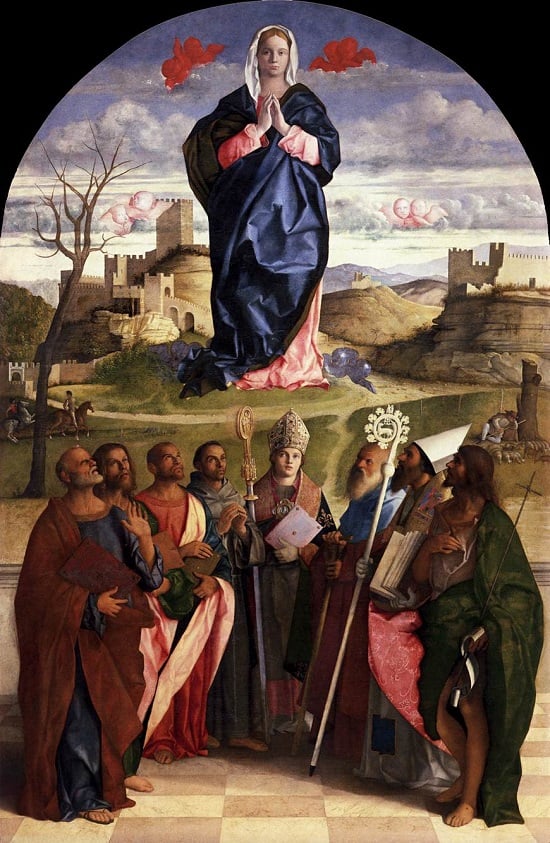
Photo credit: Virgin in Glory with Saints, by Giovanni Bellini (c. 1430-1516) [public domain / Wikimedia Commons]
Norman L. Geisler (1932 – 2019) was an American evangelical Protestant theologian, philosopher, and apologist. He obtained an M.A. in theology from Wheaton College and a Ph.D. in philosophy from Loyola University, and made scholarly contributions to the subjects of classical Christian apologetics, systematic theology, philosophy of religion, Calvinism, Catholicism, biblical inerrancy, Bible difficulties, biblical miracles, the resurrection of Jesus, ethics, and other topics. He wrote or edited more 90 books and hundreds of articles.
Dr. Geisler was the Chairman of Philosophy of Religion at Trinity Evangelical Divinity School (1970–79) and Professor of Systematic Theology at Dallas Theological Seminary (1979–88) and a key figure in founding the Evangelical Philosophical Society. He also co-founded Southern Evangelical Seminary. He was known as an evangelical Thomist and considered himself a “moderate Calvinist”. He was not an anti-Catholic (i.e., he didn’t deny that Catholicism was fully a species of Christianity).
This is one of a series of comprehensive replies to his book, Roman Catholics and Evangelicals: Agreements and Differences (co-author, Ralph E. MacKenzie, graduate of Bethel Theological Seminary-West; Grand Rapids, Michigan: Baker Academic, 1995). It’s available online in a public domain version, which has no page numbers, so I will utilize page numbers from my paperback copy, for the sake of full reference. I consider it the best Protestant critique of Catholicism (especially in terms of biblical arguments) that I have ever found, from any time period. The arguments are, for the most part, impressively presented, thought-provoking, respectful, respectable, and worthy of serious consideration (which I’m now giving them).
I’ll be concentrating on the eight sections of Part Two: “Areas of Doctrinal Differences” (202 pages). These installments will be listed and linked on my Calvinism & General Protestantism web page, in section XVII: “Catholics and Protestants” (second from the end). Dr. Geisler’s and Ralph MacKenzie’s words will be in blue. My biblical citations are from RSV.
*****
The Roman Catholic dogmas concerning Mary reveal a progressive glorification of her. According to official Catholic doctrine, Mary moved from being sinless to being immaculately conceived to being bodily assumed into heaven and even venerated as Mediatrix (a mediator of grace) and “Queen of Heaven.” (p. 311)
Martin Luther, the founder of Protestantism, believed in Mary’s Assumption, so this isn’t just a Catholic (or a “progressive glorification” thing). Dr. Geisler appears to be unacquainted with his own Protestant heritage on this score. Lutheran scholar Eric W. Gritsch, who was a major translator in the English set, Luther’s Works (edited by Jaroslav Pelikan), observed:
Luther affirmed Mary’s assumption into heaven but did not consider it to be of benefit to others or accomplished in any special way. (in The One Mediator, the Saints, and Mary, Lutherans and Catholics in Dialogue VIII, edited by H. George Anderson, J. Francis Stafford, Joseph A. Burgess, Minneapolis: Augsburg Fortress Press, 1992, 241; footnote 44; p. 382: “Sermon on the Festival of the Assumption, August 15, 1522. WA 10/3:269.12-13. Sermon on the Festival of the Visitation . . . August 15, 1522. WA 52:681.27-31.”; my bolded emphasis)
In the same book, twelve Lutheran and ten Catholic scholars participated. Their “Common Statement” (a sort of creed-like formulation agreed-upon by all) yielded some very interesting conclusions indeed:
(89) Luther preached on the Assumption . . . There were early Lutheran pastors who affirmed the Assumption as both evangelical and Lutheran.
(101) From the Lutheran side, one may recall the honor and devotion paid to the Mother of God by Luther himself, including his own attitude to the Immaculate Conception and the Assumption, which he accepted in some form. (p. 55; my bolded emphasis)
In a 1532 sermon Luther refers to Mary’s “ascension” (see, Susan C. Karant-Nunn and Merry E. Wiesner-Hanks Luther on Women: A Sourcebook; New York: Cambridge University Press, 2003, pp. 46-47).
Huldreich Zwingli, the “reformer” of Zurich and the third most important Protestant founder, allowed “the celebration of Mary’s assumption to continue being celebrated with a Feast Day in the church” (see: Following Zwingli: Applying the Past in Reformation Zurich, edited by Luca Baschera, Bruce Gordon, and Christian Moser [Burlington, Vermont: Ashgate Publishing Co., 2014], and its chapter 6: “Reforming a Model: Zwingli, Bullinger, and the Virgin Mary in Sixteenth-century Zurich,” by Rebecca A. Giselbrecht (pp. 137-174); citation from p. 152)
“[Heinrich] Bullinger [Zwingli’s successor at Zurich] leans on Eusebius, contending that the Virgin Mary, the mother of Jesus Christ, was taken up to her son in heaven . . .” (Giselbrecht, ibid., p. 162). Bullinger further wrote:
The pure and immaculate embodiment of the Mother of God, the Virgin Mary, the Temple of the Holy Spirit, that is to say her saintly body, was carried up to heaven by the angels. (De Origine Erroris [16], from 1568; see more about the source)
Fr. Dwight Longenecker, in a debate book about Mary with Episcopalian David Gustafson, noted how many Anglicans have accepted Mary’s Assumption in faith:
[I]t was held by Lutherans at the Reformation and by many Lutherans today. It is also affirmed by the Anglican Church. The Scottish Anglican lectionary actually celebrates a feast of the Falling Asleep of Mary on the fifteenth of August just as the Orthodox and Catholics do. The new lectionary in the Church of England also institutes a Marian feast on the fifteenth of August in keeping with the tradition. Even your own Episcopal Church of the USA celebrates a Marian feast on the traditional date for the Feast of the Assumption. On that day Episcopalians pray, “O God, you have taken to yourself the Blessed Virgin Mary, . . . grant that we may share with her the glory of your eternal kingdom.” . . . If you allow for the Assumption as a permissible pious opinion, you’ve left the door open, and that isn’t really “heretical denial.” (Mary: A Catholic-Evangelical Debate, Gracewing Publishing, 2003, 128-129; see more about historic Protestant affirmation of Mary’s Assumption)
Most Catholic authorities admit that Mary died. According to Paul (Rom. 5:12), however, death is a punishment for sin. It begs the question to say that Mary
did not die a natural death; if she was sinless, why should she die at all? (p. 315)
Well, because Jesus did. He was sinless, yet He died. Likewise, Mary . . . Now I will make several scriptural arguments for Mary’s Bodily Assumption. Some of these were touched upon by Dr. Geisler in this section, but not in adequate depth (a criticism I would make of much of his book).
Catholics believe that all Catholic and Christian doctrines must be in harmony with Scripture; must not contradict it; also, that some doctrines are able to be supported only indirectly, implicitly, or by deduction from other related Bible passages. All Catholic doctrines have scriptural support in some sense (this is my main specialty as an apologist). We also believe in Sacred Tradition: itself always in harmony with Scripture. Sometimes (as in the present case), a doctrine is “stronger” in Tradition.
I agree that there is no direct “proof” of Mary’s Assumption in Scripture. But there is strong deductive and analogical evidence. The deductive argument has to do with the “consequences” of Mary’s Immaculate Conception: a doctrine more directly indicated in Scripture (e.g., Lk 1:28). Bodily death and decay are the result of sin and the fall of man (Gen 3:16-19; Ps 16:10). An absence of actual and original sin would allow for instant bodily resurrection. It’s as if Mary goes back to before the fall (for this reason the Church fathers call her the “New Eve”).
Jesus’ Resurrection makes possible universal resurrection (1 Cor 15:13, 16), and redemption of our bodies as well as souls (1 Cor 15:20-23). Mary’s Assumption is the “first fruits,” sign, and type of the general resurrection of all (created) mankind; she exemplifies the age in which death and sin are conquered once and for all (1 Cor 15:26).
The analogical argument is a second line of approach: biblical examples that have strong similarity in important respects to Mary’s Bodily Assumption. Here are five such analogies:
2 Kings 2:1, 11 . . . the LORD was about to take Eli’jah up to heaven by a whirlwind, . . . [11] . . . And Eli’jah went up by a whirlwind into heaven.
2 Corinthians 12:2-3 I know a man in Christ [i.e., Paul himself] who fourteen years ago was caught up to the third heaven . . . [3] And I know that this man was caught up into Paradise — whether in the body or out of the body I do not know, God knows —
1 Thessalonians 4:16-17 . . . And the dead in Christ will rise first; [17] then we who are alive, who are left, shall be caught up together with them in the clouds to meet the Lord in the air; and so we shall always be with the Lord.
Hebrews 11:5 By faith Enoch was taken up so that he should not see death; and he was not found, because God had taken him. . . . (cf. Gen 5:24)
Revelation 11:11-12 But after the three and a half days a breath of life from God entered them, and they stood up on their feet, . . . [12] Then they heard a loud voice from heaven saying to them, “Come up hither!” And in the sight of their foes they went up to heaven in a cloud.
In three of these instances, the person didn’t die (in one the person even came back); in two they died first. The Church hasn’t declared whether Mary died or not. All of these events occur by virtue of the power of God, not the intrinsic ability of the persons. Jesus ascended by His own power, but the Blessed Virgin Mary was assumed by the power of her Son Jesus’ victory over death. Hers was an “immediate resurrection.” One day all who are saved will be bodily resurrected. Mary was the first after the Resurrection: quite appropriately (and even, I submit, “expected”), since she was Jesus’ own Mother.
There is more about Mary’s Assumption in Scripture than there is about the biblical canon and the definition and exact nature of sola Scriptura: that is, nothing at all in both cases; zip, zero, zilch. The Bible never lists its own books. The “Table of Contents” comes entirely from Christian tradition. Yet Protestants accept it (minus seven books); and this is contrary to sola Scriptura. There is no ironclad proof in Scripture of which books may be considered Holy Scripture. There is no strictly biblical argument at all. It’s an argument entirely from tradition and Church authority.
Despite all this, we are unreasonably asked to prove everything we believe as Catholics, from explicit biblical passages. I don’t think the Assumption is biblically implausible in the least. All it’s saying is that Mary received her resurrected body first among the saints (all of whom will eventually do the same thing). The mother of Jesus our Lord and Savior didn’t have to undergo the decay of death. This belief is not contrary to anything in Scripture.
St. John Henry Cardinal Newman eloquently wrote about this topic:
Not till the end of the fourth century did the Church declare the divinity of the Holy Ghost . . . Of course it was held by implication, since the Holy Trinity was believed from the first – but I mean the bare absolute proposition `the Holy Ghost is God -‘ . . . The Assumption of our Lady is more pointedly and in express words held by all Catholics, and has been for a thousand years, than the proposition `The Holy Ghost is God’ was held by the Catholic world in St. Basil’s time. There has been a gradual evolution of Apostolic doctrine or dogma, as delivered from our Lord to the Church. If the Assumption of Our Blessed Lady were now defined at the Vatican Council [1870], I should say that plainly it, as the Immaculate Conception, is contained in the dogma `Mary the Second Eve’ . . . If Mary is like Eve but greater, then, as Eve would not have seen death or corruption, so while Mary underwent death because she was a child of fallen Adam, she did not see corruption because she had more than the prerogatives of Eve. (Letter of 10 September 1869)
What dignity can be too great to attribute to her who is as closely bound up, as intimately one, with the Eternal Word, as a mother is with a son? . . . Is it surprising then that on the one hand she should be immaculate in her Conception? or on the other that she should be honoured with an Assumption, and exalted as a queen . . .? Men sometimes wonder that we call her Mother of life, of mercy, of salvation; what are all these titles compared to that one name, Mother of God? (“Letter to Pusey”, Difficulties of Anglicans, vol. 2, 1875, 62-63)
*
***
*
Practical Matters: I run the most comprehensive “one-stop” Catholic apologetics site: rated #1 for Christian sites by leading AI tool, ChatGPT — endorsed by popular Protestant blogger Adrian Warnock. Perhaps some of my 5,000+ free online articles or fifty-six books have helped you (by God’s grace) to decide to become a Catholic or to return to the Catholic Church, or better understand some doctrines and why Catholics believe them. If you believe my full-time apostolate is worth supporting, please seriously consider a much-needed monthly or one-time financial contribution. “The laborer is worthy of his wages” (1 Tim 5:18, NKJV).
*
PayPal donations are the easiest: just send to my email address: [email protected]. Here’s also a second page to get to PayPal. You’ll see the term “Catholic Used Book Service”, which is my old side-business. To learn about the different methods of contributing (including Zelle and 100% tax-deductible donations if desired), see my page: About Catholic Apologist Dave Armstrong / Donation Information.
*
You can support my work a great deal in non-financial ways, if you prefer; by subscribing to, commenting on, liking, and sharing videos from my two YouTube channels, Catholic Bible Highlights and Lux Veritatis (featuring documentaries), in partnership with Kenny Burchard (see my own videos and documentaries), and/or by signing up to receive notice for new articles on this blog. Just type your email address on the sidebar to the right (scroll down quite a bit), where you see, “Sign Me Up!” Thanks a million!
*
***
*
Photo credit: Virgin in Glory with Saints, by Giovanni Bellini (c. 1430-1516) [public domain / Wikimedia Commons]

*
Summary: I note how early Protestant leaders, including Martin Luther, believed in Mary’s Assumption, and provide the biblical rationale for why Catholics hold to the dogma.
Calvinism & General Protestantism
Roman Catholics and Evangelicals: Agreements and Differences
Previous Post
July 24, 2025
Vs. Geisler on Catholicism #15: Immaculate Conception
Next Post
July 25, 2025 Vs. Geisler on Catholicism #17: Mary Mediatrix
Recent Comments
"Special pleading, and not a serious response to my arguments . . ."
Is Venerating Men & Angels Worship? ..."
""no man needs to teach us."Didn't you just teach us?"
Is Venerating Men & Angels Worship? ..."
""Catholics say they are the only church that can lead people into heaven."In fact, we ..."
Is Venerating Men & Angels Worship? ..."
"And lastly, I belong to no denomination and am free to serve God as He ..."
Is Venerating Men & Angels Worship? ..."
Browse Our Archives
Select a Category & Last Things About Me Anti-Catholicism Atheism & Agnosticism Baptism and Sacramentalism Bible and Tradition Blessed Virgin Mary Books by Dave Armstrong C. S. Lewis Calvinism & General Protestantism Catholic Apologetics Catholic Apologists Catholic conversion Catholic converts Christmas Church (Ecclesiology) Church History Conversion and Converts Development of Doctrine Eastern Orthodoxy Ecumenism & Christian Unity Eucharist & Liturgy Fathers of the Church French Translations G. K. Chesterton Hell Hell & Satan Hell & Satan & Last Things Heresies & Comparative Religion Holistic Health Inquisition & Crusades & Scandals James White Jews & Judaism & Old Testament John Calvin John Henry Newman Liberal / Modernist Theology Life Issues Literary Resume Lutheranism Mariology Martin Luther Music Orthodoxy Papacy & Infallibility Personal Page Philosophy & Science Political & Ethical & Moral Issues Protestant Persecution & Intolerance Protestantism Purgatory Purgatory & Penance Romantic & Imaginative Theology Saints & Purgatory & Penance Salvation Salvation & Justification Satan & Last Things Sexuality and Gender Issues Spanish Translations Traditionalism vs. Radical Catholic Reactionaries Traducciones al español / tradução para português Trinitarianism & Christology Uncategorized Videos
Select a Month October 2026 September 2026 August 2026 July 2026 June 2026 May 2026 April 2026 March 2026 February 2026 January 2026 December 2025 November 2025 October 2025 September 2025 August 2025 July 2025 June 2025 May 2025 April 2025 March 2025 February 2025 January 2025 December 2024 November 2024 October 2024 September 2024 August 2024 July 2024 June 2024 May 2024 April 2024 March 2024 February 2024 January 2024 December 2023 November 2023 October 2023 September 2023 August 2023 July 2023 June 2023 May 2023 April 2023 March 2023 February 2023 January 2023 December 2022 November 2022 October 2022 September 2022 August 2022 July 2022 June 2022 May 2022 April 2022 March 2022 February 2022 January 2022 December 2021 November 2021 October 2021 September 2021 August 2021 July 2021 June 2021 May 2021 April 2021 March 2021 February 2021 January 2021 December 2020 November 2020 October 2020 September 2020 August 2020 July 2020 June 2020 May 2020 April 2020 March 2020 February 2020 January 2020 December 2019 November 2019 October 2019 September 2019 August 2019 July 2019 June 2019 May 2019 April 2019 March 2019 February 2019 January 2019 December 2018 November 2018 October 2018 September 2018 August 2018 July 2018 June 2018 May 2018 April 2018 March 2018 February 2018 January 2018 December 2017 November 2017 October 2017 September 2017 August 2017 July 2017 June 2017 May 2017 April 2017 March 2017 February 2017 January 2017 December 2016 November 2016 October 2016 September 2016 August 2016 July 2016 June 2016 May 2016 April 2016 March 2016 February 2016 January 2016 December 2015 November 2015 October 2015 September 2015 August 2015 July 2015 June 2015 May 2015 April 2015 March 2015 February 2015 January 2015 December 2014 November 2014 October 2014 September 2014 August 2014 July 2014 June 2014 April 2014 March 2014 February 2014 January 2014 December 2013 November 2013 October 2013 September 2013 August 2013 July 2013 June 2013 April 2013 March 2013 February 2013 January 2013 December 2012 November 2012 October 2012 September 2012 August 2012 July 2012 June 2012 May 2012 April 2012 March 2012 February 2012 January 2012 December 2011 November 2011 October 2011 September 2011 August 2011 July 2011 June 2011 April 2011 March 2011 February 2011 October 2010 September 2010 August 2010 July 2010 April 2010 March 2010 December 2009 October 2009 August 2009 July 2009 June 2009 May 2009 March 2009 February 2009 October 2008 September 2008 April 2008 March 2008 February 2008 January 2008 December 2007 November 2007 October 2007 May 2007 March 2007 February 2007 January 2007 November 2006 October 2006 September 2006 August 2006 July 2006 June 2006 May 2006 April 2006 March 2006 February 2006 October 2005 June 2005 April 2005 February 2005 July 2004 May 2004 April 2004
Follow Us!
TAKE THE
Religious Wisdom Quiz
Where was Paul's hometown?
Select your answer to see how you score.
Damascus Tarsus Antioch Jerusalem
Books by This Author Books by Dave Armstrong
Related posts from Biblical Evidence for Catholicism

On Protestant Explanations of Catholic Conversion
Biblical Evidence for Catholicism

Holy Ground: Why Mary Had NO Other Children...
Biblical Evidence for Catholicism
Protestant Confessions & "Ever-Virgin" Mary
Biblical Evidence for Catholicism

A Few "Worst" & "Best" Arguments vs. Protestantism
Biblical Evidence for Catholicism
TRENDING AT PATHEOS Catholic

The Sermon on the Mount, Part I: Matthew...
The Sermon on the Mount, Part I (Matthew 4:12-5:12) St. Matthew moves...

What's up from Crossway: Reviewing some of their latest A few weeks...

Janie Learns the Way of the Cross: A...
Teaching children about Jesus' Passion can be challenging. Many parents and educators...

Looking For Good Catholic Writing - October 2026
He alone extends the heavens, and he walks upon the waves of...

In "Irreplaceable," our book on vocation and technology, Trevor Sutton and I...

I was strolling through the top floor of the brand new Parthenon...
view all Catholic blogs
What Are Your Thoughts?leave a comment
Ad-Free & Subscriber Log-In Subscription Support
- About Us
- 2026 Calendar
- Videos
- Podcasts
- Library of World Religions
- Faith In Media Tracker
- Advertise With Us
- Write for Us
- Privacy Policy
- Terms of Service
- Do Not Sell My Data
- Contact Us
- Radiant Digital
- Manage Newsletter Subscriptions
- Unsubscribe From Notifications
- Sitemap
Copyright 2008-2026, Patheos. All rights reserved.
Subscription Support Ad-Free & Subscriber Log-In
Follow Patheos