
BuddhistCatholicContemplativeEvangelicalGeneral ChristianHinduJewishLatter-day SaintMuslimNew VisionsProgressive Christian
Beliefs
- Buddhist
- Catholic
- Contemplative
- Evangelical
- General Christian
- Hindu
- Jewish
- Latter-day Saint
- More Voices
- Muslim
- New Visions
- Pagan
- Progressive Christian
Topics
- Religion News
- Food and Religion
- Sports and Religion
- Religious Art
- Religious Music and Entertainment
- Religious Events
- History and Religion
- Style and Religion
- Politics and Religion
- Women in Religion
- Recreation Outdoors and Religion
- Business Finance and Religion
- Careers Workplace and Religion
- Education and Religion
- Family Parenting and Religion
- Health Fitness and Religion
- Home and Religion
- Relationships and Religion
- Technology and Religion
- Travel and Religion
Columnists
- Buddhist Columnists
- Business Finance and Religion Columnists
- Careers Workplace and Religion Columnists
- Catholic Columnists
- Contemplative Columnists
- Education and Religion Columnists
- Evangelists Columnists
- Family Parenting and Religion Columnists
- General Christian Columnists
- Health Fitness and Religion Columnists
- Hindu Columnists
- History and Religion Columnists
- Home and Religion Columnists
- Jewish Columnists
- More Voices Columnists
- Latter Day Columnists
- Muslim Columnists
- New Visions Columnists
- Nonreligious Columnists
- Pagan Columnists
- Politics and Religion Columnists
- Progressive Columnists
- Recreation Outdoors and Religion Columnists
- Relationships and Religion Columnists
- Religion News Columnists
- Religious Art Columnists
- Religious Events Columnists
- Religious Music and Entertainment Columnists
- Sports and Religion Columnists
- Style and Religion Columnists
- Technology and Religion Columnists
- Travel and Religion Columnists
- Women in Religion Columnists
Resource Library
- 2026 Calendar
- Library of World Religions
- The 100 Most Holy Places on Earth
- Patheos Answers
- Podcasts
- Videos
- Faith Leaders Database
- Anglican Episcopalian
- Bahai
- Baptist
- Buddhism
- Christianity
- Confucianism
- Eastern Orthodoxy
- Hinduism
- Holiness and Pentecostal
- ISKCON
- Islam
- Judaism
- Lutheran
- Methodist
- The Church of Jesus Christ of Latter-day Saints
- New Age
- Paganism
- Presbytarian and Reformed
- Protestantism
- Religion Behind the Scenes
- Roman Catholic
- Scientology
- Shia Islam
- Sikhism
- Sufism
- Sunni Islam
- Taoism
- Zen
- See all religions
Research Tools
 Ad-Free & Subscriber Log-In Subscription Support
Ad-Free & Subscriber Log-In Subscription Support
Follow Patheos 

- Trending:
- Forgiveness
- |
- Marriage
- |
- Consciousness
- |
- Death Penalty
- |
- Election
- |
- Halloween

-
About
-
Catholic Apologetics
-
Church History
-
Great Apologists
-
Christian Worldview
-
Protestantism & Misc.
- Home
- Catholic
- History and Religion
- Vs. Geisler on Catholicism #14: Mary’s Perpetual Virginity
Vs. Geisler on Catholicism #14: Mary’s Perpetual Virginity
Last updated on: June 6, 2026 at 12:05 am by Dave Armstrong
Vs. Geisler on Catholicism #14: Mary’s Perpetual Virginity 2026-06-06T00:05:36-04:00 Dave Armstrong
Patheos Explore the world's faith through different perspectives on religion and spirituality! Patheos has the views of the prevalent religions and spiritualities of the world.
Including Protestant Reformers & Aquinas On In Partu Virginity; Biblical Data on Jesus’ “Brothers”
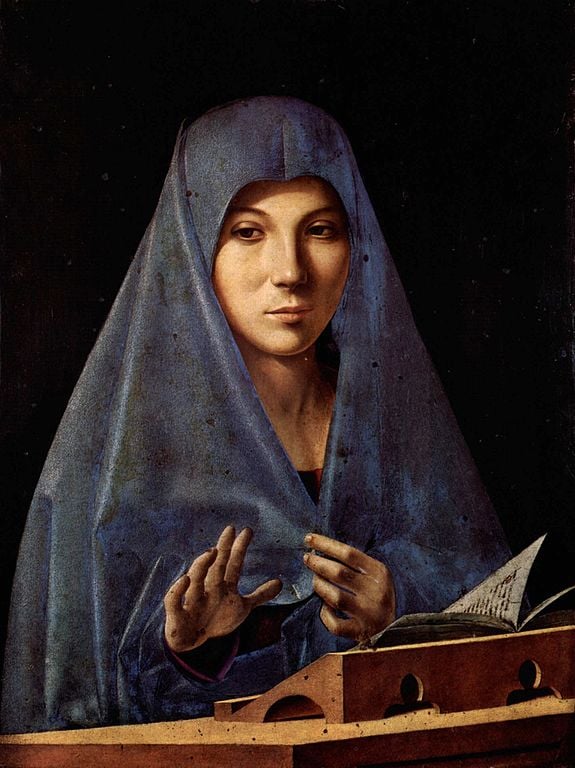
Photo credit: Virgin Annunciate (1475), by Antonello da Messina (1430-1479) [public domain / Wikimedia Commons]
Norman L. Geisler (1932 – 2019) was an American evangelical Protestant theologian, philosopher, and apologist. He obtained an M.A. in theology from Wheaton College and a Ph.D. in philosophy from Loyola University, and made scholarly contributions to the subjects of classical Christian apologetics, systematic theology, philosophy of religion, Calvinism, Catholicism, biblical inerrancy, Bible difficulties, biblical miracles, the resurrection of Jesus, ethics, and other topics. He wrote or edited more 90 books and hundreds of articles.
Dr. Geisler was the Chairman of Philosophy of Religion at Trinity Evangelical Divinity School (1970–79) and Professor of Systematic Theology at Dallas Theological Seminary (1979–88) and a key figure in founding the Evangelical Philosophical Society. He also co-founded Southern Evangelical Seminary. He was known as an evangelical Thomist and considered himself a “moderate Calvinist”. He was not an anti-Catholic (i.e., he didn’t deny that Catholicism was fully a species of Christianity).
This is one of a series of comprehensive replies to his book, Roman Catholics and Evangelicals: Agreements and Differences (co-author, Ralph E. MacKenzie, graduate of Bethel Theological Seminary-West; Grand Rapids, Michigan: Baker Academic, 1995). It’s available online in a public domain version, which has no page numbers, so I will utilize page numbers from my paperback copy, for the sake of full reference. I consider it the best Protestant critique of Catholicism (especially in terms of biblical arguments) that I have ever found, from any time period. The arguments are, for the most part, impressively presented, thought-provoking, respectful, respectable, and worthy of serious consideration (which I’m now giving them).
I’ll be concentrating on the eight sections of Part Two: “Areas of Doctrinal Differences” (202 pages). These installments will be listed and linked on my Calvinism & General Protestantism web page, in section XVII: “Catholics and Protestants” (second from the end). Dr. Geisler’s and Ralph MacKenzie’s words will be in blue. My biblical citations are from RSV.
*****
Catholics also believe, contrary to Protestants, that Jesus was also born in a way that left Mary a virgin.’ Ott puts it this way: “Mary bore her son without
any violation of her virginal integrity.” This is considered an official doctrine of Catholicism on the grounds of general proclamation. How this happened, however, is not a matter of Catholic dogma. Generally, traditional Catholic scholarship held that “Mary gave birth in miraculous fashion without opening of the womb and injury to the hymen, and consequently also without pains.” [citing Ludwig Ott, Fundamentals of Catholic Dogma, TAN Books, 1960, p. 205] (p. 300)
The idea of a miraculous birth of Christ, without coming through the birth canal or causing pain, is more Gnostic than Christian. It is more like an event found in a second- or third-century apocryphal book than a first-century inspired Book. (p. 301)
What is called Mary’s virginity “in partu” — virginity historically defined as an intact hymen, not simply absence of sexual relations — is not simply Catholic belief, because the founder of Protestantism, Martin Luther, also believed in it:
She brought forth without sin, without shame, without pain and without injury, just as she had conceived without sin. The curse of Eve did not come on her, where God said: “In pain thou shalt bring forth children,” Gen. 3:16; otherwise it was with her in every particular as with every woman who gives birth to a child. (Sermon for Christmas Eve; Luke 2:1-14, translated by George H. Trabert, 24 December 1521; in Vol. 1 of Sermons of Martin Luther, The Church Postils; edited and partially translated by John Nicholas Lenker, 8 volumes. Volumes 1-5 were originally published in Minneapolis by Lutherans of All Lands, 1904-1906; my bolding and italics)
She gave birth without labor, pain, and injury to herself, not as Eve and all other women, but because by the Holy Spirit and without sin, . . . (Personal Prayer Book, 1522, in Luther’s Works, vol. 43, p. 40; my italics and bolding)
Scripture stops with this, that she was a virgin before and at the birth of Christ; . . . (That Jesus Christ Was Born a Jew, May 1523, in Luther’s Works, Vol. 45, p. 206; my italics and bolding)
In chapter 7 he even describes the mother of Christ, the Virgin Mary, how she is to conceive and bear him with her virginity intact. (Preface to the Prophet Isaiah, 1528, in Luther’s Works, vol. 35, p. 275 [see an alternate translation]; my italics and bolding)
To his credit, Geisler does acknowledge that “Some Protestants have accepted Mary’s perpetual virginity, including Luther” (p. 301), even quoting Luther to the effect that he accepted Mary’s in partu virginity. That’s more than we get from most Protestant treatments of this topic. But he’s not presenting the whole truth, namely, that “classic” or “mainstream” Protestant or “Reformation” doctrine virtually unanimously concurred with Catholicism regarding Mary’s perpetual virginity, and to a lesser but still very significant degree, they also believed in her in partu virginity.
These beliefs were only discarded much later: generally during the period of increasing liberalization of Protestant theological beliefs in the 18th-19th centuries. Here are three more early Protestant leaders who believed in in partu virginity:
Huldreich Zwingli, the third most important early Protestant leader after Luther and Calvin, also believed in Mary’s in partu virginity:
To deny that Mary remained ‘inviolata’ before, during and after the birth of her Son, was to doubt the omnipotence of God . . . and it was right and profitable to repeat the angelic greeting – not prayer – ‘Hail Mary’ . . . God esteemed Mary above all creatures, including the saints and angels – it was her purity, innocence and invincible faith that mankind must follow. (The Perpetual Virginity of Mary, September 17, 1522; noted in G. R. Potter, Zwingli [London: Cambridge Univ. Press, 1976], pp. 88-89; my italics and bolding)
I believe with all my heart according to the word of holy gospel that this pure virgin bore for us the Son of God and that she remained, in the birth and after it, a pure and unsullied virgin, for eternity. (Sermon: Mary, Ever Virgin, Mother of God, in 1524, cited in Max Thurian, Mary: Mother of All Christians [New York, Herder and Herder, 1963] p. 76; primary source listed on p. 196: Collected Works, Berlin, I, 391-428; my italics and bolding)
Heinrich Bullinger, Zwingli’s successor at Zurich, and also one of the most important of the early Protestant leaders or “reformers”, concurred. Catholic scholar Hilda Graef describes his view:
He defends Mary’s perpetual virginity, including the virginity in partu . . . (Mary: A History of Doctrine and Devotion, revised edition, Ave Maria Press, 2009, p. 15)
Early Anglican leader Thomas Cranmer also appears to agree with this perspective.
*
We agree that Scripture says very little explicitly about Mary’s in partu virginity. Some scriptural arguments are made by analogy (e.g., Ezekiel 44:2: “This gate shall remain shut; it shall not be opened, and no one shall enter by it; for the LORD, the God of Israel, has entered by it; therefore it shall remain shut.”). No less than St. Augustine and St. Thomas Aquinas made that argument. Catholics contend that it is primarily an argument from “fittingness” or propriety (itself a biblical concept) and a further protection of the doctrine of the incarnation.
I elaborate upon this in my article, “Holy Ground” & Mary’s Perpetual Virginity [5-24-16]. Geisler mentions it by noting that “Pope Siricius (A.D. 384-399), . . . argued that it would be horrifying to think of another birth issuing from the same virginal womb from which the Son of God was born” (p. 301).
*
St. Thomas Aquinas, in his Summa Theologica (Third Part: Question 28. The virginity of the Mother of God) brilliantly lays out the case for in partu virginity from reason and fittingness, based on Scripture:
Article 2. Whether Christ’s Mother was a virgin in His birth?
[. . .]
In a sermon of the Council of Ephesus (P. III, Cap. ix) it is said: “After giving birth, nature knows not a virgin: but grace enhances her fruitfulness, and effects her motherhood, while in no way does it injure her virginity.” Therefore Christ’s Mother was a virgin also in giving birth to Him.
I answer that, Without any doubt whatever we must assert that the Mother of Christ was a virgin even in His Birth: for the prophet says not only: “Behold a virgin shall conceive,” but adds: “and shall bear a son.” [Is 7:14; cited in Mt 1:22-23] This indeed was befitting for three reasons. First, because this was in keeping with a property of Him whose Birth is in question, for He is the Word of God. For the word is not only conceived in the mind without corruption, but also proceeds from the mind without corruption. Wherefore in order to show that body to be the body of the very Word of God, it was fitting that it should be born of a virgin incorrupt. Whence in the sermon of the Council of Ephesus (quoted above) we read: “Whosoever brings forth mere flesh, ceases to be a virgin. But since she gave birth to the Word made flesh, God safeguarded her virginity so as to manifest His Word, by which Word He thus manifested Himself: for neither does our word, when brought forth, corrupt the mind; nor does God, the substantial Word, deigning to be born, destroy virginity.”
Secondly, this is fitting as regards the effect of Christ’s Incarnation: since He came for this purpose, that He might take away our corruption. Wherefore it is unfitting that in His Birth He should corrupt His Mother’s virginity. Thus Augustine says in a sermon on the Nativity of Our Lord: “It was not right that He who came to heal corruption, should by His advent violate integrity.”
Thirdly, it was fitting that He Who commanded us to honor our father and mother should not in His Birth lessen the honor due to His Mother.
Reply to Objection 1. Ambrose says this in expounding the evangelist’s quotation from the Law: “Every male opening the womb shall be called holy to the Lord.” This, says Bede, “is said in regard to the wonted manner of birth; not that we are to believe that our Lord in coming forth violated the abode of her sacred womb, which His entrance therein had hallowed.” Wherefore the opening here spoken of does not imply the unlocking of the enclosure of virginal purity; but the mere coming forth of the infant from the maternal womb.
Reply to Objection 2. Christ wished so to show the reality of His body, as to manifest His Godhead at the same time. For this reason He mingled wondrous with lowly things. Wherefore, to show that His body was real, He was born of a woman. But in order to manifest His Godhead, He was born of a virgin, for “such a Birth befits a God,” as Ambrose says in the Christmas hymn.
Reply to Objection 3. Some have held that Christ, in His Birth, assumed the gift of “subtlety,” when He came forth from the closed womb of a virgin; and that He assumed the gift of “agility” when with dry feet He walked on the sea. But this is not consistent with what has been decided above (Article 14). For these gifts of a glorified body result from an overflow of the soul’s glory on to the body, as we shall explain further on, in treating of glorified bodies (Supplement:82): and it has been said above (III:13:3 ad 1; III:16:1 ad 2) that before His Passion Christ “allowed His flesh to do and to suffer what was proper to it” (Damascene, De Fide Orth. iii): nor was there such an overflow of glory from His soul on to His body.
We must therefore say that all these things took place miraculously by Divine power. Whence Augustine says (Sup. Joan. Tract. 121): “To the substance of a body in which was the Godhead closed doors were no obstacle. For truly He had power to enter in by doors not open, in Whose Birth His Mother’s virginity remained inviolate.” And Dionysius says in an epistle (Ad Caium iv) that “Christ excelled man in doing that which is proper to man: this is shown in His supernatural conception, of a virgin, and in the unstable waters bearing the weight of earthly feet.”
Article 3. Whether Christ’s Mother remained a virgin after His birth?
[. . .]
It is written (Ezekiel 44:2): “This gate shall be shut, it shall not be opened, and no man shall pass through it; because the Lord the God of Israel hath entered in by it.” Expounding these words, Augustine says in a sermon (De Annunt. Dom. iii): “What means this closed gate in the House of the Lord, except that Mary is to be ever inviolate? What does it mean that ‘no man shall pass through it,’ save that Joseph shall not know her? And what is this—’The Lord alone enters in and goeth out by it’—except that the Holy Ghost shall impregnate her, and that the Lord of angels shall be born of her? And what means this—’it shall be shut for evermore’—but that Mary is a virgin before His Birth, a virgin in His Birth, and a virgin after His Birth?”
I answer that, Without any hesitation we must abhor the error of Helvidius, who dared to assert that Christ’s Mother, after His Birth, was carnally known by Joseph, and bore other children. For, in the first place, this is derogatory to Christ’s perfection: for as He is in His Godhead the Only-Begotten of the Father, being thus His Son in every respect perfect, so it was becoming that He should be the Only-begotten son of His Mother, as being her perfect offspring.
Secondly, this error is an insult to the Holy Ghost, whose “shrine” was the virginal womb [“Sacrarium Spiritus Sancti” (Office of B. M. V., Ant. ad Benedictus, T. P.), wherein He had formed the flesh of Christ: wherefore it was unbecoming that it should be desecrated by intercourse with man.
Thirdly, this is derogatory to the dignity and holiness of God’s Mother: for thus she would seem to be most ungrateful, were she not content with such a Son; and were she, of her own accord, by carnal intercourse to forfeit that virginity which had been miraculously preserved in her.
Fourthly, it would be tantamount to an imputation of extreme presumption in Joseph, to assume that he attempted to violate her whom by the angel’s revelation he knew to have conceived by the Holy Ghost.
We must therefore simply assert that the Mother of God, as she was a virgin in conceiving Him and a virgin in giving Him birth, did she remain a virgin ever afterwards.
There are clear references to Jesus’ brothers and sisters in the context of his immediate family (namely, his legal father and actual mother), which almost always indicate they were actual brothers, not cousins, as many Catholics believe. For example, Matthew 13:55 declares: “Is he not the carpenter’s son? Is not his mother Mary and his brothers James, Joseph, Simon, and Judas? Are not his sisters all with us?” (cf. Matt. 12:46 and Gal. 1:19). There are several reasons why this text almost certainly indicates that Mary had other children after Jesus. For one thing, “brothers” and “sisters” are mentioned in the context of the family with the “carpenter’s son” and “mother,” which clearly indicates they are immediate blood brothers. For another, the Greek term for “brother” (adelphos) here is the normal word for “blood brother.” In fact, there is no a single example where adelphos is used for “cousin” in the New Testament. There is a word for “cousin” (anepsios), as in Colossians 4:10, where Mark is described as “the cousin [anepsios] of Barnabas.” But this word is not used in Matthew 13 or in any passage referring to Jesus’ brothers and sisters. Finally, the words “brother” and “sister” are used many other times in the New Testament in a family connection, always meaning a literal blood brother or sister (Mark 1:16, 19; 13:12; John 11:1-2; Acts 23:16; Rom. 16:15). (pp. 302-303)
In view of all this biblical evidence, there seems to be no real scriptural basis for the Catholic belief in Mary’s perpetual virginity. (p. 303)
The idea that Mary had children after Jesus is only “horrifying,” as some Catholics claim, if one presupposes some kind of Gnostic concept of virginal purity. (p. 303)
Jesus Himself appears to refer to those often called His “brothers” in the Bible as “kin” or “cousins”:
Mark 6:3-4 Is not this the carpenter, the son of Mary and brother of James and Joses and Judas and Simon, and are not his sisters here with us?” And they took offense at him. [4] And Jesus said to them, “A prophet is not without honor, except in his own country, and among his own kin, and in his own house.” (cf. Mt 13:57: “in his own country and in his own house”; Lk 4:24: “no prophet is acceptable in his own country.”)
“Kin” is a translation of the Greek word, suggenes / συγγενής which means “relative” and can also mean “cousin” according to Strong’s Exhaustive Concordance. See Strong’s word #4773 . KJV translates it as Mary’s “cousin Elisabeth” in Luke 1:36 and “her cousins” in Luke 1:58, and elsewhere usually as “kinsmen” but never “brother.” NASB usually renders it “relatives” (and “kinsmen” a few times, too).
*
I submit, then, that Jesus is referring to some of His named “brothers” in Mark 6:3 as cousins or non-sibling relatives in Mark 6:4, by referring to them as suggenes / συγγενής (“kin” in RSV). The idea ties in with John 7:5: “For even his brothers [adelphos] did not believe in him.” Thus, they are mentioned in the scene in Nazareth where Jesus was rejected, and so Jesus noted that a “prophet” didn’t receive “honor” from “his own kin.” They later likely became believers, but at this point, before the Holy Spirit was given, they didn’t yet “get” it.
*
The ones called his “brothers” are the only relatives described as not believing in Him. Thus, it’s quite plausible — along with immediate context — that these are the ones Jesus refers to as cousins. It can mean “kinsman” or “countrymen” etc., but in the Bible Gateway page that lists many Bible translations for Luke 1:36 (Elizabeth), “cousin” is the translation of suggenes used in 17 of them.
*
Geisler makes many mini-biblical arguments above. I have several of my own, too (and have collected 50 elsewhere):
*
1) The New Testament never uses the phrases, “son[s] of Mary” or “son[s] of Joseph” for anyone besides Jesus.
2) “Son of Mary” appears once, referring to Jesus (Mk 6:3 above). He is called “brother” of four men and “his sisters” are mentioned. Yet none of them are called “sons / daughters” of Mary or Joseph.
3) The phrase, “Mary’s sons” never appears in the New Testament.
4) Neither one of the phrases, “daughter[s] of Mary” or “Mary’s daughter[s]” ever appear in the New Testament.
5) “Son of Joseph” (referring to the carpenter from Nazareth) appears twice: both times referring to Jesus (Jn 1:45; 6:42).
6) “Sons of Joseph” appears once (Heb 11:21), but unfortunately for deniers of Mary’s perpetual virginity, it refers to the patriarch Joseph. Why is that, if these are his sons and Jesus’ supposed siblings?
7) The phrase, “Joseph’s sons” never appears in the New Testament.
8) The phrase, “Daughter[s] of Joseph” never appears in the New Testament.
9) The phrase, “Joseph’s daughter[s]” never appears in the New Testament.
10) Mary is never called the “mother” of these alleged siblings of Jesus, whereas she is called Jesus’ “mother” (Jn 2:1; 19:25).
11) In the following two passages, these “brothers” were mentioned but Mary wasn’t called their mother; only Jesus‘ mother:
Matthew 13:55 “Is not this the carpenter’s son? Is not his mother called Mary? And are not his brothers James and Joseph and Simon and Judas?”
Acts 1:14 All these with one accord devoted themselves to prayer, together with the women and Mary the mother of Jesus, and with his brothers.
Doesn’t it stand to reason and isn’t it common sense — if these “brothers” were indeed the siblings of Jesus –, that Acts 1:14 would read, instead, something like: “Mary the mother of Jesus and his brothers”? Then we wouldn’t be having this dispute; it would have been so clear and undeniable. A similar argument could be made for Mark 6:3.
*
Why wouldn’t God have made it easy to understand and logically and grammatically impossible to deny, if Jesus had siblings? Holy Scripture is always very clear (with a little of the necessary study of hermeneutics and exegesis). There were many opportunities and contexts in the New Testament where this could easily have taken place, but for some odd reason (maybe because the notion of Jesus having siblings is a falsehood and not historical fact?) it never does.
*
*
***
*
Practical Matters: I run the most comprehensive “one-stop” Catholic apologetics site: rated #1 for Christian sites by leading AI tool, ChatGPT — endorsed by popular Protestant blogger Adrian Warnock. Perhaps some of my 5,000+ free online articles or fifty-six books have helped you (by God’s grace) to decide to become a Catholic or to return to the Catholic Church, or better understand some doctrines and why Catholics believe them. If you believe my full-time apostolate is worth supporting, please seriously consider a much-needed monthly or one-time financial contribution. “The laborer is worthy of his wages” (1 Tim 5:18, NKJV).
*
PayPal donations are the easiest: just send to my email address: [email protected]. Here’s also a second page to get to PayPal. You’ll see the term “Catholic Used Book Service”, which is my old side-business. To learn about the different methods of contributing (including Zelle and 100% tax-deductible donations if desired), see my page: About Catholic Apologist Dave Armstrong / Donation Information.
*
You can support my work a great deal in non-financial ways, if you prefer; by subscribing to, commenting on, liking, and sharing videos from my two YouTube channels, Catholic Bible Highlights and Lux Veritatis (featuring documentaries), in partnership with Kenny Burchard (see my own videos and documentaries), and/or by signing up to receive notice for new articles on this blog. Just type your email address on the sidebar to the right (scroll down quite a bit), where you see, “Sign Me Up!” Thanks a million!
*
***
*
Photo credit: Virgin Annunciate (1475), by Antonello da Messina (1430-1479) [public domain / Wikimedia Commons]

*
Summary: I discuss the Catholic & biblical notion of virginity “in partu” (during birth): held by several Protestant founders, & present biblical arguments for Mary’s perpetual virginity.
Calvinism & General Protestantism
Roman Catholics and Evangelicals: Agreements and Differences
Previous Post
July 22, 2025
Vs. Geisler on Catholicism #13: Church & Ecclesiology
Next Post
July 24, 2025 Vs. Geisler on Catholicism #15: Immaculate Conception
Recent Comments
"And lastly, I belong to no denomination and am free to serve God as He ..."
Is Venerating Men & Angels Worship? ..."
"And obeisance doesn't mean "worship". It means "respect", "obey", or "submission". Very weird that you ..."
Is Venerating Men & Angels Worship? ..."
"Many of these scriptures you have noted have been taken out of context. With Daniel, ..."
Is Venerating Men & Angels Worship? ..."
""Protestants often point out that Jesus is now triumphant in heaven and object to Catholics ..."
Three More Anti-Catholic Lies About Catholicism ..."
Browse Our Archives
Select a Category & Last Things About Me Anti-Catholicism Atheism & Agnosticism Baptism and Sacramentalism Bible and Tradition Blessed Virgin Mary Books by Dave Armstrong C. S. Lewis Calvinism & General Protestantism Catholic Apologetics Catholic Apologists Catholic conversion Catholic converts Christmas Church (Ecclesiology) Church History Conversion and Converts Development of Doctrine Eastern Orthodoxy Ecumenism & Christian Unity Eucharist & Liturgy Fathers of the Church French Translations G. K. Chesterton Hell Hell & Satan Hell & Satan & Last Things Heresies & Comparative Religion Holistic Health Inquisition & Crusades & Scandals James White Jews & Judaism & Old Testament John Calvin John Henry Newman Liberal / Modernist Theology Life Issues Literary Resume Lutheranism Mariology Martin Luther Music Orthodoxy Papacy & Infallibility Personal Page Philosophy & Science Political & Ethical & Moral Issues Protestant Persecution & Intolerance Protestantism Purgatory Purgatory & Penance Romantic & Imaginative Theology Saints & Purgatory & Penance Salvation Salvation & Justification Satan & Last Things Sexuality and Gender Issues Spanish Translations Traditionalism vs. Radical Catholic Reactionaries Traducciones al español / tradução para português Trinitarianism & Christology Uncategorized Videos
Select a Month October 2026 September 2026 August 2026 July 2026 June 2026 May 2026 April 2026 March 2026 February 2026 January 2026 December 2025 November 2025 October 2025 September 2025 August 2025 July 2025 June 2025 May 2025 April 2025 March 2025 February 2025 January 2025 December 2024 November 2024 October 2024 September 2024 August 2024 July 2024 June 2024 May 2024 April 2024 March 2024 February 2024 January 2024 December 2023 November 2023 October 2023 September 2023 August 2023 July 2023 June 2023 May 2023 April 2023 March 2023 February 2023 January 2023 December 2022 November 2022 October 2022 September 2022 August 2022 July 2022 June 2022 May 2022 April 2022 March 2022 February 2022 January 2022 December 2021 November 2021 October 2021 September 2021 August 2021 July 2021 June 2021 May 2021 April 2021 March 2021 February 2021 January 2021 December 2020 November 2020 October 2020 September 2020 August 2020 July 2020 June 2020 May 2020 April 2020 March 2020 February 2020 January 2020 December 2019 November 2019 October 2019 September 2019 August 2019 July 2019 June 2019 May 2019 April 2019 March 2019 February 2019 January 2019 December 2018 November 2018 October 2018 September 2018 August 2018 July 2018 June 2018 May 2018 April 2018 March 2018 February 2018 January 2018 December 2017 November 2017 October 2017 September 2017 August 2017 July 2017 June 2017 May 2017 April 2017 March 2017 February 2017 January 2017 December 2016 November 2016 October 2016 September 2016 August 2016 July 2016 June 2016 May 2016 April 2016 March 2016 February 2016 January 2016 December 2015 November 2015 October 2015 September 2015 August 2015 July 2015 June 2015 May 2015 April 2015 March 2015 February 2015 January 2015 December 2014 November 2014 October 2014 September 2014 August 2014 July 2014 June 2014 April 2014 March 2014 February 2014 January 2014 December 2013 November 2013 October 2013 September 2013 August 2013 July 2013 June 2013 April 2013 March 2013 February 2013 January 2013 December 2012 November 2012 October 2012 September 2012 August 2012 July 2012 June 2012 May 2012 April 2012 March 2012 February 2012 January 2012 December 2011 November 2011 October 2011 September 2011 August 2011 July 2011 June 2011 April 2011 March 2011 February 2011 October 2010 September 2010 August 2010 July 2010 April 2010 March 2010 December 2009 October 2009 August 2009 July 2009 June 2009 May 2009 March 2009 February 2009 October 2008 September 2008 April 2008 March 2008 February 2008 January 2008 December 2007 November 2007 October 2007 May 2007 March 2007 February 2007 January 2007 November 2006 October 2006 September 2006 August 2006 July 2006 June 2006 May 2006 April 2006 March 2006 February 2006 October 2005 June 2005 April 2005 February 2005 July 2004 May 2004 April 2004
Follow Us!
TAKE THE
Religious Wisdom Quiz
Who boldly risked her life to save her people with the phrase, "If I perish, I perish"?
Select your answer to see how you score.
Hannah Deborah Esther Ruth
Books by This Author Books by Dave Armstrong
Related posts from Biblical Evidence for Catholicism

On Protestant Explanations of Catholic Conversion
Biblical Evidence for Catholicism

Holy Ground: Why Mary Had NO Other Children...
Biblical Evidence for Catholicism
Protestant Confessions & "Ever-Virgin" Mary
Biblical Evidence for Catholicism

A Few "Worst" & "Best" Arguments vs. Protestantism
Biblical Evidence for Catholicism
TRENDING AT PATHEOS Catholic

I was strolling through the top floor of the brand new Parthenon...

What Does Gêvâh Mean For Kimberley Guifoyle &...
This week, a lot of the news is focused on Kimberly Guilfoyle....

INNER CIRCLE: Profound Mystery (Of Christ In All...
Ephesians 5:31-32 “For this reason, a man will leave his father and...

Do Not Rejoice When Your Enemy Falls: The...
Turning an execution into a public spectacle is a disturbing expression of...

'The Chosen' S6 Trailer: The Passion Gets Very...
Not many watching 'The Chosen' worry about spoilers, but just because they...

The purpose-driven labor priest
A labor activist reads Rick Warren and it gets me wondering about...
view all Catholic blogs
What Are Your Thoughts?leave a comment
Ad-Free & Subscriber Log-In Subscription Support
- About Us
- 2026 Calendar
- Videos
- Podcasts
- Library of World Religions
- Faith In Media Tracker
- Advertise With Us
- Write for Us
- Privacy Policy
- Terms of Service
- Do Not Sell My Data
- Contact Us
- Radiant Digital
- Manage Newsletter Subscriptions
- Unsubscribe From Notifications
- Sitemap
Copyright 2008-2026, Patheos. All rights reserved.
Subscription Support Ad-Free & Subscriber Log-In
Follow Patheos