
BuddhistCatholicContemplativeEvangelicalGeneral ChristianHinduJewishLatter-day SaintMuslimNew VisionsProgressive Christian
Beliefs
- Buddhist
- Catholic
- Contemplative
- Evangelical
- General Christian
- Hindu
- Jewish
- Latter-day Saint
- More Voices
- Muslim
- New Visions
- Pagan
- Progressive Christian
Topics
- Religion News
- Food and Religion
- Sports and Religion
- Religious Art
- Religious Music and Entertainment
- Religious Events
- History and Religion
- Style and Religion
- Politics and Religion
- Women in Religion
- Recreation Outdoors and Religion
- Business Finance and Religion
- Careers Workplace and Religion
- Education and Religion
- Family Parenting and Religion
- Health Fitness and Religion
- Home and Religion
- Relationships and Religion
- Technology and Religion
- Travel and Religion
Columnists
- Buddhist Columnists
- Business Finance and Religion Columnists
- Careers Workplace and Religion Columnists
- Catholic Columnists
- Contemplative Columnists
- Education and Religion Columnists
- Evangelists Columnists
- Family Parenting and Religion Columnists
- General Christian Columnists
- Health Fitness and Religion Columnists
- Hindu Columnists
- History and Religion Columnists
- Home and Religion Columnists
- Jewish Columnists
- More Voices Columnists
- Latter Day Columnists
- Muslim Columnists
- New Visions Columnists
- Nonreligious Columnists
- Pagan Columnists
- Politics and Religion Columnists
- Progressive Columnists
- Recreation Outdoors and Religion Columnists
- Relationships and Religion Columnists
- Religion News Columnists
- Religious Art Columnists
- Religious Events Columnists
- Religious Music and Entertainment Columnists
- Sports and Religion Columnists
- Style and Religion Columnists
- Technology and Religion Columnists
- Travel and Religion Columnists
- Women in Religion Columnists
Resource Library
- 2026 Calendar
- Library of World Religions
- The 100 Most Holy Places on Earth
- Patheos Answers
- Podcasts
- Videos
- Faith Leaders Database
- Anglican Episcopalian
- Bahai
- Baptist
- Buddhism
- Christianity
- Confucianism
- Eastern Orthodoxy
- Hinduism
- Holiness and Pentecostal
- ISKCON
- Islam
- Judaism
- Lutheran
- Methodist
- The Church of Jesus Christ of Latter-day Saints
- New Age
- Paganism
- Presbytarian and Reformed
- Protestantism
- Religion Behind the Scenes
- Roman Catholic
- Scientology
- Shia Islam
- Sikhism
- Sufism
- Sunni Islam
- Taoism
- Zen
- See all religions
Research Tools
 Ad-Free & Subscriber Log-In Subscription Support
Ad-Free & Subscriber Log-In Subscription Support
Follow Patheos 

- Trending:
- Forgiveness
- |
- Marriage
- |
- Consciousness
- |
- Death Penalty
- |
- Election
- |
- Halloween

-
About
-
Catholic Apologetics
-
Church History
-
Great Apologists
-
Christian Worldview
-
Protestantism & Misc.
- Home
- Catholic
- History and Religion
- Vs. Geisler on Catholicism #13: Church & Ecclesiology
Vs. Geisler on Catholicism #13: Church & Ecclesiology
Last updated on: July 22, 2025 at 10:10 am by Dave Armstrong
Vs. Geisler on Catholicism #13: Church & Ecclesiology 2025-07-22T10:10:14-04:00 Dave Armstrong
Patheos Explore the world's faith through different perspectives on religion and spirituality! Patheos has the views of the prevalent religions and spiritualities of the world.
Including Authority in the Church; Paul the “Lone Ranger”?; Apostolic Succession: Five Biblical Proofs
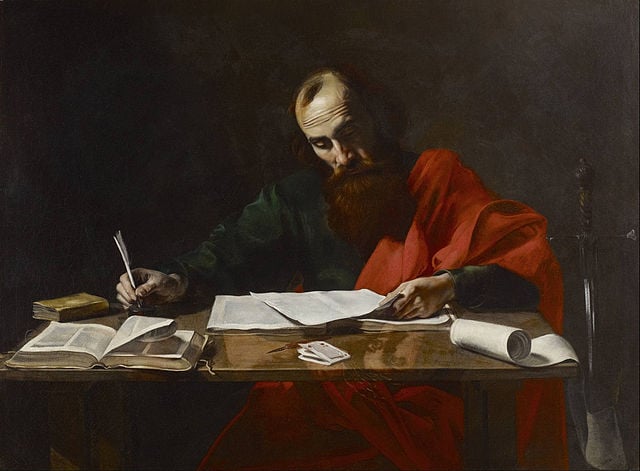
Photo credit: Saint Paul Writing His Epistles (c. 1618-1620); attributed to Valentin de Boulogne (1591-1632) [public domain / Wikimedia Commons]
Norman L. Geisler (1932 – 2019) was an American evangelical Protestant theologian, philosopher, and apologist. He obtained an M.A. in theology from Wheaton College and a Ph.D. in philosophy from Loyola University, and made scholarly contributions to the subjects of classical Christian apologetics, systematic theology, philosophy of religion, Calvinism, Catholicism, biblical inerrancy, Bible difficulties, biblical miracles, the resurrection of Jesus, ethics, and other topics. He wrote or edited more 90 books and hundreds of articles.
Dr. Geisler was the Chairman of Philosophy of Religion at Trinity Evangelical Divinity School (1970–79) and Professor of Systematic Theology at Dallas Theological Seminary (1979–88) and a key figure in founding the Evangelical Philosophical Society. He also co-founded Southern Evangelical Seminary. He was known as an evangelical Thomist and considered himself a “moderate Calvinist”. He was not an anti-Catholic (i.e., he didn’t deny that Catholicism was fully a species of Christianity).
This is one of a series of comprehensive replies to his book, Roman Catholics and Evangelicals: Agreements and Differences (co-author, Ralph E. MacKenzie, graduate of Bethel Theological Seminary-West; Grand Rapids, Michigan: Baker Academic, 1995). It’s available online in a public domain version, which has no page numbers, so I will utilize page numbers from my paperback copy, for the sake of full reference. I consider it the best Protestant critique of Catholicism (especially in terms of biblical arguments) that I have ever found, from any time period. The arguments are, for the most part, impressively presented, thought-provoking, respectful, respectable, and worthy of serious consideration (which I’m now giving them).
I’ll be concentrating on the eight sections of Part Two: “Areas of Doctrinal Differences” (202 pages). These installments will be listed and linked on my Calvinism & General Protestantism web page, in section XVII: “Catholics and Protestants” (second from the end). Dr. Geisler’s and Ralph MacKenzie’s words will be in blue. My biblical citations are from RSV.
*****
Romans 1:5. Based on this text, Catholics claim that “The teaching office [of the Roman Catholic Church] demands from its incumbents the duty of obedience to the faith.” This is not, however, supported by this text which states: “Through him [Christ] we have received the grace of apostleship, to bring about the obedience of faith.” First, Paul is speaking here about his apostleship (v. 1), not that of Peter, to say nothing of Peter’s alleged successors, Roman Catholic popes. (p. 274)
Clearly, the “commands” to be “observed” were those of Christ (Matt. 28:20), not those of any alleged representative of Christ on earth (like Peter). (p. 281)
Dr. Geisler is getting way ahead of himself. Before we get to the papacy, we have to first discuss whether an authoritative, hierarchical, episcopal Church is taught in the Bible, and whether believers are obliged to obey its rules and injunctions. It’s clear in the Bible that both things are true. Paul’s statement is echoed elsewhere:
Acts 15:6, 23, 28 The apostles and the elders were gathered together to consider this matter. . . . [23] w. . . “The brethren, both the apostles and the elders, to the brethren who are of the Gentiles in Antioch and Syria and Cilicia, greeting. . . . [28] For it has seemed good to the Holy Spirit and to us to lay upon you no greater burden than these necessary things:
1 Corinthians 10:32 Give no offense to Jews or to Greeks or to the church of God,
1 Timothy 3:1-2 The saying is sure: If any one aspires to the office of bishop, he desires a noble task. [2] Now a bishop must be above reproach, the husband of one wife, temperate, sensible, dignified, hospitable, an apt teacher, (cf. Phil 1:1; Titus 1:7)
1 Timothy 3:15 . . . the household of God, which is the church of the living God, the pillar and bulwark of the truth.
1 Timothy 5:17 Let the elders who rule well be considered worthy of double honor, especially those who labor in preaching and teaching;
Titus 3:1 Remind them to be submissive to rulers and authorities, to be obedient, . . .
Hebrews 13:17 Obey your leaders and submit to them; for they are keeping watch over your souls, as men who will have to give account. Let them do this joyfully, and not sadly, for that would be of no advantage to you.
1 Peter 5:5 Likewise you that are younger be subject to the elders. . . .
It is also incorrect to regard St. Paul as some kind of spiritual “lone ranger,” on his own with no particular ecclesiastical allegiance (as evangelicals like Dr. Geisler tend to do), since he was commissioned by Jesus Himself as an apostle. In his very conversion experience, Jesus informed Paul that he would be told what to do (Acts 9:6; cf. 9:17). Ananias guided him at first. He went to see St. Peter in Jerusalem for fifteen days in order to be confirmed in his calling (Gal 1:18), and fourteen years later was commissioned by Peter, James, and John (Gal 2:1-2, 9). He was also sent out by the Church at Antioch (Acts 13:1-4), which was in contact with the Church at Jerusalem (Acts 11:19-27). Later on, Paul reported back to Antioch (Acts 14:26-28).
St. Paul seems to have been a lesser figure than Peter and even James at the council of Jerusalem (Acts 15). The Bible doesn’t record any of his words at the council. It simply states that he and Barnabas “declared all that God had done with them” (Acts 15:4) and that the other apostles and elders “listened” to them “as they related what signs and wonders God had done through them among the Gentiles” (15:12). Peter was the one who had a vision about clean foods — prior to this chapter — that led to him to give the decisive speech (15:7-11), after which the text — written by Luke, Paul’s traveling companions — states that “all the assembly kept silence” (15:12), whereas before Peter spoke there had been “much debate” (15:7). Then Paul and Timothy “went on their way through the cities, they delivered to them for observance the decisions which had been reached by the apostles and elders who were at Jerusalem” (Acts 16:4).
It’s true that Paul exercised much oversight over many local churches later on, but Jerusalem was the mother Church of all Christianity, and in its council, Peter was the key figure. We would or should expect as much, since, after all, Jesus built His church upon Peter (Mt 16:18-19). Peter had led the disciples, and he led the early Church at first, too. Thus, the first Church council affirms the papacy, since Peter presided over it as the main thinker and decision-maker. He acted as we would expect a pope to act.
Further, to be an apostle one had to be an eyewitness of the resurrected Christ (Acts 1:22; 1 Cor. 9:1; 15:5- 7), which clearly disqualifies anyone after the first century, and thus negates the claim that the teaching office of the Roman Catholic Church is somehow implied here. (p. 274)
Once these confirmed apostles died, however, there was no living apostolic authority. The only apostolic authority present today is that of the apostolic
writings (namely, the New Testament) that were confirmed by apostolic signs. (p. 275)
There is absolutely no proof that apostolic authority was passed on to anyone after the time of the apostles. (p. 293)
Catholics agree with Protestants that apostles ceased after the first century. But they passed their authority onto those who either already were or became bishops. We see this in the choosing of Matthias to replace Judas. Acts 1:20 affirms: “His [Judas’] office another take.” The Greek word there is episkope (“bishop”): which is why in KJV it reads, “his bishoprick let another take.” That’s apostolic succession.
Secondly, we also see it in the Jerusalem Council (Acts 15) where apostles and elders jointly exercised authority. Once the apostles died out the elders (bishops) would take over their authority.
Thirdly, we see Paul commissioning the elders of the Church of Ephesus to take over as the leaders after he is gone:
Acts 20:28 Take heed to yourselves and to all the flock, in which the Holy Spirit has made you overseers [Greek, episkopos = bishop], to care for the church of God which he obtained with the blood of his own Son.
As a fourth biblical argument, Paul and Barnabas “appointed elders . . . in every church” (Acts 14:23), then later we see Paul commissioning and delegating Titus to do exactly the same thing:
Titus 1:5 This is why I left you in Crete, that you might amend what was defective, and appoint elders in every town as I directed you,
The fifth argument is the combination of Paul’s first and second letters to Timothy, where he certainly seems — by many indications — to be passing on his office and responsibilities to Timothy.
This is apostolic succession: a thing Dr. Geisler and most Protestants curiously deny, even though it is explicit biblical teaching. Peter and James in Acts 15, Paul in Acts 20, and Titus in Titus 1:5 are all functioning as “super-bishops” who have authority over many local churches, not just one. Paul urges Titus to “teach what befits sound doctrine” (Titus 2:1) and “Declare these things; exhort and reprove with all authority. Let no one disregard you” (2:15).
Paul, Peter, James were apostles, but the elders at the Jerusalem Council and at Ephesus were not. They were bishops and most if not all had not met Jesus, either before or after His resurrection (nor had Titus or Timothy). If that’s not simultaneously hierarchy and apostolic succession, then no one has ever seen it. It’s as clear as a summer day at high noon with no clouds in the sky.
*
***
*
Practical Matters: I run the most comprehensive “one-stop” Catholic apologetics site: rated #1 for Christian sites by leading AI tool, ChatGPT — endorsed by popular Protestant blogger Adrian Warnock. Perhaps some of my 5,000+ free online articles or fifty-six books have helped you (by God’s grace) to decide to become a Catholic or to return to the Catholic Church, or better understand some doctrines and why Catholics believe them. If you believe my full-time apostolate is worth supporting, please seriously consider a much-needed monthly or one-time financial contribution. “The laborer is worthy of his wages” (1 Tim 5:18, NKJV).
*
PayPal donations are the easiest: just send to my email address: [email protected]. Here’s also a second page to get to PayPal. You’ll see the term “Catholic Used Book Service”, which is my old side-business. To learn about the different methods of contributing (including Zelle and 100% tax-deductible donations if desired), see my page: About Catholic Apologist Dave Armstrong / Donation Information.
*
You can support my work a great deal in non-financial ways, if you prefer; by subscribing to, commenting on, liking, and sharing videos from my two YouTube channels, Catholic Bible Highlights and Lux Veritatis (featuring documentaries), in partnership with Kenny Burchard (see my own videos and documentaries), and/or by signing up to receive notice for new articles on this blog. Just type your email address on the sidebar to the right (scroll down quite a bit), where you see, “Sign Me Up!” Thanks a million!
*
***
*
Photo credit: Saint Paul Writing His Epistles (c. 1618-1620); attributed to Valentin de Boulogne (1591-1632) [public domain / Wikimedia Commons]

*
Summary: I provide several Bible passages about authority in the Church, deal with the false idea that Paul was a “lone ranger”, and then give five biblical proofs for apostolic succession.
Calvinism & General Protestantism
Roman Catholics and Evangelicals: Agreements and Differences
Previous Post
July 21, 2025
Vs. Geisler on Catholicism #12: Baptismal Regeneration
Next Post
July 23, 2025 Vs. Geisler on Catholicism #14: Mary's Perpetual Virginity
Recent Comments
"Special pleading, and not a serious response to my arguments . . ."
Is Venerating Men & Angels Worship? ..."
""no man needs to teach us."Didn't you just teach us?"
Is Venerating Men & Angels Worship? ..."
""Catholics say they are the only church that can lead people into heaven."In fact, we ..."
Is Venerating Men & Angels Worship? ..."
"And lastly, I belong to no denomination and am free to serve God as He ..."
Is Venerating Men & Angels Worship? ..."
Browse Our Archives
Select a Category & Last Things About Me Anti-Catholicism Atheism & Agnosticism Baptism and Sacramentalism Bible and Tradition Blessed Virgin Mary Books by Dave Armstrong C. S. Lewis Calvinism & General Protestantism Catholic Apologetics Catholic Apologists Catholic conversion Catholic converts Christmas Church (Ecclesiology) Church History Conversion and Converts Development of Doctrine Eastern Orthodoxy Ecumenism & Christian Unity Eucharist & Liturgy Fathers of the Church French Translations G. K. Chesterton Hell Hell & Satan Hell & Satan & Last Things Heresies & Comparative Religion Holistic Health Inquisition & Crusades & Scandals James White Jews & Judaism & Old Testament John Calvin John Henry Newman Liberal / Modernist Theology Life Issues Literary Resume Lutheranism Mariology Martin Luther Music Orthodoxy Papacy & Infallibility Personal Page Philosophy & Science Political & Ethical & Moral Issues Protestant Persecution & Intolerance Protestantism Purgatory Purgatory & Penance Romantic & Imaginative Theology Saints & Purgatory & Penance Salvation Salvation & Justification Satan & Last Things Sexuality and Gender Issues Spanish Translations Traditionalism vs. Radical Catholic Reactionaries Traducciones al español / tradução para português Trinitarianism & Christology Uncategorized Videos
Select a Month October 2026 September 2026 August 2026 July 2026 June 2026 May 2026 April 2026 March 2026 February 2026 January 2026 December 2025 November 2025 October 2025 September 2025 August 2025 July 2025 June 2025 May 2025 April 2025 March 2025 February 2025 January 2025 December 2024 November 2024 October 2024 September 2024 August 2024 July 2024 June 2024 May 2024 April 2024 March 2024 February 2024 January 2024 December 2023 November 2023 October 2023 September 2023 August 2023 July 2023 June 2023 May 2023 April 2023 March 2023 February 2023 January 2023 December 2022 November 2022 October 2022 September 2022 August 2022 July 2022 June 2022 May 2022 April 2022 March 2022 February 2022 January 2022 December 2021 November 2021 October 2021 September 2021 August 2021 July 2021 June 2021 May 2021 April 2021 March 2021 February 2021 January 2021 December 2020 November 2020 October 2020 September 2020 August 2020 July 2020 June 2020 May 2020 April 2020 March 2020 February 2020 January 2020 December 2019 November 2019 October 2019 September 2019 August 2019 July 2019 June 2019 May 2019 April 2019 March 2019 February 2019 January 2019 December 2018 November 2018 October 2018 September 2018 August 2018 July 2018 June 2018 May 2018 April 2018 March 2018 February 2018 January 2018 December 2017 November 2017 October 2017 September 2017 August 2017 July 2017 June 2017 May 2017 April 2017 March 2017 February 2017 January 2017 December 2016 November 2016 October 2016 September 2016 August 2016 July 2016 June 2016 May 2016 April 2016 March 2016 February 2016 January 2016 December 2015 November 2015 October 2015 September 2015 August 2015 July 2015 June 2015 May 2015 April 2015 March 2015 February 2015 January 2015 December 2014 November 2014 October 2014 September 2014 August 2014 July 2014 June 2014 April 2014 March 2014 February 2014 January 2014 December 2013 November 2013 October 2013 September 2013 August 2013 July 2013 June 2013 April 2013 March 2013 February 2013 January 2013 December 2012 November 2012 October 2012 September 2012 August 2012 July 2012 June 2012 May 2012 April 2012 March 2012 February 2012 January 2012 December 2011 November 2011 October 2011 September 2011 August 2011 July 2011 June 2011 April 2011 March 2011 February 2011 October 2010 September 2010 August 2010 July 2010 April 2010 March 2010 December 2009 October 2009 August 2009 July 2009 June 2009 May 2009 March 2009 February 2009 October 2008 September 2008 April 2008 March 2008 February 2008 January 2008 December 2007 November 2007 October 2007 May 2007 March 2007 February 2007 January 2007 November 2006 October 2006 September 2006 August 2006 July 2006 June 2006 May 2006 April 2006 March 2006 February 2006 October 2005 June 2005 April 2005 February 2005 July 2004 May 2004 April 2004
Follow Us!
TAKE THE
Religious Wisdom Quiz
Which book of the Bible has the most chapters?
Select your answer to see how you score.
Proverbs Genesis Psalms Isaiah
Books by This Author Books by Dave Armstrong
Related posts from Biblical Evidence for Catholicism

On Protestant Explanations of Catholic Conversion
Biblical Evidence for Catholicism

Protestant Confessions & "Ever-Virgin" Mary
Biblical Evidence for Catholicism

Jesus Founded the [Catholic] Church. If Not Him,...
Biblical Evidence for Catholicism

A Few "Worst" & "Best" Arguments vs. Protestantism
Biblical Evidence for Catholicism
TRENDING AT PATHEOS Catholic

The Sermon on the Mount, Part I: Matthew...
The Sermon on the Mount, Part I (Matthew 4:12-5:12) St. Matthew moves...

What's up from Crossway: Reviewing some of their latest A few weeks...

Janie Learns the Way of the Cross: A...
Teaching children about Jesus' Passion can be challenging. Many parents and educators...

Looking For Good Catholic Writing - October 2026
He alone extends the heavens, and he walks upon the waves of...

In "Irreplaceable," our book on vocation and technology, Trevor Sutton and I...

I was strolling through the top floor of the brand new Parthenon...
view all Catholic blogs
What Are Your Thoughts?leave a comment
Ad-Free & Subscriber Log-In Subscription Support
- About Us
- 2026 Calendar
- Videos
- Podcasts
- Library of World Religions
- Faith In Media Tracker
- Advertise With Us
- Write for Us
- Privacy Policy
- Terms of Service
- Do Not Sell My Data
- Contact Us
- Radiant Digital
- Manage Newsletter Subscriptions
- Unsubscribe From Notifications
- Sitemap
Copyright 2008-2026, Patheos. All rights reserved.
Subscription Support Ad-Free & Subscriber Log-In
Follow Patheos