
BuddhistCatholicContemplativeEvangelicalGeneral ChristianHinduJewishLatter-day SaintMuslimNew VisionsProgressive Christian
Beliefs
- Buddhist
- Catholic
- Contemplative
- Evangelical
- General Christian
- Hindu
- Jewish
- Latter-day Saint
- More Voices
- Muslim
- New Visions
- Pagan
- Progressive Christian
Topics
- Religion News
- Food and Religion
- Sports and Religion
- Religious Art
- Religious Music and Entertainment
- Religious Events
- History and Religion
- Style and Religion
- Politics and Religion
- Women in Religion
- Recreation Outdoors and Religion
- Business Finance and Religion
- Careers Workplace and Religion
- Education and Religion
- Family Parenting and Religion
- Health Fitness and Religion
- Home and Religion
- Relationships and Religion
- Technology and Religion
- Travel and Religion
Columnists
- Buddhist Columnists
- Business Finance and Religion Columnists
- Careers Workplace and Religion Columnists
- Catholic Columnists
- Contemplative Columnists
- Education and Religion Columnists
- Evangelists Columnists
- Family Parenting and Religion Columnists
- General Christian Columnists
- Health Fitness and Religion Columnists
- Hindu Columnists
- History and Religion Columnists
- Home and Religion Columnists
- Jewish Columnists
- More Voices Columnists
- Latter Day Columnists
- Muslim Columnists
- New Visions Columnists
- Nonreligious Columnists
- Pagan Columnists
- Politics and Religion Columnists
- Progressive Columnists
- Recreation Outdoors and Religion Columnists
- Relationships and Religion Columnists
- Religion News Columnists
- Religious Art Columnists
- Religious Events Columnists
- Religious Music and Entertainment Columnists
- Sports and Religion Columnists
- Style and Religion Columnists
- Technology and Religion Columnists
- Travel and Religion Columnists
- Women in Religion Columnists
Resource Library
- 2026 Calendar
- Library of World Religions
- The 100 Most Holy Places on Earth
- Patheos Answers
- Podcasts
- Videos
- Faith Leaders Database
- Anglican Episcopalian
- Bahai
- Baptist
- Buddhism
- Christianity
- Confucianism
- Eastern Orthodoxy
- Hinduism
- Holiness and Pentecostal
- ISKCON
- Islam
- Judaism
- Lutheran
- Methodist
- The Church of Jesus Christ of Latter-day Saints
- New Age
- Paganism
- Presbytarian and Reformed
- Protestantism
- Religion Behind the Scenes
- Roman Catholic
- Scientology
- Shia Islam
- Sikhism
- Sufism
- Sunni Islam
- Taoism
- Zen
- See all religions
Research Tools
 Ad-Free & Subscriber Log-In Subscription Support
Ad-Free & Subscriber Log-In Subscription Support
Follow Patheos 

- Trending:
- Forgiveness
- |
- Marriage
- |
- Consciousness
- |
- Death Penalty
- |
- Election
- |
- Halloween

-
About
-
Catholic Apologetics
-
Church History
-
Great Apologists
-
Christian Worldview
-
Protestantism & Misc.
- Home
- Catholic
- History and Religion
- Is the Catholic Definition of “Christian” Deceptive?
Is the Catholic Definition of “Christian” Deceptive?
Last updated on: July 26, 2025 at 1:20 pm by Dave Armstrong
Is the Catholic Definition of “Christian” Deceptive? 2025-07-26T13:20:59-04:00 Dave Armstrong
Patheos Explore the world's faith through different perspectives on religion and spirituality! Patheos has the views of the prevalent religions and spiritualities of the world.
Vs. “TurretinFan”: Including Some “Reminiscing” About Past Interactions with the Major Anti-Catholic Apologists Online
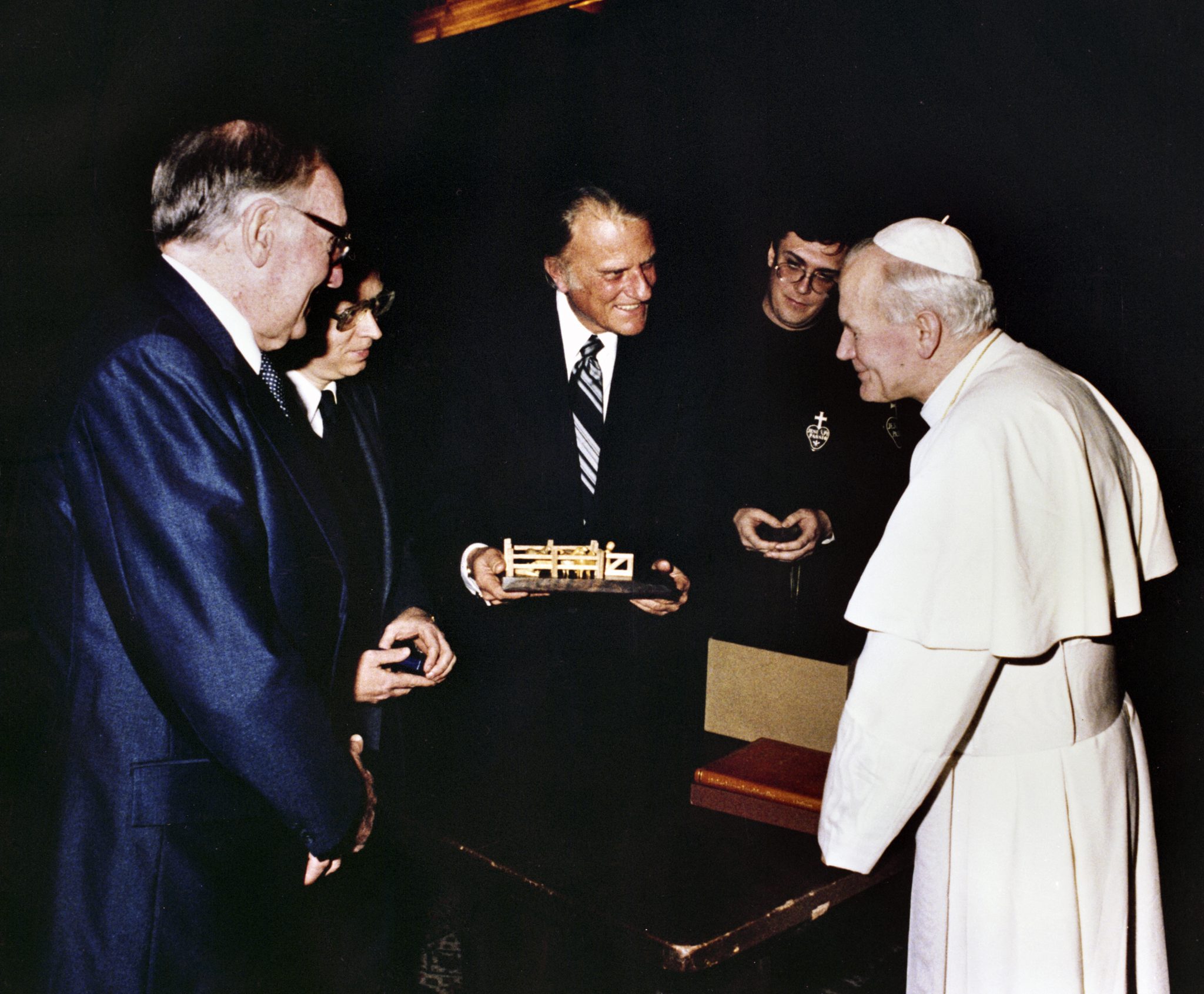
Photo credit: Billy Graham giving Pope St. John Paul II a woodcarving of a shepherd and his sheep at their meeting in 1981. [The Billy Graham Library: “Billy Graham and Pope John Paul II” (August 31, 2021) ]
TurretinFan, a rather eccentric anti-Catholic Calvinist, stopped responding to me in 2010, jumping on the bandwagon with several other anti-Catholics who had previously been vigorously replying to my materials at great length (notably, Bishop “Dr.” [???] James White, James Swan, the late Steve Hays, and Jason Engwer). Eric Svendsen was another one, but he left the Internet for good in November 2005 and has remained true to his word. I guess all of them simply got tired of making fools of themselves and invariably losing debates with Catholics, including myself.
Now, it’s true that I had made a resolution in 2007 (not a “vow”: as these clowns all pretended took place, making a great deal of it) to stop debating anti-Catholics. Periodically, I make those decisions, based on prudential considerations of wise use of time. For example, I am no longer — for the foreseeable future — dealing with Catholics on the far right of the spectrum (radical Catholic reactionaries). I have done a ton of that in the past — including two books — and now I am writing about other things. There are a million topics to address in Catholic and general Christian apologetics. I’ve hit them all at one time or another, in my 5,000+ articles and 56 books. As a self-employed apologist and author, I decide what to write about (or do videos about) at any given time.
Some years later (after 2007), I started replying to anti-Catholics again, at least now and then (my patience permitting), including many many refutations of the articles of all these people. But they never responded anymore. Even when they did do so (before 2010) they rarely if ever made a reply past the first round. They would attempt one rebuttal, then I would counter-reply, and they would ignore that. This was especially the case with Bishop White, who has acted in that fashion ever since he fled in terror from our first debate-by-mail in 1995, leaving 36 (single-spaced typewritten) pages unanswered. He knew he had met his match.
I had done nothing, as regards a stated resolve to cease interaction, that Bishop White hadn’t already done. He wrote to me on 12 January 2001:
I have done all I could since then [our first “postal debate” from 1995] in light of certain aspects of your behavior to avoid interaction like the plague. My website contains nothing about you for that very reason. . . .
Mr. Armstrong, I have no interest, whatsoever, in continuing this with you. I don’t like you, and I don’t believe you like me. Until a few weeks ago I had followed the path of wisdom and avoided every entanglement with you. I erred in moving from that path. . . .
I’m going to ask you to join me in promising to stay as far away from each other as possible. I’m not asking you to not respond on your own website to what I write or doing whatever you want to do when speaking, etc. I am talking about personal interaction. Stay out of #prosapologian. Don’t write to me. Don’t ask to do dialogues, debates, or anything else. You just do your thing, and I’ll do mine. OK?
Of course the good bishop didn’t keep to his resolution, either. He kept making public replies and potshots and insults for seven more years, up until 2008, including lengthy multi-part supposed “rebuttals” of my books, The Catholic Verses (2004) and The One-Minute Apologist (2007). I would respond back and he would invariably ignore it. I wrote an entire book about him that he has completely ignored. But a search of my name on White’s Alpha & Omega blog, yields 130 results: some written there by his buddies James Swan and TurretinFan. That’s hardly “stay[ing] as far away” from me “as possible” or his blog “contain[ing] nothing about” me.
That was just a quick survey of some of what we Catholic apologists go through with anti-Catholic zealots, not even including their endless personal — and rather childish — insults. But it was often enjoyable, in-between the immense frustrations and absurdities. This article will also illustrate the futility of trying to deal with these anti-Catholic brain-dead pseudo-arguments. And it will almost certainly be ignored, too.
But it’s still good to expose falsehoods for what they are and to express and defend the truth; so I do it as opportunity arises. That’s why I am writing this article. Turretin is now active on YouTube, and I may start interacting with those videos if I feel it is worthwhile. TurretinFan is interacting with Catholic apologist William Albrecht. Whether he will with me again remains to be seen. He’d be the first of the big-name anti-Catholics to change his policy in that respect, if so. His choice. I keep defending truth, in any event.
*****
I am replying to TurretinFan’s very last reply to me on his blog, entitled, “Defining “Christian” so as to Deceive Christians” (6-9-10). His words will be in blue; my past words in green.
Over in the comment box of the GreenBaggins blog, Dave Armstrong asked:
First of all, how could one who accepts the Nicene and Apostles’ Creed not be a Christian? I think that is something you should ask yourself. If those do not help clarify who is and who is not a Christian, what in the world does? This is the very purpose of creeds and confessions: to determine in a concise manner who is within and outside of the fold.
One has to ask why, i.e. upon what pretense, Dave selects the creeds of those councils, and not the Tridentine creed?
That’s simple, and I think TurretinFan (a lawyer) could have figured it out with even sixty seconds of reflection. Protestants reject the authority of Trent, and indeed, the infallibility of all ecumenical councils (though many of them “respect” to a large degree the first seven). They don’t reject the early creeds; therefore, it’s a way that we can establish common ground with them, with regard to a definition of “Christian” that both sides can agree with.
But even Protestant belief in the Nicene Creed has to be qualified in at least one respect. It refers to “baptism for the forgiveness of sins” (baptismal regeneration), which most Protestants reject (Lutherans, Anglicans, some Methodists, Churches of Christ, and Disciples of Christ being the exceptions). With that exception, though, an orthodox Protestant could accept the Nicene Creed, and certainly the Apostles’ Creed with no reservations at all, since it doesn’t mention the controversial topic (for them) of baptism.
If TFan would actually respond to this, no doubt he would dispute what I just wrote and go round and round, offering the most ridiculous sophistical points, because that’s what he does (see my previous reply to him for a prime example of his modus operandi), and why I haven’t bothered interacting with him much through the years. His disordered thinking is evident in this very article of his, where he expresses the impossibility of agreeing on this rather simple matter.
If one is going to include “heretics” who do not accept the Tridentine creed, why not accept heretics who do not accept the Nicene creed? After all, from Rome’s perspective, both Arians (who reject Nicaea) and the Reformed (who reject Trent) are “outside the fold” in the same sense.
This is fallacious reasoning in two ways. First of all, Protestants are heretical in some respects but not so in many others, including those which are the basis for our concluding that they are fellow Christians in the Body of Christ. “Heresy” simply means not complying with some received doctrine, established in the Catholic Church long since. But it doesn’t necessarily exclude them from the category of Christianity altogether. Trent, Canon IV on baptism, states that “heretics” — if they baptize with a trinitarian formula — perform a “true baptism.” With that comes all of the baptismal graces that Catholics receive at baptism, including regeneration, entrance into the Body of Christ and the kingdom of God (i.e., into Christianity); indeed, even “incorporation into Christ” Himself.
Protestants do the same thing with each other. So, for example, a Calvinist like TFan would say that Lutherans are “heretical” when they accept doctrines that Calvinists deny: such as their denial of double predestination, or acceptance of the Real Presence in the Eucharist and baptismal regeneration; all the while not denying that they are fellow Protestants and therefore Christians. Lutherans return the favor when critiquing Calvinists. That’s all we’re saying with regard to Protestants.
TFan seems to think there is some analogy here between Protestants and Arians. This is not the case at all. Arians (Jehovah’s Witnesses, today) are Christological heretics who deny the Holy Trinity and Jesus’ divinity (they blasphemously think that He was created). Therefore, their baptism is invalid and in no way can they be considered Christians. That’s why I studied and opposed them in the early 80s as a Protestant evangelical “cult researcher”: my first major apologetics project. My work then is just as relevant and sound now and remains online on my blog.
Protestants are out of the “Catholic fold” but Jehovah’s Witnesses are outside of the much larger category of the “Christian fold.” It’s not “the same sense” as he claimed. TFan and Catholics like myself can both oppose them — “arm-in-arm” as it were — on the same grounds that we agree with: belief in the Holy Trinity and the deity of Christ, and doctrines like eternal hellfire, that they also deny.
I understand that there are Christians out there who like to use one of those creeds as being a true definition of what is involved in being a Christian. That’s because they think that the essential doctrines of the faith are captured in those creeds. That’s not Rome’s position – Rome doesn’t permit people to differ over what Trent has said: if you deny Trent, you can’t reasonably call yourself a Roman Catholic.
Yes, of course (to the last sentence). But you can call yourself a Christian. You can deny parts of Trent and still be a Christian, according to Trent itself, because “Christian” is a larger category: the group of people who adhere to the two creeds. They express what might be called “mere Christianity” (to use C. S. Lewis’ term). All Christians can come together and blissfully agree, to that extent.
For a Roman Catholic to select the Nicene Creed or the Apostles’ Creed as definitive of what it means to be a Christian is, at best, arbitrary.
Not at all, as explained. It’s perfectly coherent and consistent. And it’s because we believe trinitarian baptism is what causes one to enter into the covenant community; to become regenerated and a Christian. The Nicene Creed states this; the Apostles’ Creed probably implies it, in referring to “the forgiveness of sins.”
Trent and Nicaea are equally authoritative for a Romanist. Monothelitism (not condemned at Nicaea) is just dogmatically defined to be a heresy as Arianism. Iconoclasm is as strongly opposed as Monothelitism.
These are non sequiturs in terms of this particular dispute.
And Trent’s Canon IX on Justification defines Sola Fide to be as false as any other condemned teaching.
True, but sola fide is not the gospel. It’s merely one late-arriving slant on biblical soteriology. The leading (Protestant) historian of justification, Alister McGrath, called it a “theological novum” and Protestant theologian and apologist Norman Geisler stated that no one believed in it between Paul and Luther. Why should anyone believe something that took fifteen centuries to even show up? Trent was merely condemning a theological novelty / heresy that had been in existence only about 25 years before it condemned it.
TFan’s fundamental mistake here, of course, is thinking that sola fide is the gospel. It’s not; it’s not even biblical (as my 100 passages collected against it prove). we know what the gospel is because we have a record of the apostles preaching it immediately after Pentecost. St. Peter’s first sermon of the Christian age and new covenant (Acts 2:22-40) is certainly the gospel, especially since 3000 people became Christians upon hearing it (2:41)! In it he utters not a word about “faith alone.” He instructs the hearers, rather, to “repent, and be baptized . . . so that your sins may be forgiven” (2:38).
St. Paul defines the gospel in Acts 13:16-41 as the resurrection of Jesus (vss. 32-33), and in 1 Corinthians 15:1-8 as His death, burial, and resurrection. When Paul converted, straightaway he also got baptized, in order to have his “sins washed away” (baptismal regeneration again). Furthermore, when the rich young ruler asked Jesus how he could be saved (Lk 18:18-25), our Lord, accordingly, didn’t say “just believe in Me with faith alone.” No, He commanded him to perform a “work,” to sell all that he had. Jesus also rewards and grants salvation at least partially according to works and acts of charity, rather than on the basis of sola fide (Mt 16:27; 25:30-46 – note conjunction “for” in v. 35).
So then, the explicit scriptural proclamations and definitions of the gospel strikingly exclude “faith alone,” while other actions by Jesus and the apostles contradict it by force of example. The death, burial and resurrection of Jesus is the “good news,” not some technical soteriological theory. Even common sense would dictate that this “good news” is comprised of Jesus’ redemptive work for us: the great historical drama of His incarnation and atonement; not forensic, extrinsic, declared, imputed justification. How could a mere theological abstract reasonably be called “good news”?
I wish that anti-Catholic Protestants would define the gospel from the Bible alone (since that is supposedly the Protestant formal principle), as I have done. I define it straight from the Bible, whereas anti-Catholics want to define it according to a mere “tradition of men” (i.e., Melanchthon’s and Calvin’s). I find this quite tragi-comically ironic. Catholics and Protestants both hold to the gospel as biblically defined above. We differ on questions of justification, which is the application of salvation and the gospel and Jesus’ work to the individual, not the gospel itself. Nor is TULIP (Calvinism) the gospel, strictly speaking.
Unfortunately, a number of Christians fall for this sort of sophistry. They imagine that folks like Mr. Armstrong are recognizing them as true followers of Christ by calling them a Christian. . . . This confusion is exacerbated by the fact that there are many folks within the Roman Catholic Church who do actually think that non-RCs are just on different paths to heaven: RC members who essentially adopt pluralism. Those two groups read Vatican II’s comments “ecumenical” comments in radically different ways. And which group reads Vatican II correctly?
It’s only a tiny group of dissidents in the Catholic Church on the far right (quasi-schismatics) and far left (theological liberals) who reject Vatican II, just as the Old Catholics rejected Vatican I in 1870 (due to their dislike of papal infallibility) and left the Church, and basically ceased having any significance after that. TFan goes on and on about Catholic councils, seemingly forgetting that Vatican II is as authoritative as Trent, according to Catholicism. And it teaches repeatedly that Protestants are Christians:
Decree on Ecumenism (Unitatis Redintegratio, 21 November 1964) [my emphases]:
One CANNOT CHARGE WITH THE SIN OF SEPARATION those who at present are born into these communities and in them are brought up in the faith of Christ, and the Catholic Church accepts them with RESPECT and AFFECTION as BROTHERS. For men who believe in Christ and have been properly baptized are put in some, though imperfect, communion with the Catholic Church. (3)
all who have been justified by faith in baptism are INCORPORATED INTO CHRIST [footnote cites Council of Florence, Session 8, from the year 1439]; they therefore have a right to be called CHRISTIANS, and with good reason are accepted as BROTHERS by the children of the Catholic Church. (3)
Moreover, some, even very many, of the most significant elements and endowments which together go to build up and give life to the Church itself, can exist OUTSIDE the visible boundaries of the Catholic Church: the written Word of God; the life of grace; faith, hope and charity, with the other interior gifts of the Holy Spirit, as well as visible elements. ALL of these . . . COME FROM CHRIST and lead back to him . . . (3)
The brethren divided from us also carry out many liturgical actions of the Christian religion. In ways that vary according to the conditions of each Church or community, these liturgical actions most certainly can truly engender a LIFE OF GRACE, and, one must say, can aptly GIVE ACCESS TO THE COMMUNION OF SALVATION. (3)
the separated Churches and communions as such . . . have been by no means deprived of significance and IMPORTANCE IN THE MYSTERY OF SALVATION. For the Spirit of Christ has not refrained from using them as a MEANS OF SALVATION which derive their efficacy from the very fullness of grace and truth entrusted to the Catholic Church. (3)
Catholics must gladly acknowledge and esteem the TRULY CHRISTIAN ENDOWMENTS for our common heritage which are to be found among our separated brethren. It is right and salutary to recognize the RICHES OF CHRIST and virtuous works in the lives of others who are BEARING WITNESS TO CHRIST, sometimes even to the shedding of their blood. (4)
Nor should we forget that anything WROUGHT BY THE GRACE OF THE HOLY SPIRIT in the hearts of our separated brethren can CONTRIBUTE TO OUR OWN EDIFICATION. Whatever is TRULY CHRISTIAN is never contrary to what GENUINELY BELONGS TO THE FAITH; indeed, it can always bring a more perfect realization of the very mystery of Christ and the Church. (4)
For more along these lines, see:
How Catholics View Protestants [9-4-03; rev. 10-9-03 and 1-5-05; abridged on 11-14-16]
Dialogue: Definition of “Christian” (vs. Reformed Pastor) (+ Did Trent Anathematize all Protestants?) [6-5-10]
Anti-Catholics Are Catholics’ Brothers in Christ [4-18-02; reposted on 4-22-24]
Comments on the Question: “Are Protestants Heretics?” [2-2-07]
My Respect for Protestants / Catholic Ecumenical Principles [2001; addendum: 1-8-03]
Gratefulness for My Evangelical Protestant Background [3-18-08]
What I Like About Calvinism and Calvinists [June 2009]
The “Catholic-Sounding” Luther: 25 Examples [6-16-08]
50 “Catholic” John Calvin Views [3-18-10]
Ecumenism vs. No Salvation Outside of the Church? (vs. Dustin Buck Lattimore) [8-9-17]
Baptismal Ecumenism: A New Evangelistic Paradigm (Rod Bennett) [8-11-17]
Nor is even the term “separated brethren” a new thing from the 1960s, as seemingly most Protestants and many Catholics mistakenly think. Pope Leo XIII used it twice in official documents in 1895 and again in 1898. Pope St. Pius X referenced “dissident brothers” in 1910. Venerable Pope Pius XII used it twice in documents in papal encyclicals in 1939, and four more times in 1944. Etc., etc.
See: “Separated Brethren” Term Before Vatican II (1962-1965) [3-25-13]
*
***
*
Practical Matters: I run the most comprehensive “one-stop” Catholic apologetics site: rated #1 for Christian sites by leading AI tool, ChatGPT — endorsed by popular Protestant blogger Adrian Warnock. Perhaps some of my 5,000+ free online articles or fifty-six books have helped you (by God’s grace) to decide to become a Catholic or to return to the Catholic Church, or better understand some doctrines and why Catholics believe them. If you believe my full-time apostolate is worth supporting, please seriously consider a much-needed monthly or one-time financial contribution. “The laborer is worthy of his wages” (1 Tim 5:18, NKJV).
*
PayPal donations are the easiest: just send to my email address: [email protected]. Here’s also a second page to get to PayPal. You’ll see the term “Catholic Used Book Service”, which is my old side-business. To learn about the different methods of contributing (including Zelle and 100% tax-deductible donations if desired), see my page: About Catholic Apologist Dave Armstrong / Donation Information.
*
You can support my work a great deal in non-financial ways, if you prefer; by subscribing to, commenting on, liking, and sharing videos from my two YouTube channels, Catholic Bible Highlights and Lux Veritatis (featuring documentaries), in partnership with Kenny Burchard (see my own videos and documentaries), and/or by signing up to receive notice for new articles on this blog. Just type your email address on the sidebar to the right (scroll down quite a bit), where you see, “Sign Me Up!” Thanks a million!
*
***
*
Photo credit: Billy Graham giving Pope St. John Paul II a woodcarving of a shepherd and his sheep at their meeting in 1981. [The Billy Graham Library: “Billy Graham and Pope John Paul II” (August 31, 2021) ]
Summary: Exchange with anti-Catholic Calvinist “TurretinFan” about whether Catholics are equivocating and being inconsistent in their definition of the word “Christian.”
Previous Post

July 25, 2025
Are All Protestants "Saved"? ("TurretinFan" Insanity)
Next Post
August 5, 2025 Jesus' Prayer for Peter (Luke 22) & Indefectibility
Recent Comments
"And lastly, I belong to no denomination and am free to serve God as He ..."
Is Venerating Men & Angels Worship? ..."
"And obeisance doesn't mean "worship". It means "respect", "obey", or "submission". Very weird that you ..."
Is Venerating Men & Angels Worship? ..."
"Many of these scriptures you have noted have been taken out of context. With Daniel, ..."
Is Venerating Men & Angels Worship? ..."
""Protestants often point out that Jesus is now triumphant in heaven and object to Catholics ..."
Three More Anti-Catholic Lies About Catholicism ..."
Browse Our Archives
Select a Category & Last Things About Me Anti-Catholicism Atheism & Agnosticism Baptism and Sacramentalism Bible and Tradition Blessed Virgin Mary Books by Dave Armstrong C. S. Lewis Calvinism & General Protestantism Catholic Apologetics Catholic Apologists Catholic conversion Catholic converts Christmas Church (Ecclesiology) Church History Conversion and Converts Development of Doctrine Eastern Orthodoxy Ecumenism & Christian Unity Eucharist & Liturgy Fathers of the Church French Translations G. K. Chesterton Hell Hell & Satan Hell & Satan & Last Things Heresies & Comparative Religion Holistic Health Inquisition & Crusades & Scandals James White Jews & Judaism & Old Testament John Calvin John Henry Newman Liberal / Modernist Theology Life Issues Literary Resume Lutheranism Mariology Martin Luther Music Orthodoxy Papacy & Infallibility Personal Page Philosophy & Science Political & Ethical & Moral Issues Protestant Persecution & Intolerance Protestantism Purgatory Purgatory & Penance Romantic & Imaginative Theology Saints & Purgatory & Penance Salvation Salvation & Justification Satan & Last Things Sexuality and Gender Issues Spanish Translations Traditionalism vs. Radical Catholic Reactionaries Traducciones al español / tradução para português Trinitarianism & Christology Uncategorized Videos
Select a Month October 2026 September 2026 August 2026 July 2026 June 2026 May 2026 April 2026 March 2026 February 2026 January 2026 December 2025 November 2025 October 2025 September 2025 August 2025 July 2025 June 2025 May 2025 April 2025 March 2025 February 2025 January 2025 December 2024 November 2024 October 2024 September 2024 August 2024 July 2024 June 2024 May 2024 April 2024 March 2024 February 2024 January 2024 December 2023 November 2023 October 2023 September 2023 August 2023 July 2023 June 2023 May 2023 April 2023 March 2023 February 2023 January 2023 December 2022 November 2022 October 2022 September 2022 August 2022 July 2022 June 2022 May 2022 April 2022 March 2022 February 2022 January 2022 December 2021 November 2021 October 2021 September 2021 August 2021 July 2021 June 2021 May 2021 April 2021 March 2021 February 2021 January 2021 December 2020 November 2020 October 2020 September 2020 August 2020 July 2020 June 2020 May 2020 April 2020 March 2020 February 2020 January 2020 December 2019 November 2019 October 2019 September 2019 August 2019 July 2019 June 2019 May 2019 April 2019 March 2019 February 2019 January 2019 December 2018 November 2018 October 2018 September 2018 August 2018 July 2018 June 2018 May 2018 April 2018 March 2018 February 2018 January 2018 December 2017 November 2017 October 2017 September 2017 August 2017 July 2017 June 2017 May 2017 April 2017 March 2017 February 2017 January 2017 December 2016 November 2016 October 2016 September 2016 August 2016 July 2016 June 2016 May 2016 April 2016 March 2016 February 2016 January 2016 December 2015 November 2015 October 2015 September 2015 August 2015 July 2015 June 2015 May 2015 April 2015 March 2015 February 2015 January 2015 December 2014 November 2014 October 2014 September 2014 August 2014 July 2014 June 2014 April 2014 March 2014 February 2014 January 2014 December 2013 November 2013 October 2013 September 2013 August 2013 July 2013 June 2013 April 2013 March 2013 February 2013 January 2013 December 2012 November 2012 October 2012 September 2012 August 2012 July 2012 June 2012 May 2012 April 2012 March 2012 February 2012 January 2012 December 2011 November 2011 October 2011 September 2011 August 2011 July 2011 June 2011 April 2011 March 2011 February 2011 October 2010 September 2010 August 2010 July 2010 April 2010 March 2010 December 2009 October 2009 August 2009 July 2009 June 2009 May 2009 March 2009 February 2009 October 2008 September 2008 April 2008 March 2008 February 2008 January 2008 December 2007 November 2007 October 2007 May 2007 March 2007 February 2007 January 2007 November 2006 October 2006 September 2006 August 2006 July 2006 June 2006 May 2006 April 2006 March 2006 February 2006 October 2005 June 2005 April 2005 February 2005 July 2004 May 2004 April 2004
Follow Us!
TAKE THE
Religious Wisdom Quiz
What was Paul’s profession before becoming an apostle?
Select your answer to see how you score.
Tentmaker Tax Collector Fisherman Carpenter
Books by This Author Books by Dave Armstrong
Related posts from Biblical Evidence for Catholicism

Three More Anti-Catholic Lies About Catholicism (#6-4)
Biblical Evidence for Catholicism

Top Ten Anti-Catholic Lies (#10-7)
Biblical Evidence for Catholicism
Faith & Works: Harmonizing the Bible (Dialogue)
Biblical Evidence for Catholicism

Can You Be Saved by Faith Alone? (The...
Biblical Evidence for Catholicism
TRENDING AT PATHEOS Catholic

I was strolling through the top floor of the brand new Parthenon...

What Does Gêvâh Mean For Kimberley Guifoyle &...
This week, a lot of the news is focused on Kimberly Guilfoyle....

INNER CIRCLE: Profound Mystery (Of Christ In All...
Ephesians 5:31-32 “For this reason, a man will leave his father and...

Do Not Rejoice When Your Enemy Falls: The...
Turning an execution into a public spectacle is a disturbing expression of...

'The Chosen' S6 Trailer: The Passion Gets Very...
Not many watching 'The Chosen' worry about spoilers, but just because they...

The purpose-driven labor priest
A labor activist reads Rick Warren and it gets me wondering about...
view all Catholic blogs
What Are Your Thoughts?leave a comment
Ad-Free & Subscriber Log-In Subscription Support
- About Us
- 2026 Calendar
- Videos
- Podcasts
- Library of World Religions
- Faith In Media Tracker
- Advertise With Us
- Write for Us
- Privacy Policy
- Terms of Service
- Do Not Sell My Data
- Contact Us
- Radiant Digital
- Manage Newsletter Subscriptions
- Unsubscribe From Notifications
- Sitemap
Copyright 2008-2026, Patheos. All rights reserved.
Subscription Support Ad-Free & Subscriber Log-In
Follow Patheos