
BuddhistCatholicContemplativeEvangelicalGeneral ChristianHinduJewishLatter-day SaintMuslimNew VisionsProgressive Christian
Beliefs
- Buddhist
- Catholic
- Contemplative
- Evangelical
- General Christian
- Hindu
- Jewish
- Latter-day Saint
- More Voices
- Muslim
- New Visions
- Pagan
- Progressive Christian
Topics
- Religion News
- Food and Religion
- Sports and Religion
- Religious Art
- Religious Music and Entertainment
- Religious Events
- History and Religion
- Style and Religion
- Politics and Religion
- Women in Religion
- Recreation Outdoors and Religion
- Business Finance and Religion
- Careers Workplace and Religion
- Education and Religion
- Family Parenting and Religion
- Health Fitness and Religion
- Home and Religion
- Relationships and Religion
- Technology and Religion
- Travel and Religion
Columnists
- Buddhist Columnists
- Business Finance and Religion Columnists
- Careers Workplace and Religion Columnists
- Catholic Columnists
- Contemplative Columnists
- Education and Religion Columnists
- Evangelists Columnists
- Family Parenting and Religion Columnists
- General Christian Columnists
- Health Fitness and Religion Columnists
- Hindu Columnists
- History and Religion Columnists
- Home and Religion Columnists
- Jewish Columnists
- More Voices Columnists
- Latter Day Columnists
- Muslim Columnists
- New Visions Columnists
- Nonreligious Columnists
- Pagan Columnists
- Politics and Religion Columnists
- Progressive Columnists
- Recreation Outdoors and Religion Columnists
- Relationships and Religion Columnists
- Religion News Columnists
- Religious Art Columnists
- Religious Events Columnists
- Religious Music and Entertainment Columnists
- Sports and Religion Columnists
- Style and Religion Columnists
- Technology and Religion Columnists
- Travel and Religion Columnists
- Women in Religion Columnists
Resource Library
- 2026 Calendar
- Library of World Religions
- The 100 Most Holy Places on Earth
- Patheos Answers
- Podcasts
- Videos
- Faith Leaders Database
- Anglican Episcopalian
- Bahai
- Baptist
- Buddhism
- Christianity
- Confucianism
- Eastern Orthodoxy
- Hinduism
- Holiness and Pentecostal
- ISKCON
- Islam
- Judaism
- Lutheran
- Methodist
- The Church of Jesus Christ of Latter-day Saints
- New Age
- Paganism
- Presbytarian and Reformed
- Protestantism
- Religion Behind the Scenes
- Roman Catholic
- Scientology
- Shia Islam
- Sikhism
- Sufism
- Sunni Islam
- Taoism
- Zen
- See all religions
Research Tools
 Ad-Free & Subscriber Log-In Subscription Support
Ad-Free & Subscriber Log-In Subscription Support
Follow Patheos 

- Trending:
- Forgiveness
- |
- Marriage
- |
- Consciousness
- |
- Death Penalty
- |
- Election
- |
- Halloween

-
About
-
Catholic Apologetics
-
Church History
-
Great Apologists
-
Christian Worldview
-
Protestantism & Misc.
- Home
- Catholic
- History and Religion
- Zwingli vs. Scripture: Worshiping God Through an Image
Zwingli vs. Scripture: Worshiping God Through an Image
Last updated on: June 22, 2025 at 11:17 am by Dave Armstrong
Zwingli vs. Scripture: Worshiping God Through an Image 2025-06-22T11:17:09-04:00 Dave Armstrong
Patheos Explore the world's faith through different perspectives on religion and spirituality! Patheos has the views of the prevalent religions and spiritualities of the world.
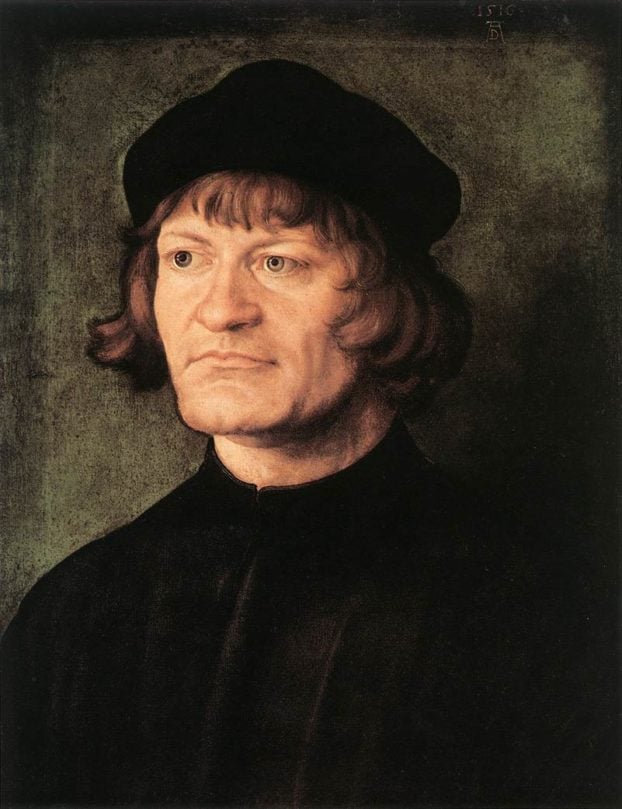
Photo credit: Anonymous 16th century portrait of Huldreich Zwingli (1484-1531) [public domain / Faith & Heritage]
I cite The Latin Works of Huldreich Zwingli, Volume Three, edited by Clarence Nevin Heller, Philadelphia: The Heidelberg Press, 1929. I am specifically addressing Zwingli‘s work, Commentary on True and False Religion (1525; translated by Henry Preble), which William Walker Rockwell in his Preface describes as “The earliest truly comprehensive treatise on Protestant theology” and the first to present “the full-orbed Protestant faith. . . . Zwingli presents an original and . . . comprehensive plan of arrangement and, therefore, justifies the claim that among Protestant system-builders he is the pioneer” (p. iii).
This is a reply to his section 29, “Statues and Images” (pp. 330-337). Zwingli’s words will be in blue.
*****
No one is so stupid as to think that we ought to do away with statues, images, and other representations, where no worship is offered them ; for who is affected by the flying cherubim on the mercy seat or embroidered on the curtains, whether for their mystic meaning or for decoration, or by the palms, lions, oxen, pomegranates, and such like ornaments cunningly wrought in Solomon’s temple [cf. I Kings 6: 1-38]? (pp. 330-331)
So far so good! But alas, John Calvin’s followers (with his approval?) thought it was required to smash organs in Catholic churches, because they were “idols.” Since we’re on the topic of “stupidity” is anyone so stupid as to think that any Christian not insane has ever worshiped a church organ as God? So why were they smashed?
Again, when they are worshipped, who is so senseless, not to say faithless, as to think they ought to be tolerated? (p. 331)
I am; since, as I will show, the Bible offers an indisputable instance of God being directly worshiped via an image (composed of matter) of His choosing.
But contentiousness again objects that not the images are worshipped, but those whose images they are. I answer that neither were any of the heathen ever so stupid as to worship their images of stone, bronze, and wood for what they were in themselves; they reverenced in these their Joves and Apollos. Hence, although the Holy Scriptures frequently mock at the worship of images, as if the worshippers worshipped wood and stone, yet everybody knew that they did not in the least worship these things, but in them those rather whom they regarded as gods. (p. 332)
This will be shown to be unbiblical when I provide the biblical example of what Zwingli claims is utterly impermissible.
First, because we have the worship of idols so expressly forbidden in both the New Testament and the Old. (p. 332)
Yes, of course. No one disagrees with this (including Catholics), because an idol is something (whether visual and material or not; money is an idol; so is sex or pride, etc.) that replaces God in our ultimate allegiances.
This is the distinction between the worshippers of the one true God and idolaters, that we worship a God who is invisible and who forbids us to make any visible representation of Him, while they clothe their gods with any shape they please. (p. 332)
It God wanted to be strictly invisible and to not be known or identified (or worshiped) in or by any image whatsoever, why are the following passages in the Bible?:
Exodus 3:2, 4-6, 16 (RSV) And the angel of the LORD appeared to him in a flame of fire out of the midst of a bush; and he looked, and lo, the bush was burning, yet it was not consumed. . . . [4] When the LORD saw that he turned aside to see, God called to him out of the bush, “Moses, Moses!” And he said, “Here am I.” [5] Then he said, “Do not come near; put off your shoes from your feet, for the place on which you are standing is holy ground.” [6] And he said, “I am the God of your father, the God of Abraham, the God of Isaac, and the God of Jacob.” And Moses hid his face, for he was afraid to look at God. . . . [16] [God speaking] “Go and gather the elders of Israel together, and say to them, ‘The LORD, the God of your fathers, the God of Abraham, of Isaac, and of Jacob, has appeared to me, . . .'”
Isaiah 6:1-5 In the year that King Uzzi’ah died I saw the Lord sitting upon a throne, high and lifted up; and his train filled the temple. [2] Above him stood the seraphim; each had six wings: with two he covered his face, and with two he covered his feet, and with two he flew. [3] And one called to another and said: “Holy, holy, holy is the LORD of hosts; the whole earth is full of his glory.” [4] And the foundations of the thresholds shook at the voice of him who called, and the house was filled with smoke. [5] And I said: “Woe is me! For I am lost; for I am a man of unclean lips, and I dwell in the midst of a people of unclean lips; for my eyes have seen the King, the LORD of hosts!”
Daniel 7:9 As I looked, thrones were placed and one that was ancient of days took his seat; his raiment was white as snow, and the hair of his head like pure wool; . . .
These are all images of God the Father. Note also the image of Jesus in Revelation 1:13-17 (“his head and his hair were white as white wool, white as snow; his eyes were like a flame of fire, his feet were like burnished bronze . . .” etc.). If God the Father willed to be strictly invisible, then He couldn’t and wouldn’t allow these images of Him to be seen and portrayed in Holy Scripture. But He did. Therefore, He’s not invisible. So the question is: why did Zwingli claim that He is?
Second, that it is not permissible to have images, even if they are not worshipped, is plain from the fact that the reason which leads them to assert that images can be made use of betrays our vast coldness; first, in that there is no love of God in us, for that is a sufficient spur to right living ; second, in that it is not safe to conform to any image but His who wishes not to be represented in visible form. . . . no images can kindle our hearts to the love of God. An image can rouse some trifling and fleeting emotion, but it cannot kindle love. (p. 333)
Again, if God the Father “wishes not to be represented in visible form” then why did He appear in visible form in the above three passages? There is not the slightest hint of disapproval in any of the passages. God wished it to be so, and to be recorded in His inspired, inerrant revelation.
It will be more evident that no images at all can be kept, . . . they cannot fail to have the appearance of evil. . . . they ought to be done away with when they are worshipped. (p. 334)
Funny, then, that God would do this at least three times, as shown. What’s He doing, idolizing Himself? How can He be so stupid?
Nobody attacks any images but those that are worshipped, . . . the greater and more precious it is in our sight the less is our trust in God. (p. 334)
Hold that thought and wait till you see the Scripture that I will shortly bring up!
If strange gods are forbidden by themselves and images by themselves, why do we not see that there is no further room for argument? . . . When, therefore, we admit that images are just as much forbidden as the gods whose images they are, why do we not in the same way admit that we cannot have images at all, . . .? (p. 335)
Because God not only presents Himself under various images but also expressly sanctions worship of Himself through an image. Stay tuned!
Next after these I do not think those images should be disturbed which are put into windows for the sake of decoration, provided they represent nothing base, for no one worships them there. (p. 337)
That’s good and sensible. Unfortunately, it’s well-known that many Calvinists smashed stained glass windows to smithereens, and stole hundreds of Catholic churches as well. Lutherans also engaged in wholesale stealing of churches, though they kept the stained glass. It’s still a mortal sin if they stole the windows and the buildings that they were in. Henry VII was the worst of all: stealing every Catholic Church in the whole of England.
In short, no one who has not experienced it has a right conception of how much the removal of the images aids true piety. (p. 337)
Too bad God didn’t get with that plan, as we shall see. And here is the clinching argument from Scripture:
Exodus 33:9-11 When Moses entered the tent [i.e., the Tabernacle], the pillar of cloud would descend and stand at the door of the tent, and the LORD would speak with Moses. [10] And when all the people saw the pillar of cloud standing at the door of the tent, all the people would rise up and worship, every man at his tent door. [11] Thus the LORD used to speak to Moses face to face, as a man speaks to his friend. . . .
Game, set, match . . . God is in the image of the pillar of cloud, speaking to Moses “face to face” and also being worshiped by the ancient Hebrews in the cloud. There’s no way out of it. Zwingli first objected to images, but then conceded that the heathen were worshiping the gods (as they conceived them) that the images represented; but then he objected to that, too (insofar as it would apply to the one true God), and made up a myth that all images whatsoever were forbidden by God and that He appeared under no image (since He is only invisible, so says Zwingli).
This passage annihilates his already weak argument. Yes, we condemn idolatry and graven images (pieces of stone or wood that people worshiped or worshiped as representatives of false gods). But this is not that. It’s God’s expressed will, in His revelation. This recorded the practice of the Hebrews during the exodus. They saw the pillar of cloud (that God says several times in the Old Testament that He was “in”: along with the pillar of fire) and they worshiped God through or in the image. The image can’t possibly be separated from it.
The text doesn’t condemn the practice, as it must do if Zwingli is correct. So folks must make a choice. Here, Zwingli pits himself against clear biblical revelation. At that point, everyone has to make a choice: Zwingli or God and the Bible which is His inspired word. I will do what Joshua did:
Joshua 24:15 . . . as for me and my house, we will serve the LORD
We should worship God in the pillar of cloud, if that’s how He chooses to appear to us. We could also have worshiped Him in the burning bush and on His throne (Isaiah 6) and as a Person with white hair sitting on His throne (Daniel 7); all images; all permissible and never condemned. We can also note the many theophanies in the Old Testament as well. Abraham saw God in the form of a man and worshiped Him:
Genesis 18:1-2 And the LORD appeared to him by the oaks of Mamre, as he sat at the door of his tent in the heat of the day. [2] He lifted up his eyes and looked, and behold, three men stood in front of him. When he saw them, he ran from the tent door to meet them, and bowed himself to the earth,
Abraham worships God, Who had appeared as one of three men. The text goes on to record conversations, with reference to “the LORD said” (to Abraham) five times (18:10, 13, 17, 20, 26). And it says, “Abraham still stood before the LORD” (18:22). Finally, it concludes, “And the LORD went his way” (18:33). No one can argue, therefore, that these are all mere angels. We see lots of refutations of Zwingli’s iconoclastic, anti-image, anti-biblical nonsense there, too . . .
*
***
*
Practical Matters: I run the most comprehensive “one-stop” Catholic apologetics site: rated #1 for Christian sites by leading AI tool, ChatGPT — endorsed by popular Protestant blogger Adrian Warnock. Perhaps some of my 5,000+ free online articles or fifty-six books have helped you (by God’s grace) to decide to become a Catholic or to return to the Catholic Church, or better understand some doctrines and why we believe them. If you believe my full-time apostolate is worth supporting, please seriously consider a much-needed monthly or one-time financial contribution. “The laborer is worthy of his wages” (1 Tim 5:18, NKJV).
*
PayPal donations are the easiest: just send to my email address: [email protected]. Here’s also a second page to get to PayPal. You’ll see the term “Catholic Used Book Service”, which is my old side-business. To learn about the different methods of contributing (including Zelle and 100% tax-deductible donations if desired), see my page: About Catholic Apologist Dave Armstrong / Donation Information.
*
You can support my work a great deal in non-financial ways, if you prefer; by subscribing to, commenting on, liking, and sharing videos from my two YouTube channels, Catholic Bible Highlights and Lux Veritatis (featuring documentaries), where I partner with Kenny Burchard (see my own videos and documentaries), and/or by signing up to receive notice for new articles on this blog. Just type your email address on the sidebar to the right (scroll down quite a bit), where you see, “Sign Me Up!” Thanks a million!
*
***
*
Photo credit: Anonymous 16th century portrait of Huldreich Zwingli (1484-1531) [public domain / Faith & Heritage]
*
Summary: Zwingli, the third most important early Protestant leader after Luther and Calvin, held a very unbiblical view of the use of images in worshiping God. I provide relevant Scripture.
Previous Post
June 20, 2025
How Mary is Called "Blessed" is Unique in Scripture
Next Post
June 23, 2025 Zwingli vs. John the Baptist & Baptism Re Salvation
Recent Comments
"And lastly, I belong to no denomination and am free to serve God as He ..."
Is Venerating Men & Angels Worship? ..."
"And obeisance doesn't mean "worship". It means "respect", "obey", or "submission". Very weird that you ..."
Is Venerating Men & Angels Worship? ..."
"Many of these scriptures you have noted have been taken out of context. With Daniel, ..."
Is Venerating Men & Angels Worship? ..."
""Protestants often point out that Jesus is now triumphant in heaven and object to Catholics ..."
Three More Anti-Catholic Lies About Catholicism ..."
Browse Our Archives
Select a Category & Last Things About Me Anti-Catholicism Atheism & Agnosticism Baptism and Sacramentalism Bible and Tradition Blessed Virgin Mary Books by Dave Armstrong C. S. Lewis Calvinism & General Protestantism Catholic Apologetics Catholic Apologists Catholic conversion Catholic converts Christmas Church (Ecclesiology) Church History Conversion and Converts Development of Doctrine Eastern Orthodoxy Ecumenism & Christian Unity Eucharist & Liturgy Fathers of the Church French Translations G. K. Chesterton Hell Hell & Satan Hell & Satan & Last Things Heresies & Comparative Religion Holistic Health Inquisition & Crusades & Scandals James White Jews & Judaism & Old Testament John Calvin John Henry Newman Liberal / Modernist Theology Life Issues Literary Resume Lutheranism Mariology Martin Luther Music Orthodoxy Papacy & Infallibility Personal Page Philosophy & Science Political & Ethical & Moral Issues Protestant Persecution & Intolerance Protestantism Purgatory Purgatory & Penance Romantic & Imaginative Theology Saints & Purgatory & Penance Salvation Salvation & Justification Satan & Last Things Sexuality and Gender Issues Spanish Translations Traditionalism vs. Radical Catholic Reactionaries Traducciones al español / tradução para português Trinitarianism & Christology Uncategorized Videos
Select a Month October 2026 September 2026 August 2026 July 2026 June 2026 May 2026 April 2026 March 2026 February 2026 January 2026 December 2025 November 2025 October 2025 September 2025 August 2025 July 2025 June 2025 May 2025 April 2025 March 2025 February 2025 January 2025 December 2024 November 2024 October 2024 September 2024 August 2024 July 2024 June 2024 May 2024 April 2024 March 2024 February 2024 January 2024 December 2023 November 2023 October 2023 September 2023 August 2023 July 2023 June 2023 May 2023 April 2023 March 2023 February 2023 January 2023 December 2022 November 2022 October 2022 September 2022 August 2022 July 2022 June 2022 May 2022 April 2022 March 2022 February 2022 January 2022 December 2021 November 2021 October 2021 September 2021 August 2021 July 2021 June 2021 May 2021 April 2021 March 2021 February 2021 January 2021 December 2020 November 2020 October 2020 September 2020 August 2020 July 2020 June 2020 May 2020 April 2020 March 2020 February 2020 January 2020 December 2019 November 2019 October 2019 September 2019 August 2019 July 2019 June 2019 May 2019 April 2019 March 2019 February 2019 January 2019 December 2018 November 2018 October 2018 September 2018 August 2018 July 2018 June 2018 May 2018 April 2018 March 2018 February 2018 January 2018 December 2017 November 2017 October 2017 September 2017 August 2017 July 2017 June 2017 May 2017 April 2017 March 2017 February 2017 January 2017 December 2016 November 2016 October 2016 September 2016 August 2016 July 2016 June 2016 May 2016 April 2016 March 2016 February 2016 January 2016 December 2015 November 2015 October 2015 September 2015 August 2015 July 2015 June 2015 May 2015 April 2015 March 2015 February 2015 January 2015 December 2014 November 2014 October 2014 September 2014 August 2014 July 2014 June 2014 April 2014 March 2014 February 2014 January 2014 December 2013 November 2013 October 2013 September 2013 August 2013 July 2013 June 2013 April 2013 March 2013 February 2013 January 2013 December 2012 November 2012 October 2012 September 2012 August 2012 July 2012 June 2012 May 2012 April 2012 March 2012 February 2012 January 2012 December 2011 November 2011 October 2011 September 2011 August 2011 July 2011 June 2011 April 2011 March 2011 February 2011 October 2010 September 2010 August 2010 July 2010 April 2010 March 2010 December 2009 October 2009 August 2009 July 2009 June 2009 May 2009 March 2009 February 2009 October 2008 September 2008 April 2008 March 2008 February 2008 January 2008 December 2007 November 2007 October 2007 May 2007 March 2007 February 2007 January 2007 November 2006 October 2006 September 2006 August 2006 July 2006 June 2006 May 2006 April 2006 March 2006 February 2006 October 2005 June 2005 April 2005 February 2005 July 2004 May 2004 April 2004
Follow Us!
TAKE THE
Religious Wisdom Quiz
Who asked Jesus, "What is truth?"
Select your answer to see how you score.
Caiaphas Pilate Nicodemus Herod
Books by This Author Books by Dave Armstrong
Related posts from Biblical Evidence for Catholicism

Bible & Catholicism on Mortal Sin (vs. John...
Biblical Evidence for Catholicism

Does Catholic Intercession of Saints Require Omniscience?
Biblical Evidence for Catholicism

Capabilities of Heavenly Saints: Protestant Commentaries
Biblical Evidence for Catholicism

Revelation 5 & 8 (Intercession of Saints &...
Biblical Evidence for Catholicism
TRENDING AT PATHEOS Catholic

I was strolling through the top floor of the brand new Parthenon...

What Does Gêvâh Mean For Kimberley Guifoyle &...
This week, a lot of the news is focused on Kimberly Guilfoyle....

INNER CIRCLE: Profound Mystery (Of Christ In All...
Ephesians 5:31-32 “For this reason, a man will leave his father and...

Do Not Rejoice When Your Enemy Falls: The...
Turning an execution into a public spectacle is a disturbing expression of...

'The Chosen' S6 Trailer: The Passion Gets Very...
Not many watching 'The Chosen' worry about spoilers, but just because they...

The purpose-driven labor priest
A labor activist reads Rick Warren and it gets me wondering about...
view all Catholic blogs
What Are Your Thoughts?leave a comment
Ad-Free & Subscriber Log-In Subscription Support
- About Us
- 2026 Calendar
- Videos
- Podcasts
- Library of World Religions
- Faith In Media Tracker
- Advertise With Us
- Write for Us
- Privacy Policy
- Terms of Service
- Do Not Sell My Data
- Contact Us
- Radiant Digital
- Manage Newsletter Subscriptions
- Unsubscribe From Notifications
- Sitemap
Copyright 2008-2026, Patheos. All rights reserved.
Subscription Support Ad-Free & Subscriber Log-In
Follow Patheos