
BuddhistCatholicContemplativeEvangelicalGeneral ChristianHinduJewishLatter-day SaintMuslimNew VisionsProgressive Christian
Beliefs
- Buddhist
- Catholic
- Contemplative
- Evangelical
- General Christian
- Hindu
- Jewish
- Latter-day Saint
- More Voices
- Muslim
- New Visions
- Pagan
- Progressive Christian
Topics
- Religion News
- Food and Religion
- Sports and Religion
- Religious Art
- Religious Music and Entertainment
- Religious Events
- History and Religion
- Style and Religion
- Politics and Religion
- Women in Religion
- Recreation Outdoors and Religion
- Business Finance and Religion
- Careers Workplace and Religion
- Education and Religion
- Family Parenting and Religion
- Health Fitness and Religion
- Home and Religion
- Relationships and Religion
- Technology and Religion
- Travel and Religion
Columnists
- Buddhist Columnists
- Business Finance and Religion Columnists
- Careers Workplace and Religion Columnists
- Catholic Columnists
- Contemplative Columnists
- Education and Religion Columnists
- Evangelists Columnists
- Family Parenting and Religion Columnists
- General Christian Columnists
- Health Fitness and Religion Columnists
- Hindu Columnists
- History and Religion Columnists
- Home and Religion Columnists
- Jewish Columnists
- More Voices Columnists
- Latter Day Columnists
- Muslim Columnists
- New Visions Columnists
- Nonreligious Columnists
- Pagan Columnists
- Politics and Religion Columnists
- Progressive Columnists
- Recreation Outdoors and Religion Columnists
- Relationships and Religion Columnists
- Religion News Columnists
- Religious Art Columnists
- Religious Events Columnists
- Religious Music and Entertainment Columnists
- Sports and Religion Columnists
- Style and Religion Columnists
- Technology and Religion Columnists
- Travel and Religion Columnists
- Women in Religion Columnists
Resource Library
- 2026 Calendar
- Library of World Religions
- The 100 Most Holy Places on Earth
- Patheos Answers
- Podcasts
- Videos
- Faith Leaders Database
- Anglican Episcopalian
- Bahai
- Baptist
- Buddhism
- Christianity
- Confucianism
- Eastern Orthodoxy
- Hinduism
- Holiness and Pentecostal
- ISKCON
- Islam
- Judaism
- Lutheran
- Methodist
- The Church of Jesus Christ of Latter-day Saints
- New Age
- Paganism
- Presbytarian and Reformed
- Protestantism
- Religion Behind the Scenes
- Roman Catholic
- Scientology
- Shia Islam
- Sikhism
- Sufism
- Sunni Islam
- Taoism
- Zen
- See all religions
Research Tools
 Ad-Free & Subscriber Log-In Subscription Support
Ad-Free & Subscriber Log-In Subscription Support
Follow Patheos 

- Trending:
- Forgiveness
- |
- Marriage
- |
- Consciousness
- |
- Death Penalty
- |
- Election
- |
- Halloween

-
About
-
Catholic Apologetics
-
Church History
-
Great Apologists
-
Christian Worldview
-
Protestantism & Misc.
- Home
- Catholic
- History and Religion
- John Calvin’s 1554 Defense of the Execution of Heretics
John Calvin’s 1554 Defense of the Execution of Heretics
Last updated on: June 6, 2026 at 12:05 am by Dave Armstrong
John Calvin’s 1554 Defense of the Execution of Heretics 2026-06-06T00:05:16-04:00 Dave Armstrong
Patheos Explore the world's faith through different perspectives on religion and spirituality! Patheos has the views of the prevalent religions and spiritualities of the world.
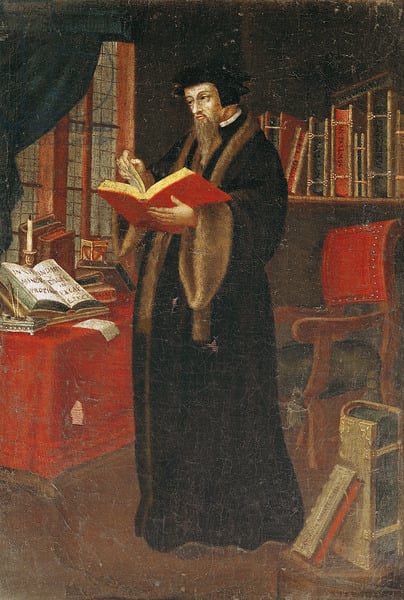
Photo Credit: Portrait of John Calvin (French school, 16th century) [public domain / Wikimedia Commons]
John Calvin’s words will be in blue.
I’ve written several times about the extreme intolerance of the early Protestant leader John Calvin (1509-1564). Protestants (usually only dimly acquainted with the history of the matter and according to received tradition), are accustomed to think that Calvin had a mere lapse regarding the execution of anti-trinitarian heretic Michael Servetus on 27 October 1553, as if this were an “embarrassing” exception to the rule of his usual thinking. Nothing could be further from the truth. I’ve written several times about this general topic:
Calvin the “Destroyer” of Servetus: James Swan Misses Forest for Trees [8-24-17]
John Calvin Mocked Servetus’ Reaction to His Death Sentence [3-25-10]
Calvin Supports Death Penalty for Heresy After Servetus [11-6-11]
I ran across another related document in the two-volume set, which I have in hardcover in my own library, Toleration and the Reformation (Joseph Lecler, S.J., New York: Association Press, 1960, from the 1955 French edition; translated by T. L. Westow). It was published in January 1554, within three months of Servetus’ execution by burning; largely as a result of criticisms received for his advocacy of that event. It’s called Declaratio orthodoxae fidei (Latin text: Calvini Opera, t. VIII, pp. 453-644].
The book is available for free in Latin, online [link one / link two/ link three / link four]. Post-Reformation Digital Library contains links to it on its John Calvin page. The work had never seemingly been translated into English until literally twenty-five days before this writing (14 May 2025), and even that is merely a self-published effort, using AI. I may eventually get to work, myself, and translate portions of it, using Google Translate. This is an important part of 16th century Protestant history that ought to be known. Truth is truth, and facts are facts.
No Reformed / Calvinist — or any sort of Protestant — publisher had seen fit to translate the Declaratio into English, these past 471 years. Yet so many times, Protestants will object when I simply note that their own folks have often sought to conceal unsavory aspects of their past history (while exercising a double standard in constantly and loudly proclaiming similar Catholic “skeletons.”
This was also true of the 55-volume Luther’s Works in English, which decided not to include several of Luther’s more controversial treatises or letters — some of which I have been citing from other sources since 1990. To their credit, the editors of that set have, in recent years, decided to greatly expand it, in order to reflect the scope of the much larger German Weimar edition of 1883. It is now up to at least 79 volumes.
Fr. Lecler describes Declaratio orthodoxae fidei as “one of the most frightening treatises ever written to justify the persecution of heretics” (Lecler, Vol. 1, 333). Then he cites Calvin, from the 1554 French edition of this work (I will cite those page numbers hereafter):
Our sympathy-mongers, who take such great pleasure in leaving heresies unpunished, now see that their fantasy hardly conforms with God’s commandment. Afraid lest the Church be blamed for being too severe, they would allow all kinds of errors to spread freely to secure tolerance for one man. But God does not even allow whole towns and populations to be spared, but will have the walls razed and the memory of the inhabitants destroyed and all things frustrated as a sign of his utter detestation, lest the contagion spread. He even gives us to understand that by concealing a crime one becomes an accomplice. Nor is this to be wondered at, since it is here a question of rejecting God and sane doctrine, which perverts and violates every human and divine right. (Lecler, Vol. 1, 333; Declaratio, 47-48; see Deut 13:12-18)
Calvin continues:
Though I admit that the princes have no power to penetrate the human heart with their edicts and to move them so that they submit to God and conform with the truth, their vocation compels them nevertheless not to tolerate that God’s name be reviled, and evil and venomous tongues tear his sacred word to pieces. . . .
That humanity, advocated by those who are in favour of a pardon for heretics, is greater cruelty because in order to save the wolves they expose the poor sheep. I ask you, is it reasonable that heretics should be allowed to murder souls and to poison them with their false doctrine, and that we should prevent the sword, contrary to God’s commandment, from touching their bodies, and that the whole Body of Jesus Chris be lacerated that the stench of one rotten member may remain undisturbed? (Lecler, Vol. 1, 334; Declaratio, 32, 35-36)
This was the same rationale, of course, as that of the Inquisition, defended by St. Thomas Aquinas and many others. But Calvin’s thinking (paraphrased by Lecler) was that ” ‘papists’ do not have the same right to persecute Protestants, since they follow a false doctrine!” (Vol. 1, 334). Hence, Calvin wrote:
The swords of persecutors cannot prevent good and faithful magistrates from applying the rod of justice for the sake of the Church, formerly applied unjustly; and the tortures, suffered by the martyrs, cannot be an obstacle to the protection which good princes bestow on the children of God. (Lecler, Vol. 1, 335; Declaratio, 21)
Ah, so we are to believe that Calvin advocated capital punishment, but not “cruel and unusual” punishment and torture leading up to it? He certainly didn’t act in accord with this sublime ideal. Regarding the Comparet brothers in Geneva in 1555, thought to be guilty of some sort of conspiracy against the government, Non-Catholic Calvin biographer Hugh Young Reyburn wrote:
One of the two men, Comparet, who had been arrested, was condemned on 27 June [1555] to have his head cut off, his body quartered, and the sections exposed in different places according to custom. His head with one quarter of his body was fastened to the gibbet referred to. . . . the younger Comparet was simply beheaded. The executioner did his work so clumsily that he added needless pangs to the victim’s agony, and the Council punished him by dismissing him from his office for a year and a day. Calvin, on the other hand, wrote to Farel on 24 July, “I am persuaded that it is not without the special will of God that, apart from any verdict of the judges, the criminals have endured protracted torment at the hands of the executioner.” [Opera, xv. 693; cf. xxi. 610] . . .
It was determined to get the truth out of him [Francois Daniel], and Calvin wrote to Farel on 24 July [Opera, xv. 693; cf. Letters of John Calvin (Phila.), Vol. 3, 206], “We shall see in a couple of days, I hope, what the torture will wring from him.” . . .
Although he was neither consulted as to the torture, nor was present when it was applied, Calvin certainly approved of it. . . .
It is unfortunate for Calvin’s reputation that he should have thought the use of torture justifiable under any circumstances, and it is still more unfortunate that he commended the use of it to prove that which was evident. . . . All that was proved was a sudden flare-up on the street created by the reckless folly of some half-intoxicated Libertines. Nevertheless, the Council acted as if the rioters had been the agents of a carefully-laid scheme of revolution.
These atrocious incidents of Calvin enthusiastically approving torture occurred just a year-and-a-half after he stated that he was opposed to torture, in his Declaratio orthodoxae fidei.
Unsurprisingly, I couldn’t find the Declaratio orthodoxae fidei listed in a supposed “Complete Works Of John Calvin” listed at godrules.net. Nor did Christian Classics Ethereal Library, which has 55 works of Calvin listed, see fit to include it. But the famous 19th century Protestant Church historian, Philip Schaff, made mention of it in his History of the Church, Vol. 8, § 157. Calvin’s Defence of the Death Penalty for Heretics. He stated:
The public sentiment, Catholic and Protestant, as we have seen, approved of the traditional doctrine, that obstinate heretics should be made harmless by death, and continued unchanged down to the close of the seventeenth century. . . .
Not only dissenters and personal enemies, but also, as Beza admits, some orthodox and pious people and friends of Calvin were dissatisfied with the severity of the punishment, and feared, not without reason, that it would justify and encourage the Romanists in their cruel persecution of Protestants in France and elsewhere.
Under these circumstances Calvin felt it to be his disagreeable duty to defend his conduct, and to refute the errors of Servetus. He was urged by Bullinger to do it. He completed the work in a few months and published it in Latin and French in the beginning of 1554. It had an official character and was signed by all the fifteen ministers of Geneva.
Beza aided him in this controversy and undertook to refute the pamphlet of Bellius, and did so with great ability and eloquence.
Calvin’s work against Servetus gave complete satisfaction to Melanchthon. It is the strongest refutation of the errors of his opponent which his age produced, but it is not free from bitterness against one who, at last, had humbly asked his pardon, and who had been sent to the judgment seat of God by a violent death. It is impossible to read without pain the following passage:
Whoever shall now contend that it is unjust to put heretics and blasphemers to death will knowingly and willingly incur their very guilt. This is not laid down on human authority; it is God who speaks and prescribes a perpetual rule for his Church. It is not in vain that he banishes all those human affections which soften our hearts; that he commands paternal love and all the benevolent feelings between brothers, relations, and friends to cease; in a word, that he almost deprives men of their nature in order that nothing may hinder their holy zeal. Why is so implacable a severity exacted but that we may know that God is defrauded of his honor, unless the piety that is due to him be preferred to all human duties, and that when his glory is to be asserted, humanity must be almost obliterated from our memories? . . .
Calvin’s “Defence” did not altogether satisfy even some of his best friends. Zurkinden, the State Secretary of Bern, wrote him Feb. 10, 1554: “I wish the former part of your book, respecting the right which the magistrates may have to use the sword in coercing heretics, had not appeared in your name, but in that of your council, which might have been left to defend its own act. I do not see how you can find any favor with men of sedate mind in being the first formally to treat this subject, which is a hateful one to almost all.” Bullinger intimated his objections more mildly in a letter of March 26, 1554, in which he says: “I only fear that your book will not be so acceptable to many of the more simple-minded persons, who, nevertheless, are attached both to yourself and to the truth, by reason of its brevity and consequent obscurity, and the weightiness of the subject. . . .”
Capital punishment for heresy was so widespread in Calvinist-controlled countries that Fr. Lecler noted:
The Dutch Protestant martyrology mentions 877 names for the sixteenth century, of which 617, or about two-thirds, were Anabaptists. Similar proportions would probably be found for Switzerland and the countries of central Europe, where the persecution was equally severe. (Vol. 1, 209; see Henri Pirenne, Histoire de Belgique , t. III, p. 362, n. 3, based on the Bibliographie des martyrologes protestants neerlandais, Ghent, 1890)
*
***
*
Practical Matters: I run the most comprehensive “one-stop” Catholic apologetics site: rated #1 for Christian sites by leading AI tool, ChatGPT — endorsed by popular Protestant blogger Adrian Warnock. Perhaps some of my 5,000+ free online articles or fifty-six books have helped you (by God’s grace) to decide to become Catholic or to return to the Church, or better understand some doctrines and why we believe them. If you believe my full-time apostolate is worth supporting, please seriously consider a much-needed monthly or one-time financial contribution. “The laborer is worthy of his wages” (1 Tim 5:18, NKJV).
*
PayPal donations are the easiest: just send to my email address: [email protected]. Here’s also a second page to get to PayPal. You’ll see the term “Catholic Used Book Service”, which is my old side-business. To learn about the different methods of contributing (including Zelle and 100% tax-deductible donations if desired), see my page: About Catholic Apologist Dave Armstrong / Donation Information.
*
You can support my work a great deal in non-financial ways, if you prefer; by subscribing to, commenting on, liking, and sharing videos from my two YouTube channels, Catholic Bible Highlights and Lux Veritatis (featuring documentaries), where I partner with Kenny Burchard (see my own videos and documentaries), and/or by signing up to receive notice for new articles on this blog. Just type your email address on the sidebar to the right (scroll down quite a bit), where you see, “Sign Me Up!” Thanks a million!
*
***
*
Photo Credit: Portrait of John Calvin (French school, 16th century) [public domain / Wikimedia Commons]

Summary: I summarize John Calvin’s treatise from Jan. 1554, entitled Declaratio orthodoxae fidei [Declaration of the Orthodox Faith], in which he defends the duty of executing heretics.
Protestant Persecution & Intolerance
Calvin & capital punishment for heretics
Calvin & the death penalty for heretics
Calvin's religious intolerance
John Calvin & religious persecution
John Calvin's Declaratio orthodoxae fidei
Protestant persecution and intolerance
Previous Post
June 5, 2025
Catholic Inquisition Myths Busted by Real Historians
Next Post

June 11, 2025 How Tall Was Goliath? The Truth Revealed!
Recent Comments
"And lastly, I belong to no denomination and am free to serve God as He ..."
Is Venerating Men & Angels Worship? ..."
"And obeisance doesn't mean "worship". It means "respect", "obey", or "submission". Very weird that you ..."
Is Venerating Men & Angels Worship? ..."
"Many of these scriptures you have noted have been taken out of context. With Daniel, ..."
Is Venerating Men & Angels Worship? ..."
""Protestants often point out that Jesus is now triumphant in heaven and object to Catholics ..."
Three More Anti-Catholic Lies About Catholicism ..."
Browse Our Archives
Select a Category & Last Things About Me Anti-Catholicism Atheism & Agnosticism Baptism and Sacramentalism Bible and Tradition Blessed Virgin Mary Books by Dave Armstrong C. S. Lewis Calvinism & General Protestantism Catholic Apologetics Catholic Apologists Catholic conversion Catholic converts Christmas Church (Ecclesiology) Church History Conversion and Converts Development of Doctrine Eastern Orthodoxy Ecumenism & Christian Unity Eucharist & Liturgy Fathers of the Church French Translations G. K. Chesterton Hell Hell & Satan Hell & Satan & Last Things Heresies & Comparative Religion Holistic Health Inquisition & Crusades & Scandals James White Jews & Judaism & Old Testament John Calvin John Henry Newman Liberal / Modernist Theology Life Issues Literary Resume Lutheranism Mariology Martin Luther Music Orthodoxy Papacy & Infallibility Personal Page Philosophy & Science Political & Ethical & Moral Issues Protestant Persecution & Intolerance Protestantism Purgatory Purgatory & Penance Romantic & Imaginative Theology Saints & Purgatory & Penance Salvation Salvation & Justification Satan & Last Things Sexuality and Gender Issues Spanish Translations Traditionalism vs. Radical Catholic Reactionaries Traducciones al español / tradução para português Trinitarianism & Christology Uncategorized Videos
Select a Month October 2026 September 2026 August 2026 July 2026 June 2026 May 2026 April 2026 March 2026 February 2026 January 2026 December 2025 November 2025 October 2025 September 2025 August 2025 July 2025 June 2025 May 2025 April 2025 March 2025 February 2025 January 2025 December 2024 November 2024 October 2024 September 2024 August 2024 July 2024 June 2024 May 2024 April 2024 March 2024 February 2024 January 2024 December 2023 November 2023 October 2023 September 2023 August 2023 July 2023 June 2023 May 2023 April 2023 March 2023 February 2023 January 2023 December 2022 November 2022 October 2022 September 2022 August 2022 July 2022 June 2022 May 2022 April 2022 March 2022 February 2022 January 2022 December 2021 November 2021 October 2021 September 2021 August 2021 July 2021 June 2021 May 2021 April 2021 March 2021 February 2021 January 2021 December 2020 November 2020 October 2020 September 2020 August 2020 July 2020 June 2020 May 2020 April 2020 March 2020 February 2020 January 2020 December 2019 November 2019 October 2019 September 2019 August 2019 July 2019 June 2019 May 2019 April 2019 March 2019 February 2019 January 2019 December 2018 November 2018 October 2018 September 2018 August 2018 July 2018 June 2018 May 2018 April 2018 March 2018 February 2018 January 2018 December 2017 November 2017 October 2017 September 2017 August 2017 July 2017 June 2017 May 2017 April 2017 March 2017 February 2017 January 2017 December 2016 November 2016 October 2016 September 2016 August 2016 July 2016 June 2016 May 2016 April 2016 March 2016 February 2016 January 2016 December 2015 November 2015 October 2015 September 2015 August 2015 July 2015 June 2015 May 2015 April 2015 March 2015 February 2015 January 2015 December 2014 November 2014 October 2014 September 2014 August 2014 July 2014 June 2014 April 2014 March 2014 February 2014 January 2014 December 2013 November 2013 October 2013 September 2013 August 2013 July 2013 June 2013 April 2013 March 2013 February 2013 January 2013 December 2012 November 2012 October 2012 September 2012 August 2012 July 2012 June 2012 May 2012 April 2012 March 2012 February 2012 January 2012 December 2011 November 2011 October 2011 September 2011 August 2011 July 2011 June 2011 April 2011 March 2011 February 2011 October 2010 September 2010 August 2010 July 2010 April 2010 March 2010 December 2009 October 2009 August 2009 July 2009 June 2009 May 2009 March 2009 February 2009 October 2008 September 2008 April 2008 March 2008 February 2008 January 2008 December 2007 November 2007 October 2007 May 2007 March 2007 February 2007 January 2007 November 2006 October 2006 September 2006 August 2006 July 2006 June 2006 May 2006 April 2006 March 2006 February 2006 October 2005 June 2005 April 2005 February 2005 July 2004 May 2004 April 2004
Follow Us!
TAKE THE
Religious Wisdom Quiz
What famous cathedral is in Paris, known for its flying buttresses and rose windows?
Select your answer to see how you score.
Notre Dame St. Paul's St. Peter's Canterbury
Books by This Author Books by Dave Armstrong
Related posts from Biblical Evidence for Catholicism
John Calvin & Calvinists on Forensic Justification
Biblical Evidence for Catholicism
Proof That Calvin Affirmed Mary's Perpetual Virginity
Biblical Evidence for Catholicism
Gavin Ortlund, Hus's Burning, & Double Standards
Biblical Evidence for Catholicism

Early Protestant Leaders Damning Each Other: 40 Examples
Biblical Evidence for Catholicism
TRENDING AT PATHEOS Catholic

In "Irreplaceable," our book on vocation and technology, Trevor Sutton and I...

I was strolling through the top floor of the brand new Parthenon...

What Does Gêvâh Mean For Kimberley Guifoyle &...
This week, a lot of the news is focused on Kimberly Guilfoyle....

INNER CIRCLE: Profound Mystery (Of Christ In All...
Ephesians 5:31-32 “For this reason, a man will leave his father and...

Do Not Rejoice When Your Enemy Falls: The...
Turning an execution into a public spectacle is a disturbing expression of...

'The Chosen' S6 Trailer: The Passion Gets Very...
Not many watching 'The Chosen' worry about spoilers, but just because they...
view all Catholic blogs
What Are Your Thoughts?leave a comment
Ad-Free & Subscriber Log-In Subscription Support
- About Us
- 2026 Calendar
- Videos
- Podcasts
- Library of World Religions
- Faith In Media Tracker
- Advertise With Us
- Write for Us
- Privacy Policy
- Terms of Service
- Do Not Sell My Data
- Contact Us
- Radiant Digital
- Manage Newsletter Subscriptions
- Unsubscribe From Notifications
- Sitemap
Copyright 2008-2026, Patheos. All rights reserved.
Subscription Support Ad-Free & Subscriber Log-In
Follow Patheos