
BuddhistCatholicContemplativeEvangelicalGeneral ChristianHinduJewishLatter-day SaintMuslimNew VisionsProgressive Christian
Beliefs
- Buddhist
- Catholic
- Contemplative
- Evangelical
- General Christian
- Hindu
- Jewish
- Latter-day Saint
- More Voices
- Muslim
- New Visions
- Pagan
- Progressive Christian
Topics
- Religion News
- Food and Religion
- Sports and Religion
- Religious Art
- Religious Music and Entertainment
- Religious Events
- History and Religion
- Style and Religion
- Politics and Religion
- Women in Religion
- Recreation Outdoors and Religion
- Business Finance and Religion
- Careers Workplace and Religion
- Education and Religion
- Family Parenting and Religion
- Health Fitness and Religion
- Home and Religion
- Relationships and Religion
- Technology and Religion
- Travel and Religion
Columnists
- Buddhist Columnists
- Business Finance and Religion Columnists
- Careers Workplace and Religion Columnists
- Catholic Columnists
- Contemplative Columnists
- Education and Religion Columnists
- Evangelists Columnists
- Family Parenting and Religion Columnists
- General Christian Columnists
- Health Fitness and Religion Columnists
- Hindu Columnists
- History and Religion Columnists
- Home and Religion Columnists
- Jewish Columnists
- More Voices Columnists
- Latter Day Columnists
- Muslim Columnists
- New Visions Columnists
- Nonreligious Columnists
- Pagan Columnists
- Politics and Religion Columnists
- Progressive Columnists
- Recreation Outdoors and Religion Columnists
- Relationships and Religion Columnists
- Religion News Columnists
- Religious Art Columnists
- Religious Events Columnists
- Religious Music and Entertainment Columnists
- Sports and Religion Columnists
- Style and Religion Columnists
- Technology and Religion Columnists
- Travel and Religion Columnists
- Women in Religion Columnists
Resource Library
- 2026 Calendar
- Library of World Religions
- The 100 Most Holy Places on Earth
- Patheos Answers
- Podcasts
- Videos
- Faith Leaders Database
- Anglican Episcopalian
- Bahai
- Baptist
- Buddhism
- Christianity
- Confucianism
- Eastern Orthodoxy
- Hinduism
- Holiness and Pentecostal
- ISKCON
- Islam
- Judaism
- Lutheran
- Methodist
- The Church of Jesus Christ of Latter-day Saints
- New Age
- Paganism
- Presbytarian and Reformed
- Protestantism
- Religion Behind the Scenes
- Roman Catholic
- Scientology
- Shia Islam
- Sikhism
- Sufism
- Sunni Islam
- Taoism
- Zen
- See all religions
Research Tools
 Ad-Free & Subscriber Log-In Subscription Support
Ad-Free & Subscriber Log-In Subscription Support
Follow Patheos 

- Trending:
- Forgiveness
- |
- Marriage
- |
- Consciousness
- |
- Death Penalty
- |
- Election
- |
- Halloween

-
About
-
Catholic Apologetics
-
Church History
-
Great Apologists
-
Christian Worldview
-
Protestantism & Misc.
- Home
- Catholic
- History and Religion
- Reply to Lucas Banzoli’s 30 “Common” (?) Protestant Views
Reply to Lucas Banzoli’s 30 “Common” (?) Protestant Views
Last updated on: June 6, 2026 at 12:52 am by Dave Armstrong
Reply to Lucas Banzoli’s 30 “Common” (?) Protestant Views 2026-06-06T00:52:51-04:00 Dave Armstrong
Patheos Explore the world's faith through different perspectives on religion and spirituality! Patheos has the views of the prevalent religions and spiritualities of the world.
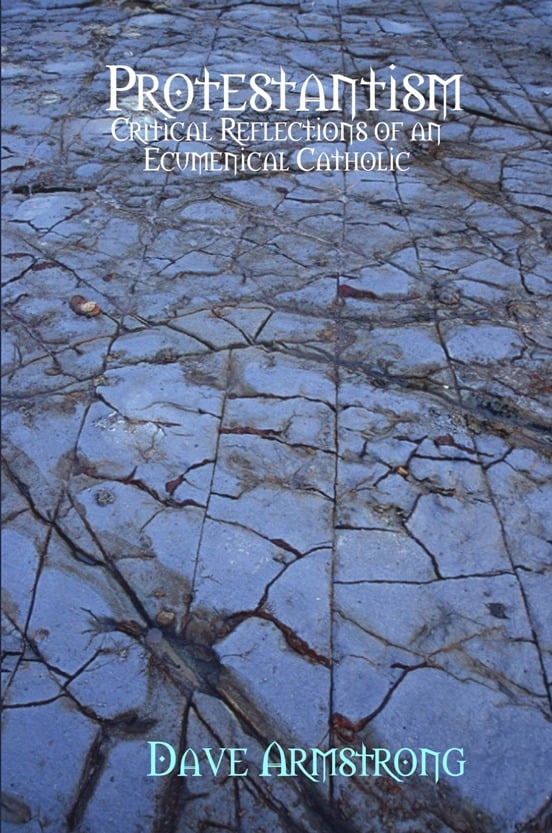
Photo credit: my self-published 2003 book
Lucas Banzoli is a very active Brazilian anti-Catholic polemicist, who holds to basically a Seventh-day Adventist theology, whereby there is no such thing as a soul that consciously exists outside of a body, and no hell (soul sleep and annihilationism). He has a Master’s degree in theology, a degree and postgraduate work in history, a license in letters, and is a history teacher, author of 27 self-published books, as well as blogmaster for six blogs. He has many videos on YouTube.
This is my 68th refutation of Banzoli’s writings. From 25 May until 12 November 2022 he wrote not one single word in reply, claiming that my articles were “without exception poor, superficial and weak” and that “only a severely cognitively impaired person” would take them “seriously.” Nevertheless, he found them so “entertaining” that after almost six months of inaction he resolved to “make a point of rebutting” them “one by one”; this effort being his “new favorite sport.” But apparently he changed his mind again, since he has replied to me only 16 times (the last one dated 2-20-23).
This is a reply to the controversial and relevant items of his list, in his article, “A Confession of Faith Common to all Protestants” [Uma Confissão de Fé comum a todos os protestantes] (10-29-24)
Lucas’ original Portugese was automatically translated into English on his blog by Google Translate. His words will be in blue.
*****
You have certainly seen a Catholic accuse Protestants of being divided into “40,000 sects with different doctrines” (which is humanly impossible, since there are not even 40,000 doctrines to have 40,000 doctrinal divergences),
Yes; this is a dumb argument. I renounced it over twenty years ago in my article, 33,000 Protestant Denominations? No! [9-4-04], and have ever since said “hundreds” to describe the number of Protestant denominations. There are methodological difficulties with the usual figures. In any event, denominationalism itself is utterly unbiblical and anything beyond one Church is already a very serious unbiblical falsehood.
and many of them say that there is not even a common core of doctrines to be considered “Protestant”, as if “Protestant” could be anything.
That’s a stupid belief, too, but I immediately note that almost all of what Protestants have in common are beliefs that Catholics and Orthodox also hold; in other words, these are tenets that all Christians hold in common. I will demonstrate that in my reply.
First of all, it is important to highlight two things. First, unlike the scarecrow constantly present in Catholic apologetics, antitrinitarians are not “protestants,”
I’ve been a Catholic apologist for almost 35 years, and I haven’t observed this false view being “constantly present in Catholic apologetics.” One would have to be very ignorant to claim this, and as usual when sweeping statements about “Catholic apologists” are made by Protestants, not even a single example is provided. Speaking for myself, I have never ever stated that actual Protestants denied the Trinity.
Unfortunately, out of ignorance or bad faith, many of them say this because they believe that Jehovah’s Witnesses are Protestants,
“Many”? I think not. It doesn’t take much knowledge at all to see that JWS are not Protestants or any other kind of Christians. They’re Arian heretics. I particularly object to this silly characterization, seeing that my first major apologetics project as a Protestant evangelical in 1981, was to do a massive refutation of the false belief of Jehovah’s Witnesses. I was part of an “anti-cult” ministry.
behind the secondary issues that divide us is a primary and much more important element that unites us.
And he thinks these are listed in his thirty points. But I will show that with regard to many of these so-called “central” or “primary” beliefs, Protestants in fact disagree with each other. Note that Lucas claims in his title that these points are “common to all Protestants.” So if I demonstrate that several of them aren’t, he is guilty of a misleading, only partially true title and would have to shorten his list to half as long in order to be intellectually honest.
Nineteen, or 63% of all his points are simply beliefs held in common with all Christians, and thus irrelevant. What Lucas needs to demonstrate are beliefs that are distinctive to Protestants and held by all of them. That list becomes a very short one indeed, under scrutiny (perhaps even nonexistent). Thus, we can exclude (in this scenario that I think is reasonable) from the discussion right off the bat (#1-2, 4-6, 8, 11, 13-17, 21-22, 25-29; #21 being somewhat unique, as I will explain).
The other eleven points, or 37% of the list (#3, 7, 9-10, 12, 18-20, 23-24, 30) are disputable, and I contend that there are Protestants — not infrequently, many — who disagree with what Lucas claims is unanimity. Thus, 100% of his points fail in their purpose, under scrutiny: being either irrelevant (19) or untrue as a matter of fact (11), leaving his claim a complete failure. Let’s take a look at the “duds.”
3) We believe that God is the only one we should pray to and the only one who answers our prayers.
Catholics agree that God ultimately answers our prayers, and that when saints are involved, they are functioning as intermediaries who can only “pass along” what God brings about. But there are some Protestants who believe that saints can be invoked. A post from St. Michael’s Anglican Church in Matthews, North Carolina states:
The practice of requesting the intercessions of the glorified Saints is no different in degree, nature, or kind from the necessary intercessory prayer that Christians offer for one another on earth. If I ask you to pray for me and for my intentions, I know that in Christian charity you will do so. If you ask prayers of me, I should be delighted and moved by the same charity to pray for you. Offering requests through God in the Communion of the Saints to those fellow Christians who reign with Christ beyond the veil is no different. We may ask for their prayers, just as we pray for them. . . .
Anglicans are not obliged to solicit the gracious prayers of the Saints on our behalf, but, just as they are not compelled to request the intercessory prayers of fellow Christians in heaven, so they are forbidden to say that such a practice is contrary to Scripture and Tradition. For Anglicans, the practice of the invocation of the Saints is limited in the main to private devotions and extraliturgical services which are not part of the usual public Liturgy. However, it is certainly to be encouraged and has never been rejected by the Anglican Church, , which counts herself a true Apostolic Church practicing the fullness of the Catholic Faith, of which the Communion of Saints is a supreme article. Please note that Article of Religion XXII does not condemn the ancient or patristic or biblical doctrine concerning the Invocation of Saints and other related truths, but only the Romish, that is, the popularly-believed late medieval and thus erroneous view of the same. The Anglican teaching is the reformed Catholic view, anchored in the Holy Scriptures and the Tradition of the Primitive Church.
Anglican apologist C. S. Lewis wrote:
I accept the authority of the Benedicite for the propriety of invoking . . . saints. . . . ( The Collected Letters of C. S. Lewis, Vol. III: Narnia, Cambridge, and Joy 1950-1963, edited by Walter Hooper, HarperSanFrancisco, 2007, To the Editor of the Church Times, 15 July 1949)
With approximately 85 – 110 million members, Anglicanism is the third-largest Christian communion after Catholicism and Eastern Orthodoxy.
7) We believe in a worship free of graven images for purposes of worship and/or veneration, and that we should not bow down before any image.
Martin Luther believed in adoration of Jesus in the sacrament of the Eucharist, which includes bowing before the consecrated host and chalice. He even wrote a treatise about it in 1523, called, The Adoration of the Sacrament, which is included in Luther’s Works in English, in volume 36, pp. 268–305, where he proclaimed, “he who does believe, as sufficient demonstration has shown it ought to be believed, can surely not withhold his adoration of the body and blood of Christ without sinning . . . One should not withhold from him such worship and adoration either . . . one should not condemn and accuse of heresy people who do adore the sacrament.”
Luther was observed bowing before the consecrated host and chalice. It’s for this reason that John Calvin called Luther “half-papist” and that “he had raised up the idol in God’s temple.” See more on this. Some “high” Anglicans or Anglo-Catholics practice this, too. So, for example, the article, “What is Eucharistic Adoration?” from Church of the Good Shepherd, an Anglo-Catholic parish in South Carolina, affirmed:
The practice of Eucharistic Adoration is the spiritual exercise of adoring the Real Presence of Christ in the Blessed Sacrament. The intention of such a devotion is to allow the faithful to be connected with an awareness of the gift of Christ’s sacramental presence and experience a spiritual communion with Him. . . .
In the Church of England, Father John Mason Neale (1818-1866) revived interest in Eucharistic Adoration among Anglicans when he made it a part of the devotional life of the nuns of the Society of Saint Margaret. Father Neale saw Benediction of the Blessed Sacrament and Eucharistic Exposition as the logical devotional expression of the Church Catholic’s understanding of the Real Presence.
9) We believe that Sacred Scripture is the highest authority for Christians, the highest and final authority that prevails over any tradition, teaching, denomination, council, confession of faith or religious leadership.
This is generally true of Protestantism, as one of its two pillars and its rule of faith, but again, there are exceptions (whereas Lucas ignores that). Anglicanism and its offshoot, Methodism, place a higher emphasis on tradition and the authority of the Church, and also accept the notion of apostolic succession, both of which are, strictly speaking, contradictory to sola Scriptura (Scripture Alone as the only infallible authority). Along these lines, John Wesley, the key figure at the beginning of Methodism, but himself a lifelong Anglican, stated:
If to baptize infants has been the general practice of the Christian Church in all places and in all ages, then this must have been the practice of the apostles, and, consequently, the mind of Christ. . . . The fact being thus cleared, that infant baptism has been the general practice of the Christian Church in all places and in all ages, that it has continued without interruption in the Church of God for above seventeen hundred years, we may safely conclude it was handed down from the apostles, who best knew the mind of Christ. (A Treatise on Baptism; in Coll. iii, 232-233; 11 Nov. 1756)
Martin Luther had made the exact same point over 200 years earlier:
Child baptism derives from the apostles and has been practised since the days of he apostles. . . .
Were child baptism now wrong God would certainly not have permitted it to continue so long, nor let it become so universally and thoroughly established in all Christendom, but it would sometime have gone down in disgrace. The fact that the Anabaptists now dishonor it does not mean anything final or injurious to it. Just as God has established that Christians in all the world have accepted the Bible as Bible, the Lord’s Prayer as Lord’s Prayer, and faith of a child as faith, so also he has established child baptism and kept it from being rejected while all kinds of heresies have disappeared which are much more recent and later than child baptism. This miracle of God is an indication that child baptism must be right. . . .
You say, this does not prove that child baptism is certain. For there is no passage in Scripture for it. My answer: that is true. From Scripture we cannot clearly conclude that you could establish child baptism as a practice among the first Christians after the apostles. But you can well conclude that in our day no one may reject or neglect the practice of child baptism which has so long a tradition, since God actually not only has permitted it, but from the beginning so ordered, that it has not yet disappeared.
For where we see the work of God we should yield and believe in the same way as when we hear his Word, unless the plain Scripture tells us otherwise. . . .
[I]f the first, or child, baptism were not right, it would follow that for more than a thousand years there was no baptism or any Christendom, which is impossible. . . . For over a thousand years there were hardly any other but child baptisms. . . .
We . . . are certain enough, because it is nowhere contrary to Scripture, but is rather in accord with Scripture. (Concerning Rebaptism, January 1528; in Luther’s Works, 225-262; citation from 254-257)
The Anglican historian of Christian theology, Alister McGrath (b. 1953) noted the high irony of how even Martin Luther and his Lutherans changed their tune about sola Scriptura and the Bible after 1525 (just four years after Luther was excommunicated and in effect started Lutheranism):
The magisterial Reformation initially seems to have allowed that every individual had the right to interpret Scripture; but . . . The Peasant’s Revolt of 1525 appears to have convinced some, such as Luther, that individual believers (especially German peasants) were simply not capable of interpreting Scripture. It is one of the ironies of the Lutheran Reformation that a movement which laid such stress upon the importance of Scripture should subsequently deny its less educated members direct access to that same Scripture, for fear that they might misinterpret it (in other words, reach a different interpretation from that of the magisterial reformers). (Reformation Thought: An Introduction, 4th edition, 2012, p. 110)
10) We believe that the reading of Sacred Scripture is for all the faithful, that its translation into the language of the people should be encouraged and that it can be freely examined by the faithful, to the detriment of an ecclesiastical monopoly of some institution.
First of all, Lucas lies about supposed Catholic suppression of the Bible, and denunciation of non-Latin vernacular translations in particular. McGrath gives the actual facts of the matter:
No universal or absolute prohibition of the translation of scriptures into the vernacular was ever issued by a medieval pope or council, nor was any similar prohibition directed against the use of such translations by the laity.” (The Intellectual Origins of the European Reformation, 1987, p. 124)
Nor was this even true of Luther’s original Lutheranism, within the first ten years. McGrath explains the details:
For example, the school regulations of the duchy of Wurttemburg laid down that only the most able schoolchildren were to be allowed to study the New Testament in their final years — and even then, only if they studied it in Greek or Latin. The remainder — presumably the vast bulk — were required to read Luther’s Lesser Catechism instead. The direct interpretation of Scripture was thus effectively reserved for a small, privileged group of people. . . . The principle of the “clarity of Scripture’ appears to have been quietly marginalized, in the light of the use made of the Bible by the more radical elements within the Reformation. Similarly, the idea that everyone had the right and the ability to interpret Scripture faithfully became the sole possession of the radicals. (Reformation Thought: An Introduction, 2nd edition from 1993, p. 155)
12) We believe that Jesus is the only person who spent his entire life without contracting any stain of sin.
*
Again, Martin Luther, the founder of the system, believed in the Immaculate Conception of Mary, which includes her sinlessness (even from original sin). No one has to take my word for that. Many Lutheran scholars and historians assert it. The well-known Lutheran scholar Arthur Carl Piepkorn stated in a scholarly article in 1967 that “Martin Luther’s personal adherence to the Immaculate Conception of the Mother of God (barring two lapses) seems to have been life-long.” This same piece was described as a “splendid and learned summary” by the great Lutheran scholar Jaroslav Pelikan in his 1996 book, Mary Through The Ages, on page 249. Prominent Lutheran theologian Friedrich Heiler was cited in a 1959 Lutheran article stating that “Mary is for Luther ‘immaculately conceived,’ . . . in the sense . . . which the Roman Church in 1854 formulated as a dogma.”
*
The eminent Lutheran scholar Eric W. Gritsch, one of the translator in the 55-volume set of the works of Luther, concurred, writing: “The literary evidence from Luther’s works clearly supports the view that Luther affirmed the doctrine.” He also stated that “Luther affirmed Mary’s assumption into heaven.” This was in the 1992 book, The One Mediator, the Saints, and Mary, Lutherans and Catholics in Dialogue VIII, written by twelve Lutheran and ten Catholic scholars. The Lutherans agreed with a common statement on page 54: “Luther himself professed the Immaculate Conception as a pleasing thought, though not as an article of faith.” Also, the German Lutheran Julius Köstlin, author of a famous 1883 biography, Life of Luther, stated that “the Immaculate Conception” was “firmly maintained by Luther himself.” For more on this, see:
*
Martin Luther’s Mariology (Particularly the Immaculate Conception) (4-26-03; major revision: 4-7-08)
*
Luther & Mary’s Immaculate Conception: Lutheran Scholars’ Opinions (9-30-10)
Luther & the Immaculate Conception: More Non-Catholic Historians & Scholars (9-30-10)
Martin Luther’s Belief in the “Immaculate Purification” of Mary (10-2-10)
*
Some Protestants also believe that John the Baptist never sinned.
*
18) We believe in the necessity of good works as a consequence of salvation by faith, and not as the cause of salvation.
*
Several strains of Protestantism dissent from the strict, pure notion of faith alone (sola fide), where works have nothing whatsoever (formally) to do with salvation. In particular, we can point to Christian perfectionism. Wikipedia has an excellent, in-depth article with the same title. I cite it at some length:
Within many denominations of Christianity, Christian perfection is the theological concept of the process or the event of achieving spiritual maturity or perfection. The ultimate goal of this process is union with God characterized by pure love of God and other people as well as personal holiness or sanctification. Other terms used for this or similar concepts include entire sanctification, holiness, perfect love, the baptism with the Holy Spirit, the indwelling of the Holy Spirit, baptism by fire, the second blessing, and the second work of grace. . . .
Traditional Quakerism uses the term perfection and teaches that it is the calling of a believer.
Perfection is a prominent doctrine within the Methodist tradition, . . . Methodists use the term Baptism of the Holy Spirit to refer to the second work of grace, entire sanctification.
Other denominations, such as the Lutheran Churches and Reformed Churches, reject the possibility of Christian perfection in this life as contrary to the doctrine of salvation by faith alone, . . .
In traditional Calvinism and high church Anglicanism, perfection was viewed as a gift bestowed on righteous persons only after their death (see Glorification). John Wesley, the founder of Methodism, was responsible for reviving the idea of spiritual perfection in Protestantism. . . . Wesley transformed Christian perfection as found in church tradition by interpreting it through a Protestant lens that understood sanctification in light of justification by grace through faith working by love. . . .
Wesley taught that the manifestation of being entirely sanctified included engagement in works of piety and works of mercy. . . .
Daniel L. Burnett, a professor at Wesley Biblical Seminary, writes that:
Views compatible with the Wesleyan understanding of entire sanctification were carried forward in later times by men like the medieval Catholic priest Thomas a Kempis, . . . the Dutch theologian Jacobus Arminius, the German Pietist Phillip Jacob Spener, the Quaker founder George Fox, the Anglican bishop Jeremy Taylor, and the English devotional writer William Law. Many of these influences fed into [John] Wesley’s heritage and laid the foundation for the development of his thought.
John Wesley wrote about the falsity of “faith alone”:
Beware of solifidianism; crying nothing but, ‘Believe, believe’ and condemning those as ignorant or legal who speak in a more scriptural way. At certain seasons, indeed, it may be right to treat of nothing but repentance, or merely of faith, or altogether of holiness; but, in general, our call is to declare the whole counsel of God, and to prophesy according to the analogy of faith. The written word treats of the whole and every particular branch of righteousness, descending to its minutest branches; as to be sober, courteous, diligent, patient, to honour all men. So, likewise, the Holy Spirit works the same in our hearts, not merely creating desires after holiness in general, but strongly inclining us to every particular grace, leading us to every individual part of ‘whatsoever is lovely.’ And this with the greatest propriety; for as ‘by works faith is made perfect’, so the completing or destroying the work of faith, and enjoying the favour, or suffering the displeasure, of God, greatly depends on every single act of obedience or disobedience. (A Plain Account of Christian Perfection, 1767; rev. 1777; in W xi, 431-432; from Farther Thoughts on Christian Perfection, 1762)
19) We believe that salvation is defined based on what we have done in this life only, with no second chances for salvation after death (whether through reincarnation, purgatory or the like).
There are two silly and absurd things here. Catholics don’t believe in a “second chance” for salvation after death. One’s eternal destiny is determined at the moment of death, and doesn’t change. Accordingly, all who are in purgatory, in our view, are saved and inevitably on the way to heaven. Secondly, no Christian, as the term has always been defined through history, believes in reincarnation. That said, now we can address purgatory. And yes, some serious Protestants believe in this, too. C. S. Lewis wrote:
Our souls demand Purgatory, don’t they? Would it not break the heart if God said to us, “It is true, my son, that your breath smells and your rags drip with mud and slime, but we are charitable here and no one will upbraid you with these things, nor draw away from you. Enter into the joy”? Should we not reply, “With submission, sir, and if there is no objection, I’d rather be cleaned first.” “It may hurt, you know” — “Even so, sir.”
I assume that the process of purification will normally involve suffering. Partly from tradition; partly because most real good that has been done me in this life has involved it. . . .
My favourite image on this matter comes from the dentist’s chair. I hope that when the tooth of life is drawn and I am “coming round,” a voice will say, “Rinse your mouth out with this.” This will be Purgatory. The rinsing may take longer than I can now imagine. The taste of this may be more fiery and astringent than my present sensibility could endure. (Letters to Malcolm: Chiefly on Prayer, New York: Harcourt Brace Jovanovich, 1964, 107-109)
See more on this and also Lewis’ belief in prayers for the dead. The Wikipedia article, “Purgatory” states:
Elements of the Anglican, Lutheran, and Methodist traditions hold that for some there is cleansing after death and pray for the dead, knowing it to be efficacious.
Wesleyan scholar Jerry L. Walls defended the doctrine in his book, Purgatory: The Logic of Total Transformation (Oxford University Press, 2011).
20) We believe that sins can and should be confessed directly to God, who forgives us if we are sincerely repentant, and that we can also confess our sins to one another (especially if we have sinned against them), and not under the obligation of a private confession to a priest or that forgiveness depends on that private confession.
Some Protestants accept this, too. John Wesley wrote:
Do not they yet know that the only Popish confession is the Confession made by a single person to a priest? — and this itself is in no wise condemned by our Church; nay, she recommends it in some cases. (A Plain Account of the People Called Methodists; in Coll. iv, 186 [W (1831) v. 176-190]; 1748)
C. S. Lewis, the famous Anglican apologist, believed in and practiced formal confession, as I discovered when reading the book, The Collected Letters of C. S. Lewis, Vol. II: Books, Broadcasts, and the War, 1931-1949, edited by Walter Hooper, HarperSanFrancisco, 2004. In a letter to his friend Mary Neylan on 4 January 1941 (“Supplement” section of Volume III from 2007), Lewis gave a basic explanation, referring to “Confession and Absolution which our church enjoins on no-one but leaves free to all . . . the confessor is the representative of our Lord and declares His forgiveness” (p. 1540). Writing again to her on 26 April 1941 Lewis stated (p. 481) that practicing confession was “a desire to walk in well established ways which have the approval of Christendom as a whole.” See much more on this.
The Wikipedia article, “Absolution” has a wealth of information about various Protestant versions of confession and absolution. It states about Lutheranism:
The second form of confession and absolution is known as “Holy Absolution“, which is done privately to the pastor (commonly only upon request). Here the person confessing (known as the “penitent“) confesses his individual sins and makes an act of contrition as the pastor, acting in persona Christi, announces this following formula of absolution (or similar): “In the stead and by the command of my Lord Jesus Christ I forgive you all your sins in the name of the Father and of the Son and of the Holy Spirit.” In the Lutheran Church, the pastor is bound by the Seal of the Confessional (similar to the Roman Catholic tradition). Luther’s Small Catechism says “the pastor is pledged not to tell anyone else of sins told him in private confession, for those sins have been removed.”
And about Anglicanism:
In the Church of England and in the Anglican Communion in general, formal, sacramental absolution is given to penitents in the sacrament of penance now formally called the Reconciliation of a Penitent and colloquially called “confession.”
And in Methodism:
In the Methodist Church, penance is defined by the Articles of Religion as one of those “Commonly called Sacraments but not to be counted for Sacraments of the Gospel”, also known as the “five lesser sacraments“. John Wesley, the founder of the Methodist Church, held “the validity of Anglican practice in his day as reflected in the 1662 Book of Common Prayer“, stating that “We grant confession to men to be in many cases of use: public, in case of public scandal; private, to a spiritual guide for disburdening of the conscience, and as a help to repentance.” The Book of Worship of The United Methodist Church contains the rite for private confession and absolution in A Service of Healing II, in which the minister pronounces the words “In the name of Jesus Christ, you are forgiven!” . . .
Lay confession is permitted, although this is not the norm. Near the time of death, many Methodists confess their sins and receive absolution from an ordained minister, in addition to being anointed.
23) We believe that baptism and the Lord’s Supper are still valid today.
*
Note how vague and general this statement is. There is a good reason for that. It’s because Protestants have massive disagreements on the nature of these rites, which most of them agree with us in regarding them as sacraments. I could document this till kingdom come, but I’ll just provide a brief summary. From the beginning, Protestants differed on the Eucharist, with Luther and Lutherans following a view of the Real Presence, similar but not identical to the Catholic view (more like that of Orthodoxy). Zwingli opted for a completely symbolic Eucharist, and John Calvin took a middle position, of a mystical presence.
*
That’s basically the three views regained today, that is, unless one is a Quaker or member of the Salvation Army: neither of which practice it at all. An article by a Quaker explains:
As far as I know, there are only two Christian traditions who officially don’t celebrate the Eucharist: the Salvation Army and the Society of Friends (Quakers). A fellow student at Queen’s Theological Foundation, where I study Theology, who is a ‘Salvationist’, told me that there are many different reasons for the Salvation Army not celebrating the Eucharist, but these are two important ones: they have always regarded women as equal in ministry (and sacraments at the time were only distributable by men); and they believe that throughout history the sacraments have had a divisive influence on the church, and differing beliefs about them have led to abuse and controversy. . . .
The Quakers have never celebrated the Eucharist or any sacraments. . . . because Quakers find that all ritual distracts and takes focus away from God. Also, Quakers believe that ministry is not only equal between men and women, but that it belongs to all people, not just a few ministers.
Protestants got so ridiculous about the Eucharist within their first six decades, that in 1577, at Ingolstadt in Germany, a book entitled, Two Hundred Interpretations of the Words, “This is My Body” was published.
Note also that Lucas didn’t claim that Protestants agreed on ordination, because he knows that many of them now ordain women; nor that they can agree on something as fundamental as abortion (all of the mainline denominations favor it) or divorce, or whether practicing homosexuals can get married, or whether sodomy is a sin.
As for baptism, note that these two groups don’t practice that, either, despite it being a command of Jesus Christ (oh well). Beyond that, there are four major variations of baptism among Protestants, who are split into infant baptism and adult believers’ baptism camps (the former group, including Luther and Calvin and their followers, used to execute the latter for this reason).
Furthermore, the infant camp contains those who accept baptismal regeneration (Lutherans, Anglicans, and to some extent, Methodists), as does the adult camp (Churches of Christ and Disciples of Christ). Thus, there are five distinct competing belief-systems among Protestants with regard to baptism. They can’t even agree on these crucially important sacraments: both directly tied to salvation in Holy Scripture.
24) We believe that the Church consists of the body of Christ, the gathering together of all those saved in Christ wherever they are.
*
This is the “mystical body” and Catholics agree that it is comprised of the elect, known ultimately only by God. But various Protestants also hold to a “visible Church” that goes far beyond this limited conception. So, for example, John Calvin wrote:
In this Church there is a very large mixture of hypocrites, who have nothing of Christ but the name and outward appearance: of ambitious, avaricious, envious, evil-speaking men, some also of impurer lives, who are tolerated for a time, either because their guilt cannot be legally established, or because due strictness of discipline is not always observed. Hence, as it is necessary to believe the invisible Church, which is manifest to the eye of God only, so we are also enjoined to regard this Church which is so called with reference to man, and to cultivate its communion. (Institutes of the Christian Religion, IV, 1:7)
Still those of whom we have spoken sin in their turn, by not knowing how to set bounds to their offence. For where the Lord requires mercy they omit it, and give themselves up to immoderate severity. Thinking there is no church where there is not complete purity and integrity of conduct, they, through hatred of wickedness, withdraw from a genuine church, while they think they are shunning the company of the ungodly. They allege that the Church of God is holy. But that they may at the same time understand that it contains a mixture of good and bad, let them hear from the lips of our Saviour that parable in which he compares the Church to a net in which all kinds of fishes are taken, but not separated until they are brought ashore. Let them hear it compared to a field which, planted with good seed, is by the fraud of an enemy mingled with tares, and is not freed of them until the harvest is brought into the barn. Let them hear, in fine, that it is a thrashing-floor in which the collected wheat lies concealed under the chaff, until, cleansed by the fanners and the sieve, it is at length laid up in the granary. If the Lord declares that the Church will labour under the defect of being burdened with a multitude of wicked until the day of judgment, it is in vain to look for a church altogether free from blemish (Mt. 13). (Ibid., IV, 1:13)
Likewise, Martin Luther wrote:
The second kind of fellowship is an outward, bodily and visible fellowship, by which one is admitted to the Holy Sacrament and receives and partakes of it together with others. From this fellowship or communion bishop and pope can exclude one, and forbid it to him on account of his sin, and that is called putting him under the ban. . . . This external ban, both the lesser and the greater, was instituted by Christ when He said in Matthew xviii: “If thy brother shall trespass against thee, go and tell him his fault between thee and him alone: if he shall hear thee, thou hast gained thy brother. If he will not hear thee, then take with thee one or two more, that in the mouth of two or three witnesses every word or transaction may be established. If he will not hear them, then tell it unto the whole congregation, the Church. If he neglect to hear the Church, let him be unto thee a heathen man and a publican.” [Matt. 18:15 ff.] Likewise St. Paul says in I Corinthians v: “If any man among you be a fornicator, or covetous, or an idolator, or a railer, or a drunkard, or an extortioner, with such an one keep not company, neither eat with him.” [1. Cor. 5:11] Again he says in II Thessalonians iii: “If any man obey not our word by this epistle, note that man and have no company with him, that he may be ashamed.” [2 Thess. 3:14] Again, John says in his second Epistle: “If any one come unto you, and bring not this doctrine, receive him not into your house, neither bid him God speed, and he that biddeth him God speed is partaker of his evil deeds.” [2 John 10] . . . St. Paul limits the purpose of the ban to the correction of our neighbor, that he be put to shame when no one associates with him, and he adds in 11 Thessalonians iii: “Count him not as an enemy, but admonish him as a brother.” [2 Thess. 3:15] . . . To put under the ban is not, as some think, to deliver a soul to Satan and deprive it of the intercession and of all the good works of the Church. (A Treatise Concerning the Ban, 1520)
30) We believe in the final judgment, when God will judge both the righteous and the wicked; the righteous to receive the reward of eternal life, and the wicked to be condemned.
*
Note that Lucas doesn’t mention hell. And that’s because his own view in this respect is like the Seventh-Day Adventists. He believes in soul-sleep after death, and in annihilationism, which is a denial of the very biblical doctrine of an eternal hell of punishment and of the eternal existence of all souls. He classifies himself as a Protestant, but denies things that probably 95% of them or more believe. Thus, already, we see a doctrinal relativism concerning the doctrine of man (anthropology) and eschatology (last things).
*
Annihilationism is gaining ground as a fashionable view among even evangelical Protestants (usually more traditional). John Stott was one such figure who came to adopt it. F. F. Bruce — the great biblical scholar — wrote a letter to Stott in 1989, saying, “annihilation is certainly an acceptable interpretation of the relevant New Testament passages. . . For myself, I remain agnostic.”
*
In his book, The Problem of Pain, even C. S. Lewis sounds like an annihilationist. He wrote:
But I notice that Our Lord, while stressing the terror of hell with unsparing severity usually emphasizes the idea not of duration but of finality. Consignment to the destroying fire is usually treated as the end of the story—not as the beginning of a new story. That the lost soul is eternally fixed in its diabolical attitude we cannot doubt: but whether this eternal fixity implies endless duration—or duration at all—we cannot say.
So the endless debates go in within Protestantism, with regard to this issue and many dozens of others. I have now shown, from Lucas’ own list, that in the ten areas which are Protestant distinctives and not in agreement with other Christians, there are always some Protestants who disagree. It’s theological relativism and ecclesiological chaos.
*
***
*
21) We believe that it is against the will of the Holy Spirit for heretics to be burned, since Jesus commanded us to love everyone, even our enemies.
All Christians have believed that snice the mid-18th century at the latest. Virtually all Christians believed in and practiced capital punishment for heresy before that time. So this discussion is useless and a wash. For the abundant history of Protestant scandals in this regard, see my web page, Protestantism: Historic Persecution & Intolerance.
*
***
*
Practical Matters: I run the most comprehensive “one-stop” Catholic apologetics site: rated #1 for Christian sites by leading AI tool, ChatGPT — endorsed by popular Protestant blogger Adrian Warnock. Perhaps some of my 5,000+ free online articles or fifty-six books have helped you (by God’s grace) to decide to become Catholic or to return to the Church, or better understand some doctrines and why we believe them. If you believe my full-time apostolate is worth supporting, please seriously consider a much-needed monthly or one-time financial contribution. “The laborer is worthy of his wages” (1 Tim 5:18, NKJV).
*
PayPal donations are the easiest: just send to my email address: [email protected]. Here’s also a second page to get to PayPal. You’ll see the term “Catholic Used Book Service”, which is my old side-business. To learn about the different methods of contributing (including Zelle and 100% tax-deductible donations if desired), see my page: About Catholic Apologist Dave Armstrong / Donation Information.
*
You can support my work a great deal in non-financial ways, if you prefer; by subscribing to, commenting on, liking, and sharing videos from my YouTube channel, Catholic Bible Highlights, where I partner with Kenny Burchard (see my own videos), and/or by signing up to receive notice for new articles on this blog. Just type your email address on the sidebar to the right (scroll down quite a bit), where you see, “Sign Me Up!” Thanks a million!
*
***
*
Photo credit: my self-published 2003 book [see book and purchase information]
Summary: Protestant apologist Lucas Banzoli fails to prove — as I demonstrate with facts — that Protestants have things in common besides those that all Christians have in common.
Calvinism & General Protestantism
Protestant doctrinal relativism
Protestant secondary doctrines
Previous Post
April 22, 2025
Peter's Primacy: Reply to Anglican Bishop Charles Gore
Next Post
April 25, 2025 Robert Fastiggi: Pope Francis "Often Misunderstood"
Recent Comments
"Special pleading, and not a serious response to my arguments . . ."
Is Venerating Men & Angels Worship? ..."
""no man needs to teach us."Didn't you just teach us?"
Is Venerating Men & Angels Worship? ..."
""Catholics say they are the only church that can lead people into heaven."In fact, we ..."
Is Venerating Men & Angels Worship? ..."
"And lastly, I belong to no denomination and am free to serve God as He ..."
Is Venerating Men & Angels Worship? ..."
Browse Our Archives
Select a Category & Last Things About Me Anti-Catholicism Atheism & Agnosticism Baptism and Sacramentalism Bible and Tradition Blessed Virgin Mary Books by Dave Armstrong C. S. Lewis Calvinism & General Protestantism Catholic Apologetics Catholic Apologists Catholic conversion Catholic converts Christmas Church (Ecclesiology) Church History Conversion and Converts Development of Doctrine Eastern Orthodoxy Ecumenism & Christian Unity Eucharist & Liturgy Fathers of the Church French Translations G. K. Chesterton Hell Hell & Satan Hell & Satan & Last Things Heresies & Comparative Religion Holistic Health Inquisition & Crusades & Scandals James White Jews & Judaism & Old Testament John Calvin John Henry Newman Liberal / Modernist Theology Life Issues Literary Resume Lutheranism Mariology Martin Luther Music Orthodoxy Papacy & Infallibility Personal Page Philosophy & Science Political & Ethical & Moral Issues Protestant Persecution & Intolerance Protestantism Purgatory Purgatory & Penance Romantic & Imaginative Theology Saints & Purgatory & Penance Salvation Salvation & Justification Satan & Last Things Sexuality and Gender Issues Spanish Translations Traditionalism vs. Radical Catholic Reactionaries Traducciones al español / tradução para português Trinitarianism & Christology Uncategorized Videos
Select a Month October 2026 September 2026 August 2026 July 2026 June 2026 May 2026 April 2026 March 2026 February 2026 January 2026 December 2025 November 2025 October 2025 September 2025 August 2025 July 2025 June 2025 May 2025 April 2025 March 2025 February 2025 January 2025 December 2024 November 2024 October 2024 September 2024 August 2024 July 2024 June 2024 May 2024 April 2024 March 2024 February 2024 January 2024 December 2023 November 2023 October 2023 September 2023 August 2023 July 2023 June 2023 May 2023 April 2023 March 2023 February 2023 January 2023 December 2022 November 2022 October 2022 September 2022 August 2022 July 2022 June 2022 May 2022 April 2022 March 2022 February 2022 January 2022 December 2021 November 2021 October 2021 September 2021 August 2021 July 2021 June 2021 May 2021 April 2021 March 2021 February 2021 January 2021 December 2020 November 2020 October 2020 September 2020 August 2020 July 2020 June 2020 May 2020 April 2020 March 2020 February 2020 January 2020 December 2019 November 2019 October 2019 September 2019 August 2019 July 2019 June 2019 May 2019 April 2019 March 2019 February 2019 January 2019 December 2018 November 2018 October 2018 September 2018 August 2018 July 2018 June 2018 May 2018 April 2018 March 2018 February 2018 January 2018 December 2017 November 2017 October 2017 September 2017 August 2017 July 2017 June 2017 May 2017 April 2017 March 2017 February 2017 January 2017 December 2016 November 2016 October 2016 September 2016 August 2016 July 2016 June 2016 May 2016 April 2016 March 2016 February 2016 January 2016 December 2015 November 2015 October 2015 September 2015 August 2015 July 2015 June 2015 May 2015 April 2015 March 2015 February 2015 January 2015 December 2014 November 2014 October 2014 September 2014 August 2014 July 2014 June 2014 April 2014 March 2014 February 2014 January 2014 December 2013 November 2013 October 2013 September 2013 August 2013 July 2013 June 2013 April 2013 March 2013 February 2013 January 2013 December 2012 November 2012 October 2012 September 2012 August 2012 July 2012 June 2012 May 2012 April 2012 March 2012 February 2012 January 2012 December 2011 November 2011 October 2011 September 2011 August 2011 July 2011 June 2011 April 2011 March 2011 February 2011 October 2010 September 2010 August 2010 July 2010 April 2010 March 2010 December 2009 October 2009 August 2009 July 2009 June 2009 May 2009 March 2009 February 2009 October 2008 September 2008 April 2008 March 2008 February 2008 January 2008 December 2007 November 2007 October 2007 May 2007 March 2007 February 2007 January 2007 November 2006 October 2006 September 2006 August 2006 July 2006 June 2006 May 2006 April 2006 March 2006 February 2006 October 2005 June 2005 April 2005 February 2005 July 2004 May 2004 April 2004
Follow Us!
TAKE THE
Religious Wisdom Quiz
Who killed Goliath with a stone and sling?
Select your answer to see how you score.
David Samson Jonathan Saul
Books by This Author Books by Dave Armstrong
Related posts from Biblical Evidence for Catholicism

Top Three Anti-Catholic Lies About Catholicism
Biblical Evidence for Catholicism

On Protestant Explanations of Catholic Conversion
Biblical Evidence for Catholicism

Three More Anti-Catholic Lies About Catholicism (#6-4)
Biblical Evidence for Catholicism

Top Ten Anti-Catholic Lies (#10-7)
Biblical Evidence for Catholicism
TRENDING AT PATHEOS Catholic

When Halloween Unmasks Married Hearts
Written by Dr. David K. Ewen from Eternal Truth Bible College Behind...

Aristotle. He’s been called the father of logic, the father of the...

Methodist Central Hall and Westminster Abbey
Situated on the same square is Methodist Central Hall and Westminster Abbey. ...

57th Dove Awards Honor Dolly Parton, Crown New...
On gospel music’s biggest night, the 57th annual GMA Dove Awards honored...

The First Eucharistic Controversy: Christ’s Real Presence
For Catholics, the Eucharist is the source and summit of the Christian...

What a Stop Sign Can Teach Us About...
How to Make a Decision When You Can't Hear God Main point:...
view all Catholic blogs
What Are Your Thoughts?leave a comment
Ad-Free & Subscriber Log-In Subscription Support
- About Us
- 2026 Calendar
- Videos
- Podcasts
- Library of World Religions
- Faith In Media Tracker
- Advertise With Us
- Write for Us
- Privacy Policy
- Terms of Service
- Do Not Sell My Data
- Contact Us
- Radiant Digital
- Manage Newsletter Subscriptions
- Unsubscribe From Notifications
- Sitemap
Copyright 2008-2026, Patheos. All rights reserved.
Subscription Support Ad-Free & Subscriber Log-In
Follow Patheos