
BuddhistCatholicContemplativeEvangelicalGeneral ChristianHinduJewishLatter-day SaintMuslimNew VisionsProgressive Christian
Beliefs
- Buddhist
- Catholic
- Contemplative
- Evangelical
- General Christian
- Hindu
- Jewish
- Latter-day Saint
- More Voices
- Muslim
- New Visions
- Pagan
- Progressive Christian
Topics
- Religion News
- Food and Religion
- Sports and Religion
- Religious Art
- Religious Music and Entertainment
- Religious Events
- History and Religion
- Style and Religion
- Politics and Religion
- Women in Religion
- Recreation Outdoors and Religion
- Business Finance and Religion
- Careers Workplace and Religion
- Education and Religion
- Family Parenting and Religion
- Health Fitness and Religion
- Home and Religion
- Relationships and Religion
- Technology and Religion
- Travel and Religion
Columnists
- Buddhist Columnists
- Business Finance and Religion Columnists
- Careers Workplace and Religion Columnists
- Catholic Columnists
- Contemplative Columnists
- Education and Religion Columnists
- Evangelists Columnists
- Family Parenting and Religion Columnists
- General Christian Columnists
- Health Fitness and Religion Columnists
- Hindu Columnists
- History and Religion Columnists
- Home and Religion Columnists
- Jewish Columnists
- More Voices Columnists
- Latter Day Columnists
- Muslim Columnists
- New Visions Columnists
- Nonreligious Columnists
- Pagan Columnists
- Politics and Religion Columnists
- Progressive Columnists
- Recreation Outdoors and Religion Columnists
- Relationships and Religion Columnists
- Religion News Columnists
- Religious Art Columnists
- Religious Events Columnists
- Religious Music and Entertainment Columnists
- Sports and Religion Columnists
- Style and Religion Columnists
- Technology and Religion Columnists
- Travel and Religion Columnists
- Women in Religion Columnists
Resource Library
- 2026 Calendar
- Library of World Religions
- The 100 Most Holy Places on Earth
- Patheos Answers
- Podcasts
- Videos
- Faith Leaders Database
- Anglican Episcopalian
- Bahai
- Baptist
- Buddhism
- Christianity
- Confucianism
- Eastern Orthodoxy
- Hinduism
- Holiness and Pentecostal
- ISKCON
- Islam
- Judaism
- Lutheran
- Methodist
- The Church of Jesus Christ of Latter-day Saints
- New Age
- Paganism
- Presbytarian and Reformed
- Protestantism
- Religion Behind the Scenes
- Roman Catholic
- Scientology
- Shia Islam
- Sikhism
- Sufism
- Sunni Islam
- Taoism
- Zen
- See all religions
Research Tools
 Ad-Free & Subscriber Log-In Subscription Support
Ad-Free & Subscriber Log-In Subscription Support
Follow Patheos 

- Trending:
- Forgiveness
- |
- Marriage
- |
- Consciousness
- |
- Death Penalty
- |
- Election
- |
- Halloween

-
About
-
Catholic Apologetics
-
Church History
-
Great Apologists
-
Christian Worldview
-
Protestantism & Misc.
- Home
- Catholic
- History and Religion
- Peter’s Primacy: Reply to Anglican Bishop Charles Gore
Peter’s Primacy: Reply to Anglican Bishop Charles Gore
Last updated on: April 22, 2025 at 6:17 pm by Dave Armstrong
Peter’s Primacy: Reply to Anglican Bishop Charles Gore 2025-04-22T18:17:38-04:00 Dave Armstrong
Patheos Explore the world's faith through different perspectives on religion and spirituality! Patheos has the views of the prevalent religions and spiritualities of the world.
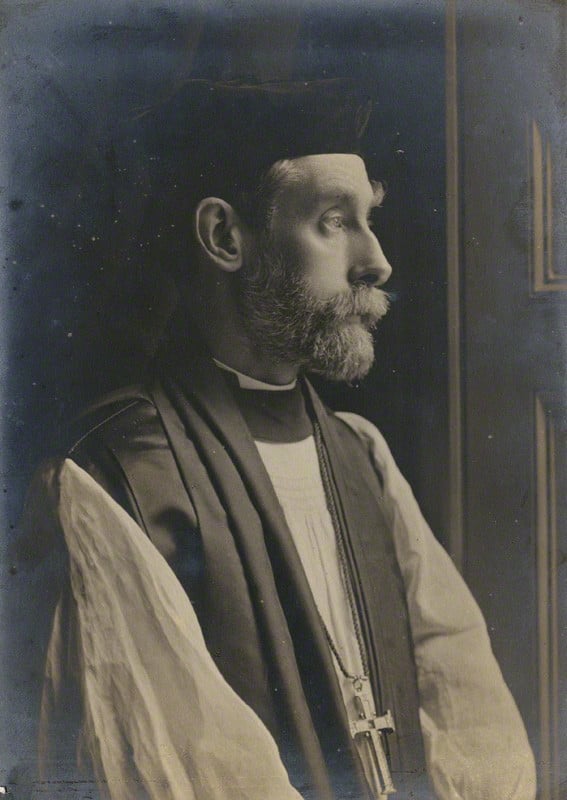
Photo credit: Bishop Charles Gore, by John Lemmon Russell, 1902, from the National Portrait Gallery [public domain / Wikimedia Commons]
Charles Gore (1853–1932) was a bishop in the Church of England (at Worcester, Birmingham, and Oxford), one of the most influential Anglican theologians of the 19th century, and author of many books. I am replying to his well-known volume, Roman Catholic Claims (London: Rivingtons, 2nd ed., 1889), specifically to chapter V: “The Promise to St. Peter” (pp. 71-88). His words will be in blue. I use RSV for Bible citations.
*****
To this promise of Christ to St. Peter [Matt. xvi. 13-20], . . . we will now turn our attention. St. Peter, acting as the spokesman of the other Apostles, had just given expression to the great conviction which had been slowly growing in the minds of the whole band, that the Son of Man was the Christ the Son of the living God. This outspoken confession of His Divine mission and Nature Christ meets and confirms with His most solemn benediction: ‘Blessed art thou’ (so we may venture to paraphrase it) ‘Simon Bar-Jonah: for this conviction is not derived from weak human nature, it is a supernatural communication from above: and (in virtue of this thy profession of it ) I also say unto thee that thou art Rock-man and upon this rock I will build my Church, and the gates of death shall not prevail against it. And I will give to thee the keys of the kingdom of heaven; and whatsoever thou shalt prohibit on earth shall be prohibited in heaven, and whatsoever thou shalt permit on earth, shall be permitted in heaven.’
This passage is, on the face of it, one involving several ambiguities. It is difficult, I think, to feel any doubt that our Lord is here pronouncing the person Peter to be the Rock. (pp. 71-72)
Many important Protestants over the last 500 years have — with equal “certainty” and vigor — expressly denied this last thing, even though Bp. Gore thinks it is “difficult” to “doubt” that it refers to Peter himself as the Rock (i.e., what Catholics have been saying from the beginning).
The Church as a human society is to be built on human characters, and in virtue of St. Peter’s courageous act of faith in Himself, his deliberate acceptance of His Divine claim, our Lord sees in him, what he had hitherto failed to find among men, a solid basis on which His spiritual fabric may be reared, or at least a basis capable of being solidified by discipline and experience, till it become a foundation of rock on which the Church can rest. (p. 72)
Amen! Delighted to hear that we agree on this.
So far our Lord is dealing with St. Peter as a human character, but He goes on beyond all question to promise to invest him with an office, the office of steward in the Divine kingdom, and with a supernatural legislative authority. (p. 72)
Indeed.
St. Peter speaks in this passage as one of a body of twelve. (p. 73)
Sure; but he is clearly the leader and preeminent one. I have provided fifty biblical reasons for believing this.
Is Christ dealing with him as distinct from the others, or as their representative? (p. 73)
More so the former, but part of a group, just as popes today work with bishops, while being “higher” than they are.
Is the office to belong to him only or in a special sense, or is it to be given to all who share the apostolic commission? (p. 73)
Him only, as strongly suggested by his being singularly classified as the “Rock” (a new name) upon which Jesus builds His Church, and the fact that only he receives the “keys of the kingdom” (Mt 16:19).
The ground for this question is left the more open by the fact that Christ is not here bestowing an office but promising it. The passage is an anticipation, a promise (‘I will,’ not ‘I do‘ ) which waits its interpretation in our Lord’s future action, . . . (p. 73)
This seems much ado about nothing, since what God says He will do, He inevitably does, and God did indeed set up Peter as the leader in the early Church, as is evident in the book of Acts. And if there is a leader at first, then it’s just common sense to hold that there will be a perpetual leader, just as there are perpetual bishops. Why have a leader for some thirty years, and then none ever after? That makes no sense. Thus, Jesus’ commission to St. Peter plainly has implications for Church leadership all through history.
It must, we think, be admitted that our Lord’s subsequent language and conduct do not confirm. the stronger and more exclusive meaning which has been put upon His promise to St. Peter. The solemn delegations of ministerial authority given by our Lord after His Resurrection, are so given as to imply the essential equality of all the Apostles. (p. 75)
I don’t see how. Peter is regarded by Jesus as the Chief Shepherd after Himself (Jn 21:15-17) when He tells Peter to “Feed my lambs” and “Tend my sheep” and “Feed my sheep.” This is obviously the office of the chief shepherd of the people of God. The retort is that all this is, is an undoing of Peter’s three denials. That may very well be true, too, but if so, it doesn’t follow that my interpretation is null and void. He still encouraged Peter to be a pastor of what is arguably the entire Church. In the context of many Bible passages already indicating a profound leadership of Peter among the disciples and in the early Church, it’s significant that Jesus uses an agricultural shepherd and sheep parallel, which is a metaphor for being a pastor. The word “shepherd” is used 15 times in the NT in this fashion.
So what does Jesus do here? He was with seven of the disciples (Jn 21:2) in a post-Resurrection appearance. But He singled out Peter and charged him to be the shepherd of the entire Church, since He uses the words “the sheep” or “sheep” 14 times in John 10: meaning, believers in the Church. There He was talking about Himself as the Ultimate Shepherd. But there are also earthly shepherds (pastors or priests or bishops). Jesus didn’t say this to all seven disciples present. He said it to Peter only. That must have some significance. It fits into the scenario of him being the leader of the Church.
Moreover, Peter alone among the apostles is mentioned by name as having been prayed for by Jesus Christ in order that his “faith may not fail” (Lk 22:32). I believe it’s the only time Jesus is said to have prayed for one person, who is named. And guess who it is? Just a “coincidence”: it’s once again Peter. Furthermore, Peter alone among the apostles is exhorted by Jesus to “strengthen your brethren” (Lk 22:32): the supreme pastor again. Bp. Gore acknowledges these two things on page 76 and describes them (virtually conceding two important points and Petrine distinctives!) as “special dealings of our Lord with St. Peter.” If all of the above is “essential equality” it’s certainly the strangest “essential equality” I’ve ever seen.
The Bible massively indicates that he was the leader of the disciples and of the early Church. Protestants don’t even deny that. It’s too obvious. Here he is shown to be that again by being singled out. All of them would be shepherds but Jesus talks to Peter alone. It makes perfect sense. If He built His Church upon Peter, then Peter would certainly be charged with feeding the “sheep” en masse. Peter didn’t have a specific flock when Jesus told Him to feed His sheep. So it seems to be a universal shepherding, which also is what we see in the nature of his first epistle, which is to a large group (“To the exiles of the Dispersion in Pontus, Galatia, Cappado’cia, Asia, and Bithyn’ia”: 1:1), not one local church, as with Paul’s letters.
Pontus was in the north of Turkey and largely surrounding the Black Sea north of it. Galatia was in the center of Asia Minor (Turkey), Cappadocia in its southeast, and Bithynia in its northwest. “Asia” in the NT refers to Asia Minor. So Peter was writing to Christians in a vast area. The size of Turkey is about a thousand miles from west to east, and 300-400 miles from north to south. This is the area, and also east and north of the Black Sea, that was the recipient of Peter’s first epistle.
*
“As the Father hath sent Me, even so send I you” the Apostles in general: (p. 75)
*
Yes; they were all being sent to go turn the world upside down, as the first evangelists (cf. Mt 28:19-20). That has nothing to do with whether or not they have a leader, and who that was. We know who it was (see the above biblical argumentation).
*
“and when He had said this, He breathed on them and saith unto them, Receive ye the Holy Ghost; . . . (p. 75)
*
That’s the indwelling, possessed by all baptized Christians, not just the eleven disciples.
*
. . . whosesoever sins ye forgive, they are forgiven unto them; whosesoever sins ye retain, they are retained.” (p. 75)
*
Yes, the disciples, representative of future clergy, all have the power to bind and loose, meaning to impose penances and to grant absolution. They have that in common with popes, who can also do the same. Bishops and priests both have the same power in that specific respect. Just because some things are held in common, it doesn’t follow that all are.
*
Thus the Mission to represent Christ, as endowed with His authority to baptize and to teach, to remit and to retain sins (which is the power of the keys in its application to individuals) is given to the whole apostolic body at once and equally. (p. 75)
*
Yes, they have that in common, but again, it doesn’t follow that there is no leader who possesses exclusive prerogatives. Bp. Gore seems to commit a basic logical fallacy and fails to make basic, elementary distinctions. I’ve already listed five aspects that were unique to Peter, after all, and in see also my list of fifty things.
*
To all equally had the Holy Eucharist been committed before His passion. (p. 75)
*
Yes indeed, but it’s a non sequitur (irrelevancy) with regard to the singular leadership status of Peter, which is the topic of this chapter of his.
*
It would seem then that what is promised to St. Peter in virtue of his confession of Christ’s name, is bestowed by our Lord equally on all after His Resurrection, . . . (p. 75)
*
This is a gratuitous assumption on inadequate grounds, but not a solid proof, whereas I submit that I have proven my case from the Bible.
*
and St. Peter’s primacy which he undoubtedly held in the apostolic college, carries with it no distinctive powers, but is a personal leadership amongst equals. (p. 75)
*
Again, he assumes without proof. This is merely special pleading and wishful thinking.
*
Mr. Rivington [Catholic] interprets this to mean that it was ‘unnecessary’ for our Lord to pray for all the Apostles because ‘there was one head among them with whom they were to be joined’: so that He prayed for one, in order to protect all! (p. 76)
*
That may be, but I think it’s a weak apologetic. I believe that the more important aspect is the simple fact that Peter is the only person — as far as I know, and I think I’m right — that the Lord is described as praying for. There were certainly others, but singling this out is, I believe, the Bible writers’ way of indicating the huge importance of the person who was described as a recipient of the Lord’s prayer. And this is part of an overall pattern, too, where he is singled out. So, for example, an angel tells Mary Magdalene and others at the empty tomb, “go, tell his disciples and Peter that he is going before you to Galilee” (Mk 16:7).
*
St. Paul distinguishes the Lord’s post-Resurrection appearances to Peter from those to other apostles (1 Cor 15:4-8). The two disciples on the road to Emmaus make the same distinction (Lk 24:34), in this instance mentioning only Peter (“Simon”), even though they themselves had just seen the risen Jesus within the previous hour (Lk 24:33). Peter is often spoken of as distinct among apostles (Mk 1:36; Lk 9:28,32; Acts 2:37; 5:29; 1 Cor 9:5), and is often the spokesman for the other apostles, especially at climactic moments (Mk 8:29; Mt 18:21; Lk 9:5; 12:41; Jn 6:67 ff.).
*
Peter’s name occurs first in all lists of apostles (Mt 10:2; Mk 3:16; Lk 6:14; Acts 1:13). Matthew even calls him the “first” (10:2). Judas Iscariot is invariably mentioned last. Peter is almost without exception named first whenever he appears with anyone else. In one (only?) example to the contrary, Galatians 2:9, where he (“Cephas”) is listed after James and before John, he is clearly preeminent in the entire context (e.g., 1:18-19; 2:7-8). And Peter’s name is always the first listed even of the “inner circle” of the disciples (Peter, James and John – Mt 17:1; 26:37,40; Mk 5:37; 14:37). The cumulative evidence is overwhelming and undeniable.
*
How strangely is this idea in contrast with the fact of our Lord’s prayer in St. John, xvii. 9, 10. [“I am praying for them; . . . for those whom thou hast given me, . . .”] (p. 76)
*
They are prayed for as a collective, without individual names given, whereas Peter is prayed for specifically by name. This indicates preeminence. It’s this way for a reason. God — speaking through the evangelists — was indicating the special and unique status of Peter. The point isn’t that Jesus didn’t pray for the others, too, but how the prayer is differently presented in Holy Scripture. It’s somewhat like how Moses was singled out because God spoke to him “face to face”:
Exodus 33:11 Thus the LORD used to speak to Moses face to face, as a man speaks to his friend. . . .
Deuteronomy 34:10 And there has not arisen a prophet since in Israel like Moses, whom the LORD knew face to face,
Moreover, we have the terminology of “the LORD and . . . his servant Moses”: Ex 14:31; “my servant Moses; he is entrusted with all my house”: Num 12:7; “Moses the servant of the LORD”: Dt. 34:5; Josh 1:1-2, 7, 13, 15; 8:31, 33; 9:24; 11:12, 15; 12:6; 13:8; 14:7; 18:7; 22:2, 4-5; whereas Joshua is called Moses‘ “servant”: Ex 24:13; 33:11. Joshua isn’t called God’s servant, even though both he and Moses served Him, because Moses was over him. What’s “strange” is how Bp. Gore seems to utterly overlook so much that I have brought up. As so often in these debates with old sources from dead people (or even with live Protestants), I invariably utilize far more Scripture than my Protestant opponent does, because it’s God’s revelation and as such carries inherent and intrinsic weight. It’s where the argument must be grounded. Any proclaimed Christian view must be in harmony with all of it.
*
But when Jesus says, “but I have prayed for you that your faith may not fail” (Lk 22:32), this isn’t just because Peter was to deny Him for a short amount of time before he repented (it could have only been ten minutes, as opposed to the seeming months that Paul persecuted and killed Christians), but also has implications for his role as pope, where his faith can’t fail without dire implications for the Church and the faithful. This gets into papal indefectibility, that was most explicitly discussed in Vatican I in 1870. All of this points to one thing: Petrine — and papal — preeminence and supremacy.
*
There is nothing in the Gospels to suggest that St. Peter’s position among the Apostles was any less personal or any more destined to be an abiding fact in the Church’s ministry than that of St. John. (p. 77)
*
This is simply absurd, and is contradicted by all I have argued above, and many other Bible-based articles I have written about Petrine primacy, on my Papacy and Infallibility web page.
*
He was the leader-the ‘coryphæus’ of the apostolic band. He spoke and acted at first as such, and, as holding ‘ the keys of the kingdom of heaven,’ opened the door to the Gentiles. But his position of leader does not seem to carry with it any prerogative of primary importance. The Apostles at Jerusalem are described as “sending him ” [Acts viii. 14] with St. John to Samaria. (p. 78)
*
That’s an “interesting” argument. Why don’t we apply it to St. Paul, too?:
Acts 17:10 The brethren immediately sent Paul and Silas away by night to Beroe’a . . .
Acts 17:14 Then the brethren immediately sent Paul off on his way to the sea, . . .
At least the “apostles” sent Peter somewhere; with Paul it was mere “brethren.” They obviously weren’t “higher” than he was, so this argument from the word “sent” collapses.
*
He occupies no governing position in the Council at Jerusalem. . . . the formal authority, the formal “ I decide,” comes from St. James, and the decree goes
out in the name of “the Apostles and elders” generally. (p. 79)
*
From Acts 15, we learn that “after there was much debate, Peter rose” to address the assembly (15:7). The Bible records his speech, which goes on for five verses. Then it reports that “all the assembly kept silence” after having previously been split (15:12). Paul and Barnabas speak next, speaking about “signs and wonders God had done through them among the Gentiles” (15:12). Then when James speaks, not making additional authoritative pronouncements, but confirming Peter’s exposition, and referring right back to what “Simeon [Peter] has related . . .” (15:14), and he says, “with this the words of the prophets agree” (15:15). To me, this suggests that Peter’s talk was central and definitive. James speaking last could easily be explained by the fact that he was the bishop of Jerusalem and therefore the “host.”
*
James says, “my judgment is . . . ” (15:19). But it doesn’t necessarily follow, logically, that his is either the only or definitive, most authoritative judgment. St. Paul hardly plays any major role. Is he “under” James, too? Bp. Gore contradicts himself anyway, since he notes that the decree went out from all. So if that undermines Peter’s authority, it equally undermines James’ supposedly greater conciliar authority. It was a decree agreed upon by the overall assembly, including even non-apostles (“elders”).
*
It was a council, just as Catholic ecumenical councils are group efforts, but ultimately led by popes. What James stated doesn’t disprove that Peter wasn’t the one with the crucial intake, that brought about the actual outcome. Even Bp. Gore (remarkably) concedes, “Christ’s revelation to him, indeed, when he opened the door to the Gentiles, [Acts xv. 7-11] was a fact which must have been conclusive of the question before the meeting” (p. 76). Exactly! Peter spoke and the debate ended, and James referred back to him, sounding every bit like someone deferring to a superior’s opinion.
*
***
*
Practical Matters: I run the most comprehensive “one-stop” Catholic apologetics site: rated #1 for Christian sites by leading AI tool, ChatGPT — endorsed by popular Protestant blogger Adrian Warnock. Perhaps some of my 5,000+ free online articles or fifty-six books have helped you (by God’s grace) to decide to become Catholic or to return to the Church, or better understand some doctrines and why we believe them. If you believe my full-time apostolate is worth supporting, please seriously consider a much-needed monthly or one-time financial contribution. “The laborer is worthy of his wages” (1 Tim 5:18, NKJV).
*
PayPal donations are the easiest: just send to my email address: [email protected]. Here’s also a second page to get to PayPal. You’ll see the term “Catholic Used Book Service”, which is my old side-business. To learn about the different methods of contributing (including Zelle and 100% tax-deductible donations if desired), see my page: About Catholic Apologist Dave Armstrong / Donation Information.
*
You can support my work a great deal in non-financial ways, if you prefer; by subscribing to, commenting on, liking, and sharing videos from my YouTube channel, Catholic Bible Highlights, where I partner with Kenny Burchard (see my own videos), and/or by signing up to receive notice for new articles on this blog. Just type your email address on the sidebar to the right (scroll down quite a bit), where you see, “Sign Me Up!” Thanks a million!
*
***
*
Photo credit: Bishop Charles Gore, by John Lemmon Russell, 1902, from the National Portrait Gallery [public domain / Wikimedia Commons]

Summary: Anglican Bishop Charles Gore (1853–1932) made all the usual anti-Petrine arguments, which I believe I have refuted from Holy Scripture itself and various logical observations.
Previous Post
April 14, 2025
Justification in the Book of James (Different from Paul?)
Next Post

April 24, 2025 Reply to Lucas Banzoli's 30 "Common" (?) Protestant Views
Recent Comments
"Special pleading, and not a serious response to my arguments . . ."
Is Venerating Men & Angels Worship? ..."
""no man needs to teach us."Didn't you just teach us?"
Is Venerating Men & Angels Worship? ..."
""Catholics say they are the only church that can lead people into heaven."In fact, we ..."
Is Venerating Men & Angels Worship? ..."
"And lastly, I belong to no denomination and am free to serve God as He ..."
Is Venerating Men & Angels Worship? ..."
Browse Our Archives
Select a Category & Last Things About Me Anti-Catholicism Atheism & Agnosticism Baptism and Sacramentalism Bible and Tradition Blessed Virgin Mary Books by Dave Armstrong C. S. Lewis Calvinism & General Protestantism Catholic Apologetics Catholic Apologists Catholic conversion Catholic converts Christmas Church (Ecclesiology) Church History Conversion and Converts Development of Doctrine Eastern Orthodoxy Ecumenism & Christian Unity Eucharist & Liturgy Fathers of the Church French Translations G. K. Chesterton Hell Hell & Satan Hell & Satan & Last Things Heresies & Comparative Religion Holistic Health Inquisition & Crusades & Scandals James White Jews & Judaism & Old Testament John Calvin John Henry Newman Liberal / Modernist Theology Life Issues Literary Resume Lutheranism Mariology Martin Luther Music Orthodoxy Papacy & Infallibility Personal Page Philosophy & Science Political & Ethical & Moral Issues Protestant Persecution & Intolerance Protestantism Purgatory Purgatory & Penance Romantic & Imaginative Theology Saints & Purgatory & Penance Salvation Salvation & Justification Satan & Last Things Sexuality and Gender Issues Spanish Translations Traditionalism vs. Radical Catholic Reactionaries Traducciones al español / tradução para português Trinitarianism & Christology Uncategorized Videos
Select a Month October 2026 September 2026 August 2026 July 2026 June 2026 May 2026 April 2026 March 2026 February 2026 January 2026 December 2025 November 2025 October 2025 September 2025 August 2025 July 2025 June 2025 May 2025 April 2025 March 2025 February 2025 January 2025 December 2024 November 2024 October 2024 September 2024 August 2024 July 2024 June 2024 May 2024 April 2024 March 2024 February 2024 January 2024 December 2023 November 2023 October 2023 September 2023 August 2023 July 2023 June 2023 May 2023 April 2023 March 2023 February 2023 January 2023 December 2022 November 2022 October 2022 September 2022 August 2022 July 2022 June 2022 May 2022 April 2022 March 2022 February 2022 January 2022 December 2021 November 2021 October 2021 September 2021 August 2021 July 2021 June 2021 May 2021 April 2021 March 2021 February 2021 January 2021 December 2020 November 2020 October 2020 September 2020 August 2020 July 2020 June 2020 May 2020 April 2020 March 2020 February 2020 January 2020 December 2019 November 2019 October 2019 September 2019 August 2019 July 2019 June 2019 May 2019 April 2019 March 2019 February 2019 January 2019 December 2018 November 2018 October 2018 September 2018 August 2018 July 2018 June 2018 May 2018 April 2018 March 2018 February 2018 January 2018 December 2017 November 2017 October 2017 September 2017 August 2017 July 2017 June 2017 May 2017 April 2017 March 2017 February 2017 January 2017 December 2016 November 2016 October 2016 September 2016 August 2016 July 2016 June 2016 May 2016 April 2016 March 2016 February 2016 January 2016 December 2015 November 2015 October 2015 September 2015 August 2015 July 2015 June 2015 May 2015 April 2015 March 2015 February 2015 January 2015 December 2014 November 2014 October 2014 September 2014 August 2014 July 2014 June 2014 April 2014 March 2014 February 2014 January 2014 December 2013 November 2013 October 2013 September 2013 August 2013 July 2013 June 2013 April 2013 March 2013 February 2013 January 2013 December 2012 November 2012 October 2012 September 2012 August 2012 July 2012 June 2012 May 2012 April 2012 March 2012 February 2012 January 2012 December 2011 November 2011 October 2011 September 2011 August 2011 July 2011 June 2011 April 2011 March 2011 February 2011 October 2010 September 2010 August 2010 July 2010 April 2010 March 2010 December 2009 October 2009 August 2009 July 2009 June 2009 May 2009 March 2009 February 2009 October 2008 September 2008 April 2008 March 2008 February 2008 January 2008 December 2007 November 2007 October 2007 May 2007 March 2007 February 2007 January 2007 November 2006 October 2006 September 2006 August 2006 July 2006 June 2006 May 2006 April 2006 March 2006 February 2006 October 2005 June 2005 April 2005 February 2005 July 2004 May 2004 April 2004
Follow Us!
TAKE THE
Religious Wisdom Quiz
Which book of the Bible contains the most direct prophecies about the Messiah?
Select your answer to see how you score.
Micah Isaiah Zechariah Psalms
Books by This Author Books by Dave Armstrong
Related posts from Biblical Evidence for Catholicism

Was Peter "Any Old" Apostle? 10 Anti-Papal Arguments
Biblical Evidence for Catholicism

11 Protestant Objections to Papal Authority Debunked
Biblical Evidence for Catholicism

Matthew 16 & the Papacy (vs. Patrick O'Brien)
Biblical Evidence for Catholicism
Inspired Prophets: An Analogy to Infallible Popes
Biblical Evidence for Catholicism
TRENDING AT PATHEOS Catholic

The Sermon on the Mount, Part I: Matthew...
The Sermon on the Mount, Part I (Matthew 4:12-5:12) St. Matthew moves...

What's up from Crossway: Reviewing some of their latest A few weeks...

Janie Learns the Way of the Cross: A...
Teaching children about Jesus' Passion can be challenging. Many parents and educators...

Looking For Good Catholic Writing - October 2026
He alone extends the heavens, and he walks upon the waves of...

In "Irreplaceable," our book on vocation and technology, Trevor Sutton and I...

I was strolling through the top floor of the brand new Parthenon...
view all Catholic blogs
What Are Your Thoughts?leave a comment
Ad-Free & Subscriber Log-In Subscription Support
- About Us
- 2026 Calendar
- Videos
- Podcasts
- Library of World Religions
- Faith In Media Tracker
- Advertise With Us
- Write for Us
- Privacy Policy
- Terms of Service
- Do Not Sell My Data
- Contact Us
- Radiant Digital
- Manage Newsletter Subscriptions
- Unsubscribe From Notifications
- Sitemap
Copyright 2008-2026, Patheos. All rights reserved.
Subscription Support Ad-Free & Subscriber Log-In
Follow Patheos