
BuddhistCatholicContemplativeEvangelicalGeneral ChristianHinduJewishLatter-day SaintMuslimNew VisionsProgressive Christian
Beliefs
- Buddhist
- Catholic
- Contemplative
- Evangelical
- General Christian
- Hindu
- Jewish
- Latter-day Saint
- More Voices
- Muslim
- New Visions
- Pagan
- Progressive Christian
Topics
- Religion News
- Food and Religion
- Sports and Religion
- Religious Art
- Religious Music and Entertainment
- Religious Events
- History and Religion
- Style and Religion
- Politics and Religion
- Women in Religion
- Recreation Outdoors and Religion
- Business Finance and Religion
- Careers Workplace and Religion
- Education and Religion
- Family Parenting and Religion
- Health Fitness and Religion
- Home and Religion
- Relationships and Religion
- Technology and Religion
- Travel and Religion
Columnists
- Buddhist Columnists
- Business Finance and Religion Columnists
- Careers Workplace and Religion Columnists
- Catholic Columnists
- Contemplative Columnists
- Education and Religion Columnists
- Evangelists Columnists
- Family Parenting and Religion Columnists
- General Christian Columnists
- Health Fitness and Religion Columnists
- Hindu Columnists
- History and Religion Columnists
- Home and Religion Columnists
- Jewish Columnists
- More Voices Columnists
- Latter Day Columnists
- Muslim Columnists
- New Visions Columnists
- Nonreligious Columnists
- Pagan Columnists
- Politics and Religion Columnists
- Progressive Columnists
- Recreation Outdoors and Religion Columnists
- Relationships and Religion Columnists
- Religion News Columnists
- Religious Art Columnists
- Religious Events Columnists
- Religious Music and Entertainment Columnists
- Sports and Religion Columnists
- Style and Religion Columnists
- Technology and Religion Columnists
- Travel and Religion Columnists
- Women in Religion Columnists
Resource Library
- 2026 Calendar
- Library of World Religions
- The 100 Most Holy Places on Earth
- Patheos Answers
- Podcasts
- Videos
- Faith Leaders Database
- Anglican Episcopalian
- Bahai
- Baptist
- Buddhism
- Christianity
- Confucianism
- Eastern Orthodoxy
- Hinduism
- Holiness and Pentecostal
- ISKCON
- Islam
- Judaism
- Lutheran
- Methodist
- The Church of Jesus Christ of Latter-day Saints
- New Age
- Paganism
- Presbytarian and Reformed
- Protestantism
- Religion Behind the Scenes
- Roman Catholic
- Scientology
- Shia Islam
- Sikhism
- Sufism
- Sunni Islam
- Taoism
- Zen
- See all religions
Research Tools
 Ad-Free & Subscriber Log-In Subscription Support
Ad-Free & Subscriber Log-In Subscription Support
Follow Patheos 

- Trending:
- Forgiveness
- |
- Marriage
- |
- Consciousness
- |
- Death Penalty
- |
- Election
- |
- Halloween

-
About
-
Catholic Apologetics
-
Church History
-
Great Apologists
-
Christian Worldview
-
Protestantism & Misc.
- Home
- Catholic
- History and Religion
- New Perspective on Paul: Exegesis of “Works of the Law”
New Perspective on Paul: Exegesis of “Works of the Law”
Last updated on: April 4, 2025 at 4:09 pm by Dave Armstrong
New Perspective on Paul: Exegesis of “Works of the Law” 2025-04-04T16:09:14-04:00 Dave Armstrong
Patheos Explore the world's faith through different perspectives on religion and spirituality! Patheos has the views of the prevalent religions and spiritualities of the world.
Does “Works of the Law” Refer to All Good Works Whatsoever?
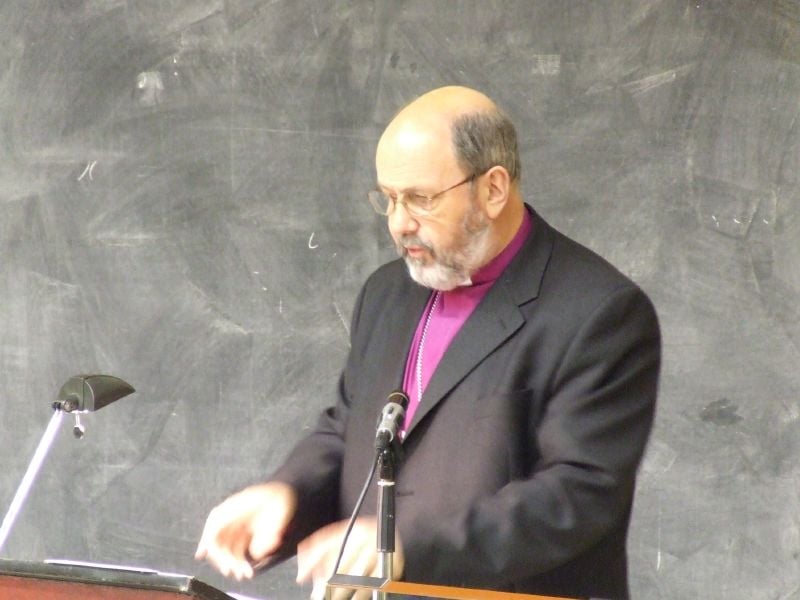
Photo credit: N. T. Wright (20 December 2007), by Gareth Saunders [Wikimedia Commons / Creative Commons Attribution-Share Alike 2.0 Generic license]
Heinrich Bullinger (1504-1575), a Calvinist leader in early Protestantism, or “reformer”, after citing Galatians 2:16, wrote the following in his most significant work, Decades (1551; rep. Cambridge University Press, 1849; first and second decades):
This is now the third time that Paul saith, that men are not justified by the works of the law: in the which clause he comprehendeth all manner of works of what sort soever. (p. 113)
John Calvin, in his Commentaries, draws the same false conclusion about Galatians 2:16:
Let it therefore remain settled, that the proposition is so framed as to admit of no exception, “that we are justified in no other way than by faith,” or, “that we are not justified but by faith,” or, which amounts to the same thing, “that we are justified by faith alone.”
Hence it appears with what silly trifling the Papists of our day dispute with us about the word, as if it had been a word of our contrivance. But Paul was unacquainted with the theology of the Papists, who declare that a man is justified by faith, and yet make a part of justification to consist in works. Of such half-justification Paul knew nothing. For, when he instructs us that we are justified by faith, because we cannot be justified by works, he takes for granted what is true, that we cannot be justified through the righteousness of Christ, unless we are poor and destitute of a righteousness of our own. Consequently, either nothing or all must be ascribed to faith or to works.
And therein lies a fundamental error, repeated by many many Protestants for over 500 years: the interpretation of a particular phrase in Paul relating to Mosaic Law, to supposedly mean all good works; thus leading to a false “faith alone” viewpoint. Recently, I proved the falsity of “faith alone” (sola fide) from a hundred passages in the Bible. But Calvin and Bullinger somehow manage to ignore that much clear teaching of the Bible. The Wikipedia article, “New Perspective on Paul” (“NPP”) provides a good overview:
The “New Perspective” movement began with the publication of the 1977 essay Paul and Palestinian Judaism by E. P. Sanders, an American New Testament scholar and Christian theologian.
Historically, the old Protestant perspective claims that Paul advocates justification through faith in Jesus Christ over justification through works of the Mosaic Law. During the Protestant Reformation, this theological principle became known as sola fide (“faith alone”); this was traditionally understood as Paul arguing that good works performed by Christians would not factor into their salvation; only their faith in Jesus Christ would save them. In this perspective, Paul dismissed 1st-century Palestinian Judaism as a sterile and legalistic religion.
According to Sanders, Paul’s letters do not address good works but instead question Jewish religious observances such as circumcision, dietary laws, and Sabbath laws, which were the “boundary markers” that set the Jews apart from other ethno-religious groups in the Levant. Sanders further argues that 1st-century Palestinian Judaism was not a “legalistic community”, nor was it oriented to “salvation by works”. As God’s “chosen people”, they were under his covenant. Contrary to Protestant belief, following the Mosaic Law was not a way of entering the covenant but of staying within it. . . .
The writings of the Apostle Paul contain a substantial amount of criticism regarding the “works of the Law“.
By contrast, “New Perspective” scholars see Paul as talking about “badges of covenant membership” or criticizing Gentile believers who had begun to rely on the Torah to reckon Jewish kinship. . . .
The “New Perspective on Paul” has, by and large, been an internal debate among Protestant biblical scholars. Many Roman Catholic and Eastern Orthodox scholars have responded favorably to the “New Perspective”, seeing a greater commonality with certain strands of their own traditions.
Anglican bishop and Bible scholar N. T. Wright (b. 1948) is the most well-known figure in the NPP movement. He stated in a lecture delivered at the Tenth Edinburgh Dogmatics Conference (August 2003):
In my early days of research, before Sanders had published Paul and Palestinian Judaism in 1977 and long before Dunn coined the phrase ‘The New Perspective on Paul’, I was puzzled by one exegetical issue in particular, which I here oversimplify for the sake of summary. If I read Paul in the then standard Lutheran way, Galatians made plenty of sense, but I had to fudge (as I could see dozens of writers fudging) the positive statements about the Law in Romans. If I read Paul in the Reformed way . . ., Romans made a lot of sense, but I had to fudge . . . the negative statements about the Law in Galatians. . . . it dawned on me, I think in 1976, that a different solution was possible. In Romans 10.3 Paul, writing about his fellow Jews, declares that they are ignorant of the righteousness of God, and are seeking to establish ‘their own righteousness’. The wider context, not least 9.30–33, deals with the respective positions of Jews and Gentiles within God’s purposes – and with a lot more besides, of course, but not least that. Supposing, I thought, Paul meant ‘seeking to establish their own righteousness’, not in the sense of a moral status based on the performance of Torah and the consequent accumulation of a treasury of merit, but an ethnic status based on the possession of Torah as the sign of automatic covenant membership? I saw at once that this would make excellent sense of Romans 9 and 10, and would enable the positive statements about the Law throughout Romans to be given full weight while making it clear that this kind of use of Torah, as an ethnic talisman, was an abuse. I sat up in bed that night reading through Galatians and saw that at point after point this way of looking at Paul would make much better sense of Galatians, too, than either the standard post-Luther readings or the attempted Reformed ones. . . .
I regard as absolutely basic the need to understand Paul in a way which does justice to all the letters, as well as to the key passages in individual ones) . . . the struggle to think Paul’s thoughts after him [is] a matter of obedience to scripture. . . .
When Jimmy Dunn added his stones to the growing pile I found myself in both agreement and disagreement with him. His proposal about the meaning of ‘works of the law’ in Paul – that they are not the moral works through which one gains merit but the works through which the Jew is defined over against the pagan – I regard as exactly right. It has proved itself again and again in the detailed exegesis; attempts to deny it have in my view failed. . . .
It is blindingly obvious when you read Romans and Galatians . . . that virtually whenever Paul talks about justification he does so in the context of a critique of Judaism and of the coming together of Jew and Gentile in Christ. As an exegete determined to listen to scripture rather than abstract my favourite bits from it I cannot ignore this. The only notice that most mainstream theology has taken of this context is to assume that the Jews were guilty of the kind of works-righteousness of which theologians from Augustine to Calvin and beyond have criticised their opponents; . . . I regard the New Perspective’s challenge to this point as more or less established. . . .
It seems that there has been a massive conspiracy of silence on something which was quite clear for Paul (as indeed for Jesus). Paul, in company with mainstream second-Temple Judaism, affirms that God’s final judgment will be in accordance with the entirety of a life led – in accordance, in other words, with works. He says this clearly and unambiguously in Romans 14.10–12 and 2 Corinthians 5.10. He affirms it in that terrifying passage about church-builders in 1 Corinthians 3. But the main passage in question is of course Romans 2.1–16. . . .
Here is the first statement about justification in Romans, and lo and behold it affirms justification according to works! The doers of the law, he says, will be justified (2.13). Shock, horror; Paul cannot (so many have thought) have really meant it. So the passage has been treated as a hypothetical position which Paul then undermines by showing that nobody can actually achieve it; or, by Sanders for instance, as a piece of unassimilated Jewish preaching which Paul allows to stand even though it conflicts with other things he says. But all such theories are undermined by exegesis itself, not least by observing the many small but significant threads that stitch Romans 2 into the fabric of the letter as a whole. Paul means what he says. Granted, he redefines what ‘doing the law’ really means; he does this in chapter 8, and again in chapter 10, with a codicil in chapter 13. But he makes the point most compactly in Philippians 1.6: he who began a good work in you will bring it to completion on the day of Christ Jesus. The ‘works’ in accordance with which the Christian will be vindicated on the last day are not the unaided works of the self-help moralist. Nor are they the performance of the ethnically distinctive Jewish boundary-markers (sabbath, food-laws and circumcision). They are the things which show, rather, that one is in Christ; the things which are produced in one’s life as a result of the Spirit’s indwelling and operation. . . .
I am fascinated by the way in which some of those most conscious of their reformation heritage shy away from Paul’s clear statements about future judgment according to works. It is not often enough remarked upon, for instance, that in the Thessalonian letters, and in Philippians, he looks ahead to the coming day of judgment and sees God’s favourable verdict not on the basis of the merits and death of Christ, not because like Lord Hailsham he simply casts himself on the mercy of the judge, but on the basis of his apostolic work. . . . [Paul is] clear that the things he does in the present, by moral and physical effort, will count to his credit on the last day, precisely because they are the effective signs that the Spirit of the living Christ has been at work in him. We are embarrassed about saying this kind of thing; Paul clearly is not. What on earth can have happened to a sola scriptura theology that it should find itself forced to screen out such emphatic, indeed celebratory, statements?
With that background in mind, I’d like to briefly examine the contexts of St. Paul’s use of the phrase, “works of the law.” Here are the eight instances of that phrase or “works of law” in six verses in his epistles:
Romans 3:20 For no human being will be justified in his sight by works of the law, since through the law comes knowledge of sin.
Romans 3:28 For we hold that a man is justified by faith apart from works of law. (also, “works” in 3:27 seems to be in the same sense, based on the context of 3:20, 28)
Galatians 2:16 yet who know that a man is not justified by works of the law but through faith in Jesus Christ, even we have believed in Christ Jesus, in order to be justified by faith in Christ, and not by works of the law, because by works of the law shall no one be justified.
Galatians 3:2 Let me ask you only this: Did you receive the Spirit by works of the law, or by hearing with faith?
Galatians 3:5 Does he who supplies the Spirit to you and works miracles among you do so by works of the law, or by hearing with faith?
Galatians 3:10 For all who rely on works of the law are under a curse; for it is written, “Cursed be every one who does not abide by all things written in the book of the law, and do them.”
Do the immediate contexts of these passages suggest that Paul is referring to all works — even good works — , or, on the other hand, works in the sense of Jewish religious observances such as circumcision, dietary laws, and Sabbath laws, which were the ‘boundary markers’ that set the Jews apart” (as the Wikipedia article put it)? The phrase, “works of the law” — because of the word “law” — would seem to me to suggest on its face the latter position, but as we have seen, most Protestant exegetes through the centuries have not thought so, and have followed Bullinger’s and Calvin’s thinking on the issue.
N. T. Wright thinks they have been greatly mistaken, and Catholics agree wholeheartedly with that assessment. The erroneous man-generated tradition of sola fide has overcome common sense exegesis in this instance. When Paul refers to “the law” all agree that he means by that, the Mosaic Law, given to Moses on Mt. Sinai and codified in the first five books of the Bible (the Torah or Pentateuch). Let’s now examine the contexts of these passages.
Romans 3:20
The “law” is referred to in both the immediate preceding and succeeding verses:
Romans 3:19 Now we know that whatever the law says it speaks to those who are under the law, so that every mouth may be stopped, and the whole world may be held accountable to God.
Romans 3:21 But now the righteousness of God has been manifested apart from law, although the law and the prophets bear witness to it,
Romans 3:28
The context of the next three verses refers to Jews and Gentiles, circumcision, and “the law” and Paul even makes it a point to stress that “we uphold the law.”
Romans 3:29-31 Or is God the God of Jews only? Is he not the God of Gentiles also? Yes, of Gentiles also, [30] since God is one; and he will justify the circumcised on the ground of their faith and the uncircumcised through their faith. [31] Do we then overthrow the law by this faith? By no means! On the contrary, we uphold the law.
In the next chapter, devoted to Abraham, who lived before the law, Paul still refers to “the law” five times in 4:13-16.
Galatians 2:16
Galatians 2:15 We . . . are Jews by birth . . .
Galatians 2:19-21 For I through the law died to the law, that I might live to God. . . . [21] I do not nullify the grace of God; for if justification were through the law, then Christ died to no purpose.
Galatians 3:2, 5, 10
Paul had been discussing “the law” at the end of chapter 2 (2:19-21). Then he proceeds to refer to “the law” twelve more times throughout the chapter, besides 3:2, 5, 10 (3:11-13, 17-19, 21, 23-24).
*
***
*
Practical Matters: I run the most comprehensive “one-stop” Catholic apologetics site: rated #1 for Christian sites by leading AI tool, ChatGPT — endorsed by popular Protestant blogger Adrian Warnock. Perhaps some of my 5,000+ free online articles or fifty-six books have helped you (by God’s grace) to decide to become Catholic or to return to the Church, or better understand some doctrines and why we believe them. If you believe my full-time apostolate is worth supporting, please seriously consider a much-needed monthly or one-time financial contribution. “The laborer is worthy of his wages” (1 Tim 5:18, NKJV).
*
PayPal donations are the easiest: just send to my email address: [email protected]. Here’s also a second page to get to PayPal. You’ll see the term “Catholic Used Book Service”, which is my old side-business. To learn about the different methods of contributing (including Zelle and 100% tax-deductible donations if desired), see my page: About Catholic Apologist Dave Armstrong / Donation Information.
*
You can support my work a great deal in non-financial ways, if you prefer; by subscribing to, commenting on, liking, and sharing videos from my YouTube channel, Catholic Bible Highlights, where I partner with Kenny Burchard (see my own videos), and/or by signing up to receive notice for new articles on this blog. Just type your email address on the sidebar to the right (scroll down quite a bit), where you see, “Sign Me Up!” Thanks a million!
*
***
*
Photo credit: N. T. Wright (20 December 2007), by Gareth Saunders [Wikimedia Commons / Creative Commons Attribution-Share Alike 2.0 Generic license]

Summary: The New Perspective on Paul — in agreement with Catholics — holds that Pauline “works of the law” are “boundary markers” that set the Jews apart from other religious groups.
Previous Post
April 1, 2025
Veneration in the Bible ("Roman Creature-Worship"?)
Next Post
April 7, 2025 Luther's "Table Talk": How Historically Accurate Is It?
Recent Comments
"And lastly, I belong to no denomination and am free to serve God as He ..."
Is Venerating Men & Angels Worship? ..."
"And obeisance doesn't mean "worship". It means "respect", "obey", or "submission". Very weird that you ..."
Is Venerating Men & Angels Worship? ..."
"Many of these scriptures you have noted have been taken out of context. With Daniel, ..."
Is Venerating Men & Angels Worship? ..."
""Protestants often point out that Jesus is now triumphant in heaven and object to Catholics ..."
Three More Anti-Catholic Lies About Catholicism ..."
Browse Our Archives
Select a Category & Last Things About Me Anti-Catholicism Atheism & Agnosticism Baptism and Sacramentalism Bible and Tradition Blessed Virgin Mary Books by Dave Armstrong C. S. Lewis Calvinism & General Protestantism Catholic Apologetics Catholic Apologists Catholic conversion Catholic converts Christmas Church (Ecclesiology) Church History Conversion and Converts Development of Doctrine Eastern Orthodoxy Ecumenism & Christian Unity Eucharist & Liturgy Fathers of the Church French Translations G. K. Chesterton Hell Hell & Satan Hell & Satan & Last Things Heresies & Comparative Religion Holistic Health Inquisition & Crusades & Scandals James White Jews & Judaism & Old Testament John Calvin John Henry Newman Liberal / Modernist Theology Life Issues Literary Resume Lutheranism Mariology Martin Luther Music Orthodoxy Papacy & Infallibility Personal Page Philosophy & Science Political & Ethical & Moral Issues Protestant Persecution & Intolerance Protestantism Purgatory Purgatory & Penance Romantic & Imaginative Theology Saints & Purgatory & Penance Salvation Salvation & Justification Satan & Last Things Sexuality and Gender Issues Spanish Translations Traditionalism vs. Radical Catholic Reactionaries Traducciones al español / tradução para português Trinitarianism & Christology Uncategorized Videos
Select a Month October 2026 September 2026 August 2026 July 2026 June 2026 May 2026 April 2026 March 2026 February 2026 January 2026 December 2025 November 2025 October 2025 September 2025 August 2025 July 2025 June 2025 May 2025 April 2025 March 2025 February 2025 January 2025 December 2024 November 2024 October 2024 September 2024 August 2024 July 2024 June 2024 May 2024 April 2024 March 2024 February 2024 January 2024 December 2023 November 2023 October 2023 September 2023 August 2023 July 2023 June 2023 May 2023 April 2023 March 2023 February 2023 January 2023 December 2022 November 2022 October 2022 September 2022 August 2022 July 2022 June 2022 May 2022 April 2022 March 2022 February 2022 January 2022 December 2021 November 2021 October 2021 September 2021 August 2021 July 2021 June 2021 May 2021 April 2021 March 2021 February 2021 January 2021 December 2020 November 2020 October 2020 September 2020 August 2020 July 2020 June 2020 May 2020 April 2020 March 2020 February 2020 January 2020 December 2019 November 2019 October 2019 September 2019 August 2019 July 2019 June 2019 May 2019 April 2019 March 2019 February 2019 January 2019 December 2018 November 2018 October 2018 September 2018 August 2018 July 2018 June 2018 May 2018 April 2018 March 2018 February 2018 January 2018 December 2017 November 2017 October 2017 September 2017 August 2017 July 2017 June 2017 May 2017 April 2017 March 2017 February 2017 January 2017 December 2016 November 2016 October 2016 September 2016 August 2016 July 2016 June 2016 May 2016 April 2016 March 2016 February 2016 January 2016 December 2015 November 2015 October 2015 September 2015 August 2015 July 2015 June 2015 May 2015 April 2015 March 2015 February 2015 January 2015 December 2014 November 2014 October 2014 September 2014 August 2014 July 2014 June 2014 April 2014 March 2014 February 2014 January 2014 December 2013 November 2013 October 2013 September 2013 August 2013 July 2013 June 2013 April 2013 March 2013 February 2013 January 2013 December 2012 November 2012 October 2012 September 2012 August 2012 July 2012 June 2012 May 2012 April 2012 March 2012 February 2012 January 2012 December 2011 November 2011 October 2011 September 2011 August 2011 July 2011 June 2011 April 2011 March 2011 February 2011 October 2010 September 2010 August 2010 July 2010 April 2010 March 2010 December 2009 October 2009 August 2009 July 2009 June 2009 May 2009 March 2009 February 2009 October 2008 September 2008 April 2008 March 2008 February 2008 January 2008 December 2007 November 2007 October 2007 May 2007 March 2007 February 2007 January 2007 November 2006 October 2006 September 2006 August 2006 July 2006 June 2006 May 2006 April 2006 March 2006 February 2006 October 2005 June 2005 April 2005 February 2005 July 2004 May 2004 April 2004
Follow Us!
TAKE THE
Religious Wisdom Quiz
Who was cast into a fiery furnace but was unharmed?
Select your answer to see how you score.
Elijah and Elisha Moses, Aaron, and Joshua Daniel Shadrach, Meshach, and Abednego
Books by This Author Books by Dave Armstrong
Related posts from Biblical Evidence for Catholicism

Bible & Catholicism on Mortal Sin (vs. John...
Biblical Evidence for Catholicism

Dialogue on Eternal Security / Absolute Assurance
Biblical Evidence for Catholicism

"Faith Alone" Dialogue with a Calvinist
Biblical Evidence for Catholicism

Exegesis of 75 NT Faith [Alone?] & Works...
Biblical Evidence for Catholicism
TRENDING AT PATHEOS Catholic

In "Irreplaceable," our book on vocation and technology, Trevor Sutton and I...

I was strolling through the top floor of the brand new Parthenon...

What Does Gêvâh Mean For Kimberley Guifoyle &...
This week, a lot of the news is focused on Kimberly Guilfoyle....

INNER CIRCLE: Profound Mystery (Of Christ In All...
Ephesians 5:31-32 “For this reason, a man will leave his father and...

Do Not Rejoice When Your Enemy Falls: The...
Turning an execution into a public spectacle is a disturbing expression of...

'The Chosen' S6 Trailer: The Passion Gets Very...
Not many watching 'The Chosen' worry about spoilers, but just because they...
view all Catholic blogs
What Are Your Thoughts?leave a comment
Ad-Free & Subscriber Log-In Subscription Support
- About Us
- 2026 Calendar
- Videos
- Podcasts
- Library of World Religions
- Faith In Media Tracker
- Advertise With Us
- Write for Us
- Privacy Policy
- Terms of Service
- Do Not Sell My Data
- Contact Us
- Radiant Digital
- Manage Newsletter Subscriptions
- Unsubscribe From Notifications
- Sitemap
Copyright 2008-2026, Patheos. All rights reserved.
Subscription Support Ad-Free & Subscriber Log-In
Follow Patheos