
BuddhistCatholicContemplativeEvangelicalGeneral ChristianHinduJewishLatter-day SaintMuslimNew VisionsProgressive Christian
Beliefs
- Buddhist
- Catholic
- Contemplative
- Evangelical
- General Christian
- Hindu
- Jewish
- Latter-day Saint
- More Voices
- Muslim
- New Visions
- Pagan
- Progressive Christian
Topics
- Religion News
- Food and Religion
- Sports and Religion
- Religious Art
- Religious Music and Entertainment
- Religious Events
- History and Religion
- Style and Religion
- Politics and Religion
- Women in Religion
- Recreation Outdoors and Religion
- Business Finance and Religion
- Careers Workplace and Religion
- Education and Religion
- Family Parenting and Religion
- Health Fitness and Religion
- Home and Religion
- Relationships and Religion
- Technology and Religion
- Travel and Religion
Columnists
- Buddhist Columnists
- Business Finance and Religion Columnists
- Careers Workplace and Religion Columnists
- Catholic Columnists
- Contemplative Columnists
- Education and Religion Columnists
- Evangelists Columnists
- Family Parenting and Religion Columnists
- General Christian Columnists
- Health Fitness and Religion Columnists
- Hindu Columnists
- History and Religion Columnists
- Home and Religion Columnists
- Jewish Columnists
- More Voices Columnists
- Latter Day Columnists
- Muslim Columnists
- New Visions Columnists
- Nonreligious Columnists
- Pagan Columnists
- Politics and Religion Columnists
- Progressive Columnists
- Recreation Outdoors and Religion Columnists
- Relationships and Religion Columnists
- Religion News Columnists
- Religious Art Columnists
- Religious Events Columnists
- Religious Music and Entertainment Columnists
- Sports and Religion Columnists
- Style and Religion Columnists
- Technology and Religion Columnists
- Travel and Religion Columnists
- Women in Religion Columnists
Resource Library
- 2026 Calendar
- Library of World Religions
- The 100 Most Holy Places on Earth
- Patheos Answers
- Podcasts
- Videos
- Faith Leaders Database
- Anglican Episcopalian
- Bahai
- Baptist
- Buddhism
- Christianity
- Confucianism
- Eastern Orthodoxy
- Hinduism
- Holiness and Pentecostal
- ISKCON
- Islam
- Judaism
- Lutheran
- Methodist
- The Church of Jesus Christ of Latter-day Saints
- New Age
- Paganism
- Presbytarian and Reformed
- Protestantism
- Religion Behind the Scenes
- Roman Catholic
- Scientology
- Shia Islam
- Sikhism
- Sufism
- Sunni Islam
- Taoism
- Zen
- See all religions
Research Tools
 Ad-Free & Subscriber Log-In Subscription Support
Ad-Free & Subscriber Log-In Subscription Support
Follow Patheos 

- Trending:
- Forgiveness
- |
- Marriage
- |
- Consciousness
- |
- Death Penalty
- |
- Election
- |
- Halloween

-
About
-
Catholic Apologetics
-
Church History
-
Great Apologists
-
Christian Worldview
-
Protestantism & Misc.
- Home
- Catholic
- History and Religion
- Luke 22:32: “I Have Prayed for [Peter]” + Indefectibility
Luke 22:32: “I Have Prayed for [Peter]” + Indefectibility
Last updated on: April 30, 2025 at 1:06 pm by Dave Armstrong
Luke 22:32: “I Have Prayed for [Peter]” + Indefectibility 2025-04-30T13:06:54-04:00 Dave Armstrong
Patheos Explore the world's faith through different perspectives on religion and spirituality! Patheos has the views of the prevalent religions and spiritualities of the world.
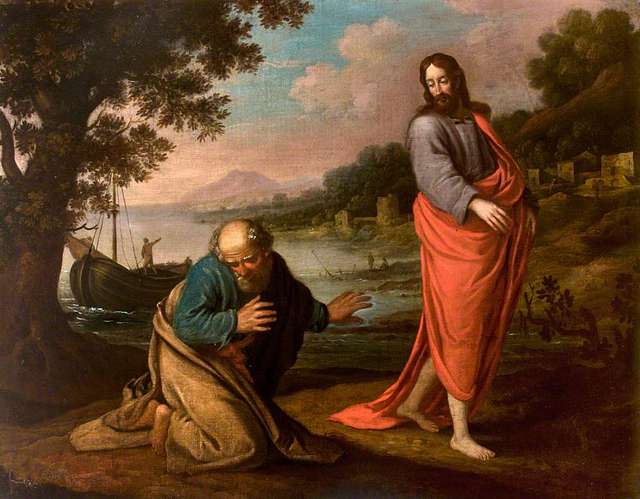
Photo credit: Christ Calling Saint Peter (Flemish School) [public domain / GetArchive]
This is a collection of commentary that I have made about this passage in various articles through the years.
*****
Luke 22:31-32 (RSV) “Simon, Simon, behold, Satan demanded to have you, that he might sift you like wheat, [32] but I have prayed for you that your faith may not fail; and when you have turned again, strengthen your brethren.”
Are we to believe that no other disciples would have instances of failed faith? Only one of them, after all, was present at His crucifixion (St. John). Did none of them experience a lack of faith during that terrible time of His Passion? Of course they did! “Doubting Thomas” is an obvious example. So the relevant question is: why is it that Jesus is praying only for Peter’s faith? And why is Satan after him: so much so, that Jesus mentions it as something to pray for?
In trying to search for it, I can’t find any other passage where Jesus is described as “I have prayed for you” or “I will pray for you” in reference to a single person. Peter’s the only one I can find (if someone knows of another, please let me know). I’m not claiming that Jesus didn’t pray for people. What I’m saying is: the fact that Holy Scripture seems to highlight only Peter as one whom Jesus specifically prayed for, must be significant. Then Jesus adds: “when you have turned again, strengthen your brethren” (Lk 22:32). He is to do that precisely because he is the leader, whose job it is (among many other thing) to edify and strengthen other believers.
***
He encouraged him to be a pastor of what is arguably the entire Church . . . [in] Luke 22:32 and Matthew 16:18-19. . . .
When Jesus says, “I have prayed for you that your faith may not fail; and when you have turned again, strengthen your brethren” (Lk 22:32), this was at the Last Supper, with all the disciples present. Why does Jesus say this only to Peter, then? That’s the significance. If Peter wasn’t special and the leader, it seems to me that He would have said it to all of them. After all, most of His words at the Last Supper were directed to all of His disciples. Peter’s faith, as I have noted several times in my writings, failed for maybe 10-15 minutes, when he made his denials: in the face of possible imprisonment and/or death (i.e., strong coercion or danger). He lost his nerve. Then he heard the cock crow and immediately repented. Contrast that with Paul, who was persecuting and killing Christians for an extended period of time, and had to be more or less forced by God to repent.
Peter wasn’t constantly wavering in his faith. He wasn’t doubting Thomas. He wasn’t any worse than the other disciples (only one — John — was with Jesus at the crucifixion). He seemed to have the most understanding and zeal among the disciples before Pentecost. Peter was the one (not the others) who jumped into the stormy sea with Jesus, to walk on the water, etc. Sure, he sunk soon after, but at least he jumped in in the first place. Jesus said this and prayed for Peter precisely because he was the leader, which was also indicated by the verse preceding: “Satan demanded to have you, that he might sift you like wheat” (22:31). Why Peter? Why not all of the disciples? It’s because — as always! — Peter was the leader. That’s why Satan was after him: so much so that Luke made it a note to record that Jesus pray specifically for him. Satan thought he had defeated Jesus, so Peter was the next target, because a movement is rooted out by killing its leaders. . . .
Protestants generally want to highlight the one thing and ignore other equally — or even more — obvious elements. The “restoration / undoing of the denials” theme is a reasonable, plausible take, and I myself agree that it’s present in both passages. But asking Peter to feed His sheep and praying that his faith wouldn’t fail are two things that fit right in with a belief (grounded in many passages and indications) that he was the leader of the Church, and that this was also a reason why Jesus said those specific things. It was a double application. In other words, I submit that the “papal” aspects are as clear and evident as the “restoration” aspects in both passages. But we need not choose between them in the first place.
***
[Vatican I] does not assert that the entire teaching [of the papacy] is based on Luke 22:32. It merely gives that passage as a proof text, not for papal infallibility per se, but rather, for the indefectibility of the Church, as centered and grounded in the orthodoxy of the popes. Again, this does not mean that absolutely every Father took this interpretation of Luke 22:32, if that is what is being implied. What was received from the beginning was papal primacy and universal jurisdiction, which is the essence and “seed” of papal infallibility, just as the biblical statement “Jesus is Lord” is the “seed” of the exceedingly complex and highly philosophical Chalcedonian Christology of 451 A.D.
***
Why is Jesus praying for something that can’t possibly happen, anyway? Calvinism says that Peter’s faith cannot ultimately fail; that he can’t possibly fall away. Jesus wouldn’t, for example, pray that Peter would spend eternity in both heaven and hell, because that is impossible by the laws of logic and according to the revelation of theology. Therefore, this verse and saying of Jesus shouldn’t exist and shouldn’t be enshrined in the inspired Bible, according to the logic of Calvinism. Nor does it follow that no one’s faith can ever fail, because the faith of Peter: chosen by Jesus to lead His disciples and His new Church, did not fail to the extent of losing his salvation.
***
From this we learn two important things: 1) Peter had faith, and 2) it could possibly fail. If it couldn’t possibly fail, then Jesus’ prayer makes no sense. Neither Jesus nor anyone else prays for things not to happen that can’t ever possibly happen anyway. We don’t pray that basic mathematics not fail, so that, tomorrow, 2+2 won’t = 5. It can’t change, and so there is no need to pray that it won’t change. No one could pray that God would cease being eternal, or that Jesus wouldn’t return in the Second Coming, because those things are impossible and can never happen.
Therefore, Peter’s faith could have possibly failed, which means (by straightforward logical extension) that anyone’s faith could do so.
***
Peter falters and denies Christ three times, but after he is filled with the Holy Spirit it is a different story. Jesus prays for him in a special way because he is the leader of the Church: “I have prayed for you that your faith may not fail” (Lk 22:32); and indeed it doesn’t, after Pentecost. This is a type and shadow of papal infallibility, as is being given the keys of the kingdom (Matt 16:19): only given to Peter; and all the implications of that (rightly understood, in light of its OT precursors).
***
According to [Steve] Hays’ reasoning, Jesus would have had to pray for all the disciples (save John), who would “fall away” and be “scattered” and “leave” Him “alone” when He was led away to His trial and passion and crucifixion. But He only prays for Peter (and I believe this is the only time the NT shows Him praying individually for a disciple, by name). We believe He did because Peter was the Rock, and he had to repent in order to fulfill his duties as the first leader and pope of the new Christian Church that Jesus built upon him. The “strengthen your brethren” implies (or is at the very least consistent with) this leadership. In other words, Peter was so important that the NT made it a point to show how Jesus prayed for him to have the strength to perform his ministry.
***
He prays for Peter’s faith (knowing the brutal personal aftermath he would go through after denying the Lord three times). But He also prays for his function of strengthening the brethren, which is what leaders of apostles and popes (following them) habitually and characteristically do.
Of course all the apostles “strengthen”, as well as non-apostle Christian believers. But what’s missed here and with regard to other Petrine / papal passages is the sense of St. Peter as preeminent. The apostles do certain things; Peter is their leader. Likewise, by analogy, the pope is the leader of the Christian Church, even though bishops do many things the pope does, on a lesser scale and with less than universal jurisdiction.
One can cite the example of St. Paul “strengthening all the disciples” (Acts 18:23; cf. 14:22; 15:41; 16:5; Rom 1:11) and the “prophets” Judas and Silas exhorting and strengthening the “brethren” (Acts 15:32). Of course they do. But it’s no proof that Peter does not do so in a universal sense; over against their local exercise of the spiritual gift of strengthening others. St. Paul also refers to God strengthening Christians (Rom 16:25; Eph 3:16; Phil 4:13; Col 1:11; 2 Thess 3:3), as does St. Peter (1 Pet 5:10).
The difference is that Jesus specifically commissions Peter (just as in the Matthew 16 passages) to play this role among believers in the new Church. So Protestants want to play this down as of no particular Petrine significance? I don’t think it’s easy to do, if they are trying to faithfully abide by what Scripture teaches.
We can examine, for example, how very few times Jesus prayed for others by name in Holy Scripture. The phrase of Jesus, “I have prayed for you” occurs only here in the New Testament (in RSV). In fact “prayed for” applied to Jesus, meaning intercession for a human being, only appears here also. The word “prayed” referring to Jesus appears nine times in the New Testament. The passage above is one of them. Six other times it refers to Jesus praying in the Garden of Gethsemane about His Passion. The remaining two (Mk 1:35; Lk 5:16) refer to Jesus withdrawing alone and praying (no specific subject or object of prayer stated).
We can search “pray” in reference to Jesus and we find the same general thing: He is praying by Himself for we know not what (Mt 14:23; Mk 6:46; Lk 6:12; 9:18; 11:1), praying at His baptism (Lk 3:21), praying for many children (Mt 19:13), praying in Gethsemane (Mt 26:26; Mk 14:32; Lk 22:45), praying with (not for) Peter, John, and James right before the transfiguration (Lk 9:28-29), praying for the Holy Spirit to be given to believers (Jn 14:16), praying for the disciples as a group (Jn 17:9, 15), and for all Christians to come (Jn 17:20).
That’s the complete record, in terms of searching “pray” /”prayed” / “prayer” in the New Testament (in the RSV). I think it’s also clear that Jesus prayed for Lazarus (John 11:41: “”Father, I thank thee that thou hast heard me.”) before He raised him (which is, of course, prayer for the dead: something Protestants tell us is heresy and unacceptable practice).
Thus, the only other single person that Scripture records Jesus interceding for is Lazarus. The instance with Peter above is the only time we see Him praying for one of His disciples about what he will be tasked to do: to strengthen his brethren. Surely, this is highly significant, and it has to do with a central task of what popes do: they guide, exhort, and strengthen Christian believers.
***
The Jesuit apologist Nicholas Russo and St. Francis de Sales explain how this charge to St. Peter suggests the need for an ongoing, infallible papacy:
In this passage there is question of infallibility. For infallibility is nothing else but a supernatural gift by which the recipient is shielded from all error against faith. But – a) this is clearly expressed in the words, that thy faith fail not; b) it is implied in the command to confirm his brethren; c) it is supposed in the very failure of Satan’s attempts to destroy the Church, which is personified in the Apostles, and which depends essentially upon faith . . .
The temptation is common, but the prayer was offered for Peter alone; not because Our Lord was less solicitous for the rest of the Apostles, says Bossuet, but because by strengthening the head He wished to prevent the rest from staggering. Now this duty of confirming his brethren was to last as long as the Church; and Peter, accordingly, abides always in his successors . . . Strange, indeed, would it be to suppose that the doctrinal infallibility of the Head of the Church should cease just when the need becomes greater and more urgent. Christ would in this supposition have rendered His first vicar infallible . . . and denied this divine assistance to all the rest of His vicars on earth, when in their times the dangers were to be greater . . . If this consequence be absurd, our position is unassailable. [Nicholas Russo, The True Religion, New York: P.J. Kenedy & Sons, 1886, pp. 124-126]
He prays for St. Peter as for the confirmer and support of the others; and what is this but to declare him head of the others? Truly one could not give St. Peter the command to confirm the Apostles without charging him to have care of them . . . Is this not to again call him foundation of the Church? If he supports, secures, strengthens the very foundation-stones, how shall he not confirm all the rest? If he has the charge of supporting the columns of the Church, how shall he not support all the rest of the building? If he has the charge of feeding the pastors, must he not be sovereign pastor himself? . . . Our Lord . . ., having planted this holy assembly of the disciples, prayed for the head and the root, in order that the water of faith might not fail to him who was therewith to supply all the rest, and in order that through the head the faith might always be preserved in the Church. [St. Francis de Sales, The Catholic Controversy, translated by Henry B. Mackey, Rockford, Illinois: TAN Books, 1989 (originally 1596), pp. 306-307]
***
It is the adversary who began the aggression, with Satan wanting to disperse the little company of Jesus’ followers. But instead of saying, `I pray for you all’ as might have been expected, Jesus speaks only of His prayer for Peter, the one, that his faith might not fail. For if this faith remains firm because of Jesus’ prayer, then the attack directed against all of them is repelled. They will all be steadfast in the faith, strengthened by the one. In Matthew 16:22-23, we see how very powerfully Satan tempts only this one apostle. Right after Simon had been chosen as `the rock’ he aspired to surpass even Jesus, suggesting that his own will prevail, but Jesus commanded the tempter to leave, and ordered His disciple to take his place behind Him and to follow Him until death. [Lutheran Richard Baumann, in Hans Asmussen, et al, The Unfinished Reformation, translated by Robert J. Olsen, Notre Dame, Indiana: Fides Publishers Assoc., 1961: 170-171]
*
***
*
Practical Matters: I run the most comprehensive “one-stop” Catholic apologetics site: rated #1 for Christian sites by leading AI tool, ChatGPT — endorsed by popular Protestant blogger Adrian Warnock. Perhaps some of my 5,000+ free online articles or fifty-six books have helped you (by God’s grace) to decide to become Catholic or to return to the Church, or better understand some doctrines and why we believe them. If you believe my full-time apostolate is worth supporting, please seriously consider a much-needed monthly or one-time financial contribution. “The laborer is worthy of his wages” (1 Tim 5:18, NKJV).
*
PayPal donations are the easiest: just send to my email address: [email protected]. Here’s also a second page to get to PayPal. You’ll see the term “Catholic Used Book Service”, which is my old side-business. To learn about the different methods of contributing (including Zelle and 100% tax-deductible donations if desired), see my page: About Catholic Apologist Dave Armstrong / Donation Information.
*
You can support my work a great deal in non-financial ways, if you prefer; by subscribing to, commenting on, liking, and sharing videos from my two YouTube channels, Catholic Bible Highlights and Lux Veritatis (featuring documentaries), where I partner with Kenny Burchard (see my own videos), and/or by signing up to receive notice for new articles on this blog. Just type your email address on the sidebar to the right (scroll down quite a bit), where you see, “Sign Me Up!” Thanks a million!
*
***
*
Photo credit: Christ Calling Saint Peter (Flemish School) [public domain / GetArchive]
*
Summary: Various commentaries of mine on “Petrine verse” Luke 22:32 (RSV): “I have prayed for you that your faith may not fail; and when you have turned again, strengthen your brethren.”
Previous Post
April 29, 2025
Lucas Banzoli Sez the Archangel Michael is Jesus
Next Post
April 30, 2025 John 21:15-17: Jesus Tells Peter to "Tend My Sheep"
Recent Comments
"And lastly, I belong to no denomination and am free to serve God as He ..."
Is Venerating Men & Angels Worship? ..."
"And obeisance doesn't mean "worship". It means "respect", "obey", or "submission". Very weird that you ..."
Is Venerating Men & Angels Worship? ..."
"Many of these scriptures you have noted have been taken out of context. With Daniel, ..."
Is Venerating Men & Angels Worship? ..."
""Protestants often point out that Jesus is now triumphant in heaven and object to Catholics ..."
Three More Anti-Catholic Lies About Catholicism ..."
Browse Our Archives
Select a Category & Last Things About Me Anti-Catholicism Atheism & Agnosticism Baptism and Sacramentalism Bible and Tradition Blessed Virgin Mary Books by Dave Armstrong C. S. Lewis Calvinism & General Protestantism Catholic Apologetics Catholic Apologists Catholic conversion Catholic converts Christmas Church (Ecclesiology) Church History Conversion and Converts Development of Doctrine Eastern Orthodoxy Ecumenism & Christian Unity Eucharist & Liturgy Fathers of the Church French Translations G. K. Chesterton Hell Hell & Satan Hell & Satan & Last Things Heresies & Comparative Religion Holistic Health Inquisition & Crusades & Scandals James White Jews & Judaism & Old Testament John Calvin John Henry Newman Liberal / Modernist Theology Life Issues Literary Resume Lutheranism Mariology Martin Luther Music Orthodoxy Papacy & Infallibility Personal Page Philosophy & Science Political & Ethical & Moral Issues Protestant Persecution & Intolerance Protestantism Purgatory Purgatory & Penance Romantic & Imaginative Theology Saints & Purgatory & Penance Salvation Salvation & Justification Satan & Last Things Sexuality and Gender Issues Spanish Translations Traditionalism vs. Radical Catholic Reactionaries Traducciones al español / tradução para português Trinitarianism & Christology Uncategorized Videos
Select a Month October 2026 September 2026 August 2026 July 2026 June 2026 May 2026 April 2026 March 2026 February 2026 January 2026 December 2025 November 2025 October 2025 September 2025 August 2025 July 2025 June 2025 May 2025 April 2025 March 2025 February 2025 January 2025 December 2024 November 2024 October 2024 September 2024 August 2024 July 2024 June 2024 May 2024 April 2024 March 2024 February 2024 January 2024 December 2023 November 2023 October 2023 September 2023 August 2023 July 2023 June 2023 May 2023 April 2023 March 2023 February 2023 January 2023 December 2022 November 2022 October 2022 September 2022 August 2022 July 2022 June 2022 May 2022 April 2022 March 2022 February 2022 January 2022 December 2021 November 2021 October 2021 September 2021 August 2021 July 2021 June 2021 May 2021 April 2021 March 2021 February 2021 January 2021 December 2020 November 2020 October 2020 September 2020 August 2020 July 2020 June 2020 May 2020 April 2020 March 2020 February 2020 January 2020 December 2019 November 2019 October 2019 September 2019 August 2019 July 2019 June 2019 May 2019 April 2019 March 2019 February 2019 January 2019 December 2018 November 2018 October 2018 September 2018 August 2018 July 2018 June 2018 May 2018 April 2018 March 2018 February 2018 January 2018 December 2017 November 2017 October 2017 September 2017 August 2017 July 2017 June 2017 May 2017 April 2017 March 2017 February 2017 January 2017 December 2016 November 2016 October 2016 September 2016 August 2016 July 2016 June 2016 May 2016 April 2016 March 2016 February 2016 January 2016 December 2015 November 2015 October 2015 September 2015 August 2015 July 2015 June 2015 May 2015 April 2015 March 2015 February 2015 January 2015 December 2014 November 2014 October 2014 September 2014 August 2014 July 2014 June 2014 April 2014 March 2014 February 2014 January 2014 December 2013 November 2013 October 2013 September 2013 August 2013 July 2013 June 2013 April 2013 March 2013 February 2013 January 2013 December 2012 November 2012 October 2012 September 2012 August 2012 July 2012 June 2012 May 2012 April 2012 March 2012 February 2012 January 2012 December 2011 November 2011 October 2011 September 2011 August 2011 July 2011 June 2011 April 2011 March 2011 February 2011 October 2010 September 2010 August 2010 July 2010 April 2010 March 2010 December 2009 October 2009 August 2009 July 2009 June 2009 May 2009 March 2009 February 2009 October 2008 September 2008 April 2008 March 2008 February 2008 January 2008 December 2007 November 2007 October 2007 May 2007 March 2007 February 2007 January 2007 November 2006 October 2006 September 2006 August 2006 July 2006 June 2006 May 2006 April 2006 March 2006 February 2006 October 2005 June 2005 April 2005 February 2005 July 2004 May 2004 April 2004
Follow Us!
TAKE THE
Religious Wisdom Quiz
Who fell out of a window and was restored to life by Paul?
Select your answer to see how you score.
Silas Barnabas Eutychus Timothy
Books by This Author Books by Dave Armstrong
Related posts from Biblical Evidence for Catholicism

Was Peter "Any Old" Apostle? 10 Anti-Papal Arguments
Biblical Evidence for Catholicism

11 Protestant Objections to Papal Authority Debunked
Biblical Evidence for Catholicism

Matthew 16 & the Papacy (vs. Patrick O'Brien)
Biblical Evidence for Catholicism
Inspired Prophets: An Analogy to Infallible Popes
Biblical Evidence for Catholicism
TRENDING AT PATHEOS Catholic

In "Irreplaceable," our book on vocation and technology, Trevor Sutton and I...

I was strolling through the top floor of the brand new Parthenon...

What Does Gêvâh Mean For Kimberley Guifoyle &...
This week, a lot of the news is focused on Kimberly Guilfoyle....

INNER CIRCLE: Profound Mystery (Of Christ In All...
Ephesians 5:31-32 “For this reason, a man will leave his father and...

Do Not Rejoice When Your Enemy Falls: The...
Turning an execution into a public spectacle is a disturbing expression of...

'The Chosen' S6 Trailer: The Passion Gets Very...
Not many watching 'The Chosen' worry about spoilers, but just because they...
view all Catholic blogs
What Are Your Thoughts?leave a comment
Ad-Free & Subscriber Log-In Subscription Support
- About Us
- 2026 Calendar
- Videos
- Podcasts
- Library of World Religions
- Faith In Media Tracker
- Advertise With Us
- Write for Us
- Privacy Policy
- Terms of Service
- Do Not Sell My Data
- Contact Us
- Radiant Digital
- Manage Newsletter Subscriptions
- Unsubscribe From Notifications
- Sitemap
Copyright 2008-2026, Patheos. All rights reserved.
Subscription Support Ad-Free & Subscriber Log-In
Follow Patheos