
BuddhistCatholicContemplativeEvangelicalGeneral ChristianHinduJewishLatter-day SaintMuslimNew VisionsProgressive Christian
Beliefs
- Buddhist
- Catholic
- Contemplative
- Evangelical
- General Christian
- Hindu
- Jewish
- Latter-day Saint
- More Voices
- Muslim
- New Visions
- Pagan
- Progressive Christian
Topics
- Religion News
- Food and Religion
- Sports and Religion
- Religious Art
- Religious Music and Entertainment
- Religious Events
- History and Religion
- Style and Religion
- Politics and Religion
- Women in Religion
- Recreation Outdoors and Religion
- Business Finance and Religion
- Careers Workplace and Religion
- Education and Religion
- Family Parenting and Religion
- Health Fitness and Religion
- Home and Religion
- Relationships and Religion
- Technology and Religion
- Travel and Religion
Columnists
- Buddhist Columnists
- Business Finance and Religion Columnists
- Careers Workplace and Religion Columnists
- Catholic Columnists
- Contemplative Columnists
- Education and Religion Columnists
- Evangelists Columnists
- Family Parenting and Religion Columnists
- General Christian Columnists
- Health Fitness and Religion Columnists
- Hindu Columnists
- History and Religion Columnists
- Home and Religion Columnists
- Jewish Columnists
- More Voices Columnists
- Latter Day Columnists
- Muslim Columnists
- New Visions Columnists
- Nonreligious Columnists
- Pagan Columnists
- Politics and Religion Columnists
- Progressive Columnists
- Recreation Outdoors and Religion Columnists
- Relationships and Religion Columnists
- Religion News Columnists
- Religious Art Columnists
- Religious Events Columnists
- Religious Music and Entertainment Columnists
- Sports and Religion Columnists
- Style and Religion Columnists
- Technology and Religion Columnists
- Travel and Religion Columnists
- Women in Religion Columnists
Resource Library
- 2026 Calendar
- Library of World Religions
- The 100 Most Holy Places on Earth
- Patheos Answers
- Podcasts
- Videos
- Faith Leaders Database
- Anglican Episcopalian
- Bahai
- Baptist
- Buddhism
- Christianity
- Confucianism
- Eastern Orthodoxy
- Hinduism
- Holiness and Pentecostal
- ISKCON
- Islam
- Judaism
- Lutheran
- Methodist
- The Church of Jesus Christ of Latter-day Saints
- New Age
- Paganism
- Presbytarian and Reformed
- Protestantism
- Religion Behind the Scenes
- Roman Catholic
- Scientology
- Shia Islam
- Sikhism
- Sufism
- Sunni Islam
- Taoism
- Zen
- See all religions
Research Tools
 Ad-Free & Subscriber Log-In Subscription Support
Ad-Free & Subscriber Log-In Subscription Support
Follow Patheos 

- Trending:
- Forgiveness
- |
- Marriage
- |
- Consciousness
- |
- Death Penalty
- |
- Election
- |
- Halloween

-
About
-
Catholic Apologetics
-
Church History
-
Great Apologists
-
Christian Worldview
-
Protestantism & Misc.
- Home
- Catholic
- History and Religion
- Was St. Paul Still a Pharisee After His Conversion?
Was St. Paul Still a Pharisee After His Conversion?
Last updated on: March 15, 2025 at 1:18 pm by Dave Armstrong
Was St. Paul Still a Pharisee After His Conversion? 2025-03-15T13:18:58-04:00 Dave Armstrong
Patheos Explore the world's faith through different perspectives on religion and spirituality! Patheos has the views of the prevalent religions and spiritualities of the world.
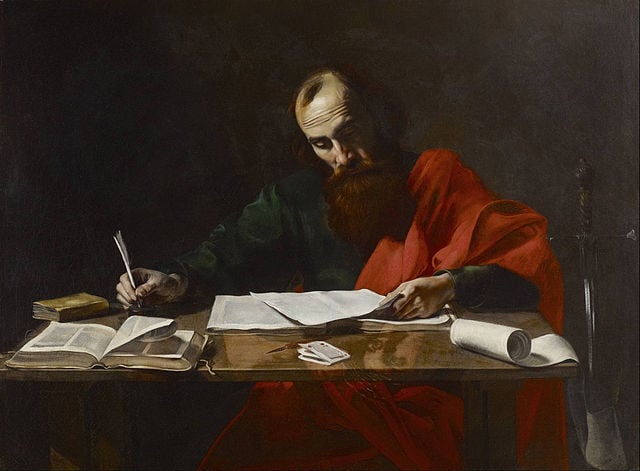
Photo credit: Saint Paul Writing His Epistles (c. 1618-1620); attributed to Valentin de Boulogne (1591-1632) [public domain / Wikimedia Commons]
This came about in an exchange with (I think) a Lutheran; some sort of Protestant, at any rate, in a Protestant venue.
*****
The Pharisees are usually regarded by Christians of all stripes as the “bad guys” in the New Testament. In many respects they were. But they remained the mainstream Jewish tradition, and they accepted the view that Moses received oral tradition from God on Mt. Sinai in addition to the written law, and many other theological views that Christianity inherited.
Both Jesus and Paul assumed and followed various pharisaical customs and practices. The biggest problem of all for those who want to say they are all bad, is that Paul called himself a Pharisee twice at his trial (Acts 23:6; 26:5) and again in Philippians 3:5 (the first instance clearly in the present tense). That doesn’t harmonize well with the attempt to completely demonize the Pharisees.
Our friend argued that Paul saying “I am a Pharisee” during his trial (Acts 23:6, RSV) is essentially nullified because in context he also mentioned his past life as a Pharisee (“a son of Pharisees”). He was basically accusing St. Paul of lying and sophistry: pretending to be a Pharisee as a methodological tactic to cause division between the Pharisees and Sadducees who were present at his trial. But he didn’t have to pretend or lie in order to do that. The division remained, and by his identifying himself as of one of the two parties, this would cause division between them.
My father wasn’t Catholic; he was a Methodist. But if he were a Catholic, I could state, “I am a Catholic, the son of a Catholic.” The fact that I mentioned that my father also was has no bearing whatsoever on whether I am one or not today. It merely strengthens the statement by placing it in the context of a familial, upbringing tie as well as a theological one.
Ellicott’s Commentary for English Readers (not Catholic; nor are any of the other commentaries I will cite) makes a great comment on the passage:
Was St. Paul at that time really a Pharisee? Was he not, as following in his Master’s footsteps, the sworn foe of Pharisaism? The answer to that question, which obviously ought to be answered and not suppressed, is that all parties have their good and bad sides, and that those whom the rank and file of a party most revile may be the most effective witnesses for the truths on which the existence of the party rests. The true leaders of the Pharisees had given a prominence to the doctrine of the Resurrection which it had never had before. They taught an ethical rather than a sacrificial religion. Many of them had been, like Nicodemus and Joseph of Arimathæa, secret disciples of our Lord. At this very time there were many avowed Pharisees among the members of the Christian Church (Acts 15:5). St. Paul, therefore, could not be charged with any suppressio veri in calling himself a Pharisee. It did not involve even a tacit disclaimer of his faith in Christ. It was rather as though he said, “I am one with you in all that is truest in your creed. I invite you to listen and see whether what I now proclaim to you is not the crown and completion of all your hopes and yearnings. Is not the resurrection of Jesus the one thing needed for a proof of that hope of the resurrection of the dead of which you and your fathers have been witnesses?”
Gill’s Exposition of the Entire Bible concurs:
He was not only brought up in that sect from his youth, and lived according to it before his conversion, but he was still a Pharisee; wherefore he does not say, I “was”, but I “am” a Pharisee; for whatever distinguished the Pharisee from the Sadducee, whether in principle, or in practice, and manner of living, which agreed with Christianity, the apostle still retained; as the belief of the immortality of the soul, the resurrection of the dead, and a future state, and strict holiness of life and conversation.
Meyer’s NT Commentary agrees, too:
He designates himself as a Jew, who, as such, belonged to no other than the religious society of the Pharisees; and particularly in the doctrine of the resurrection, Paul, as a Christian, continued to defend the confession of the Pharisees (in opposition to all Sadduceeism) according to its truth confirmed in the case of Christ Himself (Acts 4:1 f.). His contending against the legal righteousness, hypocrisy, etc., of the Pharisees, and his consequent labouring in an anti-Pharisaical sense, were directed not against the sect in itself, but against its moral and other perversions. Designated a Jew, Paul still remained what he was from his birth, a Pharisee, and as such an orthodox Jew, in contrast to Sadducean naturalism.
Likewise, Expositor’s Greek Testament:
It is difficult to see why the Apostle should not describe himself as a Pharisee in face of the statement, Acts 15:5, that many members of the sect were also members of the Christian Church. They, like St. Paul, must have acknowledged that Jesus was the Messiah. But that Messiahship was attested by the avowal of the resurrection of Jesus, and the resurrection was a prominent article of the Pharisees’ creed. In the acceptance of this latter doctrine St. Paul was at one not only with the “Pharisees who believed,” but with the whole sect, and that he used the title in this limited way, viz., with relation to the hope of the resurrection, is plain from the context, which fixes the limitation by the Apostle’s own words.
As to Acts 26:5, it’s true that it isn’t technically present tense. But since it has to be harmonized with Acts 23:6 which is present tense, it harmonizes (as all Scripture does). Paul states, “according to the strictest party of our religion I have lived as a Pharisee.” Note the “our religion.” He doesn’t consider that Christianity is a separate religion from Judaism, but rather, is an extension of it, harmonious with it, or a consistent development of Judaism (which indeed it is).
I could say, “I have lived as a Catholic” [since 1990, in my case]. That statement alone doesn’t necessarily imply that I have since ceased to live as or be a Catholic, though it might. I could also say, “I have lived as a pagan occultist” [which was true from 1970 or so through to 1977]. In that case it did cease. But since we have to harmonize 26:5 with 23:6, we see that it is consistent with a continued allegiance.
In Philippians 3:3-10, he never states that he has ceased to be a Pharisee. He couldn’t, because that would contradict Acts 23:6 and it would 1) make him a liar or equivocator, and 2) make the Bible contradict itself, which inspired revelation cannot do. And so it’s saying the same thing. Paul writes in 3:5: “of the people of Israel, of the tribe of Benjamin, a Hebrew born of Hebrews; as to the law a Pharisee”. He was still an Israelite, still from the tribe of Benjamin, still a Hebrew, and still a Pharisee.
As two of the commentaries I cited noted, Acts 15:5 refers to “some believers who belonged to the party of the Pharisees.” There is, therefore, nothing intrinsically inconsistent for a Christian to continue to be a Pharisee (whereas there are no Christian Sadducees, because they were basically the theological liberals of the time). Paul was a Pharisee, and so was, in fact, Jesus.
*
***
*
Practical Matters: I run the most comprehensive “one-stop” Catholic apologetics site: rated #1 for Christian sites by leading AI tool, ChatGPT — endorsed by popular Protestant blogger Adrian Warnock. Perhaps some of my 5,000+ free online articles or fifty-six books have helped you (by God’s grace) to decide to become Catholic or to return to the Church, or better understand some doctrines and why we believe them. If you believe my full-time apostolate is worth supporting, please seriously consider a much-needed monthly or one-time financial contribution. “The laborer is worthy of his wages” (1 Tim 5:18, NKJV).
*
PayPal donations are the easiest: just send to my email address: [email protected]. Here’s also a second page to get to PayPal. You’ll see the term “Catholic Used Book Service”, which is my old side-business. To learn about the different methods of contributing (including Zelle and 100% tax-deductible donations if desired), see my page: About Catholic Apologist Dave Armstrong / Donation Information.
*
You can support my work a great deal in non-financial ways, if you prefer; by subscribing to, commenting on, liking, and sharing videos from my YouTube channel, Catholic Bible Highlights, where I partner with Kenny Burchard (see my own videos), and/or by signing up to receive notice for new articles on this blog. Just type your email address on the sidebar to the right (scroll down quite a bit), where you see, “Sign Me Up!” Thanks a million!
*
***
*
Photo credit: Saint Paul Writing His Epistles (c. 1618-1620); attributed to Valentin de Boulogne (1591-1632) [public domain / Wikimedia Commons]

Summary: Reply to a Protestant who disputed that St. Paul called himself a Pharisee in the present tense (Acts 23:6; cf. Acts 26:5; Phil 3:5). Acts 15:5 also refers to Christian Pharisees.
Jews & Judaism & Old Testament
Previous Post

March 13, 2025
Is Scripture Totally Clear? (vs. Anglican Stearns #2)
Next Post

March 17, 2025 No Particular Judgment? (vs. Anglican Stearns #3)
Recent Comments
"Special pleading, and not a serious response to my arguments . . ."
Is Venerating Men & Angels Worship? ..."
""no man needs to teach us."Didn't you just teach us?"
Is Venerating Men & Angels Worship? ..."
""Catholics say they are the only church that can lead people into heaven."In fact, we ..."
Is Venerating Men & Angels Worship? ..."
"And lastly, I belong to no denomination and am free to serve God as He ..."
Is Venerating Men & Angels Worship? ..."
Browse Our Archives
Select a Category & Last Things About Me Anti-Catholicism Atheism & Agnosticism Baptism and Sacramentalism Bible and Tradition Blessed Virgin Mary Books by Dave Armstrong C. S. Lewis Calvinism & General Protestantism Catholic Apologetics Catholic Apologists Catholic conversion Catholic converts Christmas Church (Ecclesiology) Church History Conversion and Converts Development of Doctrine Eastern Orthodoxy Ecumenism & Christian Unity Eucharist & Liturgy Fathers of the Church French Translations G. K. Chesterton Hell Hell & Satan Hell & Satan & Last Things Heresies & Comparative Religion Holistic Health Inquisition & Crusades & Scandals James White Jews & Judaism & Old Testament John Calvin John Henry Newman Liberal / Modernist Theology Life Issues Literary Resume Lutheranism Mariology Martin Luther Music Orthodoxy Papacy & Infallibility Personal Page Philosophy & Science Political & Ethical & Moral Issues Protestant Persecution & Intolerance Protestantism Purgatory Purgatory & Penance Romantic & Imaginative Theology Saints & Purgatory & Penance Salvation Salvation & Justification Satan & Last Things Sexuality and Gender Issues Spanish Translations Traditionalism vs. Radical Catholic Reactionaries Traducciones al español / tradução para português Trinitarianism & Christology Uncategorized Videos
Select a Month October 2026 September 2026 August 2026 July 2026 June 2026 May 2026 April 2026 March 2026 February 2026 January 2026 December 2025 November 2025 October 2025 September 2025 August 2025 July 2025 June 2025 May 2025 April 2025 March 2025 February 2025 January 2025 December 2024 November 2024 October 2024 September 2024 August 2024 July 2024 June 2024 May 2024 April 2024 March 2024 February 2024 January 2024 December 2023 November 2023 October 2023 September 2023 August 2023 July 2023 June 2023 May 2023 April 2023 March 2023 February 2023 January 2023 December 2022 November 2022 October 2022 September 2022 August 2022 July 2022 June 2022 May 2022 April 2022 March 2022 February 2022 January 2022 December 2021 November 2021 October 2021 September 2021 August 2021 July 2021 June 2021 May 2021 April 2021 March 2021 February 2021 January 2021 December 2020 November 2020 October 2020 September 2020 August 2020 July 2020 June 2020 May 2020 April 2020 March 2020 February 2020 January 2020 December 2019 November 2019 October 2019 September 2019 August 2019 July 2019 June 2019 May 2019 April 2019 March 2019 February 2019 January 2019 December 2018 November 2018 October 2018 September 2018 August 2018 July 2018 June 2018 May 2018 April 2018 March 2018 February 2018 January 2018 December 2017 November 2017 October 2017 September 2017 August 2017 July 2017 June 2017 May 2017 April 2017 March 2017 February 2017 January 2017 December 2016 November 2016 October 2016 September 2016 August 2016 July 2016 June 2016 May 2016 April 2016 March 2016 February 2016 January 2016 December 2015 November 2015 October 2015 September 2015 August 2015 July 2015 June 2015 May 2015 April 2015 March 2015 February 2015 January 2015 December 2014 November 2014 October 2014 September 2014 August 2014 July 2014 June 2014 April 2014 March 2014 February 2014 January 2014 December 2013 November 2013 October 2013 September 2013 August 2013 July 2013 June 2013 April 2013 March 2013 February 2013 January 2013 December 2012 November 2012 October 2012 September 2012 August 2012 July 2012 June 2012 May 2012 April 2012 March 2012 February 2012 January 2012 December 2011 November 2011 October 2011 September 2011 August 2011 July 2011 June 2011 April 2011 March 2011 February 2011 October 2010 September 2010 August 2010 July 2010 April 2010 March 2010 December 2009 October 2009 August 2009 July 2009 June 2009 May 2009 March 2009 February 2009 October 2008 September 2008 April 2008 March 2008 February 2008 January 2008 December 2007 November 2007 October 2007 May 2007 March 2007 February 2007 January 2007 November 2006 October 2006 September 2006 August 2006 July 2006 June 2006 May 2006 April 2006 March 2006 February 2006 October 2005 June 2005 April 2005 February 2005 July 2004 May 2004 April 2004
Follow Us!
TAKE THE
Religious Wisdom Quiz
What is taught about gossip in the Bible?
Select your answer to see how you score.
Encourage it Avoid it Enjoy it Spread it
Books by This Author Books by Dave Armstrong
Related posts from Biblical Evidence for Catholicism

God's Presence, the Ark, the Eucharist, & Death
Biblical Evidence for Catholicism
Garden of Eden’s Location Verified by Science
Biblical Evidence for Catholicism
Unregenerate Good Works in the Old Testament
Biblical Evidence for Catholicism
Perfectly Keeping the Law: Top Ten Bible Proofs
Biblical Evidence for Catholicism
TRENDING AT PATHEOS Catholic

The First Eucharistic Controversy: Christ’s Real Presence
For Catholics, the Eucharist is the source and summit of the Christian...

What a Stop Sign Can Teach Us About...
How to Make a Decision When You Can't Hear God Main point:...

Archdiocese Hosts Military Marriage Retreat in Germany
RASTATT, Germany — The transient military lifestyle, with its frequent deployments and...

Nearly every morning, I make the drive to Detroit with my high-school-age...

The Real AI Story Is Adoption Without Trust
Artificial intelligence has crossed a political threshold. It is no longer a...

A new article, written by Jeff Lindsay and Gale L. Pooley,...
view all Catholic blogs
What Are Your Thoughts?leave a comment
Ad-Free & Subscriber Log-In Subscription Support
- About Us
- 2026 Calendar
- Videos
- Podcasts
- Library of World Religions
- Faith In Media Tracker
- Advertise With Us
- Write for Us
- Privacy Policy
- Terms of Service
- Do Not Sell My Data
- Contact Us
- Radiant Digital
- Manage Newsletter Subscriptions
- Unsubscribe From Notifications
- Sitemap
Copyright 2008-2026, Patheos. All rights reserved.
Subscription Support Ad-Free & Subscriber Log-In
Follow Patheos