
BuddhistCatholicContemplativeEvangelicalGeneral ChristianHinduJewishLatter-day SaintMuslimNew VisionsProgressive Christian
Beliefs
- Buddhist
- Catholic
- Contemplative
- Evangelical
- General Christian
- Hindu
- Jewish
- Latter-day Saint
- More Voices
- Muslim
- New Visions
- Pagan
- Progressive Christian
Topics
- Religion News
- Food and Religion
- Sports and Religion
- Religious Art
- Religious Music and Entertainment
- Religious Events
- History and Religion
- Style and Religion
- Politics and Religion
- Women in Religion
- Recreation Outdoors and Religion
- Business Finance and Religion
- Careers Workplace and Religion
- Education and Religion
- Family Parenting and Religion
- Health Fitness and Religion
- Home and Religion
- Relationships and Religion
- Technology and Religion
- Travel and Religion
Columnists
- Buddhist Columnists
- Business Finance and Religion Columnists
- Careers Workplace and Religion Columnists
- Catholic Columnists
- Contemplative Columnists
- Education and Religion Columnists
- Evangelists Columnists
- Family Parenting and Religion Columnists
- General Christian Columnists
- Health Fitness and Religion Columnists
- Hindu Columnists
- History and Religion Columnists
- Home and Religion Columnists
- Jewish Columnists
- More Voices Columnists
- Latter Day Columnists
- Muslim Columnists
- New Visions Columnists
- Nonreligious Columnists
- Pagan Columnists
- Politics and Religion Columnists
- Progressive Columnists
- Recreation Outdoors and Religion Columnists
- Relationships and Religion Columnists
- Religion News Columnists
- Religious Art Columnists
- Religious Events Columnists
- Religious Music and Entertainment Columnists
- Sports and Religion Columnists
- Style and Religion Columnists
- Technology and Religion Columnists
- Travel and Religion Columnists
- Women in Religion Columnists
Resource Library
- 2026 Calendar
- Library of World Religions
- The 100 Most Holy Places on Earth
- Patheos Answers
- Podcasts
- Videos
- Faith Leaders Database
- Anglican Episcopalian
- Bahai
- Baptist
- Buddhism
- Christianity
- Confucianism
- Eastern Orthodoxy
- Hinduism
- Holiness and Pentecostal
- ISKCON
- Islam
- Judaism
- Lutheran
- Methodist
- The Church of Jesus Christ of Latter-day Saints
- New Age
- Paganism
- Presbytarian and Reformed
- Protestantism
- Religion Behind the Scenes
- Roman Catholic
- Scientology
- Shia Islam
- Sikhism
- Sufism
- Sunni Islam
- Taoism
- Zen
- See all religions
Research Tools
 Ad-Free & Subscriber Log-In Subscription Support
Ad-Free & Subscriber Log-In Subscription Support
Follow Patheos 

- Trending:
- Forgiveness
- |
- Marriage
- |
- Consciousness
- |
- Death Penalty
- |
- Election
- |
- Halloween

-
About
-
Catholic Apologetics
-
Church History
-
Great Apologists
-
Christian Worldview
-
Protestantism & Misc.
- Home
- Catholic
- History and Religion
- Relics: Biblical Proofs (vs. Anglican C. H. H. Wright #2)
Relics: Biblical Proofs (vs. Anglican C. H. H. Wright #2)
Last updated on: March 26, 2025 at 11:36 am by Dave Armstrong
Relics: Biblical Proofs (vs. Anglican C. H. H. Wright #2) 2025-03-26T11:36:53-04:00 Dave Armstrong
Patheos Explore the world's faith through different perspectives on religion and spirituality! Patheos has the views of the prevalent religions and spiritualities of the world.
+ Ten Protestant Commentaries in Support of Peter’s Healing Shadow (Acts 5:15): Which Rev. Wright Denied
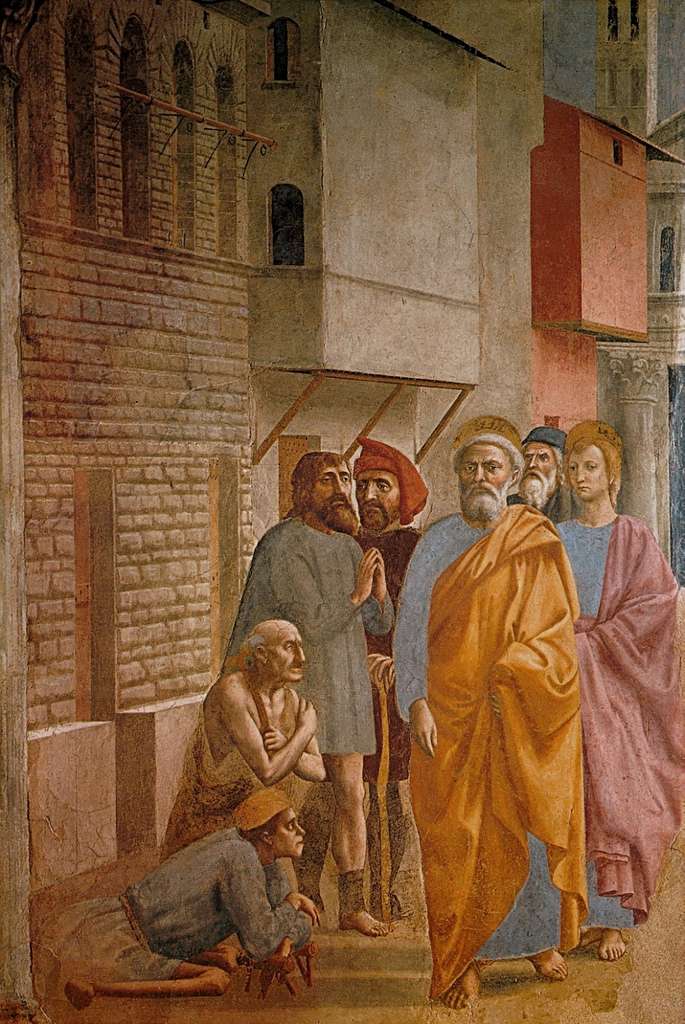
Photo credit: St. Peter Healing the Sick with His Shadow (1425), by Masaccio (1401-1428) [public domain / Get Archive]
Charles Henry Hamilton Wright (1836-1909) was an Irish Anglican clergyman. He graduated from Trinity College, Dublin, in 1857, was the Grinfield lecturer on the Septuagint at Oxford (1893–97), vicar of Saint John’s, Liverpool (1891–98), examiner in Hebrew at the University of London (1897–99), and clerical superintendent of the Protestant Reformation Society (1898–1907). He authored a number of books, including The Intermediate State and Prayers for the Dead (1900) and the volume I will be examining, Roman Catholicism, or The Doctrines of the Church of Rome Briefly Examined in the Light of Scripture (London: The Religious Tract Society, revised 5th ed., 1926).
His words will be in blue. I use RSV for biblical citations.
***
In favour of the veneration due to relics, the case of the man raised up to life on touching the bones of Elisha (2 Kings xiii. 21) is quoted. But that incident, if part of the original book, stands completely isolated, and even that miracle did not lead to the worship of the prophet’s bones. (p. 190)
First, Rev. Wright casts doubt on whether the passage is actually part of Holy Scripture, sinking to the methodology of the most radical biblical critics (up to and including atheists), who habitually are suspicious of the text of canonical Scripture, rather than holding to biblical inspiration, inerrancy, and infallibility, as consistent Christians of all stripes do. This is the length that this Anglican will go in order to reject Catholic, biblical teaching. It’s very telling, isn’t it?
Then in his next desperate move to avoid the clear implication of the text, he says that the occurrence was “completely isolated.” Whether something is mentioned once or a hundred times is irrelevant as to whether it is inspired (as part of God-breathed revelation) or true. The Annunciation, for example, was a one-time event in Scripture: mentioned only in Luke, and that was the announcement of the incarnation. This is simply an unworthy debate tactic. Moreover, whether veneration of Elisha’s bones was mentioned in this place or occurred in history (whether recorded or not) is irrelevant to the conclusions that we draw from what happened. It is what it is.
Then he uses the usual tactic of irrationally and cynically collapsing all reverence and veneration into “worship” so that it sounds like idolatry. But even his own citation, drawn from the Council of Trent uses the phrase “veneration and honour.” This is all standard playbook anti-Catholicism: fundamentally silly and a gross misrepresentation of what Catholics believe. We believe that physical matter can be a conveyor of spiritual grace. This is the foundation for the use of relics (objects associated with saints) and sacramentals (sacred or devotional objects).
Veneration of the saints and their relics is essentially different from the kind of worship or adoration reserved for God alone, in that it is a high honor given to something or someone because of the grace revealed or demonstrated in them from God. The relic (and the saint from whom it is derived) reflects the greatness of God just as a masterpiece of art or music reflects the greatness of the artist or composer. Therefore, in such veneration, it’s God being honored. The saint or his or her relics reflect God’s grace and holiness. To worship as divine a saint or relic is not following Catholic teaching, which fully agrees with Protestantism with regard to the evil of idolatry.
In the passage about Elisha’s bones, from 2 Kings, matter clearly imparts God’s miraculous grace. That is all that is needed for Catholics reasonably and scripturally to hold such relics in the highest regard and honor (veneration). It is not necessary for the entire doctrine of veneration to be spelled out in the verse, only the fundamental assumption behind it (matter can convey grace), which is the basis for the Catholic belief and practice. We are physical creatures; God became man, and so by the principle of the incarnation and sacramentalism, the physical becomes involved in the spiritual. What we believe about relics is based on these biblical presuppositions.
Many Protestants (including Martin Luther himself, Lutherans, Methodists, Anglicans, Churches of Christ) accept this principle with regard to the waters of baptism, which, so they hold, cause spiritual regeneration to occur, even in an infant. That is, again, matter (water) conveying grace (regeneration). And so Elisha’s bones raised a man from the dead. Why would anyone wish to downplay or minimize that? It’s because they are irrationally unbiblical.
The touching of the hem of Christ’s garment (Matt. ix. 20) was a sign of faith in Christ, but not a proof of any virtue in His clothes. (pp. 190-191)
Again, he misses the fundamental point. The woman did have commendable faith. But it’s not the clothes themselves. It’s the fact that they were connected with Jesus. They conveyed grace and healing for that reason and no other. Let’s do a quick thought experiment. Imagine a scenario in which somehow we could verify that a shirt was worn by Our Lord Jesus Christ Himself and came into the possession of Rev. Wright. Do you think he (or anyone) would make a rag out of it, for use in cleaning a cow stall or grease from a car? I think not. It would be reverenced and cherished for its association with Christ. That’s 90% of the way towards the Catholic understanding of a relic.
Protestants enjoy visiting Israel as much as anyone else. And they reverence the holy places there, and do things like touch the star where Jesus was born or the white hill underneath where He was crucified. That’s reverence for holy places. They may not think that they literally receive grace in doing so, but it’s close. They wouldn’t ever consider for even a moment, bulldozing any of these holy places and making a parking lot or a McDonalds. Yet they inconsistently fight against the idea of relics and veneration given to them. Part of the antipathy, no doubt, is because many have this false notion that we are worshiping them as if they are equal to God Himself. It’s not true. They might represent or be associated with God or a saint, but that doesn’t make them equal to them. It doesn’t make them idols. They’re neither replacing God nor placed above Him.
Extraordinary was the faith of the people in Peter after the awful deaths of Ananias and Sapphira. But although they imagined Peter’s shadow could heal the sick, the text does not state that as a fact (Acts v. 15, 16). (p. 191)
This is very interesting. In his rush to immediately discount any Catholic biblical argument in favor of relics, he is led to the conclusion that this didn’t refer to healing as a result of Peter’s shadow. But even his own Protestant commentators massively disagree with him. They generally hold that healings likely did occur. I provide ten examples below.
Acts 5:12-16 Now many signs and wonders were done among the people by the hands of the apostles. And they were all together in Solomon’s Portico. [13] None of the rest dared join them, but the people held them in high honor. [14] And more than ever believers were added to the Lord, multitudes both of men and women, [15] so that they even carried out the sick into the streets, and laid them on beds and pallets, that as Peter came by at least his shadow might fall on some of them. [16] The people also gathered from the towns around Jerusalem, bringing the sick and those afflicted with unclean spirits, and they were all healed.
Ellicott’s Commentary for English Readers: (15) Insomuch that they brought forth the sick . . .—The tense implies habitual action. For some days or weeks the sick were laid all along the streets—the broad open streets, as distinct from the lanes and alleys (see Note on Matthew 6:5)—by which the Apostle went to and fro between his home and the Temple.
That at the least the shadow of Peter . . . .—It is implied in the next verse that the hope was not disappointed. . . . Christ healed sometimes directly by a word, without contact of any kind (Matthew 8:13; John 4:52); sometimes through material media—the fringe of His garment (Matthew 9:20), or the clay smeared over the blind man’s eyes (John 9:5) becoming channels through which the healing virtue passed. All that was wanted was the expectation of an intense faith, as the subjective condition on the one side, the presence of an objective supernatural power on the other, and any medium upon which the imagination might happen to fix itself as a help to faith. So afterwards the “hand, kerchiefs and aprons” from St. Paul’s skin do what the shadow of St. Peter does here (Acts 19:12). In the use of oil, as in Mark 6:13, James 5:14, we find a medium employed which had in itself a healing power, with which the prayer of faith was to co-operate.
Benson Commentary: . . . in order that, if they could neither have access to Peter, nor he come to them, at least the shadow of him passing by might overshadow some of them — Though it could not reach them all, and they had faith to believe this would be the means of healing them. And it is probable that they were not disappointed, but that some, at least, were thus healed, as the woman mentioned in the gospel was, by touching Christ’s garment. According to their faith it was done unto them. And in this, among other things, the promise of Christ, (John 14:12,) The works that I do, shall ye also do, and greater works than these, &c., was eminently fulfilled. And if such miracles were wrought by Peter’s shadow, we have reason to think some were wrought in some such way by the other apostles; as by the handkerchiefs from Paul’s body, Acts 19:12.
Expositor’s Greek Testament: The further question arises in spite of the severe strictures of Zeller, Overbeck, Holtzmann, as to how far the narrative indicates that the shadow of Peter actually produced the healing effects. Acts 5:16 shows that the sick folk were all healed, but Zöckler maintains that there is nothing to show that St. Luke endorses the enthusiastic superstition of the people (so J. Lightfoot, Nösgen, Lechler, Rendall). On the other hand we may compare Matthew 9:20, Mark 6:56, John 9:5, Acts 19:12; and Baumgarten’s comment should be considered that, although it is not actually said that a miraculous power went forth from Peter’s shadow, it is a question why, if no such power is implied, the words should be introduced at all into a narrative which evidently purports to note the extraordinary powers of the Apostles. . . . as Blass says, Luke does not distinctly assert that cures were wrought by the shadow of Peter, although there is no reason to deny that the Evangelist had this in mind, since he does not hesitate to refer the same miraculous powers to St. Paul.
Henry Alford, Greek Testament Critical Exegetical Commentary: We need find no stumbling-block in the fact of Peter’s shadow having been believed to be the medium (or, as is surely implied, having been the medium) of working miracles. Cannot the ‘Creator Spirit’ work with any instruments, or with none, as pleases Him? And what is a hand or a voice, more than a shadow, except that the analogy of the ordinary instrument is a greater help to faith in the recipient? Where faith, as apparently here, did not need this help, the less likely medium was adopted.
[John] Calvin’s Commentaries: the apostles were endued with such power for this cause, because they were ministers of the gospel. Therefore they used this gift, inasmuch as it served to further the credit of the gospel; yea, God did no less show forth his power in their shadow than in their mouth.
F. F. Bruce, New International Commentary, Book of Acts (revised version, Eerdmans, 1988, p. 109): Peter’s shadow was as efficacious a medium of healing power as the hem of his Master’s robe had been. No wonder that the people in general sounded the apostles’ praises and that the number of believers increased.
C. Peter Wagner, The Book of Acts: A Commentary (Baker, 2008): Apparently Peter, at the time, was ministering in the role of what some would call a “faith healer” today. Others were doing miracles as well, but it seems that Peter had a special anointing.
David W. Pau, Baker Illustrated Bible Commentary, Acts: [Peter’s] shadow reminds one of Jesus’ own magnificent power (Luke 8:44) . . .
Eckhard J. Schnabel, Exegetical Commentary on the New Testament (Zondervan Academic, 2016, p. 293): Some, not all, of the sick were healed through Peter’s shadow . . .
Ben Witherington, The Acts of the Apostles (Eerdmans, 1998, p. 227): It is not clear whether Luke also holds this belief, but v. 16b probably suggests he did (cf. Acts 19:12 [Paul’s handkerchiefs]).
Aprons were, indeed, on one occasion brought from the body of Paul ( Acts xix. 11 , 12); but if ever extraordinary miracles were required, it was at Ephesus, the great stronghold of magical arts. (p. 191)
I see. It’s almost like Rev. Wright begrudgingly concedes that a relic-like miracle did occur; but only “on one occasion”, mind you! Then he tries to irrationally water it down or minimize its strength as a Catholic proof for relics by making the odd comment that it was especially needed at Ephesus. That’s simply an irrelevant diversion; what is called a non sequitur. Rev. Wright has not succeeded in disproving the fact that the principle behind the Catholic belief in relics and their power is clearly taught in the Bible. He belittles, attempts to minimize, is dismissive, and doesn’t even seem to take the topic seriously (all traits very common in anti-Catholic polemics), but he doesn’t disprove our view; not even within a million miles.
*
***
*
Practical Matters: I run the most comprehensive “one-stop” Catholic apologetics site: rated #1 for Christian sites by leading AI tool, ChatGPT — endorsed by popular Protestant blogger Adrian Warnock. Perhaps some of my 5,000+ free online articles or fifty-six books have helped you (by God’s grace) to decide to become Catholic or to return to the Church, or better understand some doctrines and why we believe them. If you believe my full-time apostolate is worth supporting, please seriously consider a much-needed monthly or one-time financial contribution. “The laborer is worthy of his wages” (1 Tim 5:18, NKJV).
*
PayPal donations are the easiest: just send to my email address: [email protected]. Here’s also a second page to get to PayPal. You’ll see the term “Catholic Used Book Service”, which is my old side-business. To learn about the different methods of contributing (including Zelle and 100% tax-deductible donations if desired), see my page: About Catholic Apologist Dave Armstrong / Donation Information.
*
You can support my work a great deal in non-financial ways, if you prefer; by subscribing to, commenting on, liking, and sharing videos from my YouTube channel, Catholic Bible Highlights, where I partner with Kenny Burchard (see my own videos), and/or by signing up to receive notice for new articles on this blog. Just type your email address on the sidebar to the right (scroll down quite a bit), where you see, “Sign Me Up!” Thanks a million!
*
***
*
Photo credit: St. Peter Healing the Sick with His Shadow (1425), by Masaccio (1401-1428) [public domain / Get Archive]
Summary: I reply to several weak mini-arguments from the Anglican, Charles Henry Hamilton Wright (1836-1909), against the biblical conception of the spiritual power of relics.
Previous Post
March 25, 2025
Deus me curou! (Úlcera, alergias alimentares)
Next Post
March 28, 2025 Consecrated Celibacy (vs. Lutheran von Hase)
Recent Comments
"Special pleading, and not a serious response to my arguments . . ."
Is Venerating Men & Angels Worship? ..."
""no man needs to teach us."Didn't you just teach us?"
Is Venerating Men & Angels Worship? ..."
""Catholics say they are the only church that can lead people into heaven."In fact, we ..."
Is Venerating Men & Angels Worship? ..."
"And lastly, I belong to no denomination and am free to serve God as He ..."
Is Venerating Men & Angels Worship? ..."
Browse Our Archives
Select a Category & Last Things About Me Anti-Catholicism Atheism & Agnosticism Baptism and Sacramentalism Bible and Tradition Blessed Virgin Mary Books by Dave Armstrong C. S. Lewis Calvinism & General Protestantism Catholic Apologetics Catholic Apologists Catholic conversion Catholic converts Christmas Church (Ecclesiology) Church History Conversion and Converts Development of Doctrine Eastern Orthodoxy Ecumenism & Christian Unity Eucharist & Liturgy Fathers of the Church French Translations G. K. Chesterton Hell Hell & Satan Hell & Satan & Last Things Heresies & Comparative Religion Holistic Health Inquisition & Crusades & Scandals James White Jews & Judaism & Old Testament John Calvin John Henry Newman Liberal / Modernist Theology Life Issues Literary Resume Lutheranism Mariology Martin Luther Music Orthodoxy Papacy & Infallibility Personal Page Philosophy & Science Political & Ethical & Moral Issues Protestant Persecution & Intolerance Protestantism Purgatory Purgatory & Penance Romantic & Imaginative Theology Saints & Purgatory & Penance Salvation Salvation & Justification Satan & Last Things Sexuality and Gender Issues Spanish Translations Traditionalism vs. Radical Catholic Reactionaries Traducciones al español / tradução para português Trinitarianism & Christology Uncategorized Videos
Select a Month October 2026 September 2026 August 2026 July 2026 June 2026 May 2026 April 2026 March 2026 February 2026 January 2026 December 2025 November 2025 October 2025 September 2025 August 2025 July 2025 June 2025 May 2025 April 2025 March 2025 February 2025 January 2025 December 2024 November 2024 October 2024 September 2024 August 2024 July 2024 June 2024 May 2024 April 2024 March 2024 February 2024 January 2024 December 2023 November 2023 October 2023 September 2023 August 2023 July 2023 June 2023 May 2023 April 2023 March 2023 February 2023 January 2023 December 2022 November 2022 October 2022 September 2022 August 2022 July 2022 June 2022 May 2022 April 2022 March 2022 February 2022 January 2022 December 2021 November 2021 October 2021 September 2021 August 2021 July 2021 June 2021 May 2021 April 2021 March 2021 February 2021 January 2021 December 2020 November 2020 October 2020 September 2020 August 2020 July 2020 June 2020 May 2020 April 2020 March 2020 February 2020 January 2020 December 2019 November 2019 October 2019 September 2019 August 2019 July 2019 June 2019 May 2019 April 2019 March 2019 February 2019 January 2019 December 2018 November 2018 October 2018 September 2018 August 2018 July 2018 June 2018 May 2018 April 2018 March 2018 February 2018 January 2018 December 2017 November 2017 October 2017 September 2017 August 2017 July 2017 June 2017 May 2017 April 2017 March 2017 February 2017 January 2017 December 2016 November 2016 October 2016 September 2016 August 2016 July 2016 June 2016 May 2016 April 2016 March 2016 February 2016 January 2016 December 2015 November 2015 October 2015 September 2015 August 2015 July 2015 June 2015 May 2015 April 2015 March 2015 February 2015 January 2015 December 2014 November 2014 October 2014 September 2014 August 2014 July 2014 June 2014 April 2014 March 2014 February 2014 January 2014 December 2013 November 2013 October 2013 September 2013 August 2013 July 2013 June 2013 April 2013 March 2013 February 2013 January 2013 December 2012 November 2012 October 2012 September 2012 August 2012 July 2012 June 2012 May 2012 April 2012 March 2012 February 2012 January 2012 December 2011 November 2011 October 2011 September 2011 August 2011 July 2011 June 2011 April 2011 March 2011 February 2011 October 2010 September 2010 August 2010 July 2010 April 2010 March 2010 December 2009 October 2009 August 2009 July 2009 June 2009 May 2009 March 2009 February 2009 October 2008 September 2008 April 2008 March 2008 February 2008 January 2008 December 2007 November 2007 October 2007 May 2007 March 2007 February 2007 January 2007 November 2006 October 2006 September 2006 August 2006 July 2006 June 2006 May 2006 April 2006 March 2006 February 2006 October 2005 June 2005 April 2005 February 2005 July 2004 May 2004 April 2004
Follow Us!
TAKE THE
Religious Wisdom Quiz
I made a rash vow that cost me my only child after a military victory. Who am I?
Select your answer to see how you score.
Jephthah Samson Gideon Barak
Books by This Author Books by Dave Armstrong
Related posts from Biblical Evidence for Catholicism

Bible & Catholicism on Mortal Sin (vs. John...
Biblical Evidence for Catholicism

Does Catholic Intercession of Saints Require Omniscience?
Biblical Evidence for Catholicism

Capabilities of Heavenly Saints: Protestant Commentaries
Biblical Evidence for Catholicism

Revelation 5 & 8 (Intercession of Saints &...
Biblical Evidence for Catholicism
TRENDING AT PATHEOS Catholic

The Sermon on the Mount, Part I: Matthew...
The Sermon on the Mount, Part I (Matthew 4:12-5:12) St. Matthew moves...

What's up from Crossway: Reviewing some of their latest A few weeks...

Janie Learns the Way of the Cross: A...
Teaching children about Jesus' Passion can be challenging. Many parents and educators...

Looking For Good Catholic Writing - October 2026
He alone extends the heavens, and he walks upon the waves of...

In "Irreplaceable," our book on vocation and technology, Trevor Sutton and I...

I was strolling through the top floor of the brand new Parthenon...
view all Catholic blogs
What Are Your Thoughts?leave a comment
Ad-Free & Subscriber Log-In Subscription Support
- About Us
- 2026 Calendar
- Videos
- Podcasts
- Library of World Religions
- Faith In Media Tracker
- Advertise With Us
- Write for Us
- Privacy Policy
- Terms of Service
- Do Not Sell My Data
- Contact Us
- Radiant Digital
- Manage Newsletter Subscriptions
- Unsubscribe From Notifications
- Sitemap
Copyright 2008-2026, Patheos. All rights reserved.
Subscription Support Ad-Free & Subscriber Log-In
Follow Patheos