
BuddhistCatholicContemplativeEvangelicalGeneral ChristianHinduJewishLatter-day SaintMuslimNew VisionsProgressive Christian
Beliefs
- Buddhist
- Catholic
- Contemplative
- Evangelical
- General Christian
- Hindu
- Jewish
- Latter-day Saint
- More Voices
- Muslim
- New Visions
- Pagan
- Progressive Christian
Topics
- Religion News
- Food and Religion
- Sports and Religion
- Religious Art
- Religious Music and Entertainment
- Religious Events
- History and Religion
- Style and Religion
- Politics and Religion
- Women in Religion
- Recreation Outdoors and Religion
- Business Finance and Religion
- Careers Workplace and Religion
- Education and Religion
- Family Parenting and Religion
- Health Fitness and Religion
- Home and Religion
- Relationships and Religion
- Technology and Religion
- Travel and Religion
Columnists
- Buddhist Columnists
- Business Finance and Religion Columnists
- Careers Workplace and Religion Columnists
- Catholic Columnists
- Contemplative Columnists
- Education and Religion Columnists
- Evangelists Columnists
- Family Parenting and Religion Columnists
- General Christian Columnists
- Health Fitness and Religion Columnists
- Hindu Columnists
- History and Religion Columnists
- Home and Religion Columnists
- Jewish Columnists
- More Voices Columnists
- Latter Day Columnists
- Muslim Columnists
- New Visions Columnists
- Nonreligious Columnists
- Pagan Columnists
- Politics and Religion Columnists
- Progressive Columnists
- Recreation Outdoors and Religion Columnists
- Relationships and Religion Columnists
- Religion News Columnists
- Religious Art Columnists
- Religious Events Columnists
- Religious Music and Entertainment Columnists
- Sports and Religion Columnists
- Style and Religion Columnists
- Technology and Religion Columnists
- Travel and Religion Columnists
- Women in Religion Columnists
Resource Library
- 2026 Calendar
- Library of World Religions
- The 100 Most Holy Places on Earth
- Patheos Answers
- Podcasts
- Videos
- Faith Leaders Database
- Anglican Episcopalian
- Bahai
- Baptist
- Buddhism
- Christianity
- Confucianism
- Eastern Orthodoxy
- Hinduism
- Holiness and Pentecostal
- ISKCON
- Islam
- Judaism
- Lutheran
- Methodist
- The Church of Jesus Christ of Latter-day Saints
- New Age
- Paganism
- Presbytarian and Reformed
- Protestantism
- Religion Behind the Scenes
- Roman Catholic
- Scientology
- Shia Islam
- Sikhism
- Sufism
- Sunni Islam
- Taoism
- Zen
- See all religions
Research Tools
 Ad-Free & Subscriber Log-In Subscription Support
Ad-Free & Subscriber Log-In Subscription Support
Follow Patheos 

- Trending:
- Forgiveness
- |
- Marriage
- |
- Consciousness
- |
- Death Penalty
- |
- Election
- |
- Halloween

-
About
-
Catholic Apologetics
-
Church History
-
Great Apologists
-
Christian Worldview
-
Protestantism & Misc.
- Home
- Catholic
- History and Religion
- Is Scripture Totally Clear? (vs. Anglican Stearns #2)
Is Scripture Totally Clear? (vs. Anglican Stearns #2)
Last updated on: June 6, 2026 at 12:52 am by Dave Armstrong
Is Scripture Totally Clear? (vs. Anglican Stearns #2) 2026-06-06T00:52:51-04:00 Dave Armstrong
Patheos Explore the world's faith through different perspectives on religion and spirituality! Patheos has the views of the prevalent religions and spiritualities of the world.
+ the Church Fathers (Especially St. Augustine) on the Question of the Perspicuity (Clearness in the Main) of Scripture

Photo credit: Janeke88 (8-7-15) [Pixabay / CC0 Creative Commons license]
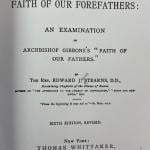
Edward Josiah Stearns (1810-1890) was an Episcopal clergyman from Maryland and author of several books. His volume, The Faith of Our Forefathers (New York: Thomas Whittaker, 1879), was a reply to The Faith of Our Fathers (1876), by James Cardinal Gibbons (1834-1921), one of the best and most well-known Catholic apologetics works, with an emphasis on scriptural arguments and replies to Protestant critiques of Catholicism. It had sold over 1.4 million copies by the time of its 83rd edition in 1917 and was the most popular book in the United States until Gone With the Wind was published in 1939. This volume highly influenced my own development as a soon-to-be Catholic apologist in the early 1990s: especially with regard to my usual modus operandi of focusing on “biblical evidence” for Catholicism.
The words of Rev. Stearns will be in blue, and those of Cardinal Gibbons in green. I use RSV for biblical citations.
***
A word of introduction is in order before we begin.
Catholics hold that Scripture is a fairly clear document and able to be understood by the average reader, but also that the Church is needed to provide a doctrinal norm, an overall framework for determining proper biblical interpretation. I’ve always found Holy Scripture to be clear in my many biblical studies, but Church history shows us that it isn’t clear enough to bring men to agreement. Catholics don’t think Scripture is nearly as unclear and obscure as we are often caricatured to supposedly believe. But we know that heretics throughout the centuries have distorted the Scripture, for whatever reason, so that an authoritative statement of orthodoxy becomes practically necessary in order to preserve unity as well as orthodoxy.
It’s often stated that Scripture is “perspicuous” (clear) and able to be understood in the main by the committed, regenerate layman, and that by comparing Bible passage with Bible passage, the truth can always be found. But the rub is that there are different ways of harmonizing the Scripture. There is the Calvinist way and the Arminian way and the Baptist way, the Lutheran, Anglican, Nazarene, Presbyterian, Methodist, Plymouth Brethren, 7th-Day Adventist, Mennonite, Church of God, Church of Christ ways, etc., etc. ad infinitum. Simply invoking the principle does not solve the problem in the least.
Catholicism doesn’t require a totally obscure Bible at all. This is a myth. But could virtually the entire Bible be understood without the need of authoritative teachers? No. And that’s rather obvious to this day. Protestants continue to absurdly claim that the Bible is perspicuous, yet fail to agree amongst themselves. And their reasons for why this is (stupidity or sin on the other guy’s part) are as absurd and silly as the original false premise.
One can arrive at any number of true doctrines by reading Scripture alone. I pretty much did that in a number of cases, when I was a Protestant. The problem, however, comes with the Jehovah’s Witness (an Arian) on the next block, who reads the same Scripture that we do and concludes that Jesus was created. It’s with the Mormon two blocks over who believes that God was once a man and that men can become gods. It’s with the Christian Scientist and the Sabellian (Jesus Only) and the Unitarian and Moonie and Scientologist and snake handlers and Name-it-Claim-it heretics, etc., etc., etc. They’re all operating on the principle of Scripture Alone, just as the ancient Arians and virtually all heresies did, too.
The Catholic view of authority and Holy Scripture is not about some ubiquitous churchman looking over everyone’s shoulder so that they would interpret each and every verse exactly as the Church says it ought to be interpreted (in fact, less than ten Bible verses are “officially” interpreted by the Catholic Church). People can read the Bible and it was largely clear; just not always, and it is not self-interpreting enough to prevent heresy without the Church intervening on behalf of orthodoxy. This is the Catholic rule of faith.
The Protestant rule of faith, sola Scriptura, on the other hand, cannot pronounce on orthodoxy, except on a denominational level only. All it can do is appeal back to the individual and claim that Scripture is perspicuous (clear) and formally sufficient and that no Church council has binding authority if an individual sees otherwise in Holy Scripture. That can never bring about unity, and never has in fact, because it is inadequate for establishing orthodoxy as applying to all Christians across the board.
“A competent guide must be clear and intelligible to all, so that every one may fully understand the true meaning of the instructions it contains. Is the Bible a book intelligible to all ? Far from it; it is full of obscurities and difficulties not only for the illiterate, but even for the learned.” (p. 104.) [cited on p. 84]
That there are hard places in Scripture nobody denies, but they are not those necessary to salvation. (p. 84)
This is one of those maxims of Protestantism that are easy to state, but much more difficult to prove (especially in actual practice). To give just two examples: baptism is said in Scripture several times to be necessary to salvation, yet Protestants can’t agree on whether this is true or not, and separate into five major camps regarding baptism. Secondly, the Eucharist is said to be necessary for salvation as well (Jesus states this repeatedly in John 6), but Protestant can’t agree on that, either. Therefore, I submit, judging by Protestantism’s various and contradictory conclusions, the Bible must not be clear — in and of itself without authoritative interpretation –about what is necessary for salvation.
The “things hard to be understood,” which ”St. Peter himself informs us” of, ” in the Epistles of St. Paul,” are, as the connection shows, certain prophecies, particularly about the “times and seasons,” which are purposely left in uncertainty, that we may be always watching for the coming of the Lord. (p. 85)
Okay; let’s take a closer look at this passage:
2 Peter 3:15-17 . . . So also our beloved brother Paul wrote to you according to the wisdom given him, [16] speaking of this as he does in all his letters. There are some things in them hard to understand, which the ignorant and unstable twist to their own destruction, as they do the other scriptures. [17] You therefore, beloved, knowing this beforehand, beware lest you be carried away with the error of lawless men and lose your own stability.
It’s indeed true that earlier in the chapter, St. Peter wrote about the coming of the Lord: the specific time of which we don’t and can’t know (“the day of the Lord will come like a thief”: 3:10). Verse 16 at its beginning appears to refer back to this theme, but then St. Peter moves on from it and makes a general statement: “There are some things in them [Paul’s letters] hard to understand.” In other words, he doesn’t write something to the effect of, “and this teaching [about prophecies, etc.] is hard to understand.” He is now expressing himself in broad terms. Then he notes that these “things . . . hard to understand” [in Paul] are what “the ignorant and unstable twist to their own destruction”.
If there is any doubt that he is thinking in general terms at this point, there can be none when we see that he writes, “. . . “as they do the other scriptures”. So now Peter is saying that many scriptures — not necessarily even those written just by Paul — are “twist[ed]” by the ignorant and unstable. And this, of course, proves the Catholic point and disproves the Protestant one about the perspicuity of Scripture: supposedly sufficient enough as to preclude a binding, authoritative interpretation from the Church. Note also that Peter ends with a warning: “lest you be carried away with the error of lawless men and lose your own stability.” In other words, he thinks the problem is sufficiently serious to warn every reader to be vigilant and to not be led astray.
A comeback may be that Peter is only teaching that Pauline and/or other portions of Scripture are difficult only for the “ignorant and unstable.” The problem with that is that many people are “ignorant” (i.e., simply lacking knowledge of Scripture, or its exegesis, and the nature and exercise of hermeneutics: systematic interpretation of Scripture). Anyone who has spent much time at all in Christians circles (Protestant and Catholic alike; and I’ve been in both for many years) knows full well of the massive amount of biblical illiteracy.
That’s all it takes to distort the Bible, even before we get to deliberate heresy or spiritual, emotional, or theological instability. Needless to say, the endless internal Protestant disagreements do not give one much confidence at all in the Protestant assertion of “perspicuity of Scripture”. All that the denominationalism and division show is that excessive private judgment and rejection of a binding teaching authority as to orthodox theology leads to ecclesiological chaos and theological relativism, ending up in confusion and lack of certainty.
The passage the Archbishop quotes from 2 St. Peter 1:20, ”that no prophecy of Scripture is made by private interpretation,” refers, not to the explanation of it, but to the making of it, as the very wording of it shows; and if it did not, the next verse would make it plain. (p. 85)
Let’s look at this one, too:
2 Peter 1:20-21 First of all you must understand this, that no prophecy of scripture is a matter of one’s own interpretation, [21] because no prophecy ever came by the impulse of man, but men moved by the Holy Spirit spoke from God.
Rev. Stearns’ exegesis is too simple and incomplete. The overall point Peter is making is that prophecy can’t be understood as a matter of private interpretation, because it’s spiritually discerned: having come from God the Holy Spirit in the first place. The more spiritual and less carnal a thing is, the more we need an authoritative Church to interpret and apply it, because the Church is the accumulated wisdom of spiritual persons for 2,000 years, which is far superior to anyone’s own specific understandings. But Rev. Stearns vainly contends that this has nothing to do with “explanation.”
I don’t see how that could be, because the word “interpretation” doesn’t refer to “the making of” prophecy. It refers to the understanding of it, and that leads us back to the discussion at hand: how clear Scripture is to the individual without any aid of a Church and a Sacred Tradition, or even matters such as cross-referencing from Scripture itself. Rev. Stearns is doing very poor exegesis and winds up special pleading.
To nail down his point, St. Peter goes on (originally the New Testament had no verses or chapters) to warn of the bad effects of erroneous private interpretation of Scripture:
2 Peter 2:1-3 But false prophets also arose among the people, just as there will be false teachers among you, who will secretly bring in destructive heresies, even denying the Master who bought them, bringing upon themselves swift destruction. [2] And many will follow their licentiousness, and because of them the way of truth will be reviled. [3] And in their greed they will exploit you with false words; . . .
St. Paul warns about the same sort of thing:
2 Timothy 4:3-4 For the time is coming when people will not endure sound teaching, but having itching ears they will accumulate for themselves teachers to suit their own likings, [4] and will turn away from listening to the truth and wander into myths.
These factors are some of the many reasons why it’s a dangerous thing for individuals to think that they understand all of Scripture, and — in the final analysis, or bottom line — need no assistance from an authoritative Tradition and/or Church: the latter being “the pillar and bulwark of the truth” (1 Tim 3:15).
What the ”certain man” wanted of St. Philip (Acts 8:31) was something to aid his private judgment, not to supplant it; and the explanation that St. Philip gave of the prophecy commended itself to the man’s private judgment, else he would not have asked to be baptized. (p. 85)
I don’t think this flies, either. Let’s look at it:
Acts 8:27, 30-35 . . . behold, an Ethiopian, a eunuch, a minister of the Can’dace, queen of the Ethiopians, in charge of all her treasure, had come to Jerusalem to worship . . . [30] So Philip ran to him, and heard him reading Isaiah the prophet, and asked, “Do you understand what you are reading?” [31] And he said, “How can I, unless some one guides me?” And he invited Philip to come up and sit with him. [32] Now the passage of the scripture which he was reading was this: “As a sheep led to the slaughter or a lamb before its shearer is dumb, so he opens not his mouth. [33] In his humiliation justice was denied him. Who can describe his generation? For his life is taken up from the earth.” [34] And the eunuch said to Philip, “About whom, pray, does the prophet say this, about himself or about some one else?” [35] Then Philip opened his mouth, and beginning with this scripture he told him the good news of Jesus.
Rev. Stearns tries to make out that the eunuch had sufficient understanding, and only needed an aid for relatively better understanding. But that’s not how the text reads, prima facie. He’s asked if he understands what he is reading, and the eunuch answers, “How can I, unless some one guides me?” How clear can something be?! This is precisely what Catholics contend: it’s good to have an authoritative guide to help any given individual understand Scripture. The eunuch had an apostle. We have the Holy Church and Holy Tradition and other passages in the Holy Bible (cross-referencing). The eunuch was reading Isaiah 53, a well-known messianic passage. He didn’t even know that it applied to the Messiah, and thought it might be Isaiah writing about himself. And so Philip shared with him that it was referring to Jesus the Messiah.
Rev. Stearns makes a great deal out of the eunuch asking to be baptized, as if this confirmed that he had a solid, reliable “private judgment“. But the text informs us that, right after Philip started sharing the gospel, “they went along the road” and “came to some water” (8:36). We know that they were on “a desert road” (8:26), so it may very well have been some time before they arrived at water. And during that time, in Philip’s sharing of the gospel, he very likely would have proclaimed the necessity of baptism.
This is, after all, what St. Peter did in the first Christian sermon, recorded six chapters earlier in Acts. After proclaiming the gospel (Acts 2:22-36), the very next thing he did was to say, “”Repent, and be baptized every one of you” (2:38). So it’s more likely that Philip told the eunuch about baptism than it is that the eunuch already knew about its importance and necessity (although that’s certainly possible, too). But even if the eunuch did know that much, it has no bearing on his overall knowledge of Scripture. He surely didn’t know much about biblical theology, if he wasn’t aware that Isaiah 53 was a messianic passage. And this is precisely why he asked to be guided and instructed in biblical exegesis.
St. Augustine wrote about this passage:
And we know that the eunuch who was reading Isaiah the prophet, and did not understand what he read, was not sent by the apostle to an angel, nor was it an angel who explained to him what he did not understand, nor was he inwardly illuminated by the grace of God without the interposition of man; on the contrary, at the suggestion of God, Philip, who did understand the prophet, came to him, and sat with him, and in human words, and with a human tongue, opened to him the Scriptures. [Acts 8:26] Did not God talk with Moses, and yet he, with great wisdom and entire absence of jealous pride, accepted the plan of his father-in-law, a man of an alien race, for ruling and administering the affairs of the great nation entrusted to him? [Exodus 18:13] (On Christian Doctrine, Preface, 7)
The highly educated Augustine even wrote that he himself — like the Ethiopian eunuch — did not understand the book of Isaiah, which was recommended for him to read by his mentor, St. Ambrose, shortly after his conversion:
I, not understanding the first portion of the book, and imagining the whole to be like it, laid it aside, intending to take it up hereafter, when better practised in our Lord’s words. (The Confessions, ix, 5, 13)
St. John Chrysostom also preached about it:
Even as the eunuch of Candace read, but until one came who instructed him in the meaning of what he was reading he derived no great benefit from it . . . we must not attend to the words merely, but turn our attention to the sense, and learn the aim of the speaker, and the cause and the occasion, and by putting all these things together turn out the hidden meaning. (Homily on Matthew 26:19, Against Marcionists and Manichæans)
Rev. Stearns doesn’t discuss other biblical passages directly relevant to the question of the clearness or perspicuity of Scripture. But I will, because I think people deserve a much fuller biblical explanation:
Nehemiah 8:1-3, 7-9, 12 And all the people gathered as one man into the square before the Water Gate; and they told Ezra the scribe to bring the book of the law of Moses which the LORD had given to Israel. [2] And Ezra the priest brought the law before the assembly, . . . [3] And he read from it . . . [7] Also Jesh’ua, Bani, Sherebi’ah, Jamin, Akkub, Shab’bethai, Hodi’ah, Ma-asei’ah, Keli’ta, Azari’ah, Jo’zabad, Hanan, Pelai’ah, the Levites, helped the people to understand the law, . . . [8] And they read from the book, from the law of God, clearly; and they gave the sense, so that the people understood the reading. [9] . . . and the Levites who taught the people . . . [12] . . . they had understood the words that were declared to them.
Mark 4:33-34 With many such parables he spoke the word to them, as they were able to hear it; [34] he did not speak to them without a parable, but privately to his own disciples he explained everything.
Luke 24:25-27, 32 And he said to them, “O foolish men, and slow of heart to believe all that the prophets have spoken! [26] Was it not necessary that the Christ should suffer these things and enter into his glory?” [27] And beginning with Moses and all the prophets, he interpreted to them in all the scriptures the things concerning himself. . . . [32] They said to each other, “Did not our hearts burn within us while he talked to us on the road, while he opened to us the scriptures?”
The two disciples on the road to Emmaus later marveled at how Jesus “opened to us the scriptures”. In other words, those prophecies were not understood until Jesus explained them, and in fact, most of the Jews did not see that they were fulfilled. Thus, Old Testament Scripture was insufficient for these messianic truths to be grasped simply by reading them. One could retort that the Jews were hardhearted and thus could not understand since they had not the Holy Spirit and God’s grace to illumine their understanding. But that proves too much because it would also have to apply to these two disciples, and indeed all of the disciples, who did not understand what was happening, even after Jesus repeatedly told them that He was to suffer and to die, and that this was all foretold.
The Phillips Modern English translation renders Luke 24:32 as, “he made the scriptures plain to us.” The Greek word for “opened” is dianoigo (Strong’s Concordance word #1272). According to Joseph Thayer’s Greek-English Lexicon of the New Testament (Grand Rapids, Michigan: Baker Book House, 1977 reprint of 1901 edition, p. 140), it means “to open by dividing or drawing asunder, to open thoroughly (what had been closed).” This meaning can be seen in other passages where dianoigo appears: Mark 7:34-35, Luke 2:23, 24:31,45, Acts 16:14, 17:3.
Obviously, then, Holy Scripture is informing us that some parts of it were “closed” and “not plain” until the “infallible” teaching authority and interpretation of our Lord Jesus opened it up and made it plain. This runs utterly contrary to the Protestant notion of perspicuity of Scripture and its more or less ubiquitous self-interpreting nature, at the very least as regards salvation. In this instance, it did have to do with salvation, because Jesus was talking about “all the scriptures the things concerning himself.” They hadn’t understood those passages until Jesus “opened” them up to them. It’s hard to imagine a clearer refutation of the Protestant notion of perspicuity.
Shortly after in the text, Jesus appears to the eleven disciples and reiterates the same teaching:
Luke 24:44-47 Then he said to them, “These are my words which I spoke to you, while I was still with you, that everything written about me in the law of Moses and the prophets and the psalms must be fulfilled.” [45] Then he opened their minds to understand the scriptures, [46] and said to them, “Thus it is written, that the Christ should suffer and on the third day rise from the dead, [47] and that repentance and forgiveness of sins should be preached in his name to all nations, beginning from Jerusalem.
Note again that they didn’t understand the Old Testament Scriptures simply by reading them. Nor did they understand the gospel itself (thus Scripture wasn’t clear about even the gospel and salvation, for them to grasp it: directly contrary to what Protestants assert). It was necessary that Jesus “opened their minds to understand the scriptures.” If this was true of the disciples who lived with Jesus for three years and had innumerable discussions with Him, how much more is it necessary for us today and for men and women all through time? We don’t have Jesus to explain all of this, but we have the Church that He left, which was to be guided by the Holy Spirit and protected by Him from error (see, e.g., Acts 15:28: “it has seemed good to the Holy Spirit and to us”).
The great Protestant theologian G. C. Berkouwer (1903-1996) wrote very helpfully about this issue of perspicuity:
An attempt has often been made to solve this problem by referring to the ‘objective’ clarity of Scripture, so that every incomplete understanding and insight of Scripture is said to be due to the blinding of human eyes that could not observe the true light shining from it . . .
In considering this seemingly simple solution . . . we will soon discover that not all questions are answered by it . . . An incomplete understanding or a total misunderstanding of Scripture cannot simply be explained by blindness. Certain obstacles to understanding may also be related to Scripture’s concrete form of human language conditioned by history . . . Scripture . . . is tied to historical situations and circumstances in so many ways that not every word we read is immediately clear in itself . . . Therefore, it will not surprise us that many questions have been raised in the course of history about the perspicuity of Scripture . . . Some wondered whether this confession of clarity was indeed a true confession . . . The church has frequently been aware of a certain ‘inaccessibility.’
According to Bavinck . . . it may not be overlooked that, according to Rome . . . Scripture is not regarded as a completely obscure and inaccessible book, written, so to speak, in secret language . . . Instead, Rome is convinced that an understanding of Scripture is possible – a clear understanding. But Rome is at the same time deeply impressed by the dangers involved in reading the Bible. Their desire is to protect Scripture against all arbitrary and individualistic exegesis . . .
It is indeed one of the most moving and difficult aspects of the confession of Scripture’s clarity that it does not automatically lead to a total uniformity of perception, disposing of any problems. We are confronted with important differences and forked roads . . . and all parties normally appeal to Scripture and its perspicuity. The heretics did not disregard the authority of Scripture but made an appeal to it and to its clear witness with the subjective conviction of seeing the truth in the words of Scripture. (Studies in Dogmatics: Holy Scripture, Grand Rapids, Michigan: Eerdmans, 1975, translated from the Dutch edition of 1967 by Jack B. Rogers, 268-271, 286)
See Related Reading
Is the Bible in Fact Clear, or “Perspicuous” to Every Individual? [2007]
Luther: Scripture Easily Grasped by “Plowboys” [11-1-08]
Erasmus’ Hyperaspistes (1526): Sola Scriptura and Perspicuity of Scripture [2-12-09]
The Perspicuity (Clearness) of Scripture: A Summary [1-22-10]
The Anglican Newman (1833-1838) on the Falsity of Perspicuity (Clearness) of Holy Scripture [3-7-11]
Perspicuity (Clearness) of Scripture (vs. Wm. Whitaker) [July 2012]
The Bible: “Clear” & “Self-Interpreting”? [February 2014]
The Clearness, or “Perspicuity,” of Sacred Scripture [National Catholic Register, 11-16-17]
Is Inspiration Immediately Evident in Every Biblical Book? [National Catholic Register, 7-28-18]
“Difficulty” in Understanding the Bible: Hebrew Cultural Factors [2-5-21]
Irish Ecclesiastical Record vs. Anti-Catholic George Salmon, Pt. 6: The Innumerable Perils of Perspicuity of Scripture and Private Judgment [3-16-23]
Rev. Stearns then produces many citations of the Church fathers (on pp. 87-95) in support or alleged support of Protestant perspicuity. Many simply say that it’s good and profitable to read Scripture, a thing that the Catholic Church has never denied. As an editor of three books of patristic quotations, I can present several, too, that support the Catholic position on this and are quite contrary to the Protestant view. Anglican patristics scholar J. N. D. Kelly wrote:
So Athanasius, disputing with the Arians, claimed that his own doctrine had been handed down from father to father, whereas they could not produce a single respectable witness to theirs . . .
The ancient idea that the Church alone, in virtue of being the home of the Spirit and having preserved the authentic apostolic testimony in her rule of faith, liturgical action and general witness, possesses the indispensable key to Scripture, continued to operate as powerfully as in the days of Irenaeus and Tertullian . . . Athanasius himself, after dwelling on the entire adequacy of Scripture, went on to emphasize the desirability of having sound teachers to expound it. Against the Arians he flung the charge that they would never have made shipwreck of the faith had they held fast as a sheet-anchor to the . . . Church’s peculiar and traditionally handed down grasp of the purport of revelation. Hilary insisted that only those who accept the Church’s teaching can comprehend what the Bible is getting at. According to Augustine, its doubtful or ambiguous passages need to be cleared up by ‘the rule of faith’; it was, moreover, the authority of the Church alone which in his eyes guaranteed its veracity. . . .
It should be unnecessary to accumulate further evidence. Throughout the whole period Scripture and tradition ranked as complementary authorities, media different in form but coincident in content. To inquire which counted as superior or more ultimate is to pose the question in misleading terms. If Scripture was abundantly sufficient in principle, tradition was recognized as the surest clue to its interpretation, for in tradition the Church retained, as a legacy from the apostles which was embedded in all the organs of her institutional life, an unerring grasp of the real purport and meaning of the revelation to which Scripture and tradition alike bore witness. (Early Christian Doctrines, San Francisco: Harper and Row, 1978, 45, 47-48; italics my own)
Let’s go right to the teaching of St. Augustine — virtually the “patron saint” of Protestantism — on how clear Scripture is, and whether it’s necessary to have the Church as its authoritative interpreter. I have seven pages of his citations on this topic, in my book, The Quotable Augustine: Distinctively Catholic Elements in His Theology (Sep. 2012, 245 pages). Here is a heavy sampling:
Let the reader consult the rule of faith which he has gathered from the plainer passages of Scripture, and from the authority of the Church, . . . (On Christian Doctrine, 3, 2, 2)
For many meanings of the holy Scriptures are concealed, and are known only to a few of singular intelligence . . . (Explanations of the Psalms, 68:30 [68, 36] )
For every one with average intelligence can easily see that the explanation of the Scriptures should be sought for from those who are the professed teachers of the Scriptures; and that it may happen, and indeed always happens, that many things seem absurd to the ignorant, which, when they are explained by the learned, appear all the more excellent, and are received in the explanation with the greater pleasure on account of the obstructions which made it difficult to reach the meaning. This commonly happens as regards the holy books of the Old Testament, . . . (On the Morals of the Catholic Church, 1)
But hasty and careless readers are led astray by many and manifold obscurities and ambiguities, substituting one meaning for another; and in some places they cannot hit upon even a fair interpretation. Some of the expressions are so obscure as to shroud the meaning in the thickest darkness. And I do not doubt that all this was divinely arranged for the purpose of subduing pride by toil, and of preventing a feeling of satiety in the intellect, which generally holds in small esteem what is discovered without difficulty. . . . the Holy Spirit has, with admirable wisdom and care for our welfare, so arranged the Holy Scriptures as by the plainer passages to satisfy our hunger, and by the more obscure to stimulate our appetite. For almost nothing is dug out of those obscure passages which may not be found set forth in the plainest language elsewhere. (On Christian Doctrine, ii, 7-8)
There are some passages which are not understood in their proper force, or are understood with great difficulty, at whatever length, however clearly, or with whatever eloquence the speaker may expound them; and these should never be brought before the people at all, or only on rare occasions when there is some urgent reason. (On Christian Doctrine, iv, 22-23)
I resolved, therefore, to direct my mind to the Holy Scriptures, that I might see what they were. And behold, I perceive something not comprehended by the proud, not disclosed to children, but lowly as you approach, sublime as you advance, and veiled in mysteries; and I was not of the number of those who could enter into it, or bend my neck to follow its steps. . . . nor could the sharpness of my wit pierce their inner meaning. (The Confessions, iii, 5, 9)
For not in vain have You willed that the obscure secret of so many pages should be written. The Confessions, xi, 2, 3)
Those who are able commentators on the Scripture, . . . notwithstanding their common loyalty to the one true faith, must often bring forward various opinions on account of the obscurity of many passages; although this difference of interpretation by no means involves departure from the unity of the faith; just as one commentator may himself give, in harmony with the faith which he holds, two different interpretations of the same passage, because the obscurity of the passage makes both equally admissible. (Ep. 82 [5, 34]: to St. Jerome [405] )
Without doubt in that sentence of the Apostle [1 Corinthians 3:11-15] we must look for another interpretation, and we must account it among those things, whereof Peter says, that there are certain in his writings hard to be understood, which men ought not to pervert unto their own destruction, . . . Here perhaps I may be asked, what my own sense is of this same sentence of Paul, and in what way I think that it ought to be understood. I confess that on this point I should rather hear men of more understanding and learning than myself speak, . . . (On Faith and Works, 26-27)
There is a third class of objectors who either really do understand Scripture well, or think they do, and who, because they know (or imagine) that they have attained a certain power of interpreting the sacred books without reading any directions of the kind that I propose to lay down here, will cry out that such rules are not necessary for any one, but that everything rightly done towards clearing up the obscurities of Scripture could be better done by the unassisted grace of God. . . . No, no; rather let us put away false pride and learn whatever can be learned from man; . . . lest, being ensnared by such wiles of the enemy and by our own perversity, we may even refuse to go to the churches to hear the gospel itself, or to read a book, or to listen to another reading or preaching, . . . Cornelius the centurion, although an angel announced to him that his prayers were heard and his alms had in remembrance, was yet handed over to Peter for instruction, and not only received the sacraments from the apostle’s hands, but was also instructed by him as to the proper objects of faith, hope, and love. (On Christian Doctrine, Preface, 2, 5-6)
If you acknowledge the supreme authority of Scripture, you should recognise that authority which from the time of Christ Himself, through the ministry of His apostles, and through a regular succession of bishops in the seats of the apostles, has been preserved to our own day throughout the whole world, with a reputation known to all. There the Old Testament too has its difficulties solved, and its predictions fulfilled. (Against Faustus the Manichee, xxxiii, 9)
What, moreover, shall I say of those commentators on the divine Scriptures who have flourished in the catholic Church? They have never tried to pervert these testimonies to an alien sense, because they were firmly established in our most ancient and solid faith, and were never moved aside by the novelty of error. (On Marriage and Concupiscence, ii, 51)
Likewise, St. John Chrysostom, whom Rev. Stearns cited at great length, taught the same thing:
If anyone unpracticed in the art undertake to work a mine, he will get no gold, but confounding all aimlessly and together, will undergo a labor unprofitable and pernicious: so also they who understand not the method of Holy Scripture, nor search out its peculiarities and laws, but go over all its points carelessly and in one manner, will mix the gold with earth, and never discover the treasure which is laid up in it. I say this now because the passage before us contains much gold, not indeed manifest to view, but covered over with much obscurity, and therefore by digging and purifying we must arrive at the legitimate sense. . . . we rest not in the mere words; for thus the heretics err, because they enquire not into the object of the speaker nor the disposition of the hearers. If we add not these and other points besides, as times and places and the opinions of the listeners, many absurd consequences will follow. (Homily XL on John, v. 5:31-32)
If in things of this life a man can gain no great profit if he conduct them in an indifferent and chance way, much more will this be the case in spiritual things, since these require yet greater attention. Wherefore Christ when He referred the Jews to the Scriptures, sent them not to a mere reading, but a careful and considerate search; for He said not, “Read the Scriptures,” but, “Search the Scriptures.” Since the sayings relating to Him required great attention, (for they had been concealed from the beginning for the advantage of the men of that time,) He biddeth them now dig down with care that they might be able to discover what lay in the depth below. These sayings were not on the surface, nor were they cast forth to open view, but lay like some treasure hidden very deep. Now he that searcheth for hidden things, except he seek them with care and toil, will never find the object of his search. (Homily XLI on John, v. 5:39-40)
*
***
*
Practical Matters: I run the most comprehensive “one-stop” Catholic apologetics site: rated #1 for Christian sites by leading AI tool, ChatGPT — endorsed by popular Protestant blogger Adrian Warnock. Perhaps some of my 5,000+ free online articles or fifty-six books have helped you (by God’s grace) to decide to become Catholic or to return to the Church, or better understand some doctrines and why we believe them. If you believe my full-time apostolate is worth supporting, please seriously consider a much-needed monthly or one-time financial contribution. “The laborer is worthy of his wages” (1 Tim 5:18, NKJV).
*
PayPal donations are the easiest: just send to my email address: [email protected]. Here’s also a second page to get to PayPal. You’ll see the term “Catholic Used Book Service”, which is my old side-business. To learn about the different methods of contributing (including Zelle and 100% tax-deductible donations if desired), see my page: About Catholic Apologist Dave Armstrong / Donation Information.
*
You can support my work a great deal in non-financial ways, if you prefer; by subscribing to, commenting on, liking, and sharing videos from my YouTube channel, Catholic Bible Highlights, where I partner with Kenny Burchard (see my own videos), and/or by signing up to receive notice for new articles on this blog. Just type your email address on the sidebar to the right (scroll down quite a bit), where you see, “Sign Me Up!” Thanks a million!
*
***
*
Photo credit: Janeke88 (8-7-15) [Pixabay / CC0 Creative Commons license]
Summary: Reply to Anglican Edward Josiah Stearns regarding the supposed total clearness of the Bible, pertaining to matters of salvation, and lack of necessity for a Christian authority.
Calvinism & General Protestantism
Previous Post
March 11, 2025
Infallible Church Authority (vs. Anglican Stearns #1)
Next Post
March 15, 2025 Was St. Paul Still a Pharisee After His Conversion?
Recent Comments
"Special pleading, and not a serious response to my arguments . . ."
Is Venerating Men & Angels Worship? ..."
""no man needs to teach us."Didn't you just teach us?"
Is Venerating Men & Angels Worship? ..."
""Catholics say they are the only church that can lead people into heaven."In fact, we ..."
Is Venerating Men & Angels Worship? ..."
"And lastly, I belong to no denomination and am free to serve God as He ..."
Is Venerating Men & Angels Worship? ..."
Browse Our Archives
Select a Category & Last Things About Me Anti-Catholicism Atheism & Agnosticism Baptism and Sacramentalism Bible and Tradition Blessed Virgin Mary Books by Dave Armstrong C. S. Lewis Calvinism & General Protestantism Catholic Apologetics Catholic Apologists Catholic conversion Catholic converts Christmas Church (Ecclesiology) Church History Conversion and Converts Development of Doctrine Eastern Orthodoxy Ecumenism & Christian Unity Eucharist & Liturgy Fathers of the Church French Translations G. K. Chesterton Hell Hell & Satan Hell & Satan & Last Things Heresies & Comparative Religion Holistic Health Inquisition & Crusades & Scandals James White Jews & Judaism & Old Testament John Calvin John Henry Newman Liberal / Modernist Theology Life Issues Literary Resume Lutheranism Mariology Martin Luther Music Orthodoxy Papacy & Infallibility Personal Page Philosophy & Science Political & Ethical & Moral Issues Protestant Persecution & Intolerance Protestantism Purgatory Purgatory & Penance Romantic & Imaginative Theology Saints & Purgatory & Penance Salvation Salvation & Justification Satan & Last Things Sexuality and Gender Issues Spanish Translations Traditionalism vs. Radical Catholic Reactionaries Traducciones al español / tradução para português Trinitarianism & Christology Uncategorized Videos
Select a Month October 2026 September 2026 August 2026 July 2026 June 2026 May 2026 April 2026 March 2026 February 2026 January 2026 December 2025 November 2025 October 2025 September 2025 August 2025 July 2025 June 2025 May 2025 April 2025 March 2025 February 2025 January 2025 December 2024 November 2024 October 2024 September 2024 August 2024 July 2024 June 2024 May 2024 April 2024 March 2024 February 2024 January 2024 December 2023 November 2023 October 2023 September 2023 August 2023 July 2023 June 2023 May 2023 April 2023 March 2023 February 2023 January 2023 December 2022 November 2022 October 2022 September 2022 August 2022 July 2022 June 2022 May 2022 April 2022 March 2022 February 2022 January 2022 December 2021 November 2021 October 2021 September 2021 August 2021 July 2021 June 2021 May 2021 April 2021 March 2021 February 2021 January 2021 December 2020 November 2020 October 2020 September 2020 August 2020 July 2020 June 2020 May 2020 April 2020 March 2020 February 2020 January 2020 December 2019 November 2019 October 2019 September 2019 August 2019 July 2019 June 2019 May 2019 April 2019 March 2019 February 2019 January 2019 December 2018 November 2018 October 2018 September 2018 August 2018 July 2018 June 2018 May 2018 April 2018 March 2018 February 2018 January 2018 December 2017 November 2017 October 2017 September 2017 August 2017 July 2017 June 2017 May 2017 April 2017 March 2017 February 2017 January 2017 December 2016 November 2016 October 2016 September 2016 August 2016 July 2016 June 2016 May 2016 April 2016 March 2016 February 2016 January 2016 December 2015 November 2015 October 2015 September 2015 August 2015 July 2015 June 2015 May 2015 April 2015 March 2015 February 2015 January 2015 December 2014 November 2014 October 2014 September 2014 August 2014 July 2014 June 2014 April 2014 March 2014 February 2014 January 2014 December 2013 November 2013 October 2013 September 2013 August 2013 July 2013 June 2013 April 2013 March 2013 February 2013 January 2013 December 2012 November 2012 October 2012 September 2012 August 2012 July 2012 June 2012 May 2012 April 2012 March 2012 February 2012 January 2012 December 2011 November 2011 October 2011 September 2011 August 2011 July 2011 June 2011 April 2011 March 2011 February 2011 October 2010 September 2010 August 2010 July 2010 April 2010 March 2010 December 2009 October 2009 August 2009 July 2009 June 2009 May 2009 March 2009 February 2009 October 2008 September 2008 April 2008 March 2008 February 2008 January 2008 December 2007 November 2007 October 2007 May 2007 March 2007 February 2007 January 2007 November 2006 October 2006 September 2006 August 2006 July 2006 June 2006 May 2006 April 2006 March 2006 February 2006 October 2005 June 2005 April 2005 February 2005 July 2004 May 2004 April 2004
Follow Us!
TAKE THE
Religious Wisdom Quiz
I am twelve stones taken from a riverbed and set up as a memorial to a miraculous crossing. What am I?
Select your answer to see how you score.
Altar stones The memorial stones The Stones of remembrance Bethel
Books by This Author Books by Dave Armstrong
Related posts from Biblical Evidence for Catholicism

On Protestant Explanations of Catholic Conversion
Biblical Evidence for Catholicism

Protestant Confessions & "Ever-Virgin" Mary
Biblical Evidence for Catholicism

A Few "Worst" & "Best" Arguments vs. Protestantism
Biblical Evidence for Catholicism

Jerusalem Council vs. James White & Sola Scriptura
Biblical Evidence for Catholicism
TRENDING AT PATHEOS Catholic

The Sermon on the Mount, Part I: Matthew...
The Sermon on the Mount, Part I (Matthew 4:12-5:12) St. Matthew moves...

What's up from Crossway: Reviewing some of their latest A few weeks...

Janie Learns the Way of the Cross: A...
Teaching children about Jesus' Passion can be challenging. Many parents and educators...

Looking For Good Catholic Writing - October 2026
He alone extends the heavens, and he walks upon the waves of...

In "Irreplaceable," our book on vocation and technology, Trevor Sutton and I...

I was strolling through the top floor of the brand new Parthenon...
view all Catholic blogs
What Are Your Thoughts?leave a comment
Ad-Free & Subscriber Log-In Subscription Support
- About Us
- 2026 Calendar
- Videos
- Podcasts
- Library of World Religions
- Faith In Media Tracker
- Advertise With Us
- Write for Us
- Privacy Policy
- Terms of Service
- Do Not Sell My Data
- Contact Us
- Radiant Digital
- Manage Newsletter Subscriptions
- Unsubscribe From Notifications
- Sitemap
Copyright 2008-2026, Patheos. All rights reserved.
Subscription Support Ad-Free & Subscriber Log-In
Follow Patheos