
BuddhistCatholicContemplativeEvangelicalGeneral ChristianHinduJewishLatter-day SaintMuslimNew VisionsProgressive Christian
Beliefs
- Buddhist
- Catholic
- Contemplative
- Evangelical
- General Christian
- Hindu
- Jewish
- Latter-day Saint
- More Voices
- Muslim
- New Visions
- Pagan
- Progressive Christian
Topics
- Religion News
- Food and Religion
- Sports and Religion
- Religious Art
- Religious Music and Entertainment
- Religious Events
- History and Religion
- Style and Religion
- Politics and Religion
- Women in Religion
- Recreation Outdoors and Religion
- Business Finance and Religion
- Careers Workplace and Religion
- Education and Religion
- Family Parenting and Religion
- Health Fitness and Religion
- Home and Religion
- Relationships and Religion
- Technology and Religion
- Travel and Religion
Columnists
- Buddhist Columnists
- Business Finance and Religion Columnists
- Careers Workplace and Religion Columnists
- Catholic Columnists
- Contemplative Columnists
- Education and Religion Columnists
- Evangelists Columnists
- Family Parenting and Religion Columnists
- General Christian Columnists
- Health Fitness and Religion Columnists
- Hindu Columnists
- History and Religion Columnists
- Home and Religion Columnists
- Jewish Columnists
- More Voices Columnists
- Latter Day Columnists
- Muslim Columnists
- New Visions Columnists
- Nonreligious Columnists
- Pagan Columnists
- Politics and Religion Columnists
- Progressive Columnists
- Recreation Outdoors and Religion Columnists
- Relationships and Religion Columnists
- Religion News Columnists
- Religious Art Columnists
- Religious Events Columnists
- Religious Music and Entertainment Columnists
- Sports and Religion Columnists
- Style and Religion Columnists
- Technology and Religion Columnists
- Travel and Religion Columnists
- Women in Religion Columnists
Resource Library
- 2026 Calendar
- Library of World Religions
- The 100 Most Holy Places on Earth
- Patheos Answers
- Podcasts
- Videos
- Faith Leaders Database
- Anglican Episcopalian
- Bahai
- Baptist
- Buddhism
- Christianity
- Confucianism
- Eastern Orthodoxy
- Hinduism
- Holiness and Pentecostal
- ISKCON
- Islam
- Judaism
- Lutheran
- Methodist
- The Church of Jesus Christ of Latter-day Saints
- New Age
- Paganism
- Presbytarian and Reformed
- Protestantism
- Religion Behind the Scenes
- Roman Catholic
- Scientology
- Shia Islam
- Sikhism
- Sufism
- Sunni Islam
- Taoism
- Zen
- See all religions
Research Tools
 Ad-Free & Subscriber Log-In Subscription Support
Ad-Free & Subscriber Log-In Subscription Support
Follow Patheos 

- Trending:
- Forgiveness
- |
- Marriage
- |
- Consciousness
- |
- Death Penalty
- |
- Election
- |
- Halloween

-
About
-
Catholic Apologetics
-
Church History
-
Great Apologists
-
Christian Worldview
-
Protestantism & Misc.
- Home
- Catholic
- History and Religion
- Invocation of Saints (vs. Anglican C. H. H. Wright #1)
Invocation of Saints (vs. Anglican C. H. H. Wright #1)
Last updated on: April 1, 2025 at 5:56 pm by Dave Armstrong
Invocation of Saints (vs. Anglican C. H. H. Wright #1) 2025-04-01T17:56:17-04:00 Dave Armstrong
Patheos Explore the world's faith through different perspectives on religion and spirituality! Patheos has the views of the prevalent religions and spiritualities of the world.
Five Biblical Proofs
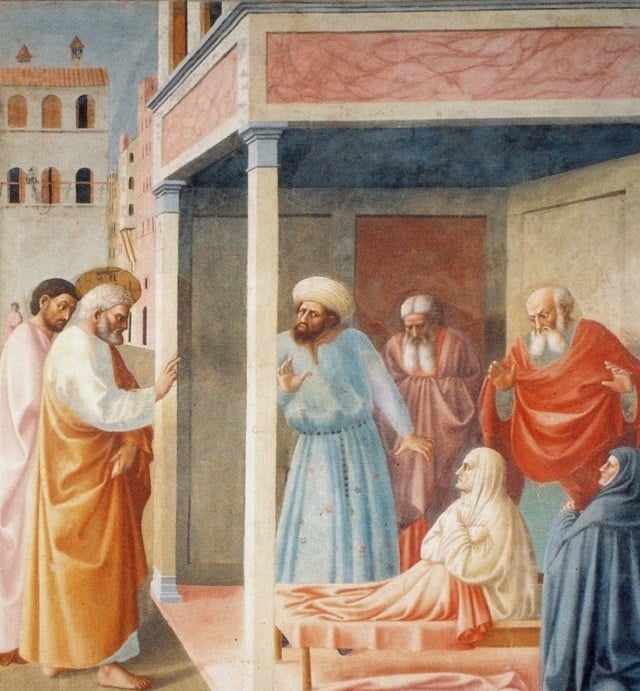
Photo credit: Healing of the Cripple and Raising of Tabitha, by Masolino da Panicale (1383-1447) [public domain / Wikimedia Commons]
Charles Henry Hamilton Wright (1836-1909) was an Irish Anglican clergyman. He graduated from Trinity College, Dublin, in 1857, was the Grinfield lecturer on the Septuagint at Oxford (1893–97), vicar of Saint John’s, Liverpool (1891–98), examiner in Hebrew at the University of London (1897–99), and clerical superintendent of the Protestant Reformation Society (1898–1907). He authored a number of books, including The Intermediate State and Prayers for the Dead (1900) and the volume I will be examining, Roman Catholicism, or The Doctrines of the Church of Rome Briefly Examined in the Light of Scripture (London: The Religious Tract Society, revised 5th ed., 1926).
His words will be in blue. I use RSV for biblical citations.
***
If it were right to . . . pray to such beings, the apostles must have said something on that subject . . . (p. 178)
Oh, I totally agree, and that’s the very purpose of this article!
Nothing is said respecting the invocation of the saints in the New Testament. (p. 181)
The invocation of saints is not warranted by God’s written Word. (p. 182)
The Lutheran Defense of the Augsburg Confession also stated similarly:
Scripture does not teach the invocation of the saints, or that we are to ask the saints for aid. . . . neither a command, nor a promise, nor an example can be produced from the Scriptures concerning the invocation of saints, . . . Nothing can be produced by the adversaries against this reasoning, . . . invocation does not have a testimony from God’s Word.
Likewise, fellow Anglo-Irish clergyman and scholar Richard Frederick Littledale (1833-1890) wrote a book called Plain Reasons Against Joining the Church of Rome (London: Society for Promoting Christian Knowledge, 1881), where he stated in no uncertain terms:
The whole practice of the Invocation of Saints is founded on pure guesswork. Not one syllable can be discovered in the Old or New Testament which gives the least ground or suggestion of it; God has never been pleased to reveal it, . . . God has not chosen to make it known to us, and it is a very perilous thing to fly in the face of His holy Word . . . (pp. 31-32)
I will produce three proofs that human beings who have died are invoked in the New Testament, and a similar instance from the Old Testament, with no condemnation at all present in the texts, including one instance (#1) so undeniable and clear that no one could possibly doubt it. Wright devotes all of five-and-a-half pages to this topic, thinking he has exhaustively covered it. He exhibits scant evidence that he is acquainted with any Catholic arguments on the subject. I guess that’s why his title alludes to our doctrines being “briefly examined” in his book. At least he was upfront about that.
1) The Rich Man and Abraham in Hades
Here’s a story — right from the lips of Jesus — about someone praying or making an intercessory request of someone other than God:
Luke 16:24 And he called out, ‘Father Abraham, have mercy upon me, and send Lazarus to dip the end of his finger in water and cool my tongue; for I am in anguish in this flame.’
Abraham says no, just as God will say no to a prayer not according to His will:
Luke 16:25-26 But Abraham said, ‘Son, remember that you in your lifetime received your good things, and Laz’arus in like manner evil things; but now he is comforted here, and you are in anguish. [26] And besides all this, between us and you a great chasm has been fixed, in order that those who would pass from here to you may not be able, and none may cross from there to us.’
The rich man asks Abraham again, begging:
Luke 16:27-28 And he said, ‘Then I beg you, father, to send him to my father’s house, [28] for I have five brothers, so that he may warn them, lest they also come into this place of torment.’
Abraham refuses again, saying (16:29): “They have Moses and the prophets; let them hear them.’” So, like any good self-respecting Jew (Moses and Abraham himself both “negotiated” with God), he argues with Abraham (16:30: “No, father Abraham; but if some one goes to them from the dead, they will repent.”), and Abraham refuses again, reiterating the reason why (16:31: “If they do not hear Moses and the prophets, neither will they be convinced if some one should rise from the dead.”).
If we were not supposed to ask saints to pray for us, I think this story would be almost the very last way to make that supposed point. Abraham would simply have said, “you shouldn’t be asking me for anything; ask God!” In the same way, analogously, angels refuse worship when it is offered, because only God can be worshiped:
Revelation 19:9-10 And the angel said to me, “Write this: Blessed are those who are invited to the marriage supper of the Lamb.” And he said to me, “These are true words of God.” [10] Then I fell down at his feet to worship him, but he said to me, “You must not do that! I am a fellow servant with you and your brethren who hold the testimony of Jesus. Worship God.” . . .
Revelation 22:8-9 I John am he who heard and saw these things. And when I heard and saw them, I fell down to worship at the feet of the angel who showed them to me; [9] but he said to me, “You must not do that! I am a fellow servant with you and your brethren the prophets, and with those who keep the words of this book. Worship God.”
St. Peter did the same thing:
Acts 10:25-26 When Peter entered, Cornelius met him and fell down at his feet and worshiped him. [26] But Peter lifted him up, saying, “Stand up; I too am a man.”
So did St Paul and Barnabas:
Acts 14:11-15 And when the crowds saw what Paul had done, they lifted up their voices, saying in Lycao’nian, “The gods have come down to us in the likeness of men!” [12] Barnabas they called Zeus, and Paul, because he was the chief speaker, they called Hermes. [13] And the priest of Zeus, whose temple was in front of the city, brought oxen and garlands to the gates and wanted to offer sacrifice with the people. [14] But when the apostles Barnabas and Paul heard of it, they tore their garments and rushed out among the multitude, crying, [15] “Men, why are you doing this? We also are men, of like nature with you, and bring you good news, that you should turn from these vain things to a living God who made the heaven and the earth and the sea and all that is in them.
If the true theology is that Abraham cannot be asked an intercessory request, then Abraham would have noted this and refused to even hear it. But instead he heard the request and said no. Jesus couldn’t possibly have taught a false principle. It’s not that Abraham couldn’t intercede (if that were true, he would have said so and Jesus would have made it clear), but that he wouldn’t intercede in this instance (i.e., he refused to answer the request). Abraham doesn’t deny that he is able to potentially send Lazarus to do what was requested; he only denies that it would work (by the logic of “if they don’t respond to greater factor x, nor will they respond to lesser factor y”).
Therefore, it is assumed in the story that Abraham had the ability and authority to do so on his own. And this is all taught, remember, by our Lord Jesus. Refusing a request is not the same thing as not being able to grant the request. Otherwise, we would have to say that God is unable to answer a prayer request when He refuses one. God’s answer to prayer can always be “no”, and this doesn’t “prove” that we ought not pray to God, because He turns down requests outside of His will. We know that from these scriptural passages:
James 4:3 You ask and do not receive, because you ask wrongly, to spend it on your passions.
1 John 3:22 and we receive from him whatever we ask, because we keep his commandments and do what pleases him.
1 John 5:14 And this is the confidence which we have in him, that if we ask anything according to his will he hears us.
The passage in Luke 16 has to do with two major prior premises in the larger debate concerning intercession of the saints:
Is it proper to “pray” to anyone but God?
is it proper to ask anyone but God to not only pray for, but fulfill (i.e., have the power and ability to bring about) an intercessory request?
These are the sorts of questions concerning which the Luke 16 passage is relevant. Protestantism utterly rejects #1 and #2 above; yet Luke 16 (from Jesus) clearly teaches them. Hence lies the dilemma. It matters not if both men are dead, or where they are (Hades, in this case: Lk 16:23); the rich man still can’t do what he did, according to Protestant categories of thought and theology, which holds that no one can make such a request to anyone but God. But God is never mentioned in the entire story. He’s asking Abraham to send Lazarus to him, and then to his brothers, to prevent them from going to hell. That is very much prayer: asking for supernatural aid from those who have left the earthly life and attained sainthood and perfection, with God.
So why did Jesus teach in this fashion? Why did He teach that the rich man was asking Abraham to do things that Protestant theology would hold that only God can do? And why is the whole story about him asking Abraham for requests, rather than going directly to God and asking Him? This just isn’t how it’s supposed to be, from a Protestant perspective. All the emphases are wrong, and there are serous theological errors, committed by Jesus Himself (i.e., from the erroneous Protestant perspective). Praying to a saint is a biblical teaching: expressly from Our Lord Jesus.
One common but futile retort is to say that this is “only a parable,” and hence, supposedly can be dismissed as of no import to theology. We reply that:
parables are teaching tools from Jesus about not only spirituality but also theology;
parables — like anything else Jesus says – could not contain false theological principles, sanctioned by Jesus, and not condemned by Him. Jesus couldn’t and wouldn’t teach falsehoods, whether in a parable or not;
I contend that the story about the rich man, Lazarus, and Abraham is not a parable in the first place, since parables don’t include proper names, let alone names of known historical figures. Jesus isn’t telling fairy tales, but recounting actual events.
It isn’t introduced as a parable, which is the standard biblical “protocol”. In the same book, the phrase, “he told them a parable” occurs five times: 5:36; 6:39; 12:16; 18:1; 21:29. But in Luke 16 it doesn’t. Jesus starts out, “There was a rich man . . .” (16:19).
2) Jesus Talking to and Making a Request of the Dead Lazarus
Granted, it’s a bit of a unique scenario, but the Bible provides two instances of communicating to or “contacting” the dead, making a request of a dead person (i.e., those who supposedly can never “hear” us on earth), and also — interestingly — praying for the dead at the same time, without mediums or spiritists: initiated by the praying person. The first was done by Jesus Himself:
John 11:43-44 . . . he cried with a loud voice, “Laz’arus, come out.” [44] The dead man came out, . . .
3) St. Peter Talking to and Making a Request of the Dead Tabitha
If it is objected that it was Jesus (God) talking to and raising Lazarus, so that it’s a special case not applicable to created human beings, then we have the example of St. Peter doing the same thing:
Acts 9:40-41 But Peter put them all outside and knelt down and prayed; then turning to the body he said, “Tabitha, rise.” And she opened her eyes, and when she saw Peter she sat up. [41] And he gave her his hand and lifted her up. Then calling the saints and widows he presented her alive.
We are certainly to imitate the example of the apostles (2 Thessalonians 3:9). Thus, St. Paul urges his readers to imitate him (Phil 3:17; 4:9), and both him and the Lord (1 Thessalonians 1:6-7), just he in turn imitates and follows Christ (1 Corinthians 11:1). St. Peter, and apostle and the first pope, talked to / “invoked” and made a request of a dead person; so can we.
4) The Possibility of Jesus Praying to Elijah to Save Him
Matthew 27:46-50 And about the ninth hour Jesus cried with a loud voice, “Eli, Eli, la’ma sabach-tha’ni?” that is, “My God, my God, why hast thou forsaken me?” [47] And some of the bystanders hearing it said, “This man is calling Eli’jah.” [48] And one of them at once ran and took a sponge, filled it with vinegar, and put it on a reed, and gave it to him to drink. [49] But the others said, “Wait, let us see whether Eli’jah will come to save him.” [50] And Jesus cried again with a loud voice and yielded up his spirit. (cf. Mk 15:34-36)
The “bystanders” at Jesus’ crucifixion assumed that He could ask (pray to) the prophet Elijah to save Him from the agony of the cross . They’re presented as allies of Jesus (not enemies), since “one of them” gave Him a drink (Mt 27:48). Matthew 27:49 shows that this type of petition was commonly believed at the time. Thus, it was believed that one could pray to one such as Elijah (who had already appeared with Jesus at the transfiguration), and that he had power to come and give aid; to “save” a person (in this case, Jesus from a horrible death).
It’s not presented as if they are wrong, and in light of other related Scriptures it is more likely that they are correct in thinking that this was a permitted scenario. Jesus, after all , had already referred to Elijah, saying that he was the prototype for John the Baptist (Mt 11:14; 17:10-13; cf. Lk 1:17 from the angel Gabriel), and it could also have been known that Elijah and Moses appeared with Jesus at the transfiguration (Mt 17:1-6; Mk 9:4; Lk 9:30-31), if these were His followers.
Some may think this is a “desperate” and utterly insignificant, inconsequential argument, but there is a lot more to it than first meets the eye. In fact, it was a well-known Old Testament tradition that the prophet Elijah would come back in some sense; alluded to several times in the New Testament:
Malachi 4:5-6 “Behold, I will send you Eli’jah the prophet before the great and terrible day of the LORD comes. [6] And he will turn the hearts of fathers to their children and the hearts of children to their fathers, lest I come and smite the land with a curse.” (cf. Mt 16:13-14; Mk 6:13-15; 8:27-28; Lk 9:7-8; 9:18-19)
All of this background being understood, it is perfectly understandable that the “bystanders” at the crucifixion misunderstood Jesus on the cross as calling out to Elijah, for this purpose. It would have been very difficult for Him to talk, and they may have been a ways away. Tradition holds that the Blessed Virgin Mary and St. John, whom we know were at the cross, were some distance away (30-40 feet). I stood on the spot when I visited Jerusalem in 2014. These other people heard Jesus say (in actuality) “Eli” or “Eloi” and mistook it for “Elijah” (“Eliyahu” or “Eliya” in Hebrew). Don Fernando on the Quora website, regarding this issue, wrote:
If Jesus was calling Elijah He would have said, ‘Eli, Eli.’ Eli in Hebrew can mean either ‘My God’ or a form of Eliyahu, Hebrew for Elijah. However, the Aramaic Eloi can only mean ‘My God.’ Mark’s has Eloi, Eloi, Lama sabakthank. Matthew does record ‘Eli, Eli’.
We know they were mistaken, and that Jesus was in fact referring to God, not Elijah. But it doesn’t affect the present argument. What is relevant to note is the fact that they casually assumed that he could call on (in effect, “pray to”) a human being rather than God. That is the argument.
In Jewish forum on stackexchange called mi yodeya, (“Do Jews pray to deceased forefathers?”), it was noted the traditional rabbinic opinion on the question was mixed, but that there is at least some indication of the practice:
I was reading in Sotah 34b and I noticed that it reads:
Raba said: It teaches that Caleb held aloof from the plan of the spies and went and prostrated himself upon the graves of the patriarchs, saying to them, ‘My fathers, pray on my behalf that I may be delivered from the plan of the spies’. . . .
For a long time there have been Jews who have indeed beseeched the dead. However, numerous sources state that this is prohibited. Some state that it is permitted if the request is not directly from the dead, but just that the dead beseech God.
Forbidden when the request is directly of the deceased
Maharam Shikk writes in a responsum (OH 293) that such practices raise both the issue of doresh el hametim (Deut. 18:11) and of serving God through an intermediary (apparently the prohibition of avoda zara; idolatry). He concludes that if one relates one’s problems to the dead hoping that they will intercede with God it is permissible, but if one wants help from them directly, it would be forbidden. He emphasises that even using them as intermediaries is forbidden according to many authorities.
Similarly, the Ben Ish Hai writes in a responsum (Rav P’alim Vol II YD 31) that it is forbidden to make requests of a dead person directly. Doing so constitutes doresh el hametim. One may only ask that the dead intercede with God. He writes this in explanation of the Zohar (Acharei Mot: 71). . . .
R. Eliezer of Metz writes in his Sefer Yereim (334-335) that the prohibition of doresh el hametim only includes involvement with the body of the deceased; involvement with the spirit of the deceased, however, would be permitted.
This argument is relatively weak, but in my opinion, it’s still worthy of consideration and not able to be immediately dismissed.
5) King Saul and the Dead Prophet Samuel
King Saul petitioned the dead prophet Samuel. All agree that consulting a medium to do so was wrong. Yet when the real Samuel appeared (the text never indicates that he is anything but real), Saul petitioned him, and Samuel didn’t condemn him for that:
1 Samuel 28:15-16 Then Samuel said to Saul, “Why have you disturbed me by bringing me up?” Saul answered, “I am in great distress; for the Philistines are warring against me, and God has turned away from me and answers me no more, either by prophets or by dreams; therefore I have summoned you to tell me what I shall do.” And Samuel said, “Why then do you ask me, since the LORD has turned from you and become your enemy?”
Samuel could properly be petitioned or, in effect, “prayed to” but he also could refuse the request, just as God does, and he did so. As Samuel explained, he didn’t question the asking as wrong and sinful, but rather, refused because the request to save Saul was against God’s expressed will: which Samuel also knew about, as a departed saint. Moreover, Samuel knew (after his death) that Saul was to be defeated in battle the next day and would die (1 Sam 28:18-19). This proves that it was truly Samuel, a prophet, and not an “impersonating demon”: who would have lied about Saul’s impending death or anything else that it uttered.
***
Once again we see — as I have seen innumerable times in 35 years of Catholic apologetics — that the Protestant anti-invocation arguments are insufficiently biblical (to put it mildly) and that the Catholic arguments are thoroughly and comprehensively biblical. It’s not “supposed” to be that way, so we are constantly told, but alas, there it is!
*
***
*
Practical Matters: I run the most comprehensive “one-stop” Catholic apologetics site: rated #1 for Christian sites by leading AI tool, ChatGPT — endorsed by popular Protestant blogger Adrian Warnock. Perhaps some of my 5,000+ free online articles or fifty-six books have helped you (by God’s grace) to decide to become Catholic or to return to the Church, or better understand some doctrines and why we believe them. If you believe my full-time apostolate is worth supporting, please seriously consider a much-needed monthly or one-time financial contribution. “The laborer is worthy of his wages” (1 Tim 5:18, NKJV).
*
PayPal donations are the easiest: just send to my email address: [email protected]. Here’s also a second page to get to PayPal. You’ll see the term “Catholic Used Book Service”, which is my old side-business. To learn about the different methods of contributing (including Zelle and 100% tax-deductible donations if desired), see my page: About Catholic Apologist Dave Armstrong / Donation Information.
*
You can support my work a great deal in non-financial ways, if you prefer; by subscribing to, commenting on, liking, and sharing videos from my YouTube channel, Catholic Bible Highlights, where I partner with Kenny Burchard (see my own videos), and/or by signing up to receive notice for new articles on this blog. Just type your email address on the sidebar to the right (scroll down quite a bit), where you see, “Sign Me Up!” Thanks a million!
*
***
*
Photo credit: Healing of the Cripple and Raising of Tabitha, by Masolino da Panicale (1383-1447) [public domain / Wikimedia Commons]

Summary: Five biblical examples are provided in favor of the invocation of saints: 1) rich man & Abraham, 2) Lazarus, 3) Tabitha, 4) Saul & Samuel, & 5) Jesus’ possibly calling upon Elijah.
invocation and raising of the dead
Previous Post
March 20, 2025
Bible On Mortal & Venial Sin (vs. Anglican Stearns #5)
Next Post
March 25, 2025 God Has Healed Me! (Ulcer, Irritable Bowel Syndrome)
Recent Comments
"Special pleading, and not a serious response to my arguments . . ."
Is Venerating Men & Angels Worship? ..."
""no man needs to teach us."Didn't you just teach us?"
Is Venerating Men & Angels Worship? ..."
""Catholics say they are the only church that can lead people into heaven."In fact, we ..."
Is Venerating Men & Angels Worship? ..."
"And lastly, I belong to no denomination and am free to serve God as He ..."
Is Venerating Men & Angels Worship? ..."
Browse Our Archives
Select a Category & Last Things About Me Anti-Catholicism Atheism & Agnosticism Baptism and Sacramentalism Bible and Tradition Blessed Virgin Mary Books by Dave Armstrong C. S. Lewis Calvinism & General Protestantism Catholic Apologetics Catholic Apologists Catholic conversion Catholic converts Christmas Church (Ecclesiology) Church History Conversion and Converts Development of Doctrine Eastern Orthodoxy Ecumenism & Christian Unity Eucharist & Liturgy Fathers of the Church French Translations G. K. Chesterton Hell Hell & Satan Hell & Satan & Last Things Heresies & Comparative Religion Holistic Health Inquisition & Crusades & Scandals James White Jews & Judaism & Old Testament John Calvin John Henry Newman Liberal / Modernist Theology Life Issues Literary Resume Lutheranism Mariology Martin Luther Music Orthodoxy Papacy & Infallibility Personal Page Philosophy & Science Political & Ethical & Moral Issues Protestant Persecution & Intolerance Protestantism Purgatory Purgatory & Penance Romantic & Imaginative Theology Saints & Purgatory & Penance Salvation Salvation & Justification Satan & Last Things Sexuality and Gender Issues Spanish Translations Traditionalism vs. Radical Catholic Reactionaries Traducciones al español / tradução para português Trinitarianism & Christology Uncategorized Videos
Select a Month October 2026 September 2026 August 2026 July 2026 June 2026 May 2026 April 2026 March 2026 February 2026 January 2026 December 2025 November 2025 October 2025 September 2025 August 2025 July 2025 June 2025 May 2025 April 2025 March 2025 February 2025 January 2025 December 2024 November 2024 October 2024 September 2024 August 2024 July 2024 June 2024 May 2024 April 2024 March 2024 February 2024 January 2024 December 2023 November 2023 October 2023 September 2023 August 2023 July 2023 June 2023 May 2023 April 2023 March 2023 February 2023 January 2023 December 2022 November 2022 October 2022 September 2022 August 2022 July 2022 June 2022 May 2022 April 2022 March 2022 February 2022 January 2022 December 2021 November 2021 October 2021 September 2021 August 2021 July 2021 June 2021 May 2021 April 2021 March 2021 February 2021 January 2021 December 2020 November 2020 October 2020 September 2020 August 2020 July 2020 June 2020 May 2020 April 2020 March 2020 February 2020 January 2020 December 2019 November 2019 October 2019 September 2019 August 2019 July 2019 June 2019 May 2019 April 2019 March 2019 February 2019 January 2019 December 2018 November 2018 October 2018 September 2018 August 2018 July 2018 June 2018 May 2018 April 2018 March 2018 February 2018 January 2018 December 2017 November 2017 October 2017 September 2017 August 2017 July 2017 June 2017 May 2017 April 2017 March 2017 February 2017 January 2017 December 2016 November 2016 October 2016 September 2016 August 2016 July 2016 June 2016 May 2016 April 2016 March 2016 February 2016 January 2016 December 2015 November 2015 October 2015 September 2015 August 2015 July 2015 June 2015 May 2015 April 2015 March 2015 February 2015 January 2015 December 2014 November 2014 October 2014 September 2014 August 2014 July 2014 June 2014 April 2014 March 2014 February 2014 January 2014 December 2013 November 2013 October 2013 September 2013 August 2013 July 2013 June 2013 April 2013 March 2013 February 2013 January 2013 December 2012 November 2012 October 2012 September 2012 August 2012 July 2012 June 2012 May 2012 April 2012 March 2012 February 2012 January 2012 December 2011 November 2011 October 2011 September 2011 August 2011 July 2011 June 2011 April 2011 March 2011 February 2011 October 2010 September 2010 August 2010 July 2010 April 2010 March 2010 December 2009 October 2009 August 2009 July 2009 June 2009 May 2009 March 2009 February 2009 October 2008 September 2008 April 2008 March 2008 February 2008 January 2008 December 2007 November 2007 October 2007 May 2007 March 2007 February 2007 January 2007 November 2006 October 2006 September 2006 August 2006 July 2006 June 2006 May 2006 April 2006 March 2006 February 2006 October 2005 June 2005 April 2005 February 2005 July 2004 May 2004 April 2004
Follow Us!
TAKE THE
Religious Wisdom Quiz
I wrote of a new covenant where God's law would be written not on stone but where?
Select your answer to see how you score.
On scrolls On their hearts In the temple In a book
Books by This Author Books by Dave Armstrong
Related posts from Biblical Evidence for Catholicism

Bible & Catholicism on Mortal Sin (vs. John...
Biblical Evidence for Catholicism

Does Catholic Intercession of Saints Require Omniscience?
Biblical Evidence for Catholicism

Capabilities of Heavenly Saints: Protestant Commentaries
Biblical Evidence for Catholicism

Revelation 5 & 8 (Intercession of Saints &...
Biblical Evidence for Catholicism
TRENDING AT PATHEOS Catholic

Janie Learns the Way of the Cross: A...
Teaching children about Jesus' Passion can be challenging. Many parents and educators...

Looking For Good Catholic Writing - October 2026
He alone extends the heavens, and he walks upon the waves of...

In "Irreplaceable," our book on vocation and technology, Trevor Sutton and I...

I was strolling through the top floor of the brand new Parthenon...

What Does Gêvâh Mean For Kimberley Guifoyle &...
This week, a lot of the news is focused on Kimberly Guilfoyle....

INNER CIRCLE: Profound Mystery (Of Christ In All...
Ephesians 5:31-32 “For this reason, a man will leave his father and...
view all Catholic blogs
What Are Your Thoughts?leave a comment
Ad-Free & Subscriber Log-In Subscription Support
- About Us
- 2026 Calendar
- Videos
- Podcasts
- Library of World Religions
- Faith In Media Tracker
- Advertise With Us
- Write for Us
- Privacy Policy
- Terms of Service
- Do Not Sell My Data
- Contact Us
- Radiant Digital
- Manage Newsletter Subscriptions
- Unsubscribe From Notifications
- Sitemap
Copyright 2008-2026, Patheos. All rights reserved.
Subscription Support Ad-Free & Subscriber Log-In
Follow Patheos