
BuddhistCatholicContemplativeEvangelicalGeneral ChristianHinduJewishLatter-day SaintMuslimNew VisionsProgressive Christian
Beliefs
- Buddhist
- Catholic
- Contemplative
- Evangelical
- General Christian
- Hindu
- Jewish
- Latter-day Saint
- More Voices
- Muslim
- New Visions
- Pagan
- Progressive Christian
Topics
- Religion News
- Food and Religion
- Sports and Religion
- Religious Art
- Religious Music and Entertainment
- Religious Events
- History and Religion
- Style and Religion
- Politics and Religion
- Women in Religion
- Recreation Outdoors and Religion
- Business Finance and Religion
- Careers Workplace and Religion
- Education and Religion
- Family Parenting and Religion
- Health Fitness and Religion
- Home and Religion
- Relationships and Religion
- Technology and Religion
- Travel and Religion
Columnists
- Buddhist Columnists
- Business Finance and Religion Columnists
- Careers Workplace and Religion Columnists
- Catholic Columnists
- Contemplative Columnists
- Education and Religion Columnists
- Evangelists Columnists
- Family Parenting and Religion Columnists
- General Christian Columnists
- Health Fitness and Religion Columnists
- Hindu Columnists
- History and Religion Columnists
- Home and Religion Columnists
- Jewish Columnists
- More Voices Columnists
- Latter Day Columnists
- Muslim Columnists
- New Visions Columnists
- Nonreligious Columnists
- Pagan Columnists
- Politics and Religion Columnists
- Progressive Columnists
- Recreation Outdoors and Religion Columnists
- Relationships and Religion Columnists
- Religion News Columnists
- Religious Art Columnists
- Religious Events Columnists
- Religious Music and Entertainment Columnists
- Sports and Religion Columnists
- Style and Religion Columnists
- Technology and Religion Columnists
- Travel and Religion Columnists
- Women in Religion Columnists
Resource Library
- 2026 Calendar
- Library of World Religions
- The 100 Most Holy Places on Earth
- Patheos Answers
- Podcasts
- Videos
- Faith Leaders Database
- Anglican Episcopalian
- Bahai
- Baptist
- Buddhism
- Christianity
- Confucianism
- Eastern Orthodoxy
- Hinduism
- Holiness and Pentecostal
- ISKCON
- Islam
- Judaism
- Lutheran
- Methodist
- The Church of Jesus Christ of Latter-day Saints
- New Age
- Paganism
- Presbytarian and Reformed
- Protestantism
- Religion Behind the Scenes
- Roman Catholic
- Scientology
- Shia Islam
- Sikhism
- Sufism
- Sunni Islam
- Taoism
- Zen
- See all religions
Research Tools
 Ad-Free & Subscriber Log-In Subscription Support
Ad-Free & Subscriber Log-In Subscription Support
Follow Patheos 

- Trending:
- Forgiveness
- |
- Marriage
- |
- Consciousness
- |
- Death Penalty
- |
- Election
- |
- Halloween

-
About
-
Catholic Apologetics
-
Church History
-
Great Apologists
-
Christian Worldview
-
Protestantism & Misc.
- Home
- Catholic
- History and Religion
- Newman, Sinless Mary, & Development (vs. Javier Perdomo)
Newman, Sinless Mary, & Development (vs. Javier Perdomo)
Last updated on: June 6, 2026 at 12:52 am by Dave Armstrong
Newman, Sinless Mary, & Development (vs. Javier Perdomo) 2026-06-06T00:52:51-04:00 Dave Armstrong
Patheos Explore the world's faith through different perspectives on religion and spirituality! Patheos has the views of the prevalent religions and spiritualities of the world.
. . . Concentrating on the New Eve Analogy in the Church Fathers and its Full Implication Regarding Mary’s Freedom from Actual and Original Sin
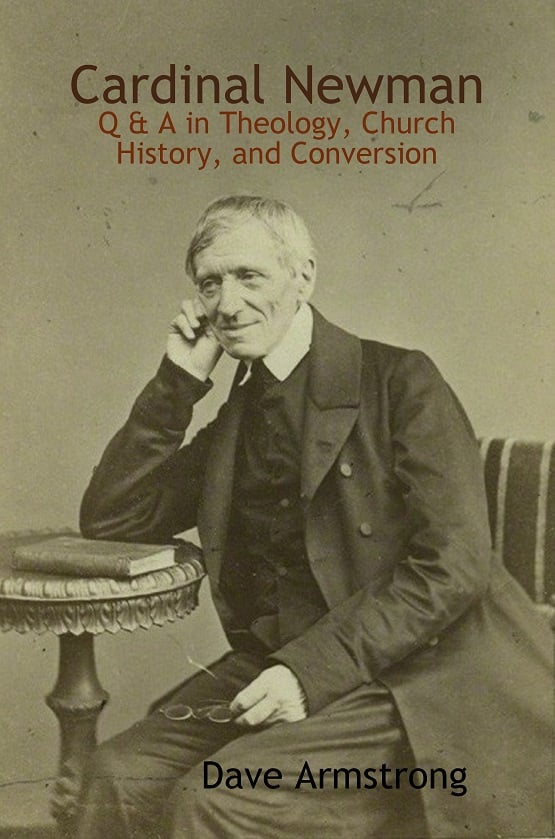
Photo credit: self-designed cover of my self-published book (2015)
This is a follow-up to my previous articles, Mary’s Sinlessness & the Fathers (vs. Javier Perdomo) [2-5-25] and Patristic Development of a Sinless Mary (Cdl. Newman) [2-6-25], and responds to a further counter-reply from the Lutheran apologist and YouTuber, Javier Perdomo, on his own thread, Church Fathers & Medievals on the Immaculate Conception [2-4-25]. His words will be in blue.
*****
Thank you for taking the time to thoughtfully interact with my article.
My pleasure. Same back to you.
ON YOUR USE OF CARDINAL NEWMAN’S QUOTES
Surely, Cardinal Newman (as well as yourself) would have a deeper familiarity with the full extent of Mariology in Church History than I do since, at least at the time of writing this comment, I haven’t yet embarked on a deep-dive into all facets of historical Mariology. That being said, I see quite a few problems with Cardinal Newman’s approach to this issue (at least in the quotes you’ve provided).
Newman seems to equate patristic assertions of the Blessed Virgin (B.V. from henceforth) “being without sin” as to her “being conceived and born without sin.”
Surely, we can see that there’s a gap between those two ideas which hasn’t been bridged yet.
He does not do so. Rather, he argues it as follows (which was in my reply):
As to the antiquity of the doctrine. In the first ages original sin was not formally spoken of in contrast to actual. . . . Not till the time of St Augustine could the question be mooted precisely whether our Lady was without original sin or not. Up to his time, and after his time, it was usual to say or to imply that Mary had nothing to do with sin, in vague terms. . . . This does not go so far as actually to pronounce that she had the grace of God from the first moment of her existence, and never was under the power of original sin, but by comparing her with Eve, who was created of course without original sin, and by giving her so high an office, it implies it. (The Letters and Diaries of John Henry Newman, vol. 22; To Lady Chatterton, 2 Oct. 1865)
For example, say that one of your friends has just watched Forrest Gump for the first time and approaches you to talk about the movie. He talks about the different characters and eventually makes his way to Lieutenant Dan, starting off saying something like, “Man, it makes sense that he was so bitter and despondent. I mean, just imagine being without legs.” If you then responded to your friend by saying, “Man, yeah, I would be pretty despondent too if I had been born without legs.” Your friend would likely look at you with a puzzled look on his face. Why? Lt. Dan wasn’t born without legs; in fact, he has both of them in an earlier point in the movie.
To say that someone “was without [INSERT THING HERE]” does not necessitate that said person was without said thing from the moment of their birth or conception — that would require additional supporting context or arguments to help bridge the gap.
The additional “context” would be the sufficiently full development of the doctrine of original sin. Cdl. Newman says this didn’t occur until the time of St. Augustine: some 350 years after the death of Jesus at a minimum. Accordingly, Anglican J. N. D. Kelly (Early Christian Doctrines, HarperSanFrancisco, rev., 1978, 172) writes about St. Irenaeus, that he “nowhere formulates a specific account of the connexion between Adam’ guilty act and the rest of mankind.” In the earlier Justin Martyr, we find — as we would expect — an even simpler conception. Kelly describes it as “the sin of Adam and Eve . . . is the prototype of our sin” (p. 167).
Likewise, Tertullian’s view “can hardly be read as implying our solidarity with the first man in his culpability (i.e., original guilt) as well as in the consequences of his act” (p. 176), and Origen’s position “entails . . . the abandonment of any doctrine of corporate sinfulness” (p. 181). Conclusion: the doctrine was still developing, so that a fully developed view of the immaculate conception (presupposing corporate original sin) couldn’t occur until the 4th or 5th century.
Thus, Newman was making no false equation or committing equivocation; rather, he was simply pointing out the history of the development of the doctrine of original sin. He also notes the implications of analogizing Eve and Mary, since Eve was indeed created without original sin and was sinless before the fall. So this implies a sinless Eve by analogy, and this comparison occurs early and widespread in the fathers, which was Newman’s main patristic argument in this respect.
In the case of the B.V., even if someone makes a statement about her being sinless in some sense, there’s a range of options to choose from as to what that means: 1. She may have been conceived literally without sin, 2. She may have been hyperbolically “without sin” in a particular instance (denoting how righteous and pleasing to God a particular decision/action was), 3. She may have been generally “without sin” in a hyperbolic sense (denoting how particularly righteous her heart and actions were as a whole in comparison to other people), 4. She may have been literally without sin after a particular event or point in time (such as the annunciation or her being overshadowed by the Holy Spirit, for example) despite having been sinful prior, or 5. She may have had sinful flesh but never chosen to act upon the flesh’s sinful desires (i.e. – having original sin, but no actual sin). The context is really important for determining which of these is meant by the person making the statement.
I agree; but in the pre-Augustinian fathers, all of this was formulated with an insufficiently developed understanding of original sin, and you still have to face the fact that if Mary is directly compared to the pre-fall Eve, then she must have been sinless as Eve was, which was an actual, pure sinlessness, from before the fall of mankind: as God originally intended it to be for all of us.
The way Newman attempts to bridge the gap is through a typological argument with the B.V. being the New Eve. For the sake for the argument, let’s grant that typological connection. Why should we assume that this means Mary was sinless from conception?
It strongly implies it, by the reasoning I just provided. Let me try to explain it some more. Eve was the one person, along with Adam, who was absolutely pure and without sin. This has implications for original sin, too, since Eve totally lacked that before her rebellion and fall; hence, Mary would have to possess the same traits in order to do better than Eve did, and to be the New / Second Eve. But the earlier fathers wouldn’t have a full understanding of that because they didn’t yet grasp original sin in its fullness.
Does everything about Eve transfer on to Mary? We know that, even prior to the Fall, God commanded Eve to be joined to her husband, and to be fruitful and multiply to replenish the earth (Genesis 1:28)… but, you wouldn’t agree that this aspect of Eve transfers to the B.V. (since you affirm her perpetual virginity). Pre-Fall, Eve felt no shame and wore no clothes everywhere she went… but you don’t believe that transfers over to the B.V.. Pre-Fall, Eve wouldn’t have experienced natural death… but you don’t believe that transfers over to the B.V.
An analogy on one sense has nothing logically to do with possible additional analogies, so this is a non sequitur.
It would seem as arbitrary to me to try to pass along Eve’s sinlessness from conception to the B.V. as it would be to pass on any of the aforementioned attributes to her.
That doesn’t follow logically, if the topic at hand is sinlessness and freedom from original sin. Catholics don’t dogmatize about whether Mary died or not, though most believe that she did (including myself), since the analogy there is to her Son.
This is especially the case when even some of the Church Fathers that Newman relies on do not speak of the B.V. in terms of having always been sinless, or anything of the sort, when discussing her as the New Eve.
They don’t technically have to, because the one-to-one comparison is being made, and we all agree that Eve was sinless and without original sin before the fall. I already noted that different doctrines develop at different rates. And with some doctrines, there are relatively more exceptions than with others. That’s the case with this. It’s not fatal to our view at all, because it’s simply the reality that we observe in studying the fathers and examining any given doctrine throughout its history.
If Protestants want to claim that the patristic facts you collect disprove Mary’s Immaculate Conception or even a Mary free of actual sin only, then you are in a world of trouble when it comes to the two “pillars” of Protestantism: sola Scriptura and sola fide. I myself have collected dozens and dozens of proofs showing that virtually no Church father — perhaps literally none — believed in either one (see the categories “VII. Bible / Tradition / Sola Scriptura” and “XXIV. Salvation / Justification / “Faith Alone” on my Fathers of the Church web page).
Irenaeus, in particular, applies the typology simply to say that Eve chose to disobey God when approached by Satan (which brought about humanity’s Fall), whereas the B.V. chose to obey God when approached by Gabriel (which would bring about humanity’s Redemption).
As I already showed from Kelly, Irenaeus didn’t understand original sin as the Church later did from the 4th century onward.
Here is the full quote from Irenaeus that Newman made reference to:
That the Lord then was manifestly coming to His own things, and was sustaining them by means of that creation which is supported by Himself, and was making a recapitulation of that disobedience which had occurred in connection with a tree, through the obedience which was [exhibited by Himself when He hung] upon a tree, [the effects] also of that deception being done away with, by which that virgin Eve, who was already espoused to a man, was unhappily misled,—was happily announced, through means of the truth [spoken] by the angel to the Virgin Mary, who was [also espoused] to a man. For just as the former was led astray by the word of an angel, so that she fled from God when she had transgressed His word; so did the latter, by an angelic communication, receive the glad tidings that she should sustain (portaret) God, being obedient to His word. And if the former did disobey God, yet the latter was persuaded to be obedient to God, in order that the Virgin Mary might become the patroness (advocata) of the virgin Eve. And thus, as the human race fell into bondage to death by means of a virgin, so is it rescued by a virgin; virginal disobedience having been balanced in the opposite scale by virginal obedience. For in the same way the sin of the first created man (protoplasti) receives amendment by the correction of the First-begotten, and the coming of the serpent is conquered by the harmlessness of the dove, those bonds being unloosed by which we had been fast bound to death. (ANF01, Against Heresies: Book V, Chapter XIX)
Again, if Mary was the New Eve because she said yes to God, then she had to be without sin because the analogy was to the pre-fallen Eve who was without actual or original sin at the time when she was called upon to choose God or herself. Mary said yes, and so she had to be at least as “high” in the scheme of things as the unfallen Eve in order to do so.
This is how and why the New Eve analogy implies both a sinless Mary (free from actual sin) and by extension, with a fuller understanding, a Mary free from original sin as well. Far from being a disproof of Newman and development of doctrine, what we see in earlier fathers like St. Irenaeus is exactly the sort of thing that we would expect to find according to Newman’s theory of development.
For Newman to stretch out this account of one pivotal moment of obedience to somehow mean that Mary always chose to obey God in every single other instance of her life is an unjustified leap, if I’ve ever seen one.
It’s not at all, seeing that Adam and Eve’s decision involved the entire human race (standard original sin theology, based on 1 Corinthians 15:22: “in Adam all die”: RSV; and a few other passages). Thus, if Mary undid what Eve did, as many many fathers taught, then it would likewise have enormous implications for the history of redemption (since she bore our savior and Lord) and also, by straightforward extension, for her own sinlessness, because in effect, she was put back in Eve’s position of choosing between God (sinless original state) and herself (sin after willfully rebelling).
At this point, one may be tempted to counter by saying something along the lines of: “But wait, wouldn’t these same sorts of arguments cast doubt upon Christ’s sinlessness and status as the New Adam also?” The short answer to that is, simply: no. We have warrant from the Biblical text itself explicitly calling Jesus sinless (See: 2 Corinthians 5:21, 1 Peter 2:22, 1 John 3:5, Hebrews 4:15, etc…). When it comes to how to best understand these verses, the fact that Jesus is the God-Man (that there is a hypostatic union between Christ’s divine nature and human nature) easily bridges the gap and provides sufficient context and warrant for us to assert that the incarnate Christ was without sin from His very conception.
We have Luke 1:28 and kecharitomene to establish that Mary was without sin as well. I’ve written several articles consisting of entirely biblical arguments for Mary’s sinlessness. Here are two:
Luke 1:28 (“Full of Grace”) & Immaculate Conception [2004]
Mary’s Immaculate Conception: A Biblical Argument [2010]
Here, one may be tempted to respond to this rejoinder by saying something like, “Well, Mary had a very personal and intimate connection to God when she bore Him in her womb. Surely that’s enough to establish her sinlessness also!” But… was she bearing Christ in her womb at the moment of her own conception? No, she wasn’t.
Actually, Catholics don’t believe that it was absolutely necessary for her to be sinless in order to bear Christ. Rather, we say that it was “fitting” or proper, and this is based on much biblical data regarding the notion of fittingness.
Additionally, I would also contest Newman’s contention that, “Now, as to the doctrine of the Immaculate Conception, it was implied in early times, and never denied.” For that, I would present a myriad quotes from this very article.
It certainly wasn’t denied early on, because it would have required an understanding of original sin to do so, which was absent. But it was implied on the basis of what I have been explaining.
ON YOUR OWN POINTS
You echoed several of Cdl. Newman’s points which I addressed above, so I won’t rehash my response to those points here.
Nor will I rehash my replies!
However, I do want to address an additional statement you made:
Assume for the sake of argument that Mary actually inherited original sin for a nanosecond before God performed His special act of grace. Whether that happened or not, still we know that she definitely would have inherited it had God not acted. The very act on His part shows that it was necessary to prevent such an inheritance. In this specific sense one can incorporate all of the statements from the fathers saying that inheritance of original sin was universal, without any harm to the Catholic doctrine.
This would be like if someone said, “Every single one of my pets has been fed today”… despite knowing that when they tried to feed their smaller cat, their bigger cat stepped in and bullied the smaller one out of its food. Would the person’s claim that “every single one of my pets have been fed today” be rendered true by fact that the food would have made it to the smaller cat were it not for the bigger cat preventing it from happening? I can think of at least one very hungry kitty who’d object to that being the case.
This attempted disproof fails because it actually supports my point. The smaller cat would have eaten (analogy to the fall and entrance into sin) but for the fact that another cause (the bigger cat; analogy to God’s intervention in the Immaculate Conception) intervened and prevented it from that eventuality. Likewise, Mary would have inherited original sin like all of us because her Immaculate Conception has nothing to do with her mother and everything to do with God’s special miraculous act of grace. This is how she can call God her savior. God prevented her from sin, which has the same effect as someone else being rescued from the pit of sin after having fallen into it.
To keep things brief in regards to the doctrinal development arguments, I will simply point the following out: the frustrating bit here is that Roman Catholic apologetics makes much use of the “consensus of the Fathers” when RCs believe said consensus to be in their favor. However, when the tide turns the other way, and the consensus is against a given RC position… well, an untold number of Fathers can just be wrong, and we can just appeal to doctrinal development. It really feels like: “Heads, I win. Tails, you lose.”
That may be how it seems to you and who knows how many Protestants, as well as legions of Catholics who haven’t studied the history and nature of doctrinal development, but the facts of history are what they are. And what we find is that some doctrines develop very fast (e.g., baptismal regeneration, Real Presence in the Eucharist, episcopal Church government) and others very slowly (the Holy Trinity, original sin, the full understanding of the papacy, trinitarianism, the communion of saints, Christology, the canon of the Bible, Mariology).
Meanwhile, some doctrines prove themselves — after closer examination — to be corruptions of what came earlier or outright novelties, and so are virtually universally rejected by the fathers, till being resurrected in the 16th century (sola Scriptura, sola fide, symbolic Eucharist and baptism, denominationalism, etc.). Those are the facts of patristic history and I have backed all of them up, myself.
I would keep going on, but I promised to keep things brief so that I could offer a response within a reasonable amount of time from your own response to me.
I appreciate it. Thanks for the opportunity to further explain my Catholic views, and how I believe development of doctrine has functioned in actual Church history.
Again, thanks for your thoughts and for a respectful back and forth.
Same to you. This is enjoyable, constructive dialogue and I believe that it will be instructive and edifying to readers.
*
***
*
Practical Matters: I run the most comprehensive “one-stop” Catholic apologetics site: rated #1 for Christian sites by leading AI tool, ChatGPT — endorsed by popular Protestant blogger Adrian Warnock. Perhaps some of my 5,000+ free online articles or fifty-six books have helped you (by God’s grace) to decide to become Catholic or to return to the Church, or better understand some doctrines and why we believe them. If you believe my full-time apostolate is worth supporting, please seriously consider a much-needed monthly or one-time financial contribution. “The laborer is worthy of his wages” (1 Tim 5:18, NKJV).
*
PayPal donations are the easiest: just send to my email address: [email protected]. Here’s also a second page to get to PayPal. You’ll see the term “Catholic Used Book Service”, which is my old side-business. To learn about the different methods of contributing (including Zelle and 100% tax-deductible donations if desired), see my page: About Catholic Apologist Dave Armstrong / Donation Information.
*
You can support my work a great deal in non-financial ways, if you prefer; by subscribing to, commenting on, liking, and sharing videos from my YouTube channel, Catholic Bible Highlights, where I partner with Kenny Burchard (see my own videos), and/or by signing up to receive notice for new articles on this blog. Just type your email address on the sidebar to the right (scroll down quite a bit), where you see, “Sign Me Up!” Thanks a million!
*
***
*
Photo credit: self-designed cover of my self-published book (2015) [see book and purchase information]
Summary: I argue, following Cdl. Newman’s reasoning, that Mary’s sinlessness was strongly implied in the widespread and early patristic motif of Mary as the New Eve or Second Eve.
Newman on the fathers & Mary's sinlessness
Previous Post
February 11, 2025
John Calvin’s Ten Striking “Catholic” Views
Next Post
February 24, 2025 François Turretin and the Debate Over the Lord’s Supper
Recent Comments
"Special pleading, and not a serious response to my arguments . . ."
Is Venerating Men & Angels Worship? ..."
""no man needs to teach us."Didn't you just teach us?"
Is Venerating Men & Angels Worship? ..."
""Catholics say they are the only church that can lead people into heaven."In fact, we ..."
Is Venerating Men & Angels Worship? ..."
"And lastly, I belong to no denomination and am free to serve God as He ..."
Is Venerating Men & Angels Worship? ..."
Browse Our Archives
Select a Category & Last Things About Me Anti-Catholicism Atheism & Agnosticism Baptism and Sacramentalism Bible and Tradition Blessed Virgin Mary Books by Dave Armstrong C. S. Lewis Calvinism & General Protestantism Catholic Apologetics Catholic Apologists Catholic conversion Catholic converts Christmas Church (Ecclesiology) Church History Conversion and Converts Development of Doctrine Eastern Orthodoxy Ecumenism & Christian Unity Eucharist & Liturgy Fathers of the Church French Translations G. K. Chesterton Hell Hell & Satan Hell & Satan & Last Things Heresies & Comparative Religion Holistic Health Inquisition & Crusades & Scandals James White Jews & Judaism & Old Testament John Calvin John Henry Newman Liberal / Modernist Theology Life Issues Literary Resume Lutheranism Mariology Martin Luther Music Orthodoxy Papacy & Infallibility Personal Page Philosophy & Science Political & Ethical & Moral Issues Protestant Persecution & Intolerance Protestantism Purgatory Purgatory & Penance Romantic & Imaginative Theology Saints & Purgatory & Penance Salvation Salvation & Justification Satan & Last Things Sexuality and Gender Issues Spanish Translations Traditionalism vs. Radical Catholic Reactionaries Traducciones al español / tradução para português Trinitarianism & Christology Uncategorized Videos
Select a Month October 2026 September 2026 August 2026 July 2026 June 2026 May 2026 April 2026 March 2026 February 2026 January 2026 December 2025 November 2025 October 2025 September 2025 August 2025 July 2025 June 2025 May 2025 April 2025 March 2025 February 2025 January 2025 December 2024 November 2024 October 2024 September 2024 August 2024 July 2024 June 2024 May 2024 April 2024 March 2024 February 2024 January 2024 December 2023 November 2023 October 2023 September 2023 August 2023 July 2023 June 2023 May 2023 April 2023 March 2023 February 2023 January 2023 December 2022 November 2022 October 2022 September 2022 August 2022 July 2022 June 2022 May 2022 April 2022 March 2022 February 2022 January 2022 December 2021 November 2021 October 2021 September 2021 August 2021 July 2021 June 2021 May 2021 April 2021 March 2021 February 2021 January 2021 December 2020 November 2020 October 2020 September 2020 August 2020 July 2020 June 2020 May 2020 April 2020 March 2020 February 2020 January 2020 December 2019 November 2019 October 2019 September 2019 August 2019 July 2019 June 2019 May 2019 April 2019 March 2019 February 2019 January 2019 December 2018 November 2018 October 2018 September 2018 August 2018 July 2018 June 2018 May 2018 April 2018 March 2018 February 2018 January 2018 December 2017 November 2017 October 2017 September 2017 August 2017 July 2017 June 2017 May 2017 April 2017 March 2017 February 2017 January 2017 December 2016 November 2016 October 2016 September 2016 August 2016 July 2016 June 2016 May 2016 April 2016 March 2016 February 2016 January 2016 December 2015 November 2015 October 2015 September 2015 August 2015 July 2015 June 2015 May 2015 April 2015 March 2015 February 2015 January 2015 December 2014 November 2014 October 2014 September 2014 August 2014 July 2014 June 2014 April 2014 March 2014 February 2014 January 2014 December 2013 November 2013 October 2013 September 2013 August 2013 July 2013 June 2013 April 2013 March 2013 February 2013 January 2013 December 2012 November 2012 October 2012 September 2012 August 2012 July 2012 June 2012 May 2012 April 2012 March 2012 February 2012 January 2012 December 2011 November 2011 October 2011 September 2011 August 2011 July 2011 June 2011 April 2011 March 2011 February 2011 October 2010 September 2010 August 2010 July 2010 April 2010 March 2010 December 2009 October 2009 August 2009 July 2009 June 2009 May 2009 March 2009 February 2009 October 2008 September 2008 April 2008 March 2008 February 2008 January 2008 December 2007 November 2007 October 2007 May 2007 March 2007 February 2007 January 2007 November 2006 October 2006 September 2006 August 2006 July 2006 June 2006 May 2006 April 2006 March 2006 February 2006 October 2005 June 2005 April 2005 February 2005 July 2004 May 2004 April 2004
Follow Us!
TAKE THE
Religious Wisdom Quiz
Who was Jacob's first wife?
Select your answer to see how you score.
Rachel Dinah Leah Rebekah
Books by This Author Books by Dave Armstrong
Related posts from Biblical Evidence for Catholicism

Holy Ground: Why Mary Had NO Other Children...
Biblical Evidence for Catholicism
Protestant Confessions & "Ever-Virgin" Mary
Biblical Evidence for Catholicism

Mary Wife of Clopas (Jn 19:25): Mary's Sister-in-Law?
Biblical Evidence for Catholicism

Jesus Had Four Brothers? The Bible Sez No!
Biblical Evidence for Catholicism
TRENDING AT PATHEOS Catholic

The Sermon on the Mount, Part I: Matthew...
The Sermon on the Mount, Part I (Matthew 4:12-5:12) St. Matthew moves...

What's up from Crossway: Reviewing some of their latest A few weeks...

Janie Learns the Way of the Cross: A...
Teaching children about Jesus' Passion can be challenging. Many parents and educators...

Looking For Good Catholic Writing - October 2026
He alone extends the heavens, and he walks upon the waves of...

In "Irreplaceable," our book on vocation and technology, Trevor Sutton and I...

I was strolling through the top floor of the brand new Parthenon...
view all Catholic blogs
What Are Your Thoughts?leave a comment
Ad-Free & Subscriber Log-In Subscription Support
- About Us
- 2026 Calendar
- Videos
- Podcasts
- Library of World Religions
- Faith In Media Tracker
- Advertise With Us
- Write for Us
- Privacy Policy
- Terms of Service
- Do Not Sell My Data
- Contact Us
- Radiant Digital
- Manage Newsletter Subscriptions
- Unsubscribe From Notifications
- Sitemap
Copyright 2008-2026, Patheos. All rights reserved.
Subscription Support Ad-Free & Subscriber Log-In
Follow Patheos