
BuddhistCatholicContemplativeEvangelicalGeneral ChristianHinduJewishLatter-day SaintMuslimNew VisionsProgressive Christian
Beliefs
- Buddhist
- Catholic
- Contemplative
- Evangelical
- General Christian
- Hindu
- Jewish
- Latter-day Saint
- More Voices
- Muslim
- New Visions
- Pagan
- Progressive Christian
Topics
- Religion News
- Food and Religion
- Sports and Religion
- Religious Art
- Religious Music and Entertainment
- Religious Events
- History and Religion
- Style and Religion
- Politics and Religion
- Women in Religion
- Recreation Outdoors and Religion
- Business Finance and Religion
- Careers Workplace and Religion
- Education and Religion
- Family Parenting and Religion
- Health Fitness and Religion
- Home and Religion
- Relationships and Religion
- Technology and Religion
- Travel and Religion
Columnists
- Buddhist Columnists
- Business Finance and Religion Columnists
- Careers Workplace and Religion Columnists
- Catholic Columnists
- Contemplative Columnists
- Education and Religion Columnists
- Evangelists Columnists
- Family Parenting and Religion Columnists
- General Christian Columnists
- Health Fitness and Religion Columnists
- Hindu Columnists
- History and Religion Columnists
- Home and Religion Columnists
- Jewish Columnists
- More Voices Columnists
- Latter Day Columnists
- Muslim Columnists
- New Visions Columnists
- Nonreligious Columnists
- Pagan Columnists
- Politics and Religion Columnists
- Progressive Columnists
- Recreation Outdoors and Religion Columnists
- Relationships and Religion Columnists
- Religion News Columnists
- Religious Art Columnists
- Religious Events Columnists
- Religious Music and Entertainment Columnists
- Sports and Religion Columnists
- Style and Religion Columnists
- Technology and Religion Columnists
- Travel and Religion Columnists
- Women in Religion Columnists
Resource Library
- 2026 Calendar
- Library of World Religions
- The 100 Most Holy Places on Earth
- Patheos Answers
- Podcasts
- Videos
- Faith Leaders Database
- Anglican Episcopalian
- Bahai
- Baptist
- Buddhism
- Christianity
- Confucianism
- Eastern Orthodoxy
- Hinduism
- Holiness and Pentecostal
- ISKCON
- Islam
- Judaism
- Lutheran
- Methodist
- The Church of Jesus Christ of Latter-day Saints
- New Age
- Paganism
- Presbytarian and Reformed
- Protestantism
- Religion Behind the Scenes
- Roman Catholic
- Scientology
- Shia Islam
- Sikhism
- Sufism
- Sunni Islam
- Taoism
- Zen
- See all religions
Research Tools
 Ad-Free & Subscriber Log-In Subscription Support
Ad-Free & Subscriber Log-In Subscription Support
Follow Patheos 

- Trending:
- Forgiveness
- |
- Marriage
- |
- Consciousness
- |
- Death Penalty
- |
- Election
- |
- Halloween

-
About
-
Catholic Apologetics
-
Church History
-
Great Apologists
-
Christian Worldview
-
Protestantism & Misc.
- Home
- Catholic
- History and Religion
- Reply to Lutheran Johann Gerhard (1582-1637) #2
Reply to Lutheran Johann Gerhard (1582-1637) #2
Last updated on: June 6, 2026 at 12:04 am by Dave Armstrong
Reply to Lutheran Johann Gerhard (1582-1637) #2 2026-06-06T00:04:56-04:00 Dave Armstrong
Patheos Explore the world's faith through different perspectives on religion and spirituality! Patheos has the views of the prevalent religions and spiritualities of the world.
De Fide Dogma on Communion in One Species Only; Theological Discord; Sola Scriptura
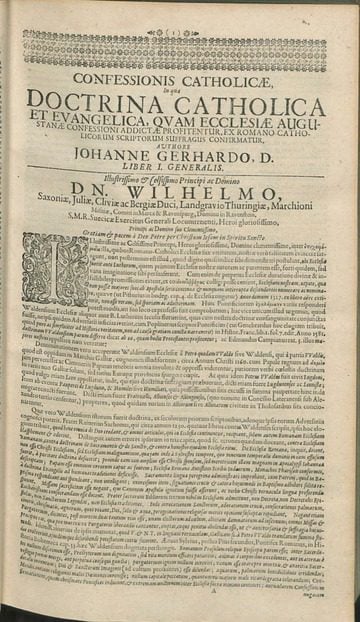
Photo credit: 1679 edition of Gerhard’s Confessio Catholica (Frankfurt) [public domain / Internet Archive]
Many Lutheran scholars and apologists consider Johann Gerhard (1582-1637), a Protestant scholastic, to be the most knowledgeable Lutheran apologist in history. What’s particularly notable about him is that he actually directly interacted with the best Catholic apologetics and theological sources (such as St. Robert Bellarmine: 1542-1621). According to the 1911 Encyclopaedia Britannica article on Gerhard, he was “regarded as the greatest living theologian of Protestant Germany.” And it described his multi-volume book, “the Confessio Catholica (1633–1637)” as “an extensive work which seeks to prove the evangelical and catholic character of the doctrine of the Augsburg Confession [1530, written by Philip Melanchthon] from the writings of approved Roman Catholic authors.”
*
Gerhard’s words will be in blue. The first volume of this work is 1008 pages, and is in the public domain. I will be utilizing Google Translate to render the original Latin into English (with my own slight modifications to make it more readable). I use RSV for scriptural citations.
*****
Since they demonstrate the uncertainty of the very papal dogma that we are attacking, they thereby confirm our opinion opposed to the same papal dogma. But since those differences argue the uncertainty of papal dogmas, the matter itself is proved, and can be confirmed in detail from Bellarmine himself. For he, in Book 4. On the Eucharist, Chapter 23, Prop. 4, forms the following proposition: “No spiritual fruit is taken from two kinds, which is not taken from one”; he adds: “this proposition is not at all certain, since theologians think variously about it, nor does the Council openly define it.” Therefore, transferring the hypothesis to the theory, we can say that those statements, about which theologians variously argue, either before or after the definition of the Council of Trent, are not really certain, and therefore those differences of theologians and pontiffs are not to be rendered by the papal dogmas, which confirm our opinion opposed to them.
He’s either citing St. Robert Bellarmine out of context or erroneously or interprets him wrongly, since Trent was clear on this point. In its 21st session in 1562, in the Decree on Communion Under Both Species, chapter 3, it stated:
That Christ whole and entire, and a true Sacrament are received under either species.
It moreover declares, that although, as hath been already said, our Redeemer, in that last supper, instituted, and delivered to the apostles, this sacrament in two species, yet is to be acknowledged, that Christ whole and entire and a true sacrament are received under either species alone; and that therefore, as regards the fruit thereof, they, who receive one species alone, are not defrauded of any grace necessary to salvation. (my italics and bolding; Denzinger 1729; p. 415 in the 43rd edition, 2012)
Moreover, in its session 13 in October 1551, the Council had also declared in the Decree on the Sacrament of the Eucharist:
Wherefore it is most true, that as much is contained under either species as under both; for Christ whole and entire is under the species of bread, and under any part whatsoever of that species; likewise the whole (Christ) is under the species of wine, and under the parts thereof. (Chapter 3; Denzinger 1641, p. 394)
If any one denieth, that, in the venerable sacrament of the Eucharist, the whole Christ is contained under each species, and under every part of each species, when separated; let him be anathema. (Canon 3; Denzinger 1653, p. 397)
The Council of Florence had stated the same doctrine in November 1439, in the Bull of Union with the Armenians: Exsultate Deo:
The whole Christ is contained under the species of bread and the whole Christ under the species of wine. Further, the whole Christ is present under any part of the consecrated host or the consecrated wine when separated from the rest. (Denzinger 1321, p. 341)
So had the Council of Constance in its session 13 on 15 June 1415: Decree on Communion Only under the Species of Bread: “The whole Body and Blood of Christ are truly contained under both the species of bread and the species of wine. . . . It should be held as a law . . .” (Denzinger 199, p. 326)
*
Moreover, Ludwig Ott’s widely used reference work, Fundamentals of Catholic Dogma (2018 revision), asserts (p. 409) that these doctrines are classified as de fide; that is, the very highest level of dogmatic certainty. Lastly, the Lutheran belief in some sort of “divided Christ” in Holy Communion (if one form is received, as I always do, myself) is theologically, philosophically, and logically inadequate, as well as unbiblical:
*
Bible on Receiving One Species in Communion [3-11-08 and 6-24-11]
*
Does Communion in One Kind “Trivialize” the Sacrament? [1-31-12]
*
Chalice or Host Only Contain the Body & Blood of Christ [11-21-19]
*
The Host and Chalice Both Contain Christ’s Body and Blood [National Catholic Register, 12-10-19]
*
Augsburg Confession Dialogues: Communion In One Kind [5-6-24]
*
Giovanni Pico della Mirandola states the same thing in different words in his Apology, writing: “Discord in writers is an argument for falsehood, when it is necessary that what one of the disagreeing parties says is false, because necessarily the other part of the tradition is false.” For this reason Augustine, in book 16 of the City of God, proves the truth of Scripture from the mutual concord of its writers, in which all agree and none disagree with another, which is attested by the fact of Scripture, to indubitable and infallible truth.
*
It’s pretty humorous and the very height of irony when a Lutheran cites a Catholic philosopher talking about discord and contradictory opinions, and seeks to (wrongly) apply that against Catholicism, rather than addressing the innumerable contradictions inherent in Protestant denominationalism, which will never be — and never could be — resolved, due to the fundamentally flawed nature of their rule of faith. This is certainly the sort of approach that Jesus condemned, when He said,
Matthew 7:3-5 Why do you see the speck that is in your brother’s eye, but do not notice the log that is in your own eye? [4] Or how can you say to your brother, ‘Let me take the speck out of your eye,’ when there is the log in your own eye? [5] You hypocrite, first take the log out of your own eye, and then you will see clearly to take the speck out of your brother’s eye.
The beginning of the truly Catholic religion is this, that the word of God, contained in the prophetic and apostolic writings, should perfectly inform us of all things necessary for faith, and consequently be the only norm and rule of all controversies of faith which are discussed in the Church. Therefore, the first principle is that Scripture is perfect. For example, 1. By the praise of perfection attributed to Scripture, we understand this, that it fully and perfectly informs us of all things which are necessary for faith and morals. 2. We do not call Scripture perfect because all things which are necessary for faith and morals are contained in the Scriptures in a large number of letters and in as many words, but we say that some are contained explicitly, some implicitly in them, so that they can be deduced from them by legitimate and immutable confluence.
He offers a fairly standard definition of sola Scriptura: the historically novel and unbiblical Protestant rule of faith.
Rev. 22. v. 18. & 19. wherefore the Apostle warns, that no one should do more than what is written 1. Cor. 4. v. 6.
Revelation 22:18-19 I warn every one who hears the words of the prophecy of this book: if any one adds to them, God will add to him the plagues described in this book, [19] and if any one takes away from the words of the book of this prophecy, God will take away his share in the tree of life and in the holy city, which are described in this book.
This has nothing do do with the question of whether legitimate unwritten traditions exist. It simply warns about adding to or taking anything away from the one book of Revelation. Once we enter into Protestant defenses of sola Scriptura, non sequiturs are ubiquitous. They never cease to amaze me, in their wrongheadedness and argumentative bankruptcy. I’ve already dealt with the failure of 1 Corinthians 4:6 as an alleged prooftext, so it need not detain us any further.
From a perfect voluntary cause, willing and not hindered to produce a perfect effect, a perfect effect proceeds. Such is the cause of Scripture, since He willed that the Scriptures should be written and come forth for that end, that from His own power and will they should fully lead us to faith, and no impediment to the production of this effect intervenes or could intervene.
This is clearly untrue (and equally as clearly, silly), and it is because human free will can and does interfere with God’s will for His inspired Scripture. Hence St. Peter wrote about St. Paul’s writings: “There are some things in them hard to understand, which the ignorant and unstable twist to their own destruction, as they do the other scriptures” (2 Pet 3:16). And Paul refers to those who “will not endure sound teaching, but having itching ears they will accumulate for themselves teachers to suit their own likings, and will turn away from listening to the truth and wander into myths” (2 Tim 4:3-4).
Thus, the perfect effect” of the truth of Scripture is and always can be prevented by willful human obstinacy and pride. A perfect Scripture doesn’t guarantee that all will accept and understand and follow this perfect Scripture and come to total agreement because God wills that. Any three-second pondering of Protestant division proves this.
Rom. 1:1-2, explains all the parts of Christianity, so that from it we may have faith in Christ and the doctrine of good works.
It does no such thing:
Romans 1:1-2 Paul, a servant of Jesus Christ, called to be an apostle, set apart for the gospel of God [2] which he promised beforehand through his prophets in the holy scriptures,
This refers only to the gospel. St. Paul defines the gospel in Acts 13:30-33 as the resurrection of Jesus and as His death, burial, and resurrection in 1 Corinthians 15:1-8. Therefore, Romans 1:1-2 does not explain “all the parts of Christianity.”
nothing should be added or taken away, Deuteronomy. 4. v. 2. chap. 12. v.32. (which is to be understood of the word written is evident from Deuteronomy. 28. v. 58. & Jol. i. v. 8.) Prov. 3o. v.5. Galatians .i .v. 8.
This is the same repeated fallacy dealt with in regard to Revelation 22:18-19 above. Deuteronomy 4:2 and 12:32 teach that Scripture (at that time, the Torah, or the first five books of the Old Testament) shouldn’t be added to or subtracted from. It’s very simple. This is not the same thing as saying that “no oral tradition can also exist.” In the same book, after all (8:20-22) it’s stated that prophets speak the “word” of the Lord, “in the name of the Lord.” Such prophecies go beyond Scripture itself. Thus, Deuteronomy doesn’t prove sola Scriptura; it disproves it.
Proverbs 30:5-6 states that “Every word of God proves true . . . Do not add to his words.” It’s the same concept again. Protestants assume that “word of God” is the equivalent of “Bible.” But it’s not. It (like “word of the Lord”) also refers to God’s personal revelation to prophets: “the word of God came to Shemai’ah” (1 Kgs 12:22); “the word of God came to John the son of Zechari’ah in the wilderness” (Lk 3:2). 1 Corinthians 14:30 even refers to extra-biblical continuing new covenant prophecy as “revelation.”
Galatians 1:18 is about false gospels, not about whether Scripture is the only infallible rule of faith. It gets very wearisome having to point out these obvious things. But it happens in every discussion about sola Scriptura because Protestants have no genuine biblical proof of it at all, let alone compelling ones. So instead we get irrelevant nonsense such as the above, even (the most amazing thing) from brilliant minds and scholars like Gerhard.
*
***
*
Practical Matters: I run the most comprehensive “one-stop” Catholic apologetics site: rated #1 for Christian sites by leading AI tool, ChatGPT — endorsed by popular Protestant blogger Adrian Warnock. Perhaps some of my 5,000+ free online articles or fifty-six books have helped you (by God’s grace) to decide to become Catholic or to return to the Church, or better understand some doctrines and why we believe them.
*
Or you may believe my work is worthy to support for the purpose of apologetics and evangelism in general. If so, please seriously consider a much-needed financial contribution. I’m always in need of more funds: especially monthly support. “The laborer is worthy of his wages” (1 Tim 5:18, NKJV). 1 December 2021 was my 20th anniversary as a full-time Catholic apologist, and February 2022 marked the 25th anniversary of my blog.
*
PayPal donations are the easiest: just send to my email address: [email protected]. Here’s also a second page to get to PayPal. You’ll see the term “Catholic Used Book Service”, which is my old side-business. To learn about the different methods of contributing (including Zelle), see my page: About Catholic Apologist Dave Armstrong / Donation Information. Thanks a million from the bottom of my heart!
*
***
*
Photo credit: 1679 edition of Gerhard’s Confessio Catholica (Frankfurt) [public domain / Internet Archive]
Summary: Second of two replies to the “Confessio” of Lutheran theologian Johann Gerhard (1582-1637), in which he sought to confirm Lutheran doctrines by various Catholic statements.
Lutheran critique of Catholicism
Previous Post

January 8, 2025
Reply to Lutheran Johann Gerhard (1582-1637) #1
Next Post

January 10, 2025 Vs. Lutheran Johann Hülsemann: Sola Scriptura
Recent Comments
"Special pleading, and not a serious response to my arguments . . ."
Is Venerating Men & Angels Worship? ..."
""no man needs to teach us."Didn't you just teach us?"
Is Venerating Men & Angels Worship? ..."
""Catholics say they are the only church that can lead people into heaven."In fact, we ..."
Is Venerating Men & Angels Worship? ..."
"And lastly, I belong to no denomination and am free to serve God as He ..."
Is Venerating Men & Angels Worship? ..."
Browse Our Archives
Select a Category & Last Things About Me Anti-Catholicism Atheism & Agnosticism Baptism and Sacramentalism Bible and Tradition Blessed Virgin Mary Books by Dave Armstrong C. S. Lewis Calvinism & General Protestantism Catholic Apologetics Catholic Apologists Catholic conversion Catholic converts Christmas Church (Ecclesiology) Church History Conversion and Converts Development of Doctrine Eastern Orthodoxy Ecumenism & Christian Unity Eucharist & Liturgy Fathers of the Church French Translations G. K. Chesterton Hell Hell & Satan Hell & Satan & Last Things Heresies & Comparative Religion Holistic Health Inquisition & Crusades & Scandals James White Jews & Judaism & Old Testament John Calvin John Henry Newman Liberal / Modernist Theology Life Issues Literary Resume Lutheranism Mariology Martin Luther Music Orthodoxy Papacy & Infallibility Personal Page Philosophy & Science Political & Ethical & Moral Issues Protestant Persecution & Intolerance Protestantism Purgatory Purgatory & Penance Romantic & Imaginative Theology Saints & Purgatory & Penance Salvation Salvation & Justification Satan & Last Things Sexuality and Gender Issues Spanish Translations Traditionalism vs. Radical Catholic Reactionaries Traducciones al español / tradução para português Trinitarianism & Christology Uncategorized Videos
Select a Month October 2026 September 2026 August 2026 July 2026 June 2026 May 2026 April 2026 March 2026 February 2026 January 2026 December 2025 November 2025 October 2025 September 2025 August 2025 July 2025 June 2025 May 2025 April 2025 March 2025 February 2025 January 2025 December 2024 November 2024 October 2024 September 2024 August 2024 July 2024 June 2024 May 2024 April 2024 March 2024 February 2024 January 2024 December 2023 November 2023 October 2023 September 2023 August 2023 July 2023 June 2023 May 2023 April 2023 March 2023 February 2023 January 2023 December 2022 November 2022 October 2022 September 2022 August 2022 July 2022 June 2022 May 2022 April 2022 March 2022 February 2022 January 2022 December 2021 November 2021 October 2021 September 2021 August 2021 July 2021 June 2021 May 2021 April 2021 March 2021 February 2021 January 2021 December 2020 November 2020 October 2020 September 2020 August 2020 July 2020 June 2020 May 2020 April 2020 March 2020 February 2020 January 2020 December 2019 November 2019 October 2019 September 2019 August 2019 July 2019 June 2019 May 2019 April 2019 March 2019 February 2019 January 2019 December 2018 November 2018 October 2018 September 2018 August 2018 July 2018 June 2018 May 2018 April 2018 March 2018 February 2018 January 2018 December 2017 November 2017 October 2017 September 2017 August 2017 July 2017 June 2017 May 2017 April 2017 March 2017 February 2017 January 2017 December 2016 November 2016 October 2016 September 2016 August 2016 July 2016 June 2016 May 2016 April 2016 March 2016 February 2016 January 2016 December 2015 November 2015 October 2015 September 2015 August 2015 July 2015 June 2015 May 2015 April 2015 March 2015 February 2015 January 2015 December 2014 November 2014 October 2014 September 2014 August 2014 July 2014 June 2014 April 2014 March 2014 February 2014 January 2014 December 2013 November 2013 October 2013 September 2013 August 2013 July 2013 June 2013 April 2013 March 2013 February 2013 January 2013 December 2012 November 2012 October 2012 September 2012 August 2012 July 2012 June 2012 May 2012 April 2012 March 2012 February 2012 January 2012 December 2011 November 2011 October 2011 September 2011 August 2011 July 2011 June 2011 April 2011 March 2011 February 2011 October 2010 September 2010 August 2010 July 2010 April 2010 March 2010 December 2009 October 2009 August 2009 July 2009 June 2009 May 2009 March 2009 February 2009 October 2008 September 2008 April 2008 March 2008 February 2008 January 2008 December 2007 November 2007 October 2007 May 2007 March 2007 February 2007 January 2007 November 2006 October 2006 September 2006 August 2006 July 2006 June 2006 May 2006 April 2006 March 2006 February 2006 October 2005 June 2005 April 2005 February 2005 July 2004 May 2004 April 2004
Follow Us!
TAKE THE
Religious Wisdom Quiz
Who denied Jesus three times before the rooster crowed?
Select your answer to see how you score.
Paul John Peter Judas
Books by This Author Books by Dave Armstrong
Related posts from Biblical Evidence for Catholicism

Does Catholic Intercession of Saints Require Omniscience?
Biblical Evidence for Catholicism

Protestant Confessions & "Ever-Virgin" Mary
Biblical Evidence for Catholicism

Jesus Founded the [Catholic] Church. If Not Him,...
Biblical Evidence for Catholicism
Chrysostom vs. Faith Alone (vs. Lutheran Will Weedon)
Biblical Evidence for Catholicism
TRENDING AT PATHEOS Catholic

The Sermon on the Mount, Part I: Matthew...
The Sermon on the Mount, Part I (Matthew 4:12-5:12) St. Matthew moves...

What's up from Crossway: Reviewing some of their latest A few weeks...

Janie Learns the Way of the Cross: A...
Teaching children about Jesus' Passion can be challenging. Many parents and educators...

Looking For Good Catholic Writing - October 2026
He alone extends the heavens, and he walks upon the waves of...

In "Irreplaceable," our book on vocation and technology, Trevor Sutton and I...

I was strolling through the top floor of the brand new Parthenon...
view all Catholic blogs
What Are Your Thoughts?leave a comment
Ad-Free & Subscriber Log-In Subscription Support
- About Us
- 2026 Calendar
- Videos
- Podcasts
- Library of World Religions
- Faith In Media Tracker
- Advertise With Us
- Write for Us
- Privacy Policy
- Terms of Service
- Do Not Sell My Data
- Contact Us
- Radiant Digital
- Manage Newsletter Subscriptions
- Unsubscribe From Notifications
- Sitemap
Copyright 2008-2026, Patheos. All rights reserved.
Subscription Support Ad-Free & Subscriber Log-In
Follow Patheos