
BuddhistCatholicContemplativeEvangelicalGeneral ChristianHinduJewishLatter-day SaintMuslimNew VisionsProgressive Christian
Beliefs
- Buddhist
- Catholic
- Contemplative
- Evangelical
- General Christian
- Hindu
- Jewish
- Latter-day Saint
- More Voices
- Muslim
- New Visions
- Pagan
- Progressive Christian
Topics
- Religion News
- Food and Religion
- Sports and Religion
- Religious Art
- Religious Music and Entertainment
- Religious Events
- History and Religion
- Style and Religion
- Politics and Religion
- Women in Religion
- Recreation Outdoors and Religion
- Business Finance and Religion
- Careers Workplace and Religion
- Education and Religion
- Family Parenting and Religion
- Health Fitness and Religion
- Home and Religion
- Relationships and Religion
- Technology and Religion
- Travel and Religion
Columnists
- Buddhist Columnists
- Business Finance and Religion Columnists
- Careers Workplace and Religion Columnists
- Catholic Columnists
- Contemplative Columnists
- Education and Religion Columnists
- Evangelists Columnists
- Family Parenting and Religion Columnists
- General Christian Columnists
- Health Fitness and Religion Columnists
- Hindu Columnists
- History and Religion Columnists
- Home and Religion Columnists
- Jewish Columnists
- More Voices Columnists
- Latter Day Columnists
- Muslim Columnists
- New Visions Columnists
- Nonreligious Columnists
- Pagan Columnists
- Politics and Religion Columnists
- Progressive Columnists
- Recreation Outdoors and Religion Columnists
- Relationships and Religion Columnists
- Religion News Columnists
- Religious Art Columnists
- Religious Events Columnists
- Religious Music and Entertainment Columnists
- Sports and Religion Columnists
- Style and Religion Columnists
- Technology and Religion Columnists
- Travel and Religion Columnists
- Women in Religion Columnists
Resource Library
- 2026 Calendar
- Library of World Religions
- The 100 Most Holy Places on Earth
- Patheos Answers
- Podcasts
- Videos
- Faith Leaders Database
- Anglican Episcopalian
- Bahai
- Baptist
- Buddhism
- Christianity
- Confucianism
- Eastern Orthodoxy
- Hinduism
- Holiness and Pentecostal
- ISKCON
- Islam
- Judaism
- Lutheran
- Methodist
- The Church of Jesus Christ of Latter-day Saints
- New Age
- Paganism
- Presbytarian and Reformed
- Protestantism
- Religion Behind the Scenes
- Roman Catholic
- Scientology
- Shia Islam
- Sikhism
- Sufism
- Sunni Islam
- Taoism
- Zen
- See all religions
Research Tools
 Ad-Free & Subscriber Log-In Subscription Support
Ad-Free & Subscriber Log-In Subscription Support
Follow Patheos 

- Trending:
- Forgiveness
- |
- Marriage
- |
- Consciousness
- |
- Death Penalty
- |
- Election
- |
- Halloween

-
About
-
Catholic Apologetics
-
Church History
-
Great Apologists
-
Christian Worldview
-
Protestantism & Misc.
- Home
- Catholic
- History and Religion
- Reply to Anglican E. B. Pusey #4
Reply to Anglican E. B. Pusey #4
Last updated on: January 29, 2025 at 8:30 pm by Dave Armstrong
Reply to Anglican E. B. Pusey #4 2025-01-29T20:30:30-04:00 Dave Armstrong
Patheos Explore the world's faith through different perspectives on religion and spirituality! Patheos has the views of the prevalent religions and spiritualities of the world.
Infallible Ecumenical Councils; Nature of Saints’ Intercession
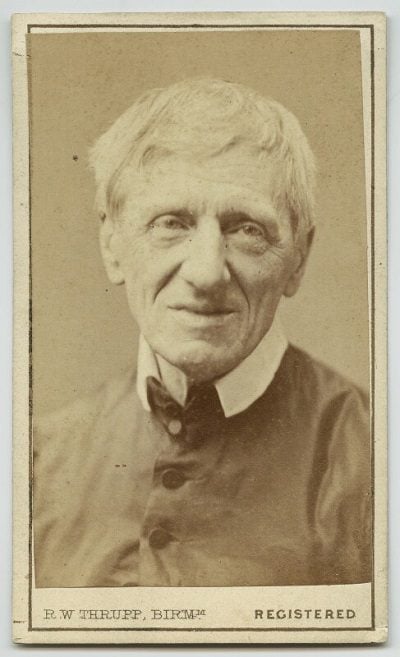
Photo credit: photograph of St. John Henry Cardinal Newman (1801-1890) from 1866, four years before E. B. Pusey’s second long letter to him. [public domain]
Edward Bouverie (E. B.) Pusey (1800-1882) was an English Anglican cleric, professor of Hebrew at Oxford University for more than fifty years, and author of many books. He was a leading figure in the Oxford Movement, along with St. John Henry Cardinal Newman and John Keble, an expert on patristics, and was involved in many theological and academic controversies. Pusey helped revive the doctrine of the Real Presence in the Church of England, and because of several other affinities with Catholic theology and tradition, he and his followers (derisively called “Puseyites”) were mocked by over-anxious adversaries in 1853 as “half papist and half protestant”. But, unlike Newman and like Keble, he never left Anglicanism.
I continue my replies to Pusey by examining a few portions of his Eirenicon, Pt. III, entitled, Is healthful reunion impossible?: a second letter to the Very Rev. J.H. Newman, D. D. (London: Rivingtons, 1870). He described Newman in the beginning of his second volume of three, as his “dearest friend” and a person “whom I still admire as well as love” and he fondly recalled the “sunny memories” of their time together in the Oxford Movement. Pusey’s words will be in blue. All of my replies to Pusey will be collected under the “Anglicanism” section of my Calvinism and General Protestantism web page, under his name. I use RSV for Bible citations.
*****
In principle I agree, that upon any point which a General Council, received by the whole Church, should pronounce to be “de fide,” private judgment is at an end. Private judgment has no place there. It is for the Church to decide upon the evidence, whether from Holy Scripture or from unbroken tradition from the first. She, not individuals, is the judge of that evidence ; for she, not individuals apart from her, has our Lord’s promises. Whatever she should decide, I should not only accept, but it has long been my habit of mind, “implicite” to accept it beforehand. I mean that, while of course I believe all which I know that the Church has defined, I believe, with my inmost will, whatever she holds, whether I know it or no. . . . if the whole Church, including the Greek and Anglican Communions, were to define these or any other points, to be “de fide,” I should hold all further inquiry as to evidence to be at an end. In whatever way they should rule any question, however contrary to my previous impressions, I should submit to it, and hold it, as being, by such universal consent of the whole Church, proved to be part of the Apostles’ faith. I have ever submitted my credenda to a power beyond myself. We have differed, then, and must differ, upon a point of fact— what are the component parts of that Church, whose reception of any doctrine saves us from all further inquiry, and rules that doctrine for us; not as to the principle, whether any such power exists. (pp. 3-4)
In regard to the office of the Church, and the consequent duties of individuals towards her in the abstract, the Council of Trent and the Church of England are, I am persuaded, agreed. Both Churches hold and must hold, what Holy Scripture teaches, that the Church is “the pillar and ground of the truth;” both agree that she has the office to transmit, guard, preach, propagate that God-given truth ; both must hold, that what has once been infallibly fixed cannot receive any additional certainty (since nothing can add to infallibility), and so, that with regard to all which has been fixed by (Ecumenical Councils, the office of the Church is only to transmit and teach it. Later (Ecumenical Councils did not add authority to the earlier, but entered on their office by the confession of what had been laid down by those before them. (pp. 21-22)
The Church, not individuals, must be the judge, whether what she proposes as ” of faith” does rest on that tradition. (p. 23)
This conception of sublime Christian authority is consistent with the Catholic rule of faith, and most emphatically not with sola Scriptura, which denies the infallibility of ecumenical councils. Catholics would disagree, however, with the inclusion of official Anglicanism as a full participant in such a council. There was enough disagreement to preclude such a council in 1870, and there is far more now, as Anglicanism continues to reject apostolic teaching (especially in the area of morals) in several serious ways.
On the crucial question of ” the Invocation of saints,” the Lutheran Abbot of Lokkum [Gerhard Wolter Molanus: 1633-1722] asked . . . for a recognition of the principle, which many of your writers have laid down, that, even when things are asked directly of the saints, nothing more is intended than by the simple “Ora pro nobis” [“pray for us”]. He wished it to be stated, that whatever be the language employed, they are not asked as though it were in their own power to grant any thing, but only to pray our Lord with us, that He would grant it. The Lutheran’s proposition was —
If the Roman Catholics say publicly that they have no other trust toward the saints, than that which they feel towards the living, whose intercessions they implore; that they understand all and each of the prayers directed to them, in what words or forms soever conceived, no otherwise than intercessionally, — as when they say ‘Sancta Maria, libera me in hora mortis’ the meaning is, ‘Holy Mary, intercede for me with thy Son, that He free me in the hour of death,’ — the peril alleged by Protestants as to the Invocation of Saints will cease. If, moreover, the Romans from time to time teach their people that the Invocation of Saints is not simply enjoined, but by the force of the Council of Trent is placed at every one’s choice, whether he would direct his prayers to the saint or to God Himself; that the saints ought not to be invoked rashly and needlessly on every occasion, . . . (pp. 15-16)
This was always the case in Catholic theology — the claim otherwise derived from a miscomprehension of non-literal sorts of language in Catholic descriptions and pious expression, as I have dealt with in previous installments of this series. We have already made this clear “publicly” in the Council of Trent, in its last (25th) session in December 1563, in its Decree, On the Invocation, Veneration, and Relics, of Saints, and On Sacred Images, where it is stated that “the saints, who reign together with Christ, offer up their own prayers to God for men” and that “it is good and useful suppliantly to invoke them, and to have recourse to their prayers, aid, (and) help for obtaining benefits from God, through His Son, Jesus Christ our Lord, who is our alone Redeemer and Saviour.”
None of this remotely teaches or even implies the saints have power in and of themselves to answer prayers. The whole point is that their prayers have more power and efficacy, due to their perfect holiness (Jas 5:16). One wonders, then, “where’s the beef?” Why was Molanus asking a question that had plainly been addressed at Trent? What is there not to understand? Pope Pius IV’s Tridentine Profession of Faith of 13 November 1564 reiterates that the saints in heaven “offer prayers to God for us” (Denzinger #1867; p. 436 in the 2012 43rd edition).
Principles so enunciated would remove most of the objections which lie so deep in the English mind (such, I mean, as are not members of the Roman Church, whether members of the English Church or Dissenters), against the invocation. This would remove what has been the special crux to many of us. (pp. 19-20)
Again, I don’t see how Trent and the Tridentine Profession of Faith were not crystal clear on this point. That’s the magisterium and the “presupposition” for how any writings of Catholic individuals on the topic are to be understood. If we supposedly taught otherwise, then I think Pusey and any other Protestant critic ought to — and would be able to — produce statements along those lines from official sources like popes and ecumenical councils. Instead, typically, we get endless excepts from Liguori’s Glories of Mary, which, as I explained years ago, are habitually taken out of context and presented in a half-truth fashion, ignoring other relevant excepts from the same book that fully explain their meaning. It’s like Protestants who do this are sawing off the limb they are sitting on or creating their own difficulties, where in fact there are none.
*
***
*
Practical Matters: I run the most comprehensive “one-stop” Catholic apologetics site: rated #1 for Christian sites by leading AI tool, ChatGPT — endorsed by popular Protestant blogger Adrian Warnock. Perhaps some of my 5,000+ free online articles or fifty-six books have helped you (by God’s grace) to decide to become Catholic or to return to the Church, or better understand some doctrines and why we believe them. If you believe my full-time apostolate is worth supporting, please seriously consider a much-needed monthly or one-time financial contribution. “The laborer is worthy of his wages” (1 Tim 5:18, NKJV).
*
PayPal donations are the easiest: just send to my email address: [email protected]. Here’s also a second page to get to PayPal. You’ll see the term “Catholic Used Book Service”, which is my old side-business. To learn about the different methods of contributing (including Zelle and 100% tax-deductible donations if desired), see my page: About Catholic Apologist Dave Armstrong / Donation Information.
*
You can support my work a great deal in non-financial ways, if you prefer; by subscribing to, commenting on, liking, and sharing videos from my YouTube channel, Catholic Bible Highlights, where I partner with Kenny Burchard (see my own videos), and/or by signing up to receive notice for new articles on this blog. Just type your email address on the sidebar to the right (scroll down quite a bit), where you see, “Sign Me Up!” Thanks a million!
*
***
*
Photo credit: photograph of St. John Henry Cardinal Newman (1801-1890) from 1866, four years before E. B. Pusey’s second long letter to him. [public domain]
Summary: Reply to a few portions of E. B. Pusey’s Is healthful reunion impossible?: a second letter to the Very Rev. J.H. Newman (1870), dealing mostly with the intercession of the saints.
Calvinism & General Protestantism
Anglicans & intercession of saints
Previous Post
January 28, 2025
John Martignoni: "What the Heck is Papal Indefectibility?"
Next Post
January 29, 2025 Apostolic Tradition: 28 Passages in Paul's Epistles
Recent Comments
"Special pleading, and not a serious response to my arguments . . ."
Is Venerating Men & Angels Worship? ..."
""no man needs to teach us."Didn't you just teach us?"
Is Venerating Men & Angels Worship? ..."
""Catholics say they are the only church that can lead people into heaven."In fact, we ..."
Is Venerating Men & Angels Worship? ..."
"And lastly, I belong to no denomination and am free to serve God as He ..."
Is Venerating Men & Angels Worship? ..."
Browse Our Archives
Select a Category & Last Things About Me Anti-Catholicism Atheism & Agnosticism Baptism and Sacramentalism Bible and Tradition Blessed Virgin Mary Books by Dave Armstrong C. S. Lewis Calvinism & General Protestantism Catholic Apologetics Catholic Apologists Catholic conversion Catholic converts Christmas Church (Ecclesiology) Church History Conversion and Converts Development of Doctrine Eastern Orthodoxy Ecumenism & Christian Unity Eucharist & Liturgy Fathers of the Church French Translations G. K. Chesterton Hell Hell & Satan Hell & Satan & Last Things Heresies & Comparative Religion Holistic Health Inquisition & Crusades & Scandals James White Jews & Judaism & Old Testament John Calvin John Henry Newman Liberal / Modernist Theology Life Issues Literary Resume Lutheranism Mariology Martin Luther Music Orthodoxy Papacy & Infallibility Personal Page Philosophy & Science Political & Ethical & Moral Issues Protestant Persecution & Intolerance Protestantism Purgatory Purgatory & Penance Romantic & Imaginative Theology Saints & Purgatory & Penance Salvation Salvation & Justification Satan & Last Things Sexuality and Gender Issues Spanish Translations Traditionalism vs. Radical Catholic Reactionaries Traducciones al español / tradução para português Trinitarianism & Christology Uncategorized Videos
Select a Month October 2026 September 2026 August 2026 July 2026 June 2026 May 2026 April 2026 March 2026 February 2026 January 2026 December 2025 November 2025 October 2025 September 2025 August 2025 July 2025 June 2025 May 2025 April 2025 March 2025 February 2025 January 2025 December 2024 November 2024 October 2024 September 2024 August 2024 July 2024 June 2024 May 2024 April 2024 March 2024 February 2024 January 2024 December 2023 November 2023 October 2023 September 2023 August 2023 July 2023 June 2023 May 2023 April 2023 March 2023 February 2023 January 2023 December 2022 November 2022 October 2022 September 2022 August 2022 July 2022 June 2022 May 2022 April 2022 March 2022 February 2022 January 2022 December 2021 November 2021 October 2021 September 2021 August 2021 July 2021 June 2021 May 2021 April 2021 March 2021 February 2021 January 2021 December 2020 November 2020 October 2020 September 2020 August 2020 July 2020 June 2020 May 2020 April 2020 March 2020 February 2020 January 2020 December 2019 November 2019 October 2019 September 2019 August 2019 July 2019 June 2019 May 2019 April 2019 March 2019 February 2019 January 2019 December 2018 November 2018 October 2018 September 2018 August 2018 July 2018 June 2018 May 2018 April 2018 March 2018 February 2018 January 2018 December 2017 November 2017 October 2017 September 2017 August 2017 July 2017 June 2017 May 2017 April 2017 March 2017 February 2017 January 2017 December 2016 November 2016 October 2016 September 2016 August 2016 July 2016 June 2016 May 2016 April 2016 March 2016 February 2016 January 2016 December 2015 November 2015 October 2015 September 2015 August 2015 July 2015 June 2015 May 2015 April 2015 March 2015 February 2015 January 2015 December 2014 November 2014 October 2014 September 2014 August 2014 July 2014 June 2014 April 2014 March 2014 February 2014 January 2014 December 2013 November 2013 October 2013 September 2013 August 2013 July 2013 June 2013 April 2013 March 2013 February 2013 January 2013 December 2012 November 2012 October 2012 September 2012 August 2012 July 2012 June 2012 May 2012 April 2012 March 2012 February 2012 January 2012 December 2011 November 2011 October 2011 September 2011 August 2011 July 2011 June 2011 April 2011 March 2011 February 2011 October 2010 September 2010 August 2010 July 2010 April 2010 March 2010 December 2009 October 2009 August 2009 July 2009 June 2009 May 2009 March 2009 February 2009 October 2008 September 2008 April 2008 March 2008 February 2008 January 2008 December 2007 November 2007 October 2007 May 2007 March 2007 February 2007 January 2007 November 2006 October 2006 September 2006 August 2006 July 2006 June 2006 May 2006 April 2006 March 2006 February 2006 October 2005 June 2005 April 2005 February 2005 July 2004 May 2004 April 2004
Follow Us!
TAKE THE
Religious Wisdom Quiz
Who was the tax collector who climbed a tree to see Jesus?
Select your answer to see how you score.
Zacchaeus Nicodemus Philip Matthew
Books by This Author Books by Dave Armstrong
Related posts from Biblical Evidence for Catholicism

On Protestant Explanations of Catholic Conversion
Biblical Evidence for Catholicism

Bible & Catholicism on Mortal Sin (vs. John...
Biblical Evidence for Catholicism

Does Catholic Intercession of Saints Require Omniscience?
Biblical Evidence for Catholicism

Capabilities of Heavenly Saints: Protestant Commentaries
Biblical Evidence for Catholicism
TRENDING AT PATHEOS Catholic

Swimfan: Forgotten Aughts Pleasures
This is a recovery effort. In 2002, My Big Fat Greek Wedding...

Top Three Anti-Catholic Lies About Catholicism
This is my initial transcript for the video, "THE 3 WORST...

Pope Leo Celebrates Mass for Nurses & Docs...
I don't have any idea how he did it, but Pope Leo...

The Sermon on the Mount, Part I: Matthew...
The Sermon on the Mount, Part I (Matthew 4:12-5:12) St. Matthew moves...

What's up from Crossway: Reviewing some of their latest A few weeks...

Janie Learns the Way of the Cross: A...
Teaching children about Jesus' Passion can be challenging. Many parents and educators...
view all Catholic blogs
What Are Your Thoughts?leave a comment
Ad-Free & Subscriber Log-In Subscription Support
- About Us
- 2026 Calendar
- Videos
- Podcasts
- Library of World Religions
- Faith In Media Tracker
- Advertise With Us
- Write for Us
- Privacy Policy
- Terms of Service
- Do Not Sell My Data
- Contact Us
- Radiant Digital
- Manage Newsletter Subscriptions
- Unsubscribe From Notifications
- Sitemap
Copyright 2008-2026, Patheos. All rights reserved.
Subscription Support Ad-Free & Subscriber Log-In
Follow Patheos