
BuddhistCatholicContemplativeEvangelicalGeneral ChristianHinduJewishLatter-day SaintMuslimNew VisionsProgressive Christian
Beliefs
- Buddhist
- Catholic
- Contemplative
- Evangelical
- General Christian
- Hindu
- Jewish
- Latter-day Saint
- More Voices
- Muslim
- New Visions
- Pagan
- Progressive Christian
Topics
- Religion News
- Food and Religion
- Sports and Religion
- Religious Art
- Religious Music and Entertainment
- Religious Events
- History and Religion
- Style and Religion
- Politics and Religion
- Women in Religion
- Recreation Outdoors and Religion
- Business Finance and Religion
- Careers Workplace and Religion
- Education and Religion
- Family Parenting and Religion
- Health Fitness and Religion
- Home and Religion
- Relationships and Religion
- Technology and Religion
- Travel and Religion
Columnists
- Buddhist Columnists
- Business Finance and Religion Columnists
- Careers Workplace and Religion Columnists
- Catholic Columnists
- Contemplative Columnists
- Education and Religion Columnists
- Evangelists Columnists
- Family Parenting and Religion Columnists
- General Christian Columnists
- Health Fitness and Religion Columnists
- Hindu Columnists
- History and Religion Columnists
- Home and Religion Columnists
- Jewish Columnists
- More Voices Columnists
- Latter Day Columnists
- Muslim Columnists
- New Visions Columnists
- Nonreligious Columnists
- Pagan Columnists
- Politics and Religion Columnists
- Progressive Columnists
- Recreation Outdoors and Religion Columnists
- Relationships and Religion Columnists
- Religion News Columnists
- Religious Art Columnists
- Religious Events Columnists
- Religious Music and Entertainment Columnists
- Sports and Religion Columnists
- Style and Religion Columnists
- Technology and Religion Columnists
- Travel and Religion Columnists
- Women in Religion Columnists
Resource Library
- 2026 Calendar
- Library of World Religions
- The 100 Most Holy Places on Earth
- Patheos Answers
- Podcasts
- Videos
- Faith Leaders Database
- Anglican Episcopalian
- Bahai
- Baptist
- Buddhism
- Christianity
- Confucianism
- Eastern Orthodoxy
- Hinduism
- Holiness and Pentecostal
- ISKCON
- Islam
- Judaism
- Lutheran
- Methodist
- The Church of Jesus Christ of Latter-day Saints
- New Age
- Paganism
- Presbytarian and Reformed
- Protestantism
- Religion Behind the Scenes
- Roman Catholic
- Scientology
- Shia Islam
- Sikhism
- Sufism
- Sunni Islam
- Taoism
- Zen
- See all religions
Research Tools
 Ad-Free & Subscriber Log-In Subscription Support
Ad-Free & Subscriber Log-In Subscription Support
Follow Patheos 

- Trending:
- Forgiveness
- |
- Marriage
- |
- Consciousness
- |
- Death Penalty
- |
- Election
- |
- Halloween

-
About
-
Catholic Apologetics
-
Church History
-
Great Apologists
-
Christian Worldview
-
Protestantism & Misc.
- Home
- Catholic
- History and Religion
- Luther & Mary’s Perpetual Virginity: More Context
Luther & Mary’s Perpetual Virginity: More Context
Last updated on: June 6, 2026 at 12:52 am by Dave Armstrong
Luther & Mary’s Perpetual Virginity: More Context 2026-06-06T00:52:32-04:00 Dave Armstrong
Patheos Explore the world's faith through different perspectives on religion and spirituality! Patheos has the views of the prevalent religions and spiritualities of the world.
+ His Belief in Her Virginity During Christ’s Birth (In Partu)
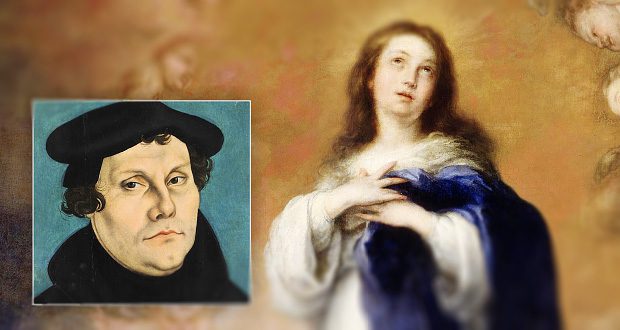
Photo credit: image for my article, “Martin Luther and the ‘Immaculate Purification’ of Mary” (Seton Magazine, 5-6-14)
As anyone who has followed my apologetics career would know, I’ve done a great deal of research on Martin Luther, the founder of Protestantism, including writing a book about him, and editing another consisting of his “traditional” or “Catholic” utterances. In the early 1990s, right after I became a Catholic and immediately launched into Catholic apologetics and study of Luther and the Protestant Revolt, I sought citations of Luther from whatever sources I could find.
In those pre-Internet days, they usually came from Catholic libraries, such as the one at the University of Detroit: a Jesuit school. Most of these dated from before the time that Luther’s works were seriously translated into English (in 1930: six volumes, and 1955: 55 volumes). In due course, I started publishing these online, after I uploaded my website in February 1997.
Because they dated from a time before the English sets of Luther became available, these works cited German editions of Luther, such as the 1883 Weimar set (the “gold standard”). Thus, I couldn’t pursue them further to examine the context of the statements. Since then, of course, many of Luther’s writings have become available online, and even the German versions can be translated with Google Translate. Others have provided lengthy citations from the works in English, which they have in electronic versions (i.e., they can easily cut-and-paste and avoid having to laboriously type out everything).
I don’t have those resources, but I do now possess the entire (originally) 55-volume set, Luther’s Works, which sits on a bookshelf right in my living room. It’s scheduled to be expanded to 82 volumes by 2025. This means that I have sometimes cited statements of Luther that had never been “officially” translated into English until the last fifteen years.
I’d like to first say a word about in partu virginity. “Ever virgin” means conception while remaining a virgin (virgin birth), virginity during childbirth, and perpetual virginity after the birth of Jesus (no siblings of Jesus or sexual activity).The Church has interpreted Mary’s virginity during the birth (in partu) as an inviolability of the hymen; in other words, it was a physically miraculous birth rather than a natural one. Traditionally, virginity literally meant (at least in one of its senses) inviolability of the hymen (more delicately or indirectly expressed as “physical integrity” or “bodily integrity”); not merely the absence of sex.
Mary didn’t suffer pain during childbirth, according to “in partu”. Why mention the “during” part? The miracle is that she was a virgin throughout the whole process of Jesus’ conception and birth, as well as afterwards. This has nothing to do with some silly supposed Catholic animus against sex or old celibate men against women. The entire reason is to reinforce and bolster the miraculous nature of the incarnation.
“In partu” (bodily integrity / physical integrity) is part and parcel of the de fide (highest level) dogma of Mary’s perpetual virginity, and it is binding on all Catholics. It is taught in Denzinger, Enchridion symbolorum: #291, 294, 427, 442, 503, 571, 1880: all of which are cited in the Catechism of the Catholic Church, #499, as is Vatican II, Lumen Gentium, #52, #57.
Some theologians hold that Mary’s in partu virginity is not itself de fide, but rather, is classified as sententia certa: defined by Dr. Ludwig Ott as follows: “A teaching pertaining to the Faith, or a theologically certain teaching (sententia ad fidem pertinens or theologice serta) is a doctrine, on which the Magisterium of the Church has not yet finally pronounced, but whose truth is guaranteed by its intrinsic connection with the doctrine of revelation (theological conclusions).” — Fundamentals of Catholic Dogma (2018 revision by my good friend, Dr. Robert Fastiggi), page 11. As such, it is nevertheless still binding on Catholics. For much more on this topic, word-search the section “Mary’s In Partu Virginity . . .” on my Blessed Virgin Mary web page.
I will present the relevant portions of Luther that address this topic and provide greater context, with the key sections bolded and sometimes also italicized. Luther’s words will be in blue, and excerpts regarding in partu virginity (which he did believe in), in green.
The following citations are from Luther’s treatise, That Jesus Christ Was Born a Jew, May 1523, in Luther’s Works, Vol. 45, 199-229; particular citation page numbers listed below:
A new lie about me is being circulated. I am supposed to have preached and written that Mary, the mother of God, was not a virgin either before or after the birth of Christ, but that she conceived Christ through Joseph, and had more children after that. Above and beyond all this, I am supposed to have preached a new heresy, namely, that Christ was [through Joseph] the seed of Abraham. (p. 199; bracketed comment in the original; from the editors; as throughout)
**
We should be satisfied simply to hold that she remained a virgin after the birth of Christ because Scripture does not state or indicate that she later lost her virginity. . . . the Scripture stops with this, that she was a virgin before and at the birth of Christ; . . . (p. 206)
**
This is the way St. Matthew [1:18] construes this passage when he says, “When Mary the mother of Jesus had been betrothed to Joseph, before they came together she was found to be with child of the Holy Spirit,” etc. What does this mean other than that she was a young maiden who had not yet known a man although she was capable of it, but before she knew the man she was with child, and that this was an amazing thing since no maiden becomes pregnant prior to intercourse with a man? Thus, the evangelist regarded her in the same light as did the prophet, and set her forth as the sign and wonder.
Now this refutes also the false interpretation which some have drawn from the words of Matthew, where he says, “Before they came together she was found to be with child.” They interpret this as though the evangelist meant to say, “Later she came together with Joseph like any other wife and lay with him, but before this occurred she was with child apart from Joseph,” etc. Again, when he says, “And Joseph knew her not until she brought forth her first-born son” [Matt. 1:25], they interpret it as though the evangelist meant to say that he knew her, but not before she had brought forth her first-born son. This was the view of Helvidius which was refuted by Jerome.
Such carnal interpretations miss the meaning and purpose of the evangelist. (pp. 210-211)
**
The words of the evangelist do not refer to anything that occurred after the birth, but only to what took place before it. . . . Therefore, one cannot from these words [Matt. 1:18, 25] conclude that Mary, after the birth of Christ, became a wife in the usual sense; it is therefore neither to be asserted nor believed. All the words are merely indicative of the marvelous fact that she was with child and gave birth before she had lain with a man. (p. 212)
The form of expression used by Matthew is the common idiom, as if I were to say, “Pharaoh believed not Moses, until he was drowned in the Red Sea.” Here it does not follow that Pharaoh believed later, after he had drowned; on the contrary, it means that he never did believe. Similarly when Matthew [1:25] says that Joseph did not know Mary carnally until she had brought forth her son, it does not follow that he knew her subsequently; on the contrary, it means that he never did know her. Again, the Red Sea overwhelmed Pharaoh before he got across. Here too it does not follow that Pharaoh got across later, after the Red Sea had overwhelmed him, but rather that he did not get across at all. In like manner, when Matthew [1:18] says, “She was found to be with child before they came together,” it does not follow that Mary subsequently lay with Joseph, but rather that she did not lie with him. . . .
There are many more similar expressions, so that this babble of Helvidius is without justification; in addition, he has neither noticed nor paid any attention to either Scripture or the common idiom. (pp. 212-213)
**
Here are additional proofs that Luther believed in Mary’s virginity in partu, or during the birth of Jesus Christ:
She brought forth without sin, without shame, without pain and without injury, just as she had conceived without sin. The curse of Eve did not come on her, where God said: “In pain thou shalt bring forth children,” Gen. 3:16; otherwise it was with her in every particular as with every woman who gives birth to a child. (Sermon for Christmas Eve; Luke 2:1-14, translated by George H. Trabert, 24 December 1521; in Vol. 1 of Sermons of Martin Luther, The Church Postils; edited and partially translated by John Nicholas Lenker, 8 volumes. Volumes 1-5 were originally published in Minneapolis by Lutherans of All Lands, 1904-1906)
**
He was born of the immaculate Virgin Mary, without changing her physical and spiritual virginity, . . . (Personal Prayer Book, 1522, in Luther’s Works, Vol. 43, pp. 26-27)
She gave birth without labor, pain, and injury to herself, not as Eve and all other women, but because by the Holy Spirit and without sin, she became fertile, conceived, and gave birth in a way granted to no other woman. (Ibid., p. 40)
**
In chapter 7 he even describes the mother of Christ, the Virgin Mary, how she is to conceive and bear him with her virginity intact. (Preface to the Prophet Isaiah, 1528, in Luther’s Works, v. 35, p. 275)
**
Even the hyper-biased anti-Catholic Reformed Protestant James Swan concedes that Luther believed in Mary’s virginity in partu:
Yes, it’s true Luther adhered to Mary’s perpetual virginity, . . .
He held Mary retained her virginity during the birth of Christ (in partu) (LW 58:433-434). How was this possible? Luther held that Christ has a “spiritual mode” “to which he neither occupies nor yields space but passes through everything created as he wills,” including his mother (LW 37:222). (“Luther Believed in Mary’s Perpetual Virginity?“, Boors All, 4-20-20)
Related Reading
Luther & Mary’s Virginity During Childbirth (The Miraculous Birth of Jesus [“in Partu”] Without Pain) [10-12-11; additions on 9-19-15]
Martin Luther’s Belief in the Perpetual Virginity of Mary [9-23-14]
Luther & Mary’s Virginity [4-22-20]
Martin Luther: Mary Was a Perpetual Virgin [6-10-24]
*
***
*
Practical Matters: I run the most comprehensive “one-stop” Catholic apologetics site: rated #1 for Christian sites by leading AI tool, ChatGPT — endorsed by popular Protestant blogger Adrian Warnock. Perhaps some of my 5,000+ free online articles or fifty-six books have helped you (by God’s grace) to decide to become Catholic or to return to the Church, or better understand some doctrines and why we believe them.
*
Or you may believe my work is worthy to support for the purpose of apologetics and evangelism in general. If so, please seriously consider a much-needed financial contribution. I’m always in need of more funds: especially monthly support. “The laborer is worthy of his wages” (1 Tim 5:18, NKJV). 1 December 2021 was my 20th anniversary as a full-time Catholic apologist, and February 2022 marked the 25th anniversary of my blog.
*
PayPal donations are the easiest: just send to my email address: [email protected]. Here’s also a second page to get to PayPal. You’ll see the term “Catholic Used Book Service”, which is my old side-business. To learn about the different methods of contributing (including Zelle), see my page: About Catholic Apologist Dave Armstrong / Donation Information. Thanks a million from the bottom of my heart!
*
***
*
Photo credit: image for my article, “Martin Luther and the ‘Immaculate Purification’ of Mary” (Seton Magazine, 5-6-14)
Summary: I provide more context regarding one of Protestant founder Martin Luther’s affirmations of Mary’s perpetual virginity. I also document his belief in her “in partu” virginity.
Luther & perpetual virginity of Mary
Mary's virginity during childbirth
Previous Post

December 16, 2024
Transformation of Believers in the NT: 150 Passages
Next Post

December 19, 2024 Baptismal Regeneration: Refuting Jason Engwer's Attacks
Recent Comments
"Special pleading, and not a serious response to my arguments . . ."
Is Venerating Men & Angels Worship? ..."
""no man needs to teach us."Didn't you just teach us?"
Is Venerating Men & Angels Worship? ..."
""Catholics say they are the only church that can lead people into heaven."In fact, we ..."
Is Venerating Men & Angels Worship? ..."
"And lastly, I belong to no denomination and am free to serve God as He ..."
Is Venerating Men & Angels Worship? ..."
Browse Our Archives
Select a Category & Last Things About Me Anti-Catholicism Atheism & Agnosticism Baptism and Sacramentalism Bible and Tradition Blessed Virgin Mary Books by Dave Armstrong C. S. Lewis Calvinism & General Protestantism Catholic Apologetics Catholic Apologists Catholic conversion Catholic converts Christmas Church (Ecclesiology) Church History Conversion and Converts Development of Doctrine Eastern Orthodoxy Ecumenism & Christian Unity Eucharist & Liturgy Fathers of the Church French Translations G. K. Chesterton Hell Hell & Satan Hell & Satan & Last Things Heresies & Comparative Religion Holistic Health Inquisition & Crusades & Scandals James White Jews & Judaism & Old Testament John Calvin John Henry Newman Liberal / Modernist Theology Life Issues Literary Resume Lutheranism Mariology Martin Luther Music Orthodoxy Papacy & Infallibility Personal Page Philosophy & Science Political & Ethical & Moral Issues Protestant Persecution & Intolerance Protestantism Purgatory Purgatory & Penance Romantic & Imaginative Theology Saints & Purgatory & Penance Salvation Salvation & Justification Satan & Last Things Sexuality and Gender Issues Spanish Translations Traditionalism vs. Radical Catholic Reactionaries Traducciones al español / tradução para português Trinitarianism & Christology Uncategorized Videos
Select a Month October 2026 September 2026 August 2026 July 2026 June 2026 May 2026 April 2026 March 2026 February 2026 January 2026 December 2025 November 2025 October 2025 September 2025 August 2025 July 2025 June 2025 May 2025 April 2025 March 2025 February 2025 January 2025 December 2024 November 2024 October 2024 September 2024 August 2024 July 2024 June 2024 May 2024 April 2024 March 2024 February 2024 January 2024 December 2023 November 2023 October 2023 September 2023 August 2023 July 2023 June 2023 May 2023 April 2023 March 2023 February 2023 January 2023 December 2022 November 2022 October 2022 September 2022 August 2022 July 2022 June 2022 May 2022 April 2022 March 2022 February 2022 January 2022 December 2021 November 2021 October 2021 September 2021 August 2021 July 2021 June 2021 May 2021 April 2021 March 2021 February 2021 January 2021 December 2020 November 2020 October 2020 September 2020 August 2020 July 2020 June 2020 May 2020 April 2020 March 2020 February 2020 January 2020 December 2019 November 2019 October 2019 September 2019 August 2019 July 2019 June 2019 May 2019 April 2019 March 2019 February 2019 January 2019 December 2018 November 2018 October 2018 September 2018 August 2018 July 2018 June 2018 May 2018 April 2018 March 2018 February 2018 January 2018 December 2017 November 2017 October 2017 September 2017 August 2017 July 2017 June 2017 May 2017 April 2017 March 2017 February 2017 January 2017 December 2016 November 2016 October 2016 September 2016 August 2016 July 2016 June 2016 May 2016 April 2016 March 2016 February 2016 January 2016 December 2015 November 2015 October 2015 September 2015 August 2015 July 2015 June 2015 May 2015 April 2015 March 2015 February 2015 January 2015 December 2014 November 2014 October 2014 September 2014 August 2014 July 2014 June 2014 April 2014 March 2014 February 2014 January 2014 December 2013 November 2013 October 2013 September 2013 August 2013 July 2013 June 2013 April 2013 March 2013 February 2013 January 2013 December 2012 November 2012 October 2012 September 2012 August 2012 July 2012 June 2012 May 2012 April 2012 March 2012 February 2012 January 2012 December 2011 November 2011 October 2011 September 2011 August 2011 July 2011 June 2011 April 2011 March 2011 February 2011 October 2010 September 2010 August 2010 July 2010 April 2010 March 2010 December 2009 October 2009 August 2009 July 2009 June 2009 May 2009 March 2009 February 2009 October 2008 September 2008 April 2008 March 2008 February 2008 January 2008 December 2007 November 2007 October 2007 May 2007 March 2007 February 2007 January 2007 November 2006 October 2006 September 2006 August 2006 July 2006 June 2006 May 2006 April 2006 March 2006 February 2006 October 2005 June 2005 April 2005 February 2005 July 2004 May 2004 April 2004
Follow Us!
TAKE THE
Religious Wisdom Quiz
How did the apostles choose Matthias to replace Judas?
Select your answer to see how you score.
By the Holy Spirit By Vote They cast lots Peter appointed him
Books by This Author Books by Dave Armstrong
Related posts from Biblical Evidence for Catholicism

Holy Ground: Why Mary Had NO Other Children...
Biblical Evidence for Catholicism
Protestant Confessions & "Ever-Virgin" Mary
Biblical Evidence for Catholicism

Mary Wife of Clopas (Jn 19:25): Mary's Sister-in-Law?
Biblical Evidence for Catholicism

Jesus Had Four Brothers? The Bible Sez No!
Biblical Evidence for Catholicism
TRENDING AT PATHEOS Catholic

In one sense walking into Westminster Abbey is like walking down the...

'Super Scam Me' Exposes AI Jon Bon Jovi...
Leslie Pickett believed she was in a relationship with Jon Bon Jovi....

The Brazilian Remake of Kendricks' 'Flywheel' Opens in...
“Flywheel,” the story that launched the Kendrick Brothers’ filmmaking career is getting...

The Dangers of Gradual Accommodation (Winking at Sin)
Recently, the “law of gradualness” resurfaced during the opening of a weeklong,...

The Iron Gates and the Lion of the...
Yesterday, I didn't finish my report about, well, yesterday. So I'll...

The Image: On the Horror of Capitalism and...
The Image Then went the Pharisees, and took counsel how they might...
view all Catholic blogs
What Are Your Thoughts?leave a comment
Ad-Free & Subscriber Log-In Subscription Support
- About Us
- 2026 Calendar
- Videos
- Podcasts
- Library of World Religions
- Faith In Media Tracker
- Advertise With Us
- Write for Us
- Privacy Policy
- Terms of Service
- Do Not Sell My Data
- Contact Us
- Radiant Digital
- Manage Newsletter Subscriptions
- Unsubscribe From Notifications
- Sitemap
Copyright 2008-2026, Patheos. All rights reserved.
Subscription Support Ad-Free & Subscriber Log-In
Follow Patheos