
BuddhistCatholicContemplativeEvangelicalGeneral ChristianHinduJewishLatter-day SaintMuslimNew VisionsProgressive Christian
Beliefs
- Buddhist
- Catholic
- Contemplative
- Evangelical
- General Christian
- Hindu
- Jewish
- Latter-day Saint
- More Voices
- Muslim
- New Visions
- Pagan
- Progressive Christian
Topics
- Religion News
- Food and Religion
- Sports and Religion
- Religious Art
- Religious Music and Entertainment
- Religious Events
- History and Religion
- Style and Religion
- Politics and Religion
- Women in Religion
- Recreation Outdoors and Religion
- Business Finance and Religion
- Careers Workplace and Religion
- Education and Religion
- Family Parenting and Religion
- Health Fitness and Religion
- Home and Religion
- Relationships and Religion
- Technology and Religion
- Travel and Religion
Columnists
- Buddhist Columnists
- Business Finance and Religion Columnists
- Careers Workplace and Religion Columnists
- Catholic Columnists
- Contemplative Columnists
- Education and Religion Columnists
- Evangelists Columnists
- Family Parenting and Religion Columnists
- General Christian Columnists
- Health Fitness and Religion Columnists
- Hindu Columnists
- History and Religion Columnists
- Home and Religion Columnists
- Jewish Columnists
- More Voices Columnists
- Latter Day Columnists
- Muslim Columnists
- New Visions Columnists
- Nonreligious Columnists
- Pagan Columnists
- Politics and Religion Columnists
- Progressive Columnists
- Recreation Outdoors and Religion Columnists
- Relationships and Religion Columnists
- Religion News Columnists
- Religious Art Columnists
- Religious Events Columnists
- Religious Music and Entertainment Columnists
- Sports and Religion Columnists
- Style and Religion Columnists
- Technology and Religion Columnists
- Travel and Religion Columnists
- Women in Religion Columnists
Resource Library
- 2026 Calendar
- Library of World Religions
- The 100 Most Holy Places on Earth
- Patheos Answers
- Podcasts
- Videos
- Faith Leaders Database
- Anglican Episcopalian
- Bahai
- Baptist
- Buddhism
- Christianity
- Confucianism
- Eastern Orthodoxy
- Hinduism
- Holiness and Pentecostal
- ISKCON
- Islam
- Judaism
- Lutheran
- Methodist
- The Church of Jesus Christ of Latter-day Saints
- New Age
- Paganism
- Presbytarian and Reformed
- Protestantism
- Religion Behind the Scenes
- Roman Catholic
- Scientology
- Shia Islam
- Sikhism
- Sufism
- Sunni Islam
- Taoism
- Zen
- See all religions
Research Tools
 Ad-Free & Subscriber Log-In Subscription Support
Ad-Free & Subscriber Log-In Subscription Support
Follow Patheos 

- Trending:
- Forgiveness
- |
- Marriage
- |
- Consciousness
- |
- Death Penalty
- |
- Election
- |
- Halloween

-
About
-
Catholic Apologetics
-
Church History
-
Great Apologists
-
Christian Worldview
-
Protestantism & Misc.
- Home
- Catholic
- History and Religion
- Perfectly Keeping the Law: 15 Bible Passages
Perfectly Keeping the Law: 15 Bible Passages
Last updated on: January 13, 2025 at 6:26 pm by Dave Armstrong
Perfectly Keeping the Law: 15 Bible Passages 2025-01-13T18:26:24-04:00 Dave Armstrong
Patheos Explore the world's faith through different perspectives on religion and spirituality! Patheos has the views of the prevalent religions and spiritualities of the world.
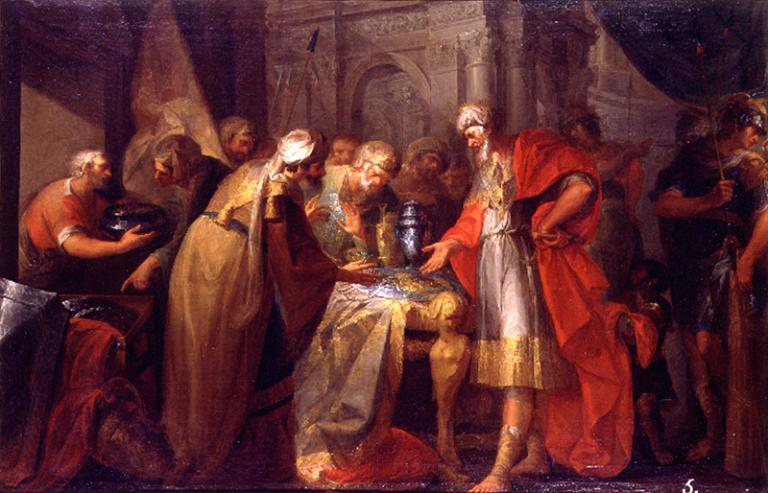
Photo credit: Hezekiah showing off his wealth to envoys of the Babylonian king (1789) by Vicente López Portaña [public domain / Wikimedia Commons]
This is a common “slogan” among Protestants, in attempting to make the point that we are all totally depraved (what Calvinists believe), or fallen to such an extent that we can never even possibly rise above sin. Catholics already agree that no one can save themselves (over against the heresy of Pelagianism). What I’m particularly referring to, however, is the notion that no one ever has, or could, perfectly keep the Mosaic law (with its 613 commandments). Protestants then go on to say that this was why we needed grace. Again, Catholics already agree with that broad statement; we totally concur that salvation ultimately comes by God’s grace alone. It’s not a disagreement between us, and never has been. Whoever thinks it is, is ignorant of the matter.
Protestants will often cite James 2:10 (I use RSV) in this regard: “whoever keeps the whole law but fails in one point has become guilty of all of it” (cf. Gal 3:10). Looked at closely, that’s not asserting in the first place that no one can ever perfectly keep the law. It’s saying, rather, that failing in one point is the same as failing in all. That’s a different thing than saying that no one can possibly keep the whole law and avoid violating it in some way. The Protestant simply assumes from the outset without argument that no one can do it, which is invalid circular reasoning.
***
“Please Hit ‘Subscribe’”! If you have received benefit from this or any of my other 5,000+ articles, please follow my blog by signing up (with your email address) on the sidebar to the right (you may have to scroll down a bit), above where there is an icon bar, “Sign Me Up!”: to receive notice when I post a new blog article. This is the equivalent of subscribing to a YouTube channel. My blog was rated #1 for Christian sites by leading AI tool, ChatGPT: endorsed by influential Protestant blogger Adrian Warnock. Actually, I partner with Kenny Burchard on the YouTube channel, Catholic Bible Highlights. Please subscribe there, too! Please also consider following me on Twitter / X and purchasing one or more of my 55 books. All of this helps me get more exposure, and (however little!) more income for my full-time apologetics work. Thanks so much and happy reading!
***
Monergism.com is a Calvinist site. On it, I found the article, “Of Man’s Inability to Keep the Law Perfectly” (from the book, The Ten Commandments), written by a Scottish Presbyterian theologian, Thomas Boston (1676-1732), who wrote:
. . . the absolute impossibility of yielding a perfect obedience thereto . . .
There is not a just man upon earth. By the just man in this text is not meant an evangelically just man, or one just in respect of parts, though not of degrees; but one who is legally so, just in the eye of the law, as having yielded perfect obedience to all its commands . . .
There can be no perfect keeping of the commands of God . . .
Since Adam fell, no mere man is able, while in this life, either of himself, or by virtue of any grace now given, to keep the commands perfectly. Of himself he cannot do it; neither is there any measure of grace given to any in this life, whereby they may be enabled to do it . . . And there is no promise of grace given in the word, whereby believers may be enabled to keep the commands of God perfectly . . .
How about looking to see what the Bible actually teaches on the topic, since James 2:10 doesn’t claim what it is purported and casually assumed to have asserted. The Psalmist assumes that it’s possible:
Psalm 119:1 Blessed are those whose way is blameless, who walk in the law of the LORD!
Psalm 119:80 May my heart be blameless in thy statutes, that I may not be put to shame!
St. Luke, writing in his inspired Gospel, makes the same point about Zechariah and Elizabeth, the parents of John the Baptist (see Lk 1:5):
Luke 1:6 And they were both righteous before God, walking in all the commandments and ordinances of the Lord blameless.
There it is, folks: plain as day. Protestants who deny this are wrong, and we know that they are because it says so in God’s inerrant and inspired revelation. It’s always better to follow that, than the mere traditions of men, dreamt up in the 16th century, to counter received Catholic tradition. Not only this; we also have the corroborating testimony of no less than the great St. Paul:
Philippians 3:4-6 Though I myself have reason for confidence in the flesh also. If any other man thinks he has reason for confidence in the flesh, I have more: [5] circumcised on the eighth day, of the people of Israel, of the tribe of Benjamin, a Hebrew born of Hebrews; as to the law a Pharisee, [6] as to zeal a persecutor of the church, as to righteousness under the law blameless. (cf. Gal 1:14: “I advanced in Judaism beyond many of my own age among my people, so extremely zealous was I for the traditions of my fathers.”)
Maybe someone at this point wants to quibble about the meaning of the Greek word translated “blameless”? Okay, let’s have that discussion. It’s the same word in both Luke 1:6 and Philippians 3:6: amemptos (ἄμεμπτος): Strong’s Greek word #273. Strong’s Lexicon on this same page defines it as:
a state of being without fault or blame. It conveys the idea of moral integrity and uprightness, often in the context of one’s conduct before God and others. In the New Testament, it is used to describe individuals who live in a manner that is above reproach, adhering to God’s commandments and maintaining a pure and righteous lifestyle.
Thayer’s Greek Lexicon gives the meaning for these two passage as “blameless, deserving no censure . . . free from fault or defect.” Baptist Greek linguist A. T. Robertson in his Word Pictures in the New Testament, commenting on Philippians 3:6, states that it indicates that Paul “knew and practised all the rules of the rabbis. A marvellous record, scoring a hundred in Judaism.” So he kept all the laws!
God the Father is repeatedly presented in the Bible as assuming that His people were capable of keeping His laws and (synonyms) statutes and ordinances and covenant and His commandments: given to Moses on Mt. Sinai. Otherwise, it was all a big farce: He commanded them to do something that He knew all along was impossible.
To the contrary, the Psalmist did it:
Psalm 119:56 . . . I have kept thy precepts.
Psalm 119:67 . . . now I keep thy word.
Psalm 119:69 . . . with my whole heart I keep thy precepts
Psalm 119:100 . . . I keep thy precepts.
Psalm 119:168 I keep thy precepts and testimonies, for all my ways are before thee. (he also verifies that others are doing so: Ps 119:63: “I am a companion of all who fear thee, of those who keep thy precepts.”)
So did King David, according to God:
1 Kings 11:34 . . . David my servant whom I chose, who kept my commandments and my statutes;
1 Kings 14:8 . . . you have not been like my servant David, who kept my commandments, and followed me with all his heart, doing only that which was right in my eyes,
So did Moses, Aaron, and Samuel (see Ps 99:6):
Psalm 99:7 . . . they kept his testimonies, and the statutes that he gave them.
The children of Levi did:
Deuteronomy 33:9 . . . they observed thy word, and kept thy covenant. (see 33:8-9a)
So did King Hezekiah:
2 Kings 18:3, 5-7 And he did what was right in the eyes of the LORD, according to all that David his father had done. . . . [5] He trusted in the LORD the God of Israel; so that there was none like him among all the kings of Judah after him, nor among those who were before him. [6] For he held fast to the LORD; he did not depart from following him, but kept the commandments which the LORD commanded Moses. [7] And the LORD was with him; wherever he went forth, he prospered.
Also, it should be noted that the New Testament states three times that one can entirely keep the Law simply by loving neighbors:
Romans 13:8-10 Owe no one anything, except to love one another; for he who loves his neighbor has fulfilled the law. [9] The commandments, “You shall not commit adultery, You shall not kill, You shall not steal, You shall not covet,” and any other commandment, are summed up in this sentence, “You shall love your neighbor as yourself.” [Lev 19:18] [10] Love does no wrong to a neighbor; therefore love is the fulfilling of the law.
Galatians 5:13-14 For you were called to freedom, brethren; only do not use your freedom as an opportunity for the flesh, but through love be servants of one another. [14] For the whole law is fulfilled in one word, “You shall love your neighbor as yourself.”
James 2:8-9 If you really fulfil the royal law, according to the scripture, “You shall love your neighbor as yourself,” you do well. [9] But if you show partiality, you commit sin, and are convicted by the law as transgressors.
If we need a model of how to love, Jesus says that He Himself is the example:
John 13:34 A new commandment I give to you, that you love one another; even as I have loved you, that you also love one another.
John 15:9-10, 12-13, 17 As the Father has loved me, so have I loved you; abide in my love. [10] If you keep my commandments, you will abide in my love, just as I have kept my Father’s commandments and abide in his love. . . . [12] “This is my commandment, that you love one another as I have loved you. [13] Greater love has no man than this, that a man lay down his life for his friends. . . . [17] This I command you, to love one another.
St. John reiterates all of this in his first two epistles:
1 John 3:11, 23 For this is the message which you have heard from the beginning, that we should love one another, . . . [23] And this is his commandment, that we should believe in the name of his Son Jesus Christ and love one another, just as he has commanded us.
1 John 4:11-12 Beloved, if God so loved us, we also ought to love one another. [12] No man has ever seen God; if we love one another, God abides in us and his love is perfected in us.
2 John 1:5 And now I beg you, lady, not as though I were writing you a new commandment, but the one we have had from the beginning, that we love one another.
So the next time you hear this claim that no one could possibly keep the law and God’s commandments and precepts, show them this, and point out that St. Paul, Zechariah and Elizabeth, the Psalmist, King David, Moses, Aaron, Samuel, the children of Levi, and King Hezekiah, and anyone who truly loves their neighbor all did — according to Holy Scripture — that which Protestants are trying to tell us that supposedly no one can do and no one ever did. Make your choice today: God’s inspired, inerrant revelation or false traditions of men concocted fifteen centuries after Christ.
*
***
*
Practical Matters: I run the most comprehensive “one-stop” Catholic apologetics site: rated #1 for Christian sites by leading AI tool, ChatGPT — endorsed by popular Protestant blogger Adrian Warnock. Perhaps some of my 5,000+ free online articles or fifty-six books have helped you (by God’s grace) to decide to become Catholic or to return to the Church, or better understand some doctrines and why we believe them.
*
Or you may believe my work is worthy to support for the purpose of apologetics and evangelism in general. If so, please seriously consider a much-needed financial contribution. I’m always in need of more funds: especially monthly support. “The laborer is worthy of his wages” (1 Tim 5:18, NKJV). 1 December 2021 was my 20th anniversary as a full-time Catholic apologist, and February 2022 marked the 25th anniversary of my blog.
*
PayPal donations are the easiest: just send to my email address: [email protected]. Here’s also a second page to get to PayPal. You’ll see the term “Catholic Used Book Service”, which is my old side-business. To learn about the different methods of contributing (including Zelle), see my page: About Catholic Apologist Dave Armstrong / Donation Information. Thanks a million from the bottom of my heart!
*
***
*
Photo credit: Hezekiah showing off his wealth to envoys of the Babylonian king (1789) by Vicente López Portaña [public domain / Wikimedia Commons]

Summary: St. Paul, Zechariah and Elizabeth, King David, Moses, Aaron, Samuel, and King Hezekiah all perfectly followed God’s laws, which Protestants tell us no one ever did or could do.
Previous Post

December 10, 2024
Doctrinal Development: 80 Bible Passages
Next Post
December 12, 2024 "Blameless" & "Pure" in the Bible (Sinless?): 40 Passages
Recent Comments
"Special pleading, and not a serious response to my arguments . . ."
Is Venerating Men & Angels Worship? ..."
""no man needs to teach us."Didn't you just teach us?"
Is Venerating Men & Angels Worship? ..."
""Catholics say they are the only church that can lead people into heaven."In fact, we ..."
Is Venerating Men & Angels Worship? ..."
"And lastly, I belong to no denomination and am free to serve God as He ..."
Is Venerating Men & Angels Worship? ..."
Browse Our Archives
Select a Category & Last Things About Me Anti-Catholicism Atheism & Agnosticism Baptism and Sacramentalism Bible and Tradition Blessed Virgin Mary Books by Dave Armstrong C. S. Lewis Calvinism & General Protestantism Catholic Apologetics Catholic Apologists Catholic conversion Catholic converts Christmas Church (Ecclesiology) Church History Conversion and Converts Development of Doctrine Eastern Orthodoxy Ecumenism & Christian Unity Eucharist & Liturgy Fathers of the Church French Translations G. K. Chesterton Hell Hell & Satan Hell & Satan & Last Things Heresies & Comparative Religion Holistic Health Inquisition & Crusades & Scandals James White Jews & Judaism & Old Testament John Calvin John Henry Newman Liberal / Modernist Theology Life Issues Literary Resume Lutheranism Mariology Martin Luther Music Orthodoxy Papacy & Infallibility Personal Page Philosophy & Science Political & Ethical & Moral Issues Protestant Persecution & Intolerance Protestantism Purgatory Purgatory & Penance Romantic & Imaginative Theology Saints & Purgatory & Penance Salvation Salvation & Justification Satan & Last Things Sexuality and Gender Issues Spanish Translations Traditionalism vs. Radical Catholic Reactionaries Traducciones al español / tradução para português Trinitarianism & Christology Uncategorized Videos
Select a Month October 2026 September 2026 August 2026 July 2026 June 2026 May 2026 April 2026 March 2026 February 2026 January 2026 December 2025 November 2025 October 2025 September 2025 August 2025 July 2025 June 2025 May 2025 April 2025 March 2025 February 2025 January 2025 December 2024 November 2024 October 2024 September 2024 August 2024 July 2024 June 2024 May 2024 April 2024 March 2024 February 2024 January 2024 December 2023 November 2023 October 2023 September 2023 August 2023 July 2023 June 2023 May 2023 April 2023 March 2023 February 2023 January 2023 December 2022 November 2022 October 2022 September 2022 August 2022 July 2022 June 2022 May 2022 April 2022 March 2022 February 2022 January 2022 December 2021 November 2021 October 2021 September 2021 August 2021 July 2021 June 2021 May 2021 April 2021 March 2021 February 2021 January 2021 December 2020 November 2020 October 2020 September 2020 August 2020 July 2020 June 2020 May 2020 April 2020 March 2020 February 2020 January 2020 December 2019 November 2019 October 2019 September 2019 August 2019 July 2019 June 2019 May 2019 April 2019 March 2019 February 2019 January 2019 December 2018 November 2018 October 2018 September 2018 August 2018 July 2018 June 2018 May 2018 April 2018 March 2018 February 2018 January 2018 December 2017 November 2017 October 2017 September 2017 August 2017 July 2017 June 2017 May 2017 April 2017 March 2017 February 2017 January 2017 December 2016 November 2016 October 2016 September 2016 August 2016 July 2016 June 2016 May 2016 April 2016 March 2016 February 2016 January 2016 December 2015 November 2015 October 2015 September 2015 August 2015 July 2015 June 2015 May 2015 April 2015 March 2015 February 2015 January 2015 December 2014 November 2014 October 2014 September 2014 August 2014 July 2014 June 2014 April 2014 March 2014 February 2014 January 2014 December 2013 November 2013 October 2013 September 2013 August 2013 July 2013 June 2013 April 2013 March 2013 February 2013 January 2013 December 2012 November 2012 October 2012 September 2012 August 2012 July 2012 June 2012 May 2012 April 2012 March 2012 February 2012 January 2012 December 2011 November 2011 October 2011 September 2011 August 2011 July 2011 June 2011 April 2011 March 2011 February 2011 October 2010 September 2010 August 2010 July 2010 April 2010 March 2010 December 2009 October 2009 August 2009 July 2009 June 2009 May 2009 March 2009 February 2009 October 2008 September 2008 April 2008 March 2008 February 2008 January 2008 December 2007 November 2007 October 2007 May 2007 March 2007 February 2007 January 2007 November 2006 October 2006 September 2006 August 2006 July 2006 June 2006 May 2006 April 2006 March 2006 February 2006 October 2005 June 2005 April 2005 February 2005 July 2004 May 2004 April 2004
Follow Us!
TAKE THE
Religious Wisdom Quiz
True or False: Hebrews teaches that the blood of bulls and goats can take away sins.
Select your answer to see how you score.
FALSE TRUE
Books by This Author Books by Dave Armstrong
Related posts from Biblical Evidence for Catholicism

Bible & Catholicism on Mortal Sin (vs. John...
Biblical Evidence for Catholicism

Dialogue on Eternal Security / Absolute Assurance
Biblical Evidence for Catholicism

"Faith Alone" Dialogue with a Calvinist
Biblical Evidence for Catholicism

Exegesis of 75 NT Faith [Alone?] & Works...
Biblical Evidence for Catholicism
TRENDING AT PATHEOS Catholic

57th Dove Awards Honor Dolly Parton, Crown New...
On gospel music’s biggest night, the 57th annual GMA Dove Awards honored...

The First Eucharistic Controversy: Christ’s Real Presence
For Catholics, the Eucharist is the source and summit of the Christian...

What a Stop Sign Can Teach Us About...
How to Make a Decision When You Can't Hear God Main point:...

Archdiocese Hosts Military Marriage Retreat in Germany
RASTATT, Germany — The transient military lifestyle, with its frequent deployments and...

Nearly every morning, I make the drive to Detroit with my high-school-age...

The Real AI Story Is Adoption Without Trust
Artificial intelligence has crossed a political threshold. It is no longer a...
view all Catholic blogs
What Are Your Thoughts?leave a comment
Ad-Free & Subscriber Log-In Subscription Support
- About Us
- 2026 Calendar
- Videos
- Podcasts
- Library of World Religions
- Faith In Media Tracker
- Advertise With Us
- Write for Us
- Privacy Policy
- Terms of Service
- Do Not Sell My Data
- Contact Us
- Radiant Digital
- Manage Newsletter Subscriptions
- Unsubscribe From Notifications
- Sitemap
Copyright 2008-2026, Patheos. All rights reserved.
Subscription Support Ad-Free & Subscriber Log-In
Follow Patheos