
BuddhistCatholicContemplativeEvangelicalGeneral ChristianHinduJewishLatter-day SaintMuslimNew VisionsProgressive Christian
Beliefs
- Buddhist
- Catholic
- Contemplative
- Evangelical
- General Christian
- Hindu
- Jewish
- Latter-day Saint
- More Voices
- Muslim
- New Visions
- Pagan
- Progressive Christian
Topics
- Religion News
- Food and Religion
- Sports and Religion
- Religious Art
- Religious Music and Entertainment
- Religious Events
- History and Religion
- Style and Religion
- Politics and Religion
- Women in Religion
- Recreation Outdoors and Religion
- Business Finance and Religion
- Careers Workplace and Religion
- Education and Religion
- Family Parenting and Religion
- Health Fitness and Religion
- Home and Religion
- Relationships and Religion
- Technology and Religion
- Travel and Religion
Columnists
- Buddhist Columnists
- Business Finance and Religion Columnists
- Careers Workplace and Religion Columnists
- Catholic Columnists
- Contemplative Columnists
- Education and Religion Columnists
- Evangelists Columnists
- Family Parenting and Religion Columnists
- General Christian Columnists
- Health Fitness and Religion Columnists
- Hindu Columnists
- History and Religion Columnists
- Home and Religion Columnists
- Jewish Columnists
- More Voices Columnists
- Latter Day Columnists
- Muslim Columnists
- New Visions Columnists
- Nonreligious Columnists
- Pagan Columnists
- Politics and Religion Columnists
- Progressive Columnists
- Recreation Outdoors and Religion Columnists
- Relationships and Religion Columnists
- Religion News Columnists
- Religious Art Columnists
- Religious Events Columnists
- Religious Music and Entertainment Columnists
- Sports and Religion Columnists
- Style and Religion Columnists
- Technology and Religion Columnists
- Travel and Religion Columnists
- Women in Religion Columnists
Resource Library
- 2026 Calendar
- Library of World Religions
- The 100 Most Holy Places on Earth
- Patheos Answers
- Podcasts
- Videos
- Faith Leaders Database
- Anglican Episcopalian
- Bahai
- Baptist
- Buddhism
- Christianity
- Confucianism
- Eastern Orthodoxy
- Hinduism
- Holiness and Pentecostal
- ISKCON
- Islam
- Judaism
- Lutheran
- Methodist
- The Church of Jesus Christ of Latter-day Saints
- New Age
- Paganism
- Presbytarian and Reformed
- Protestantism
- Religion Behind the Scenes
- Roman Catholic
- Scientology
- Shia Islam
- Sikhism
- Sufism
- Sunni Islam
- Taoism
- Zen
- See all religions
Research Tools
 Ad-Free & Subscriber Log-In Subscription Support
Ad-Free & Subscriber Log-In Subscription Support
Follow Patheos 

- Trending:
- Forgiveness
- |
- Marriage
- |
- Consciousness
- |
- Death Penalty
- |
- Election
- |
- Halloween

-
About
-
Catholic Apologetics
-
Church History
-
Great Apologists
-
Christian Worldview
-
Protestantism & Misc.
- Home
- Catholic
- History and Religion
- Reply to Calvin’s Antidote to Trent (Justification), Pt. 2
Reply to Calvin’s Antidote to Trent (Justification), Pt. 2
Last updated on: October 17, 2024 at 10:28 am by Dave Armstrong
Reply to Calvin’s Antidote to Trent (Justification), Pt. 2 2024-10-17T10:28:42-04:00 Dave Armstrong
Patheos Explore the world's faith through different perspectives on religion and spirituality! Patheos has the views of the prevalent religions and spiritualities of the world.
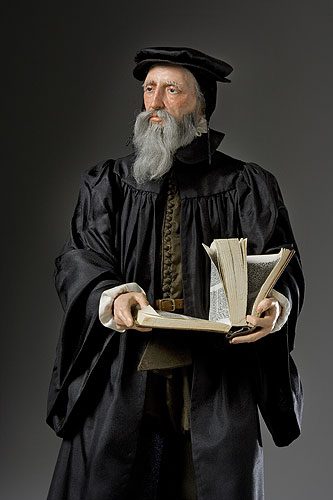
Photo credit: Historical mixed media figure of John Calvin produced by artist/historian George S. Stuart and photographed by Peter d’Aprix: from the George S. Stuart Gallery of Historical Figures archive [Wikimedia Commons / Creative CommonsAttribution-Share Alike 3.0 Unported license]
This is a reply to John Calvin’s Acts of the Council of Trent with the Antidote (Nov. 1547), specifically his comments on the Sixth Session of the Council of Trent (Jan. 1547), regarding justification. The online treatise is taken from Selected Works of John Calvin: Tracts and Letters, Vol. 3: Tracts, Part 3; edited and translated by Henry Beveridge (Edinburgh: Calvin Translation Society, 1851). I have a hardcover copy of this volume in my own library: a reprint from Baker Book House (Grand Rapids, Michigan, 1983).
John Calvin’s words will be in blue; citations from Trent in green. I use RSV for biblical citations.
See Part One.
*****
It was indeed an absurd dream, but they are still more grossly absurd when they give it as their opinion, that none of all the things which precede Justification, whether faith or works, merit it. What works antecedent to Justification are they here imagining? What kind of order is this in which the fruit is antecedent in time to the root? In one word, that pious readers may understand how great progress has been made in securing purity of doctrine, the monks dunned into the ears of the reverend Fathers, whose part was to nod assent, this old song, that good works which precede justification are not meritorious of eternal salvation, but preparatory only. If any works precede faith, they should also be taken into account. But there is no merit, because there are no works; for if men inquire into their works, they will find only evil works.
Posterity will scarcely believe that the Papacy had fallen into such a stupor as to imagine the possibility of any work antecedent to justification, even though they denied it to be meritorious of so great a blessing! For what can come from man until he is born again by the Spirit of God?
Such works as repentance, any good thing that they do, by prevenient grace, the sort of general theistic belief that Paul refers to in Romans 1:20: “Ever since the creation of the world his invisible nature, namely, his eternal power and deity, has been clearly perceived in the things that have been made.” Or, “the law written upon their hearts”:
Romans 2:13-16 For it is not the hearers of the law who are righteous before God, but the doers of the law who will be justified. [14] When Gentiles who have not the law do by nature what the law requires, they are a law to themselves, even though they do not have the law. [15] They show that what the law requires is written on their hearts, while their conscience also bears witness and their conflicting thoughts accuse or perhaps excuse them [16] on that day when, according to my gospel, God judges the secrets of men by Christ Jesus.
Or the virtuous pagan beliefs that Paul built upon in Athens, to preach the gospel:
Acts 17:22-23, 27-28 . . . “Men of Athens, I perceive that in every way you are very religious. [23] For as I passed along, and observed the objects of your worship, I found also an altar with this inscription, ‘To an unknown god.’ What therefore you worship as unknown, this I proclaim to you. . . . [27] . . . he is not far from each one of us, [28] for `In him we live and move and have our being’; as even some of your poets have said, `For we are indeed his offspring.’
Or the faith of the Roman centurion who came to Jesus, at whom Jesus “marveled” and said, “I tell you, not even in Israel have I found such faith” (Lk 7:9). Calvin believes in total depravity; i.e., that human beings can do no good whatsoever before they are regenerated, and that even ostensibly good actions are inevitably tainted by evil in some fashion. But the anonymous psalmist in 112:5-6 refers to the “righteous” (Heb. tob), as does the book of Proverbs repeatedly: using the words “righteous” or “good” (11:23; 12:2; 13:22; 14:14, 19), using the same word, tob, which appears in Psalm 14:2-3. References to righteous men are innumerable (e.g., Job 17:9; 22:19; Ps 5:12; 32:11; 34:15; 37:16, 32; Mt 9:13; 13:17; 25:37, 46; Rom 5:19; Heb 11:4; Jas 5:16; 1 Pet 3:12; 4:18, etc.). See my articles:
Calvinist Total Depravity: Does Romans 1 Apply to All Men? [4-10-08]
Bible vs. the Reformed Doctrine of Total Depravity [2010]
Total Depravity & the Evil of the Non-Elect (vs. John Calvin) [10-12-12]
St. Augustine, Calvin, & Calvinists Regarding Total Depravity [1-7-14]
Very different is the reasoning of Paul. He exhorts the Ephesians to remember (Ephesians 2) that they were saved by grace, not by themselves nor by their own works.
We don’t deny that, so it’s a moot point or a non sequitur.
***
“Please Hit ‘Subscribe’”! If you have received benefit from this or any of my other 4,800+ articles, please follow my blog by signing up (with your email address) on the sidebar to the right (you may have to scroll down a bit), above where there is an icon bar, “Sign Me Up!”: to receive notice when I post a new blog article. This is the equivalent of subscribing to a YouTube channel. My blog was rated #1 for Christian sites by leading AI tool, ChatGPT: endorsed by influential Protestant blogger Adrian Warnock. Please also consider following me on Twitter / X and purchasing one or more of my 55 books. All of this helps me get more exposure, and (however little!) more income for my full-time apologetics work. Thanks so much and happy reading!
***
Scripture, . . . opposes faith to works . . .
Really?:
Matthew 7:21 Not every one who says to me, ‘Lord, Lord,’ shall enter the kingdom of heaven, but he who does the will of my Father who is in heaven. . . .
Matthew 19:16-17, 20-21 And behold, one came up to him, saying, “Teacher, what good deed must I do, to have eternal life?” [17] And he said to him, “. . . If you would enter life, keep the commandments.” . . . [20] The young man said to him, “All these I have observed; what do I still lack?” [21] Jesus said to him, “If you would be perfect, go, sell what you possess and give to the poor, and you will have treasure in heaven; and come, follow me.”
Matthew 19:29 And every one who has left houses or brothers or sisters or father or mother or children or lands, for my name’s sake, will receive a hundredfold, and inherit eternal life. (cf. Mk 10:29-30)
Luke 3:9 (+ Mt 3:10; 7:19) . . . every tree therefore that does not bear good fruit is cut down and thrown into the fire.
John 5:28-29 . . . all who are in the tombs will hear his voice [29] and come forth, those who have done good, to the resurrection of life, and those who have done evil, to the resurrection of judgment.
Romans 1:5, 17 through whom we have received grace and apostleship to bring about the obedience of faith for the sake of his name among all the nations, . . . [17] For in it the righteousness of God is revealed through faith for faith; as it is written, “He who through faith is righteous shall live.” (cf. Acts 6:7)
Romans 2:13 For it is not the hearers of the law who are righteous before God, but the doers of the law who will be justified.
Romans 16:26 . . . the obedience of faith
Galatians 5:6 . . . faith working through love.
1 Thessalonians 1:3 . . . your work of faith . . .
2 Thessalonians 1:11 . . . work of faith by his power,
Hebrews 11:8 By faith Abraham obeyed . . .
James 2:14, 17, 20-22, 24, 26 What does it profit, my brethren, if a man says he has faith but has not works? Can his faith save him? . . . [17] So faith by itself, if it has no works, is dead. . . . [20] . . . faith apart from works is barren . . . [21] Was not Abraham our father justified by works, when he offered his son Isaac upon the altar? [22] You see that faith was active along with his works, and faith was completed by works, . . . [24] You see that a man is justified by works and not by faith alone. . . . [26] . . . faith apart from works is dead.
In the tenth chapter, they inveigh against what they call The Vain Confidence of Heretics. This consists, according to their definition, in our holding it as certain that our sins are forgiven, and resting in this certainty. But if such certainty makes heretics, where will be the happiness which David extols? (Psalm 32) Nay, where will be the peace of which Paul discourses in the fifth chapter to the Romans, if we rest in anything but the good-will of God?
We rest in it, in an outlook of moral assurance of salvation and a thorough self-examination of conscience:
Bible on the Moral Assurance of Salvation (Persevering in Faith, with Hope) [10-21-08]
But we’re not absolutely sure of our eternal salvation. St. Paul certainly wasn’t. See:
Assurance of Instant Salvation? / Apostasy / Falling Away (Bible passages) [c. 2000]
“Certainty” of Eternal Life? (1 Jn 5:13 & Jn 5:24) [5-8-02]
St. Paul on Falling Away from Grace and Salvation [2004]
Absolute Assurance of Salvation?: Debunking “Prooftexts” [Oct. 2010]
“Once Saved, Always Saved”: Is it Biblical? Antinomian? [8-18-15]
Reply to Protestant Challenges Re Eternal Security (vs. Jason Engwer) [7-26-20]
Defense of Bible Passages vs. Eternal Security & Faith Alone (vs. Jason Engwer) [8-12-20]
Reply to Jason Engwer Re Eternal Security [9-26-23]
*
Where, then, is that boldness of which Paul elsewhere speaks, (Ephesians 3:12,) that access with confidence to the Father through faith in Christ? . . . Nay, they overthrow all true prayer to God, when they keep pious minds suspended by fear which alone shuts the door of access against us. “He who doubts,” says James, (James 1:6) “is like a wave of the sea driven by the wind.” Let not such think that they shall obtain anything of the Lord. “Let him who would pray effectually not doubt.” Attend to the antithesis between faith and doubt, plainly intimating that faith is destroyed as soon as certainty is taken away.
*
We do have that access, but it’s not the same as absolute assurance of eschatological salvation. St. Paul also warned:
1 Corinthians 9:27 I pommel my body and subdue it, lest after preaching to others I myself should be disqualified.
1 Corinthians 10:12 Therefore let anyone who thinks that he stands take heed lest he fall.
Galatians 5:1 For freedom Christ has set us free; stand fast, therefore, and do not submit again to a yoke of slavery.
Galatians 5:4 You are severed from Christ, you who would be justified by the law; you have fallen away from grace.
Philippians 3:8-14 Indeed I count everything as loss because of the surpassing worth of knowing Christ Jesus my Lord. For his sake I have suffered the loss of all things, and count them as refuse, in order that I may gain Christ and be found in him, not having a righteousness of my own, based on law, but that which is through faith in Christ, the righteousness from God that depends on faith; that I may know him and the power of his resurrection, and may share his sufferings, becoming like him in his death, that if possible I may attain the resurrection from the dead. Not that I have already obtained this or am already perfect; but I press on to make it my own, because Christ Jesus has made me his own. Brethren, I do not consider that I have made it my own; but one thing I do, forgetting what lies behind and straining forward to what lies ahead, I press on toward the goal for the prize of the upward call of God in Christ Jesus.
1 Timothy 4:1 Now the Spirit expressly says that in later times some will depart from the faith by giving heed to deceitful spirits and doctrines of demons.
But that the whole of their theology may be more manifest to my readers, let them weigh the words which follow under the same head. It ought not to be asserted, they say, that those who have been truly justified ought to entertain an unhesitating doubt that they are justified.
That’s not our teaching, which is thoroughly based on Paul’s. We simply deny absolute certainty of the future, including that of our attainment of heaven. This doesn’t equate to constant, anxious doubt, which is merely Calvin’s “either/or” self-delusion. It’s simply the acknowledgment of the obvious reality that we don’t know the future, and that we can possibly fall away from faith. Calvin, of course, denies that it’s possible to fall away, which is equally unbiblical, per the above articles. So each unbiblical error of his is compounded upon others, leading him further and further away from the Bible itself: all the while making the same accusation towards us, of the very thing he is doing..
I am ashamed to debate the matter, as if it were doubtful, with men who call themselves Christians. The doctrine of Scripture is clear. “We know,” says John, (1 John 4:6,) “that we are the children of God.”
Indeed, but how does John say that we know this?:
1 John 2:3-5 And by this we may be sure that we know him, if we keep his commandments. [4] He who says “I know him” but disobeys his commandments is a liar, and the truth is not in him; [5] but whoever keeps his word, in him truly love for God is perfected. By this we may be sure that we are in him:
1 John 3:24 All who keep his commandments abide in him, and he in them. And by this we know that he abides in us, by the Spirit which he has given us.
He doesn’t teach, “we’re absolutely sure because we have faith!” He wasn’t a Calvinist and would have — along with Paul and James and Peter — flunked out of their seminaries. Rather, good works and obeying commandments are how we know, and “knowing” doesn’t mean that it is for all time, into eternity. We can know in the present, because we’re in the present and there is no required speculation about what is to come. *That’*s Paul’s and John’s teaching. That’s why Paul refers to “lest after preaching to others I myself should be disqualified” (1 Cor 9:27) and “let anyone who thinks that he stands take heed lest he fall” (1 Cor 10:12) and “if possible I may attain the resurrection from the dead. Not that I have already obtained this or am already perfect; but I press on to make it my own. Brethren, I do not consider that I have made it my own . . . ” (Phil 3:11-13).
And, indeed, they are ignorant of the whole nature of faith who mingle doubt with it.
Again; it’s not doubt per se; rather, it’s a common sense acknowledgment that we don’t know the future. Jesus said, “he who endures to the end will be saved” (Mt 10:22). We don’t know that we’ll do that. But we have a strong faith that God’s enabling power will give us the strength and perseverance to do that, provided we are willing the whole way and don’t “fall away” (Gal 5:4; cf. Mt 13:6-7: parable of the sower). Paul condemns doubt (Rom 14:23), but he still warns about a possible falling away, if one isn’t vigilant and doesn’t “press on” like he does, or as James describes: “he who . . . perseveres, being no hearer that forgets but a doer that acts, he shall be blessed in his doing” (Jas 1:25).
*
***
*
Practical Matters: I run the most comprehensive “one-stop” Catholic apologetics site: rated #1 for Christian sites by leading AI tool, ChatGPT — endorsed by popular Protestant blogger Adrian Warnock. Perhaps some of my 4,800+ free online articles or fifty-five books have helped you (by God’s grace) to decide to become Catholic or to return to the Church, or better understand some doctrines and why we believe them.
*
Or you may believe my work is worthy to support for the purpose of apologetics and evangelism in general. If so, please seriously consider a much-needed financial contribution. I’m always in need of more funds: especially monthly support. “The laborer is worthy of his wages” (1 Tim 5:18, NKJV). 1 December 2021 was my 20th anniversary as a full-time Catholic apologist, and February 2022 marked the 25th anniversary of my blog.
*
PayPal donations are the easiest: just send to my email address: [email protected]. Here’s also a second page to get to PayPal. You’ll see the term “Catholic Used Book Service”, which is my old side-business. To learn about the different methods of contributing (including Zelle), see my page: About Catholic Apologist Dave Armstrong / Donation Information. Thanks a million from the bottom of my heart!
*
***
*
Photo credit: Historical mixed media figure of John Calvin produced by artist/historian George S. Stuart and photographed by Peter d’Aprix: from the George S. Stuart Gallery of Historical Figures archive [Wikimedia Commons / Creative CommonsAttribution-Share Alike 3.0 Unported license]

Summary: Part II of my critical examination of John Calvin’s 1547 treatise, “Acts of the Council of Trent with the Antidote”: regarding the issue of justification by faith, and salvation.
Previous Post

October 14, 2024
Reply to Calvin's Antidote to Trent on Justification
Next Post

October 22, 2024 Bible vs. "Faith Alone" vs. John Calvin #1
Recent Comments
"Special pleading, and not a serious response to my arguments . . ."
Is Venerating Men & Angels Worship? ..."
""no man needs to teach us."Didn't you just teach us?"
Is Venerating Men & Angels Worship? ..."
""Catholics say they are the only church that can lead people into heaven."In fact, we ..."
Is Venerating Men & Angels Worship? ..."
"And lastly, I belong to no denomination and am free to serve God as He ..."
Is Venerating Men & Angels Worship? ..."
Browse Our Archives
Select a Category & Last Things About Me Anti-Catholicism Atheism & Agnosticism Baptism and Sacramentalism Bible and Tradition Blessed Virgin Mary Books by Dave Armstrong C. S. Lewis Calvinism & General Protestantism Catholic Apologetics Catholic Apologists Catholic conversion Catholic converts Christmas Church (Ecclesiology) Church History Conversion and Converts Development of Doctrine Eastern Orthodoxy Ecumenism & Christian Unity Eucharist & Liturgy Fathers of the Church French Translations G. K. Chesterton Hell Hell & Satan Hell & Satan & Last Things Heresies & Comparative Religion Holistic Health Inquisition & Crusades & Scandals James White Jews & Judaism & Old Testament John Calvin John Henry Newman Liberal / Modernist Theology Life Issues Literary Resume Lutheranism Mariology Martin Luther Music Orthodoxy Papacy & Infallibility Personal Page Philosophy & Science Political & Ethical & Moral Issues Protestant Persecution & Intolerance Protestantism Purgatory Purgatory & Penance Romantic & Imaginative Theology Saints & Purgatory & Penance Salvation Salvation & Justification Satan & Last Things Sexuality and Gender Issues Spanish Translations Traditionalism vs. Radical Catholic Reactionaries Traducciones al español / tradução para português Trinitarianism & Christology Uncategorized Videos
Select a Month October 2026 September 2026 August 2026 July 2026 June 2026 May 2026 April 2026 March 2026 February 2026 January 2026 December 2025 November 2025 October 2025 September 2025 August 2025 July 2025 June 2025 May 2025 April 2025 March 2025 February 2025 January 2025 December 2024 November 2024 October 2024 September 2024 August 2024 July 2024 June 2024 May 2024 April 2024 March 2024 February 2024 January 2024 December 2023 November 2023 October 2023 September 2023 August 2023 July 2023 June 2023 May 2023 April 2023 March 2023 February 2023 January 2023 December 2022 November 2022 October 2022 September 2022 August 2022 July 2022 June 2022 May 2022 April 2022 March 2022 February 2022 January 2022 December 2021 November 2021 October 2021 September 2021 August 2021 July 2021 June 2021 May 2021 April 2021 March 2021 February 2021 January 2021 December 2020 November 2020 October 2020 September 2020 August 2020 July 2020 June 2020 May 2020 April 2020 March 2020 February 2020 January 2020 December 2019 November 2019 October 2019 September 2019 August 2019 July 2019 June 2019 May 2019 April 2019 March 2019 February 2019 January 2019 December 2018 November 2018 October 2018 September 2018 August 2018 July 2018 June 2018 May 2018 April 2018 March 2018 February 2018 January 2018 December 2017 November 2017 October 2017 September 2017 August 2017 July 2017 June 2017 May 2017 April 2017 March 2017 February 2017 January 2017 December 2016 November 2016 October 2016 September 2016 August 2016 July 2016 June 2016 May 2016 April 2016 March 2016 February 2016 January 2016 December 2015 November 2015 October 2015 September 2015 August 2015 July 2015 June 2015 May 2015 April 2015 March 2015 February 2015 January 2015 December 2014 November 2014 October 2014 September 2014 August 2014 July 2014 June 2014 April 2014 March 2014 February 2014 January 2014 December 2013 November 2013 October 2013 September 2013 August 2013 July 2013 June 2013 April 2013 March 2013 February 2013 January 2013 December 2012 November 2012 October 2012 September 2012 August 2012 July 2012 June 2012 May 2012 April 2012 March 2012 February 2012 January 2012 December 2011 November 2011 October 2011 September 2011 August 2011 July 2011 June 2011 April 2011 March 2011 February 2011 October 2010 September 2010 August 2010 July 2010 April 2010 March 2010 December 2009 October 2009 August 2009 July 2009 June 2009 May 2009 March 2009 February 2009 October 2008 September 2008 April 2008 March 2008 February 2008 January 2008 December 2007 November 2007 October 2007 May 2007 March 2007 February 2007 January 2007 November 2006 October 2006 September 2006 August 2006 July 2006 June 2006 May 2006 April 2006 March 2006 February 2006 October 2005 June 2005 April 2005 February 2005 July 2004 May 2004 April 2004
Follow Us!
TAKE THE
Religious Wisdom Quiz
Which book of the Bible contains the most direct prophecies about the Messiah?
Select your answer to see how you score.
Micah Isaiah Zechariah Psalms
Books by This Author Books by Dave Armstrong
Related posts from Biblical Evidence for Catholicism

Bible & Catholicism on Mortal Sin (vs. John...
Biblical Evidence for Catholicism

Dialogue on Eternal Security / Absolute Assurance
Biblical Evidence for Catholicism

"Faith Alone" Dialogue with a Calvinist
Biblical Evidence for Catholicism

Exegesis of 75 NT Faith [Alone?] & Works...
Biblical Evidence for Catholicism
TRENDING AT PATHEOS Catholic

The Sermon on the Mount, Part I: Matthew...
The Sermon on the Mount, Part I (Matthew 4:12-5:12) St. Matthew moves...

What's up from Crossway: Reviewing some of their latest A few weeks...

Janie Learns the Way of the Cross: A...
Teaching children about Jesus' Passion can be challenging. Many parents and educators...

Looking For Good Catholic Writing - October 2026
He alone extends the heavens, and he walks upon the waves of...

In "Irreplaceable," our book on vocation and technology, Trevor Sutton and I...

I was strolling through the top floor of the brand new Parthenon...
view all Catholic blogs
What Are Your Thoughts?leave a comment
Ad-Free & Subscriber Log-In Subscription Support
- About Us
- 2026 Calendar
- Videos
- Podcasts
- Library of World Religions
- Faith In Media Tracker
- Advertise With Us
- Write for Us
- Privacy Policy
- Terms of Service
- Do Not Sell My Data
- Contact Us
- Radiant Digital
- Manage Newsletter Subscriptions
- Unsubscribe From Notifications
- Sitemap
Copyright 2008-2026, Patheos. All rights reserved.
Subscription Support Ad-Free & Subscriber Log-In
Follow Patheos