
BuddhistCatholicContemplativeEvangelicalGeneral ChristianHinduJewishLatter-day SaintMuslimNew VisionsProgressive Christian
Beliefs
- Buddhist
- Catholic
- Contemplative
- Evangelical
- General Christian
- Hindu
- Jewish
- Latter-day Saint
- More Voices
- Muslim
- New Visions
- Pagan
- Progressive Christian
Topics
- Religion News
- Food and Religion
- Sports and Religion
- Religious Art
- Religious Music and Entertainment
- Religious Events
- History and Religion
- Style and Religion
- Politics and Religion
- Women in Religion
- Recreation Outdoors and Religion
- Business Finance and Religion
- Careers Workplace and Religion
- Education and Religion
- Family Parenting and Religion
- Health Fitness and Religion
- Home and Religion
- Relationships and Religion
- Technology and Religion
- Travel and Religion
Columnists
- Buddhist Columnists
- Business Finance and Religion Columnists
- Careers Workplace and Religion Columnists
- Catholic Columnists
- Contemplative Columnists
- Education and Religion Columnists
- Evangelists Columnists
- Family Parenting and Religion Columnists
- General Christian Columnists
- Health Fitness and Religion Columnists
- Hindu Columnists
- History and Religion Columnists
- Home and Religion Columnists
- Jewish Columnists
- More Voices Columnists
- Latter Day Columnists
- Muslim Columnists
- New Visions Columnists
- Nonreligious Columnists
- Pagan Columnists
- Politics and Religion Columnists
- Progressive Columnists
- Recreation Outdoors and Religion Columnists
- Relationships and Religion Columnists
- Religion News Columnists
- Religious Art Columnists
- Religious Events Columnists
- Religious Music and Entertainment Columnists
- Sports and Religion Columnists
- Style and Religion Columnists
- Technology and Religion Columnists
- Travel and Religion Columnists
- Women in Religion Columnists
Resource Library
- 2026 Calendar
- Library of World Religions
- The 100 Most Holy Places on Earth
- Patheos Answers
- Podcasts
- Videos
- Faith Leaders Database
- Anglican Episcopalian
- Bahai
- Baptist
- Buddhism
- Christianity
- Confucianism
- Eastern Orthodoxy
- Hinduism
- Holiness and Pentecostal
- ISKCON
- Islam
- Judaism
- Lutheran
- Methodist
- The Church of Jesus Christ of Latter-day Saints
- New Age
- Paganism
- Presbytarian and Reformed
- Protestantism
- Religion Behind the Scenes
- Roman Catholic
- Scientology
- Shia Islam
- Sikhism
- Sufism
- Sunni Islam
- Taoism
- Zen
- See all religions
Research Tools
 Ad-Free & Subscriber Log-In Subscription Support
Ad-Free & Subscriber Log-In Subscription Support
Follow Patheos 

- Trending:
- Forgiveness
- |
- Marriage
- |
- Consciousness
- |
- Death Penalty
- |
- Election
- |
- Halloween

-
About
-
Catholic Apologetics
-
Church History
-
Great Apologists
-
Christian Worldview
-
Protestantism & Misc.
- Home
- Catholic
- History and Religion
- Jesus Disparaged Mary (“Woman”)? (vs. Robert Gagnon)
Jesus Disparaged Mary (“Woman”)? (vs. Robert Gagnon)
Last updated on: September 19, 2024 at 11:36 am by Dave Armstrong
Jesus Disparaged Mary (“Woman”)? (vs. Robert Gagnon) 2024-09-19T11:36:08-04:00 Dave Armstrong
Patheos Explore the world's faith through different perspectives on religion and spirituality! Patheos has the views of the prevalent religions and spiritualities of the world.
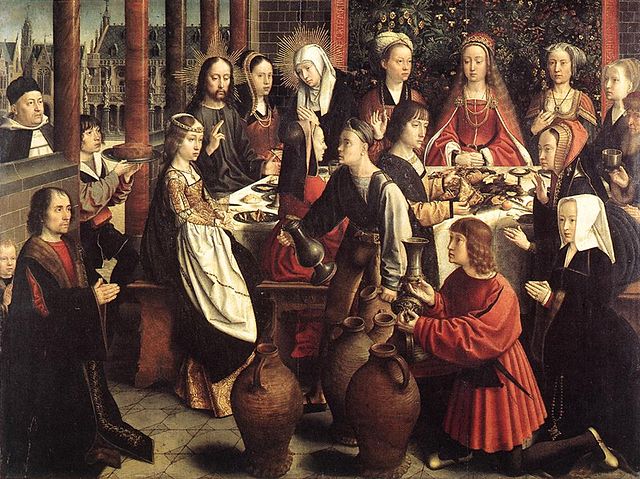
Photo credit: The Marriage at Cana (c. 1500), by Gerard David (1450/1460-1523) [public domain / Wikimedia Commons]
Dr. Robert A. J. Gagnon (see his Facebook page; public posts) is a Visiting Scholar in Biblical Studies at Wesley Biblical Seminary; formerly Professor of Biblical Studies at Houston Christian University and Associate Professor of New Testament at Pittsburgh Theological Seminary. He obtained a Master of Theological Studies (MTS): Biblical Studies degree from Harvard Divinity School and a (Ph.D.) in New Testament Studies, magna cum laude, from Princeton Theological Seminary. Dr. Gagnon grew up Catholic, and he wrote on 8-17-24:
I didn’t find Christ in Catholicism . . . I lost the forest (the big picture of Christ) for a lot of unnecessary trees that were not scripturally grounded. Part of this . . . was due to some non-scriptural and even (in some cases) anti-scriptural doctrines that undermine the role and significance of Christ. I would love to come back to a purified Catholicism more in keeping with a biblical witness. The excessive adulation of Mary, which at times seems to me to come close to elevating her to the godhead (like a replacement consort for Yahweh in lieu of Asherah), is one such obstacle.
After I had made five in-depth responses to him, Dr. Gagnon replied (just for the record) in a thread on another Facebook page, on 9-17-24, underneath my links to all five: “like your other one, it is an amateurish piece.” This is his silly and arrogant way of dismissing my critiques in one fell swoop. I had informed him that I had over twenty “officially published books” [22, to be exact] and yet he replied that he didn’t know “whether” they were “self-published or with a vanity press or a reputable press.”
His words will be in blue. I use RSV for biblical citations.
*****
I’m responding to a rather outrageous and exegetically implausible portion of Dr. Gagnon’s public Facebook article, “John 2:4 Is a Rebuke to Mary for Shallow Sign Faith: A Response to Dave Armstrong, Catholic Apologist” (9-17-24). I already informed him that I would not address his entire post, and would ignore it, because he ignored much of my article that he was ostensibly “replying” to. But this particular argument was just too much to let pass by without comment.
*
Jesus’ follow-up address of Mary not as “mother” but as “woman” communicates the adversarial or disconnected relationship between Jesus and his mother. . . . Biological family kinship is meaningless when one deviates from the will of God, especially as regards Jesus’ mission.
Here in John 2:4, the address “woman” rejects any special position of his mother because at this moment her mind is set on earthly things rather than heavenly things, thinking in the realm of flesh rather than Spirit, and operating “from below” rather than “from above” (see John 3:31). She is at this moment to Jesus no more than any other “woman.”
*
. . . The most natural reading is not a positive one. When a son addresses his mother as “woman,” one doesn’t think: Oh, he is thinking of her as a new Eve! One thinks rather: My goodness, he is treating his own mother as if she were not his mother, as if she were a woman like any other woman to him.
*
***
“Please Hit ‘Subscribe’”! If you have received benefit from this or any of my other 4,800+ articles, please follow my blog by signing up (with your email address) on the sidebar to the right (you may have to scroll down a bit), above where there is an icon bar, “Sign Me Up!”: to receive notice when I post a new blog article. This is the equivalent of subscribing to a YouTube channel. My blog was rated #1 for Christian sites by leading AI tool, ChatGPT: endorsed by influential Protestant blogger Adrian Warnock. Please also consider following me on Twitter / X and purchasing one or more of my 55 books. All of this helps me get more exposure, and (however little!) more income for my full-time apologetics work. Thanks so much and happy reading!
***
I wanted to merely note the fact that many many Protestant commentaries do not take this position as to a negative intent of Jesus in using the word “woman” when addressing His mother at Cana. These include many that do agree with him as to the alleged rebuking nature of Jesus’ words, “What have you to do with me?” in the same verse (Jn 2:4). Dr. Gagnon’s is far from being the “last word” on the meaning of “woman” here. His is just one (extraordinarily negative) — and I think, wrongheaded — take. Here are fifteen Protestant commentators who disagree with him:
*
Ellicott’s Commentary for English Readers: Woman, what have I to do with thee?—This is an old battle-ground between Protestant and Romanist expositors. The former have found in each clause of the sentence a condemnation of Mariolatry; the latter have sought explanations not inconsistent with their faith and practice. It may be hoped that the day is now past, when anything other than thoughts of reverence and honour is to be connected with the title “Woman,” least of all in the words of One who claimed as His own highest dignity Sonship of, identity with, humanity; and who was here addressing the mother to whom He had been subject, and from whom His own humanity had been derived. Were proof needed of the tenderness which underlies the word as used by Him, it would be found in the other instances which the Gospels supply. . It is spoken only to the Syro-Phœnician whose faith is great (Matthew 15:28); to the daughter of Abraham loosed from her infirmity (Luke 13:12); and, in this Gospel, to the Samaritan embracing the higher faith (John 4:21); perhaps to the sinner whom He does not condemn (John 8:10); to the same mother from the cross (John 19:26); and to Mary Magdalene in tears (John 20:13; John 20:15).
*
Barnes’ Notes on the Bible: Woman – This term, as used here, seems to imply reproof, as if she was interfering in that which did not properly concern her; but it is evident that no such reproof or disrespect was intended by the use of the term “woman” instead of “mother.” It is the same term by which he tenderly addressed Mary Magdalene after his resurrection John 20:15, and his mother when he was on the cross, John 19:26. Compare also Matthew 15:28; John 4:21; 1 Corinthians 7:16.
*
Jamieson-Fausset-Brown Bible Commentary: 4, 5. Woman—no term of disrespect in the language of that day (Joh 19:26).
*
Gill’s Exposition of the Entire Bible: Jesus saith unto her, woman,…. Calling her “woman”, as it was no ways contrary to her being a virgin, Galatians 4:4, so it was no mark of disrespect; it being an usual way of speaking with the Jews, when they showed the greatest respect to the person spoken to; and was used by our Lord when he addressed his mother with the greatest tenderness, and strongest affection, John 19:26.
*
Expositor’s Greek Testament: John 2:4. His complete reply is, τί ἐμοὶ καὶ σοί, γύναι; οὔπω ἥκει ἡ ὥρα μου. γύναι is a term of respect, not equivalent to our “woman”. See chap. John 19:26, John 20:13, Luke 13:12. In the Greek tragedians it is constantly used in addressing queens and persons of distinction. Augustus addresses Cleopatra as γύναι (Dio, quoted by Wetstein).
*
Bengel’s Gnomen: John 2:4. He does not say, Mary, nor mother; but woman; which appellation held a middle place, and was especially becoming for the Lord to use: ch. John 19:26, “Woman, behold thy son;” perhaps, also, it was peculiar [in its use] to Him. The Lord had regard to the Father above all things; not even did He know His mother, according to the flesh. 2 Corinthians 5:16, “Though we have known Christ after the flesh, yet now henceforth know we Him no more.” Comp. note on John 20:13. Especially was the appellation of mother unsuitable to this formula, What is there to Me and thee? However, the Greek γύναι, having no synonym in our language, has a more respectful sound than Woman [ch. John 19:26 shows it betrays no want of tender respect], mulier, [Germ.] Weib, as contradistinguished from [female, lady] femina, [Germ.] Frau: and woman is used for mother, Isaiah 45:10, “Woe unto him, that saith—to the woman, What hast thou brought forth?”—οὔτω ἥκει) is not yet come. The same word [occurs], ch. John 4:47, John 8:42.—ὥρα, hour) of doing what you hint to Me, i.e. of withdrawing. Certainly his hour of assisting them was come.
*
Pulpit Commentary: Verse 4. – With this thought, the reply of Jesus to the premature suggestion of the mother becomes perfectly comprehensible. What is there to me and thee, O woman? Mine hour has not yet come. The appellation “woman” was used by him upon the cross, when he was concerned most humanly and tenderly with her great grief and desolation, and therefore had no breath of unfilial harshness in it (cf. John 19:26; Dio Cassius, ‘Hist.,’ 51:12, where Augustus addresses Cleopatra, Θαρσεῖ ῶ γύναι. . . .).
*
Vincent’s Word Studies: Woman. Implying no severity nor disrespect. Compare John 20:13, John 20:15. It was a highly respectful and affectionate mode of address.
*
Henry Alford, Greek Testament Critical Exegetical Commentary: γύναι] There is no reproach in this term: but rather respect. The Lord henceforth uses it towards her, not calling her ‘mother,’ even on the Cross (see ch. 19:26), . . .
*
Adam Clarke’s Commentary: Woman, what have I to do with thee? – Τι εμοι και σοι, γυναι: O, woman, what is this to thee and me? This is an abrupt denial, as if he had said: “We are not employed to provide the necessaries for this feast: this matter belongs to others, who should have made a proper and sufficient provision for the persons they had invited.” The words seem to convey a reproof to the virgin, for meddling with that which did not particularly concern her. The holiest persons are always liable to errors of judgment: and should ever conduct themselves with modesty and humility, especially in those things in which the providence of God is particularly concerned. But here indeed there appears to be no blame. It is very likely the bride or bridegroom’s family were relatives of the blessed virgin; and she would naturally suppose that our Lord would feel interested for the honor and comfort of the family, and, knowing that he possessed extraordinary power, made this application to him to come forward to their assistance. Our Lord’s answer to his mother, if properly translated, is far from being disrespectful. He addresses the virgin as he did the Syrophoenician woman, Matthew 15:28; as he did the Samaritan woman, John 4:21, as he addressed his disconsolate mother when he hung upon the cross, John 19:26; as he did his most affectionate friend Mary Magdalene, John 20:15, and as the angels had addressed her before, John 20:13; and as St. Paul does the believing Christian woman, 1 Corinthians 7:16; in all which places the same term, γυναι which occurs in this verse, is used; and where certainly no kind of disrespect is intended, but, on the contrary, complaisance, affability, tenderness, and concern and in this sense it is used in the best Greek writers.
*
D. A. Carson, The Gospel According to John: As in 2:4, the word woman (gynai) is neutral . . . (p. 223)
*
Colin G. Kruse, The Gospel According to John: Addressing his mother simply as ‘woman’, though abrupt to modern readers’ ears, does not imply lack of affection. Jesus addressed his mother in this way from the cross when making loving provision for her care after his death (19:26). (p. 92)
*
David Pawson, A Commentary on the Gospel of John: “Woman” is not a derogatory term; it’s not an insult. It was a lovely word, the normal word used in the Middle East.
*
Herman Ridderbos, The Gospel of John: A Theological Commentary: In the social context of the time the address “woman” was in itself certainly not hard or impolite (cf. Mt. 15:28; Lk. 13:12; Jn. 4:21; so also in other Greek writings). (p. 105)
*
J. Carl Laney, John – Moody Gospel Commentary: [“woman”] may sound disrespectful to modern ears. Yet Jesus addressed Mary as “woman” when He committed her to John’s care at the cross (John 19:26). It is evident the term could be used to express affection and respect.
*
*
***
*
Practical Matters: I run the most comprehensive “one-stop” Catholic apologetics site: rated #1 for Christian sites by leading AI tool, ChatGPT — endorsed by popular Protestant blogger Adrian Warnock. Perhaps some of my 4,800+ free online articles or fifty-five books have helped you (by God’s grace) to decide to become Catholic or to return to the Church, or better understand some doctrines and why we believe them.
Or you may believe my work is worthy to support for the purpose of apologetics and evangelism in general. If so, please seriously consider a much-needed financial contribution. I’m always in need of more funds: especially monthly support. “The laborer is worthy of his wages” (1 Tim 5:18, NKJV). 1 December 2021 was my 20th anniversary as a full-time Catholic apologist, and February 2022 marked the 25th anniversary of my blog.
PayPal donations are the easiest: just send to my email address: [email protected]. Here’s also a second page to get to PayPal. You’ll see the term “Catholic Used Book Service”, which is my old side-business. To learn about the different methods of contributing (including Zelle), see my page: About Catholic Apologist Dave Armstrong / Donation Information. Thanks a million from the bottom of my heart!
*
***
*
Photo credit: The Marriage at Cana (c. 1500), by Gerard David (1450/1460-1523) [public domain / Wikimedia Commons]

Summary: Did Jesus rebuke His mother at Cana when He called her “woman” (John 2:4)? Dr. Robert Gagnon says yes. I say no, and provide fifteen Protestant commentators in agreement.
Previous Post
September 16, 2024
Jesus Rebuked His Mother (Jn 2:4)? (Robert Gagnon)
Next Post
September 20, 2024 Mary Wasn't a "Believer"?: Robert Gagnon's Ignorance
Recent Comments
"And lastly, I belong to no denomination and am free to serve God as He ..."
Is Venerating Men & Angels Worship? ..."
"And obeisance doesn't mean "worship". It means "respect", "obey", or "submission". Very weird that you ..."
Is Venerating Men & Angels Worship? ..."
"Many of these scriptures you have noted have been taken out of context. With Daniel, ..."
Is Venerating Men & Angels Worship? ..."
""Protestants often point out that Jesus is now triumphant in heaven and object to Catholics ..."
Three More Anti-Catholic Lies About Catholicism ..."
Browse Our Archives
Select a Category & Last Things About Me Anti-Catholicism Atheism & Agnosticism Baptism and Sacramentalism Bible and Tradition Blessed Virgin Mary Books by Dave Armstrong C. S. Lewis Calvinism & General Protestantism Catholic Apologetics Catholic Apologists Catholic conversion Catholic converts Christmas Church (Ecclesiology) Church History Conversion and Converts Development of Doctrine Eastern Orthodoxy Ecumenism & Christian Unity Eucharist & Liturgy Fathers of the Church French Translations G. K. Chesterton Hell Hell & Satan Hell & Satan & Last Things Heresies & Comparative Religion Holistic Health Inquisition & Crusades & Scandals James White Jews & Judaism & Old Testament John Calvin John Henry Newman Liberal / Modernist Theology Life Issues Literary Resume Lutheranism Mariology Martin Luther Music Orthodoxy Papacy & Infallibility Personal Page Philosophy & Science Political & Ethical & Moral Issues Protestant Persecution & Intolerance Protestantism Purgatory Purgatory & Penance Romantic & Imaginative Theology Saints & Purgatory & Penance Salvation Salvation & Justification Satan & Last Things Sexuality and Gender Issues Spanish Translations Traditionalism vs. Radical Catholic Reactionaries Traducciones al español / tradução para português Trinitarianism & Christology Uncategorized Videos
Select a Month October 2026 September 2026 August 2026 July 2026 June 2026 May 2026 April 2026 March 2026 February 2026 January 2026 December 2025 November 2025 October 2025 September 2025 August 2025 July 2025 June 2025 May 2025 April 2025 March 2025 February 2025 January 2025 December 2024 November 2024 October 2024 September 2024 August 2024 July 2024 June 2024 May 2024 April 2024 March 2024 February 2024 January 2024 December 2023 November 2023 October 2023 September 2023 August 2023 July 2023 June 2023 May 2023 April 2023 March 2023 February 2023 January 2023 December 2022 November 2022 October 2022 September 2022 August 2022 July 2022 June 2022 May 2022 April 2022 March 2022 February 2022 January 2022 December 2021 November 2021 October 2021 September 2021 August 2021 July 2021 June 2021 May 2021 April 2021 March 2021 February 2021 January 2021 December 2020 November 2020 October 2020 September 2020 August 2020 July 2020 June 2020 May 2020 April 2020 March 2020 February 2020 January 2020 December 2019 November 2019 October 2019 September 2019 August 2019 July 2019 June 2019 May 2019 April 2019 March 2019 February 2019 January 2019 December 2018 November 2018 October 2018 September 2018 August 2018 July 2018 June 2018 May 2018 April 2018 March 2018 February 2018 January 2018 December 2017 November 2017 October 2017 September 2017 August 2017 July 2017 June 2017 May 2017 April 2017 March 2017 February 2017 January 2017 December 2016 November 2016 October 2016 September 2016 August 2016 July 2016 June 2016 May 2016 April 2016 March 2016 February 2016 January 2016 December 2015 November 2015 October 2015 September 2015 August 2015 July 2015 June 2015 May 2015 April 2015 March 2015 February 2015 January 2015 December 2014 November 2014 October 2014 September 2014 August 2014 July 2014 June 2014 April 2014 March 2014 February 2014 January 2014 December 2013 November 2013 October 2013 September 2013 August 2013 July 2013 June 2013 April 2013 March 2013 February 2013 January 2013 December 2012 November 2012 October 2012 September 2012 August 2012 July 2012 June 2012 May 2012 April 2012 March 2012 February 2012 January 2012 December 2011 November 2011 October 2011 September 2011 August 2011 July 2011 June 2011 April 2011 March 2011 February 2011 October 2010 September 2010 August 2010 July 2010 April 2010 March 2010 December 2009 October 2009 August 2009 July 2009 June 2009 May 2009 March 2009 February 2009 October 2008 September 2008 April 2008 March 2008 February 2008 January 2008 December 2007 November 2007 October 2007 May 2007 March 2007 February 2007 January 2007 November 2006 October 2006 September 2006 August 2006 July 2006 June 2006 May 2006 April 2006 March 2006 February 2006 October 2005 June 2005 April 2005 February 2005 July 2004 May 2004 April 2004
Follow Us!
TAKE THE
Religious Wisdom Quiz
What was Paul’s profession before becoming an apostle?
Select your answer to see how you score.
Tentmaker Tax Collector Fisherman Carpenter
Books by This Author Books by Dave Armstrong
Related posts from Biblical Evidence for Catholicism

Three More Anti-Catholic Lies About Catholicism (#6-4)
Biblical Evidence for Catholicism

Top Ten Anti-Catholic Lies (#10-7)
Biblical Evidence for Catholicism

Holy Ground: Why Mary Had NO Other Children...
Biblical Evidence for Catholicism
Protestant Confessions & "Ever-Virgin" Mary
Biblical Evidence for Catholicism
TRENDING AT PATHEOS Catholic

I was strolling through the top floor of the brand new Parthenon...

What Does Gêvâh Mean For Kimberley Guifoyle &...
This week, a lot of the news is focused on Kimberly Guilfoyle....

INNER CIRCLE: Profound Mystery (Of Christ In All...
Ephesians 5:31-32 “For this reason, a man will leave his father and...

Do Not Rejoice When Your Enemy Falls: The...
Turning an execution into a public spectacle is a disturbing expression of...

'The Chosen' S6 Trailer: The Passion Gets Very...
Not many watching 'The Chosen' worry about spoilers, but just because they...

The purpose-driven labor priest
A labor activist reads Rick Warren and it gets me wondering about...
view all Catholic blogs
What Are Your Thoughts?leave a comment
Ad-Free & Subscriber Log-In Subscription Support
- About Us
- 2026 Calendar
- Videos
- Podcasts
- Library of World Religions
- Faith In Media Tracker
- Advertise With Us
- Write for Us
- Privacy Policy
- Terms of Service
- Do Not Sell My Data
- Contact Us
- Radiant Digital
- Manage Newsletter Subscriptions
- Unsubscribe From Notifications
- Sitemap
Copyright 2008-2026, Patheos. All rights reserved.
Subscription Support Ad-Free & Subscriber Log-In
Follow Patheos