
BuddhistCatholicContemplativeEvangelicalGeneral ChristianHinduJewishLatter-day SaintMuslimNew VisionsProgressive Christian
Beliefs
- Buddhist
- Catholic
- Contemplative
- Evangelical
- General Christian
- Hindu
- Jewish
- Latter-day Saint
- More Voices
- Muslim
- New Visions
- Pagan
- Progressive Christian
Topics
- Religion News
- Food and Religion
- Sports and Religion
- Religious Art
- Religious Music and Entertainment
- Religious Events
- History and Religion
- Style and Religion
- Politics and Religion
- Women in Religion
- Recreation Outdoors and Religion
- Business Finance and Religion
- Careers Workplace and Religion
- Education and Religion
- Family Parenting and Religion
- Health Fitness and Religion
- Home and Religion
- Relationships and Religion
- Technology and Religion
- Travel and Religion
Columnists
- Buddhist Columnists
- Business Finance and Religion Columnists
- Careers Workplace and Religion Columnists
- Catholic Columnists
- Contemplative Columnists
- Education and Religion Columnists
- Evangelists Columnists
- Family Parenting and Religion Columnists
- General Christian Columnists
- Health Fitness and Religion Columnists
- Hindu Columnists
- History and Religion Columnists
- Home and Religion Columnists
- Jewish Columnists
- More Voices Columnists
- Latter Day Columnists
- Muslim Columnists
- New Visions Columnists
- Nonreligious Columnists
- Pagan Columnists
- Politics and Religion Columnists
- Progressive Columnists
- Recreation Outdoors and Religion Columnists
- Relationships and Religion Columnists
- Religion News Columnists
- Religious Art Columnists
- Religious Events Columnists
- Religious Music and Entertainment Columnists
- Sports and Religion Columnists
- Style and Religion Columnists
- Technology and Religion Columnists
- Travel and Religion Columnists
- Women in Religion Columnists
Resource Library
- 2026 Calendar
- Library of World Religions
- The 100 Most Holy Places on Earth
- Patheos Answers
- Podcasts
- Videos
- Faith Leaders Database
- Anglican Episcopalian
- Bahai
- Baptist
- Buddhism
- Christianity
- Confucianism
- Eastern Orthodoxy
- Hinduism
- Holiness and Pentecostal
- ISKCON
- Islam
- Judaism
- Lutheran
- Methodist
- The Church of Jesus Christ of Latter-day Saints
- New Age
- Paganism
- Presbytarian and Reformed
- Protestantism
- Religion Behind the Scenes
- Roman Catholic
- Scientology
- Shia Islam
- Sikhism
- Sufism
- Sunni Islam
- Taoism
- Zen
- See all religions
Research Tools
 Ad-Free & Subscriber Log-In Subscription Support
Ad-Free & Subscriber Log-In Subscription Support
Follow Patheos 

- Trending:
- Forgiveness
- |
- Marriage
- |
- Consciousness
- |
- Death Penalty
- |
- Election
- |
- Halloween

-
About
-
Catholic Apologetics
-
Church History
-
Great Apologists
-
Christian Worldview
-
Protestantism & Misc.
- Home
- Catholic
- History and Religion
- Reply to a Protestant: Misc. Protestant Errors
Reply to a Protestant: Misc. Protestant Errors
Last updated on: June 6, 2026 at 12:51 am by Dave Armstrong
Reply to a Protestant: Misc. Protestant Errors 2026-06-06T00:51:51-04:00 Dave Armstrong
Patheos Explore the world's faith through different perspectives on religion and spirituality! Patheos has the views of the prevalent religions and spiritualities of the world.
Includes Biblical Arguments for the Catholic Priesthood
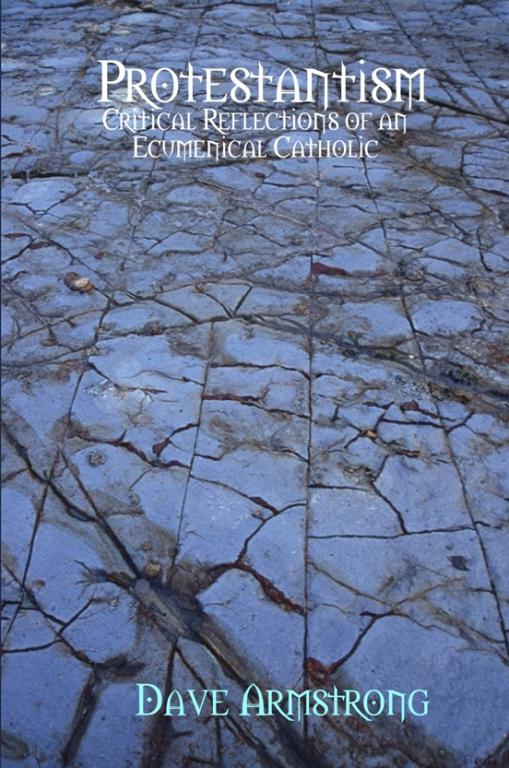
Photo credit: cover of my 2003 book, Protestantism: Critical Reflections of an Ecumenical Catholic.
This discussion and dispute began with a meme that I put up. It stated (numbers added):
Protestantism:
[1] Where everyone is a priest except priests,
[2] Where everyone can bind and loose except bishops,
[3] Where you can command angels but not ask their help,
[4] Where you can talk to the devil but not to saints,
[5] Where everyone gets a crown except the Virgin Mary,
[6] Where everyone can interpret Scripture except the Church,
[7] Where every Church is a Church except the Church.
That caused a firestorm of controversy on one of my Facebook threads. The general tenor of the many Protestant critics who showed up was that I was either grossly ignorant of Protestantism, or deliberately dishonest. I contended that much of the furor, in my opinion, was based on a mistaken view of the sort of “literature” this was: proverbial, which allows of many exceptions. I replied to the most vociferous critic, Steve Gregg, a zealous preacher who emerged from the Jesus Movement of the early 70s, in my article, “Various Protestant Errors (Vs. Steve Gregg)” and made the following observation:
Now, posting a meme doesn’t necessarily mean that one agrees with every particular of it. And this is clearly a proverbial-type of meme, that would allow many exceptions (just as passages in the Book of Proverbs do). Moreover, with Protestantism one has to generalize, since there are so many divisions, but these observations are either broadly true or true of some and sometimes many Protestants, or else I wouldn’t have posted it. There can always be partial exceptions in an individual as well. . . .
It’s important to realize that the meme doesn’t necessarily have to mean that all Protestants believe all these things. . . . It’s implying (at least in my opinion and interpretation) that these beliefs can be or are found among Protestants.
To use an analogy, I could put up a meme about “The Democratic Party” and list seven things that some or many Democrats believe (free abortion and widespread illegal immigration and opposition to fossil fuels would be three examples). It wouldn’t follow that every Democrat believes all seven things; as Democrats (the men and women on the street; not just the politicians) are quite diverse as a group, just as Protestants are. But the generalizations would hold. Democrats are absolutely overwhelmingly in favor of legal abortion, etc. The fact that some aren’t doesn’t negate the legitimacy of the generalization. And the same applies to this meme. . . .
All of the points in the meme have been believed by Protestants; often, by many, and sometimes by very many.
Gregg soon imploded and launched an avalanche of personal attacks, after misinterpreting remarks I made about the behavior of the Protestants other than him in the thread (he took them all personally), as can be seen at the end of that article. With his departure, no other Protestant (of the many critics who chimed in) was willing to reply to my response-paper, save for one person whose demeanor had been cordial all along (h e wishes to remain anonymous). This is my reply to his comments in the original thread. His words will be in blue. Cited words from my reply-paper will be in green. I use RSV for Bible citations.
1. Recognizing special ministry roles (ones of authoritative leadership and otherwise) is not synonymous with “gap-bridging between God and man” priesthood. The sacramental “gatekeeping access to God” role Protestantism saw in Catholic “priesthood” is not parallel to those roles we see affirmed in the NT.
I agree; hence I wrote, “the universal priesthood of believers . . . is scriptural, and we also believe it. But we differ in thinking that there is an additional specific class of clergy called priests, . . . In other words, there are two senses of ‘priest’ in the Bible.” Thus, I was not arguing for equation, but rather, differentiation of two groups of people.
All the examples provided fail to establish NT priesthood. They establish ministerial roles (in general and various kinds), certainly, but not a “gatekeeping access to God” role typically referenced specifically as “priests.” It isn’t there. Bishops, overseers, shepherds, many terms are used for authoritative caretaking roles, but not priesthood. Jesus is the high priest, and we merely are kept in perpetual remembrance of his high priesthood.
I wrote: “The priesthood as we know it today is not a strong motif in the New Testament. But this can be explained in terms of development of doctrine: in the early days of Christianity some things were understood only in a very basic or skeletal sense.”
That said, I did offer arguments for the priesthood, particularly as presiding over the Mass (“Jesus entrusts to His disciples a remembrance of the central aspect of the liturgy or Mass (consecration of the bread and wine) at the Last Supper [(Lk. 22:19: ‘Do this in remembrance of me’]; Paul may also have presided over a Eucharist in Acts 20:11.” [“Paul had gone up and had broken bread and eaten”], even though that wasn’t the primary purpose of what I argued in my book (which was the differentiation of “priesthood of all believers” from priests in the Catholic sense). I addressed the “binding and loosing” aspect, which ties into confession and absolution (your “gatekeeping access to God” description), in replying to #2 in the meme. If you want “gatekeeping” you see that in this passage:
John 20:23 If you forgive the sins of any, they are forgiven; if you retain the sins of any, they are retained.
That’s “gatekeeping,” because, note that it’s talking about forgiving the sins of others in a general sense; that is, even if they have nothing to do with the person offering the forgiveness, or penance (“retained”). We see the Apostle Paul doing the same thing with regard to a serious sinner in the Corinthian congregation:
1 Corinthians 5:1-5 It is actually reported that there is immorality among you, and of a kind that is not found even among pagans; for a man is living with his father’s wife. [2] And you are arrogant! Ought you not rather to mourn? Let him who has done this be removed from among you. [3] For though absent in body I am present in spirit, and as if present, I have already pronounced judgment [4] in the name of the Lord Jesus on the man who has done such a thing. When you are assembled, and my spirit is present, with the power of our Lord Jesus, [5] you are to deliver this man to Satan for the destruction of the flesh, that his spirit may be saved in the day of the Lord Jesus.
This is an example of Paul “binding” (Mt 18:18) or “retaining” sins; i.e., imposing a penance for them. That’s the priestly function in the more specific Catholic sense. Then later he relaxes the punishment, which is the “loosing” function or forgiveness, and is actually an explicit example of what we call an indulgence (the relaxing or removal of temporal punishment for sin):
2 Corinthians 2:6-8, 10 For such a one this punishment [penance!] by the majority is enough; [7] so you should rather turn to forgive and comfort him, or he may be overwhelmed by excessive sorrow. [8] So I beg you to reaffirm your love for him. . . . [10] Any one whom you forgive, I also forgive. What I have forgiven, if I have forgiven anything, has been for your sake in the presence of Christ,
Note particularly verse 10: “Any one whom you forgive, I also forgive.” Paul is forgiving those who did him no (personal) wrong, and that’s because he is functioning as a priest and gatekeeper. He can formally pronounce either forgiveness or penance as a representative of God, and he did both. Paul casually assumes that priests are still operative under the new Christian covenant, by referring to the table of the Lord (or altar) and contrasting it with the table of demons, in a eucharistic context:
1 Corinthians 10:14-21 Therefore, my beloved, shun the worship of idols. [15] I speak as to sensible men; judge for yourselves what I say. [16] The cup of blessing which we bless, is it not a participation in the blood of Christ? The bread which we break, is it not a participation in the body of Christ? [17] Because there is one bread, we who are many are one body, for we all partake of the one bread. [18] Consider the people of Israel; are not those who eat the sacrifices partners in the altar? [19] What do I imply then? That food offered to idols is anything, or that an idol is anything? [20] No, I imply that what pagans sacrifice they offer to demons and not to God. I do not want you to be partners with demons. [21] You cannot drink the cup of the Lord and the cup of demons. You cannot partake of the table of the Lord and the table of demons. (cf. 9:13)
Paul is in this same priestly thought-world in another of his statements:
Romans 15:15-17 But on some points I have written to you very boldly by way of reminder, because of the grace given me by God [16] to be a minister of Christ Jesus to the Gentiles in the priestly service of the gospel of God, so that the offering of the Gentiles may be acceptable, sanctified by the Holy Spirit. [17] In Christ Jesus, then, I have reason to be proud of my work for God.
He’s “offering” a “priestly service” to the Gentiles. The Greek word is hierourgeo. Strong’s Concordance defines it as “to be a temple-worker, i.e., officiate as a priest (fig.): — minister.” This classic (non-Catholic) reference work states: “to minister in the manner of a priest, minister in priestly service.” It also notes (from Joseph Thayer’s Greek-English Lexicon) historical etymological definitions of “to be busied with sacred things; to be perform sacred rites” (from Philo), and “used esp. of persons sacrificing” (from Josephus).
Baptist Greek scholar A. T. Robertson, in his famous work, Word Pictures of the New Testament (Nashville, Tennessee: Broadman Press, 1930; six volumes; under Romans 15:16; vol. 4, 520), provides the basic definition: “to work in sacred things, to minister as a priest.” Likewise, Marvin Vincent’s Word Studies in the New Testament (four volumes; New York: Charles Scribner’s Sons, 1887; reprinted: Grand Rapids, Michigan: Wm. B. Eerdmans Publishing Co., 1946; vol. III, 174) states, for the same passage:
Ministering (ierourgounta). Only here in the New Testament. Lit., ministering as a priest.
Offering up (prosfora). Lit., the bringing to, i.e., to the altar. Compare doeth service, John xvi. 2.
Kittel’s Theological Dictionary of the New Testament defines it as:
‘to perform sacred or sacrificial ministry.’ In Josephus and Philo it always means “to offer sacrifice” and often has no object. (hierourgia means “sacrifice” and hierourgema the “act of sacrifice.”)
None of these reference works are Catholic; thus, no charge of bias based on Catholic affiliation can be made against them. The bottom line is that Paul has called himself a priest – using two different terms.
We get the word liturgy from litourgos (Strong’s word #3011; cf. #3008, 3009, and 3010). Strong’s (word #3008: litourgeo) applies it to, among other things, “priests and Levites who were busied with the sacred rites in the tabernacle or the temple.”
Paul also casually assumes the continued existence of altars among Christians (1 Cor 10:14-21), and altars are mentioned in the New Testament in other places (apart from the many mentions of altars in heaven), as well:
Hebrews 13:9-12 Do not be led away by diverse and strange teachings; for it is well that the heart be strengthened by grace, not by foods, which have not benefited their adherents. [10] We have an altar from which those who serve the tent have no right to eat. [11] For the bodies of those animals whose blood is brought into the sanctuary by the high priest as a sacrifice for sin are burned outside the camp. [12] So Jesus also suffered outside the gate in order to sanctify the people through his own blood.
Therefore, if it is true that – as John Calvin argues in his Institutes: IV, 18:3 –: “the cross of Christ is overthrown the moment an altar is erected”, then the New Testament is against the cross. It’s much more likely that Calvin has misunderstood the passages above.
Priests dispense sacraments (1 Cor 4:1; Jas 5:14), including baptism (Mt 28:19; Acts 2:38, 41). A universal priesthood of “offering” (sacrifice) extending to “every place” in New Testament times is prophesied in Isaiah 66:18, 21 and Malachi 1:11.
***
“Please Hit ‘Subscribe’”! If you have received benefit from this or any of my other 4,800+ articles, please follow my blog by signing up (with your email address) on the sidebar to the right (you may have to scroll down a bit), above where there is an icon bar, “Sign Me Up!”: to receive notice when I post a new blog article. This is the equivalent of subscribing to a YouTube channel. My blog was rated #1 for Christian sites by leading AI tool, ChatGPT: endorsed by influential Protestant blogger Adrian Warnock. Please also consider following me on Twitter / X and purchasing one or more of my 55 books. All of this helps me get more exposure, and (however little!) more income for my full-time apologetics work. Thanks so much and happy reading!
***
2. If binding & loosing refers to excommunication and reconciliation, we see Paul prompting the Corinthian church to do so as a community rather than tasking a priest/pastor/elder to do so. This binding & loosing would be church-communal rather than limited to a few in authority.
Here you appear to be referring to the passages I brought up, above. What you overlook is the fact that Paul himself was functioning as the priest in that instance, and merely encouraging the assembly to follow-up on his instructions. Paul started the ball rolling, so to speak. Accordingly, he writes with “high” priestly, commanding authority: “Let him who has done this be removed from among you. . . . I have already pronounced judgment in the name of the Lord Jesus . . . you are to deliver this man to Satan for the destruction of the flesh, that his spirit may be saved . . .” (1 Cor 5:2-3, 5).
Paul directed the whole thing: not the Corinthians themselves. He was the priest. He was doing “gatekeeping” — as you described it. Likewise, he led and guided the relaxation of the penance or indulgence, too (which directly contradicts your argument). He commands them and tells them what to do: “this punishment by the majority is enough; so you should rather turn to forgive and comfort him . . . I beg you to reaffirm your love for him. . . . Any one whom you forgive, I also forgive” (2 Cor 2:6-8, 10).
3. Word of Faith / “Prosperity Gospel” figureheads, while they exist, are dismissed by almost all Protestants with contempt as heretical false teachers.
*
I agree. As I noted, I rebuked these errors as a young apologist in 1982, and as a charismatic Protestant. But it hasn’t been established that this error occurs only among the “word of faith” extremists. And I can attest to the fact that this mentality is rampant in pentecostal circles. I attended Assemblies of God from 1982-1986 and I personally encountered or witnessed dozens of people talking this nonsense, even though AG doctrine was against it. In this meme, practices “on the ground” are being referred to, not just official doctrines.
*
So the whole “commanding angels” thing simply is not something to say “occurs in our ranks.”
*
Again, as I noted, there are over 644 million pentecostals or charismatics worldwide. It certainly does occur in your ranks. In five seconds I found this on an Assemblies of God site:
Mark 1:34 says, “He [Jesus] did not allow the demons to speak, because they knew Him” (NKJV). In Mark 5:8, He commands, “Come out of the man, unclean spirit!” This is why believers can take authority in Jesus’ name over demonic activity.
Assemblies of God is usually regarded as the largest pentecostal denomination. It has 68.5 million members, just 6.5 million less than Presbyterians and 11.5 million less than Lutherans and Methodists. Granted, this citation is about demons, but they are angels, too, after all (fallen angels). Other charismatic articles deny that this is the case; for example, “Can Christians Command Angels?” (Samantha Carpenter, CharismaNews, 5-19-21).
*
As I’ve reiterated over and over, I don’t believe that the meme was claiming that all Protestants believe any of these points: only that some or many do. If in fact the meme writer didn’t intend that understanding (maybe he or she didn’t), it’s still certainly my own view of the points in it. This particular item probably applies to the smallest number (as I already conceded), but it’s still not nonexistent.
*
You may as well be addressing JW or LDS as “a problem in Protestant ranks” as if it is something we can existentially eradicate any more than Catholicism can.
*
Those groups are non-trinitarian heresies and not Protestant at all (I wrote against JWs in the early 80s as an evangelical Protestant: it was one of my earliest apologetics projects). The “word of faith” theology and group of folks — bad and dangerous as the theology is — is not in that category at all. They are almost all trinitarian Protestant Christians; more comparable to a group like Seventh-Day Adventists, which contains significant departures from historic Protestantism (denial of hell and assertion of soul sleep), but is not out of the fold of Christianity. That was Walter Martin’s view (the cult expert, in his book, The Kingdom of the Cults) and is my own as well.
*
Alternatively, we could point at rogue Catholic bishops maintaining their positions on controversial matters as evidence Catholicism “has that in its ranks.” If that doesn’t count because it “isn’t condoned” or “they’ve been excommunicated anyway,” the same thing holds for how widely Protestants decry Word of Faith / Prosperity Gospel. Take a look at how everyone talks about Joel Osteen. We ostracize that entire way of thinking.
*
Yep. I have been very consistent and vocal in my view that the Catholic Church has mollycoddled and pampered and winked at theological liberals and wolves in sheep’s clothing in our ranks for sixty years. We’ve had hell to pay as a result, with the sex scandals (active homosexuals entering the priesthood with those views and practices) and widespread theological illiteracy. We have plenty of serious problems “on the ground” and in practice, just as you do.
*
That said, we have a means to correct people like this, by our unified theology (even if often we don’t do it), whereas Protestants can only correct folks in one particular denomination. And then the ones being censured can simply leave and form another denomination or go to another one more amenable to their views (many liberal Protestant denominations to choose from!).
*
The example of Lot isn’t even relevant, as Lot was APPROACHED BY an angel commanding him with a message from God, and Lot RESPONDED by appealing that delivered directive. Since God had explicitly used an intermediary, Lot was positioned to respond to that intermediary. This is unrelated to Christians spontaneously “reaching out” to aimlessly command random unknown angels.
*
I commend you for addressing the second part of #3: that Protestants don’t pray to angels. Virtually all of the critics consistently missed the aspect of “compare and contrast” in the seven points. That was the second most prevalent error after not understanding the nature of generalizations.
*
The question at hand here is whether Protestants believe that we can “ask”: angels for “help”; i.e., basically pray to them. And Protestants deny that we can do so. Therefore, I produced a clear biblical example of someone dong so in the Bible, and this being casually assumed (by Moses, who wrote it) to be altogether proper. For convenience’ sake, here is the passage again:
Genesis 19:15, 18-21 When morning dawned, the angels urged Lot, saying, “Arise, take your wife and your two daughters who are here, lest you be consumed in the punishment of the city.”. . . And Lot said to them, “Oh, no, my lords; behold, your servant has found favor in your sight, and you have shown me great kindness in saving my life; but I cannot flee to the hills, lest the disaster overtake me, and I die. Behold, yonder city is near enough to flee to, and it is a little one. Let me escape there — is it not a little one? — and my life will be saved!” He said to him, “Behold, I grant you this favor also, that I will not overthrow the city of which you have spoken.
Remember, the question is whether we can ask angels for help: to petition them. Standard Protestant theological says that we cannot do so: that we can’t invoke or ask for intercessory assistance either angels or dead human beings. But what you guys forbid is clearly taught here. Lot asks the angel if he can flee to a nearby city. The angel not only allows that, but also says that he won’t destroy the city (!) by “grant[ing]” the “favor” of not “overthrow[ing]” the city. That’s petition or prayer to an angel, which is utterly impermissible in Protestantism.
*
You use a rather desperate and irrelevant reply to try to escape this dilemma by noting that the angel approached him first; therefore, it is supposedly essentially different from prayer to an angel. But it’s not. Petitionary prayer is what it is, whether an angel or dead person approaches us or not, and Protestantism forbids it. The aspect of “approaching first” is a non-essential element of it; therefore it doesn’t overthrow the difficulty.
*
4. The rich man talking to Abraham is two physically-dead (but spiritually alive?) people talking, which is not comparable to one living and one dead person talking.
*
I’ve dealt with this objection countless times. The fact that the rich man was also dead is irrelevant with regard to the absolute Protestant prohibition of invoking anyone other than God. If that is accepted as a prior premise (as it is), then it matters not that a person who is dead in Hades is making the prayer petition to a man (Abraham in this case). He or she can’t do it, because it’s forbidden. The theology doesn’t suddenly change just because a person dies. And if it is forbidden, as Protestants claim, Abraham would have had to rebuke the rich man for making the petitions. But of course he didn’t, because it is biblically permissible.
*
And the denials aren’t “ain’t doing it as that is against God’s will.” Both requests are simply useless, one because it is impossible and the other because even if granted it would make no difference. If anything, it shows the total fruitlessness of engaging in it. There’s nothing to be accomplished from it. There’s an uncrossable gap involved AND we see an implication that intervention by a faithful comforted (and dead) believer would make zero difference.
*
All of that is irrelevant to the question at hand, too (what’s known as a non sequitur in logic). All that is relevant is whether Scripture sanctions prayer to a dead man. It does here, right from the lips of Jesus, and Abraham didn’t rebuke the prayer and say, “why are you asking me?! Don’t you know that you can only ask God to answer prayer requests?!” — which he would have to do if this tenet of Protestantism were true.
*
The same thing happens again when King Saul petitions the dead prophet Samuel. Samuel tells him that he is going to die in battle the next day, and offers no solace. What he didn’t do was rebuke Saul for offering an impermissible prayer. It all fits with Catholic theology and not at all with the Protestant outlook.
*
5. Weak and dodgy. Referring to Protestants saying Mary isn’t “the queen of heaven” — but ignoring the idea of all saints attaining crowns of victory & glory — is begging there to be a point. Even saying Rev 12 = Mary is just bad exegesis someone only engages in if they’re believing what someone else has told them is there.
*
This is the point (you verify it in this reply): which is that Protestants love talking about all the crowns believers get in heaven, while denying and warring against virtually any specific honor in Mary’s case as “Maryolatry.” Mary’s crown is referred to in Revelation 12 and Protestants typically deny that the passage is about Mary. But this is exegetically weak, anti-Marian bias.
*
There are many good reasons for believing that Revelation 12 has an application to Mary (it also has a dual application to the Church). Who else, after all, “brought forth a male child, one who is to rule all the nations with a rod of iron, but her child was caught up to God and to his throne” (Rev 12:5)? The Church didn’t bring forth Jesus, since it was Jesus Who established the Church. I’ve made the exegetical case several times (here are five of those):
*
Virgin Mary: Woman of Revelation 12? [4-1-09]
*
Dialogue on the Woman of Revelation 12 (Mary?) [8-16-11]
*
Blessed Virgin Mary & Revelation 12: Debate with a Protestant [5-28-12]
*
Vs. James White #12: Mary the Woman of Revelation 12 [11-7-19]
*
Is Our Lady the Woman of Revelation 12? [National Catholic Register, 11-27-19]
*
6. No, sola scriptura does not make the individual’s interpretive role absolute. Rather, it makes interdependent communal interpretation that much more crucial, as scripture still means what it means even if we misinterpret it. We remain accountable to scripture itself, not to our interpretation of it.
*
I’ll repeat what I stated last time, because you have not addressed it at all:
The individual (like Luther, who invented this!) can judge the institutional (Catholic / Orthodox) Church. That’s exactly what Luther did in 1521 at the Diet of Worms. He knew better than the entire unbroken 1500-year tradition of the Catholic Church.
Any Protestant — by the express principle of sola Scriptura — can dissent against his or her denomination, just as Luther did against the Catholic Church, simply by declaring what is dissented against as “unscriptural. And no Protestant can show that that is not what sola Scriptura logically boils down to. Therefore, in the final analysis, the individual indeed reigns supreme in Protestantism.
*
If this is denied, then Martin Luther’s very actions to start the whole thing would be nullified; thus discounting the entire Protestant “Reformation” and its initial rationale. You can talk a good game of limited denominational authority, but that only goes so far, when there are hundreds of other denominations to choose from if someone is censured.
*
With Catholicism, by contrast, nobody is accountable to scripture itself, but ONLY to what the Magisterium declares it to mean.
*
This is patently false, and is one of the most stubborn, intransigent Protestant myths about the Catholic Church. In fact, there are only seven (some think nine) passages out of the entire Bible where the Catholic Church requires only one interpretation. Beyond that, Catholics are as free as any other exegete to interpret Scripture on their own. See my article:
*
*
The Catholic Church, of course, wants that enterprise to be guided in an ultimate sense by the Church (orthodoxy), but that’s no different from every Protestant group offering Scriptures that mean a certain thing, and an overall theology (in creeds and confessions and membership statements), meant to guide its adherents. In other words, this is a wash and a non-issue. But it sounds really good as a potshot against the Big Bad Catholic Church, doesn’t it? If only it were true . . .
*
7. Hair-splitting. The passages referenced to not indicate the points being made. If the church means all who are in Christ, but some can fall away, then they are no longer part of the church as they are no longer in Christ.
*
Yes, when they fall away, they aren’t, but the problem is that no one can know for sure whether they will persevere till the end (or whether they themselves will). We don’t know the future. We’re not God. We know there is an elect (the eschatologically saved, who make it to heaven). But we can’t know with certainty which individuals are included in that category. And because of that, “bad” individuals, or [terrible] “sinners” are in the Church, and there is abundant biblical indication of that. I only gave a small amount of the proof to be had. I have much more that can be seen on my web page, Inquisition, Crusades, & “Catholic Scandals” (in the section, “Sinners in the Church”). I’ve written about the general topic at least eleven times.
*
Addressing churches in a way that condemns some of their “bewitched” beliefs is not a way of saying “you people who count / don’t count as part of the church.”
*
Exactly! That was my point. They are part of the Church, too.
*
And if Paul meant it that way in saying “to the churches,” he was failing to address them properly because if they were actually Church they’d be infallible.
*
I don’t follow this reasoning, and so won’t comment further on it.
*
“Churches” is interconnected local gatherings of believers,
*
No one denies that.
*
whereas “the church” [entire] is all global believers. Nothing you wrote overturns that.
*
Protestants deny an institutional, hierarchical, historically verified Church, which is impossible to do. You simply ignored the one compact argument I made for the institutional Church:
[T]he Jerusalem Council . . . was led by Peter and the bishop of Jerusalem, James, attended by Paul, and consisted of “apostles and elders.” It made a decree that was agreed with by the Holy Spirit (i.e., an infallible or even inspired one) — Acts 15:28 — , which was proclaimed by Paul far and wide as binding on Christians (Acts 16:4).
That’s undeniably an institutional Church, and one that produced infallible binding decrees in council: all of which is contrary to the beliefs of most Protestants. Sola Scriptura denies that councils can be infallible, but the Jerusalem Council was. You deny that the Church was an organization. Yet here it was. BIG discussion — and if you hang around, we can get into that in far more depth — , but that is my short, nutshell answer for now.
Steve Gregg — to whom I was replying there — chose not to stick around, choosing the path of emptyheaded and misdirected insults, so we couldn’t get into “far more depth” — beyond a “nutshell answer.” Maybe you will. I think this is a good dialogue and that we could have many more. What denomination do you attend, by the way? Are you a pastor or theological professor?
As to the basic question here, see my articles and dialogues:
Debate on the Nature of the Church and Catholicism (vs. Eric Svendsen) [7-5-96]
*
Visible, Hierarchical, Apostolic Church [1996]
*
The Nature of the Church: Lutheran-Catholic Dialogue [11-19-07]
*
*
Biblical Evidence for Catholic Ecclesiological Claims [2013]
*
Bible on “One, Holy, Catholic, and Apostolic” Church [2013]
*
Debunking the Mythical Invisible Church [9-14-15]
*
Belief in One True Church: Is it “Breathtakingly Arrogant”? [5-22-17]
*
Why Do Protestants Reject the Notion of “One True Church”? [5-24-17]
*
Dialogue on “Mere Christianity” and “The Church” [11-22-17]
*
Is the One True Church a Visible or Invisible Entity? [National Catholic Register, 9-12-18]
*
Dispute on “The Church” in the NT [12-30-21]
*
Reply to Hays’ “Catholicism” #11: Visible Church; Eucharist in Acts 2:42; Ever-Changing Catholicism? [5-22-23]
*
The Authority of the Catholic Church (+ Pt. 2): chapter two of my 2009 book, Bible Truths for Catholic Truths: A Source Book for Apologists and Inquirers [10-16-23]
*
Yes, Jesus Founded The Catholic Church (vs. Jordan Cooper) [3-6-24]
*
Thanks for the cordial discussion and God bless you.
*
*
***
*
Practical Matters: I run the most comprehensive “one-stop” Catholic apologetics site: rated #1 for Christian sites by leading AI tool, ChatGPT — endorsed by popular Protestant blogger Adrian Warnock. Perhaps some of my 4,800+ free online articles or fifty-five books have helped you (by God’s grace) to decide to become Catholic or to return to the Church, or better understand some doctrines and why we believe them.
*
Or you may believe my work is worthy to support for the purpose of apologetics and evangelism in general. If so, please seriously consider a much-needed financial contribution. I’m always in need of more funds: especially monthly support. “The laborer is worthy of his wages” (1 Tim 5:18, NKJV). 1 December 2021 was my 20th anniversary as a full-time Catholic apologist, and February 2022 marked the 25th anniversary of my blog.
*
PayPal donations are the easiest: just send to my email address: [email protected]. Here’s also a second page to get to PayPal. You’ll see the term “Catholic Used Book Service”, which is my old side-business. To learn about the different methods of contributing (including Zelle), see my page: About Catholic Apologist Dave Armstrong / Donation Information. Thanks a million from the bottom of my heart!
*
***
*
Photo credit: cover of my 2003 book**,** Protestantism: Critical Reflections of an Ecumenical Catholic (see book and purchase information).
Summary: I reply to and interact with one Protestant who didn’t like a meme I put up which generalized about certain errors in Protestantism. I defend my position in depth.
Calvinism & General Protestantism
Previous Post
August 16, 2024
Meaning of "Live by Faith" (Hab 2:4, Rom 1:17, etc.)
Next Post
August 22, 2024 Immaculate Conception: Reply to Gavin Ortlund
Recent Comments
"And lastly, I belong to no denomination and am free to serve God as He ..."
Is Venerating Men & Angels Worship? ..."
"And obeisance doesn't mean "worship". It means "respect", "obey", or "submission". Very weird that you ..."
Is Venerating Men & Angels Worship? ..."
"Many of these scriptures you have noted have been taken out of context. With Daniel, ..."
Is Venerating Men & Angels Worship? ..."
""Protestants often point out that Jesus is now triumphant in heaven and object to Catholics ..."
Three More Anti-Catholic Lies About Catholicism ..."
Browse Our Archives
Select a Category & Last Things About Me Anti-Catholicism Atheism & Agnosticism Baptism and Sacramentalism Bible and Tradition Blessed Virgin Mary Books by Dave Armstrong C. S. Lewis Calvinism & General Protestantism Catholic Apologetics Catholic Apologists Catholic conversion Catholic converts Christmas Church (Ecclesiology) Church History Conversion and Converts Development of Doctrine Eastern Orthodoxy Ecumenism & Christian Unity Eucharist & Liturgy Fathers of the Church French Translations G. K. Chesterton Hell Hell & Satan Hell & Satan & Last Things Heresies & Comparative Religion Holistic Health Inquisition & Crusades & Scandals James White Jews & Judaism & Old Testament John Calvin John Henry Newman Liberal / Modernist Theology Life Issues Literary Resume Lutheranism Mariology Martin Luther Music Orthodoxy Papacy & Infallibility Personal Page Philosophy & Science Political & Ethical & Moral Issues Protestant Persecution & Intolerance Protestantism Purgatory Purgatory & Penance Romantic & Imaginative Theology Saints & Purgatory & Penance Salvation Salvation & Justification Satan & Last Things Sexuality and Gender Issues Spanish Translations Traditionalism vs. Radical Catholic Reactionaries Traducciones al español / tradução para português Trinitarianism & Christology Uncategorized Videos
Select a Month October 2026 September 2026 August 2026 July 2026 June 2026 May 2026 April 2026 March 2026 February 2026 January 2026 December 2025 November 2025 October 2025 September 2025 August 2025 July 2025 June 2025 May 2025 April 2025 March 2025 February 2025 January 2025 December 2024 November 2024 October 2024 September 2024 August 2024 July 2024 June 2024 May 2024 April 2024 March 2024 February 2024 January 2024 December 2023 November 2023 October 2023 September 2023 August 2023 July 2023 June 2023 May 2023 April 2023 March 2023 February 2023 January 2023 December 2022 November 2022 October 2022 September 2022 August 2022 July 2022 June 2022 May 2022 April 2022 March 2022 February 2022 January 2022 December 2021 November 2021 October 2021 September 2021 August 2021 July 2021 June 2021 May 2021 April 2021 March 2021 February 2021 January 2021 December 2020 November 2020 October 2020 September 2020 August 2020 July 2020 June 2020 May 2020 April 2020 March 2020 February 2020 January 2020 December 2019 November 2019 October 2019 September 2019 August 2019 July 2019 June 2019 May 2019 April 2019 March 2019 February 2019 January 2019 December 2018 November 2018 October 2018 September 2018 August 2018 July 2018 June 2018 May 2018 April 2018 March 2018 February 2018 January 2018 December 2017 November 2017 October 2017 September 2017 August 2017 July 2017 June 2017 May 2017 April 2017 March 2017 February 2017 January 2017 December 2016 November 2016 October 2016 September 2016 August 2016 July 2016 June 2016 May 2016 April 2016 March 2016 February 2016 January 2016 December 2015 November 2015 October 2015 September 2015 August 2015 July 2015 June 2015 May 2015 April 2015 March 2015 February 2015 January 2015 December 2014 November 2014 October 2014 September 2014 August 2014 July 2014 June 2014 April 2014 March 2014 February 2014 January 2014 December 2013 November 2013 October 2013 September 2013 August 2013 July 2013 June 2013 April 2013 March 2013 February 2013 January 2013 December 2012 November 2012 October 2012 September 2012 August 2012 July 2012 June 2012 May 2012 April 2012 March 2012 February 2012 January 2012 December 2011 November 2011 October 2011 September 2011 August 2011 July 2011 June 2011 April 2011 March 2011 February 2011 October 2010 September 2010 August 2010 July 2010 April 2010 March 2010 December 2009 October 2009 August 2009 July 2009 June 2009 May 2009 March 2009 February 2009 October 2008 September 2008 April 2008 March 2008 February 2008 January 2008 December 2007 November 2007 October 2007 May 2007 March 2007 February 2007 January 2007 November 2006 October 2006 September 2006 August 2006 July 2006 June 2006 May 2006 April 2006 March 2006 February 2006 October 2005 June 2005 April 2005 February 2005 July 2004 May 2004 April 2004
Follow Us!
TAKE THE
Religious Wisdom Quiz
What was Paul’s profession before becoming an apostle?
Select your answer to see how you score.
Tentmaker Tax Collector Fisherman Carpenter
Books by This Author Books by Dave Armstrong
Related posts from Biblical Evidence for Catholicism

On Protestant Explanations of Catholic Conversion
Biblical Evidence for Catholicism

Protestant Confessions & "Ever-Virgin" Mary
Biblical Evidence for Catholicism

A Few "Worst" & "Best" Arguments vs. Protestantism
Biblical Evidence for Catholicism
Reply to Anglican Sean Luke on Denominationalism
Biblical Evidence for Catholicism
TRENDING AT PATHEOS Catholic

I was strolling through the top floor of the brand new Parthenon...

What Does Gêvâh Mean For Kimberley Guifoyle &...
This week, a lot of the news is focused on Kimberly Guilfoyle....

INNER CIRCLE: Profound Mystery (Of Christ In All...
Ephesians 5:31-32 “For this reason, a man will leave his father and...

Do Not Rejoice When Your Enemy Falls: The...
Turning an execution into a public spectacle is a disturbing expression of...

'The Chosen' S6 Trailer: The Passion Gets Very...
Not many watching 'The Chosen' worry about spoilers, but just because they...

The purpose-driven labor priest
A labor activist reads Rick Warren and it gets me wondering about...
view all Catholic blogs
What Are Your Thoughts?leave a comment
Ad-Free & Subscriber Log-In Subscription Support
- About Us
- 2026 Calendar
- Videos
- Podcasts
- Library of World Religions
- Faith In Media Tracker
- Advertise With Us
- Write for Us
- Privacy Policy
- Terms of Service
- Do Not Sell My Data
- Contact Us
- Radiant Digital
- Manage Newsletter Subscriptions
- Unsubscribe From Notifications
- Sitemap
Copyright 2008-2026, Patheos. All rights reserved.
Subscription Support Ad-Free & Subscriber Log-In
Follow Patheos