
BuddhistCatholicContemplativeEvangelicalGeneral ChristianHinduJewishLatter-day SaintMuslimNew VisionsProgressive Christian
Beliefs
- Buddhist
- Catholic
- Contemplative
- Evangelical
- General Christian
- Hindu
- Jewish
- Latter-day Saint
- More Voices
- Muslim
- New Visions
- Pagan
- Progressive Christian
Topics
- Religion News
- Food and Religion
- Sports and Religion
- Religious Art
- Religious Music and Entertainment
- Religious Events
- History and Religion
- Style and Religion
- Politics and Religion
- Women in Religion
- Recreation Outdoors and Religion
- Business Finance and Religion
- Careers Workplace and Religion
- Education and Religion
- Family Parenting and Religion
- Health Fitness and Religion
- Home and Religion
- Relationships and Religion
- Technology and Religion
- Travel and Religion
Columnists
- Buddhist Columnists
- Business Finance and Religion Columnists
- Careers Workplace and Religion Columnists
- Catholic Columnists
- Contemplative Columnists
- Education and Religion Columnists
- Evangelists Columnists
- Family Parenting and Religion Columnists
- General Christian Columnists
- Health Fitness and Religion Columnists
- Hindu Columnists
- History and Religion Columnists
- Home and Religion Columnists
- Jewish Columnists
- More Voices Columnists
- Latter Day Columnists
- Muslim Columnists
- New Visions Columnists
- Nonreligious Columnists
- Pagan Columnists
- Politics and Religion Columnists
- Progressive Columnists
- Recreation Outdoors and Religion Columnists
- Relationships and Religion Columnists
- Religion News Columnists
- Religious Art Columnists
- Religious Events Columnists
- Religious Music and Entertainment Columnists
- Sports and Religion Columnists
- Style and Religion Columnists
- Technology and Religion Columnists
- Travel and Religion Columnists
- Women in Religion Columnists
Resource Library
- 2026 Calendar
- Library of World Religions
- The 100 Most Holy Places on Earth
- Patheos Answers
- Podcasts
- Videos
- Faith Leaders Database
- Anglican Episcopalian
- Bahai
- Baptist
- Buddhism
- Christianity
- Confucianism
- Eastern Orthodoxy
- Hinduism
- Holiness and Pentecostal
- ISKCON
- Islam
- Judaism
- Lutheran
- Methodist
- The Church of Jesus Christ of Latter-day Saints
- New Age
- Paganism
- Presbytarian and Reformed
- Protestantism
- Religion Behind the Scenes
- Roman Catholic
- Scientology
- Shia Islam
- Sikhism
- Sufism
- Sunni Islam
- Taoism
- Zen
- See all religions
Research Tools
 Ad-Free & Subscriber Log-In Subscription Support
Ad-Free & Subscriber Log-In Subscription Support
Follow Patheos 

- Trending:
- Forgiveness
- |
- Marriage
- |
- Consciousness
- |
- Death Penalty
- |
- Election
- |
- Halloween

-
About
-
Catholic Apologetics
-
Church History
-
Great Apologists
-
Christian Worldview
-
Protestantism & Misc.
- Home
- Catholic
- History and Religion
- Mary’s Assumption: Reply to Gavin Ortlund
Mary’s Assumption: Reply to Gavin Ortlund
Last updated on: June 6, 2026 at 12:04 am by Dave Armstrong
Mary’s Assumption: Reply to Gavin Ortlund 2026-06-06T00:04:35-04:00 Dave Armstrong
Patheos Explore the world's faith through different perspectives on religion and spirituality! Patheos has the views of the prevalent religions and spiritualities of the world.
Its “Late” Development / Two 4th Century Witnesses / Protestant Commentators on Revelation 12 / Biblical Arguments
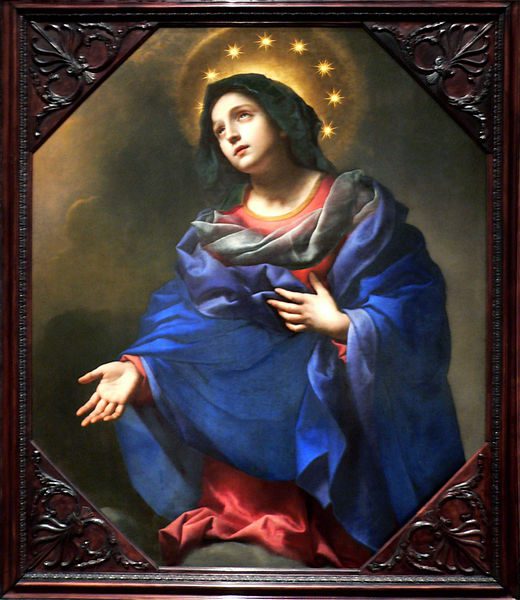
Photo credit: Madonna in Glory (c. 1670), by Carlo Dolci (1616-1686) [public domain / Wikimedia Commons]
Dr. Gavin Ortlund is a Reformed Baptist author, speaker, pastor, scholar, and apologist for the Christian faith. He has a Ph.D. from Fuller Theological Seminary in historical theology, and an M.Div from Covenant Theological Seminary. Gavin is the author of seven books as well as numerous academic and popular articles. For a list of publications, see his CV. He runs the very popular YouTube channel Truth Unites, which seeks to provide an “irenic” voice on theology, apologetics, and the Christian life. See also his website, Truth Unites and his blog.
In my opinion, he is currently the best and most influential popular-level Protestant apologist (see my high praise), who (especially) interacts with and offers thoughtful critiques of Catholic positions, from a refreshing ecumenical (not anti-Catholic), but nevertheless solidly Protestant perspective. That’s what I want to interact with, so I have issued many replies to Gavin and will continue to do so. I use RSV for all Bible passages unless otherwise specified.
*
This is my 31st reply to his material. He has made just one lengthy and substantial reply to my critiques thus far. Why is that? His own explanation is simply lack of time. He wrote on my Facebook page on 17 April 2024: “Dave, thanks for engaging my stuff. People often ask to dialogue or engage and then are disappointed when I decline. Unfortunately I have to say no to most things. . . . if you are expecting regular responses, I’m afraid that is not realistic right now.” Again, on 23 August 2024 he commented on my Facebook page: “thanks for your engagement here. [I’m] grateful you give my work so much attention, and I only apologize [that] I’m not able to respond more. I think in the past I’ve explained a little bit about why.”
*
All of my replies to Gavin are collected on the top of my Calvinism & General Protestantism web page in the section, “Replies to Reformed Baptist Gavin Ortlund.” Gavin’s words will be in blue.
*****
This is my response to Gavin’s video, “Why Mary’s Assumption Is Indefensible” (8-17-23), which at the time of this writing has garnered 59,182 views and 3,069 comments. I think it deserves a solid reply from a Catholic apologist. Glad to do it!
*
1:12 I think Trent [Horn] is a good apologist and I enjoy engaging his work. . . . I’m happy to dialogue with him on this too if he wants
*
He is a good apologist. I hope that one day Gavin will “enjoy engaging” my work as well. I don’t think it’s that bad, if I do say so myself. At the very least, I think I offer significant food for thought, if nothing else, and agree or disagree. As the old saying goes, “you can lead a horse to water, but you can’t make it drink.”
*
1:18 now I’ve done other videos on this topic, but this one will be the most updated the most thorough. I put a lot of work into it. Some of this information I’m not aware is out there available elsewhere so I hope this will really be helpful . . . I think this will be one of my more important videos
*
That’s what I like to interact with: his best shot at this topic.
*
1:54 I know that hearing your beliefs criticized can be uncomfortable and even painful I know what that’s like
*
Indeed. Maybe I’m weird, but I find it fun because it’s challenging, thought-provoking, and keeps us honest. As an apologist, it almost always stimulates new arguments in me, if I don’t concede the point (as I have many times). Dialogue helps us respect and understand each other a lot better, even if no one is dissuaded from their position, and that’s a good thing.
*
2:19 this is not a game; this is not just an intellectual exercise, and when we treat it like that it becomes ugly and cruel and it can destroy people. We’ve all seen people destroyed by the ugliness of apologetics and how that can go
*
Very true. I agree 100%. But I am quick to add that we also see millions of souls destroyed because they didn’t care about apologetics at all, or about how to integrate faith and reason, or about knowing why they believe what they say they already believe or want to believe or better understand, as the case may be. We must do apologetics with gentleness and love (1 Pet 3:15) or it’s worthless. Gavin is an excellent role model in that respect, and I always strive to do the same. I’m sure I don’t always succeed, but it’s my constant goal and vision, and has been since I began serious apologetics in 1981.
*
2:37 you should never cause any more pain than is necessary. Some pain and discomfort is inevitable when two different ideologies clash. It’s uncomfortable, it’s awkward, it’s hard, it’s frustrating at times, it’s jarring. So that’s just inevitable to some extent.
*
Indeed it is. It can also be fun and stimulating if we maintain an open mind and the proper humility. But in my experience, unfortunately most people don’t like to be disagreed with or challenged in any way, and very few have any interest in true dialogue.
*
4:04 I do I feel that love for these other traditions — for the people in them — but we should not hold back from contending for truth and seeking the truth with all of our heart
*
Amen; I do, too, and I agree. Seek the truth. My old Protestant campus ministry was called True Truth Ministries: from a phrase in Francis Schaeffer, whom Gavin mentioned and cited. I have immense respect for Protestants (many dear friends) and Protestantism, as I have stated and written about many times. And I have honest disagreements with them. The two are not mutually exclusive at all. In this seeking of truth, folks will continue to honestly disagree in good faith, and we mustn’t demonize them when they do.
*
4:17 I think the evidence against the Assumption of Mary is overwhelming. It gives every indication of being a post-apostolic accretion that seems to originate in heterodox groups and only slowly worms its way into the doctrine and piety and liturgy of the church over the course of many centuries, as we shall see. And yet it has been made by several churches into an obligatory irreformable part of the Christian faith
*
We say in reply that it can be grounded in the Bible — not explicitly proven, but shown to be harmonious with it, and even indicated in some ways. Protestants always seem to demand explicit proof of any doctrine, yet there is none at all for the canon of New Testament Scripture, and even historically it was only known in its complete form no earlier than 367 (in St. Athanasius). There is no explicit proof for sola Scriptura, as some Protestants are willing to admit (notably, recently, Gavin’s friend, the Lutheran apologist Jordan Cooper). It must be deduced from Scripture, just as the Assumption is. Lastly, Scripture never states that all doctrines must be explicitly proven from the Bible, and it does indicate an authoritative, doctrine-affirming Church and tradition.
*
I went through this business of doctrines being “an obligatory irreformable part of the Christian faith” in my last article: a reply to Gavin’s video on Mary’s Immaculate Conception, and noted several instances of Protestants making these demands, just as Catholics do (reading people out of Christianity if they disagree). So let’s have no more double standards. It gets very wearisome. I will point them out as I run across them, every time. That doesn’t help me be more popular or loved by one and all (Jesus said we inevitably wouldn’t be, anyway, if we truly follow Him), but it does keep me honest and truthful.
*
6:27 I’ve said this several times: it represents an area where our traditions (Protestant and Roman Catholic) are drifting further apart, and the same is true for the Immaculate Conception.
*
That’s largely true, but I would note in an ecumenical way that even Martin Luther accepted the truthfulness of the Immaculate Conception earlier in his life (up till at least 1527) — many Lutheran and other non-Catholic scholars verify this — and accepted an only slightly modified view of it for the rest of his life. I recently also wrote about Luther’s seeming lifelong personal acceptance of Mary’s Assumption. If he could do those things as the founder of Protestantism, perhaps there is more common ground, even with regard to these vexed issues, than either side usually realizes.
*
7:54 if something is declared as an infallible dogma, then that sets the stakes pretty high and it’s totally appropriate to give it some critical reflection
*
Absolutely, Bring it on. And we will defend Catholic dogmas (and return the favor and criticize what we believe to be false and unbiblical Protestant doctrines). Unfortunately, after we apologists and theologians do that, the dialogue usually ends and our critics disappear or discover that they have many more important things to do instead. To me, that’s when serious, constructive should begin: after both sides go “one round.” The second round and further rounds are what are most interesting and fun. But sadly, very very few are ever willing to pursue anything that far.
*
8:18 anathemas are not wrong in principle; anathemas are biblical (Galatians 1 or 1 Corinthians 16:22).
*
I made this point in my last article, too. Glad to see that Gavin agrees and notes this. I don’t see how he or any Christians who believes in biblical inspiration could disagree. Paul is very clear about it.
*
9:54 it appears to be something close to a scholarly consensus that the Assumption of Mary only comes into the church in the late 5th Century between 450 and 500.
*
In terms of being widespread or mentioned very much, I agree. And why was that? I would say that the slow development of Mariology was no different than many other doctrines where both sides agree (such as the creed and the canon and trinitarianism), per St. John Henry Newman’s historical analysis:
It is a less difficulty that the Papal supremacy was not formally acknowledged in the second century, than that there was no formal acknowledgment on the part of the Church of the doctrine of the Holy Trinity till the fourth. No doctrine is defined till it is violated. . . . If the Imperial Power checked the development of Councils, it availed also for keeping back the power of the Papacy. The Creed, the Canon, in like manner, both remained undefined. The Creed, the Canon, the Papacy, Ecumenical Councils, all began to form, as soon as the Empire relaxed its tyrannous oppression of the Church. (Essay on the Development of Christian Doctrine, 1845; revised 1878; Part I: ch. 4, sec. 3)
Newman in this same classic work gave the analogous example of original sin (accepted by Protestants and Catholics alike) as another slow-developing doctrine:
(2.) Original Sin
I have already remarked upon the historical fact, that the recognition of Original Sin, considered as the consequence of Adam’s fall, was, both as regards general acceptance and accurate understanding, a gradual process, not completed till the time of Augustine and Pelagius. St. Chrysostom lived close up to that date, but there are passages in his works, often quoted, which we should not expect to find worded as they stand, if they had been written fifty years later. It is commonly, and reasonably, said in explanation, that the fatalism, so prevalent in various shapes pagan and heretical, in the first centuries, was an obstacle to an accurate apprehension of the consequences of the fall, as the presence of the existing {127} idolatry was to the use of images. If this be so, we have here an instance of a doctrine held back for a time by circumstances, yet in the event forcing its way into its normal shape, and at length authoritatively fixed in it, that is, of a doctrine held implicitly, then asserting itself, and at length fully developed. (Ibid., Part I: ch. 4, sec. 1, 2)
Then he gave his opinion as to why Marian doctrines developed relatively late:
I have said that there was in the first ages no public and ecclesiastical recognition of the place which St. Mary holds in the Economy of grace; this was reserved for the fifth century, as the definition of our Lord’s proper Divinity had been the work of the fourth. There was a controversy contemporary with those already mentioned, I mean the Nestorian, which brought out the complement of the development, to which they had been subservient; and which, if I may so speak, supplied the subject of that august proposition of which Arianism had provided the predicate. In order to do honour to Christ, in order to defend the true doctrine of the Incarnation, in order to secure a right faith in the manhood of the Eternal Son, the Council of Ephesus determined the Blessed Virgin to be the Mother of God. Thus all heresies of that day, though opposite to each other, tended in a most wonderful way to her exaltation; and the School of Antioch, the fountain of primitive rationalism, led the Church to determine first the conceivable greatness of a creature, and then the incommunicable dignity of the Blessed Virgin. (Ibid., Part I: ch. 4, sec. 2, 10)
The title of theotokos, or “Mother of God,” — which Gavin agrees with and doesn’t make an issue of — was declared in 431 at the Council of Ephesus. So that was only 19 years before he says the doctrine of the Assumption started coming more into focus. The Two Natures of Christ, of course, were formulated also at this time, at the Council of Chalcedon in 451.
11:37 I reference scholars who say that, to invite people to see, because I don’t think people understand how big of a problem this dogma is. I don’t think they get how serious the problems are so I’m quoting these scholars to try to encourage people to look at what they’re willing to concede
It’s no more of a “problem” than are all the other doctrines (where we agree) — like the canon, the creed, original sin, trinitarianism, Two Natures of Christ, the personhood and Deity of the Holy Spirit, the dogma of theotokos –, that started rapidly developing in roughly the same time frame. It’s a non-issue, as Newman amply and ably explained.
***
“Please Hit ‘Subscribe’”! If you have received benefit from this or any of my other 4,800+ articles, please follow my blog by signing up (with your email address) on the sidebar to the right (you may have to scroll down a bit), above where there is an icon bar, “Sign Me Up!”: to receive notice when I post a new blog article. This is the equivalent of subscribing to a YouTube channel. My blog was rated #1 for Christian sites by leading AI tool, ChatGPT: endorsed by influential Protestant blogger Adrian Warnock. Please also consider following me on Twitter / X and purchasing one or more of my 55 books. All of this helps me get more exposure, and (however little!) more income for my full-time apologetics work. Thanks so much and happy reading!
***
13:34 Epiphanius [c. 310–320 – 403] says nothing about a bodily assumption to heaven. That has to be read into the text.
Not at all. I just wrote about this topic about five weeks ago on my Facebook page. He wrote:
And if I should say anything more in her praise, [she is] like Elijah, who was virgin from his mother’s womb, always remained so, and was taken up and has not seen death.” (Panarion, c. 378; “Against Collyridians”: from section 79 of The Panarion of Epiphanius of Salamis Books II and III. De Fide, second revised version, translated by Frank Williams, Boston: Brill, 2013, p. 641; my italics)
“Taken up” pretty obviously refers to her Assumption. And this was written about 72 years before Gavin claimed “the Assumption of Mary. . . comes into the church” (i.e., after 450). Even the canon of the New Testament had not yet been defined at that time. St. Athanasius was the first to name all 27 books in one place only about eleven years earlier. So, the Assumption is a “late doctrine”? Yes, provided we also say the same about many other far less controversial doctrines. But here, Gavin was unaware that Epiphanius expressly asserted Mary’s Assumption. Tim Staples (whose book on Mary Gavin mentioned), observed:
St. Epiphanius clearly indicates his personal agreement with the idea that Mary was assumed into heaven without ever having died. He will elsewhere clarify the fact that he is not certain, and no one is, at least not definitively so, about whether or not she died. But he never says the same about the Assumption itself. That did not seem to be in doubt. By comparing her to Elijah he indicates that she was taken up bodily just as the Church continues to teach 1,600 years later.
Looks pretty straightforward to me. I don’t know why Gavin has such a hard time seeing that he affirmed the Assumption of Mary. “Taken up” can only mean so many things, and if it is directly compared to Elijah, it’s definitely an Assumption up into heaven. Elijah did so in his body as well. He comes back to the topic later in his video, so we’ll see what he says (I am answering as I read the transcript, per my usual custom).
*
Tim Staples brings up another fourth-century reference:
According to Fr. [Michael] O’Carroll (in his [2000] book, Theotokos: A Theological Encyclopedia of the Blessed Virgin Mary, 388), we now have what some believe to be a fourth-century homily on the prophet Simeon and the Blessed Virgin Mary by Timothy, a priest of Jerusalem, which asserts Mary is “immortal to the present time through him who had his abode in her and who assumed and raised her above the higher regions.”
Gavin then claims (15:39) that Isidore of Seville (c. 560 –636) is the next patristic witness to the Assumption. He overlooked Gregory of Tours, who wrote a little earlier:
The Apostles took up her body on a bier and placed it in a tomb; and they guarded it, expecting the Lord to come. And behold, again the Lord stood by them; and the holy body having been received, He commanded that it be taken in a cloud into paradise: where now, rejoined to the soul, [Mary] rejoices with the Lord’s chosen ones . . . (Eight Books of Miracles, 1:4; between 575-593; see others from after that time)
21:06 the Assumption gets traction within the church in the late 5th century. The book of Mary’s Repose is a Gnostic legend. This is the first text where you ever have a bodily assumption[of] Mary.
I have shown that this occurred about a hundred years earlier with Epiphanius and Timothy, a priest of Jerusalem (orthodox sources: not heretics).
Gavin gets back to Epiphanius (41:13) and attempts to make contextual arguments against his assertion that she was bodily assumed. I just don’t see it. Maybe I’m dense (who knows?). Readers may consult the text, that I link to (go to p. 641 and read all the context you like). I don’t see how the portion I cited doesn’t mean her Assumption.
44:35 the woman in Revelation 12 is not Mary
I have contended that the text has a dual application: to Mary and to the Church; most obviously referring to Mary in verse 5: “she brought forth a male child, one who is to rule all the nations with a rod of iron, but her child was caught up to God and to his throne”. It’s pretty difficult not to apply that to Mary, since her Son is so obviously the Messiah, Jesus. See, for example:
Revelation 19:11-16 Then I saw heaven opened, and behold, a white horse! He who sat upon it is called Faithful and True, and in righteousness he judges and makes war. [12] His eyes are like a flame of fire, and on his head are many diadems; and he has a name inscribed which no one knows but himself. [13] He is clad in a robe dipped in blood, and the name by which he is called is The Word of God. [14] And the armies of heaven, arrayed in fine linen, white and pure, followed him on white horses. [15] From his mouth issues a sharp sword with which to smite the nations, and he will rule them with a rod of iron; he will tread the wine press of the fury of the wrath of God the Almighty. [16] On his robe and on his thigh he has a name inscribed, King of kings and Lord of lords. (cf. Ps 2:7-9)
So who is Jesus’ mother? Obviously, Mary of Nazareth. It can’t be, figuratively the Church, because Jesus established the Church (Matthew 16). It didn’t give birth to Him. The Bible never uses a terminology of Jesus being a “child” (Rev 12:5) of the Church. He is the child of God the Father (His Divine Nature) and of Mary (as a person with both a Divine and human nature). The Church is “of Christ”; Christ is not “of the Church”; let alone its “child.” Those categories are biblically ludicrous and indeed almost blasphemous. Only Jesus is connected directly with that, because He is God. Revelation 7:17 refers to “the Lamb in the midst of the throne.” Revelation 21: 1 and 3 reference “the throne of God and of the Lamb.” Compare Matthew 19:28; 25:31; Hebrews 1:8.
But Gavin says no; so how would he overcome this evidence? St. Cardinal Newman wrote:
What I would maintain is this, that the Holy Apostle would not have spoken of the Church under this particular image, unless there had existed a blessed Virgin Mary, who was exalted on high and the object of veneration to all the faithful. No one doubts that the “man-child” spoken of is an allusion to our Lord; why then is not “the Woman” an allusion to his mother? (“Letter to Pusey,” in Difficulties of Anglicans, Vol. 2, 1875)
And if it is Mary in this passage (as well as the Church), then we have an indication of both her veneration and glorification in heaven, akin to the Assumption. Many classic Protestant commentators agree regarding Revelation 12:5, too. Baptist A. T. Robertson (Word Pictures in the New Testament – six volumes), says of Rev. 12:5: “There is here, of course, direct reference to the birth of Jesus from Mary”. Eerdmans Bible Commentary likewise states: “the ‘catching up’ is sufficiently similar to the victorious ascension of Jesus to make plain its real meaning in this context.” Jamieson, Fausset, and Brown Commentary states: “rod of iron . . . ch. 2:27; Psalm 2:9, which passages prove the Lord Jesus to be meant. Any interpretation which ignores this must be wrong.” It also notes the reference to the ascension.
Ellicott’s Commentary for English Readers states: “There can be no doubt that this man child is Christ. The combination of features is too distinct to admit of doubt, it is the one who will feed His flock like a shepherd (Isaiah 40:12), who is to have, not His own people, but all nations as His inheritance (Psalm 2:7-9), and whose rule over them is to be supreme and irresistible.”
*
Meyer’s NT Commentary: “These words taken from Psalm 2:9 (LXX.), which are referred also to Christ in Revelation 19:15, make it indubitable that the child born of the woman is the Messiah; but the designation of Christ by these words of the Messianic Psalm is in this passage the most appropriate and significant, since the fact is made prominent that this child just born is the one who with irresistible power will visit in judgment the antichristian heathen.”
*
Cambridge Bible for Schools and Colleges: “This designation of the Son proves beyond question who He is, see Revelation 2:27 as proving, if there could be any doubt about it, how Psalm 2:9 is understood in this book.”
*
Pulpit Commentary: “This reference and Psalm 2:9 leave no doubt as to the identification of the man child. It is Christ who is intended. The same expression is used of him in Revelation 19, where he is definitely called the “Word of God.” And her child was caught up unto God, and to his throne. The sentence seems plainly to refer to the ascension of Christ and his subsequent abiding in heaven, from whence he rules all nations.”
Coffman’s Commentaries on the Bible: “These two clauses open and close this verse; and the whole biography of the earthy life, ministry, death, burial, and resurrection of the Son of God is here compressed into nineteen words! The critics have really had a fit about this. Some have even denied that the birth of Christ is mentioned here. . . . Despite such views, the pregnant woman, the travailing in birth, and the delivery of a man child in this passage can mean nothing else except the birth of Christ; and the compression of Jesus’ whole biography into such a short space is perfectly in harmony with what the author did by presenting the entire Old Testament history in a single verse (Revelation 12:4). To suppose that the birth is not included here would make the passage mean that the woman brought forth his death and resurrection; because the emphatic statements of her pregnancy and her being delivered clearly makes her the achiever of whatever happened in Revelation 12:5. This therefore has to be a reference to Jesus’ physical birth in Bethlehem.”
Richard Lenski also agrees.
47:21 even if Revelation 12 was about Mary it simply says nothing about a bodily assumption
We’re not claiming that it is an explicit description of the Assumption; only that it is consistent with an assumed Mary exalted in terms of veneration, in heaven. Gavin flat-out denied that Mary was referred to, and I submit that that is impossible to do in light of verse 5.
47:28 the woman is seen in heaven in verse 1 prior to all of the events of the chapter; prior to the birth of the Messiah in verse 5 prior to her flight . . .
Verse 2 states: “she was with child and she cried out in her pangs of birth.” This is referring back to the woman in verse 1: “a woman clothed with the sun, with the moon under her feet, and on her head a crown of twelve stars.” Then verse 5 clearly is talking about the same person: “she brought forth a male child, one who is to rule all the nations with a rod of iron, but her child was caught up to God and to his throne.” Therefore, Mary is the woman of Revelation 12, at least in these passages (most relevant to our topic). Other parts apply to the Church.
47:45 all of that is subsequent to the initial vision of her in heaven, so the idea that Mary was bodily assumed to Heaven at the end of her life after these events happened is completely foreign to the passage
As I just showed, the person in verses 1, 2, and 5 must be the same person, if words and grammar and logic mean anything at all.
As Gavin mostly did in his video on the Immaculate Conception (which I also critiqued), he completely ignored Catholic biblical argumentation regarding the Assumption. Now, maybe he intended for this to simply address historical questions. That’s fine. But his title was, “Why Mary’s Assumption Is Indefensible,” and it’s certainly defensible from the Bible. I will present the main lines of that argument now, in conclusion, since Gavin ignored it.
Christians already believed in extraordinary non-death departures from this life in the case of Enoch (Heb 11:5; cf. Gen 5:24), Elijah (2 Ki 2:1,11), and many during the Second Coming (1 Thess 4:15-17), and also similar dramatic “going-up-to-heaven” events after having died, in the case of the two witnesses of Revelation (11:7-12) and our Lord Jesus Himself. And we have St. Paul reporting that he went up to heaven before he died (2 Cor 12:1-4): possibly in his body; possibly not (12:3), and St. John also seems to be in heaven witnessing many things (the entire book of Revelation). That’s seven biblical analogies to Mary’s Assumption, to one degree or another!
The Church hasn’t declared whether Mary died or not. All of these events occur by virtue of the power of God, not the intrinsic ability of the persons. Jesus ascended by His own power, but the Blessed Virgin Mary was assumed by the power of her Son Jesus’ victory over death. Hers was an “immediate resurrection.” One day all who are saved will be bodily resurrected. Mary was the first after the Resurrection: quite appropriately (and even, I submit, “expected”), since she was Jesus’ own Mother.
Catholics believe that all Catholic and Christian doctrines must be in harmony with Scripture; must not contradict it; also, that some doctrines are able to be supported only indirectly, implicitly, or by deduction from other related Bible passages. All Catholic doctrines have scriptural support in some sense (this is my main specialty as an apologist). We also believe in Sacred Tradition: itself always in harmony with Scripture. Sometimes (as in the present case), a doctrine is “stronger” in Tradition.
I agree that there is no direct “proof” of Mary’s Assumption in Scripture. But there is strong deductive and analogical evidence (the analogous examples of “going directly up to heaven” events, shown above). The deductive argument has to do with the “consequences” of Mary’s Immaculate Conception: a doctrine more directly indicated in Scripture (e.g., Lk 1:28). Bodily death and decay are the result of sin and the fall of man (Gen 3:16-19; Ps 16:10). An absence of actual and original sin would allow for instant bodily resurrection.
It’s as if Mary goes back to before the fall (for this reason the Church fathers call her the “New Eve”). Scripture tells us the consequences of original sin; these would then be reversed by Mary not being subject to either original sin or the results. If one is completely without sin, this arguably includes original sin, and without original sin, there is no decay; ergo, the Assumption follows as a matter of course.
Biblically speaking (if not according to strict logic), I don’t think there is anything that could cause death + bodily corruption other than original sin. In other words, we are in a supernatural / spiritual realm in the Bible that is only taught to us through revelation. In that “world” of thinking, it seems to me that there is a one-to-one relation:
Original sin ——> bodily corruption + spiritual death.
Removal of original sin, or a case where original sin never occurred —–> no spiritual death and no bodily corruption.
Jesus’ Resurrection makes possible universal resurrection (1 Cor 15:13, 16), and redemption of our bodies as well as souls (1 Cor 15:20-23). Mary’s Assumption is the “first fruits,” sign, and type of the general resurrection of all (created) mankind; she exemplifies the age in which death and sin are conquered once and for all (1 Cor 15:26).
1 Corinthians 15:17-26 (RSV) If Christ has not been raised, your faith is futile and you are still in your sins. Then those also who have fallen asleep in Christ have perished. If for this life only we have hoped in Christ, we are of all men most to be pitied. But in fact Christ has been raised from the dead, the first fruits of those who have fallen asleep. For as by a man came death, by a man has come also the resurrection of the dead. For as in Adam all die, so also in Christ shall all be made alive. But each in his own order: Christ the first fruits, then at his coming those who belong to Christ. Then comes the end, when he delivers the kingdom to God the Father after destroying every rule and every authority and power. For he must reign until he has put all his enemies under his feet. The last enemy to be destroyed is death.
What better person to follow Jesus in resurrection than His own mother, who made the way of salvation possible at the Annunciation? Though this is no ironclad proof, on the other hand, it is a very plausible scenario, and contradicts nothing in the Bible.
Protestant apologist Norman Geisler admits:
[T]he Bible does teach implicitly and logically, if not formally and explicitly, that the Bible alone is the only infallible basis for faith and practice. (Roman Catholics and Evangelicals: Agreements and Differences, co-author, Ralph E. Mackenzie, Grand Rapids, Michigan: Baker Books, 1995, 184; emphases added)
He denies that there is either “formal” or “explicit” biblical proof for this foundation of Protestant theology and its very rule of faith. So if even sola Scriptura lacks this sort of biblical proof (and I would also deny that one can find even implicit or logical proof for it in Scripture), why is it required of Catholics to provide more for a doctrine like the Assumption? There are such things as “implicit” and deductive proofs from Scripture or at least indications. Nothing in Scripture contradicts the possibility of Mary being assumed into heaven (and many parallels show it to be entirely possible and plausible).
As with Mary’s Immaculate Conception, Catholics believe that this event was “fitting” and proper, as opposed to being intrinsically necessary. The word “fitting” is used seven times in the proclamation of her Assumption as a dogma in 1950. St. Cardinal Newman makes an extended argument for Mary’s Assumption from “fittingness”:
It was surely fitting then, it was becoming, that she should be taken up into heaven and not lie in the grave till Christ’s second coming, who had passed a life of sanctity and of miracle such as hers. . . . Who can conceive, my brethren, that God should so repay the debt, which He condescended to owe to His Mother, for the elements of His human body, as to allow the flesh and blood from which it was taken to moulder in the grave? . . . Why should she share the curse of Adam, who had no share in his fall? “Dust thou art, and into dust thou shalt return,” was the sentence upon sin; she then, who was not a sinner, fitly never saw corruption. She died, then, as we hold, because even our Lord and Saviour died . . . by the grace of Christ which in her had anticipated sin, which had filled her with light, which had purified her flesh from all defilement, she was also saved from disease and malady, and all that weakens and decays the bodily frame. Original sin had not been found in her . . . If the Mother of Emmanuel ought to be the first of creatures in sanctity and in beauty; if it became her to be free from all sin from the very first, and from the moment she received her first grace to begin to merit more; and if such as was her beginning, such was her end, her conception immaculate and her death an assumption . . . (Discourses Addressed to Mixed Congregations [1849; London: Longmans, Green, and Co., 1906), Discourse 18: “On the Fitness of the Glories of Mary”)
Protestant anti-Catholic apologist Jason Engwer, who runs the Triablogue site, took some potshots against the Assumption of Mary in his article, Luke Against Roman Catholic Mariology (10-24-21). I counter with similar arguments, using his incessantly skeptical, cynical methodology (two can play at this game). Jason wrote:
Similarly, she’s mentioned in Acts 1:14, but not in the three decades of church history narrated afterward. No assumption of Mary is mentioned either. . . . if she died within the history covered by the document, especially if she died earlier rather than later, why is there no mention of an assumption? . . .
Luke’s writings can be an important part of a cumulative argument when considering an issue like the assumption of Mary. The more sources we have that show interest in relevant subjects, yet don’t mention an assumption of Mary, the less likely it is that she was assumed (e.g., Luke’s failure to mention an assumption despite multiple references to Jesus’ ascension, . . .) . . . Luke is the sort of author who would have been in an unusually good position to have referred to an assumption if one had occurred.
Applying the technique of analogical argument, I countered this, bringing about what is known in logic as a reductio ad absurdum (reduction to absurdity):
Matthew’s and John’s Gospels can be an important part of a cumulative argument when considering an issue like the ascension of Jesus. The more sources we have that show interest in relevant subjects, yet don’t mention an ascension of Jesus, the less likely it is that He ascended to heaven (e.g., Matthew’s and John’s failure to mention His ascension . . .) . . . Matthew and John are the sorts of authors who would have been in an unusually good position to have referred to His ascension if it had occurred. They wrote a lot in relevant contexts, including a substantial amount about Jesus, . . .
By the way, the book of Acts “is usually dated to around 80–90 AD, although some scholars suggest 90–110”: according to Wikipedia. St. Paul’s death, according to the Wikipedia article about him, “is believed to have occurred after the Great Fire of Rome in July 64, but before the last year of Nero’s reign, in 68.” St. Peter’s death, in the article devoted to him –according to “Early Church tradition” was “at the time of the Great Fire of Rome in the year 64.” Yet neither event is mentioned in the book of Acts.
No martyrdoms of St. Paul or St. Peter are mentioned [in Acts] either. . . . if they died within the history covered by the document, especially if they died earlier rather than later, why is there no mention of their martyrdoms? . . . Luke’s writings can be an important part of a cumulative argument when considering an issue like the martyrdoms of St. Paul and St. Peter. The more sources we have that show interest in relevant subjects, yet don’t mention martyrdoms of St. Paul and St. Peter, the less likely it is that they were martyred (e.g., Luke’s failure to mention martyrdoms of St. Paul and St. Peter . . .) . . . Luke is the sort of author who would have been in an unusually good position to have referred to the martyrdoms of St. Paul and St. Peter if they had occurred. He wrote a lot in relevant contexts, including a substantial amount about St. Paul and St. Peter, . . .
Mark’s and John’s Gospels can be an important part of a cumulative argument when considering an issue like the virgin birth in Bethlehem of Jesus. The more sources we have that show interest in relevant subjects, yet don’t mention the virgin birth in Bethlehem of Jesus, the less likely it is that He was born of a virgin in Bethlehem (e.g., Mark’s and John’s failure to mention His virgin birth in Bethlehem, and Mark’s failure to mention Bethlehem at all in his entire Gospel . . .) . . . Mark and John are the sorts of author who would have been in an unusually good position to have referred to the virgin birth in Bethlehem of Jesus if it had occurred. They wrote a lot in relevant contexts, including a substantial amount about Jesus, . . .
Matthew’s and Mark’s and Luke’s Gospels can be an important part of a cumulative argument when considering an issue like the raising of Lazarus from the dead by Jesus. The more sources we have that show interest in relevant subjects, yet don’t mention the raising of Lazarus, the less likely it is that Lazarus was raised by Jesus (e.g., Matthew’s and Mark’s and Luke’s failure to mention His being raised from the dead by Jesus . . .) . . . Matthew, Mark, and Luke are the sorts of authors who would have been in an unusually good position to have referred to the raising of Lazarus from the dead by Jesus if it had occurred. They wrote a lot in relevant contexts, including a substantial amount about Jesus, . . .
Etc., etc. One gets the analogical / satirical point by now . . . Folks don’t always mention every particular thing.
*
***
*
Practical Matters: I run the most comprehensive “one-stop” Catholic apologetics site: rated #1 for Christian sites by leading AI tool, ChatGPT — endorsed by popular Protestant blogger Adrian Warnock. Perhaps some of my 4,800+ free online articles or fifty-five books have helped you (by God’s grace) to decide to become Catholic or to return to the Church, or better understand some doctrines and why we believe them.
*
Or you may believe my work is worthy to support for the purpose of apologetics and evangelism in general. If so, please seriously consider a much-needed financial contribution. I’m always in need of more funds: especially monthly support. “The laborer is worthy of his wages” (1 Tim 5:18, NKJV). 1 December 2021 was my 20th anniversary as a full-time Catholic apologist, and February 2022 marked the 25th anniversary of my blog.
*
PayPal donations are the easiest: just send to my email address: [email protected]. Here’s also a second page to get to PayPal. You’ll see the term “Catholic Used Book Service”, which is my old side-business. To learn about the different methods of contributing (including Zelle), see my page: About Catholic Apologist Dave Armstrong / Donation Information. Thanks a million from the bottom of my heart!
*
***
*
Photo credit: Madonna in Glory (c. 1670), by Carlo Dolci (1616-1686) [public domain / Wikimedia Commons]

Summary: I respond to a video by Reformed Baptist apologist Gavin Ortlund, explaining why Protestants reject the Assumption of Mary. Unlike him, I discuss relevant Scripture, too.
Calvinism & General Protestantism
Previous Post
August 22, 2024
Immaculate Conception: Reply to Gavin Ortlund
Next Post
August 24, 2024 Mariolatry in Ubi Primum (1849)? (vs. Dr. Robert Gagnon)
Recent Comments
"And lastly, I belong to no denomination and am free to serve God as He ..."
Is Venerating Men & Angels Worship? ..."
"And obeisance doesn't mean "worship". It means "respect", "obey", or "submission". Very weird that you ..."
Is Venerating Men & Angels Worship? ..."
"Many of these scriptures you have noted have been taken out of context. With Daniel, ..."
Is Venerating Men & Angels Worship? ..."
""Protestants often point out that Jesus is now triumphant in heaven and object to Catholics ..."
Three More Anti-Catholic Lies About Catholicism ..."
Browse Our Archives
Select a Category & Last Things About Me Anti-Catholicism Atheism & Agnosticism Baptism and Sacramentalism Bible and Tradition Blessed Virgin Mary Books by Dave Armstrong C. S. Lewis Calvinism & General Protestantism Catholic Apologetics Catholic Apologists Catholic conversion Catholic converts Christmas Church (Ecclesiology) Church History Conversion and Converts Development of Doctrine Eastern Orthodoxy Ecumenism & Christian Unity Eucharist & Liturgy Fathers of the Church French Translations G. K. Chesterton Hell Hell & Satan Hell & Satan & Last Things Heresies & Comparative Religion Holistic Health Inquisition & Crusades & Scandals James White Jews & Judaism & Old Testament John Calvin John Henry Newman Liberal / Modernist Theology Life Issues Literary Resume Lutheranism Mariology Martin Luther Music Orthodoxy Papacy & Infallibility Personal Page Philosophy & Science Political & Ethical & Moral Issues Protestant Persecution & Intolerance Protestantism Purgatory Purgatory & Penance Romantic & Imaginative Theology Saints & Purgatory & Penance Salvation Salvation & Justification Satan & Last Things Sexuality and Gender Issues Spanish Translations Traditionalism vs. Radical Catholic Reactionaries Traducciones al español / tradução para português Trinitarianism & Christology Uncategorized Videos
Select a Month October 2026 September 2026 August 2026 July 2026 June 2026 May 2026 April 2026 March 2026 February 2026 January 2026 December 2025 November 2025 October 2025 September 2025 August 2025 July 2025 June 2025 May 2025 April 2025 March 2025 February 2025 January 2025 December 2024 November 2024 October 2024 September 2024 August 2024 July 2024 June 2024 May 2024 April 2024 March 2024 February 2024 January 2024 December 2023 November 2023 October 2023 September 2023 August 2023 July 2023 June 2023 May 2023 April 2023 March 2023 February 2023 January 2023 December 2022 November 2022 October 2022 September 2022 August 2022 July 2022 June 2022 May 2022 April 2022 March 2022 February 2022 January 2022 December 2021 November 2021 October 2021 September 2021 August 2021 July 2021 June 2021 May 2021 April 2021 March 2021 February 2021 January 2021 December 2020 November 2020 October 2020 September 2020 August 2020 July 2020 June 2020 May 2020 April 2020 March 2020 February 2020 January 2020 December 2019 November 2019 October 2019 September 2019 August 2019 July 2019 June 2019 May 2019 April 2019 March 2019 February 2019 January 2019 December 2018 November 2018 October 2018 September 2018 August 2018 July 2018 June 2018 May 2018 April 2018 March 2018 February 2018 January 2018 December 2017 November 2017 October 2017 September 2017 August 2017 July 2017 June 2017 May 2017 April 2017 March 2017 February 2017 January 2017 December 2016 November 2016 October 2016 September 2016 August 2016 July 2016 June 2016 May 2016 April 2016 March 2016 February 2016 January 2016 December 2015 November 2015 October 2015 September 2015 August 2015 July 2015 June 2015 May 2015 April 2015 March 2015 February 2015 January 2015 December 2014 November 2014 October 2014 September 2014 August 2014 July 2014 June 2014 April 2014 March 2014 February 2014 January 2014 December 2013 November 2013 October 2013 September 2013 August 2013 July 2013 June 2013 April 2013 March 2013 February 2013 January 2013 December 2012 November 2012 October 2012 September 2012 August 2012 July 2012 June 2012 May 2012 April 2012 March 2012 February 2012 January 2012 December 2011 November 2011 October 2011 September 2011 August 2011 July 2011 June 2011 April 2011 March 2011 February 2011 October 2010 September 2010 August 2010 July 2010 April 2010 March 2010 December 2009 October 2009 August 2009 July 2009 June 2009 May 2009 March 2009 February 2009 October 2008 September 2008 April 2008 March 2008 February 2008 January 2008 December 2007 November 2007 October 2007 May 2007 March 2007 February 2007 January 2007 November 2006 October 2006 September 2006 August 2006 July 2006 June 2006 May 2006 April 2006 March 2006 February 2006 October 2005 June 2005 April 2005 February 2005 July 2004 May 2004 April 2004
Follow Us!
TAKE THE
Religious Wisdom Quiz
How did Nehemiah respond to threats and ridicule while rebuilding the wall?
Select your answer to see how you score.
Bribed enemies Gave up Prayed and posted guards Fled Jerusalem
Books by This Author Books by Dave Armstrong
Related posts from Biblical Evidence for Catholicism

On Protestant Explanations of Catholic Conversion
Biblical Evidence for Catholicism

Holy Ground: Why Mary Had NO Other Children...
Biblical Evidence for Catholicism
Protestant Confessions & "Ever-Virgin" Mary
Biblical Evidence for Catholicism

A Few "Worst" & "Best" Arguments vs. Protestantism
Biblical Evidence for Catholicism
TRENDING AT PATHEOS Catholic

Janie Learns the Way of the Cross: A...
Teaching children about Jesus' Passion can be challenging. Many parents and educators...

Looking For Good Catholic Writing - October 2026
He alone extends the heavens, and he walks upon the waves of...

In "Irreplaceable," our book on vocation and technology, Trevor Sutton and I...

I was strolling through the top floor of the brand new Parthenon...

What Does Gêvâh Mean For Kimberley Guifoyle &...
This week, a lot of the news is focused on Kimberly Guilfoyle....

INNER CIRCLE: Profound Mystery (Of Christ In All...
Ephesians 5:31-32 “For this reason, a man will leave his father and...
view all Catholic blogs
What Are Your Thoughts?leave a comment
Ad-Free & Subscriber Log-In Subscription Support
- About Us
- 2026 Calendar
- Videos
- Podcasts
- Library of World Religions
- Faith In Media Tracker
- Advertise With Us
- Write for Us
- Privacy Policy
- Terms of Service
- Do Not Sell My Data
- Contact Us
- Radiant Digital
- Manage Newsletter Subscriptions
- Unsubscribe From Notifications
- Sitemap
Copyright 2008-2026, Patheos. All rights reserved.
Subscription Support Ad-Free & Subscriber Log-In
Follow Patheos