
BuddhistCatholicContemplativeEvangelicalGeneral ChristianHinduJewishLatter-day SaintMuslimNew VisionsProgressive Christian
Beliefs
- Buddhist
- Catholic
- Contemplative
- Evangelical
- General Christian
- Hindu
- Jewish
- Latter-day Saint
- More Voices
- Muslim
- New Visions
- Pagan
- Progressive Christian
Topics
- Religion News
- Food and Religion
- Sports and Religion
- Religious Art
- Religious Music and Entertainment
- Religious Events
- History and Religion
- Style and Religion
- Politics and Religion
- Women in Religion
- Recreation Outdoors and Religion
- Business Finance and Religion
- Careers Workplace and Religion
- Education and Religion
- Family Parenting and Religion
- Health Fitness and Religion
- Home and Religion
- Relationships and Religion
- Technology and Religion
- Travel and Religion
Columnists
- Buddhist Columnists
- Business Finance and Religion Columnists
- Careers Workplace and Religion Columnists
- Catholic Columnists
- Contemplative Columnists
- Education and Religion Columnists
- Evangelists Columnists
- Family Parenting and Religion Columnists
- General Christian Columnists
- Health Fitness and Religion Columnists
- Hindu Columnists
- History and Religion Columnists
- Home and Religion Columnists
- Jewish Columnists
- More Voices Columnists
- Latter Day Columnists
- Muslim Columnists
- New Visions Columnists
- Nonreligious Columnists
- Pagan Columnists
- Politics and Religion Columnists
- Progressive Columnists
- Recreation Outdoors and Religion Columnists
- Relationships and Religion Columnists
- Religion News Columnists
- Religious Art Columnists
- Religious Events Columnists
- Religious Music and Entertainment Columnists
- Sports and Religion Columnists
- Style and Religion Columnists
- Technology and Religion Columnists
- Travel and Religion Columnists
- Women in Religion Columnists
Resource Library
- 2026 Calendar
- Library of World Religions
- The 100 Most Holy Places on Earth
- Patheos Answers
- Podcasts
- Videos
- Faith Leaders Database
- Anglican Episcopalian
- Bahai
- Baptist
- Buddhism
- Christianity
- Confucianism
- Eastern Orthodoxy
- Hinduism
- Holiness and Pentecostal
- ISKCON
- Islam
- Judaism
- Lutheran
- Methodist
- The Church of Jesus Christ of Latter-day Saints
- New Age
- Paganism
- Presbytarian and Reformed
- Protestantism
- Religion Behind the Scenes
- Roman Catholic
- Scientology
- Shia Islam
- Sikhism
- Sufism
- Sunni Islam
- Taoism
- Zen
- See all religions
Research Tools
 Ad-Free & Subscriber Log-In Subscription Support
Ad-Free & Subscriber Log-In Subscription Support
Follow Patheos 

- Trending:
- Forgiveness
- |
- Marriage
- |
- Consciousness
- |
- Death Penalty
- |
- Election
- |
- Halloween

-
About
-
Catholic Apologetics
-
Church History
-
Great Apologists
-
Christian Worldview
-
Protestantism & Misc.
- Home
- Catholic
- History and Religion
- Jesus Rebuked Mary at Cana? (vs. Dr. Robert Gagnon)
Jesus Rebuked Mary at Cana? (vs. Dr. Robert Gagnon)
Last updated on: September 17, 2024 at 11:46 pm by Dave Armstrong
Jesus Rebuked Mary at Cana? (vs. Dr. Robert Gagnon) 2024-09-17T23:46:38-04:00 Dave Armstrong
Patheos Explore the world's faith through different perspectives on religion and spirituality! Patheos has the views of the prevalent religions and spiritualities of the world.
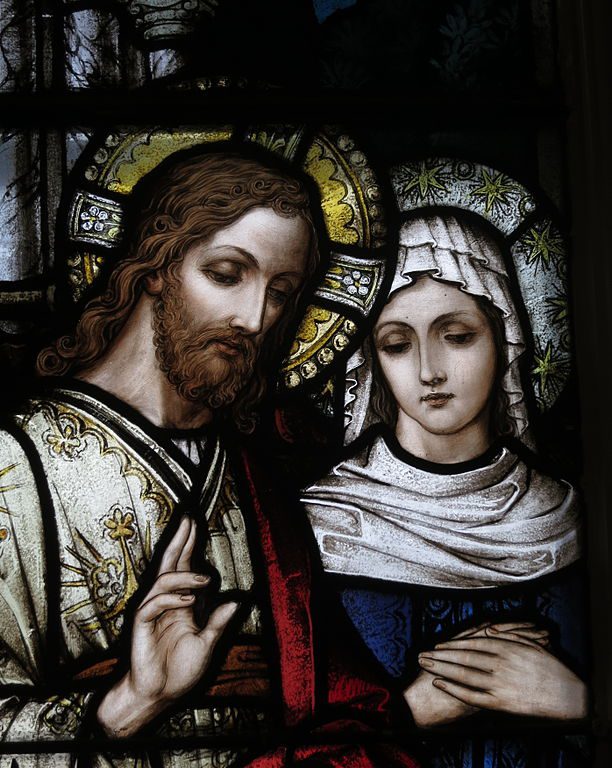
Photo credit: Saint Raphael Catholic Church (Springfield, Ohio) – stained glass, Wedding at Cana – detail (Nheyob: 11-22-14) [Wikimedia Commons / Creative Commons Attribution-Share Alike 4.0 International license]
Dr. Robert A. J. Gagnon (see his Facebook page; public posts) is a Visiting Scholar in Biblical Studies at Wesley Biblical Seminary; formerly Professor of Biblical Studies at Houston Christian University and Associate Professor of New Testament at Pittsburgh Theological Seminary. He obtained a Master of Theological Studies (MTS): Biblical Studies degree from Harvard Divinity School and a (Ph.D.) in New Testament Studies, magna cum laude, from Princeton Theological Seminary. Dr. Gagnon grew up Catholic, and he wrote on 8-17-24:
I didn’t find Christ in Catholicism . . . I lost the forest (the big picture of Christ) for a lot of unnecessary trees that were not scripturally grounded. Part of this . . . was due to some non-scriptural and even (in some cases) anti-scriptural doctrines that undermine the role and significance of Christ. I would love to come back to a purified Catholicism more in keeping with a biblical witness. The excessive adulation of Mary, which at times seems to me to come close to elevating her to the godhead (like a replacement consort for Yahweh in lieu of Asherah), is one such obstacle.
After I had made five in-depth responses to him, Dr. Gagnon replied (just for the record) in a thread on another Facebook page, on 9-17-24, underneath my links to all five: “like your other one, it is an amateurish piece.” This is his silly and arrogant way of dismissing my critiques in one fell swoop. I had informed him that I had over twenty “officially published books” [22, to be exact] and yet he replied that he didn’t know “whether” they were “self-published or with a vanity press or a reputable press.”
His words will be in blue. His article is cited in its entirety. I use RSV for biblical citations.
*****
I’m responding to a public post on his Facebook page, dated 8-17-24.
Another text that Catholics and Orthodox persons cite to elevate Mary in Scripture is the wedding in Cana in John 2:1-11. Yet they don’t realize that in this passage Jesus rebukes his mother.
*
The argument is that Mary “becomes the only person ever to tell Jesus what to do and he (somewhat grudgingly) does it” (as a respected Catholic FB friend put it). Actually, many people requested healings from Jesus with polite imperatives. Mary merely hinted to Jesus that something should be done about the depletion of wine: “They do not have wine” (v. 3).
*
Jesus then responds with a curt “What to me and to you, woman? My hour has not yet come” (v. 4). There are 3 parts to this response, the question (“What to me and to you?”), the address of his mother (“woman”), and the disclaiming assertion. We will now look at each element in turn.
*
First, the question “What to me and to you?” (Gk. ti emoi kai soi) is a Semitic idiom (Heb. mah-lî ve-lak) found in the OT in Judg 11:12; 2 Sam 16:10; 19:22; 1 Kgs 17:18; 2 Kgs 3:13; 2 Chron 35:21. In the NT the phrase appears elsewhere as a word by demoniacs to Jesus (Mark 1:24; 5:7). Minimally the phrase refers to a complete disjunction of interests. Mostly the phrase is used in situations of opposition and hostility as an adversarial formula. One can paraphrase as: “What have I done to you that you should do this to me?”
*
The phrase functions in John 2:4 as the Johannine equivalent of the rebuke uttered by Jesus in Mark’s Gospel to Simon (Peter) for expressing opposition to his divine fate to suffer and die for the sins of the world: “Get behind me, Satan (adversary)!”
*
Second, Jesus follows this adversarial formula with the distancing address of “woman” rather than “mother.” This address is reminiscent of the Jesus saying in Mark 3:33-35, where Jesus responds to his mother and brothers coming to “restrain him” as a result of hearing that Jesus was out of his mind (3:21 31): “Who is my mother…? … Whoever does the will of God, this is … my mother.” In that saying Jesus discounts any privileged place to Mary, who appears to be doing the bidding of the scribes and Pharisees.
*
This is an inaccurate (and I dare say, even cynical) exegesis, as I have written about many times:
*
Jesus’ Interactions with Mary in Relation to Marian Veneration [10-29-08]
*
“Who is My Mother?”: Beginning of “Familial Church” [8-26-19]
*
Did Jesus Deny That Mary Was “Blessed” (Lk 11:27-28)? [11-19-19]
*
Did Jesus Denigrate Calling Mary “Blessed?” [National Catholic Register, 12-24-19]
*
“Who is My Mother?” — Jesus and the “Familial Church” [National Catholic Register, 1-21-20]
*
Jesus’ “Brothers” Were “Unbelievers”? (Jason also claims that “Mary believed in Jesus,” but wavered, and had a “sort of inconsistent faith”) (vs. Jason Engwer) [5-27-20]
*
Dialogue on Whether Jesus’ Kinfolk Were “Unbelievers” (vs. Dr. Lydia McGrew) [5-28-20]
*
On Whether Jesus’ “Brothers” Were “Unbelievers” [National Catholic Register, 6-11-20]
*
Did the Blessed Virgin Mary Think Jesus Was Nuts? [7-2-20]
*
*
Did Mary Sin By Thinking Jesus was Crazy? (vs. Lucas Banzoli) [9-8-22]
*
Was Our Lady Among Those Who Accused Our Lord of Being ‘Beside Himself?’ [National Catholic Register, 9-28-22]
*
*
***
“Please Hit ‘Subscribe’”! If you have received benefit from this or any of my other 4,800+ articles, please follow my blog by signing up (with your email address) on the sidebar to the right (you may have to scroll down a bit), above where there is an icon bar, “Sign Me Up!”: to receive notice when I post a new blog article. This is the equivalent of subscribing to a YouTube channel. My blog was rated #1 for Christian sites by leading AI tool, ChatGPT: endorsed by influential Protestant blogger Adrian Warnock. Please also consider following me on Twitter / X and purchasing one or more of my 55 books. All of this helps me get more exposure, and (however little!) more income for my full-time apologetics work. Thanks so much and happy reading!
***
Here in John 2:4, the address “woman” rejects any special position of his mother because at this moment her mind is set on earthly things rather than heavenly things, thinking in the realm of flesh rather than Spirit, and operating “from below” rather than “from above” (see John 3:31). She is at this moment to Jesus no more than any other “woman.”
*
Third, Jesus adds a disclaiming assertion: “My hour has not yet come,” meaning that Jesus did not come into the world for the trivial task of resupplying a wedding with wine, but rather (given the larger context of the Fourth Gospel) to make amends for the sins of the world at the cross. Jesus’ word to Mary is a rebuke.
*
Many (including yours truly) think that this response by Jesus to his mother represents redaction (editing) by the Fourth Evangelist into a preexisting “signs source” story. The abrupt redaction (remove the saying and the preceding and following texts flow more smoothly) underscores the deficiency of sign faith that does not tie Jesus’ activity to his being “lifted up” or “exalted” on the cross, and that does not arrive at a larger identity of Jesus as the Life and Light of the world.
*
Mary does not interact with Jesus’ sharp rebuke (again, suggesting that it was added by the Fourth Evangelist into a pre-existing story). Instead, “his mother says to the servants (attending table), ‘Whatever he says to you, do'” (v. 5). In a sense, it is to her credit that she instructs others to obey her son. But she is still thinking in earthly, fleshly terms “from below,” still more concerned with the literal wine shortage at the wedding in Cana.
*
In the end Jesus does turn the water into wine, but for a deeper purpose, to “reveal his glory” (v. 10, much as Yahweh “revealed his glory” to Israel in the Mount Sinai light show). Jesus perhaps does this particular “sign” to illustrate that he is the Best Wine at the wedding banquet of the Lamb and his church.
*
In this story, Mary doesn’t come out looking so good. Her remark to Jesus, “They do not have wine,” remains on a literal level, whereas Jesus is thinking of the symbolic absence of messianic wine in an Israel that is hostile to the sending of God’s Son into the world. Her remark, far from being praised, is rebuked.
*
Addendum:
*
Those who read Jesus’ address to his mother “woman” as a mark of treating Mary as a New Eve are reading out of context.
“What to me and to you” preceding “woman” is clearly a rebuke, not a praise. It is similar to Jesus’ rebuke of Peter, calling him “adversary” (Satan). “Woman” designates that by virtue of her worldly misunderstanding of his mission she has become for him like any other woman who is not his mother.
*
The interpretation that I offer of “woman” also fits Jesus’ disregard of Mary’s special status as mother of the Messiah when she gives into worldly thinking and behavior in Mark 3:31-35. When she with her other sons goes to “restrain” Jesus because of reports that he is out of his mind, Jesus gives his famous “Who is my mother?” Biological family kinship is meaningless when one deviates from the will of God, especially as regards Jesus’ mission.
*
The most natural reading is the one that I put forward. When a son addresses his mother as “woman,” one doesn’t think: Oh, he is thinking of her as a new Eve! One thinks rather: My goodness, he is treating his own mother as if she were not his mother, as if she were a woman like any other woman to him.
*
Here again we observe the old, tired, fundamentally silly argument that Jesus was supposedly disrespectful of His mother. This silly trifle was disposed of by Catholic apologist Jimmy Akin, citing three Protestant commentators:
The Protestant commentator William Barclay writes:
“The word Woman (gynai) is also misleading. It sounds to us very rough and abrupt. But it is the same word as Jesus used on the Cross to address Mary as he left her to the care of John (John 19:26). In Homer it is the title by which Odysseus addresses Penelope, his well-loved wife. It is the title by which Augustus, the Roman Emperor, addressed Cleopatra, the famous Egyptian queen. So far from being a rough and discourteous way of address, it was a title of respect. We have no way of speaking in English which exactly renders it; but it is better to translate it Lady which gives at least the courtesy in it” (The Gospel of John, revised edition, vol. 1, p. 98).
Similarly, the Protestant Expositor’s Bible Commentary, published by Zondervan, states:
Jesus’ reply to Mary was not so abrupt as it seems. ‘Woman’ (gynai) was a polite form of address. Jesus used it when he spoke to his mother from the cross (19:26) and also when he spoke to Mary Magdalene after the Resurrection (20:15)” (vol. 9, p. 42).
Even the Fundamentalist Wycliff Bible Commentary put out by Moody Press acknowledges in its comment on this verse, “In his reply, the use of ‘Woman’ does not involve disrespect (cf. 19:26)” (p. 1076).
Akin concludes:
The fact it is not a title of disrespect should be obvious from the fact that Jesus, as an obedient Son who fulfilled the Torah perfectly, would never have spoken irreverently to his mother. His perfect fulfillment of the Torah includes a perfect fulfillment of the command, “Honor your father and mother,” which in the literal Hebrew is “Glorify your father and mother.” . . . To publicly speak irreverently of his mother is something that Jesus would never have been able to countenance. Actually, the way Jesus is using the term — at the two key junctures in John’s Gospel where Mary appears — is symbolic and emblematic of her role in redemptive history. Whereas Eve was the First Woman, Mary is the Second Woman, just as Adam was the First Man and Jesus was the Second Man (1 Cor. 15:47).
Did Jesus “rebuke” His mother at this wedding? No: . . . The Navarre Bible explains the passage:
The sentence rendered “What have you to do with me?” (RSV) is the subject of a note in RSVCE which says “while this expression always implies a divergence of view, the precise meaning is to be determined by the context, which here shows that it is not an unqualified rebuttal, still less a rebuke.” The Navarre Spanish is the equivalent of “What has it to do with you and me?”] The sentence “What has it to do with you and me?” is an oriental way of speaking which can have different nuances. Jesus’ reply seems to indicate that although in principle it was not part of God’s plan for him to use his power to solve the problem the wedding-feast had run into, our Lady’s request moves him to do precisely that. Also, one could surmise that God’s plan envisaged that Jesus should work the miracle at his Mother’s request. In any event, God willed that the Revelation of the New Testament should include this important teaching: so influential is our Lady’s intercession that God will listen to all petitions made through her; which is why Christian piety, with theological accuracy, has called our Lady “supplicant omnipotence.”
Dom Bernard Orchard’s 1953 Catholic Commentary adds more insightful interpretation:
Concerning the second: the Master’s question which literally reads: ‘What to me and to thee?’ has to be understood from biblical and not modern usage. Therefore it does not mean: ‘What concern is it of ours?’ or ‘There is no need for you to tell me’. In all the biblical passages where it occurs, Jg 11:12; 2 Kg 16:10, 19:22; 4 Kg 3:13; 2 Par 35:21; Mt 8:29; Mk 1:24, the phrase signifies, according to circumstances, a great or lesser divergence of viewpoint between the two parties concerned. In 2 Kg 16:10 it means total dissent; in Jg 11:12 it voices a complaint against an invader. In our passage, also, divergence must be admitted. In a sense our Lord’s answer is a refusal, but not an absolute refusal, rather, a refusal ad mentem, as a Roman Congregation would say, and the Blessed Virgin understood her Son’s mind from the tone of his voice. His first public miracle belonged to the divine programme of his Messianic mission into which flesh and blood could not enter. His answer is therefore an assertion of independence of his Mother, similar to the word he spoke in the temple about his Father’s business. The Blessed Virgin’s subsequent action shows that the tone of our Lord’s protest on this occasion was neither a curt nor an unqualified refusal.
Barnes’ Notes on the Bible also dissents from Dr. Gagnon’s harsh take (though suggesting a “mild reproof”):
What have I to do with thee? – See the notes at Matthew 8:29. This expression is sometimes used to denote indignation or contempt. See Judges 11:12; 2 Samuel 16:10; 1 Kings 17:18. But it is not probable that it denoted either in this place; if it did, it was a mild reproof of Mary for attempting to control or direct him in his power of working miracles. Most of the ancients supposed this to be the intention of Jesus. The words sound to us harsh, but they might have been spoken in a tender manner, and not have been intended as a reproof. It is clear that he did not intend to refuse to provide wine, but only to delay it a little; and the design was, therefore, to compose the anxiety of Mary, and to prevent her being solicitous about it. It may, then, be thus expressed: “My mother, be not anxious. To you and to me this should not be a matter of solicitude. The proper time of my interfering has not yet come. When that is come I will furnish a supply, and in the meantime neither you nor I should be solicitous.” Thus understood, it is so far from being a “harsh reproof,” that it was a mild exhortation for her to dismiss her fears and to put proper trust in him.
It all comes down to language, culture, idiom, context. But doesn’t Jesus’ fulfillment of His mother’s request for more wine (by performing a miracle — His first recorded one — to provide more) suggest that He didn’t intend to rebuke her in the first place? He did what she requested. One would think so, it seems to me. Much ado about nothing . . .
*
***
*
Practical Matters: I run the most comprehensive “one-stop” Catholic apologetics site: rated #1 for Christian sites by leading AI tool, ChatGPT — endorsed by popular Protestant blogger Adrian Warnock. Perhaps some of my 4,800+ free online articles or fifty-five books have helped you (by God’s grace) to decide to become Catholic or to return to the Church, or better understand some doctrines and why we believe them.
*
Or you may believe my work is worthy to support for the purpose of apologetics and evangelism in general. If so, please seriously consider a much-needed financial contribution. I’m always in need of more funds: especially monthly support. “The laborer is worthy of his wages” (1 Tim 5:18, NKJV). 1 December 2021 was my 20th anniversary as a full-time Catholic apologist, and February 2022 marked the 25th anniversary of my blog.
*
PayPal donations are the easiest: just send to my email address: [email protected]. Here’s also a second page to get to PayPal. You’ll see the term “Catholic Used Book Service”, which is my old side-business. To learn about the different methods of contributing (including Zelle), see my page: About Catholic Apologist Dave Armstrong / Donation Information. Thanks a million from the bottom of my heart!
*
***
*
Photo credit: Saint Raphael Catholic Church (Springfield, Ohio) – stained glass, Wedding at Cana – detail (Nheyob: 11-22-14) [Wikimedia Commons / Creative Commons Attribution-Share Alike 4.0 International license]

Summary: Protestant NT scholar Robert Gagnon insists that Jesus rebuked His mother Mary several times in Scripture. I reply regarding the wedding at Cana incident & His use of “Woman.”
Did Jesus rebuke Mary at Cana?
Previous Post
August 24, 2024
Mariolatry in Ubi Primum (1849)? (vs. Dr. Robert Gagnon)
Next Post
August 26, 2024 Bible vs. "Faith Alone": 120 NT & 30 OT Proofs
Recent Comments
"Special pleading, and not a serious response to my arguments . . ."
Is Venerating Men & Angels Worship? ..."
""no man needs to teach us."Didn't you just teach us?"
Is Venerating Men & Angels Worship? ..."
""Catholics say they are the only church that can lead people into heaven."In fact, we ..."
Is Venerating Men & Angels Worship? ..."
"And lastly, I belong to no denomination and am free to serve God as He ..."
Is Venerating Men & Angels Worship? ..."
Browse Our Archives
Select a Category & Last Things About Me Anti-Catholicism Atheism & Agnosticism Baptism and Sacramentalism Bible and Tradition Blessed Virgin Mary Books by Dave Armstrong C. S. Lewis Calvinism & General Protestantism Catholic Apologetics Catholic Apologists Catholic conversion Catholic converts Christmas Church (Ecclesiology) Church History Conversion and Converts Development of Doctrine Eastern Orthodoxy Ecumenism & Christian Unity Eucharist & Liturgy Fathers of the Church French Translations G. K. Chesterton Hell Hell & Satan Hell & Satan & Last Things Heresies & Comparative Religion Holistic Health Inquisition & Crusades & Scandals James White Jews & Judaism & Old Testament John Calvin John Henry Newman Liberal / Modernist Theology Life Issues Literary Resume Lutheranism Mariology Martin Luther Music Orthodoxy Papacy & Infallibility Personal Page Philosophy & Science Political & Ethical & Moral Issues Protestant Persecution & Intolerance Protestantism Purgatory Purgatory & Penance Romantic & Imaginative Theology Saints & Purgatory & Penance Salvation Salvation & Justification Satan & Last Things Sexuality and Gender Issues Spanish Translations Traditionalism vs. Radical Catholic Reactionaries Traducciones al español / tradução para português Trinitarianism & Christology Uncategorized Videos
Select a Month October 2026 September 2026 August 2026 July 2026 June 2026 May 2026 April 2026 March 2026 February 2026 January 2026 December 2025 November 2025 October 2025 September 2025 August 2025 July 2025 June 2025 May 2025 April 2025 March 2025 February 2025 January 2025 December 2024 November 2024 October 2024 September 2024 August 2024 July 2024 June 2024 May 2024 April 2024 March 2024 February 2024 January 2024 December 2023 November 2023 October 2023 September 2023 August 2023 July 2023 June 2023 May 2023 April 2023 March 2023 February 2023 January 2023 December 2022 November 2022 October 2022 September 2022 August 2022 July 2022 June 2022 May 2022 April 2022 March 2022 February 2022 January 2022 December 2021 November 2021 October 2021 September 2021 August 2021 July 2021 June 2021 May 2021 April 2021 March 2021 February 2021 January 2021 December 2020 November 2020 October 2020 September 2020 August 2020 July 2020 June 2020 May 2020 April 2020 March 2020 February 2020 January 2020 December 2019 November 2019 October 2019 September 2019 August 2019 July 2019 June 2019 May 2019 April 2019 March 2019 February 2019 January 2019 December 2018 November 2018 October 2018 September 2018 August 2018 July 2018 June 2018 May 2018 April 2018 March 2018 February 2018 January 2018 December 2017 November 2017 October 2017 September 2017 August 2017 July 2017 June 2017 May 2017 April 2017 March 2017 February 2017 January 2017 December 2016 November 2016 October 2016 September 2016 August 2016 July 2016 June 2016 May 2016 April 2016 March 2016 February 2016 January 2016 December 2015 November 2015 October 2015 September 2015 August 2015 July 2015 June 2015 May 2015 April 2015 March 2015 February 2015 January 2015 December 2014 November 2014 October 2014 September 2014 August 2014 July 2014 June 2014 April 2014 March 2014 February 2014 January 2014 December 2013 November 2013 October 2013 September 2013 August 2013 July 2013 June 2013 April 2013 March 2013 February 2013 January 2013 December 2012 November 2012 October 2012 September 2012 August 2012 July 2012 June 2012 May 2012 April 2012 March 2012 February 2012 January 2012 December 2011 November 2011 October 2011 September 2011 August 2011 July 2011 June 2011 April 2011 March 2011 February 2011 October 2010 September 2010 August 2010 July 2010 April 2010 March 2010 December 2009 October 2009 August 2009 July 2009 June 2009 May 2009 March 2009 February 2009 October 2008 September 2008 April 2008 March 2008 February 2008 January 2008 December 2007 November 2007 October 2007 May 2007 March 2007 February 2007 January 2007 November 2006 October 2006 September 2006 August 2006 July 2006 June 2006 May 2006 April 2006 March 2006 February 2006 October 2005 June 2005 April 2005 February 2005 July 2004 May 2004 April 2004
Follow Us!
TAKE THE
Religious Wisdom Quiz
What does the Bible say about greed?
Select your answer to see how you score.
It leads to ruin It is always wise It is best It helps you win
Books by This Author Books by Dave Armstrong
Related posts from Biblical Evidence for Catholicism

Holy Ground: Why Mary Had NO Other Children...
Biblical Evidence for Catholicism
Protestant Confessions & "Ever-Virgin" Mary
Biblical Evidence for Catholicism

Mary Wife of Clopas (Jn 19:25): Mary's Sister-in-Law?
Biblical Evidence for Catholicism

Jesus Had Four Brothers? The Bible Sez No!
Biblical Evidence for Catholicism
TRENDING AT PATHEOS Catholic

Janie Learns the Way of the Cross: A...
Teaching children about Jesus' Passion can be challenging. Many parents and educators...

Looking For Good Catholic Writing - October 2026
He alone extends the heavens, and he walks upon the waves of...

In "Irreplaceable," our book on vocation and technology, Trevor Sutton and I...

I was strolling through the top floor of the brand new Parthenon...

What Does Gêvâh Mean For Kimberley Guifoyle &...
This week, a lot of the news is focused on Kimberly Guilfoyle....

INNER CIRCLE: Profound Mystery (Of Christ In All...
Ephesians 5:31-32 “For this reason, a man will leave his father and...
view all Catholic blogs
What Are Your Thoughts?leave a comment
Ad-Free & Subscriber Log-In Subscription Support
- About Us
- 2026 Calendar
- Videos
- Podcasts
- Library of World Religions
- Faith In Media Tracker
- Advertise With Us
- Write for Us
- Privacy Policy
- Terms of Service
- Do Not Sell My Data
- Contact Us
- Radiant Digital
- Manage Newsletter Subscriptions
- Unsubscribe From Notifications
- Sitemap
Copyright 2008-2026, Patheos. All rights reserved.
Subscription Support Ad-Free & Subscriber Log-In
Follow Patheos