
BuddhistCatholicContemplativeEvangelicalGeneral ChristianHinduJewishLatter-day SaintMuslimNew VisionsProgressive Christian
Beliefs
- Buddhist
- Catholic
- Contemplative
- Evangelical
- General Christian
- Hindu
- Jewish
- Latter-day Saint
- More Voices
- Muslim
- New Visions
- Pagan
- Progressive Christian
Topics
- Religion News
- Food and Religion
- Sports and Religion
- Religious Art
- Religious Music and Entertainment
- Religious Events
- History and Religion
- Style and Religion
- Politics and Religion
- Women in Religion
- Recreation Outdoors and Religion
- Business Finance and Religion
- Careers Workplace and Religion
- Education and Religion
- Family Parenting and Religion
- Health Fitness and Religion
- Home and Religion
- Relationships and Religion
- Technology and Religion
- Travel and Religion
Columnists
- Buddhist Columnists
- Business Finance and Religion Columnists
- Careers Workplace and Religion Columnists
- Catholic Columnists
- Contemplative Columnists
- Education and Religion Columnists
- Evangelists Columnists
- Family Parenting and Religion Columnists
- General Christian Columnists
- Health Fitness and Religion Columnists
- Hindu Columnists
- History and Religion Columnists
- Home and Religion Columnists
- Jewish Columnists
- More Voices Columnists
- Latter Day Columnists
- Muslim Columnists
- New Visions Columnists
- Nonreligious Columnists
- Pagan Columnists
- Politics and Religion Columnists
- Progressive Columnists
- Recreation Outdoors and Religion Columnists
- Relationships and Religion Columnists
- Religion News Columnists
- Religious Art Columnists
- Religious Events Columnists
- Religious Music and Entertainment Columnists
- Sports and Religion Columnists
- Style and Religion Columnists
- Technology and Religion Columnists
- Travel and Religion Columnists
- Women in Religion Columnists
Resource Library
- 2026 Calendar
- Library of World Religions
- The 100 Most Holy Places on Earth
- Patheos Answers
- Podcasts
- Videos
- Faith Leaders Database
- Anglican Episcopalian
- Bahai
- Baptist
- Buddhism
- Christianity
- Confucianism
- Eastern Orthodoxy
- Hinduism
- Holiness and Pentecostal
- ISKCON
- Islam
- Judaism
- Lutheran
- Methodist
- The Church of Jesus Christ of Latter-day Saints
- New Age
- Paganism
- Presbytarian and Reformed
- Protestantism
- Religion Behind the Scenes
- Roman Catholic
- Scientology
- Shia Islam
- Sikhism
- Sufism
- Sunni Islam
- Taoism
- Zen
- See all religions
Research Tools
 Ad-Free & Subscriber Log-In Subscription Support
Ad-Free & Subscriber Log-In Subscription Support
Follow Patheos 

- Trending:
- Forgiveness
- |
- Marriage
- |
- Consciousness
- |
- Death Penalty
- |
- Election
- |
- Halloween

-
About
-
Catholic Apologetics
-
Church History
-
Great Apologists
-
Christian Worldview
-
Protestantism & Misc.
- Home
- Catholic
- History and Religion
- Bp. Barron’s Word on Fire Bible (The Promised Land)
Bp. Barron’s Word on Fire Bible (The Promised Land)
Last updated on: June 6, 2026 at 12:51 am by Dave Armstrong
Bp. Barron’s Word on Fire Bible (The Promised Land) 2026-06-06T00:51:51-04:00 Dave Armstrong
Patheos Explore the world's faith through different perspectives on religion and spirituality! Patheos has the views of the prevalent religions and spiritualities of the world.
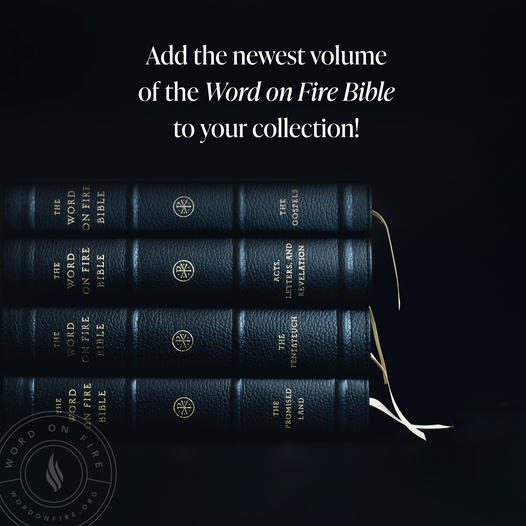
Photo Credit: photograph taken from advertising material posted on the Word on Fire website and on Facebook.
I have reviewed the previous three installments of Bishop Robert Barron’s planned seven-volume Word on Fire Bible: Volume I: The Gospels, Volume II: Acts, Letters and Revelation, and Volume III: The Pentateuch. Volume IV: The Promised Land is, like all of the others, bound in beautiful leather, with page edges of brilliant gold foil. The text utilizes the NRSV version, and is chock-full of relentlessly insightful and interesting commentary from Catholic luminaries, as well as gorgeous reproductions of great Catholic art. Word on Fire provides the following general introduction:
Volume IV of The Word on Fire Bible features the books of Joshua, Judges, Ruth, 1 and 2 Samuel, and 1 and 2 Kings . . . [with] over 75 commentaries from Bishop Robert Barron and over 175 commentaries from mystics, artists, and scholars throughout history. This volume also includes 40 works of art with commentary, 8 word studies of the original Hebrew, and introductions written by Peter Kreeft, Sally Read, Katie Prejean McGrady, Richard DeClue, and more.
I was particularly interested in the commentary offered regarding the book of Joshua and the so-called “conquest of Canaan,” having devoted 26 pages to that topic in my recent book, The Word Set in Stone: How Archaeology, Science, and History Back Up the Bible (Catholic Answers Press: 2023). Bishop Barron wrote about this in his commentary, “The Warfare of the Ban” on page 66:
We should address with focus and care this issue that bedevils many commentators today and gives fuel to the enemies of religion: How could the God who presides over the bloody conquest of the Promised Land be anything other than a moral monster? The “new” atheists of the early twenty-first century — Christopher Hitchens, Sam Harris, and especially Richard Dawkins — obsessively turned to these and other similar texts to show what they took to be the moral ambiguity of the portrait of God in the Bible.
Bishop Barron then summarized three “classic attempts to solve this problem”: the first was St. Irenaeus’ emphasis on the developmental or progressive nature of revelation in which God’s nature and actions are more understood over time (Joshua’s time being a relatively primitive era). The second explanation, taken by St. Augustine and St. Thomas Aquinas and many others (my own favored interpretation), sees the conquest as “a delegated exercise of the divine justice” (p. 67). I described this in my book, as follows:
A point can be reached at which certain segments of the human population are beyond all hope of redemption, and so God judges them, up to and including sentencing them to death. He usually uses human agents to do so—in this instance, Joshua’s army. (p. 226)
I also noted that God wasn’t exercising double standards (i.e., protecting His “chosen” people and harshly judging others), since He also predicted through His prophets the destruction of Jerusalem and its temple, if the Israelites were disobedient and unfaithful. This happened twice: in the sixth century BC and first century AD, with many thousands of deaths and/or subsequent enslavement.
Bishop Barron’s third interpretation (his own preferred one), derived from the Church father, Origen, who
argues that the whole of the Bible should be read from the standpoint of an event narrated in the last book of the Bible — namely, the appearance of the Lamb standing as though slain. . . . Therefore, any interpretation of any section of the Bible that leads to the conviction that God is an avenging, violent tyrant is, ipso facto, incorrect. (pp. 68-69)
What I discovered in approaching the book and the events in it from an archaeological perspective, is that Joshua’s “conquest’ was not, in fact, nearly as bloody and “cruel” as is usually assumed. Archaeologist Kenneth A. Kitchen, for example, observes: “The text of Joshua does not imply huge and massive fiery destructions of every site visited (only Jericho, Ai, and Hazor were burned)” (On the Reliability of the Old Testament [Grand Rapids and Cambridge: Wm. B. Eerdmans Publishing, 2003], 183). Archaeologist James K. Hoffmeier concurs:
A close look at the terms dealing with warfare in Joshua 10 reveals that they do not support the interpretation that the land of Canaan and its principal cities were demolished and devastated by the Israelites. (Israel in Egypt: The Evidence for the Authenticity of the Exodus Tradition [New York, Oxford: Oxford University Press, 1996], 34-35)
The historical record shows that there was a great deal of peaceful assimilation and coexistence alongside the earlier Canaanite inhabitants, for a long time prior to the Israelite monarchy. As an analogy, the early history of England — involving Celts, Anglo-Saxons, Vikings, and Normans — is also increasingly believed to have been largely of this nature. People didn’t fight so much as they intermarried and culturally influenced each other. In other words, bolstered by this analysis, I deny much of the widely accepted premise regarding Joshua’s allegedly “bloodthirsty” and “cruel” entrance into Canaan: a scenario emphasized by those hostile to Christianity, God, and the Bible.
The great King David figures prominently in this volume. St. Augustine is cited regarding his terrible sin of deliberately causing a man to be killed in battle, so he could have his wife, Bathsheba:
he cried out after hearing God’s fearsome threats, and said, “I have sinned”; and shortly afterward heard, “The LORD has put away your sin.” . . . in these three syllables the flames of the heart’s sacrifice rose up to heaven. So those who have done genuine penance, and have been absolved . . . (p. 421)
Magnificent commentaries on King David abound: too many to even select another in this relatively short review; so I will merely make this statement of praise for the storehouse of treasures herein and move on.
David’s son, King Solomon was known for being exceedingly wise (see 1 Kings 3:9). An excerpt from a General Audience of Pope Francis provides an elegantly simple definition of wisdom: “Wisdom is precisely this: it is the grace of being able to see everything with the eyes of God. It is simply this: it is to see the world, to see situations, circumstances, problems, everything through God’s eyes. This is wisdom” (p. 501). But, sadly, Solomon — like King Saul — fell into serious sin later in life, and he may not have ever repented of it, as David did. His downfall is a metaphor for the perpetual human condition of sin and rebellion. Andrew Tolkmith explains, in the section, “Solomon Worshiping Idols”:
Solomon, influenced by his many foreign wives, built high places for Chemosh, the god of the Moabites, and Molech, the god of the Ammonites [1 Kings ch. 11] . . .
Solomon . . . who successfully built the defining monument of the Jewish religion, to whom God promised a throne forever, nevertheless allows his heart to be turned away from the Lord. Solomon’s idolatry is all the more shocking in light of his father David’s reputation as a man after God’s own heart (1 Sam. 13:14). . . .
The actions of Solomon, whose reign is arguably the high point of Israel’s entire history, nevertheless set in motion a process that will eventually culminate in Israel’s demise and the Babylonian exile. (p. 541)
Bishop Barron follows up on these thoughts: “What is perhaps most striking, and most unnerving, about 2 Kings is the way it ends . . . [with] the utter demolition of Solomon’s kingdom and the destruction of his temple” (p. 692).
A happier story is that of Samson, another man of great faults and sins, just as in the cases of David and Solomon. But his famous end (bringing an entire house down on his enemies) was like David’s and not Solomon’s. Bishop Barron comments on him:
Perhaps the most important theological point to understand is that whatever strength we have comes ultimately from God and is enhanced by our devotion to God . . . Samson — betrayed, corralled by his enemies, tortured, and mocked — is an anticipation of Christ in his Passion. (p. 192)
Incidentally, in one of my articles, I offer archaeological confirmation that there were indeed Philistine buildings during Samson’s time (the first half of the 11th century B.C.) that were wholly or mostly supported by two pillars, which could be reached by a large man with a long arm span. The Bible was historically accurate in this story, as always!
As King David and Samson foreshadowed Christ in some ways, so Ruth foreshadowed in part the Blessed Virgin Mary and was an ancestor of our Lord Jesus Christ. Scripture is filled with such foreshadowings or prototypes or “types and shadows” as they are sometimes called. Former atheist Sally Read, in her “Introduction to Ruth,” offers some illuminating insights:
This scene, where Ruth earlier marvels that she has “found favor,” [Ruth 2:10, 12] put me in mind also of the Annunciation, when, centuries later, the angel Gabriel comes to the Virgin Mary and uses these words of Ruth as he tells her that she will bear the Son of God. Both Ruth and Mary consent to a path that potentially holds little but shadows and risk. By their consent, both women, in different ways, set in motion the salvation of the world. . . .
Her actions, though small and seemingly limited to her own story, ensure the genealogy of the Son of God. We can’t know the effect our lives will have on those around us and those after us. (pp. 213-214)
Buy this Bible and this entire set! It’s wonderful and inspiring, will edify and educate you in equal measure, and make you appreciate all the more the amazing revelation that God gave to us: His infallible Sacred Scripture.
***
Photo Credit: photograph taken from advertising material posted on the Word on Fire website and on Facebook.
Summary: My book review and recommendation of The Word on Fire Bible: Volume IV: The Promised Land, highlighting commentary on Joshua, David, Solomon, Samson, & Ruth.
Previous Post
July 15, 2024
Bible vs. Faith Alone: Romans 6:22
Next Post
July 18, 2024 Bible vs. Faith Alone: Acts 26:18
Recent Comments
"Special pleading, and not a serious response to my arguments . . ."
Is Venerating Men & Angels Worship? ..."
""no man needs to teach us."Didn't you just teach us?"
Is Venerating Men & Angels Worship? ..."
""Catholics say they are the only church that can lead people into heaven."In fact, we ..."
Is Venerating Men & Angels Worship? ..."
"And lastly, I belong to no denomination and am free to serve God as He ..."
Is Venerating Men & Angels Worship? ..."
Browse Our Archives
Select a Category & Last Things About Me Anti-Catholicism Atheism & Agnosticism Baptism and Sacramentalism Bible and Tradition Blessed Virgin Mary Books by Dave Armstrong C. S. Lewis Calvinism & General Protestantism Catholic Apologetics Catholic Apologists Catholic conversion Catholic converts Christmas Church (Ecclesiology) Church History Conversion and Converts Development of Doctrine Eastern Orthodoxy Ecumenism & Christian Unity Eucharist & Liturgy Fathers of the Church French Translations G. K. Chesterton Hell Hell & Satan Hell & Satan & Last Things Heresies & Comparative Religion Holistic Health Inquisition & Crusades & Scandals James White Jews & Judaism & Old Testament John Calvin John Henry Newman Liberal / Modernist Theology Life Issues Literary Resume Lutheranism Mariology Martin Luther Music Orthodoxy Papacy & Infallibility Personal Page Philosophy & Science Political & Ethical & Moral Issues Protestant Persecution & Intolerance Protestantism Purgatory Purgatory & Penance Romantic & Imaginative Theology Saints & Purgatory & Penance Salvation Salvation & Justification Satan & Last Things Sexuality and Gender Issues Spanish Translations Traditionalism vs. Radical Catholic Reactionaries Traducciones al español / tradução para português Trinitarianism & Christology Uncategorized Videos
Select a Month October 2026 September 2026 August 2026 July 2026 June 2026 May 2026 April 2026 March 2026 February 2026 January 2026 December 2025 November 2025 October 2025 September 2025 August 2025 July 2025 June 2025 May 2025 April 2025 March 2025 February 2025 January 2025 December 2024 November 2024 October 2024 September 2024 August 2024 July 2024 June 2024 May 2024 April 2024 March 2024 February 2024 January 2024 December 2023 November 2023 October 2023 September 2023 August 2023 July 2023 June 2023 May 2023 April 2023 March 2023 February 2023 January 2023 December 2022 November 2022 October 2022 September 2022 August 2022 July 2022 June 2022 May 2022 April 2022 March 2022 February 2022 January 2022 December 2021 November 2021 October 2021 September 2021 August 2021 July 2021 June 2021 May 2021 April 2021 March 2021 February 2021 January 2021 December 2020 November 2020 October 2020 September 2020 August 2020 July 2020 June 2020 May 2020 April 2020 March 2020 February 2020 January 2020 December 2019 November 2019 October 2019 September 2019 August 2019 July 2019 June 2019 May 2019 April 2019 March 2019 February 2019 January 2019 December 2018 November 2018 October 2018 September 2018 August 2018 July 2018 June 2018 May 2018 April 2018 March 2018 February 2018 January 2018 December 2017 November 2017 October 2017 September 2017 August 2017 July 2017 June 2017 May 2017 April 2017 March 2017 February 2017 January 2017 December 2016 November 2016 October 2016 September 2016 August 2016 July 2016 June 2016 May 2016 April 2016 March 2016 February 2016 January 2016 December 2015 November 2015 October 2015 September 2015 August 2015 July 2015 June 2015 May 2015 April 2015 March 2015 February 2015 January 2015 December 2014 November 2014 October 2014 September 2014 August 2014 July 2014 June 2014 April 2014 March 2014 February 2014 January 2014 December 2013 November 2013 October 2013 September 2013 August 2013 July 2013 June 2013 April 2013 March 2013 February 2013 January 2013 December 2012 November 2012 October 2012 September 2012 August 2012 July 2012 June 2012 May 2012 April 2012 March 2012 February 2012 January 2012 December 2011 November 2011 October 2011 September 2011 August 2011 July 2011 June 2011 April 2011 March 2011 February 2011 October 2010 September 2010 August 2010 July 2010 April 2010 March 2010 December 2009 October 2009 August 2009 July 2009 June 2009 May 2009 March 2009 February 2009 October 2008 September 2008 April 2008 March 2008 February 2008 January 2008 December 2007 November 2007 October 2007 May 2007 March 2007 February 2007 January 2007 November 2006 October 2006 September 2006 August 2006 July 2006 June 2006 May 2006 April 2006 March 2006 February 2006 October 2005 June 2005 April 2005 February 2005 July 2004 May 2004 April 2004
Follow Us!
TAKE THE
Religious Wisdom Quiz
Where was Paul's hometown?
Select your answer to see how you score.
Damascus Tarsus Antioch Jerusalem
Books by This Author Books by Dave Armstrong
Related posts from Biblical Evidence for Catholicism

A Few "Worst" & "Best" Arguments vs. Protestantism
Biblical Evidence for Catholicism

Jerusalem Council vs. James White & Sola Scriptura
Biblical Evidence for Catholicism

Biblical Perspicuity: Absurd Anti-Catholic "Defense"
Biblical Evidence for Catholicism

50 Biblical Disproofs of "Evident Clearness" of the...
Biblical Evidence for Catholicism
TRENDING AT PATHEOS Catholic

The Sermon on the Mount, Part I: Matthew...
The Sermon on the Mount, Part I (Matthew 4:12-5:12) St. Matthew moves...

What's up from Crossway: Reviewing some of their latest A few weeks...

Janie Learns the Way of the Cross: A...
Teaching children about Jesus' Passion can be challenging. Many parents and educators...

Looking For Good Catholic Writing - October 2026
He alone extends the heavens, and he walks upon the waves of...

In "Irreplaceable," our book on vocation and technology, Trevor Sutton and I...

I was strolling through the top floor of the brand new Parthenon...
view all Catholic blogs
What Are Your Thoughts?leave a comment
Ad-Free & Subscriber Log-In Subscription Support
- About Us
- 2026 Calendar
- Videos
- Podcasts
- Library of World Religions
- Faith In Media Tracker
- Advertise With Us
- Write for Us
- Privacy Policy
- Terms of Service
- Do Not Sell My Data
- Contact Us
- Radiant Digital
- Manage Newsletter Subscriptions
- Unsubscribe From Notifications
- Sitemap
Copyright 2008-2026, Patheos. All rights reserved.
Subscription Support Ad-Free & Subscriber Log-In
Follow Patheos