
BuddhistCatholicContemplativeEvangelicalGeneral ChristianHinduJewishLatter-day SaintMuslimNew VisionsProgressive Christian
Beliefs
- Buddhist
- Catholic
- Contemplative
- Evangelical
- General Christian
- Hindu
- Jewish
- Latter-day Saint
- More Voices
- Muslim
- New Visions
- Pagan
- Progressive Christian
Topics
- Religion News
- Food and Religion
- Sports and Religion
- Religious Art
- Religious Music and Entertainment
- Religious Events
- History and Religion
- Style and Religion
- Politics and Religion
- Women in Religion
- Recreation Outdoors and Religion
- Business Finance and Religion
- Careers Workplace and Religion
- Education and Religion
- Family Parenting and Religion
- Health Fitness and Religion
- Home and Religion
- Relationships and Religion
- Technology and Religion
- Travel and Religion
Columnists
- Buddhist Columnists
- Business Finance and Religion Columnists
- Careers Workplace and Religion Columnists
- Catholic Columnists
- Contemplative Columnists
- Education and Religion Columnists
- Evangelists Columnists
- Family Parenting and Religion Columnists
- General Christian Columnists
- Health Fitness and Religion Columnists
- Hindu Columnists
- History and Religion Columnists
- Home and Religion Columnists
- Jewish Columnists
- More Voices Columnists
- Latter Day Columnists
- Muslim Columnists
- New Visions Columnists
- Nonreligious Columnists
- Pagan Columnists
- Politics and Religion Columnists
- Progressive Columnists
- Recreation Outdoors and Religion Columnists
- Relationships and Religion Columnists
- Religion News Columnists
- Religious Art Columnists
- Religious Events Columnists
- Religious Music and Entertainment Columnists
- Sports and Religion Columnists
- Style and Religion Columnists
- Technology and Religion Columnists
- Travel and Religion Columnists
- Women in Religion Columnists
Resource Library
- 2026 Calendar
- Library of World Religions
- The 100 Most Holy Places on Earth
- Patheos Answers
- Podcasts
- Videos
- Faith Leaders Database
- Anglican Episcopalian
- Bahai
- Baptist
- Buddhism
- Christianity
- Confucianism
- Eastern Orthodoxy
- Hinduism
- Holiness and Pentecostal
- ISKCON
- Islam
- Judaism
- Lutheran
- Methodist
- The Church of Jesus Christ of Latter-day Saints
- New Age
- Paganism
- Presbytarian and Reformed
- Protestantism
- Religion Behind the Scenes
- Roman Catholic
- Scientology
- Shia Islam
- Sikhism
- Sufism
- Sunni Islam
- Taoism
- Zen
- See all religions
Research Tools
 Ad-Free & Subscriber Log-In Subscription Support
Ad-Free & Subscriber Log-In Subscription Support
Follow Patheos 

- Trending:
- Forgiveness
- |
- Marriage
- |
- Consciousness
- |
- Death Penalty
- |
- Election
- |
- Halloween

-
About
-
Catholic Apologetics
-
Church History
-
Great Apologists
-
Christian Worldview
-
Protestantism & Misc.
- Home
- Catholic
- History and Religion
- Biblical Canon & Sola Scriptura (vs. Jordan Cooper)
Biblical Canon & Sola Scriptura (vs. Jordan Cooper)
Last updated on: June 6, 2026 at 12:51 am by Dave Armstrong
Biblical Canon & Sola Scriptura (vs. Jordan Cooper) 2026-06-06T00:51:51-04:00 Dave Armstrong
Patheos Explore the world's faith through different perspectives on religion and spirituality! Patheos has the views of the prevalent religions and spiritualities of the world.
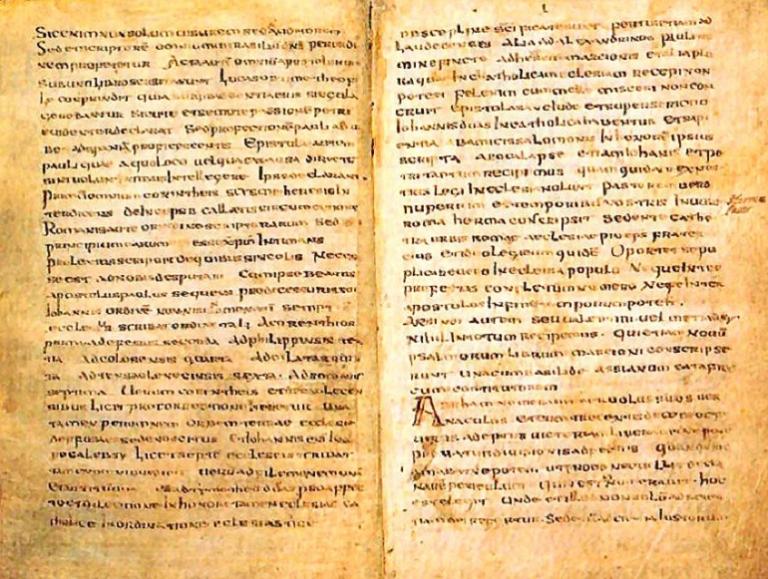
Photo credit: Muratorian Fragment (biblical manuscript). Bibliotheca Ambrosiana, Cod. J 101 sup. [source] [public domain / Wikimedia Commons]
Rev. Dr. Jordan B. Cooper is a Lutheran pastor, adjunct professor of Systematic Theology, Executive Director of the popular Just & Sinner YouTube channel, and the President of the American Lutheran Theological Seminary (which holds to a doctrinally traditional Lutheranism, similar to the Lutheran Church – Missouri Synod). He has authored several books, as well as theological articles in a variety of publications. All my Bible citations are from RSV, unless otherwise indicated. Jordan’s words will be in blue.
This is my 17th reply to Jordan (many more to come, because I want to interact with the best, most informed Protestant opponents). All of these respectful critiques can be found in the “Replies to Jordan Cooper” section at the top of my Lutheranism web page. Thus far, he has chosen not to respond to any of my critiques. He informed me of the reasons why on my Facebook page, on 17 April 2024:
I appreciate your thoughtful engagement with my material. I also appreciate not being called “anti-Catholic,” as I am not. Unfortunately, it is just a matter of time that I am unable to interact with the many lengthy pieces you have put together. With teaching, writing, running a publishing house, podcasting, working at a seminary, and doing campus ministry, I have to prioritize, which often means not doing things that would be very much worthwhile simply for lack of time.
I appreciate the explanation and nevertheless sincerely hope that Dr. Cooper does have more time and desire to dialogue with me in the future. I think we could have some good and constructive — and civil – discussions. In the meantime, I will continue to write what he regards as “thoughtful” and “worthwhile” responses.
***
I am replying to Jordan Cooper’s video, “Sola Scriptura and the Canon” (6-10-24).
Someone else introduces the topic (his words in green):
0:07-0:16 how would you respond to a uh a Catholic, for instance, who says, “well hey the Church came first, the Bible came second; particularly the New Testament came second” . . .?
*
This particular statement by the hypothetical Catholic challenger is undeniably true. The establishment of the Church began with the commission of St. Peter as its leader (Matthew 16) and with the formal institutional beginning following the indwelling of the Holy Spirit on the Day of Pentecost (Acts 2) right after the death of Christ (c. 30 AD). That’s undeniable. There was no New Testament in any sense of the word at that time; only oral traditions.
*
No one believes that any of it was written down by 30 AD; the earliest being probably the epistles to the Galatians or 1 Thessalonians (c. 48-50). If there was no New Testament at all in 30 AD, then it inexorably follows that there was no canon of the New Testament. The Church preceded the first NT writing by about 20 years. So why is this being disputed at all (one wonders), when literally no scholars agree with it?
*
0:16-0:19 and the Canon wasn’t approved until the 4th century
*
That’s also unarguably true (i.e., in its complete form): most notably at the Council of Hippo in 393 and the Council of Carthage in 397: attended and highly influenced by St. Augustine (and they included the deuterocanonical — or so-called “apocryphal” — books accepted by Catholics). St. Athanasius was the first person to list all 27 New Testament books in his Easter letter of 367, and he even used the word “canonized” (κανονιζομενα) in referring to them. The Council of Rome in 382, under the leadership of Pope Damasus I, and highly influenced by St. Ambrose of Milan, had also provided a list of the 27 NT books, just fifteen years after Athanasius and eleven years before the Council of Carthage. It decreed:
Likewise the order of the writings of the New and Eternal Testament, which only the holy and Catholic Church supports. Of the Gospels, according to Matthew one book, according to Mark one book, according to Luke one book, according to John one book.
The Epistles of Paul the Apostle in number fourteen. To the Romans one, to the Corinthians two, to the Ephesians one, to the Thessalonians two, to the Galatians one, to the Philippians one, to the Colossians one, to Timothy two, to Titus one, to Philemon one, to the Hebrews one.
Likewise the Apocalypse of John, one book. And the Acts of the Apostles one book. Likewise the canonical epistles in number seven. Of Peter the Apostle two epistles, of James the Apostle one epistle, of John the Apostle one epistle, of another John, the presbyter, two epistles, of Jude the Zealut, the Apostle one epistle.
The Muratorian Fragment (dated between 155 and 200) listed most of the NT books but not all. It omitted James, one of John’s epistles, probably 3 John, Hebrews, and 1 and 2 Peter, and it included The Apocalypse of Peter. A Catholic Answers article summarized:
The plain fact of the matter is that the canon of the Bible was not settled in the first years of the Church. It was settled only after repeated (and perhaps heated) discussions, and the final listing was determined by the pope and Catholic bishops. This is an inescapable fact, no matter how many people wish to escape from it.
There was a broad consensus for some time about the NT canonical books (Catholics don’t deny that at all), but there were always anomalies, omissions, and discrepancies (as I detailed way back in 1996 from all Protestant sources) until Athanasius in 367, followed by the aforementioned three councils. This is the point Catholics make: consensus, but not completeness. That’s the sense in which Catholics state that the Church was necessary to finally affirm or declare (not “create”!) the biblical canon. I truly don’t see how this can be denied.
*
Protestants might retort by saying that Athanasius came up with the 27 books himself. That’s true, but he was just one person and didn’t have authority over the whole Church, to make his list binding and irreversible. The councils of the Catholic Church (the magisterium) — confirmed by popes — had that authority because they involved multiple bishops. Protestants don’t like that because their rule of faith, sola Scriptura, denies the infallibility of both the Church and her councils (that’s precisely how Luther originated the idea: especially in 1519 at the Leipzig Disputation). Some of the differences regarding the canon continued even after 397. For example, 1 and 2 Clement were included in the Codex Alexandrinus in the early 5th century.
*
0:19-0:37 and so you know the church had to come together and they had to make these agreements and they had to have these authoritative statements and so on, and if you were going by scripture alone, well they didn’t have scripture alone they just had to have the Church
and sure they had the Old Testament but the scripture wasn’t decided upon et cetera et cetera. I know you’ve heard it many times.
*
That is pretty much a true statement if we consult history (though the video seems to want to make it a semi-humorous observation; this person and Jordan laugh and yuck it up while discussing it). St. Athanasius came up with the entire NT some 337 years after the crucifixion, but he was also a loyal son of the Catholic Church, who did not believe in sola Scriptura, as I have documented in great depth. So let’s see how Jordan deals with it, after they have had their fun tweaking Catholics and Catholic apologists.
*
2:17-2:51 I think the the main issue is that what it does [i.e., Catholic arguments in YouTube channel discussions] is portray a[n] historical view that’s not really accurate in terms of history. I would point to someone like Michael Kruger who has done a lot of work in the canon and I think what you have is often a presentation that there [was] a lot of confusion about which books are actually included in the canon and there needed to be some early ecumenical council to put those books together. Now there never was an ecumenical council that was put together in any sense in order to address the issue of of the New Testament canon.
*
That’s true. Rome and Carthage and Hippo (during 382-397) were local synods, but they were ratified by popes and spearheaded and dominated by some of the most well-regarded Church fathers (Ambrose and Augustine). Pope Innocent I concurred with and sanctioned the canonical ruling of the Councils of Carthage and Hippo in his Letter to Exsuperius, Bishop of Toulouse in 405 (also in 414), as did the Sixth Council of Carthage in 419.
*
2:52-3:04 the Council of Trent is the first of the Roman Catholic councils, including the ecumenical councils, through the later Western councils that actually defines definitively a canon of Scripture.
That’s true, too; however, it was merely reiterating at a higher authority level what had already been decreed exactly 1164 years earlier (382 to 1546). That’s not just me (the beloved Catholic apologist) asserting that. It’s the following reputable Protestant source:
A council probably held at Rome in 382 under St. Damasus gave a complete list of the canonical books of both the Old Testament (also known as the ‘Gelasian Decree’ because it was reproduced by Gelasius in 495), which is identical with the list given at Trent. (The Oxford Dictionary of the Christian Church, 2nd edition, edited by F. L. Cross and E. A. Livingstone, Oxford University Press, 1983, 232)
In terms of the Old Testament, the Council of Rome in 382 included Wisdom, Ecclesiasticus, Tobit, Judith, and 1 and 2 Maccabees. Baruch was included as part of Jeremiah, as in St. Athanasius’ list of 15 years previously. This is indeed identical with the Tridentine list, and comprises the seven “extra” deuterocanonical books in Catholic Bibles which Protestants reject from the canon as “apocryphal.” Nevertheless, there they are in the Council of 382. The Council of Carthage accepted the same list, as detailed by the great Protestant scholar Brooke Foss Westcott (A General Survey of the History of the Canon of the New Testament, Grand Rapids, Michigan: Baker Book House, 1980, rep. from 6th ed. of 1889, 440). Renowned Protestant Church historian Philip Schaff also concurs:
This canon [of Carthage] remained undisturbed till the sixteenth century, and was sanctioned by the council of Trent at its fourth session. (Philip Schaff, History of the Christian Church, vol. 3: Nicene and Post-Nicene Christianity, Grand Rapids, Michigan: Eerdmans, 1974 [orig. 1910], 609-610)
3:11-3:16 a provincial council does not have the authority an ecumenical council does
*
Quite true. But popes ratified them, so they had a great deal of authority on that basis.
***
“Please Hit ‘Subscribe’”! If you have received benefit from this or any of my other 4,800+ articles, please follow this blog by signing up (with your email address) on the sidebar to the right (you may have to scroll down a bit), above where there is an icon bar, “Sign Me Up!”: to receive notice when I post a new blog article. This is the equivalent of subscribing to a YouTube channel. Please also consider following me on Twitter / X and purchasing one or more of my 55 books. All of this helps me get more exposure, and (however little!) more income for my full-time apologetics work. Thanks so much and happy reading!
***
3:18-3:37 in order for the argument to really work, well, you would have to to prove that there was some kind of big debate. Nobody knew what was in the canon and the Church had to get together under the authority of the papacy to put together some some list of books. But that’s really not what’s happening when you look at the history of the early Church.
*
The truth is “in-between.” As I already noted, there was broad consensus of books and the canon before these decrees, but there was also significant disagreement on many books and also many additional books included that were later deemed uncanonical by all. I already documented this from Protestant scholars in 1996, as part of my first book, A Biblical Defense of Catholicism. Here is my summary of that historical data:
Apostolic Fathers 90-160 AD
Gospels Generally accepted by 130
Justin Martyr’s “Gospels” contain apocryphal material
Acts Scarcely known or quoted
Pauline Corpus Generally accepted by 130, yet quotations are rarely introduced as scriptural
Philippians, 1 Timothy: x Justin Martyr
2 Timothy, Titus, Philemon: x Polycarp, Justin Martyr
Hebrews Not considered canonical
? Clement of Rome
x Polycarp, Justin Martyr
James Not considered canonical; not even quoted
x Polycarp, Justin Martyr
1 Peter Not considered canonical
2 Peter Not considered canonical, nor cited
1, 2, 3 John Not considered canonical
x Justin Martyr
1 John ? Polycarp / 3 John x Polycarp
Jude Not considered canonical
x Polycarp, Justin Martyr
Revelation Not canonical
x Polycarp
Irenaeus to Origen (160-250)
Gospels Accepted
Acts Gradually accepted
Pauline Corpus Accepted with some exceptions:
2 Timothy: x Clement of Alexandria
Philemon: x Irenaeus, Origen, Tertullian, Clement of Alexandria
Hebrews Not canonical before the 4th century in the West.
? Origen
- First accepted by Clement of Alexandria
James Not canonical
? First mentioned by Origen
x Irenaeus, Tertullian, Clement of Alexandria
1 Peter Gradual acceptance- First accepted by Irenaeus, Clement of Alexandria
2 Peter Not canonical
? First mentioned by Origen
x Irenaeus, Tertullian, Clement of Alexandria
1 John Gradual acceptance- First accepted by Irenaeus
x Origen
2 John Not canonical
? Origen
x Tertullian, Clement of Alexandria
3 John Not canonical
? Origen
x Irenaeus, Tertullian, Clement of Alexandria
Jude Gradual acceptance- Clement of Alexandria
x Origen
Revelation Gradual acceptance- First accepted by Clement of Alexandria
x Barococcio Canon, c.206
Epistle of Barnabas * Clement of Alexandria, Origen
Shepherd of Hermas * Irenaeus, Tertullian, Origen, Clement of Alexandria
The Didache * Clement of Alexandria, Origen
The Apocalypse of Peter * Clement of Alexandria
The Acts of Paul * Origen- Appears in Greek, Latin (5), Syriac, Armenian, & Arabic translations
Gospel of Hebrews * Clement of AlexandriaOrigen to Nicaea (250-325)
Gospels, Acts, Pauline Corpus Accepted
Hebrews * Accepted in the East
x, ? Still disputed in the West
James x, ? Still disputed in the East
x Not accepted in the West
1 Peter Fairly well accepted
2 Peter Still disputed
1 John Fairly well accepted
2, 3 John, Jude Still disputed
Revelation Disputed, especially in the East
x DionysiusCouncil of Nicaea (325)
Questions canonicity of James, 2 Peter, 2 John, 3 John, and Jude
From 325 to the Council of Carthage (397)
Gospels, Acts, Pauline Corpus, 1 Peter, 1 John accepted
Hebrews Eventually accepted in the West
James Slow acceptance
Not even quoted in the West until around 350!
2 Peter Eventually accepted
2, 3 John, Jude Eventually accepted
Revelation Eventually accepted
x Cyril of Jerusalem, John Chrysostom, Gregory Nazianz
Epistle of Barnabas * Codex Sinaiticus – late 4th century
Shepherd of Hermas * Codex Sinaiticus – late 4th centurySources for New Testament Canon Chart (all Protestant):
J. D. Douglas, editor, New Bible Dictionary, Grand Rapids, Michigan: Eerdmans, 1962 edition, 194-198.
F. L. Cross and E. A. Livingstone, editors, The Oxford Dictionary of the Christian Church, Oxford: Oxford Univ. Press, 2nd edition, 1983, 232, 300, 309-10, 626, 641, 724, 1049, 1069.
Norman L. Geisler & William E. Nix, From God to Us: How We Got Our Bible, Chicago: Moody Press, 1974, 109-12, 117-125.
That’s quite a bit of uncertainty, if you ask me. The Church clearly needed an authoritative pronouncement, seeing that no single person came up with the complete New Testament until 367 AD. That’s what — in effect — sola Scriptura (which no one believed in, in the first place) produced.
3:37-3:53 what’s happening is the Church: they’re not putting together the canon but the Church is recognizing what God has inspired and really this is just the nature of understanding that scripture is inspired is because we have faith that scripture is inspired . . .
No one disagrees with that (the Catholic Church declared the parameters of the canon; it did not create it; nor was it claiming to be “over” it), but it doesn’t solve the problem at hand (which books were canon) as long as equally honest and pious folks were disagreeing on the biblical canon. It obviously had to be resolved somehow. Its one thing to proclaim these platitudes about biblical inspiration. The actual “messy” complicated history — the concrete facts — (as I have shown) shows a lot of disagreement alongside the significant agreement.
3:53-3:59 We also have faith that God would guide his people to know what the books that he has inspired.
It’s not always so simple to determine which book was actually part of the Bible, See:
Are All Bible Books Self-Evidently Inspired? [6-19-06]
*
Are All the Biblical Books Self-Evidently Canonical? [6-22-06]
*
Were Apostles Always Aware of Writing Scripture? (6-29-06; abridged on 9-25-16)
*
*
So sure, God guided His people, but He ultimately and definitively did so through the delegated authority of His Church. In other words, it was by means of the Catholic rule of faith (Bible-Church-Tradition) as opposed to the nonexistent Protestant one (sola Scriptura). Otherwise, it would not have been resolved (because we know from the facts of history how it was before the conciliar decrees on the canon were made).
*
Jordan goes on to examine the Old Testament canon. That’s a more involved argument (and a stronger one for Protestants) that I am deliberately not addressing in this article (since it is already over 3,000 words in length). I have elsewhere, among my 4,800+ articles, rest assured (see the “Canon” section of my Bible & Tradition web page). Protestants have enough problems with the New Testament canon. Jordan hasn’t come within a million miles of resolving those.
*
He doesn’t seem to even want to interact with all of the relevant historical issues. If he grappled with my reasoning in this reply, it would be a serious discussion (rather than just toying with the wildly inconsistent quality of mere YouTube comments made by Catholics of varying knowledge and credentials in a cursory eight-minute video), and he would have to come up with an effective counter-reply that addresses the established, documented facts of patristic history. That is to be devoutly wished!
*
***
*
Practical Matters: Perhaps some of my 4,800+ free online articles (the most comprehensive “one-stop” Catholic apologetics site) or fifty-five books have helped you (by God’s grace) to decide to become Catholic or to return to the Church, or better understand some doctrines and why we believe them.
Or you may believe my work is worthy to support for the purpose of apologetics and evangelism in general. If so, please seriously consider a much-needed financial contribution. I’m always in need of more funds: especially monthly support. “The laborer is worthy of his wages” (1 Tim 5:18, NKJV). 1 December 2021 was my 20th anniversary as a full-time Catholic apologist, and February 2022 marked the 25th anniversary of my blog.
PayPal donations are the easiest: just send to my email address: [email protected]. Here’s also a second page to get to PayPal. You’ll see the term “Catholic Used Book Service”, which is my old side-business. To learn about the different methods of contributing (including Zelle), see my page: About Catholic Apologist Dave Armstrong / Donation Information. Thanks a million from the bottom of my heart!
*
***
*
Photo credit: Muratorian Fragment (biblical manuscript). Bibliotheca Ambrosiana, Cod. J 101 sup. [source] [public domain / Wikimedia Commons]

Summary: Lutheran apologist Jordan Cooper argues that the NT biblical canon arose spontaneously in history by sola Scriptura. I show how binding conciliar Church authority was required.
Previous Post

July 24, 2024
Is Celibacy "Superior" to Marriage in Some Sense?
Next Post
July 25, 2024 Tertullian on Baptismal Regeneration
Recent Comments
"And lastly, I belong to no denomination and am free to serve God as He ..."
Is Venerating Men & Angels Worship? ..."
"And obeisance doesn't mean "worship". It means "respect", "obey", or "submission". Very weird that you ..."
Is Venerating Men & Angels Worship? ..."
"Many of these scriptures you have noted have been taken out of context. With Daniel, ..."
Is Venerating Men & Angels Worship? ..."
""Protestants often point out that Jesus is now triumphant in heaven and object to Catholics ..."
Three More Anti-Catholic Lies About Catholicism ..."
Browse Our Archives
Select a Category & Last Things About Me Anti-Catholicism Atheism & Agnosticism Baptism and Sacramentalism Bible and Tradition Blessed Virgin Mary Books by Dave Armstrong C. S. Lewis Calvinism & General Protestantism Catholic Apologetics Catholic Apologists Catholic conversion Catholic converts Christmas Church (Ecclesiology) Church History Conversion and Converts Development of Doctrine Eastern Orthodoxy Ecumenism & Christian Unity Eucharist & Liturgy Fathers of the Church French Translations G. K. Chesterton Hell Hell & Satan Hell & Satan & Last Things Heresies & Comparative Religion Holistic Health Inquisition & Crusades & Scandals James White Jews & Judaism & Old Testament John Calvin John Henry Newman Liberal / Modernist Theology Life Issues Literary Resume Lutheranism Mariology Martin Luther Music Orthodoxy Papacy & Infallibility Personal Page Philosophy & Science Political & Ethical & Moral Issues Protestant Persecution & Intolerance Protestantism Purgatory Purgatory & Penance Romantic & Imaginative Theology Saints & Purgatory & Penance Salvation Salvation & Justification Satan & Last Things Sexuality and Gender Issues Spanish Translations Traditionalism vs. Radical Catholic Reactionaries Traducciones al español / tradução para português Trinitarianism & Christology Uncategorized Videos
Select a Month October 2026 September 2026 August 2026 July 2026 June 2026 May 2026 April 2026 March 2026 February 2026 January 2026 December 2025 November 2025 October 2025 September 2025 August 2025 July 2025 June 2025 May 2025 April 2025 March 2025 February 2025 January 2025 December 2024 November 2024 October 2024 September 2024 August 2024 July 2024 June 2024 May 2024 April 2024 March 2024 February 2024 January 2024 December 2023 November 2023 October 2023 September 2023 August 2023 July 2023 June 2023 May 2023 April 2023 March 2023 February 2023 January 2023 December 2022 November 2022 October 2022 September 2022 August 2022 July 2022 June 2022 May 2022 April 2022 March 2022 February 2022 January 2022 December 2021 November 2021 October 2021 September 2021 August 2021 July 2021 June 2021 May 2021 April 2021 March 2021 February 2021 January 2021 December 2020 November 2020 October 2020 September 2020 August 2020 July 2020 June 2020 May 2020 April 2020 March 2020 February 2020 January 2020 December 2019 November 2019 October 2019 September 2019 August 2019 July 2019 June 2019 May 2019 April 2019 March 2019 February 2019 January 2019 December 2018 November 2018 October 2018 September 2018 August 2018 July 2018 June 2018 May 2018 April 2018 March 2018 February 2018 January 2018 December 2017 November 2017 October 2017 September 2017 August 2017 July 2017 June 2017 May 2017 April 2017 March 2017 February 2017 January 2017 December 2016 November 2016 October 2016 September 2016 August 2016 July 2016 June 2016 May 2016 April 2016 March 2016 February 2016 January 2016 December 2015 November 2015 October 2015 September 2015 August 2015 July 2015 June 2015 May 2015 April 2015 March 2015 February 2015 January 2015 December 2014 November 2014 October 2014 September 2014 August 2014 July 2014 June 2014 April 2014 March 2014 February 2014 January 2014 December 2013 November 2013 October 2013 September 2013 August 2013 July 2013 June 2013 April 2013 March 2013 February 2013 January 2013 December 2012 November 2012 October 2012 September 2012 August 2012 July 2012 June 2012 May 2012 April 2012 March 2012 February 2012 January 2012 December 2011 November 2011 October 2011 September 2011 August 2011 July 2011 June 2011 April 2011 March 2011 February 2011 October 2010 September 2010 August 2010 July 2010 April 2010 March 2010 December 2009 October 2009 August 2009 July 2009 June 2009 May 2009 March 2009 February 2009 October 2008 September 2008 April 2008 March 2008 February 2008 January 2008 December 2007 November 2007 October 2007 May 2007 March 2007 February 2007 January 2007 November 2006 October 2006 September 2006 August 2006 July 2006 June 2006 May 2006 April 2006 March 2006 February 2006 October 2005 June 2005 April 2005 February 2005 July 2004 May 2004 April 2004
Follow Us!
TAKE THE
Religious Wisdom Quiz
Who asked Jesus, "What is truth?"
Select your answer to see how you score.
Caiaphas Pilate Nicodemus Herod
Books by This Author Books by Dave Armstrong
Related posts from Biblical Evidence for Catholicism

Does Catholic Intercession of Saints Require Omniscience?
Biblical Evidence for Catholicism

Protestant Confessions & "Ever-Virgin" Mary
Biblical Evidence for Catholicism

Jesus Founded the [Catholic] Church. If Not Him,...
Biblical Evidence for Catholicism

A Few "Worst" & "Best" Arguments vs. Protestantism
Biblical Evidence for Catholicism
TRENDING AT PATHEOS Catholic

I was strolling through the top floor of the brand new Parthenon...

What Does Gêvâh Mean For Kimberley Guifoyle &...
This week, a lot of the news is focused on Kimberly Guilfoyle....

INNER CIRCLE: Profound Mystery (Of Christ In All...
Ephesians 5:31-32 “For this reason, a man will leave his father and...

Do Not Rejoice When Your Enemy Falls: The...
Turning an execution into a public spectacle is a disturbing expression of...

'The Chosen' S6 Trailer: The Passion Gets Very...
Not many watching 'The Chosen' worry about spoilers, but just because they...

The purpose-driven labor priest
A labor activist reads Rick Warren and it gets me wondering about...
view all Catholic blogs
What Are Your Thoughts?leave a comment
Ad-Free & Subscriber Log-In Subscription Support
- About Us
- 2026 Calendar
- Videos
- Podcasts
- Library of World Religions
- Faith In Media Tracker
- Advertise With Us
- Write for Us
- Privacy Policy
- Terms of Service
- Do Not Sell My Data
- Contact Us
- Radiant Digital
- Manage Newsletter Subscriptions
- Unsubscribe From Notifications
- Sitemap
Copyright 2008-2026, Patheos. All rights reserved.
Subscription Support Ad-Free & Subscriber Log-In
Follow Patheos