
BuddhistCatholicContemplativeEvangelicalGeneral ChristianHinduJewishLatter-day SaintMuslimNew VisionsProgressive Christian
Beliefs
- Buddhist
- Catholic
- Contemplative
- Evangelical
- General Christian
- Hindu
- Jewish
- Latter-day Saint
- More Voices
- Muslim
- New Visions
- Pagan
- Progressive Christian
Topics
- Religion News
- Food and Religion
- Sports and Religion
- Religious Art
- Religious Music and Entertainment
- Religious Events
- History and Religion
- Style and Religion
- Politics and Religion
- Women in Religion
- Recreation Outdoors and Religion
- Business Finance and Religion
- Careers Workplace and Religion
- Education and Religion
- Family Parenting and Religion
- Health Fitness and Religion
- Home and Religion
- Relationships and Religion
- Technology and Religion
- Travel and Religion
Columnists
- Buddhist Columnists
- Business Finance and Religion Columnists
- Careers Workplace and Religion Columnists
- Catholic Columnists
- Contemplative Columnists
- Education and Religion Columnists
- Evangelists Columnists
- Family Parenting and Religion Columnists
- General Christian Columnists
- Health Fitness and Religion Columnists
- Hindu Columnists
- History and Religion Columnists
- Home and Religion Columnists
- Jewish Columnists
- More Voices Columnists
- Latter Day Columnists
- Muslim Columnists
- New Visions Columnists
- Nonreligious Columnists
- Pagan Columnists
- Politics and Religion Columnists
- Progressive Columnists
- Recreation Outdoors and Religion Columnists
- Relationships and Religion Columnists
- Religion News Columnists
- Religious Art Columnists
- Religious Events Columnists
- Religious Music and Entertainment Columnists
- Sports and Religion Columnists
- Style and Religion Columnists
- Technology and Religion Columnists
- Travel and Religion Columnists
- Women in Religion Columnists
Resource Library
- 2026 Calendar
- Library of World Religions
- The 100 Most Holy Places on Earth
- Patheos Answers
- Podcasts
- Videos
- Faith Leaders Database
- Anglican Episcopalian
- Bahai
- Baptist
- Buddhism
- Christianity
- Confucianism
- Eastern Orthodoxy
- Hinduism
- Holiness and Pentecostal
- ISKCON
- Islam
- Judaism
- Lutheran
- Methodist
- The Church of Jesus Christ of Latter-day Saints
- New Age
- Paganism
- Presbytarian and Reformed
- Protestantism
- Religion Behind the Scenes
- Roman Catholic
- Scientology
- Shia Islam
- Sikhism
- Sufism
- Sunni Islam
- Taoism
- Zen
- See all religions
Research Tools
 Ad-Free & Subscriber Log-In Subscription Support
Ad-Free & Subscriber Log-In Subscription Support
Follow Patheos 

- Trending:
- Forgiveness
- |
- Marriage
- |
- Consciousness
- |
- Death Penalty
- |
- Election
- |
- Halloween

-
About
-
Catholic Apologetics
-
Church History
-
Great Apologists
-
Christian Worldview
-
Protestantism & Misc.
- Home
- Catholic
- History and Religion
- Bible vs. Faith Alone: Acts 26:18
Bible vs. Faith Alone: Acts 26:18
Last updated on: July 18, 2024 at 1:47 pm by Dave Armstrong
Bible vs. Faith Alone: Acts 26:18 2024-07-18T13:47:23-04:00 Dave Armstrong
Patheos Explore the world's faith through different perspectives on religion and spirituality! Patheos has the views of the prevalent religions and spiritualities of the world.
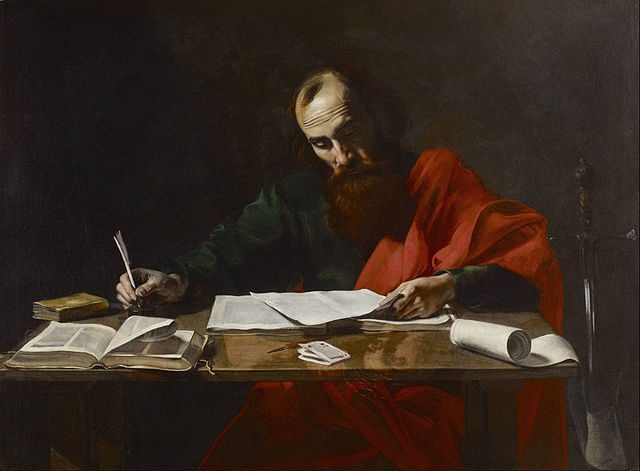
Photo Credit: Saint Paul Writing His Epistles (c. 1618-1620); attributed to Valentin de Boulogne (1591-1632) [public domain / Wikimedia Commons]
Acts 26:18 (RSV) . . . that they may turn from darkness to light and from the power of Satan to God, that they may receive forgiveness of sins and a place among those who are sanctified by faith in me.
Protestantism formally separated sanctification from justification in a way contrary to the Bible. Justification saves through faith alone, according to their view. Sanctification and good works, on the other hand, are definitely encouraged and regarded as necessary in the Christian life, but are not a cause of either justification or salvation; only God’s grace and our faith accomplish that. This is the classic Protestant “faith alone” doctrine, or sola fide in Latin, and one of the two “pillars” of the so-called Reformation, along with sola Scriptura (“Bible alone”).
The above passage contradicts this understanding, by directly tying salvation and faith to sanctification. Salvation (with regeneration) is expressed in three different ways in this verse. This is our Lord Jesus speaking to St. Paul at his conversion. The fact that one is sanctified by having faith in Jesus makes it impossible to separate sanctification and justification in a neat little package with a bow. They’re intrinsically connected. Therefore, sanctification does have something to do with both justification and salvation. It doesn’t say, “will be sanctified” or “will be progressively sanctified.” Rather, they “are” along with or alongside having faith in Jesus.
The Amplified Bible even puts it in a past tense: ” those who have been sanctified (set apart, made holy) by faith in Me.” So does New American Standard Bible: “those who have been sanctified by faith in Me.” Wuest is identical to NASB, except for “. . . which is in me.” Here are some other versions:
Young’s Literal Translation: . . . their receiving forgiveness of sins, and a lot among those having been sanctified, by faith that is toward me.
Phillips: . . . those who are made holy by their faith in me.
Literal Emphasis Translation: . . . that they might receive the remission of sins and inheritance among those having been sanctified by faith that is in Me.
Berean Literal Bible: . . . that they may receive forgiveness of sins and an inheritance among those having been sanctified by faith in Me.
Barclay: . . . those who through faith in me have become God’s consecrated people.
***
“Please Hit ‘Subscribe’”! If you have received benefit from this or any of my other 4,600+ articles, please follow this blog by signing up (with your email address) on the sidebar to the right (you may have to scroll down a bit), above where there is an icon bar, “Sign Me Up!”: to receive notice when I post a new blog article. This is the equivalent of subscribing to a YouTube channel. Please also consider following me on Twitter / X and purchasing one or more of my 55 books. All of this helps me get more exposure, and (however little!) more income for my full-time apologetics work. Thanks so much and happy reading!
***
So how do the classic Protestant commentaries handle this and try to synthesize it with standard “faith alone” soteriology?
Calvin’s Commentaries: Some do read it falsely in one text, among those who are sanctified by faith, because this word is extended unto the whole period. Therefore, the meaning thereof is, that by faith we come unto the possession of all those good things which are offered by the gospel.
Calvin implies that faith is first and then the “good thing” of sanctification is enabled to come into the life of the believer later. This is the attempted separation of justification and sanctification that is not in this text (so it’s eisegesis), since the sanctification is either contemporaneous with the faith or even described in several translations as a fait accompli by means of the faith (i.e., it’s referred to in the past tense). Bottom line: it first perfectly with Catholic soteriology, and at best is only an awkward force-fit with Protestant soteriology.
Jamieson-Fausset-Brown Bible Commentary: Faith is here made the instrument of salvation at once in its first stage, forgiveness, and its last, admission to the home of the sanctified . . .
This is the same “chronologically erroneous” explanation that Calvin offered.
Cambridge Bible for Schools and Colleges: And here “sanctified,” as so often “saint” in St Paul’s Epistles, is applied to those who have been set on the way of salvation, . . .
This is the same sort of attempt again. Granted, we all (hopefully!) grow in holiness and righteousness and lack of sin, but the text does say that sanctification occurs along with faith, with several assuming it was a past event also.
Gill’s Exposition of the Entire Bible: they are sanctified “in” him through the imputation of the holiness of his human nature to them, which is a branch of their justification before God . . . by faith that is in me, is not to be connected with the word “sanctified”, but with the word “receive”, in the preceding clause; and has respect to both benefits, which it receives from Christ
Gill also tries — I think, unsuccessfully — to separate the two things that Jesus combined together.
Ellicott’s Commentary for English Readers: Better, have been sanctified; the Greek participle being in the perfect. The word, as always, expresses primarily the idea of a completed consecration rather than of a perfected holiness (Hebrews 9:13; Hebrews 10:10; Hebrews 13:12); but the one thought passes naturally into the other. The last six words may be connected grammatically either with “sanctified” or with “receive.” On internal grounds the latter is, perhaps, the best construction. Faith, i.e., is theoretically connected with “forgiveness of sins,” as well as with the “inheritance,” which implies sanctification.
Ellicott, an Anglican, exegetes the text essentially in the same way that Catholics would. And (what a surprise!) I think he’s correct.
Matthew Poole’s Commentary: By faith that is in me; by faith which purifieth the heart; but this may be referred, either to our being sanctified, or to our receiving of the inheritance, for both are by faith . . .
Matthew Poole (1624–1679), a Presbyterian, offers a surprisingly “Catholic” take, which sounds very much like our doctrine of infused justification (including sanctification within itself).
Adam Clarke’s Commentary: And as the inheritance is said to be among them that are Sanctified, this is a farther proof that αφεσις ἁμαρτιων signifies, not only the forgiveness of sins, but also the purification of the heart.
The Methodist Clarke also closely approaches the Catholic “infused justification” interpretation.
I think that this verse offers a largely unexplored serious and interesting exegetical argument against justification by faith alone apart from any works at all, and imputed justification.
*
***
*
Practical Matters: Perhaps some of my 4,800+ free online articles (the most comprehensive “one-stop” Catholic apologetics site) or fifty-five books have helped you (by God’s grace) to decide to become Catholic or to return to the Church, or better understand some doctrines and why we believe them.
Or you may believe my work is worthy to support for the purpose of apologetics and evangelism in general. If so, please seriously consider a much-needed financial contribution. I’m always in need of more funds: especially monthly support. “The laborer is worthy of his wages” (1 Tim 5:18, NKJV). 1 December 2021 was my 20th anniversary as a full-time Catholic apologist, and February 2022 marked the 25th anniversary of my blog.
PayPal donations are the easiest: just send to my email address: [email protected]. Here’s also a second page to get to PayPal. You’ll see the term “Catholic Used Book Service”, which is my old side-business. To learn about the different methods of contributing (including Zelle), see my page: About Catholic Apologist Dave Armstrong / Donation Information. Thanks a million from the bottom of my heart!
*
***
*
Photo Credit: Saint Paul Writing His Epistles (c. 1618-1620); attributed to Valentin de Boulogne (1591-1632) [public domain / Wikimedia Commons]

Summary: I examine Acts 26:18: a Bible passage that I believe is manifestly contrary to the Protestant belief in “faith alone” (sola fide) for justification apart from sanctification.
Previous Post

July 16, 2024
Bp. Barron’s Word on Fire Bible (The Promised Land)
Next Post
July 19, 2024 Bible vs. Faith Alone: Acts 15:9
Recent Comments
"And lastly, I belong to no denomination and am free to serve God as He ..."
Is Venerating Men & Angels Worship? ..."
"And obeisance doesn't mean "worship". It means "respect", "obey", or "submission". Very weird that you ..."
Is Venerating Men & Angels Worship? ..."
"Many of these scriptures you have noted have been taken out of context. With Daniel, ..."
Is Venerating Men & Angels Worship? ..."
""Protestants often point out that Jesus is now triumphant in heaven and object to Catholics ..."
Three More Anti-Catholic Lies About Catholicism ..."
Browse Our Archives
Select a Category & Last Things About Me Anti-Catholicism Atheism & Agnosticism Baptism and Sacramentalism Bible and Tradition Blessed Virgin Mary Books by Dave Armstrong C. S. Lewis Calvinism & General Protestantism Catholic Apologetics Catholic Apologists Catholic conversion Catholic converts Christmas Church (Ecclesiology) Church History Conversion and Converts Development of Doctrine Eastern Orthodoxy Ecumenism & Christian Unity Eucharist & Liturgy Fathers of the Church French Translations G. K. Chesterton Hell Hell & Satan Hell & Satan & Last Things Heresies & Comparative Religion Holistic Health Inquisition & Crusades & Scandals James White Jews & Judaism & Old Testament John Calvin John Henry Newman Liberal / Modernist Theology Life Issues Literary Resume Lutheranism Mariology Martin Luther Music Orthodoxy Papacy & Infallibility Personal Page Philosophy & Science Political & Ethical & Moral Issues Protestant Persecution & Intolerance Protestantism Purgatory Purgatory & Penance Romantic & Imaginative Theology Saints & Purgatory & Penance Salvation Salvation & Justification Satan & Last Things Sexuality and Gender Issues Spanish Translations Traditionalism vs. Radical Catholic Reactionaries Traducciones al español / tradução para português Trinitarianism & Christology Uncategorized Videos
Select a Month October 2026 September 2026 August 2026 July 2026 June 2026 May 2026 April 2026 March 2026 February 2026 January 2026 December 2025 November 2025 October 2025 September 2025 August 2025 July 2025 June 2025 May 2025 April 2025 March 2025 February 2025 January 2025 December 2024 November 2024 October 2024 September 2024 August 2024 July 2024 June 2024 May 2024 April 2024 March 2024 February 2024 January 2024 December 2023 November 2023 October 2023 September 2023 August 2023 July 2023 June 2023 May 2023 April 2023 March 2023 February 2023 January 2023 December 2022 November 2022 October 2022 September 2022 August 2022 July 2022 June 2022 May 2022 April 2022 March 2022 February 2022 January 2022 December 2021 November 2021 October 2021 September 2021 August 2021 July 2021 June 2021 May 2021 April 2021 March 2021 February 2021 January 2021 December 2020 November 2020 October 2020 September 2020 August 2020 July 2020 June 2020 May 2020 April 2020 March 2020 February 2020 January 2020 December 2019 November 2019 October 2019 September 2019 August 2019 July 2019 June 2019 May 2019 April 2019 March 2019 February 2019 January 2019 December 2018 November 2018 October 2018 September 2018 August 2018 July 2018 June 2018 May 2018 April 2018 March 2018 February 2018 January 2018 December 2017 November 2017 October 2017 September 2017 August 2017 July 2017 June 2017 May 2017 April 2017 March 2017 February 2017 January 2017 December 2016 November 2016 October 2016 September 2016 August 2016 July 2016 June 2016 May 2016 April 2016 March 2016 February 2016 January 2016 December 2015 November 2015 October 2015 September 2015 August 2015 July 2015 June 2015 May 2015 April 2015 March 2015 February 2015 January 2015 December 2014 November 2014 October 2014 September 2014 August 2014 July 2014 June 2014 April 2014 March 2014 February 2014 January 2014 December 2013 November 2013 October 2013 September 2013 August 2013 July 2013 June 2013 April 2013 March 2013 February 2013 January 2013 December 2012 November 2012 October 2012 September 2012 August 2012 July 2012 June 2012 May 2012 April 2012 March 2012 February 2012 January 2012 December 2011 November 2011 October 2011 September 2011 August 2011 July 2011 June 2011 April 2011 March 2011 February 2011 October 2010 September 2010 August 2010 July 2010 April 2010 March 2010 December 2009 October 2009 August 2009 July 2009 June 2009 May 2009 March 2009 February 2009 October 2008 September 2008 April 2008 March 2008 February 2008 January 2008 December 2007 November 2007 October 2007 May 2007 March 2007 February 2007 January 2007 November 2006 October 2006 September 2006 August 2006 July 2006 June 2006 May 2006 April 2006 March 2006 February 2006 October 2005 June 2005 April 2005 February 2005 July 2004 May 2004 April 2004
Follow Us!
TAKE THE
Religious Wisdom Quiz
Who asked Jesus, "What is truth?"
Select your answer to see how you score.
Caiaphas Pilate Nicodemus Herod
Books by This Author Books by Dave Armstrong
Related posts from Biblical Evidence for Catholicism

Bible & Catholicism on Mortal Sin (vs. John...
Biblical Evidence for Catholicism

Dialogue on Eternal Security / Absolute Assurance
Biblical Evidence for Catholicism

"Faith Alone" Dialogue with a Calvinist
Biblical Evidence for Catholicism

Exegesis of 75 NT Faith [Alone?] & Works...
Biblical Evidence for Catholicism
TRENDING AT PATHEOS Catholic

I was strolling through the top floor of the brand new Parthenon...

What Does Gêvâh Mean For Kimberley Guifoyle &...
This week, a lot of the news is focused on Kimberly Guilfoyle....

INNER CIRCLE: Profound Mystery (Of Christ In All...
Ephesians 5:31-32 “For this reason, a man will leave his father and...

Do Not Rejoice When Your Enemy Falls: The...
Turning an execution into a public spectacle is a disturbing expression of...

'The Chosen' S6 Trailer: The Passion Gets Very...
Not many watching 'The Chosen' worry about spoilers, but just because they...

The purpose-driven labor priest
A labor activist reads Rick Warren and it gets me wondering about...
view all Catholic blogs
What Are Your Thoughts?leave a comment
Ad-Free & Subscriber Log-In Subscription Support
- About Us
- 2026 Calendar
- Videos
- Podcasts
- Library of World Religions
- Faith In Media Tracker
- Advertise With Us
- Write for Us
- Privacy Policy
- Terms of Service
- Do Not Sell My Data
- Contact Us
- Radiant Digital
- Manage Newsletter Subscriptions
- Unsubscribe From Notifications
- Sitemap
Copyright 2008-2026, Patheos. All rights reserved.
Subscription Support Ad-Free & Subscriber Log-In
Follow Patheos