
BuddhistCatholicContemplativeEvangelicalGeneral ChristianHinduJewishLatter-day SaintMuslimNew VisionsProgressive Christian
Beliefs
- Buddhist
- Catholic
- Contemplative
- Evangelical
- General Christian
- Hindu
- Jewish
- Latter-day Saint
- More Voices
- Muslim
- New Visions
- Pagan
- Progressive Christian
Topics
- Religion News
- Food and Religion
- Sports and Religion
- Religious Art
- Religious Music and Entertainment
- Religious Events
- History and Religion
- Style and Religion
- Politics and Religion
- Women in Religion
- Recreation Outdoors and Religion
- Business Finance and Religion
- Careers Workplace and Religion
- Education and Religion
- Family Parenting and Religion
- Health Fitness and Religion
- Home and Religion
- Relationships and Religion
- Technology and Religion
- Travel and Religion
Columnists
- Buddhist Columnists
- Business Finance and Religion Columnists
- Careers Workplace and Religion Columnists
- Catholic Columnists
- Contemplative Columnists
- Education and Religion Columnists
- Evangelists Columnists
- Family Parenting and Religion Columnists
- General Christian Columnists
- Health Fitness and Religion Columnists
- Hindu Columnists
- History and Religion Columnists
- Home and Religion Columnists
- Jewish Columnists
- More Voices Columnists
- Latter Day Columnists
- Muslim Columnists
- New Visions Columnists
- Nonreligious Columnists
- Pagan Columnists
- Politics and Religion Columnists
- Progressive Columnists
- Recreation Outdoors and Religion Columnists
- Relationships and Religion Columnists
- Religion News Columnists
- Religious Art Columnists
- Religious Events Columnists
- Religious Music and Entertainment Columnists
- Sports and Religion Columnists
- Style and Religion Columnists
- Technology and Religion Columnists
- Travel and Religion Columnists
- Women in Religion Columnists
Resource Library
- 2026 Calendar
- Library of World Religions
- The 100 Most Holy Places on Earth
- Patheos Answers
- Podcasts
- Videos
- Faith Leaders Database
- Anglican Episcopalian
- Bahai
- Baptist
- Buddhism
- Christianity
- Confucianism
- Eastern Orthodoxy
- Hinduism
- Holiness and Pentecostal
- ISKCON
- Islam
- Judaism
- Lutheran
- Methodist
- The Church of Jesus Christ of Latter-day Saints
- New Age
- Paganism
- Presbytarian and Reformed
- Protestantism
- Religion Behind the Scenes
- Roman Catholic
- Scientology
- Shia Islam
- Sikhism
- Sufism
- Sunni Islam
- Taoism
- Zen
- See all religions
Research Tools
 Ad-Free & Subscriber Log-In Subscription Support
Ad-Free & Subscriber Log-In Subscription Support
Follow Patheos 

- Trending:
- Forgiveness
- |
- Marriage
- |
- Consciousness
- |
- Death Penalty
- |
- Election
- |
- Halloween

-
About
-
Catholic Apologetics
-
Church History
-
Great Apologists
-
Christian Worldview
-
Protestantism & Misc.
- Home
- Catholic
- History and Religion
- Luther’s Odd Take on Mary & Jesus in the Temple at 12
Luther’s Odd Take on Mary & Jesus in the Temple at 12
Last updated on: June 14, 2024 at 11:39 am by Dave Armstrong
Luther’s Odd Take on Mary & Jesus in the Temple at 12 2024-06-14T11:39:04-04:00 Dave Armstrong
Patheos Explore the world's faith through different perspectives on religion and spirituality! Patheos has the views of the prevalent religions and spiritualities of the world.
And James Swan’s Unwarranted Conclusion from Luther’s Sermon, That He Was Accusing Her of Sin
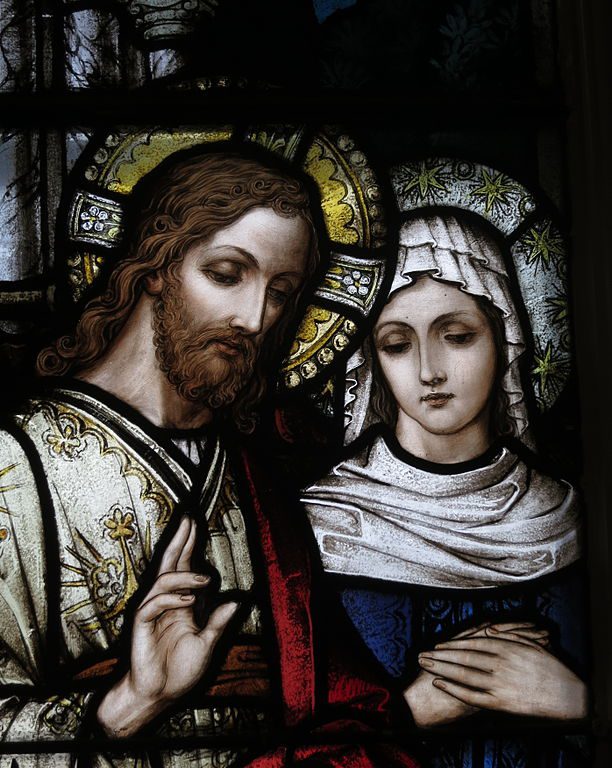
Photo credit: Saint Raphael Catholic Church (Springfield, Ohio) – stained glass, Wedding at Cana – detail (Nheyob: 11-22-14) [Wikimedia Commons / Creative Commons Attribution-Share Alike 4.0 International license]
“Please Hit ‘Subscribe’”! If you have received benefit from this or any of my other 4,600+ articles, please follow this blog by signing up (with your email address) on the sidebar to the right (you may have to scroll down a bit), above where there is an icon bar, “Sign Me Up!”: to receive notice when I post a new blog article. This is the equivalent of subscribing to a YouTube channel. Please also consider following me on Twitter / X and purchasing one or more of my 55 books. All of this helps me get more exposure, and (however little!) more income for my full-time apologetics work. Thanks so much and happy reading!
Martin Luther’s words will be in blue.
***
Anti-Catholic Reformed Protestant James Swan wrote an article entitled, “Luther: Mary Sinned” (2-16-06). He drew from Martin Luther’s second sermon on the First Sunday After Epiphany (1525), on Luke 2:41-52 (from Complete Sermons of Martin Luther, Volume 1, Michigan: Baker Books, 2000). What he cites from it, however, doesn’t support his contention that Luther was claiming that Mary sinned:
32. . . . you can see here how they err and falter, not only in this that they seek Christ and know not where to find him until they accidentally come to the temple, but also that they could not understand these words with which he censured their ignorance and is compelled to say to them: “Knew ye not, that I must be in the things of my Father?”
39. To this we should reply as is taught in this Gospel: Be they called holy, learned, fathers, councils, or any other name, even though they were Mary, Joseph and all the saints it does not follow that they could not have erred and made mistakes. For here you learn that the mother of Christ though she possessed great intelligence and enlightenment, showed great ignorance in that she did not know where to find Christ, and in consequence was censured by him because she did not know what she should have known.
46. . . . And although she had been sanctified by the Holy Spirit; yet he permitted her at times to err, even in the important matters of faith.
Why Swan concluded this is a deep, unfathomable mystery, since, first of all, mere ignorance in and of itself is not a sin (Acts 3:17; 17:30). Only obstinate or intransigent ignorance is (Eph 4:18). Luther in the above excerpts was discussing lack of knowledge, or ignorance. He stated in section 33: “God led her in such a way that he concealed much from her and daily permitted many things to happen which she had not known beforehand.”
Secondly, in the same sermon, Luther stated not just once, but twice, that he was not accusing Mary of sin (my italics):
13. Yea, though it may not be a matter of open sin, the devil can make sin of that which is no sin, and so move and terrify the heart that it will plague itself with the thought: . . .
22. . . . So here, the mother of Christ was forced to contend, even till the third day, with a heavy heart, which accused her as if she had lost the Son of God, a sin the like of which no one else on earth had committed, and she had to fear only the Most High; and yet truly there was no such sin, nor wrath, nor disfavor.
Luther in section 5 also stated that Mary was “greatly blessed with all grace and was a beautiful temple of the holy God.” And in section 33: “he guided and sustained her by his grace, although he had endowed her with many far greater gifts than others.”
Swan wants to constantly lecture Catholics about context in Luther’s writings (saying that we continually neglect it), yet he completely botches that aspect in his vapid analysis in this article? It’s laughable.
Luther does, however, accuse the Blessed Virgin Mary of an unseemly doubt and lack of faith, and I contend that this is absurd and completely unfounded, based on what we know from Luke 2. He projects onto her (and onto St. Paul elsewhere in his writings) the gargantuan and existential struggles with faith that he himself experienced, and this is completely unfounded and based on nothing but his own well-documented internal psychological turmoil and wrestling with recurring depression. Let’s take a look at the biblical passage in play:
Luke 2:42-50 (RSV) And when he was twelve years old, they went up according to custom; [43] and when the feast was ended, as they were returning, the boy Jesus stayed behind in Jerusalem. His parents did not know it, [44] but supposing him to be in the company they went a day’s journey, and they sought him among their kinsfolk and acquaintances; [45] and when they did not find him, they returned to Jerusalem, seeking him. [46] After three days they found him in the temple, sitting among the teachers, listening to them and asking them questions; [47] and all who heard him were amazed at his understanding and his answers. [48] And when they saw him they were astonished; and his mother said to him, “Son, why have you treated us so? Behold, your father and I have been looking for you anxiously.” [49] And he said to them, “How is it that you sought me? Did you not know that I must be in my Father’s house?” [50] And they did not understand the saying which he spoke to them.
I don’t think this is much of a big deal at all. Mary and Joseph were simply perplexed. So they asked, “why have you treated us so?” They didn’t understand. And I’m sure they would have been the first to admit that they wouldn’t always fully understand God the Son. They were simply worried about the whereabouts of their son. If parents didn’t worry in some strong sense about their children, when there was sufficient cause, I submit that they would be negligent, irresponsible parents. The passage doesn’t show Mary as a sinner, but rather, as a very human, normal, concerned parent, as all parents should be. We wouldn’t expect anything less of the Immaculate Mother of God.
Any parent — and I think, anyone, period, to a lesser extent — would immediately understand the emotional dynamics of the story, and Mary being sinless or Jesus being God doesn’t make the reaction any different (just as Jesus felt agonized anxiety in Gethsemane). Mary was a human being with emotions, just like the rest of us, and she experienced the especially intense and excruciating feelings of a mother looking for her “lost” child. I think once one realizes this, her recorded reaction is seen to be extraordinarily mild. Sin isn’t within a universe’s distance to it. This is ultra-normal parental emotions: as far from sin as the east is to the west. Thus, Luther wrote in ection 6:
For let us think for a moment, how she must have felt and grieved. Every father and mother can easily understand the misery and sorrow caused by the unavoidable separation from a dear child, when they know only that the child is lost. And even if the separation should last only an hour, how great are not the sorrow and lamentation, and how many tears are not shed, without consolation, without strength to eat, drink, sleep or rest, and with such misery that they would prefer to die. How much greater the suffering, if this condition were to continue for a day and a night, or even longer, when each hour must seem like a hundred years!
Nor does it necessarily follow at all that Jesus’ usual provocative and rhetorical (indeed, even “socratic”) questioning is implying sin on Mary’s part. He was simply challenging them to realize that He was anticipating His mission to come. Jesus was routinely misunderstood by almost everyone, including (quite often, before Pentecost) His own disciples (Mk 4:13; 6:52; 9:32; Lk 9:45; Jn 12:16). We should fully expect this, since He was the incarnate God, after all, Whose “ways” and “thoughts” are “higher” than ours, “as the heavens are higher than the earth” (Is 55:9).
It’s foolish to rush in and assume it’s because they were rebuked for sin: whether Mary is involved or anyone else. It’s mere rash speculation. This is an attempt to tear down the usual understanding of biblical passages by using a hyper-rationalistic, theologically liberal approach: truth be told. It’s an attitude of relentless skepticism, which is counter to a robust Christian faith. These are the sorts of questions that skeptical, Spirit-deprived atheists cynically ask about biblical texts (I know: I have dealt with such questions at great length).
But there is a further factor to consider, that classic Protestant commentaries (on Luke 2:44) have brought up:
Ellicott’s Commentary for English Readers:
Supposing him to have been in the company.—The company was probably a large one, consisting of those who had come up to keep the Passover from Nazareth and the neighbouring villages. It is not certain, but in the nature of things it is sufficiently probable, that the boys of such a company congregated together, and travelled apart from the others.
Barnes’ Notes on the Bible:
Supposing him to have been in the company . . .
- In going to these great feasts, families and neighbors would join together, and form a large collection.
- It is not improbable that Jesus was “with” them when they were about to start from Jerusalem and were making preparations. Seeing him then, they might have been certain as to his presence.
- A part of the company might have left before the others, and Joseph and Mary may have supposed that he was with them, until they overtook them at night and ascertained their mistake.
Expositor’s Greek Testament:
A company would be made up of people from the same neighbourhood, well acquainted with one another. . . . It is quite conceivable how they should have gone on so long without missing the boy, . . .
Cambridge Bible for Schools and Colleges:
In the numerous and rejoicing caravans of kinsmen and fellow-countrymen relations are often separated without feeling any anxiety.
This plausible theory fits in well with Luke 2:44. Mary and Joseph assumed Jesus was in the larger “company” of travelers (extended family and friends, per the above commentaries) after “a day’s journey.” But He wasn’t, because He had remained in the temple. They figured out that He wasn’t with them: not even in a possible second group of young cousins and acquaintances, and so they set back to Jerusalem (2:45), which would have taken another day. Thus, the search that took “three days” (2:46) likely, I think, included the day’s journey out, another day back (checking for Him in groups that were leaving Jerusalem, that they passed in their return), and a day looking for Him in Jerusalem. None of this is in the least implausible and it need not include sin at all.
*
But Luther takes it to another surreal level, with all sorts of speculations about Mary’s internal psyche and thoughts that have no basis whatsoever in the biblical text. Here are examples of that in the same (second) sermon on Luke 2:
The affliction and suffering she was compelled to endure were not of a nature that they had occurred without her fault, but her conscience forced her to remember how God had entrusted the child to her and that no one else was accountable for him, and hence storms burst and thundered in her heart: Behold, thou hast lost the child. This is no one’s fault but thine own; for thou shouldst have waited on him and looked after him, and not permitted him for a moment to go out of thy sight. How wilt thou give an account of this before God, since thou hast failed to watch over him? This is the result of sin and thou art no longer worthy to be his mother; yea, thou hast deserved to be condemned by him before all people, inasmuch as he has conferred on thee the great honor and favor of choosing thee for his mother.
Should not her heart have failed and fainted here from anxiety, for two reasons? First, because she lost her son and was unable to find him; secondly, which was the most severe of all and which could not happen to other mothers, making the pain all the more severe, because she must abhor herself before God, the only Father of the child, that he would no longer have or regard her as his mother, and hence she must be more sorrowful and sad at heart than any other woman on earth. In her own heart she regards herself guilty of the same sin as Eve, the first mother, who brought the whole human race to ruin. For what are all sins compared with this one, that she has neglected and lost this child, the Son of God and the Savior of the World? And if he should not be found, or, since he could not be lost, if God should have taken him back to himself, she would be the cause of preventing the completion of the work of the redemption of the world. Such and doubtless many other thoughts filled her heart with great fear, especially since she, as a pious child of God, had a very tender heart and conscience.
Here you may see how God dealt with the most holy person, the mother of his Son, even though she had been most highly honored by him and her joy in her Son had been immeasurably great, such as no mother ever had; and yet God so assailed her and she must be so divested of her honor and comfort that she cannot say, I am the mother of the Son. Previously she had been exalted to heaven, now she has been suddenly cast into deepest hell and is in such terror and sorrow that she might have despaired and died, and have wished that she had never seen the child, nor heard of him; and thus she might have committed a more grievous sin than any other person ever committed. . . .
Therefore, this holy Virgin was a real martyr for three days, and these days were heavier to her than was the external pain of martyrdom to other saints. She had had such anxiety on her Son’s account that she could not have suffered any more bitter pain, For that is the greatest torture and woe, when the heart is attacked and tortured. All other sufferings that assail the body are more endurable; yea, amid them the heart can be joyful and can scorn all bodily suffering, as we read concerning St. Agnes and other martyrs. That is only half-suffering when the body alone is afflicted, while the heart and soul remain full of joy; but when the heart alone is compelled to endure suffering only great and noble spirits, and special grace and strength, are able to endure it.
And in his first sermon on the same topic, Luther opined:
The great sorrow of the mother of Christ, who was deprived of her child, came upon her in order that even her trust in God might be taken from her. For she had reason to fear that God was angry with her and would no longer have her to be the mother of his Son. Nobody will understand what she suffered who has not passed through similar experiences. Therefore we should apply this example to ourselves, for it was not recorded for her sake, but for our benefit. She is now at the end of her sorrows; therefore we should profit by her example and be prepared to bear our sorrow if a similar affliction befall us.
When God vouchsafes to us a strong faith and a firm trust in him, so that we are assured he is our gracious God and we can depend upon him, then we are in paradise. But when God permits our hearts to be discouraged and we believe that he takes from us Christ our Lord; when our conscience feels that we have lost him and amidst trembling and despair our confidence is gone, then we are truly in misery and distress. For even if we are not conscious of any special sin, yet in such a condition we tremble and doubt whether God still cares for us; just as Mary here doubts and knows not whether God still deems her worthy to be the mother of his Son. Our heart thinks in the time of trial thus: God has indeed given me a strong faith, but perhaps he will take it from me and will no longer want me as his child. Only strong minds can endure such temptations and there are not many people whom God tests to this degree. Yet we must be prepared, so that we may not despair if such trials should come upon us.
It’s just Luther projecting his tumultuous inner strife onto Mary: as if everyone in their trials goes through the existential, Chicken Little angst that he habitually experienced.
*
***
*
Practical Matters: Perhaps some of my 4,600+ free online articles (the most comprehensive “one-stop” Catholic apologetics site) or fifty-five books have helped you (by God’s grace) to decide to become Catholic or to return to the Church, or better understand some doctrines and why we believe them.
Or you may believe my work is worthy to support for the purpose of apologetics and evangelism in general. If so, please seriously consider a much-needed financial contribution. I’m always in need of more funds: especially monthly support. “The laborer is worthy of his wages” (1 Tim 5:18, NKJV). 1 December 2021 was my 20th anniversary as a full-time Catholic apologist, and February 2022 marked the 25th anniversary of my blog.
PayPal donations are the easiest: just send to my email address: [email protected]. Here’s also a second page to get to PayPal. You’ll see the term “Catholic Used Book Service”, which is my old side-business. To learn about the different methods of contributing (including Zelle), see my page: About Catholic Apologist Dave Armstrong / Donation Information. Thanks a million from the bottom of my heart!
*
***
*
Photo credit: Saint Raphael Catholic Church (Springfield, Ohio) – stained glass, Wedding at Cana – detail (Nheyob: 11-22-14) [Wikimedia Commons / Creative Commons Attribution-Share Alike 4.0 International license]

Summary: Anti-Catholic Protestant polemicist James Swan contended that Luther said Mary sinned, in a sermon on Luke 2. He did not, but he also said some very weird things about Mary.
Previous Post

June 12, 2024
Grace-Caused Faith is Catholic Teaching, Too!
Next Post

June 17, 2024 Luther: "As Many Sects and Creeds as Heads"
Recent Comments
"And lastly, I belong to no denomination and am free to serve God as He ..."
Is Venerating Men & Angels Worship? ..."
"And obeisance doesn't mean "worship". It means "respect", "obey", or "submission". Very weird that you ..."
Is Venerating Men & Angels Worship? ..."
"Many of these scriptures you have noted have been taken out of context. With Daniel, ..."
Is Venerating Men & Angels Worship? ..."
""Protestants often point out that Jesus is now triumphant in heaven and object to Catholics ..."
Three More Anti-Catholic Lies About Catholicism ..."
Browse Our Archives
Select a Category & Last Things About Me Anti-Catholicism Atheism & Agnosticism Baptism and Sacramentalism Bible and Tradition Blessed Virgin Mary Books by Dave Armstrong C. S. Lewis Calvinism & General Protestantism Catholic Apologetics Catholic Apologists Catholic conversion Catholic converts Christmas Church (Ecclesiology) Church History Conversion and Converts Development of Doctrine Eastern Orthodoxy Ecumenism & Christian Unity Eucharist & Liturgy Fathers of the Church French Translations G. K. Chesterton Hell Hell & Satan Hell & Satan & Last Things Heresies & Comparative Religion Holistic Health Inquisition & Crusades & Scandals James White Jews & Judaism & Old Testament John Calvin John Henry Newman Liberal / Modernist Theology Life Issues Literary Resume Lutheranism Mariology Martin Luther Music Orthodoxy Papacy & Infallibility Personal Page Philosophy & Science Political & Ethical & Moral Issues Protestant Persecution & Intolerance Protestantism Purgatory Purgatory & Penance Romantic & Imaginative Theology Saints & Purgatory & Penance Salvation Salvation & Justification Satan & Last Things Sexuality and Gender Issues Spanish Translations Traditionalism vs. Radical Catholic Reactionaries Traducciones al español / tradução para português Trinitarianism & Christology Uncategorized Videos
Select a Month October 2026 September 2026 August 2026 July 2026 June 2026 May 2026 April 2026 March 2026 February 2026 January 2026 December 2025 November 2025 October 2025 September 2025 August 2025 July 2025 June 2025 May 2025 April 2025 March 2025 February 2025 January 2025 December 2024 November 2024 October 2024 September 2024 August 2024 July 2024 June 2024 May 2024 April 2024 March 2024 February 2024 January 2024 December 2023 November 2023 October 2023 September 2023 August 2023 July 2023 June 2023 May 2023 April 2023 March 2023 February 2023 January 2023 December 2022 November 2022 October 2022 September 2022 August 2022 July 2022 June 2022 May 2022 April 2022 March 2022 February 2022 January 2022 December 2021 November 2021 October 2021 September 2021 August 2021 July 2021 June 2021 May 2021 April 2021 March 2021 February 2021 January 2021 December 2020 November 2020 October 2020 September 2020 August 2020 July 2020 June 2020 May 2020 April 2020 March 2020 February 2020 January 2020 December 2019 November 2019 October 2019 September 2019 August 2019 July 2019 June 2019 May 2019 April 2019 March 2019 February 2019 January 2019 December 2018 November 2018 October 2018 September 2018 August 2018 July 2018 June 2018 May 2018 April 2018 March 2018 February 2018 January 2018 December 2017 November 2017 October 2017 September 2017 August 2017 July 2017 June 2017 May 2017 April 2017 March 2017 February 2017 January 2017 December 2016 November 2016 October 2016 September 2016 August 2016 July 2016 June 2016 May 2016 April 2016 March 2016 February 2016 January 2016 December 2015 November 2015 October 2015 September 2015 August 2015 July 2015 June 2015 May 2015 April 2015 March 2015 February 2015 January 2015 December 2014 November 2014 October 2014 September 2014 August 2014 July 2014 June 2014 April 2014 March 2014 February 2014 January 2014 December 2013 November 2013 October 2013 September 2013 August 2013 July 2013 June 2013 April 2013 March 2013 February 2013 January 2013 December 2012 November 2012 October 2012 September 2012 August 2012 July 2012 June 2012 May 2012 April 2012 March 2012 February 2012 January 2012 December 2011 November 2011 October 2011 September 2011 August 2011 July 2011 June 2011 April 2011 March 2011 February 2011 October 2010 September 2010 August 2010 July 2010 April 2010 March 2010 December 2009 October 2009 August 2009 July 2009 June 2009 May 2009 March 2009 February 2009 October 2008 September 2008 April 2008 March 2008 February 2008 January 2008 December 2007 November 2007 October 2007 May 2007 March 2007 February 2007 January 2007 November 2006 October 2006 September 2006 August 2006 July 2006 June 2006 May 2006 April 2006 March 2006 February 2006 October 2005 June 2005 April 2005 February 2005 July 2004 May 2004 April 2004
Follow Us!
TAKE THE
Religious Wisdom Quiz
What was Paul’s profession before becoming an apostle?
Select your answer to see how you score.
Tentmaker Tax Collector Fisherman Carpenter
Books by This Author Books by Dave Armstrong
Related posts from Biblical Evidence for Catholicism

Three More Anti-Catholic Lies About Catholicism (#6-4)
Biblical Evidence for Catholicism

Top Ten Anti-Catholic Lies (#10-7)
Biblical Evidence for Catholicism

Holy Ground: Why Mary Had NO Other Children...
Biblical Evidence for Catholicism
Protestant Confessions & "Ever-Virgin" Mary
Biblical Evidence for Catholicism
TRENDING AT PATHEOS Catholic

I was strolling through the top floor of the brand new Parthenon...

What Does Gêvâh Mean For Kimberley Guifoyle &...
This week, a lot of the news is focused on Kimberly Guilfoyle....

INNER CIRCLE: Profound Mystery (Of Christ In All...
Ephesians 5:31-32 “For this reason, a man will leave his father and...

Do Not Rejoice When Your Enemy Falls: The...
Turning an execution into a public spectacle is a disturbing expression of...

'The Chosen' S6 Trailer: The Passion Gets Very...
Not many watching 'The Chosen' worry about spoilers, but just because they...

The purpose-driven labor priest
A labor activist reads Rick Warren and it gets me wondering about...
view all Catholic blogs
What Are Your Thoughts?leave a comment
Ad-Free & Subscriber Log-In Subscription Support
- About Us
- 2026 Calendar
- Videos
- Podcasts
- Library of World Religions
- Faith In Media Tracker
- Advertise With Us
- Write for Us
- Privacy Policy
- Terms of Service
- Do Not Sell My Data
- Contact Us
- Radiant Digital
- Manage Newsletter Subscriptions
- Unsubscribe From Notifications
- Sitemap
Copyright 2008-2026, Patheos. All rights reserved.
Subscription Support Ad-Free & Subscriber Log-In
Follow Patheos