
BuddhistCatholicContemplativeEvangelicalGeneral ChristianHinduJewishLatter-day SaintMuslimNew VisionsProgressive Christian
Beliefs
- Buddhist
- Catholic
- Contemplative
- Evangelical
- General Christian
- Hindu
- Jewish
- Latter-day Saint
- More Voices
- Muslim
- New Visions
- Pagan
- Progressive Christian
Topics
- Religion News
- Food and Religion
- Sports and Religion
- Religious Art
- Religious Music and Entertainment
- Religious Events
- History and Religion
- Style and Religion
- Politics and Religion
- Women in Religion
- Recreation Outdoors and Religion
- Business Finance and Religion
- Careers Workplace and Religion
- Education and Religion
- Family Parenting and Religion
- Health Fitness and Religion
- Home and Religion
- Relationships and Religion
- Technology and Religion
- Travel and Religion
Columnists
- Buddhist Columnists
- Business Finance and Religion Columnists
- Careers Workplace and Religion Columnists
- Catholic Columnists
- Contemplative Columnists
- Education and Religion Columnists
- Evangelists Columnists
- Family Parenting and Religion Columnists
- General Christian Columnists
- Health Fitness and Religion Columnists
- Hindu Columnists
- History and Religion Columnists
- Home and Religion Columnists
- Jewish Columnists
- More Voices Columnists
- Latter Day Columnists
- Muslim Columnists
- New Visions Columnists
- Nonreligious Columnists
- Pagan Columnists
- Politics and Religion Columnists
- Progressive Columnists
- Recreation Outdoors and Religion Columnists
- Relationships and Religion Columnists
- Religion News Columnists
- Religious Art Columnists
- Religious Events Columnists
- Religious Music and Entertainment Columnists
- Sports and Religion Columnists
- Style and Religion Columnists
- Technology and Religion Columnists
- Travel and Religion Columnists
- Women in Religion Columnists
Resource Library
- 2026 Calendar
- Library of World Religions
- The 100 Most Holy Places on Earth
- Patheos Answers
- Podcasts
- Videos
- Faith Leaders Database
- Anglican Episcopalian
- Bahai
- Baptist
- Buddhism
- Christianity
- Confucianism
- Eastern Orthodoxy
- Hinduism
- Holiness and Pentecostal
- ISKCON
- Islam
- Judaism
- Lutheran
- Methodist
- The Church of Jesus Christ of Latter-day Saints
- New Age
- Paganism
- Presbytarian and Reformed
- Protestantism
- Religion Behind the Scenes
- Roman Catholic
- Scientology
- Shia Islam
- Sikhism
- Sufism
- Sunni Islam
- Taoism
- Zen
- See all religions
Research Tools
 Ad-Free & Subscriber Log-In Subscription Support
Ad-Free & Subscriber Log-In Subscription Support
Follow Patheos 

- Trending:
- Forgiveness
- |
- Marriage
- |
- Consciousness
- |
- Death Penalty
- |
- Election
- |
- Halloween

-
About
-
Catholic Apologetics
-
Church History
-
Great Apologists
-
Christian Worldview
-
Protestantism & Misc.
- Home
- Catholic
- History and Religion
- Luther Okayed Polygamy? No, But . . .
Luther Okayed Polygamy? No, But . . .
Last updated on: June 10, 2024 at 11:05 am by Dave Armstrong
Luther Okayed Polygamy? No, But . . . 2024-06-10T11:05:15-04:00 Dave Armstrong
Patheos Explore the world's faith through different perspectives on religion and spirituality! Patheos has the views of the prevalent religions and spiritualities of the world.
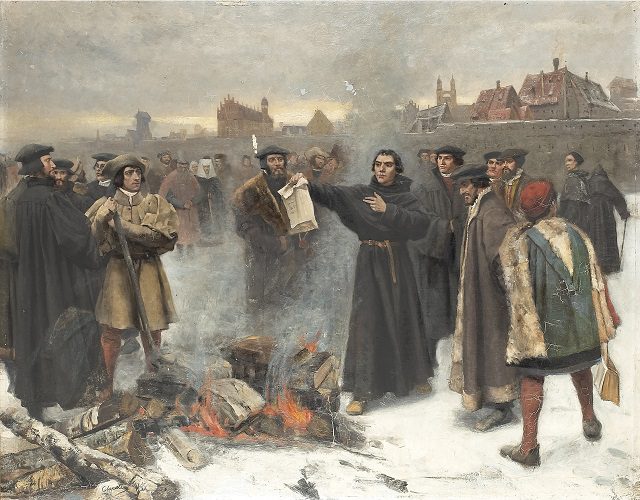
Photo credit: Luther burns the Papal bull in the square of Wittenberg year 1520 (1885), by Karl Aspelin (1857-1922) [public domain / Wikimedia Commons]
“Please Hit ‘Subscribe’”! If you have received benefit from this or any of my other 4,600+ articles, please follow this blog by signing up (with your email address) on the sidebar to the right (you may have to scroll down a bit), above where there is an icon bar, “Sign Me Up!”: to receive notice when I post a new blog article. This is the equivalent of subscribing to a YouTube channel. Please also consider following me on Twitter / X and purchasing one or more of my 55 books. All of this helps me get more exposure, and (however little!) more income for my full-time apologetics work. Thanks so much and happy reading!
***
This is a response to anti-Catholic Reformed Protestant apologist James Swan’s article, “Luther: ‘I confess that I cannot forbid a person to marry several wives, for it does not contradict the Scripture’ “ (Boors All, 1-31-09). His words will be in green. Luther’s will be in blue.
This discussion is a result of a statement from the founder of Protestantism, Martin Luther, in his letter to Chancellor Gregory Brück on 27 January 1524*.* Swan notes that “Brück was a political figure-head (and supporter of the Reformation) in Electoral Saxony (LW [Luther’s Works] 49:50). The primary source is the collection of Luther’s letters edited by ” Dr. Wilhelm Martin Leberecht de Wette. It’s found in Volume II:459. Swan provides a screen shot of the excerpt with some context. Here is the controversial statement in Latin and English (Google Translate, except for “sacred Scripture” at the end):
Ego sane fateor, me non posse prohibere, si quis plures velit uxores, nec repugnat sacris literis.
Of course I confess that I cannot prevent it if a man wants more wives, nor does it contradict sacred Scripture.
Swan likes to collect examples of Catholic apologists and others butchering the words of Luther, taking them out of context, etc. And that was his primary purpose in this article. He writes, “Rome’s defenders chastising Luther with this quote tend to make it mean more than was intended.” Mine is to note that Luther made a demonstrably false statement about what Holy Scripture teaches. It’s two very different purposes. Swan majors on the minors and seeks to find Catholics saying stupid and false things about what Luther wrote (which certainly can be found; no doubt. Ignorance abounds on both sides). I want to highlight, on the other hand, what Scripture teaches about marriage and to wonder “aloud” why Luther was mistaken regarding that question. Which of the two endeavors is more important?
I’m all for locating and objecting to out-of-context citations or twisted interpretations of same. More power to Swan insofar as he proves that these errors occur. But I’m also an advocate of addressing the most important issue here: what Luther believed Scripture taught: in this instance, erroneously so. Swan actually agrees with us about this bottom-line issue, because he stated: “Do I agree with Luther? not at all, I would argue that even his exception is wrong, and that a case for monogamy can be made from the Bible.”
Swan cites the example of the early 20th century anti-Luther Catholic polemicist Patrick O’Hare, writing (interpreting the above words) that “Luther was an out-and-out believer in polygamy.” This is untrue. It’s problematic that he claimed that Scripture didn’t “contradict” polygamy, which is a separate issue, and one quite troublesome, in my opinion. But he himself didn’t “believe” in it or “advocate” it, as we know from the larger context of these words of his.
For right after the words above, Luther wrote: “I should not like to see this example introduced amongst Christians. . . . It does not beseem Christians to seize greedily and for their own advantage on everything to which their freedom gives them a right” (from: Hartmann Grisar, Luther Vol. 5, p. 72; in this work, the translation is “Holy Scripture does not forbid this”). In Audin’s translation of a part of this portion, Luther states: “there are many things permissible that ought not becomingly to be done: of these is bigamy.” Luther added in a 1526 letter:
[M]y faithful warning and advice is that no man, Christians in particular, should have more than one wife, not only for the reason that offense would be given, and Christians must not needlessly give, but most diligently avoid giving, offense, but also for the reason that we have no word of God regarding this matter on which we might base a belief that such action would be well-pleasing to God and to Christians. . . . a Christian . . . must have, in addition, a divine word that makes him sure, . . . For this reason I cannot advise for, but must advise against, your intention, particularly since you are a Christian, unless there were an extreme necessity, as, for instance, if the wife were leprous or the husband were deprived of her for some other reason. (cited in W. H. T. Dau, Luther Examined and Reexamined: A Review of Catholic Criticism and a Plea for Reevaluation, St Louis: Concordia Publishing House, 1917, 103-104)
Again, we see that Luther was gravely mistaken about what Scripture taught (“we have no word of God regarding this matter”). Based on that false premise, he goes on to say that men can take on another wife if their wife is a leper or sexually depriving him for some other reason. The Bible plainly teaches otherwise:
Matthew 19:3-9 (RSV) And Pharisees came up to him and tested him by asking, “Is it lawful to divorce one’s wife for any cause?” [4] He answered, “Have you not read that he who made them from the beginning made them male and female, [5] and said, `For this reason a man shall leave his father and mother and be joined to his wife, and the two shall become one flesh’? [6] So they are no longer two but one flesh. What therefore God has joined together, let not man put asunder.” [7] They said to him, “Why then did Moses command one to give a certificate of divorce, and to put her away?” [8] He said to them, “For your hardness of heart Moses allowed you to divorce your wives, but from the beginning it was not so. [9] And I say to you: whoever divorces his wife, except for unchastity, and marries another, commits adultery.”
Mark 10:11-12 And he said to them, “Whoever divorces his wife and marries another, commits adultery against her; [12] and if she divorces her husband and marries another, she commits adultery.”
Romans 7:2-3 Thus a married woman is bound by law to her husband as long as he lives; but if her husband dies she is discharged from the law concerning the husband. [3] Accordingly, she will be called an adulteress if she lives with another man while her husband is alive. But if her husband dies she is free from that law, and if she marries another man she is not an adulteress.
1 Corinthians 7:2-4 But because of the temptation to immorality, each man should have his own wife and each woman her own husband. [3] The husband should give to his wife her conjugal rights, and likewise the wife to her husband. [4] For the wife does not rule over her own body, but the husband does; likewise the husband does not rule over his own body, but the wife does.
Ephesians 5:31-33 “For this reason a man shall leave his father and mother and be joined to his wife, and the two shall become one flesh.” [32] This mystery is a profound one, and I am saying that it refers to Christ and the church; [33] however, let each one of you love his wife as himself, and let the wife see that she respects her husband.
1 Timothy 3:2 . . . husband of one wife . . . (same phrase in 3:12; Titus 1:6)
Luther, by denying that the Bible plainly and repeatedly teaches monogamy, offered a watered-down version of Christian teaching on the matter that wasn’t conducive to monogamy or faithfulness to one spouse. It’s much better to say (if indeed it is the case) that “Scripture forbids x,” than “Scripture doesn’t say one way or another about x.” The latter opens doors to all sorts of violations of the biblical prohibition of x.
Luther at the Diet of Worms in 1521 famously stated that he wanted to be convinced “by Scripture or plain reason.” So why weren’t the above clear Bible passages sufficient for him to understand that the Bible prohibited polygamy? Who knows?
The Wisconsin Evangelical Lutheran Synod, one of the more traditional Lutheran denominations, shows no such confusion about Scripture and polygamy:
Recently on the WELS discussion page it was stated that polygamy is not a sin. Martin Luther was even referenced by one person. Is it true that polygamy is not a sin?
Polygamy is a sinful deviation from God’s design that marriage be between one man and one woman (Genesis 2:20-24; Matthew 19:4-6; Romans 7:2-3; 1 Corinthians 7:2; 1 Timothy 3:2; Titus 1:6). The fact that God did not intervene in people’s lives when they went beyond his design and will does not equate to approval on his part. The biblical narratives of those people who went beyond “one man, one woman” paint a home life marred by strife and troubles. Those narratives illustrate how God’s ways are always best—including what he says about his institution of marriage.
This is fascinating, given the fact that Luther assumed that Holy Scripture was able to be understood (even by a plowboy?) without any need of an authoritative interpretation from the Church (whose infallibility he denied). Yet he thinks Scripture doesn’t “contradict” or “forbid” polygamy and that there was “no word of God regarding this matter” (and in another translation, “there is not in the sacred texts the least word against those who take several wives at one time”; and another has, “nor is it in opposition to the Holy Scriptures”) — so that he couldn’t bring himself to “prohibit” (Latin, prohibere) or “prevent” it (Grisar’s translation has, “I can raise no objection”).
If Scripture is indeed so clear without the need of the Church, why is it that Martin Luther and one of the denominations that originated with him have diametrically opposed views with regard to polygamy? The WELS page even cited the same Scriptures that I did, in explaining the biblical argument against polygamy.
Lutheran Willard Bruce wrote a helpful article, “Polygamy and the Church” in the April 1963 edition of Concordia Theological Monthly (223-232). It never cites Luther’s words on the topic, by the way. He stated:
The 17th-century Lutheran theologian John Gerhard pronounced polygamy illicita ac damnata, “especially in the New Testament.” He argued: “Whatever is contrary to the original institution of marriage neither can nor should be tolerated among Christians. Polygamy is contrary to the original institution of marriage.” He defended the major premise by referring to Matt. 19:4, where Christ reiterated and confirmed the original institution of marriage and showed that the original institution is the criterion for deciding marriage questions. . . .
Gerhard also refers to Matt. 5:32 and 19:9, arguing that if it is adultery to dismiss one’s wife and marry another, how much more is it a sin to marry another while the first is retained. He cites Rom. 7:2 and 1 Cor. 7:39, which state that a woman is bound to her husband as long as he is alive. He reasons: If it is wrong for a woman to marry another man while her husband is alive (polyandry), then it is also just as wrong for a man to marry another woman or women during the life of his wife (polygyny). He refers also to 1 Cor. 7:2, “his own wife,” and “her own husband.” He quotes 1 Cor. 7:4 as showing that neither husband nor wife have the right to make their bodies available to any other person, as is done in polygamy; and he adds that it would be as wrong for them to do this by mutual consent as it would be for them to get a divorce by mutual consent. He cites 1 Tim. 3: 2 and Titus 1: 6, which, he says, refer not to virtues that belong only to bishops, but to virtues that bishops should have in common with all Christians. He also refers to the fact that marriage, as originally ordained, prefigures the relationship of Christ (who is One) and the Church (which is one). (Eph. 5:22-33). (p. 224)
So WELS and one of the greatest Lutheran theologians, John Gerhard, and myself (the lowly Catholic) all use the same Scriptures to prove the same argument (Scripture prohibits polygamy), but Martin Luther — no intellectual slouch — can’t figure this out (while thinking he knew enough to singlehandedly reject fifty Catholic practices and beliefs by 1520)? It’s a strange world, isn’t it? Truth is stranger than fiction once again.
Related Reading
Luther & Melanchthon: Bigamy of Philip of Hesse is Biblical (Hartmann Grisar) [2-14-07; abridged on 11-2-17]
Divorce: Early Church Teaching [Oct. 1998]
Biblical Evidence for the Prohibition of Divorce [2004]
Matthew 19:9 “Divorce Exception” Translation Bias [11-6-08]
Dialogue on the Matthew 19:19 Exception Clause & Divorce [11-10-08]
*
***
*
Practical Matters: Perhaps some of my 4,600+ free online articles (the most comprehensive “one-stop” Catholic apologetics site) or fifty-five books have helped you (by God’s grace) to decide to become Catholic or to return to the Church, or better understand some doctrines and why we believe them.
Or you may believe my work is worthy to support for the purpose of apologetics and evangelism in general. If so, please seriously consider a much-needed financial contribution. I’m always in need of more funds: especially monthly support. “The laborer is worthy of his wages” (1 Tim 5:18, NKJV). 1 December 2021 was my 20th anniversary as a full-time Catholic apologist, and February 2022 marked the 25th anniversary of my blog.
PayPal donations are the easiest: just send to my email address: [email protected]. Here’s also a second page to get to PayPal. You’ll see the term “Catholic Used Book Service”, which is my old side-business. To learn about the different methods of contributing (including Zelle), see my page: About Catholic Apologist Dave Armstrong / Donation Information. Thanks a million from the bottom of my heart!
*
***
*
Photo credit: Luther burns the Papal bull in the square of Wittenberg year 1520 (1885), by Karl Aspelin (1857-1922) [public domain / Wikimedia Commons]

Summary: Some Catholics distort Luther’s position: accusing him of advocating polygamy. He didn’t, but he wrongly & irresponsibly thought the Bible didn’t prohibit it.
Previous Post
June 7, 2024
Eck vs. Protestantism Chronicles: Veneration of Images
Next Post

June 10, 2024 Martin Luther: Mary Was a Perpetual Virgin
Recent Comments
"Special pleading, and not a serious response to my arguments . . ."
Is Venerating Men & Angels Worship? ..."
""no man needs to teach us."Didn't you just teach us?"
Is Venerating Men & Angels Worship? ..."
""Catholics say they are the only church that can lead people into heaven."In fact, we ..."
Is Venerating Men & Angels Worship? ..."
"And lastly, I belong to no denomination and am free to serve God as He ..."
Is Venerating Men & Angels Worship? ..."
Browse Our Archives
Select a Category & Last Things About Me Anti-Catholicism Atheism & Agnosticism Baptism and Sacramentalism Bible and Tradition Blessed Virgin Mary Books by Dave Armstrong C. S. Lewis Calvinism & General Protestantism Catholic Apologetics Catholic Apologists Catholic conversion Catholic converts Christmas Church (Ecclesiology) Church History Conversion and Converts Development of Doctrine Eastern Orthodoxy Ecumenism & Christian Unity Eucharist & Liturgy Fathers of the Church French Translations G. K. Chesterton Hell Hell & Satan Hell & Satan & Last Things Heresies & Comparative Religion Holistic Health Inquisition & Crusades & Scandals James White Jews & Judaism & Old Testament John Calvin John Henry Newman Liberal / Modernist Theology Life Issues Literary Resume Lutheranism Mariology Martin Luther Music Orthodoxy Papacy & Infallibility Personal Page Philosophy & Science Political & Ethical & Moral Issues Protestant Persecution & Intolerance Protestantism Purgatory Purgatory & Penance Romantic & Imaginative Theology Saints & Purgatory & Penance Salvation Salvation & Justification Satan & Last Things Sexuality and Gender Issues Spanish Translations Traditionalism vs. Radical Catholic Reactionaries Traducciones al español / tradução para português Trinitarianism & Christology Uncategorized Videos
Select a Month October 2026 September 2026 August 2026 July 2026 June 2026 May 2026 April 2026 March 2026 February 2026 January 2026 December 2025 November 2025 October 2025 September 2025 August 2025 July 2025 June 2025 May 2025 April 2025 March 2025 February 2025 January 2025 December 2024 November 2024 October 2024 September 2024 August 2024 July 2024 June 2024 May 2024 April 2024 March 2024 February 2024 January 2024 December 2023 November 2023 October 2023 September 2023 August 2023 July 2023 June 2023 May 2023 April 2023 March 2023 February 2023 January 2023 December 2022 November 2022 October 2022 September 2022 August 2022 July 2022 June 2022 May 2022 April 2022 March 2022 February 2022 January 2022 December 2021 November 2021 October 2021 September 2021 August 2021 July 2021 June 2021 May 2021 April 2021 March 2021 February 2021 January 2021 December 2020 November 2020 October 2020 September 2020 August 2020 July 2020 June 2020 May 2020 April 2020 March 2020 February 2020 January 2020 December 2019 November 2019 October 2019 September 2019 August 2019 July 2019 June 2019 May 2019 April 2019 March 2019 February 2019 January 2019 December 2018 November 2018 October 2018 September 2018 August 2018 July 2018 June 2018 May 2018 April 2018 March 2018 February 2018 January 2018 December 2017 November 2017 October 2017 September 2017 August 2017 July 2017 June 2017 May 2017 April 2017 March 2017 February 2017 January 2017 December 2016 November 2016 October 2016 September 2016 August 2016 July 2016 June 2016 May 2016 April 2016 March 2016 February 2016 January 2016 December 2015 November 2015 October 2015 September 2015 August 2015 July 2015 June 2015 May 2015 April 2015 March 2015 February 2015 January 2015 December 2014 November 2014 October 2014 September 2014 August 2014 July 2014 June 2014 April 2014 March 2014 February 2014 January 2014 December 2013 November 2013 October 2013 September 2013 August 2013 July 2013 June 2013 April 2013 March 2013 February 2013 January 2013 December 2012 November 2012 October 2012 September 2012 August 2012 July 2012 June 2012 May 2012 April 2012 March 2012 February 2012 January 2012 December 2011 November 2011 October 2011 September 2011 August 2011 July 2011 June 2011 April 2011 March 2011 February 2011 October 2010 September 2010 August 2010 July 2010 April 2010 March 2010 December 2009 October 2009 August 2009 July 2009 June 2009 May 2009 March 2009 February 2009 October 2008 September 2008 April 2008 March 2008 February 2008 January 2008 December 2007 November 2007 October 2007 May 2007 March 2007 February 2007 January 2007 November 2006 October 2006 September 2006 August 2006 July 2006 June 2006 May 2006 April 2006 March 2006 February 2006 October 2005 June 2005 April 2005 February 2005 July 2004 May 2004 April 2004
Follow Us!
TAKE THE
Religious Wisdom Quiz
What does the Bible say about greed?
Select your answer to see how you score.
It leads to ruin It is always wise It is best It helps you win
Books by This Author Books by Dave Armstrong
Related posts from Biblical Evidence for Catholicism

Three More Anti-Catholic Lies About Catholicism (#6-4)
Biblical Evidence for Catholicism

Top Ten Anti-Catholic Lies (#10-7)
Biblical Evidence for Catholicism

"Baptism" & Romans 10 (Engwer's Silly Word Games)
Biblical Evidence for Catholicism

Book: Martin Luther: Dissenter and Defender
Biblical Evidence for Catholicism
TRENDING AT PATHEOS Catholic

Janie Learns the Way of the Cross: A...
Teaching children about Jesus' Passion can be challenging. Many parents and educators...

Looking For Good Catholic Writing - October 2026
He alone extends the heavens, and he walks upon the waves of...

In "Irreplaceable," our book on vocation and technology, Trevor Sutton and I...

I was strolling through the top floor of the brand new Parthenon...

What Does Gêvâh Mean For Kimberley Guifoyle &...
This week, a lot of the news is focused on Kimberly Guilfoyle....

INNER CIRCLE: Profound Mystery (Of Christ In All...
Ephesians 5:31-32 “For this reason, a man will leave his father and...
view all Catholic blogs
What Are Your Thoughts?leave a comment
Ad-Free & Subscriber Log-In Subscription Support
- About Us
- 2026 Calendar
- Videos
- Podcasts
- Library of World Religions
- Faith In Media Tracker
- Advertise With Us
- Write for Us
- Privacy Policy
- Terms of Service
- Do Not Sell My Data
- Contact Us
- Radiant Digital
- Manage Newsletter Subscriptions
- Unsubscribe From Notifications
- Sitemap
Copyright 2008-2026, Patheos. All rights reserved.
Subscription Support Ad-Free & Subscriber Log-In
Follow Patheos