
BuddhistCatholicContemplativeEvangelicalGeneral ChristianHinduJewishLatter-day SaintMuslimNew VisionsProgressive Christian
Beliefs
- Buddhist
- Catholic
- Contemplative
- Evangelical
- General Christian
- Hindu
- Jewish
- Latter-day Saint
- More Voices
- Muslim
- New Visions
- Pagan
- Progressive Christian
Topics
- Religion News
- Food and Religion
- Sports and Religion
- Religious Art
- Religious Music and Entertainment
- Religious Events
- History and Religion
- Style and Religion
- Politics and Religion
- Women in Religion
- Recreation Outdoors and Religion
- Business Finance and Religion
- Careers Workplace and Religion
- Education and Religion
- Family Parenting and Religion
- Health Fitness and Religion
- Home and Religion
- Relationships and Religion
- Technology and Religion
- Travel and Religion
Columnists
- Buddhist Columnists
- Business Finance and Religion Columnists
- Careers Workplace and Religion Columnists
- Catholic Columnists
- Contemplative Columnists
- Education and Religion Columnists
- Evangelists Columnists
- Family Parenting and Religion Columnists
- General Christian Columnists
- Health Fitness and Religion Columnists
- Hindu Columnists
- History and Religion Columnists
- Home and Religion Columnists
- Jewish Columnists
- More Voices Columnists
- Latter Day Columnists
- Muslim Columnists
- New Visions Columnists
- Nonreligious Columnists
- Pagan Columnists
- Politics and Religion Columnists
- Progressive Columnists
- Recreation Outdoors and Religion Columnists
- Relationships and Religion Columnists
- Religion News Columnists
- Religious Art Columnists
- Religious Events Columnists
- Religious Music and Entertainment Columnists
- Sports and Religion Columnists
- Style and Religion Columnists
- Technology and Religion Columnists
- Travel and Religion Columnists
- Women in Religion Columnists
Resource Library
- 2026 Calendar
- Library of World Religions
- The 100 Most Holy Places on Earth
- Patheos Answers
- Podcasts
- Videos
- Faith Leaders Database
- Anglican Episcopalian
- Bahai
- Baptist
- Buddhism
- Christianity
- Confucianism
- Eastern Orthodoxy
- Hinduism
- Holiness and Pentecostal
- ISKCON
- Islam
- Judaism
- Lutheran
- Methodist
- The Church of Jesus Christ of Latter-day Saints
- New Age
- Paganism
- Presbytarian and Reformed
- Protestantism
- Religion Behind the Scenes
- Roman Catholic
- Scientology
- Shia Islam
- Sikhism
- Sufism
- Sunni Islam
- Taoism
- Zen
- See all religions
Research Tools
 Ad-Free & Subscriber Log-In Subscription Support
Ad-Free & Subscriber Log-In Subscription Support
Follow Patheos 

- Trending:
- Forgiveness
- |
- Marriage
- |
- Consciousness
- |
- Death Penalty
- |
- Election
- |
- Halloween

-
About
-
Catholic Apologetics
-
Church History
-
Great Apologists
-
Christian Worldview
-
Protestantism & Misc.
- Home
- Catholic
- History and Religion
- Luther & Mary’s Assumption + James Swan’s Silliness
Luther & Mary’s Assumption + James Swan’s Silliness
Last updated on: August 6, 2024 at 10:53 am by Dave Armstrong
Luther & Mary’s Assumption + James Swan’s Silliness 2024-08-06T10:53:59-04:00 Dave Armstrong
Patheos Explore the world's faith through different perspectives on religion and spirituality! Patheos has the views of the prevalent religions and spiritualities of the world.
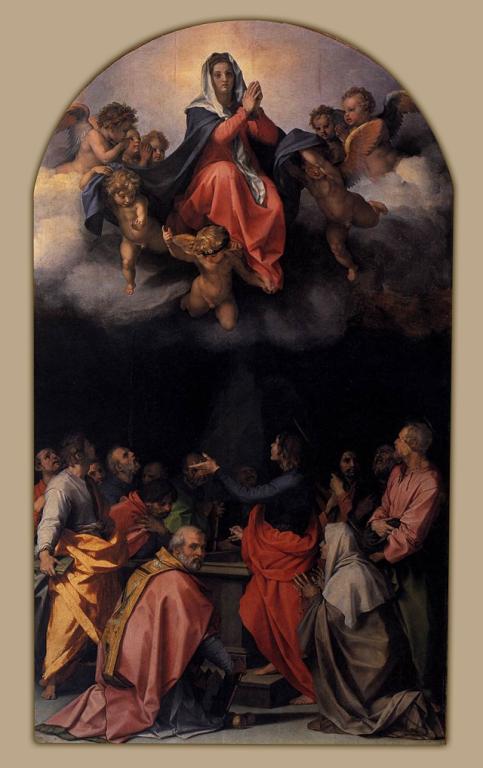
Photo Credit: Assumption of the Virgin (1526-1529), by Andrea del Sarto (1486-1530) [public domain / Wikimedia Commons]
“Please Hit ‘Subscribe’”! If you have received benefit from this or any of my other 4,600+ articles, please follow this blog by signing up (with your email address) on the sidebar to the right (you may have to scroll down a bit), above where there is an icon bar, “Sign Me Up!”: to receive notice when I post a new blog article. This is the equivalent of subscribing to a YouTube channel. Please also consider following me on Twitter / X and purchasing one or more of my 55 books. All of this helps me get more exposure, and (however little!) more income for my full-time apologetics work. Thanks so much and happy reading!
***
This is a reply to anti-Catholic Reformed Protestant polemicist James Swan’s article, “Martin Luther and Mary’s Assumption” (12-18-06). His words will be in blue; Luther’s in green.
Here’s another one of those “Martin Luther was devoted to Mary” quotes. This time, Luther is said to believe in Mary’s assumption.
Well, yes. Lutheran scholars agree that he did, as I will document.
William J. Cole did not have anything to do with the Weimar edition of Luther’s Works.
Since it was compiled either before he was born or when he was very young, that would follow, yes.
He was a Roman Catholic scholar who wrote an article on Luther’s Mariology many years ago. . . . The quote is originally from WA 10(3), 268,13 to 269. The translation utilized is from Cole’s old article from 1970, “Was Luther a Devotee of Mary?” [Marian Studies XXI].
Yep. I put it online (probably the first person to do so). And that’s where I got it. There is nothing improper in this. A secondary scholarly source can be used if he or she cites a primary source. That’s what Cole did. Nor does a person have to read the original in a different language in order to cite a secondary source citing it in English. Swan — who knows why? — has this ludicrous notion in his head that this is what is required of everyone.
The quote is from Luther’s sermon of August 15, 1522. Cole mentions it was the last time Luther preached on the Feast of the Assumption, which should tip us all off on where Luther was heading with his “Mariology” (recall, Luther lived till 1546, thus this comment comes very early in his “Reformation.”). Cole quotes Luther as saying,
“There can be no doubt that the Virgin Mary is in heaven. How it happened we do not know. And since the Holy Spirit has told us nothing about it, we can make of it no article of faith.” [note from 8-2-24: actually, these are not Luther’s words; see the Addendum at the end]
Now, one could say here that Luther leaves the door open for Mary’s assumption. Perhaps he did in 1522. . . . Here we find Luther living up to “Sola Scriptura.” One is not [to] believe in the Assumption.
Not all Lutheran historians or other scholars would agree with Swan that Luther always thought his followers should “not believe in the Assumption.” Lutheran scholar Eric W. Gritsch, who was a major translator in the English set, Luther’s Works (edited by Jaroslav Pelikan), observed:
Luther affirmed Mary’s assumption into heaven but did not consider it to be of benefit to others or accomplished in any special way. (in The One Mediator, the Saints, and Mary, Lutherans and Catholics in Dialogue VIII, edited by H. George Anderson, J. Francis Stafford, Joseph A. Burgess, Minneapolis: Augsburg Fortress Press, 1992, 241; footnote 44; p. 382: “Sermon on the Festival of the Assumption, August 15, 1522. WA 10/3:269.12-13. Sermon on the Festival of the Visitation . . . August 15, 1522. WA 52:681.27-31.”; my bolded emphasis)
In the same book, twelve Lutheran and ten Catholic scholars participated. Their “Common Statement” (a sort of creed-like formulation agreed-upon by all) yielded some very interesting conclusions indeed:
(89) Luther preached on the Assumption . . . There were early Lutheran pastors who affirmed the Assumption as both evangelical and Lutheran.
(101) From the Lutheran side, one may recall the honor and devotion paid to the Mother of God by Luther himself, including his own attitude to the Immaculate Conception and the Assumption, which he accepted in some form. (p. 55; my bolded emphasis)
Luther signed an August 19, 1527 letter to Georg Spalatin in the following (very “unProtestant”) manner:
Yours, Monday after the Assumption of Mary, 1527. Martin Luther. (in Luther: Letters of Spiritual Counsel, edited and translated by Theodore G. Tappert, Vancouver: Regent College Publishing, 2003, 230)
He did the same eight years later, in a letter dated “the Friday after the Assumption of Mary 1535” (letter to Elector John Frederick, 20 August 1535, referenced in Luther’s Works, Vol. 2, p. 21, footnote 31).
It is not to be an article of faith.
Luther did state that. But that’s a separate issue from whether he believed it at that time.
Interestingly, Cole goes on to point out that Luther “used strong language….for the elimination of the Assumption as an aspect of the ‘hypocritical church’,” particularly in celebrating a feast for it. Cole cites Luther as saying in 1544:
“The feast of the Assumption is totally papist, full of idolatry and without foundation in the Scriptures. But we, even though Mary has gone to heaven, should not bother how she went there. We will not invoke her as our special advocate as the Pope teaches. The pope takes away the honor due to the Ascension of our Lord, Christ, with the result that he has made the mother like her Son in all things.”
Even this doesn’t particular quotation necessarily require that Luther himself gave up all belief in Mary’s Assumption, since he was discussing not the thing itself, but how the feast celebrating it was conducted in the Catholic Church (thus, he referred to invoking her, etc., which has nothing directly to do with the doctrine itself).
In fairness to the work of William Cole, Cole doesn’t take a stance one way or the other if Luther ever held to the doctrine of Mary’s Assumption. He simply says that for Luther the Assumption was of “little importance…” and Luther never explicitly “denied” it either.
Swan (the world’s greatest expert on how to make a citation) gets this wrong, too, and he refutes himself in his later article, “Revisiting Luther on the Assumption of Mary” (5-24-16). He himself quotes Cole from the same article, where Cole certainly did take a “stance“:
For Luther the Assumption seems not to be so much a matter of doubt as of little importance and this is perhaps the reason, as Max Thurian affirms, that Luther did not pronounce clearly on the subject, but was content simply to affirm it.
“Affirm” means holding a belief. This ain’t rocket science. Cole thought that Luther affirmed Mary’s Assumption. But for some strange reason, Swan thinks he didn’t. The well-known Luther scholar Eric Gritsch also thought he did (“Luther affirmed Mary’s assumption into heaven”), as did the twelve Lutheran scholars in the ecumenical book mentioned above (“he accepted [Mary’s Assumption”] in some form”).
*
So who are we supposed to believe on this score?: a self-appointed Luther “expert” and anti-Catholic Protestant apologist with a philosophy degree and no published books, or a guy who helped translate the materials in the 55-volume standard set, Luther’s Works, along with twelve other Lutheran scholars, who all agree that Luther believed in it? They didn’t even say that he stopped doing so. Maybe he did. But they didn’t seem to think so, or else — it seems to me — they could and would have mentioned that.
*
It is simply the case that people in the Bible died. Scripture doesn’t tell us how many of them died. On Roman Catholic logic, one might as well suggest all the biblical characters that did not have their deaths mentioned were assumed into Heaven…or, one can simply cease and desist from sophistry.
*
Yeah, most people die a normal death; no argument there! But in Scripture there are extraordinary departures from this life, too, and Catholics are saying that if these parallels exist in Scripture, that it can’t be absolutely ruled out that Mary’s departure was of the same or similar nature. It’s a possibility, in other words: one that is in harmony with other events in the Bible. It’s not unbiblical. But it is speculative, with regard to the biblical data with respect to Mary. I think a theological / biblical case can be made for it.
*
If indeed Mary was free from sin, then it follows that she would not undergo the decay of death, which was the penalty for sin (Gen 3:16-19). But for the fall of man, no one would have died. Mary is the exception, for very good reason, and the forerunner of the resurrection that all who are saved will experience (1 Cor 15:12-23; cf. Mt 27:52-53).
*
This in turn is based on a prior acceptance of her Immaculate Conception, which can largely be argued from the Bible as well. We have the case of Enoch (Heb 11:5; cf. Gen 5:24), Elijah (2 Ki 2:1, 11), and many during the Second Coming (1 Thess 4:15-17): none of whom died before they were taken up into heaven. We also have in the Bible similar dramatic “going-up-to-heaven” events after having died, in the case of the two witnesses of Revelation (11:7-12) and our Lord Jesus Himself. Catholics are free to believe that Mary died or that she didn’t die (the dogma allows either scenario). Either way, there are scriptural parallels.
*
Swan goes on to make a more in-depth case in his follow-up article on this topic (mentioned above). Let’s see what he comes up with there:
*
Citing Luther’s 1522 sermon on the feast of the Assumption, Swan opines, “A careful reader will notice nowhere in this context does Luther admit to believing in the Assumption of Mary, . . . There is no Luther-an affirmation of the Assumption here.” I see. Why, then, does Gritsch think that this same sermon is evidence for his affirmation of the doctrine? After all, he cited it in his footnote when he wrote, “Luther affirmed Mary’s assumption into heaven.” He also cited his “Sermon on the Festival of the Visitation” from the same date. I tried unsuccessfully to find this latter sermon online. Swan cites a partial citation and translation of it, after making the point that he believes Gritsch got the date wrong:
*
It was preached in 1532 (see WA 52, XXIV). . . . Eric Gritsch actually places the preaching of this sermon in 1522, . . . but this is an error.
*
Swan then cites a portion of this 1532 sermon (source: Susan C. Karant-Nunn and Merry E. Wiesner-Hanks Luther on Women: A Sourcebook; New York: Cambridge University Press, 2003, pp. 46-47). The relevant portion is: “We however, even if she has already gone to heaven, cannot enjoy her ascension, and should not for that reason call to her or to take comfort in her intercession.” So Luther affirms her Assumption (casually assumes it) in 1532, and this is one of two reasons that Gritsch gives for asserting that he held the doctrine. I love facts!
*
Swan cites the Catholic William Cole, who correctly observed:
In summary, we can see that if the Feast is rejected, it is for reasons extraneous to the fact itself, which Luther never denied. Essentially, as Luther himself said in the same sermon the reason he does not celebrate it, “although she has gone to heaven” is that he sees it is a source of justifying invocation to Mary.
Bingo! (to use some Catholic lingo there . . . )
*
Once again, we see here that Cole simply assumes what he’s never proved, that Luther accepted the Assumption of Mary.
*
Before, Swan claimed that he took no stand either way. Now he is bashing him for supposedly assuming without proof. Swan himself (thankfully) provided more context for the second 1532 sermon, that Gritsch cited as evidence. Luther assumes her “ascension.”
*
Cole’s “benign interpretation” is a malignant interpretation of the context. Luther says there’s nothing in Scripture about it, and because of that, her ascension into heaven is not to be celebrated.
*
Again, those are two different things. We can believe in a doctrine, while not thinking a celebration of it is required or pious. And Luther explained in both 1532 and in 1544 that what he objects to is invocation of Mary in the context of the feast. So he wanted to ditch the feast, not the Assumption itself. He says there is nothing in Scripture about it, yet still believes it, so it has to be on the authority of Church and tradition, doesn’t it? In so doing, he makes a temporary exception to sola Scriptura, his rule of faith. And that is fascinating, too.
*
***
*
This though has not stopped some of Rome’s scholars from saying this [1522] sermon serves as proof that Luther believed in the Assumption of Mary.
*
Nor has it stopped Lutheran Eric Gritsch and twelve other prominent Lutheran scholars from believing that he held to the Assumption, based in part on this sermon. Swan actually deals with Gritsch’s statement, and spins it more wildly than a tornado:
*
Gritsch’s main proof? This 1522 sermon. Keep your eye on the ball again. Notice how careful Gritsch is: Luther is said to affirm Mary’s Assumption into heaven but it was not “accomplished in any special way.” In this brief synopsis offered by Gritsch, he appears to redefine what it means to be “Assumed” into heaven. What he gives with one hand, he takes away with the other, for being Assumed into heaven by its very nature is a special way of arriving in heaven!
*
Well, I would say that Luther says many silly and/or self-contradictory things. Nothing new there. In any event, Gritsch says that he affirmed the Assumption. Period. End of story. So it ain’t just us lowly “Romanists” who believe this out of our alleged desire to systematically lie and pretend, etc.
*
Many years ago now these irresponsible conclusions from Cole and O’Meara were taken by Rome’s cyber-apologists and plastered all over the Internet.
*
Swan just can’t stop with this idiocy. It’s in his anti-Catholic blood, I guess. Many Lutheran scholars agree with this conclusion! At least he acknowledged that Gritsch did so. Miracles never cease . . .
*
Why would these pop-apologists be so interested in Luther believing in Mary’s Assumption?
*
Presumably for some of the same reasons I do:
- We are interested in Christian history, including the founder of Protestantism (who is an extremely fascinating figure). I’ve always loved history in general, and it’s much more interesting to me than fiction. Anomalies like this are interesting and educational by nature.
- We would make the point that if a person committed to sola Scriptura believed in the Assumption, then it must be based in some fashion (assuming internal consistency) on the Bible, since these people reject authoritative apostolic tradition and an infallible Church.
- If the founder of Protestantism believes in a Catholic “distinctive” then it’s no longer in fact exclusively a Catholic distinctive, is it?
- We rejoice in any agreement from our Protestant separated brethren, since it means that we have that much more in common than we already do (which is quite a bit) and are more unified.
From how I’ve encountered these people, the motivation seems to be to cause dissonance in the minds of non-Roman Catholics.
*
Case in point. But what Protestants think of these facts that they are rarely told in their own circles is up to them. To me they are at bottom interesting facts, and I always seek facts and truth rather that fables and lies. They are what they are.
*
First, Luther believed in sola scriptura, but look: he also adheres to our Mariology.
*
That corresponds to my point #2 above. Kudos!
*
Second, Roman Catholics are typically fairly critical of Martin Luther. But when it comes to the topic of Mary, Luther becomes the staunch supporter of Mary; a leader that all contemporary Protestants should learn a great lesson in Mariology from.
*
We disagree with some of his teachings and agree with others. DUH! Like this is some big revelation or shocking thing? We write about disagreements because that is apologetics and comparative theology. We write about agreements for the sake of more unity and mutual understanding (#3 and #4 above). We’re not as far apart as we thought . . .
*
ADDENDUM and CORRECTION (8-2-24)
*
Swan wrote an additional article on this topic, entitled, “Another Fake Luther Quote Cited by Catholics Exposed: “There can be no doubt that the Virgin Mary is in heaven. How it happened we do not know”” (8-1-24). He obviously had read this article of mine and is responding, but in keeping with his usual silly game, he pretends that it has nothing to do with me, and never mentions my name. He does manage, however, to provide one helpful bit of research (even an unplugged clock is correct twice a day, after all!):
Luther did not write the exact quote Roman Catholics say he did. Rather, the quote is not from Luther, but from William Tappolet, author of the book, Das Marienlob der Reformatoren [The Marian Praise of the Reformers, from 1962]. The quote is actually Tappolet summarizing his personal view of Luther on the Assumption, or rather, providing a summary of (what he thinks is) Luther’s view. Then he cites Luther’s sermon for proof . . .
True to form, he proceeded to mock Catholic apologists (and if you know my ludicrous 20-year history with him, he especially had me in mind):
I suspect now may occur, at least on some Roman Catholic webpages, the disappearing Luther quote act, which has different variations.
Drumroll please.
Edited. Poof! Gone.
*
Or: Nope, we never cited this as a Luther quote. See.. it’s not on our webpage anymore, so it never happened.
Or: the documentation will be fixed: yep, we’re just great Roman Catholic researchers that figured out all of this stuff on our own.
In fact, I am not like James Swan at all: a person who seems to never be able to admit that he ever made an error in his research (at least not if I or any dreaded, despised Catholic had pointed it out). I have done none of these things. I accept the fact that he discovered an error that the Catholic William Cole made in an article that I cited. The original disproven “citation” remains above (with a note to this Addendum), and now I issue a retraction (which I will also announce on my blog). What Swan in his triumphant and arrogant correction, however, doesn’t appear to realize is that he had done the same thing that I did: accepted Cole’s “quotation” as genuine.
The mockery in his article title lands on top of his head as well. After all, he had cited Cole with some of the context surrounding the alleged Luther quote in another article of his on the same topic, dated 5-24-16, without renouncing it as a “fake Luther quote.” So obviously, he hadn’t checked the original primary source to verify it at that time; i.e., the thing that he is always chiding Catholic apologists for not doing: he expects us to look up every original Luther source in German. He wrote in his recent article:
There’s nothing necessarily wrong with citing Cole, I’ve found useful information in his article. However, there is something wrong with not checking his references! Almost anyone can do this now. No excuses Roman Catholic apologists! Do your homework!
Again, he hadn’t done that himself in 2016, so his childish lecturing again merely exposes his own hypocrisy and shoddy research (just as bad as he claims ours is, if not worse, because of his constant self-absorbed and deluded claims of intellectual superiority). As I documented above, in his article on the topic almost ten years before that, dated 12-18-06, he is just as sure of the genuineness of the Cole “citation” of Luther as any Catholic:
The quote is from Luther’s sermon of August 15, 1522. Cole mentions it was the last time Luther preached on the Feast of the Assumption,. . . Cole quotes Luther . . . Now, one could say here that Luther leaves the door open for Mary’s assumption. Perhaps he did in 1522. . . .
No ultra-enlightened, academic skepticism here, is there? For over eighteen years, then, Swan didn’t do what he blamed us for not doing, until the light bulb went off in his head and he finally proclaimed in his article yesterday, “I have solved this mystery!”
Now, having acknowledged my own mistake (and you notice that Swan is utterly, blissfully unaware of his same 18-year mistake), I hasten to add that it doesn’t change my argument in the slightest, because, as Swan noted, Tappolet was summarizing the Marian statements of Luther in his sermon on the Feast of the Assumption, on 15 August 1522. Swan was kind enough to provide an English translation of its introduction in his earlier article (I’ve italicized the most relevant portions):
Today the festival of our dear lady, the mother of God, is observed to celebrate her death and departure above. But how little this Gospel corresponds with this is plain. For this Gospel tells us nothing about Mary being in heaven. And even if one could draw from this text every detail about what it is like for a saint to be in heaven, it would be of little use. It is enough that we know that departed saints live in God, as Christ concludes in Matthew [Matthew 22] based on the passage in Exodus [Exodus 4] where God says to Moses, “I am the God of your fathers, the God of Abraham, the God of Isaac and the God of Jacob,” that God is not the God of the dead, but the God of the living.
These passages sufficiently prove that they live. But we should not try to figure out what their life is like up there for it is not necessary for us to know. It is also not necessary to discover it. Reason is incapable of it. Some great masters have understanding about some things and yet not about this. For there are three states of life. First, as a child lays in his crib he lives in God but hardly perceives it. Second, when we sleep we also are alive and are scarcely aware of it. Thirdly, when we definitely are aware and experience that we are living, even then we don’t know how.
Now since here on earth God deals with us in this meager prison (that is barely half a life), in such a way that we barely perceive how we live here, how much more can He give life in heaven where it is spacious and where is true life. So we cannot set up any definite limits or establish a rule as to how the saints live there since even here dreaming and crazy people live, but we can’t imagine how. It is enough to know that they live. But it is not necessary for us to know what that life is like. That is why I have always said that our faith always must rest upon what is known. We do not make articles of faith out of what doesn’t rest squarely on Scriptures, else we would daily make up new articles of faith. For this reason, those things that are necessary to believe which you must always preserve, which Scripture clearly reveals, are to be markedly distinguished from everything else. For faith must not build itself upon what Scripture does not clearly prove. So since the Scripture clearly says here that Abraham, Isaac, Jacob and all believers live, then it is necessary for you to believe that the mother of God lives. You can leave it in our gracious God’s hands what that life is like. Enough said about this festival. We will say something about the Gospel. (Festival Sermons of Martin Luther, Michigan: Mark V Publications, 2005, pp. 145-146)
As I showed above, Luther casually assumed Mary’s “ascension” in a 1532 sermon. Swan, as always, makes out that Catholics (never Protestants!) are overzealously rationalizing and engaging in dishonest, deceitful historical revisionism as to Luther’s Mariology. But of course, what he needs to adequately explain is how Lutheran scholar Eric Gritsch could read the same sermon, along with the 1532 sermon above, and cite both of them as the basis of his statement that “Luther affirmed Mary’s assumption into heaven”.
*
Nor has Swan explained how twelve other Luther scholars could write that Luther “accepted” Mary’s Assumption “in some form.” Note that they don’t assert that he ceased believing in it. So it’s not just Catholics who think he affirmed the Assumption (however “minimally” it may have been) his entire life; and this shows that our arguments don’t simply flow from our natural Catholic bias. They’re in line with serious Lutheran Luther scholarship.
*
Yet Swan, the amateur blogger and self-proclaimed expert on Luther, with no published books of theology, apparently thinking himself superior to all these Lutheran scholars, blithely barges ahead, writing in his recent article:
The obvious question remains… does the Luther sermon Cole and Tappolet cite prove Luther believed in the Bodily Assumption of Mary? I’ve been over that before also. Read the context for yourself, either by visiting my old blog entry, Baseley’s English rendering of the sermon from Festival Sermons of Martin Luther, or the German text. The Bodily Assumption of Mary is being read into the context by Roman Catholics. A careful reader will notice nowhere in the context does Luther admit to believing in the Assumption of Mary, . . . In this brief synopsis offered by Gritsch, he appears to redefine what it means to be “Assumed” into heaven.
Yet Gritsch and the other Lutheran scholars think that Luther did believe in the Assumption, based on these two sermons. Who to believe? Will we accept the word of a notoriously sloppy and dishonest, relentlessly sophomoric anti-Catholic blogger like James Swan, even when it expressly contradicts Lutheran scholars (including one major translator of his works in English) in matters of what Luther believed? I will accept the conclusions of the Lutheran scholars and experts on Luther, thank you. Swan is playing the sophist’s game, as usual. Avoid people who do that like the plague! I certainly would utterly ignore Swan and his vapid antics, too, if it weren’t for my duty as an apologist to expose and refute his special pleading nonsense, lest folks be led astray by it.
*
***
*
Practical Matters: Perhaps some of my 4,800+ free online articles (the most comprehensive “one-stop” Catholic apologetics site) or fifty-five books have helped you (by God’s grace) to decide to become Catholic or to return to the Church, or better understand some doctrines and why we believe them.
Or you may believe my work is worthy to support for the purpose of apologetics and evangelism in general. If so, please seriously consider a much-needed financial contribution. I’m always in need of more funds: especially monthly support. “The laborer is worthy of his wages” (1 Tim 5:18, NKJV). 1 December 2021 was my 20th anniversary as a full-time Catholic apologist, and February 2022 marked the 25th anniversary of my blog.
PayPal donations are the easiest: just send to my email address: [email protected]. Here’s also a second page to get to PayPal. You’ll see the term “Catholic Used Book Service”, which is my old side-business. To learn about the different methods of contributing (including Zelle), see my page: About Catholic Apologist Dave Armstrong / Donation Information. Thanks a million from the bottom of my heart!
*
***
*
Photo Credit: Assumption of the Virgin (1526-1529), by Andrea del Sarto (1486-1530) [public domain / Wikimedia Commons]

Summary: Anti-Catholic Protestant polemicist James Swan tries his hardest to prove that Luther rejected Mary’s Assumption, but infinitely more qualified Lutheran scholars disagree.
Previous Post
June 18, 2024
David T. King: No Father Believed in an Infallible Church
Next Post

June 19, 2024 James Swan's Double Standards Concerning Insults
Recent Comments
"And lastly, I belong to no denomination and am free to serve God as He ..."
Is Venerating Men & Angels Worship? ..."
"And obeisance doesn't mean "worship". It means "respect", "obey", or "submission". Very weird that you ..."
Is Venerating Men & Angels Worship? ..."
"Many of these scriptures you have noted have been taken out of context. With Daniel, ..."
Is Venerating Men & Angels Worship? ..."
""Protestants often point out that Jesus is now triumphant in heaven and object to Catholics ..."
Three More Anti-Catholic Lies About Catholicism ..."
Browse Our Archives
Select a Category & Last Things About Me Anti-Catholicism Atheism & Agnosticism Baptism and Sacramentalism Bible and Tradition Blessed Virgin Mary Books by Dave Armstrong C. S. Lewis Calvinism & General Protestantism Catholic Apologetics Catholic Apologists Catholic conversion Catholic converts Christmas Church (Ecclesiology) Church History Conversion and Converts Development of Doctrine Eastern Orthodoxy Ecumenism & Christian Unity Eucharist & Liturgy Fathers of the Church French Translations G. K. Chesterton Hell Hell & Satan Hell & Satan & Last Things Heresies & Comparative Religion Holistic Health Inquisition & Crusades & Scandals James White Jews & Judaism & Old Testament John Calvin John Henry Newman Liberal / Modernist Theology Life Issues Literary Resume Lutheranism Mariology Martin Luther Music Orthodoxy Papacy & Infallibility Personal Page Philosophy & Science Political & Ethical & Moral Issues Protestant Persecution & Intolerance Protestantism Purgatory Purgatory & Penance Romantic & Imaginative Theology Saints & Purgatory & Penance Salvation Salvation & Justification Satan & Last Things Sexuality and Gender Issues Spanish Translations Traditionalism vs. Radical Catholic Reactionaries Traducciones al español / tradução para português Trinitarianism & Christology Uncategorized Videos
Select a Month October 2026 September 2026 August 2026 July 2026 June 2026 May 2026 April 2026 March 2026 February 2026 January 2026 December 2025 November 2025 October 2025 September 2025 August 2025 July 2025 June 2025 May 2025 April 2025 March 2025 February 2025 January 2025 December 2024 November 2024 October 2024 September 2024 August 2024 July 2024 June 2024 May 2024 April 2024 March 2024 February 2024 January 2024 December 2023 November 2023 October 2023 September 2023 August 2023 July 2023 June 2023 May 2023 April 2023 March 2023 February 2023 January 2023 December 2022 November 2022 October 2022 September 2022 August 2022 July 2022 June 2022 May 2022 April 2022 March 2022 February 2022 January 2022 December 2021 November 2021 October 2021 September 2021 August 2021 July 2021 June 2021 May 2021 April 2021 March 2021 February 2021 January 2021 December 2020 November 2020 October 2020 September 2020 August 2020 July 2020 June 2020 May 2020 April 2020 March 2020 February 2020 January 2020 December 2019 November 2019 October 2019 September 2019 August 2019 July 2019 June 2019 May 2019 April 2019 March 2019 February 2019 January 2019 December 2018 November 2018 October 2018 September 2018 August 2018 July 2018 June 2018 May 2018 April 2018 March 2018 February 2018 January 2018 December 2017 November 2017 October 2017 September 2017 August 2017 July 2017 June 2017 May 2017 April 2017 March 2017 February 2017 January 2017 December 2016 November 2016 October 2016 September 2016 August 2016 July 2016 June 2016 May 2016 April 2016 March 2016 February 2016 January 2016 December 2015 November 2015 October 2015 September 2015 August 2015 July 2015 June 2015 May 2015 April 2015 March 2015 February 2015 January 2015 December 2014 November 2014 October 2014 September 2014 August 2014 July 2014 June 2014 April 2014 March 2014 February 2014 January 2014 December 2013 November 2013 October 2013 September 2013 August 2013 July 2013 June 2013 April 2013 March 2013 February 2013 January 2013 December 2012 November 2012 October 2012 September 2012 August 2012 July 2012 June 2012 May 2012 April 2012 March 2012 February 2012 January 2012 December 2011 November 2011 October 2011 September 2011 August 2011 July 2011 June 2011 April 2011 March 2011 February 2011 October 2010 September 2010 August 2010 July 2010 April 2010 March 2010 December 2009 October 2009 August 2009 July 2009 June 2009 May 2009 March 2009 February 2009 October 2008 September 2008 April 2008 March 2008 February 2008 January 2008 December 2007 November 2007 October 2007 May 2007 March 2007 February 2007 January 2007 November 2006 October 2006 September 2006 August 2006 July 2006 June 2006 May 2006 April 2006 March 2006 February 2006 October 2005 June 2005 April 2005 February 2005 July 2004 May 2004 April 2004
Follow Us!
TAKE THE
Religious Wisdom Quiz
Which prophet asked, "What does the Lord require of you?"
Select your answer to see how you score.
Joel Jonah Amos Micah
Books by This Author Books by Dave Armstrong
Related posts from Biblical Evidence for Catholicism

Three More Anti-Catholic Lies About Catholicism (#6-4)
Biblical Evidence for Catholicism

Top Ten Anti-Catholic Lies (#10-7)
Biblical Evidence for Catholicism

Holy Ground: Why Mary Had NO Other Children...
Biblical Evidence for Catholicism
Protestant Confessions & "Ever-Virgin" Mary
Biblical Evidence for Catholicism
TRENDING AT PATHEOS Catholic

In "Irreplaceable," our book on vocation and technology, Trevor Sutton and I...

I was strolling through the top floor of the brand new Parthenon...

What Does Gêvâh Mean For Kimberley Guifoyle &...
This week, a lot of the news is focused on Kimberly Guilfoyle....

INNER CIRCLE: Profound Mystery (Of Christ In All...
Ephesians 5:31-32 “For this reason, a man will leave his father and...

Do Not Rejoice When Your Enemy Falls: The...
Turning an execution into a public spectacle is a disturbing expression of...

'The Chosen' S6 Trailer: The Passion Gets Very...
Not many watching 'The Chosen' worry about spoilers, but just because they...
view all Catholic blogs
What Are Your Thoughts?leave a comment
Ad-Free & Subscriber Log-In Subscription Support
- About Us
- 2026 Calendar
- Videos
- Podcasts
- Library of World Religions
- Faith In Media Tracker
- Advertise With Us
- Write for Us
- Privacy Policy
- Terms of Service
- Do Not Sell My Data
- Contact Us
- Radiant Digital
- Manage Newsletter Subscriptions
- Unsubscribe From Notifications
- Sitemap
Copyright 2008-2026, Patheos. All rights reserved.
Subscription Support Ad-Free & Subscriber Log-In
Follow Patheos