
BuddhistCatholicContemplativeEvangelicalGeneral ChristianHinduJewishLatter-day SaintMuslimNew VisionsProgressive Christian
Beliefs
- Buddhist
- Catholic
- Contemplative
- Evangelical
- General Christian
- Hindu
- Jewish
- Latter-day Saint
- More Voices
- Muslim
- New Visions
- Pagan
- Progressive Christian
Topics
- Religion News
- Food and Religion
- Sports and Religion
- Religious Art
- Religious Music and Entertainment
- Religious Events
- History and Religion
- Style and Religion
- Politics and Religion
- Women in Religion
- Recreation Outdoors and Religion
- Business Finance and Religion
- Careers Workplace and Religion
- Education and Religion
- Family Parenting and Religion
- Health Fitness and Religion
- Home and Religion
- Relationships and Religion
- Technology and Religion
- Travel and Religion
Columnists
- Buddhist Columnists
- Business Finance and Religion Columnists
- Careers Workplace and Religion Columnists
- Catholic Columnists
- Contemplative Columnists
- Education and Religion Columnists
- Evangelists Columnists
- Family Parenting and Religion Columnists
- General Christian Columnists
- Health Fitness and Religion Columnists
- Hindu Columnists
- History and Religion Columnists
- Home and Religion Columnists
- Jewish Columnists
- More Voices Columnists
- Latter Day Columnists
- Muslim Columnists
- New Visions Columnists
- Nonreligious Columnists
- Pagan Columnists
- Politics and Religion Columnists
- Progressive Columnists
- Recreation Outdoors and Religion Columnists
- Relationships and Religion Columnists
- Religion News Columnists
- Religious Art Columnists
- Religious Events Columnists
- Religious Music and Entertainment Columnists
- Sports and Religion Columnists
- Style and Religion Columnists
- Technology and Religion Columnists
- Travel and Religion Columnists
- Women in Religion Columnists
Resource Library
- 2026 Calendar
- Library of World Religions
- The 100 Most Holy Places on Earth
- Patheos Answers
- Podcasts
- Videos
- Faith Leaders Database
- Anglican Episcopalian
- Bahai
- Baptist
- Buddhism
- Christianity
- Confucianism
- Eastern Orthodoxy
- Hinduism
- Holiness and Pentecostal
- ISKCON
- Islam
- Judaism
- Lutheran
- Methodist
- The Church of Jesus Christ of Latter-day Saints
- New Age
- Paganism
- Presbytarian and Reformed
- Protestantism
- Religion Behind the Scenes
- Roman Catholic
- Scientology
- Shia Islam
- Sikhism
- Sufism
- Sunni Islam
- Taoism
- Zen
- See all religions
Research Tools
 Ad-Free & Subscriber Log-In Subscription Support
Ad-Free & Subscriber Log-In Subscription Support
Follow Patheos 

- Trending:
- Forgiveness
- |
- Marriage
- |
- Consciousness
- |
- Death Penalty
- |
- Election
- |
- Halloween

-
About
-
Catholic Apologetics
-
Church History
-
Great Apologists
-
Christian Worldview
-
Protestantism & Misc.
- Home
- Catholic
- History and Religion
- Luther, Church Offices, + Swan’s & White’s Ignorance
Luther, Church Offices, + Swan’s & White’s Ignorance
Last updated on: June 6, 2026 at 12:51 am by Dave Armstrong
Luther, Church Offices, + Swan’s & White’s Ignorance 2026-06-06T00:51:32-04:00 Dave Armstrong
Patheos Explore the world's faith through different perspectives on religion and spirituality! Patheos has the views of the prevalent religions and spiritualities of the world.
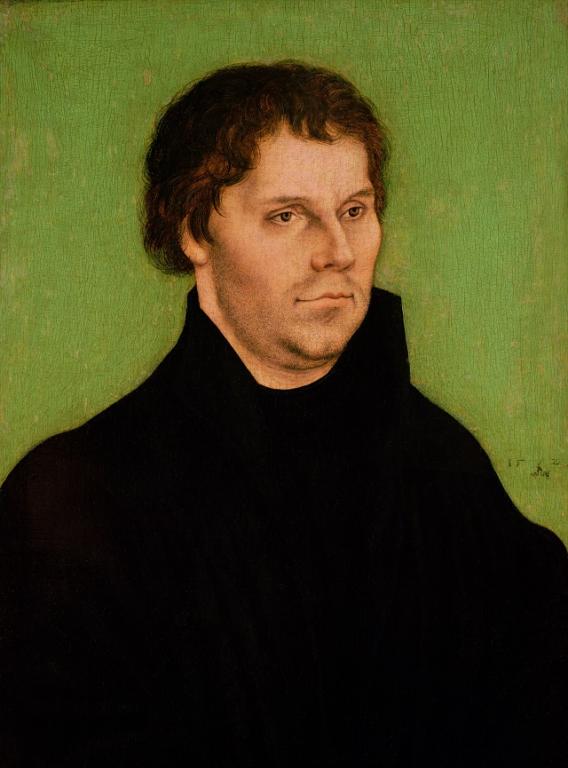
Photo credit: Portrait of Martin Luther (1525), by Lucas Cranach the Elder (1472-1553) [public domain / Wikimedia Commons]
“Please Hit ‘Subscribe’”! If you have received benefit from this or any of my other 4,600+ articles, please follow this blog by signing up (with your email address) on the sidebar to the right (you may have to scroll down a bit), above where there is an icon bar, “Sign Me Up!”: to receive notice when I post a new blog article. This is the equivalent of subscribing to a YouTube channel. Please also consider following me on Twitter / X and purchasing one or more of my 55 books. All of this helps me get more exposure, and (however little!) more income for my full-time apologetics work. Thanks so much and happy reading!
James Swan’s words will be in blue, Bishop “Dr.” [???] James White’s in green, and Martin Luther’s in purple.
***
My debate with anti-Catholics over Protestants’ and Luther’s view of church offices (made farcical by their replies) goes back a long ways. In my 2007 book, The One-Minute Apologist, I made the statement:
A Protestant Might Further Object:
. . . The Bible teaches that bishops, elders, and deacons are all synonymous terms for the same office: roughly that of a pastor today. It doesn’t indicate that bishops are higher than these other offices. (p. 17)
The format of that book was vaguely like St. Thomas Aquinas’ Summa Theologica. It included hypothetical objections in every two-page section. That’s what this was. I wasn’t maintaining that all Protestants held this view (of course they don’t!), or even most. Bishop James White had a field day in one of his critiques of my book (dated 6-13-07):
Just who believes this, I wonder? I have never read any work by any Protestant theologian of any note who has ever made this argument. So, is Armstrong just ignorant of Protestant ecclesiology, or, has he run into some tiny sect someplace that has come up with some new wacky viewpoint? Given that he was once non-Catholic, it is hard to believe he could be so ignorant of the reality regarding the fact that bishop and elder refer to the same office and are used interchangeably in the New Testament, but that this office is clearly distinguished from that of the deacon.
I made one concession as a result in my first reply of 6-14-07:
This is a case of a poor choice of one word (minor point) in the midst of a perfectly valid overall argument (major point); . . . It is true that this was an unwise use of “deacon”. If I had left out that word, the argument, coming from the hypothetical Protestant, would have been virtually identical to White’s own ecclesiology, since we see above that he equates elder and bishop (and has done so before, notably in this quote):
I am an elder in the church: hence, I am a bishop, overseer, pastor, of a local body of believers. (10 January 2001)
In fact, this utterance is the reason why I have taken to calling White “Bishop White.” He said it; I am simply following his own protocol.
The real fun began in my second reply, entitled, “James White Deacons-Elders-Bishops Controversy” (6-16-24). The most humorous aspect of it was my discovery of a prominent Lutheran (C. F. W. Walther [1811-1887]: the first president of the Lutheran Church – Missouri Synod [LCMS] and its most influential theologian), who did indeed hold a view identical to my hypothetical one. He wrote in 1867:
. . . a Bishop set over the other ministers of the church was really nothing other than a presbyter (Elder), a pastor, who only for the sake of church order was set over the other ministers of the church and who had the additional authority given to him merely by human right.
. . . since there is no distinction between such offices according to divine right, so likewise between them and a Lutheran Deacon, to whom the office of the Word is commended. For the call to preach God’s Word publicly is truly the essence of the preaching office. To preach is the highest office (function) in the church, alone on account of which all other functions are necessary. It is also the judge of all other offices. Therefore the office of Lutheran Deacon is no helping office as is, for example, the office of caring for alms, the office of Church Father or Lay Elder. Rather it is the one true office which is specially instituted and established by Christ Himself. . . .
. . . A Deacon in the biblical sense is a man who only has a helping office to the ministry of the Word according to human arrangement. But a Deacon who is called to the preaching of the Word of God, as happens in the Lutheran Church, does not attend a helping office, but rather the highest office in Christendom. He is nothing else and nothing less than what the Scripture calls a pastor, Presbyter (elder), or Bishop. He has the same authority and rank of office and the same jurisdiction and the deacons in the biblical sense are also their servants.
. . . in the Lutheran Church the deacons who are called for the preaching of the Word of God and for the Administration of the Sacraments are seen as entirely equal to the pastors . . . [my bolding and italics]
Therefore, a major figure in a major Protestant denomination held the view that I proposed as a hypothetical one in my book. James White called me “ignorant” and this position a “wacky viewpoint.” It turns out that this position in fact existed in some high Protestant circles (hence, no need to revise my book). Needless to say, Bishop White offered no reply. He has run from me since 1995 and our first debate by regular mail, so that was nothing new. He has ignored me since 2010, after having replied to me (mostly with mere mockery) scores of times from 1996 onwards.
Enter James Swan at this point. He wrote a reply two days later (6-18-07) on “Dr.” [???] White’s own blog, entitled, “Deacons, Elders, Armstrong, and…Luther.” His particular (typical) goal was to criticize a supposedly inapplicable citation from Luther that I included in my second reply:
On this account I think it follows that we neither can nor ought to give the name priest to those who are in charge of Word and sacrament among the people. The reason they have been called priests is either because of the custom of heathen people or as a vestige of the Jewish nation. The result is greatly injurious to the church. According to the New Testament Scriptures better names would be ministers, deacons, bishops, stewards, presbyters (a name often used and indicating the older members). For thus Paul writes in I Cor. 4 [:1], “This is how one should regard us, as servants of Christ and stewards of the mysteries of God.” He does not say, “as priests of Christ,” because he knew that the name and office of priest belonged to all. Paul’s frequent use of the word “stewardship” or “household,” “ministry,” “minister,” “servant,” “one serving the gospel,” etc., emphasizes that it is not the estate, or order, or any authority or dignity that he wants to uphold, but only the office and the function. The authority and the dignity of the priesthood resided in the community of believers. (Concerning the Ministry, 1523, in Luther’s Works, Vol. 40: Church and Ministry II, edited by Conrad Bergendoff, Philadelphia: Muhlenberg Press, 1958, p. 35; translated by Conrad Bergendoff; my bolding and italics)
Catholic apologist Dave Armstrong has been attempting to justify his recent blunder in his new book, The One Minute Apologist. . . . If this were simply one of his blog entries or web pages, it wouldn’t be that big of deal for him. He would simply change his blatant error (If you visit DA’s blog, you know his entries can appear, disappear, or change hour to hour). Problem solved. Unfortunately for him, the error is in a published book. He will have to wait for his second edition to fix it. Thus, we’ve been subjected to long blog entries, as Dave tries to put forth anything possible to smooth over his error.
Right. Of course, like any thinker should, — and any honest one who can admit his mistakes –, I made a concession, one day after White’s criticism-article. I revise materials when I have learned new things and/or changed my mind. I used one word in an unwise way. Guilty as charged! Swan, in his seething anti-Catholic contempt, caricatures this approach as my supposedly constantly changing my blog articles, hoping no one would notice (i.e., equivocating, being deceitful, and not admitting mistakes). He gave me no credit whatsoever for my concession. He would probably think it was insincere.
This is nothing new, coming from him. He’s treated me in this fashion for 22 years now. He didn’t grapple with the argument that I actually made. His agenda is always simply to try to make a fool of me and prove that I am a dishonest, incompetent buffoon and miserable example of an apologist. He’s a one-note tune. And here, as always, he will fail in his nefarious goal. I didn’t answer at the time because I thought I already had adequately answered in my second reply to White. But now I will, and my case will be all the stronger.
Well, before we thank Mr. Armstrong for such an invincible argument, perhaps we should make sure Luther holds what Armstrong says he does. If he doesn’t, then certain conclusions follow as to the value of Dave’s research. Before we delve into the Luther quote Armstrong utilized, let’s take a quick survey of Luther’s writings.
Sometime between 1527 and 1528, Luther lectured on 1 Timothy. This Biblical book sets forth detailed information about elders and deacons. Hence, whatever Luther says here specifically has importance as to his view. When one reads through the lectures, it is not simply a passing comment from Luther on elders and deacons. Rather, one finds long discussions as to what these offices mean. Luther clearly distinguishes between the office of elder and deacon: . . .
If you’ve read my blog or any of my Luther papers, I have stated often that Dave Armstrong has trouble with Luther. The quote he uses once again proves he does not carefully consider his information before hitting “publish” on his blog. . . . Dave’s blog is often now you see it, now you don’t. I have demonstrated once again, Dave Armstrong struggles with context. In this instance, he has Luther’s Works Volume 40, so there is no excuse.
Swan cited several instances of Luther making distinctions between Church offices. They come from pages 283-301 of Luther’s Lectures on the First Epistle to Timothy, from vol. 40 of Luther’s Works. One would think — if one only read Swan’s side of things — that this settled the issue. But not so fast. Swan’s fundamental mistake was that he failed to consider that Luther’s thought often developed, changed, contradicted itself, vacillated, or strongly emphasized certain things in specific situations. And that is the case here.
Many have noted the stark difference between Luther’s writings before 1525 and the Peasants’ Revolt, and those afterwards. Before that horrible affair, he was a revolutionary, “fire-breathing” radical, and a sort of loose cannon (at least from the Catholic perspective). He made wild claims about himself and about received Catholic teaching and practice. After the experience of that war and internal dissensions of Protestantism and concerns about many things, he tempered his rhetoric quite a bit, and — as I have documented — even made some remarkably “Catholic” statements. See:
Martin Luther’s Remarkably “Pro-Tradition” Strain of Thought [1-18-08]
The “Catholic-Sounding” Luther: 25 Examples [6-16-08]
Top Ten Remarkable “Catholic” Beliefs of Martin Luther [1-19-15]
In 2014 I even compiled an entire book of such statements from him: The “Catholic” Luther : An Ecumenical Collection of His “Traditional” Utterances, (see the Introduction).
I contend that that Luther’s evolving views influenced his conception and understanding of the function of Church offices. Mark Ellingsen (b. 1949), a Lutheran pastor (ELCA) and scholar, wrote an article entitled, “Luther’s Concept of the Ministry: The Creative Tension” (Word & World, 1981, 338-346):
Recent scholarship has generally agreed that two lines of thought about the ordained ministry coexist in tension in Luther’s writings. One finds him speaking of the ordained ministry as derived from the priesthood of all believers; yet in other places he speaks of the office as divinely instituted. That such a tension is present is not surprising. Luther’s theology is characterized by tensions on many doctrinal loci. . . . he spoke about every doctrine in a variety of ways, depending upon the particular context/concern he was addressing. (p. 339)
The present issue, Luther’s view of the ordained ministry, can function as a test case for further demonstrating Luther’s pastoral approach to theology. We shall see that the two lines of thought in Luther about the ordained ministry are not peculiar to any particular period in his career. Rather both lines of thought are present throughout his career. (p. 340)
Carried to its logical conclusion this view of the ministry’s authority derived “from below” implies the model of minister as facilitator of the congregation — the non-directive kind of leadership style about which we have spoken. Yet one also finds the Reformer speaking of the office as divinely instituted, its authority derived “from above.” This line of thought distinguishes pastor and laity and implies that the pastor is in charge. We now need to identify the presence of these lines of thought in Luther . . .
When most Lutherans reflect on Luther’s view of the ordained ministry the notion of the universal priesthood usually comes to mind. The crucial text is 1 Peter 2:9,”You are a chosen race, a royal priesthood, a holy nation, God’s own people, that you may declare the wonderful deeds of him who called you out of darkness into marvelous light. Luther appeals to this text in several places. . . . All that the ordained ministry does, it does in the name of the universal priesthood on behalf of the Church.
This theme appears frequently in Luther, particularly in his earliest writings. In his Treatise to the Christian Nobility of the German Nation (1520) he argues that ordination takes place only through the authority of the universal priesthood, not through the bishop’s authority to ordain. Likewise, in his 1523 treatise Concerning the Ministry, and in several other treatises [he lists three written in 1521 and 1523], this view of the ordained ministry appears. (p. 341)
The second strand in Luther’s view of the ordained ministry predominates later in his career. Instead of talking about the authority of the office as derived from the universal priesthood, Luther argues that the ministry’s authority is given directly by God. It is instituted by Christ Himself [he cites two of Luther’s treatises from 1528 and 1530]. This fact sets the minister apart from the universal priesthood. As such, Luther is quite clear at some points in distinguishing clergy from laity [he cites three works from 1529, 1530, and 1532]. His attributing sacramental status to ordination further indicates that the Reformer embraced this second view of the ministry. (p. 343)
. . . the emergence of this second view of the ordained ministry as instituted by Christ is merely the product of a development in Luther’s thought. Its dominance in the later stages of Luther’s life seems to be related to the different pastoral concerns which dominated in this period. His new emphasis seems to be connected with the turmoil in Wittenberg (1521) which ensued as a result
of the Reformation, the Peasants’ Revolt (1524-1526), and the horrible condition of the local parishes which the Saxon Visitation (1527-1528) revealed. In short, Luther articulated his view of the ministry as divinely instituted in situations when it became apparent that the common life of the church was not proceeding smoothly. The idea of the universal priesthood carried to extremes was not maintaining the office of ministry or keeping the church’s order. In response Luther began to speak of the ministry’s authority as an office distinct from the universal priesthood. (p. 344)
Ellingsen’s thesis (which was one aspect of the topic of his dissertation) corresponds well with my understanding expressed above, and makes perfect sense of the difference between what I cited from Luther and what Swan cited. Swan simply contended — as he always droningly and boorishly does in his attacks against my work — that I distorted Luther’s meaning, and that he got it right. The truth of the matter is far more nuanced and complex, and was expressed, I think, correctly by Dr. Ellingsen.
Early Luther (before 1525) had a much more fluid and revolutionary ecclesiology. After 1525 he became more traditional. So, sure enough, my citation was from the early period (1523) and Swan’s were from the later more conservative period (1527-1528). This explains the difference. It wasn’t my alleged distortions and ignorance. It was Luther’s complexity and changes according to situation and in reaction to horrible personal experiences.
Note that Ellingsen observed that Luther didn’t even give “sacramental status to ordination” until after 1528. He adopted a more traditional view. His best friend and successor Philip Melanchthon eventually became quite distraught regarding Luther’s earlier “anti-bishop” views. He longed, after 1530, for the return of the bishops that he and Luther had replaced with (not particularly virtuous) German princes.
I had linked to this article, by the way, already in my second reply to Bishop “Dr.” [???] James White on the subject (6-16-07). So Swan was already effectively refuted two days before he even wrote his attack-piece. I’ve simply strengthened that argument all the more in this reply (keep reading).
Lowell C. Green’s article, “Change in Luther’s Doctrine of the Ministry” (The Lutheran Quarterly 18 [1966] ) offers further corroboration of Ellingsen’s thesis:
[I]f we study Luther’s writings on the ministry and the priesthood of believers from 1520-25, isolated from his thought in other periods, we can find a strong case . . . that in the early years of the Reformation Luther apparently established the power of the congregation at the expense of the office of the ministry. The congregation appeared to have won, and the ministerial office seemed doomed to extinction in the reformation church. But a reversal set in during the second half of the 1520’s, and the office of the ministry was preserved to the developing Lutheran Church.
It is unfortunate that some scholars have limited their findings to a certain period in Luther’s career. They thereby subject themselves to the danger of rejecting in advance the possibility that Luther might have altered his position through the benefit of added experience. But this is, in fact, what took place. Prior to the Leipzig Debate of 1519, there is little indication that Luther’s view of the ministry or priesthood differed radically from that of the medieval church. In the reform treatises of 1520, however, Luther made tremendous changes. The doctrine of the general priesthood of believers emerged in protest to the outward, clerical priesthood of the papal system. The layman needed no priestly intermediary, Luther pointed out on the basis of I Peter 2:9, but through the atonement of Christ had become his own priest before the mercy seat of God. But from here on, the relation of the priesthood of believers and the office of the ministry became a problem. During the next five years Luther tended to subordinate the ministry to the priesthood. Then a change set in. Various causes for the transition might be cited. The lingering consequences of the Wittenberg anarchy of 1521-22, the peasants’ revolt, the emergence of the enthusiasts and fanatics, and the breakdown of the church that was revealed in the Saxon Visitation, must all have left their mark on Luther’s doctrine of the ministry. This becomes most noticeable after the so-called Large Catechism began to take shape, as early as 1528. The ministry was given greater authority . . . in studying Luther’s position we must be exact and clear in our thinking, and avoid constructing theories based solely on his formative writings from 1520-25.
When some folks — who can’t find anything constructive to do — set out to try to belittle, mock, and trash various of my writings and refuse to interact with them in a true dialogical fashion, it never ends well (at least in cases where I catch wind of it and have enough God-granted patience to respond).
And so, as always, it didn’t end well once again for the inimitable James Swan. He’ll ignore this (as he has all my refutations of his incessant logic- and fact-challenged nonsense for about 14 years now). But he can’t and won’t refute it. No skin off of my back. If he doesn’t have the courage of his convictions, he doesn’t. Only he can change that, with the aid of the Holy Spirit. For my part, I’m here to educate and offer food for thought, in the process of defending my expressed opinion over against unwarranted criticism. Thanks for reading!
*
***
*
Practical Matters: Perhaps some of my 4,600+ free online articles (the most comprehensive “one-stop” Catholic apologetics site) or fifty-five books have helped you (by God’s grace) to decide to become Catholic or to return to the Church, or better understand some doctrines and why we believe them.
Or you may believe my work is worthy to support for the purpose of apologetics and evangelism in general. If so, please seriously consider a much-needed financial contribution. I’m always in need of more funds: especially monthly support. “The laborer is worthy of his wages” (1 Tim 5:18, NKJV). 1 December 2021 was my 20th anniversary as a full-time Catholic apologist, and February 2022 marked the 25th anniversary of my blog.
PayPal donations are the easiest: just send to my email address: [email protected]. Here’s also a second page to get to PayPal. You’ll see the term “Catholic Used Book Service”, which is my old side-business. To learn about the different methods of contributing (including Zelle), see my page: About Catholic Apologist Dave Armstrong / Donation Information. Thanks a million from the bottom of my heart!
*
***
*
Photo credit: Portrait of Martin Luther (1525), by Lucas Cranach the Elder (1472-1553) [public domain / Wikimedia Commons]

Summary: Martin Luther’s view of Church offices and clergy changed after 1525. Earlier, he had a radical egalitarian view. Then he became more traditional as a result of bad experiences.
Previous Post
June 10, 2024
Martin Luther: Mary Was a Perpetual Virgin
Next Post
June 12, 2024 Sola Scriptura in the Protestant Confessions & Creeds
Recent Comments
"And lastly, I belong to no denomination and am free to serve God as He ..."
Is Venerating Men & Angels Worship? ..."
"And obeisance doesn't mean "worship". It means "respect", "obey", or "submission". Very weird that you ..."
Is Venerating Men & Angels Worship? ..."
"Many of these scriptures you have noted have been taken out of context. With Daniel, ..."
Is Venerating Men & Angels Worship? ..."
""Protestants often point out that Jesus is now triumphant in heaven and object to Catholics ..."
Three More Anti-Catholic Lies About Catholicism ..."
Browse Our Archives
Select a Category & Last Things About Me Anti-Catholicism Atheism & Agnosticism Baptism and Sacramentalism Bible and Tradition Blessed Virgin Mary Books by Dave Armstrong C. S. Lewis Calvinism & General Protestantism Catholic Apologetics Catholic Apologists Catholic conversion Catholic converts Christmas Church (Ecclesiology) Church History Conversion and Converts Development of Doctrine Eastern Orthodoxy Ecumenism & Christian Unity Eucharist & Liturgy Fathers of the Church French Translations G. K. Chesterton Hell Hell & Satan Hell & Satan & Last Things Heresies & Comparative Religion Holistic Health Inquisition & Crusades & Scandals James White Jews & Judaism & Old Testament John Calvin John Henry Newman Liberal / Modernist Theology Life Issues Literary Resume Lutheranism Mariology Martin Luther Music Orthodoxy Papacy & Infallibility Personal Page Philosophy & Science Political & Ethical & Moral Issues Protestant Persecution & Intolerance Protestantism Purgatory Purgatory & Penance Romantic & Imaginative Theology Saints & Purgatory & Penance Salvation Salvation & Justification Satan & Last Things Sexuality and Gender Issues Spanish Translations Traditionalism vs. Radical Catholic Reactionaries Traducciones al español / tradução para português Trinitarianism & Christology Uncategorized Videos
Select a Month October 2026 September 2026 August 2026 July 2026 June 2026 May 2026 April 2026 March 2026 February 2026 January 2026 December 2025 November 2025 October 2025 September 2025 August 2025 July 2025 June 2025 May 2025 April 2025 March 2025 February 2025 January 2025 December 2024 November 2024 October 2024 September 2024 August 2024 July 2024 June 2024 May 2024 April 2024 March 2024 February 2024 January 2024 December 2023 November 2023 October 2023 September 2023 August 2023 July 2023 June 2023 May 2023 April 2023 March 2023 February 2023 January 2023 December 2022 November 2022 October 2022 September 2022 August 2022 July 2022 June 2022 May 2022 April 2022 March 2022 February 2022 January 2022 December 2021 November 2021 October 2021 September 2021 August 2021 July 2021 June 2021 May 2021 April 2021 March 2021 February 2021 January 2021 December 2020 November 2020 October 2020 September 2020 August 2020 July 2020 June 2020 May 2020 April 2020 March 2020 February 2020 January 2020 December 2019 November 2019 October 2019 September 2019 August 2019 July 2019 June 2019 May 2019 April 2019 March 2019 February 2019 January 2019 December 2018 November 2018 October 2018 September 2018 August 2018 July 2018 June 2018 May 2018 April 2018 March 2018 February 2018 January 2018 December 2017 November 2017 October 2017 September 2017 August 2017 July 2017 June 2017 May 2017 April 2017 March 2017 February 2017 January 2017 December 2016 November 2016 October 2016 September 2016 August 2016 July 2016 June 2016 May 2016 April 2016 March 2016 February 2016 January 2016 December 2015 November 2015 October 2015 September 2015 August 2015 July 2015 June 2015 May 2015 April 2015 March 2015 February 2015 January 2015 December 2014 November 2014 October 2014 September 2014 August 2014 July 2014 June 2014 April 2014 March 2014 February 2014 January 2014 December 2013 November 2013 October 2013 September 2013 August 2013 July 2013 June 2013 April 2013 March 2013 February 2013 January 2013 December 2012 November 2012 October 2012 September 2012 August 2012 July 2012 June 2012 May 2012 April 2012 March 2012 February 2012 January 2012 December 2011 November 2011 October 2011 September 2011 August 2011 July 2011 June 2011 April 2011 March 2011 February 2011 October 2010 September 2010 August 2010 July 2010 April 2010 March 2010 December 2009 October 2009 August 2009 July 2009 June 2009 May 2009 March 2009 February 2009 October 2008 September 2008 April 2008 March 2008 February 2008 January 2008 December 2007 November 2007 October 2007 May 2007 March 2007 February 2007 January 2007 November 2006 October 2006 September 2006 August 2006 July 2006 June 2006 May 2006 April 2006 March 2006 February 2006 October 2005 June 2005 April 2005 February 2005 July 2004 May 2004 April 2004
Follow Us!
TAKE THE
Religious Wisdom Quiz
Who prayed for rain after a long drought and sent his servant to look seven times?
Select your answer to see how you score.
Elijah Isaiah Samuel Hosea
Books by This Author Books by Dave Armstrong
Related posts from Biblical Evidence for Catholicism

Three More Anti-Catholic Lies About Catholicism (#6-4)
Biblical Evidence for Catholicism

Top Ten Anti-Catholic Lies (#10-7)
Biblical Evidence for Catholicism

"Baptism" & Romans 10 (Engwer's Silly Word Games)
Biblical Evidence for Catholicism

Jerusalem Council vs. James White & Sola Scriptura
Biblical Evidence for Catholicism
TRENDING AT PATHEOS Catholic

I was strolling through the top floor of the brand new Parthenon...

What Does Gêvâh Mean For Kimberley Guifoyle &...
This week, a lot of the news is focused on Kimberly Guilfoyle....

INNER CIRCLE: Profound Mystery (Of Christ In All...
Ephesians 5:31-32 “For this reason, a man will leave his father and...

Do Not Rejoice When Your Enemy Falls: The...
Turning an execution into a public spectacle is a disturbing expression of...

'The Chosen' S6 Trailer: The Passion Gets Very...
Not many watching 'The Chosen' worry about spoilers, but just because they...

The purpose-driven labor priest
A labor activist reads Rick Warren and it gets me wondering about...
view all Catholic blogs
What Are Your Thoughts?leave a comment
Ad-Free & Subscriber Log-In Subscription Support
- About Us
- 2026 Calendar
- Videos
- Podcasts
- Library of World Religions
- Faith In Media Tracker
- Advertise With Us
- Write for Us
- Privacy Policy
- Terms of Service
- Do Not Sell My Data
- Contact Us
- Radiant Digital
- Manage Newsletter Subscriptions
- Unsubscribe From Notifications
- Sitemap
Copyright 2008-2026, Patheos. All rights reserved.
Subscription Support Ad-Free & Subscriber Log-In
Follow Patheos