
BuddhistCatholicContemplativeEvangelicalGeneral ChristianHinduJewishLatter-day SaintMuslimNew VisionsProgressive Christian
Beliefs
- Buddhist
- Catholic
- Contemplative
- Evangelical
- General Christian
- Hindu
- Jewish
- Latter-day Saint
- More Voices
- Muslim
- New Visions
- Pagan
- Progressive Christian
Topics
- Religion News
- Food and Religion
- Sports and Religion
- Religious Art
- Religious Music and Entertainment
- Religious Events
- History and Religion
- Style and Religion
- Politics and Religion
- Women in Religion
- Recreation Outdoors and Religion
- Business Finance and Religion
- Careers Workplace and Religion
- Education and Religion
- Family Parenting and Religion
- Health Fitness and Religion
- Home and Religion
- Relationships and Religion
- Technology and Religion
- Travel and Religion
Columnists
- Buddhist Columnists
- Business Finance and Religion Columnists
- Careers Workplace and Religion Columnists
- Catholic Columnists
- Contemplative Columnists
- Education and Religion Columnists
- Evangelists Columnists
- Family Parenting and Religion Columnists
- General Christian Columnists
- Health Fitness and Religion Columnists
- Hindu Columnists
- History and Religion Columnists
- Home and Religion Columnists
- Jewish Columnists
- More Voices Columnists
- Latter Day Columnists
- Muslim Columnists
- New Visions Columnists
- Nonreligious Columnists
- Pagan Columnists
- Politics and Religion Columnists
- Progressive Columnists
- Recreation Outdoors and Religion Columnists
- Relationships and Religion Columnists
- Religion News Columnists
- Religious Art Columnists
- Religious Events Columnists
- Religious Music and Entertainment Columnists
- Sports and Religion Columnists
- Style and Religion Columnists
- Technology and Religion Columnists
- Travel and Religion Columnists
- Women in Religion Columnists
Resource Library
- 2026 Calendar
- Library of World Religions
- The 100 Most Holy Places on Earth
- Patheos Answers
- Podcasts
- Videos
- Faith Leaders Database
- Anglican Episcopalian
- Bahai
- Baptist
- Buddhism
- Christianity
- Confucianism
- Eastern Orthodoxy
- Hinduism
- Holiness and Pentecostal
- ISKCON
- Islam
- Judaism
- Lutheran
- Methodist
- The Church of Jesus Christ of Latter-day Saints
- New Age
- Paganism
- Presbytarian and Reformed
- Protestantism
- Religion Behind the Scenes
- Roman Catholic
- Scientology
- Shia Islam
- Sikhism
- Sufism
- Sunni Islam
- Taoism
- Zen
- See all religions
Research Tools
 Ad-Free & Subscriber Log-In Subscription Support
Ad-Free & Subscriber Log-In Subscription Support
Follow Patheos 

- Trending:
- Forgiveness
- |
- Marriage
- |
- Consciousness
- |
- Death Penalty
- |
- Election
- |
- Halloween

-
About
-
Catholic Apologetics
-
Church History
-
Great Apologists
-
Christian Worldview
-
Protestantism & Misc.
- Home
- Catholic
- History and Religion
- End of Mary’s Life & James Swan’s Ignorance of Catholicism
End of Mary’s Life & James Swan’s Ignorance of Catholicism
Last updated on: June 7, 2024 at 12:33 pm by Dave Armstrong
End of Mary’s Life & James Swan’s Ignorance of Catholicism 2024-06-07T12:33:19-04:00 Dave Armstrong
Patheos Explore the world's faith through different perspectives on religion and spirituality! Patheos has the views of the prevalent religions and spiritualities of the world.
James Swan is an anti-Catholic Reformed Protestant apologist, who runs the Boors All blog. In his article dated 10 October 2011 and entitled, “Is There a Professional Roman Catholic Apologist in the House?,” he demonstrated the oft-observed profound ignorance of anti-Catholic critics of Catholic beliefs. He simply doesn’t understand how Catholic magisterial authority and infallibility work. His words will be in blue.
***
Over on Dr. Gene Veith’s blog I was politely challenged on my assumptions about the Assumption. Since I’m not a professional Roman Catholic apologist, I’m not able to interpret Romanism infallibly.
Certainly not, but be that as it may, I think he is duty-bound as a supposedly eminent researcher and critic of Catholicism, to interpret Catholicism honestly and intelligently and to obtain, at the very least, a basic, rudimentary knowledge of the topic that he chooses to write about for public consumption (deigning to properly educate his readers). He has done neither in this article. As I have noted many times, in any middle school debate team, the first thing learned is that the wise and able debater must know his opponent’s view at least as well as they do themselves, if not even more so.
Perhaps though, some of you can.
I don’t claim to have infallible interpretation, but that’s not necessary, and it is the Catholic magisterium’s function, not mine. What I do claim is to understand the basic distinctions that Catholics make in terms of degrees of authority of documents and doctrines. The myth that every Catholic layman must be able to possess infallible interpretation, lest Catholicism collapse in a heap from internal contradiction, has been disposed of in several of my articles:
Dialogue on the Logic of Catholic Infallible Authority [6-4-96]
Church Authority & Certainty (The “Infallibility Regress”) [July 2000; some revisions on 12-8-11]
Ecclesiological Certainty (?) & the “Infallibility Regress” [5-22-03 and 10-7-08]
Does Church Infallibility Require Infallible Catholics? [6-8-10]
Shelly: Catholics do believe Mary could and did die, then she was taken up bodily into Heaven. . . .
Some Catholics (the majority, including myself) believe that she died, and some believe that she didn’t. Both views are fully permissible, as I will further explain below.
As I’ve understood Romanism, it isn’t determined one way or the other that Mary died. A Roman Catholic is free to believe either. This is some of what Roman Catholics are required to believe about Mary’s assumption:
“…We pronounce, declare, and define it to be a divinely revealed dogma: that the Immaculate Mother of God, the ever Virgin Mary, having completed the course of her earthly life, was assumed body and soul into heavenly glory.
Hence, if anyone, which God forbid, should dare willfully to deny or call into doubt that which we have defined, let him know that he has fallen away completely from the divine and Catholic faith…It is forbidden to any man to change this, Our declaration, pronouncement, and definition or, by rash attempt, to oppose and counter it. If any man should presume to make such an attempt, let him know that he will incur the wrath of Almighty God and of the Blessed Apostles Peter and Paul.” [decree Munificentissimus Deus by Pope Pius XII; my italics; the date of this decree was 1 November 1950]
Here, Swan actually accurately understands the reality of Catholic belief (particularly regarding Mary’s Assumption). He should have quit while he was ahead, rather than go on to try in vain to establish alleged internal Catholic incoherence and contradiction. It’s one of a million examples of anti-Catholics ludicrously believing themselves to be better informed about Catholicism than Catholic theologians and apologists are, and attempting to ridiculously lecture us out of their blissful ignorance. Read on, and you’ll see a classic example of this pitiful methodology.
It seems to me that early church history didn’t know what to do about the death of Mary. For instance, the words of Epiphanius contradict the idea of a long held belief in the Assumption. Epiphanius notes another “tradition” that no one knows what happened to Mary. His is the earliest non-heretical voice that comments on the subject of Mary’s bodily assumption, around 377:
“But if some think us mistaken, let them search the Scriptures. They will not find Mary’s death; they will not find whether she died or did not die; they will not find whether she was buried or was not buried … Scripture is absolutely silent (on the end of Mary) … For my own part, I do not dare to speak, but I keep my own thoughts and I practice silence … The fact is, Scripture has outstripped the human mind and left uncertain … Did she die, we do not know … Either the holy Virgin died and was buried … Or she was killed … Or she remained alive, since nothing is impossible with God and He can do whatever He desires; for her end no-one knows.’” (Epiphanius, Panarion, Haer. 78.10-11, 23. Cited by Juniper Carol, O.F.M. ed., Mariology, Vol. II (Milwaukee: Bruce, 1957), pp. 139-40).”
Taking an agnostic view — especially because Scripture does — is not the same thing as not knowing “what to do about” something. It’s simply being intellectually honest in light of what is known and what is not known. Secondly, Epiphanius’ words do not contradict the belief in the Assumption of Mary in the least, since he is not addressing that (at least not in what Swan cites, with no less than seven ellipses (“…”). He was commenting on the question of whether she died or not, which is a completely separate question, not affecting belief in her Bodily Assumption. He thinks either scenario is possible: that she “died” or that she “remained alive” and did not undergo death (similar to Enoch and Elijah). Lawrence P. Everett, C.Ss.R., S.T.D., in his work, Mariology (Bruce Publishing Co., 1957, 461-492), observed:
In the first three centuries there are absolutely no references in the authentic works of the Fathers or ecclesiastical writers to the death or bodily immortality of Mary. Nor is there any mention of a tomb of Mary in the first centuries of Christianity. The veneration of the tomb of the Blessed Virgin at Jerusalem began about the middle of the fifth century; and even here there is no agreement as to whether its locality was in the Garden of Olives or in the Valley of Josaphat. . . . no early writer ever doubted the fact of her death. They did not, however, examine the question; they merely took the fact of her death for granted.
That doesn’t sound to me like Christians in the first three centuries “didn’t know what to do about the death of Mary.” They either didn’t think about it, or “took the fact of her death for granted.” Epiphanius had the insight of believing that either thing was possible: a death, or God taking Mary without death (which is what Catholics are still allowed to speculate about today). But the early tradition strongly tended towards what most Catholics believe: that she died, as her Son did.
Giovanni Miegge, The Virgin Mary (Philadelphia: Westminster Press, 1955), states:
“Actually the good Epiphanius made a superfluous display of hypotheses. If in his time no tradition existed about the end of Mary’s life, that is simply due to the fact that her death happened in a time when the practice of venerating the memory of martyrs or of persons eminent in the Church had not yet arisen, and it passed unobserved.” (page 85)
I think this is a dubious assertion at best. After all, Christians already believed in extraordinary non-death departures from this life in the case of Enoch (Heb 11:5; cf. Gen 5:24), Elijah (2 Ki 2:1,11), and many during the Second Coming (1 Thess 4:15-17), and also similar dramatic “going-up-to-heaven” events after having died, in the case of the two witnesses of Revelation (11:7-12) and our Lord Jesus Himself. And we have St. Paul reporting that he went up to heaven before he died (2 Cor 12:1-4): possibly in his body; possibly not (12:3), and St. John also seems to be in heaven witnessing many things (the entire book of Revelation). That’s seven biblical analogies to Mary’s Assumption, to one degree or another!
Thus there is a long scriptural history of very similar things, so that this hypothesis regarding veneration is not the only possible explanation at all. Christians simply didn’t think about it much at first: as was the case with many doctrines that developed slowly, but the above explicit scriptural parallels were perhaps what precipitated greater and more rapid development. Mariology in general is a prime example of that (because Christology and trinitarianism was more important). But it’s not alone in this respect; the same applied to many beliefs that Catholics and Protestants hold in common.
On the other hand, if pressed- I would be forced to conclude there is no “one” tradition of the assumption- there doesn’t appear to be any one unified theme or tradition.
Again, this confuses to some extent the difference between Mary’s Assumption and whether she died. They are two different things, and continued to be distinguished in the 1950 dogmatic definition.
The only certain thing that tradition appears to point to in this matter, is that no one knows what happened to Mary.
No one figured out that all 27 NT books were indeed scriptural and canonical, either, until St. Athanasius in 367: more than 330 years after the death of Christ, or roughly the same amount of time as Bach’s birth — 1685 — till now. So no biggie; ho hum. Just another instance of dozens of development of doctrine . . . Since Swan has only a very dim understanding of development, he thinks this is an issue or a “difficulty”, when in fact it is not at all.
Second, Mary’s role in the New Testament diminishes- what I mean is this- The gospel accounts contain material about Mary- Acts and the rest of the New Testament do not record her “doings” in the early church. In other words, in the Bible she fades from the scene, . . .
Yes, of course she does, because she is the humble handmaiden of the Lord, and because her Son had to be front and center at first. Once that was established, then Christians pondered her sublime role much more deeply. Catholics believe that Christians continue to learn things to this day. We’re not theologically and intellectually stagnant. But it’s all consistent developments from the apostolic deposit. Nothing new or novel . . . that was left for the Protestant Revolution to introduce.
Shelly: Actually, it is an obligation for Catholics to believe that Mary died, then was assumed into Heaven.
It’s not at all. Shelly is wrong, and even Swan pointed out why: when the Assumption was defined as obligatory dogma, the question of whether she died or not was left as an open question; i.e., Catholics were free to hold different opinions.
This certitude that Mary in fact died and was believed by the Roman Catholic Church to have died before her bodily assumption is nicely addressed by Pope Pius XII when he states in section 17 of Munificantissimu Deus (MD–see link in my original posting above) in quoting an historical source that “…Adrian I, our predecessor of immortal memory, sent to the Emperor Charlemagne. These words are found in this volume: “Venerable to us, O Lord, is the festivity of this day on which the holy Mother of God suffered temporal death, but still could not be kept down by the bonds of death, who has begotten your Son our Lord incarnate from herself.”
Yes, it is a strong tradition and continues to be the majority view today, but that’s not the same as proclaiming that it is obligatory. Catholicism has strong competing views about predestination, too, and both are allowed to be held (I’m a Molinist / Congruist). The earlier pope simply held this opinion. It doesn’t follow that all must. His opinion is not listed in Denzinger: the compendium of Catholic dogmas.
Well, we’ll have to let a professional Roman Catholic apologist solve this riddle.
There is no “riddle” in the first place! Pope Pius XII just happened to mention some instances of the “Mary died” tradition. He probably accepted it himself, but this is different from it being required of all Catholics. And we know that because when he wrote the dogmatic definition it was not part of it. None of this is in the least bit inconsistent or a problem.
I’ve read quite a number of sources (Protestant and Roman Catholic) saying that it is not essential for a Roman Catholic to believe Mary died.
And they are correct. So why doesn’t Swan accept their word? Answer: because he despises them as intellectually dishonest buffoons. His treatment of me these past 22 years is instructive. Swan cites Catholics Karl Keating, Patrick Madrid, and myself. He quotes one of my apologetics inserts from The New Catholic Answer Bible: “If indeed she was free from sin, then it follows that she would not have to undergo the decay of death, which was the penalty for sin.”
But of course that portion is not addressing the question of whether she died, but rather, whether she underwent bodily decay (which has to do with the nature of the Assumption itself). Thus Swan doesn’t even know which portion to cite, so as to prove what he is trying to prove. In other writings of mine written before Swan’s article in question, I reiterated that Catholics can believe either that she died, or did not die (examples: “Catholics have not made it a matter of dogma that Mary died. She may have, or may not have, . . .” [9-24-06] “the Church has not declared whether Mary died or not” [9-4-08] ). My blog has always had easy search functions, or else Google Advanced Search can handily locate materials as well.
I could multiply these sources as well. These were only a few. Whatever the answer, this very issue demonstrates a fatal flaw in Romanism: even their alleged infallible dogmatic pronouncements are open to interpretation.
Of course, he has demonstrated no such thing — certainly not regarding the Assumption — , as I have proven above. The problem resides in the hostility to Catholicism, illogical thinking, and fact-challenged false assumptions (no pun intended) and premises in his own head.
*
***
*
Practical Matters: Perhaps some of my 4,600+ free online articles (the most comprehensive “one-stop” Catholic apologetics site) or fifty-five books have helped you (by God’s grace) to decide to become Catholic or to return to the Church, or better understand some doctrines and why we believe them.
Or you may believe my work is worthy to support for the purpose of apologetics and evangelism in general. If so, please seriously consider a much-needed financial contribution. I’m always in need of more funds: especially monthly support. “The laborer is worthy of his wages” (1 Tim 5:18, NKJV). 1 December 2021 was my 20th anniversary as a full-time Catholic apologist, and February 2022 marked the 25th anniversary of my blog.
PayPal donations are the easiest: just send to my email address: [email protected]. Here’s also a second page to get to PayPal. You’ll see the term “Catholic Used Book Service”, which is my old side-business. To learn about the different methods of contributing (including Zelle), see my page: About Catholic Apologist Dave Armstrong / Donation Information. Thanks a million from the bottom of my heart!
*
***
*
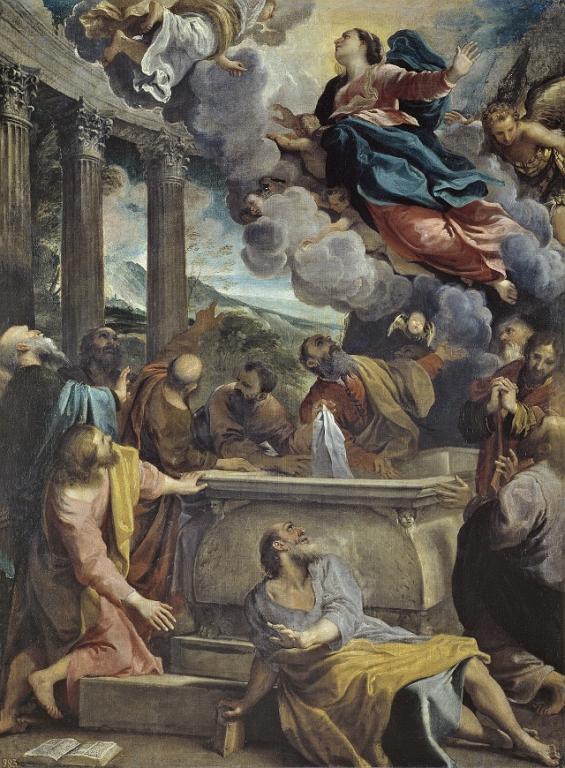
Photo credit: Assumption of Mary (c. 1590), by Annibale Carracci (1560-1609) [public domain / Wikimedia Commons]

Summary: Anti-Catholic zealot James Swan tries in vain to establish an inconsistency in Catholic opinions as to whether the Blessed Virgin Mary died prior to her Assumption.
Catholic magisterial authority
Previous Post
June 6, 2024
Did Grisar Characterize Luther as a "Psychopath"?
Next Post
June 7, 2024 Eck vs. Protestantism Chronicles: Veneration of Images
Recent Comments
"And lastly, I belong to no denomination and am free to serve God as He ..."
Is Venerating Men & Angels Worship? ..."
"And obeisance doesn't mean "worship". It means "respect", "obey", or "submission". Very weird that you ..."
Is Venerating Men & Angels Worship? ..."
"Many of these scriptures you have noted have been taken out of context. With Daniel, ..."
Is Venerating Men & Angels Worship? ..."
""Protestants often point out that Jesus is now triumphant in heaven and object to Catholics ..."
Three More Anti-Catholic Lies About Catholicism ..."
Browse Our Archives
Select a Category & Last Things About Me Anti-Catholicism Atheism & Agnosticism Baptism and Sacramentalism Bible and Tradition Blessed Virgin Mary Books by Dave Armstrong C. S. Lewis Calvinism & General Protestantism Catholic Apologetics Catholic Apologists Catholic conversion Catholic converts Christmas Church (Ecclesiology) Church History Conversion and Converts Development of Doctrine Eastern Orthodoxy Ecumenism & Christian Unity Eucharist & Liturgy Fathers of the Church French Translations G. K. Chesterton Hell Hell & Satan Hell & Satan & Last Things Heresies & Comparative Religion Holistic Health Inquisition & Crusades & Scandals James White Jews & Judaism & Old Testament John Calvin John Henry Newman Liberal / Modernist Theology Life Issues Literary Resume Lutheranism Mariology Martin Luther Music Orthodoxy Papacy & Infallibility Personal Page Philosophy & Science Political & Ethical & Moral Issues Protestant Persecution & Intolerance Protestantism Purgatory Purgatory & Penance Romantic & Imaginative Theology Saints & Purgatory & Penance Salvation Salvation & Justification Satan & Last Things Sexuality and Gender Issues Spanish Translations Traditionalism vs. Radical Catholic Reactionaries Traducciones al español / tradução para português Trinitarianism & Christology Uncategorized Videos
Select a Month October 2026 September 2026 August 2026 July 2026 June 2026 May 2026 April 2026 March 2026 February 2026 January 2026 December 2025 November 2025 October 2025 September 2025 August 2025 July 2025 June 2025 May 2025 April 2025 March 2025 February 2025 January 2025 December 2024 November 2024 October 2024 September 2024 August 2024 July 2024 June 2024 May 2024 April 2024 March 2024 February 2024 January 2024 December 2023 November 2023 October 2023 September 2023 August 2023 July 2023 June 2023 May 2023 April 2023 March 2023 February 2023 January 2023 December 2022 November 2022 October 2022 September 2022 August 2022 July 2022 June 2022 May 2022 April 2022 March 2022 February 2022 January 2022 December 2021 November 2021 October 2021 September 2021 August 2021 July 2021 June 2021 May 2021 April 2021 March 2021 February 2021 January 2021 December 2020 November 2020 October 2020 September 2020 August 2020 July 2020 June 2020 May 2020 April 2020 March 2020 February 2020 January 2020 December 2019 November 2019 October 2019 September 2019 August 2019 July 2019 June 2019 May 2019 April 2019 March 2019 February 2019 January 2019 December 2018 November 2018 October 2018 September 2018 August 2018 July 2018 June 2018 May 2018 April 2018 March 2018 February 2018 January 2018 December 2017 November 2017 October 2017 September 2017 August 2017 July 2017 June 2017 May 2017 April 2017 March 2017 February 2017 January 2017 December 2016 November 2016 October 2016 September 2016 August 2016 July 2016 June 2016 May 2016 April 2016 March 2016 February 2016 January 2016 December 2015 November 2015 October 2015 September 2015 August 2015 July 2015 June 2015 May 2015 April 2015 March 2015 February 2015 January 2015 December 2014 November 2014 October 2014 September 2014 August 2014 July 2014 June 2014 April 2014 March 2014 February 2014 January 2014 December 2013 November 2013 October 2013 September 2013 August 2013 July 2013 June 2013 April 2013 March 2013 February 2013 January 2013 December 2012 November 2012 October 2012 September 2012 August 2012 July 2012 June 2012 May 2012 April 2012 March 2012 February 2012 January 2012 December 2011 November 2011 October 2011 September 2011 August 2011 July 2011 June 2011 April 2011 March 2011 February 2011 October 2010 September 2010 August 2010 July 2010 April 2010 March 2010 December 2009 October 2009 August 2009 July 2009 June 2009 May 2009 March 2009 February 2009 October 2008 September 2008 April 2008 March 2008 February 2008 January 2008 December 2007 November 2007 October 2007 May 2007 March 2007 February 2007 January 2007 November 2006 October 2006 September 2006 August 2006 July 2006 June 2006 May 2006 April 2006 March 2006 February 2006 October 2005 June 2005 April 2005 February 2005 July 2004 May 2004 April 2004
Follow Us!
TAKE THE
Religious Wisdom Quiz
How many disciples did Jesus have?
Select your answer to see how you score.
Thirty Seven One hundred Twelve
Books by This Author Books by Dave Armstrong
Related posts from Biblical Evidence for Catholicism

Three More Anti-Catholic Lies About Catholicism (#6-4)
Biblical Evidence for Catholicism

Top Ten Anti-Catholic Lies (#10-7)
Biblical Evidence for Catholicism

Holy Ground: Why Mary Had NO Other Children...
Biblical Evidence for Catholicism
Protestant Confessions & "Ever-Virgin" Mary
Biblical Evidence for Catholicism
TRENDING AT PATHEOS Catholic

In "Irreplaceable," our book on vocation and technology, Trevor Sutton and I...

I was strolling through the top floor of the brand new Parthenon...

What Does Gêvâh Mean For Kimberley Guifoyle &...
This week, a lot of the news is focused on Kimberly Guilfoyle....

INNER CIRCLE: Profound Mystery (Of Christ In All...
Ephesians 5:31-32 “For this reason, a man will leave his father and...

Do Not Rejoice When Your Enemy Falls: The...
Turning an execution into a public spectacle is a disturbing expression of...

'The Chosen' S6 Trailer: The Passion Gets Very...
Not many watching 'The Chosen' worry about spoilers, but just because they...
view all Catholic blogs
What Are Your Thoughts?leave a comment
Ad-Free & Subscriber Log-In Subscription Support
- About Us
- 2026 Calendar
- Videos
- Podcasts
- Library of World Religions
- Faith In Media Tracker
- Advertise With Us
- Write for Us
- Privacy Policy
- Terms of Service
- Do Not Sell My Data
- Contact Us
- Radiant Digital
- Manage Newsletter Subscriptions
- Unsubscribe From Notifications
- Sitemap
Copyright 2008-2026, Patheos. All rights reserved.
Subscription Support Ad-Free & Subscriber Log-In
Follow Patheos