
BuddhistCatholicContemplativeEvangelicalGeneral ChristianHinduJewishLatter-day SaintMuslimNew VisionsProgressive Christian
Beliefs
- Buddhist
- Catholic
- Contemplative
- Evangelical
- General Christian
- Hindu
- Jewish
- Latter-day Saint
- More Voices
- Muslim
- New Visions
- Pagan
- Progressive Christian
Topics
- Religion News
- Food and Religion
- Sports and Religion
- Religious Art
- Religious Music and Entertainment
- Religious Events
- History and Religion
- Style and Religion
- Politics and Religion
- Women in Religion
- Recreation Outdoors and Religion
- Business Finance and Religion
- Careers Workplace and Religion
- Education and Religion
- Family Parenting and Religion
- Health Fitness and Religion
- Home and Religion
- Relationships and Religion
- Technology and Religion
- Travel and Religion
Columnists
- Buddhist Columnists
- Business Finance and Religion Columnists
- Careers Workplace and Religion Columnists
- Catholic Columnists
- Contemplative Columnists
- Education and Religion Columnists
- Evangelists Columnists
- Family Parenting and Religion Columnists
- General Christian Columnists
- Health Fitness and Religion Columnists
- Hindu Columnists
- History and Religion Columnists
- Home and Religion Columnists
- Jewish Columnists
- More Voices Columnists
- Latter Day Columnists
- Muslim Columnists
- New Visions Columnists
- Nonreligious Columnists
- Pagan Columnists
- Politics and Religion Columnists
- Progressive Columnists
- Recreation Outdoors and Religion Columnists
- Relationships and Religion Columnists
- Religion News Columnists
- Religious Art Columnists
- Religious Events Columnists
- Religious Music and Entertainment Columnists
- Sports and Religion Columnists
- Style and Religion Columnists
- Technology and Religion Columnists
- Travel and Religion Columnists
- Women in Religion Columnists
Resource Library
- 2026 Calendar
- Library of World Religions
- The 100 Most Holy Places on Earth
- Patheos Answers
- Podcasts
- Videos
- Faith Leaders Database
- Anglican Episcopalian
- Bahai
- Baptist
- Buddhism
- Christianity
- Confucianism
- Eastern Orthodoxy
- Hinduism
- Holiness and Pentecostal
- ISKCON
- Islam
- Judaism
- Lutheran
- Methodist
- The Church of Jesus Christ of Latter-day Saints
- New Age
- Paganism
- Presbytarian and Reformed
- Protestantism
- Religion Behind the Scenes
- Roman Catholic
- Scientology
- Shia Islam
- Sikhism
- Sufism
- Sunni Islam
- Taoism
- Zen
- See all religions
Research Tools
 Ad-Free & Subscriber Log-In Subscription Support
Ad-Free & Subscriber Log-In Subscription Support
Follow Patheos 

- Trending:
- Forgiveness
- |
- Marriage
- |
- Consciousness
- |
- Death Penalty
- |
- Election
- |
- Halloween

-
About
-
Catholic Apologetics
-
Church History
-
Great Apologists
-
Christian Worldview
-
Protestantism & Misc.
- Home
- Catholic
- History and Religion
- Reply to James White On Oral Tradition
Reply to James White On Oral Tradition
Last updated on: June 6, 2026 at 12:51 am by Dave Armstrong
Reply to James White On Oral Tradition 2026-06-06T00:51:32-04:00 Dave Armstrong
Patheos Explore the world's faith through different perspectives on religion and spirituality! Patheos has the views of the prevalent religions and spiritualities of the world.
“Please Hit ‘Subscribe’”! If you have received benefit from this or any of my other 4,600+ articles, please follow this blog by signing up (with your email address) on the sidebar to the right (you may have to scroll down a bit), above where there is an icon bar, “Sign Me Up!”: to receive notice when I post a new blog article. This is the equivalent of subscribing to a YouTube channel. Please also consider following me on Twitter / X and purchasing one or more of my 55 books. All of this helps me get more exposure, and (however little!) more income for my full-time apologetics work. Thanks so much and happy reading!
***
I am responding to James White’s article, “A Response to David Palm’s Article on Oral Tradition from This Rock Magazine, May, 1995” (4-29-98). See David Palm’s entire article. His words will be in blue. My Bible citations are from the RSV.
Matthew 2:23 And he went and dwelt in a city called Nazareth, that what was spoken by the prophets might be fulfilled, “He shall be called a Nazarene.”
Mr. Palm is quite correct when he says that it is difficult to determine the source of the quotation in Matthew 2:23. This is not the only passage that challenges us in regards to source material. However, to leap from a difficulty in identifying the Scriptural source to the existence of an undocumented and mysterious “oral tradition” is hardly the proper method of getting around a difficulty.
Why not? It’s certainly a plausible response to assert that — lacking any certain OT reference — that it could have come from an oral tradition. After all, the Jews believed in an oral Torah as well as a written one:
Biblical Evidence for the Oral Torah [10-18-11]
Two Quick Old Testament Proofs for the Oral Torah [Catholic365, 11-8-23]
And there is plenty of NT data about oral tradition in early Christianity:
Biblical Evidence for Apostolic Oral Tradition [2-20-09]
Dialogue on Oral Tradition & Apostolic Succession (vs. John E. Taylor) [5-17-17]
Oral Tradition According to Great Historic Apologists [10-18-19]
Jesus the “Nazarene” Redux (vs. Jonathan M. S. Pearce) [12-19-20]
While Mr. Palm says that all attempts to identify the Scriptural source of this passage fail, that is simply his own conclusion. Can he say with certainty that all of the suggested sources could not, in fact, provide a sufficient basis? And why should we believe that Mr. Palm’s leap into the undocumentable realm of “oral tradition” is any more solid than any of the suggestions that have been given for a Scriptural source? Can Mr. Palm show us any historical evidence to substantiate this “oral tradition” being in existence at this time?
This is a clever sleight-of-hand from White: typical of his relentless sophistry. Rather than argue for a particular take on the alleged OT pedigree of this verse, he ignores that necessary task and switches the emphasis over to Palm supposedly having to establish oral tradition itself. White’s first task is to blow Palm’s contention that there is no OT referent out of the water. That’s the easiest way to disprove it. But since White has nothing compelling (and even admits that the problem is “difficult”), he switches the topic, like all good sophists (and lawyers with bad cases) do. Be that as it may, I provide plenty of evidence for oral tradition in my links above.
Classic Protestant commentaries back up the notion that such a passage cannot be found in the OT:
Ellicott’s Commentary for English Readers: No such words are to be found in the Old Testament.
Benson Commentary: As to the interpretations which refer this to Christ’s being called Netzer, the Branch, Isaiah 11:1; Jeremiah 23:5; or Nazir, one Separated, or, the Holy One, they all fail in this, that they give no account how this was fulfilled by Christ’s living at Nazareth, he being as much the Branch, the Holy One, when he was born at Bethlehem, and before he went to Nazareth, as after.
Barnes’ Notes on the Bible: The words here are not found in any of the books of the Old Testament, and there has been much difficulty in ascertaining the meaning of this passage.
Jamieson-Fausset-Brown Bible Commentary: The little town of Nazareth, [was] mentioned neither in the Old Testament nor in Josephus . . .
Matthew Poole’s Commentary: the . . . words of this verse afford as great difficulties as any other in holy writ. . . . there is no such saying in all the prophets. There is a strange variety of opinions as to these questions.
Meyer’s NT Commentary: . . . others (Chrysostom, Theophylact, Clericus, Grätz) regard the words as a quotation from a lost prophetical book.
Expositor’s Greek Testament: But what prophecy? The reference is vague, not to any particular prophet, but to the prophets in general. In no one place can any such statement be found. Some have suggested that it occurred in some prophetic book or oracle no longer extant.
Cambridge Bible for Schools and Colleges: The meaning of this passage . . . for us it is involved in doubt.
Matthew 23:2-3 “The scribes and the Pharisees sit on Moses’ seat; [3] so practice and observe whatever they tell you, but not what they do; for they preach, but do not practice.”
I have already massively refuted White concerning this topic:
“Moses’ Seat” & Jesus vs. Sola Scriptura [12-27-03]
Refutation of James White: Moses’ Seat, the Bible, and Tradition (Introduction: #1) (+Part II | Part III | Part IV | Part V | Part VI) [5-12-05]
1 Corinthians 10:4 . . . they drank from the supernatural Rock which followed them, and the Rock was Christ.
Paul would certainly have been familiar with extra-scriptural traditions . . . Paul was likewise familiar with other Jewish works of literature, including works from the intertestamental period, and works that became a part of the Apocrypha. He was likewise familiar with Greek philosophy and mythology, and drew upon these sources as well. None of this is in dispute, of course.
Now there’s something we can agree on!
The question is, does Paul’s familiarity with such sources mean that they are divinely inspired, authoritative, and infallible? Take this passage from 1 Corinthians as an example. Surely Mr. Palm is not suggesting to us that Pseudo-Philo is providing us with an inerrant, infallible oral tradition that was passed down from Moses’ day, is he? . . . no one would seriously argue that the use of Greek philosophers means that such sources are infallible, inspired, or in any sense spiritually authoritative . . .
The source didn’t have to be inspired or infallible; nor is that Palm’s argument (he never used either word). Palm referred to possible “authoritative” oral tradition cited in the NT. But citing such information in the inspired NT would make it inspired, wouldn’t it? White’s polemical reply isn’t the relevant question. It’s just the usual White obfuscation and obscurantism. White has to explain what Paul is citing and why he would do it.
He does suggest one possibility: C. K. Barrett’s opinion that it may be a citation from the Jewish philosopher Philo or Pseudo-Philo. Palm had already suggested that in his article. Palm had already noted, “in rabbinic Tradition the rock actually followed them on their journey through the wilderness (See Tosefta Sukkah 3:11f.; Pseudo-Philo Biblical Antiquities 10:7). The former would be an oral tradition, later written down. Remember, the title of David Palm’s article was “Oral Tradition in the New Testament.” This is one example of that.
the mere fact that Paul makes reference to a Jewish idea that the rock in the wilderness was more than a mere rock hardly provides a basis for asserting that this is an inspired and infallible oral tradition that has been passed down outside of Scripture and is binding upon Christians today.
Again, White is out to sea. I reiterate that by including it in the inspired NT, the notion becomes inspired and authoritative, with the additional identification as Jesus Christ Himself. It didn’t have to be already inspired. This particular theology is binding, having been authoritatively noted by St. Paul in the inspired revelation of NT Scripture. But White wants to major on the minors and quibble about where it came from?
In fact, if Mr. Palm is defending the partim-partim view of traditional authority, is he really going to defend the idea that this tradition goes back to Moses?
It might in some less developed form. The Jews, after all, believed that Moses received an oral Torah on Mt. Sinai along with the written Law and Torah. White’s theology dogmatically — but arbitrarily — forbids such a notion from the outset. But there is nothing in the Bible to preclude its possibility. If White would claim otherwise, then let him produce such a biblical “proof.”
And if he defends the “material sufficiency” viewpoint,
Yes he would.
what does this passage provide him?
It provides an oral tradition in the NT: precisely the aim of his article. DUH!
Surely this “tradition” is not some Mosaic-interpretation of the Scriptures maintained within an “Old Testament magisterium.”
It has to come from somewhere. White hasn’t disproven the theory that it is in the Talmud, which was a later written version Jewish oral traditions. White simply plays the game of obfuscation and non sequiturs again.
1 Peter 3:19 in which he went and preached to the spirits in prison,
Palm suggests that the source for this may be “the extra-biblical book of 1 Enoch.” And so maybe it was. What does Bishop “Dr.” [???] White have to say about that? Because Palm also noted that many tie the verse to Genesis 6, he goes with that, while (predictably) mocking the possible extrabiblical source:
He has already acknowledged that Genesis 6 is the source of the nephilim concept, has he not? So what is being asserted when “Tradition” comes in here?
That there may be an additional source!
Is Mr. Palm asserting that this is an oral tradition that is inspired and infallible?
No (back to that again). White seems obsessed with this idea, that is completely irrelevant. Palm only used the word, “authoritative.”
From whence did this tradition arise?
That’s not strictly relevant, either. It’s an entirely separate discussion.
Or is Mr. Palm merely admitting that the inspired writers made reference to ideas, beliefs, and sources that were current in their day? Such an assertion is not argued by anyone.
Then why is White concerned about this article at all?
But neither is such an assertion relevant to substantiating the Roman Catholic concept of tradition, either as separate revelation or as interpretive grid.
It doesn’t have to be. There is a certain conceptual overlap:
Oral traditions in the NT
The Catholic belief in an apostolic oral tradition, passed down.
If the NT can be shown to espouse oral tradition in general, then it’s reasonable to posit that the specifically Catholic view of tradition is also harmonious with the NT. They need not be absolutely equivalent.
Is Mr. Palm saying that Peter embraced the book of 1 Enoch as an interpretive tradition of Genesis?
That seems to be a fair view of his take.
If so, does Mr. Palm likewise accept 1 Enoch as an interpretive grid, a “Tradition”?
Small-t tradition, not apostolic tradition or the apostolic deposit (of faith), which is the “big-T” tradition.
I will spare the reader citations from the book, as 99% of the work would not be accepted as having any authority interpretively by Roman Catholics or Protestants alike.
It doesn’t have to, in order for Peter to draw from the 1% that does have some significant truth. As I always say, even an unplugged clock gives the correct time (or “truth”) twice every day.
But is Mr. Palm saying that in this one instance Peter depended upon this extra-scriptural, divine, and authoritative source? Or is he simply stating that Peter is making reference to a common belief of the day that is also expressed in 1 Enoch, without making 1 Enoch, or the belief, authoritative?
The latter, it seems to me.
Remember, Mr. Palm’s “Tradition” includes, of necessity, purgatory, indulgences, Papal Infallibility, and a whole plethora of Marian doctrines.
He’s not trying to prove all that in this article; only that the NT has specimens derived from some sort of oral tradition.
Now I will only mention in passing that Mr. Palm’s reference to the early Father’s struggle against the heretics begs the issue. What was the rule of faith they used to refute the heretics? Mr. Palm’s infallible Roman Tradition? In no way. The “rule of faith” was far more simple, and was, in fact, derived from biblical sources, and is fully defendable from the Scriptures themselves. Hence, the idea that this rule of faith, this tradition, mentioned by men like Irenaeus, is in fact an extra-scriptural revelation, holds not the first drop of water.
The fathers also drew from extrabiblical traditions over against the heretics. Augustine gives the example of infant baptism (Luther refers back to that, too). I think infant baptism can be drawn from Scripture in many ways, but it’s mostly indirect, non-explicit, deductive arguments.
[Palm] A specific application of this is the doctrine of the perpetual virginity of Mary. The data of the New Testament concerning the “brothers and sisters” of Jesus are ambiguous by themselves, although I would argue that the biblical evidence leans toward the Catholic interpretation. But we have additional help in the form of the Traditions preserved in the early Church which say that Mary remained a virgin and bore no other children besides Jesus. So Tradition can sometimes serve as arbiter and interpreter in cases where the meaning of Scripture is unclear.
The student of Church history, having gotten back up off the floor upon reading that paragraph, has to simply respond, “Well then who decides from the many conflicting viewpoints found in the patristic sources what is and what is not Tradition??” It is well documented (in Kelly as well, no less!) that there were many conflicting viewpoints on this subject in the early Church. There was no unanimity of opinion, and the idea that one can trace a real “tradition” to the Apostles through the maze of differing opinions, and the deafening silence of the earliest period, requires a bright-eyed optimistic embrace of Roman authority rather than a critical historical realism.
Nonsense. The case from both the Bible and tradition had to be pretty strong in order for Luther, Calvin, and all of the major Protestant “reformers” to retain the traditional view. No Protestant has to get back up from the floor to follow the view of those two huge figures in the history of Protestantism. The differences were mostly over whether these “brothers” were Jesus’ cousins or step-brothers (from a former marriage of St. Joseph), but not about Mary’s perpetual virginity itself. I’ve written a ton about this. See the section on my Blessed Virgin Mary web page.
Mr. Palm says that Tradition can serve as an arbiter and interpreter in cases where the meaning of Scripture is unclear. Does that mean that he accepts everything that the early Church said about Scripture?
No, why would he have to do that? Exegesis develops, just as everything else does, and if some of those were non-magisterial statements, no Catholic is bound to those.
When interpreting the atonement, does he use Irenaeus’ “ransom to Satan theory” in his studies? If not, why not?
Because it wasn’t magisterial teaching. There are still some areas even today where the Catholic Church allows differing opinions (on the precise nature of predestination, for example).
Is it not painfully clear that what we really have is not “Tradition” at all, but Roman dogmatic authority masquerading under the historical title?
It’s clear as mud!
Such is surely the case.
Such is surely not the case.
Jude 9 But when the archangel Michael, contending with the devil, disputed about the body of Moses, he did not presume to pronounce a reviling judgment upon him, but said, “The Lord rebuke you.”
Again, as in previous examples, Palm confuses the mere use of common beliefs of the day with the idea that an extra-biblical, inspired oral tradition exists that is authoritative and infallible.
Parts of it could be authoritative.
Just as Jude had no problems in referring to the story of Enoch’s prophecy in the same epistle, here too we have nothing more than what we would have today if the Bible were being written. If an apostle today were writing to believers, would he be forced to *not* make reference to popular works known to his audience?
That’s not what is going on in Jude 9. It’s a claim about an actual event involving Michael and the devil. The NT presents it as true; therefore, the tradition it came from had this truth, which was inherently authoritative because it was true.
In the same way, Mr. Palm errs in trying to substantiate Roman claims to “Tradition” on the basis of the familiarity of the Apostles with tradition (small “t”).
I don’t think he is dong that in the first place. He’s drawing a relevant analogy. Analogies are always ultimately imperfect. It’s a matter of degree.
While I was not in the room with Mr. Palm and his professor when they spoke of the NT and tradition (something made mention of earlier in Mr. Palm’s article), I truly doubt that the challenge of the professor was, “David, show me any place where the apostles showed any knowledge of extra-biblical literature, tradition, folklore, or belief.” I would imagine the professor said something like, “David, show me any place where the apostles identified extra-biblical tradition as divine, inspired, or in any way infallible.”
Again, White caricatures Palm’s argument by superimposing these charged words onto it, that Palm himself didn’t use. The word, “divine” never appears in the article, either. Palm wrote:
I believe that the passages that I cited demonstrate that the New Testament authors drew on oral Tradition as they expounded the Christian faith. This fact spells real trouble for any Christian who asserts that we must find all of our doctrine in written Scripture.
That’s the argument: not all of these alleged arguments from inspiration and infallibility, merely wishfully projected by White onto Palm’s article.
*
***
*
Practical Matters: Perhaps some of my 4,600+ free online articles (the most comprehensive “one-stop” Catholic apologetics site) or fifty-five books have helped you (by God’s grace) to decide to become Catholic or to return to the Church, or better understand some doctrines and why we believe them.
Or you may believe my work is worthy to support for the purpose of apologetics and evangelism in general. If so, please seriously consider a much-needed financial contribution. I’m always in need of more funds: especially monthly support. “The laborer is worthy of his wages” (1 Tim 5:18, NKJV). 1 December 2021 was my 20th anniversary as a full-time Catholic apologist, and February 2022 marked the 25th anniversary of my blog.
PayPal donations are the easiest: just send to my email address: [email protected]. Here’s also a second page to get to PayPal. You’ll see the term “Catholic Used Book Service”, which is my old side-business. To learn about the different methods of contributing (including Zelle), see my page: About Catholic Apologist Dave Armstrong / Donation Information. Thanks a million from the bottom of my heart!
*
***
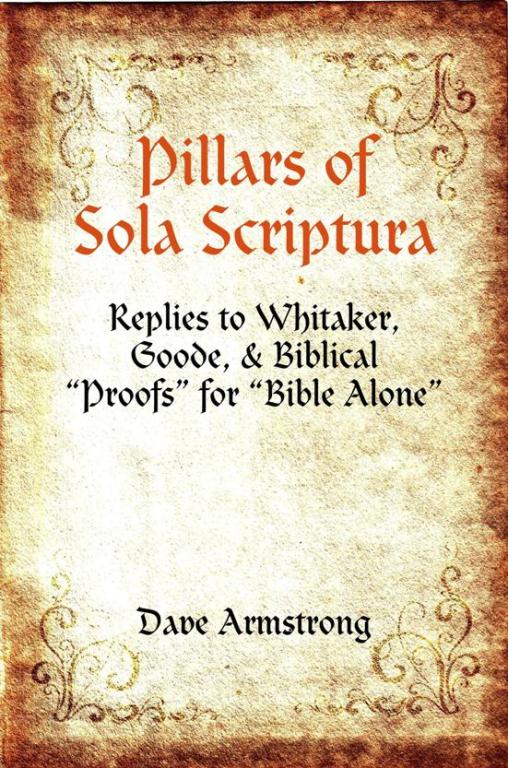
Photo credit: see book and purchase information for this book of mine.
Summary: I reply to anti-Catholic Baptist apologist James White’s weak & poorly argued critique of a 1995 article on oral tradition in the NT by Catholic apologist David Palm.
Previous Post

May 13, 2024
Debate on Sola Scriptura (vs. Bishop "Dr." [?] James White)
Next Post

May 14, 2024 Lazarus & the Rich Man: Jesus Taught False Theology?
Recent Comments
"And lastly, I belong to no denomination and am free to serve God as He ..."
Is Venerating Men & Angels Worship? ..."
"And obeisance doesn't mean "worship". It means "respect", "obey", or "submission". Very weird that you ..."
Is Venerating Men & Angels Worship? ..."
"Many of these scriptures you have noted have been taken out of context. With Daniel, ..."
Is Venerating Men & Angels Worship? ..."
""Protestants often point out that Jesus is now triumphant in heaven and object to Catholics ..."
Three More Anti-Catholic Lies About Catholicism ..."
Browse Our Archives
Select a Category & Last Things About Me Anti-Catholicism Atheism & Agnosticism Baptism and Sacramentalism Bible and Tradition Blessed Virgin Mary Books by Dave Armstrong C. S. Lewis Calvinism & General Protestantism Catholic Apologetics Catholic Apologists Catholic conversion Catholic converts Christmas Church (Ecclesiology) Church History Conversion and Converts Development of Doctrine Eastern Orthodoxy Ecumenism & Christian Unity Eucharist & Liturgy Fathers of the Church French Translations G. K. Chesterton Hell Hell & Satan Hell & Satan & Last Things Heresies & Comparative Religion Holistic Health Inquisition & Crusades & Scandals James White Jews & Judaism & Old Testament John Calvin John Henry Newman Liberal / Modernist Theology Life Issues Literary Resume Lutheranism Mariology Martin Luther Music Orthodoxy Papacy & Infallibility Personal Page Philosophy & Science Political & Ethical & Moral Issues Protestant Persecution & Intolerance Protestantism Purgatory Purgatory & Penance Romantic & Imaginative Theology Saints & Purgatory & Penance Salvation Salvation & Justification Satan & Last Things Sexuality and Gender Issues Spanish Translations Traditionalism vs. Radical Catholic Reactionaries Traducciones al español / tradução para português Trinitarianism & Christology Uncategorized Videos
Select a Month October 2026 September 2026 August 2026 July 2026 June 2026 May 2026 April 2026 March 2026 February 2026 January 2026 December 2025 November 2025 October 2025 September 2025 August 2025 July 2025 June 2025 May 2025 April 2025 March 2025 February 2025 January 2025 December 2024 November 2024 October 2024 September 2024 August 2024 July 2024 June 2024 May 2024 April 2024 March 2024 February 2024 January 2024 December 2023 November 2023 October 2023 September 2023 August 2023 July 2023 June 2023 May 2023 April 2023 March 2023 February 2023 January 2023 December 2022 November 2022 October 2022 September 2022 August 2022 July 2022 June 2022 May 2022 April 2022 March 2022 February 2022 January 2022 December 2021 November 2021 October 2021 September 2021 August 2021 July 2021 June 2021 May 2021 April 2021 March 2021 February 2021 January 2021 December 2020 November 2020 October 2020 September 2020 August 2020 July 2020 June 2020 May 2020 April 2020 March 2020 February 2020 January 2020 December 2019 November 2019 October 2019 September 2019 August 2019 July 2019 June 2019 May 2019 April 2019 March 2019 February 2019 January 2019 December 2018 November 2018 October 2018 September 2018 August 2018 July 2018 June 2018 May 2018 April 2018 March 2018 February 2018 January 2018 December 2017 November 2017 October 2017 September 2017 August 2017 July 2017 June 2017 May 2017 April 2017 March 2017 February 2017 January 2017 December 2016 November 2016 October 2016 September 2016 August 2016 July 2016 June 2016 May 2016 April 2016 March 2016 February 2016 January 2016 December 2015 November 2015 October 2015 September 2015 August 2015 July 2015 June 2015 May 2015 April 2015 March 2015 February 2015 January 2015 December 2014 November 2014 October 2014 September 2014 August 2014 July 2014 June 2014 April 2014 March 2014 February 2014 January 2014 December 2013 November 2013 October 2013 September 2013 August 2013 July 2013 June 2013 April 2013 March 2013 February 2013 January 2013 December 2012 November 2012 October 2012 September 2012 August 2012 July 2012 June 2012 May 2012 April 2012 March 2012 February 2012 January 2012 December 2011 November 2011 October 2011 September 2011 August 2011 July 2011 June 2011 April 2011 March 2011 February 2011 October 2010 September 2010 August 2010 July 2010 April 2010 March 2010 December 2009 October 2009 August 2009 July 2009 June 2009 May 2009 March 2009 February 2009 October 2008 September 2008 April 2008 March 2008 February 2008 January 2008 December 2007 November 2007 October 2007 May 2007 March 2007 February 2007 January 2007 November 2006 October 2006 September 2006 August 2006 July 2006 June 2006 May 2006 April 2006 March 2006 February 2006 October 2005 June 2005 April 2005 February 2005 July 2004 May 2004 April 2004
Follow Us!
TAKE THE
Religious Wisdom Quiz
Who prayed for rain after a long drought and sent his servant to look seven times?
Select your answer to see how you score.
Elijah Isaiah Samuel Hosea
Books by This Author Books by Dave Armstrong
Related posts from Biblical Evidence for Catholicism

A Few "Worst" & "Best" Arguments vs. Protestantism
Biblical Evidence for Catholicism

Jerusalem Council vs. James White & Sola Scriptura
Biblical Evidence for Catholicism

Biblical Perspicuity: Absurd Anti-Catholic "Defense"
Biblical Evidence for Catholicism

50 Biblical Disproofs of "Evident Clearness" of the...
Biblical Evidence for Catholicism
TRENDING AT PATHEOS Catholic

I was strolling through the top floor of the brand new Parthenon...

What Does Gêvâh Mean For Kimberley Guifoyle &...
This week, a lot of the news is focused on Kimberly Guilfoyle....

INNER CIRCLE: Profound Mystery (Of Christ In All...
Ephesians 5:31-32 “For this reason, a man will leave his father and...

Do Not Rejoice When Your Enemy Falls: The...
Turning an execution into a public spectacle is a disturbing expression of...

'The Chosen' S6 Trailer: The Passion Gets Very...
Not many watching 'The Chosen' worry about spoilers, but just because they...

The purpose-driven labor priest
A labor activist reads Rick Warren and it gets me wondering about...
view all Catholic blogs
What Are Your Thoughts?leave a comment
Ad-Free & Subscriber Log-In Subscription Support
- About Us
- 2026 Calendar
- Videos
- Podcasts
- Library of World Religions
- Faith In Media Tracker
- Advertise With Us
- Write for Us
- Privacy Policy
- Terms of Service
- Do Not Sell My Data
- Contact Us
- Radiant Digital
- Manage Newsletter Subscriptions
- Unsubscribe From Notifications
- Sitemap
Copyright 2008-2026, Patheos. All rights reserved.
Subscription Support Ad-Free & Subscriber Log-In
Follow Patheos