
BuddhistCatholicContemplativeEvangelicalGeneral ChristianHinduJewishLatter-day SaintMuslimNew VisionsProgressive Christian
Beliefs
- Buddhist
- Catholic
- Contemplative
- Evangelical
- General Christian
- Hindu
- Jewish
- Latter-day Saint
- More Voices
- Muslim
- New Visions
- Pagan
- Progressive Christian
Topics
- Religion News
- Food and Religion
- Sports and Religion
- Religious Art
- Religious Music and Entertainment
- Religious Events
- History and Religion
- Style and Religion
- Politics and Religion
- Women in Religion
- Recreation Outdoors and Religion
- Business Finance and Religion
- Careers Workplace and Religion
- Education and Religion
- Family Parenting and Religion
- Health Fitness and Religion
- Home and Religion
- Relationships and Religion
- Technology and Religion
- Travel and Religion
Columnists
- Buddhist Columnists
- Business Finance and Religion Columnists
- Careers Workplace and Religion Columnists
- Catholic Columnists
- Contemplative Columnists
- Education and Religion Columnists
- Evangelists Columnists
- Family Parenting and Religion Columnists
- General Christian Columnists
- Health Fitness and Religion Columnists
- Hindu Columnists
- History and Religion Columnists
- Home and Religion Columnists
- Jewish Columnists
- More Voices Columnists
- Latter Day Columnists
- Muslim Columnists
- New Visions Columnists
- Nonreligious Columnists
- Pagan Columnists
- Politics and Religion Columnists
- Progressive Columnists
- Recreation Outdoors and Religion Columnists
- Relationships and Religion Columnists
- Religion News Columnists
- Religious Art Columnists
- Religious Events Columnists
- Religious Music and Entertainment Columnists
- Sports and Religion Columnists
- Style and Religion Columnists
- Technology and Religion Columnists
- Travel and Religion Columnists
- Women in Religion Columnists
Resource Library
- 2026 Calendar
- Library of World Religions
- The 100 Most Holy Places on Earth
- Patheos Answers
- Podcasts
- Videos
- Faith Leaders Database
- Anglican Episcopalian
- Bahai
- Baptist
- Buddhism
- Christianity
- Confucianism
- Eastern Orthodoxy
- Hinduism
- Holiness and Pentecostal
- ISKCON
- Islam
- Judaism
- Lutheran
- Methodist
- The Church of Jesus Christ of Latter-day Saints
- New Age
- Paganism
- Presbytarian and Reformed
- Protestantism
- Religion Behind the Scenes
- Roman Catholic
- Scientology
- Shia Islam
- Sikhism
- Sufism
- Sunni Islam
- Taoism
- Zen
- See all religions
Research Tools
 Ad-Free & Subscriber Log-In Subscription Support
Ad-Free & Subscriber Log-In Subscription Support
Follow Patheos 

- Trending:
- Forgiveness
- |
- Marriage
- |
- Consciousness
- |
- Death Penalty
- |
- Election
- |
- Halloween

-
About
-
Catholic Apologetics
-
Church History
-
Great Apologists
-
Christian Worldview
-
Protestantism & Misc.
- Home
- Catholic
- History and Religion
- Peter the Pope: Early Patristic Evidence
Peter the Pope: Early Patristic Evidence
Last updated on: May 22, 2024 at 9:09 am by Dave Armstrong
Peter the Pope: Early Patristic Evidence 2024-05-22T09:09:37-04:00 Dave Armstrong
Patheos Explore the world's faith through different perspectives on religion and spirituality! Patheos has the views of the prevalent religions and spiritualities of the world.
“Please Hit ‘Subscribe’”! If you have received benefit from this or any of my other 4,600+ articles, please follow this blog by signing up (with your email address) on the sidebar to the right (you may have to scroll down a bit), above where there is an icon bar, “Sign Me Up!”: to receive notice when I post a new blog article. This is the equivalent of subscribing to a YouTube channel. Please also consider following me on Twitter / X and purchasing one or more of my 55 books. All of this helps me get more exposure, and (however little!) more income for my full-time apologetics work. Thanks so much and happy reading!
***
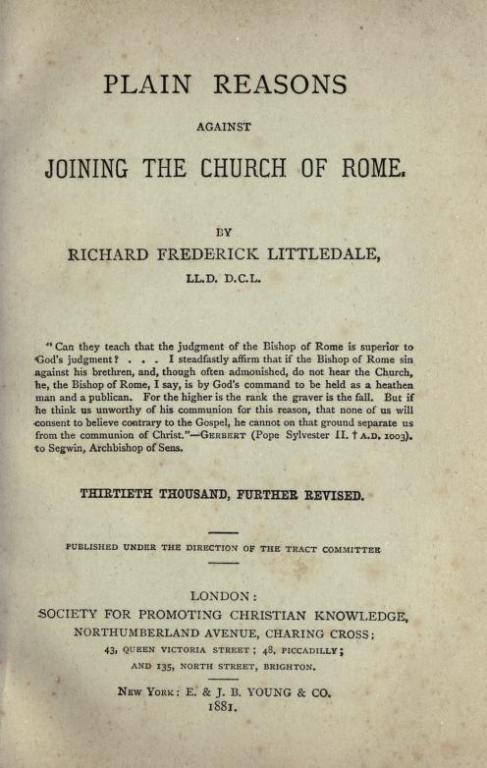
I am responding to the book, Plain Reasons Against Joining the Church of Rome (London: Society for Promoting Christian Knowledge, 1880), by Richard Frederick Littledale (1833-1890), an Anglo-Irish clergyman and prolific author. He received LL.B. and LL.D. degrees from Trinity College Dublin, in 1862, and a D.C.L. from Oxford. He was renowned as a father confessor, and next to Edward Pusey is said to have heard more confessions than any other priest of the church of England. His Plain Reasons Against Joining the Church of Rome, a volume of which thirty-six thousand copies were issued in 1880 and following years, evoked replies from the Rev. W. Horsfall, the Rev. A. Mills, Oxoniensis, and H. I. D. Ryder. I will be addressing certain of his claims regarding Peter and the Church fathers early in this book. His words will be in blue.
***
It is little more than a guess— though no doubt one with much in its favour — that St. Peter was ever at Rome at all; it is only a guess that he was ever Bishop of Rome, and for this there is very little evidence of any kind; it is only a guess that he had the power to appoint any heir to his special privilege, whatever that was; it is only a guess that he did so appoint the Bishops of Rome — and for these two guesses not the smallest scrap or tittle of evidence ever has been produced, or can be so much as reasonably supposed ever to have existed . . . the Ultramontane interpretation put on the three great texts in the Gospels which are relied on to support the ” Privilege of Peter,”— namely, St. Matt. xvi. 18, that St. Peter is the rock and foundation of the Church; St. Luke xxii. 31, 32, that St. Peter was infallible, and charged with guiding the faith of the other Apostles; and St. John xxi. 15- 17, that he was given jurisdiction over the Apostles and the whole Church — is contrary to the “unanimous consent of the Fathers,” who agree by a great majority that either Christ Himself, or St. Peter’s confession of Christ, is the rock and foundation of the Church . . . (pp. 25-26; my bolding)
St. Irenaeus (130-202) wrote:
- Since, however, it would be very tedious, in such a volume as this, to reckon up the successions of all the Churches, we do put to confusion all those who, in whatever manner, whether by an evil self-pleasing, by vainglory, or by blindness and perverse opinion, assemble in unauthorized meetings; [we do this, I say,] by indicating that tradition derived from the apostles, of the very great, the very ancient, and universally known Church founded and organized at Rome by the two most glorious apostles, Peter and Paul; as also [by pointing out] the faith preached to men, which comes down to our time by means of the successions of the bishops. For it is a matter of necessity that every Church should agree with this Church, on account of its preeminent authority [potiorem principalitatem]. (Against Heresies, Bk. III, ch. 3, 2)
Tertullian (c. 160-c. 225) stated:
For this is the manner in which the apostolic churches transmit their registers: as the church of Smyrna, which records that Polycarp was placed therein by John; as also the church of Rome, which makes Clement to have been ordained in like manner by Peter. In exactly the same way the other churches likewise exhibit (their several worthies), whom, as having been appointed to their episcopal places by apostles, they regard as transmitters of the apostolic seed. (Prescription against Heretics, 32; c. 200)
The Ecclesiastical History, by Eusebius (c. 260/265-339) was the first and by far most important comprehensive history of the Church, and was completed in its first edition before 300 AD (later editions: c. 313-323):
After the martyrdom of Paul and of Peter, Linus [start of reign between 64-68] was the first to obtain the episcopate of the church at Rome. Paul mentions him, when writing to Timothy from Rome, in the salutation at the end of the epistle. [2 Tim 4:21] (EH, Bk III, 2, 1; cf. III, 4, 9. In Bk III, ch. 13, Eusebius says that Linus was bishop for twelve years)
Clement also, who was appointed third bishop of the church at Rome, was, as Paul testifies, his co-laborer [Phil 4:3] . . . (EH, Bk III, 4, 10)
In the second year of his reign, Linus, who had been bishop of the church of Rome for twelve years, delivered his office to Anencletus. (EH, Bk III, 13, 1)
In the twelfth year of the same reign [92/93] Clement succeeded Anencletus after the latter had been bishop of the church of Rome for twelve years. (EH, Bk III, 15, 1)
At that time Clement still ruled the church of Rome, being also the third that held the episcopate there after Paul and Peter. Linus was the first, and after him came Anencletus. (EH, Bk III, 21, 1-3)
Clement committed the episcopal government of the church of Rome to Evarestus, and departed this life after he had superintended the teaching of the divine word nine years in all. (EH, Bk III, 34, 1)
At that time also Alexander [r. c. 107-109 – c. 115-119], the fifth in the line of succession from Peter and Paul, received the episcopate at Rome, after Evarestus had held the office eight years. (EH, Bk IV, 1, 1-2)
Epiphanius (c. 315-403) wrote:
6 Paul even reached Spain, and Peter often visited Pontus and Bithynia. But after Clement had been appointed and declined, if this is what happened—I suspect this but cannot say it for certain—he could have been compelled to hold the episcopate in his turn, after the deaths of Linus and Cletus who were bishops for twelve years each after the death of Saints Peter and Paul in the twelfth year of Nero.) 7 In any case, the succession of the bishops at Rome runs in this order: Peter and Paul, Linus and Cletus, Clement, Evaristus, Alexander, Xystus, Telesphorus, Hyginus, Pius, and Anicetus, whom I mentioned above, on the list. And no one need be surprised at my listing each of the items so exactly; precise information is always given in this way. (Panarion 27.6.6-7)
Likewise, St. Jerome (c. 343-420) wrote:
Clement, of whom the apostle Paul writing to the Philippians says With Clement and others of my fellow-workers whose names are written in the book of life, the fourth bishop of Rome after Peter, if indeed the second was Linus [d. c. 76] and the third Anacletus [d. c. 92], although most of the Latins think that Clement was second after the apostle. He wrote, on the part of the church of Rome, an especially valuable Letter to the church of the Corinthians, . . . (De Viris Illustribus, section 15)
Hegesippus [c. 110-c. 180] who lived at a period not far from the Apostolic age, . . . says that he went to Rome in the time of Anicetus [d. 168], the tenth bishop after Peter, and continued there till the time of Eleutherius [d. 185 or 193], bishop of the same city, who had been formerly deacon under Anicetus. (De Viris Illustribus, section 22)
Simon Peter . . . himself chief of the apostles, after having been bishop of the church of Antioch . . . pushed on to Rome . . . and held the sacerdotal chair there for twenty-five years until the last, that is the fourteenth, year of Nero. (De Viris Illustribus [On Illustrious Men], section 1)
Regarding the confusion or mixed reports about the chronology of the earliest popes, see, “Pope St. Clement I” (Catholic Encyclopedia, John Chapman, 1908). He states, for example: “At the present time no critic doubts that Cletus, Anacletus, Anencletus, are the same person. Anacletus is a Latin error; Cletus is a shortened (and more Christian) form of Anencletus.”
Was Peter In Rome?
Tertullian, in The Demurrer Against the Heretics (A.D. 200), noted of Rome, “How happy is that church . . . where Peter endured a passion like that of the Lord, where Paul was crowned in a death like John’s [referring to John the Baptist, both he and Paul being beheaded].” Protestants admit Paul died in Rome, so the implication from Tertullian is that Peter also must have been there.
In the same book, Tertullian wrote that “this is the way in which the apostolic churches transmit their lists: like the church of the Smyrnaeans, which records that Polycarp was placed there by John; like the church of the Romans, where Clement was ordained by Peter.” This Clement, known as Clement of Rome, later would be the fourth pope. Clement wrote his Letter to the Corinthians perhaps before the year 70, just a few years after Peter and Paul were killed; in it he made reference to Peter ending his life where Paul ended his.
In his Letter to the Romans (A.D. 110), Ignatius of Antioch remarked that he could not command the Roman Christians the way Peter and Paul once did, such a comment making sense only if Peter had been a leader, if not the leader, of the church in Rome.
Irenaeus, in Against Heresies (A.D. 190), said that Matthew wrote his Gospel “while Peter and Paul were evangelizing in Rome and laying the foundation of the Church.” A few lines later he notes that Linus was named as Peter’s successor, that is, the second pope, and that next in line were Anacletus (also known as Cletus), and then Clement of Rome.
Clement of Alexandria wrote at the turn of the third century. A fragment of his work Sketches is preserved in Eusebius of Caesarea’s Ecclesiastical History, the first history of the Church. Clement wrote, “When Peter preached the word publicly at Rome, and declared the gospel by the Spirit, many who were present requested that Mark, who had been for a long time his follower and who remembered his sayings, should write down what had been proclaimed.”
Lactantius, in a treatise called The Death of the Persecutors, written around 318, noted that “When Nero was already reigning [Nero reigned from 54–68], Peter came to Rome, where, in virtue of the performance of certain miracles which he worked by that power of God which had been given to him, he converted many to righteousness and established a firm and steadfast temple to God.”
These citations could be multiplied. (Refer to Jurgens’ books or to the Catholic Answers tract Peter’s Roman Residency.) No ancient writer claimed Peter ended his life anywhere other than in Rome. (“Was Peter in Rome?,” Catholic Answers, 2004)
Eighteen Church Fathers Who Thought Peter was the Rock, the Foundation of the Church and its Leader, Based on Matthew 16
Tertullian, writing around 200-220, stated that “Peter . . . is called the Rock whereon the Church was to be built” (Prescription against Heretics, 22).
St. Hippolytus wrote around 225: “By this Spirit Peter spoke that blessed word, You are the Christ, the Son of the living God. By this Spirit the rock of the Church was established” (The Discourse on the Holy Theophany, 9).
Origen writing around 230-250, called Peter “that great foundation of the Church, and most solid rock, upon which Christ founded the Church” (In Exod. Hom. v. n. 4, tom. ii) and “Upon him (Peter) . . . the Church was founded” (In Epist. ad Rom. lib. v. c. 10, tom. iv) and “Peter upon whom is built Christ’s Church” (T. iv. In Joan. Tom. v.).
St. Cyprian, c. 246, wrote about “Peter, upon whom by the same Lord the Church had been built” (Epistle 54 to Cornelius, 7).
Firmilian, c. 254, wrote about “one Church, which was once first established by Christ on a Rock” (Inter Ep. S. Cyp. Ep. lxxv).
Aphraates (c. 336) stated that “the Lord . . . set him up as the foundation, called him the rock and structure of the Church” (Homily 7:15, De Paenitentibus).
St. Ephraem (c. 350-370) called Peter “the foundation of the holy Church” (Homilies 4:1).
St. Hilary of Poitiers in 360 held that Peter was “the foundation-stone of the Church” (On the Trinity, Bk. VI, 20).
St. Cyril of Jerusalem (c. 363), commenting on Matthew 16, calls peter “the foremost of the apostles and chief herald of the Church” (Catechetical Lecture 11, 3).
St. Optatus (c. 370), commenting on the same passage, wrote that Peter was “to be preferred before all the Apostles” and was “The Head of the Apostles” (De Schism. Don. l. vii. n. 3).
St. Gregory of Nazianzen (370) stated that Peter “is entrusted with the Foundations of the Church” (T. i. or. xxxii. n. 18).
St. Gregory of Nyssa (371) wrote that Peter was “the Head of the Apostles . . . (upon him) is the Church of God firmly established. . . . that unbroken and most firm Rock upon which the Lord built His Church” (Alt. Or. De S. Steph.).
St. Basil the Great (371) stated that Peter “received on himself the building of the Church” (Adversus Eunomius 2:4).
St. Epiphanius (c. 385): “upon which (Rock) the Church is in every way built . . . Foundation of the house of God” (Adv. Haeres.).
St. Ambrose (c. 385-389): “whom when He styles a Rock, He pointed out the Foundation of the Church” (T. ii. l. iv. De Fide, c. v. n. 56).
St. John Chrysostom (c. 387): “Head or Crown of the Apostles, the First in the Church . . . that unbroken Rock, that firm Foundation, the Great Apostle, the First of the disciples” (T. ii. Hom. iii. de Paenit. n. 4).
St. Jerome (385): “Peter, upon whom the Lord has founded the Church” (Letters 41, 2).
St. Cyril of Alexandria (424): “the church . . . over this he sets Peter as shepherd” (Comm. on Matt., ad. loc.).
Nine Church Fathers Who Thought That John 21 was “Papal”: Indicative of Peter Being the Leader of the Early Church
Origen (c. 216): “the Chief Authority as regards the feeding of the sheep was delivered to Peter” (T. iv. l. 5, in Ep. ad Rom. n. 1).
St. Cyprian (c. 246): “to the same [Peter] He says, after His resurrection, Feed my sheep. And although to all the apostles, after His resurrection, He gives an equal power, . . . yet, that He might set forth unity, He arranged by His authority the origin of that unity, as beginning from one.” (Treatise 1: On the Unity of the Church, 4).
St. Ephraem (c. 350-370): “The Lord . . . delivered his flock to Simon . . . Three pledges he took from him as shepherd, that with love he should shepherd his lambs, and should visit his sheep with mercy, and should guard his ewes with fear.” (HVirg. 36, 6; CSCO 223, Syr. 94).
Ambrosiaster (c. 380-384): “After the Saviour all were included in Peter; for He constituted him to be their head, that he might be the shepherd of the Lord’s flock” (Quaest. 75, ex N. Test. in App. St. August. tom. iii. 2894).
St. Ambrose (385): Therefore did Christ also commit to Peter to feed His flock” (Ib. in. Ps. cxviii. [Mem] n. 3).
St. Epiphanius (c. 385): “He heard from the same God, ‘Peter, feed My lambs;’ to him was intrusted the flock; he leads the way admirably in the power of his own Master.” (Tom. ii. In Anchorat. n. 9).
St. John Chrysostom (c. 387): “He puts into his hands the presidency over the brethren . . . [and] says, ‘If Thou lovest Me, preside over the brethren’ . . . He sets the presidency over his own sheep . . . He appointed this man (Peter) teacher . . . of the world.” (In Joan. Hom. lxxxviii. n. 1, tom. viii.).
“What advantage, pray, could be greater than to be seen doing those things which Christ with his own lips declared to be proofs of love to Himself? For addressing the leader of the apostles He said, Peter, do you love me? and when he confessed that he did, the Lord added, if you love me tend my sheep. The Master asked the disciple if He was loved by him, not in order to get information (how should He who penetrates the hearts of all men?), but in order to teach us how great an interest He takes in the superintendence of these sheep. This being plain, it will likewise be manifest that a great and unspeakable reward will be reserved for him whose labors are concerned with these sheep, upon which Christ places such a high value. . . . For what purpose did He shed His blood? It was that He might win these sheep which He entrusted to Peter and his successors. . . . Will you, then, still contend that you were not rightly deceived, when you are about to superintend the things which belong to God, and are doing that which when Peter did the Lord said he should be able to surpass the rest of the apostles, for His words were, Peter, do you love me more than these? . . . one is required to preside over the Church, and to be entrusted with the care of so many souls . . .” (On the Priesthood, Book II, 1-2)
St. Augustine (c. 400): “. . . the Lord commended his sheep to Peter himself to feed . . . when Christ speaks to one, unity is commended — and to Peter for the first time, because Peter is first among the apostles.” (Sermo. 295).
“[T]here are many other things which most justly keep me in her bosom. The consent of peoples and nations keeps me in the Church; so does her authority, inaugurated by miracles, nourished by hope, enlarged by love, established by age. The succession of priests keeps me, beginning from the very seat of the Apostle Peter, to whom the Lord, after His resurrection, gave it in charge to feed His sheep, down to the present episcopate. And so, lastly, does the name itself of Catholic, which, not without reason, amid so many heresies, the Church has thus retained; so that, though all heretics wish to be called Catholics, yet when a stranger asks where the Catholic Church meets, no heretic will venture to point to his own chapel or house.” (Against the Fundamental Epistle of Manichaeus, ch. 4, 5).
“The Lord, indeed, had told His disciples to carry a sword; but He did not tell them to use it. But that after this sin Peter should become a pastor of the Church was no more improper than that Moses, after smiting the Egyptian, should become the leader of the congregation.” (Contra Faustum, Book XXII, 70).
“And again the Lord asked this question, and a third time He asked it. And when he asserted in reply his love, He commended to him the flock. For each several time the Lord Jesus said to Peter, as he said, I love you; Feed My lambs, feed My little sheep. In this one Peter was figured the unity of all pastors . . .” (Sermon 97 on the New Testament, 2).
“Peter generally stands for a figure of the Church.” (Sermon 25 on the New Testament, 10; cf. Sermon 96; Sermon 88, 4).
“For He says to Peter, in whom singly He forms the Church; Peter, do you love Me? He answered, Lord, I do love You. Feed My sheep. ” (Sermon 87 on the New Testament, 3).
St. Peter Chrysologus (432): “He commends His sheep to be fed by Peter, in His stead” (Serm. vi. In Ps. xcix).
For more on both passages, see: Papal Authority In The NT And The Fathers (Vs. Mike Winger) [3-9-24].
*
***
*
Practical Matters: Perhaps some of my 4,600+ free online articles (the most comprehensive “one-stop” Catholic apologetics site) or fifty-five books have helped you (by God’s grace) to decide to become Catholic or to return to the Church, or better understand some doctrines and why we believe them.
Or you may believe my work is worthy to support for the purpose of apologetics and evangelism in general. If so, please seriously consider a much-needed financial contribution. I’m always in need of more funds: especially monthly support. “The laborer is worthy of his wages” (1 Tim 5:18, NKJV). 1 December 2021 was my 20th anniversary as a full-time Catholic apologist, and February 2022 marked the 25th anniversary of my blog.
PayPal donations are the easiest: just send to my email address: [email protected]. Here’s also a second page to get to PayPal. You’ll see the term “Catholic Used Book Service”, which is my old side-business. To learn about the different methods of contributing (including Zelle), see my page: About Catholic Apologist Dave Armstrong / Donation Information. Thanks a million from the bottom of my heart!
*
***
Photo credit: Richard Frederick Littledale’s book, Plain Reasons Against Joining the Church of Rome; 1881 title page; from Internet Archive.
Summary: Anglican polemicist Richard Frederick Littledale (1833-1890) made dubious claims about patristic beliefs regarding St. Peter. I shoot them down with historical facts.
Previous Post

May 21, 2024
Catholicism = Unbiblical Idolatrous Worship?
Next Post

May 22, 2024 Defense of the Communion of Saints & Images
Recent Comments
"And lastly, I belong to no denomination and am free to serve God as He ..."
Is Venerating Men & Angels Worship? ..."
"And obeisance doesn't mean "worship". It means "respect", "obey", or "submission". Very weird that you ..."
Is Venerating Men & Angels Worship? ..."
"Many of these scriptures you have noted have been taken out of context. With Daniel, ..."
Is Venerating Men & Angels Worship? ..."
""Protestants often point out that Jesus is now triumphant in heaven and object to Catholics ..."
Three More Anti-Catholic Lies About Catholicism ..."
Browse Our Archives
Select a Category & Last Things About Me Anti-Catholicism Atheism & Agnosticism Baptism and Sacramentalism Bible and Tradition Blessed Virgin Mary Books by Dave Armstrong C. S. Lewis Calvinism & General Protestantism Catholic Apologetics Catholic Apologists Catholic conversion Catholic converts Christmas Church (Ecclesiology) Church History Conversion and Converts Development of Doctrine Eastern Orthodoxy Ecumenism & Christian Unity Eucharist & Liturgy Fathers of the Church French Translations G. K. Chesterton Hell Hell & Satan Hell & Satan & Last Things Heresies & Comparative Religion Holistic Health Inquisition & Crusades & Scandals James White Jews & Judaism & Old Testament John Calvin John Henry Newman Liberal / Modernist Theology Life Issues Literary Resume Lutheranism Mariology Martin Luther Music Orthodoxy Papacy & Infallibility Personal Page Philosophy & Science Political & Ethical & Moral Issues Protestant Persecution & Intolerance Protestantism Purgatory Purgatory & Penance Romantic & Imaginative Theology Saints & Purgatory & Penance Salvation Salvation & Justification Satan & Last Things Sexuality and Gender Issues Spanish Translations Traditionalism vs. Radical Catholic Reactionaries Traducciones al español / tradução para português Trinitarianism & Christology Uncategorized Videos
Select a Month October 2026 September 2026 August 2026 July 2026 June 2026 May 2026 April 2026 March 2026 February 2026 January 2026 December 2025 November 2025 October 2025 September 2025 August 2025 July 2025 June 2025 May 2025 April 2025 March 2025 February 2025 January 2025 December 2024 November 2024 October 2024 September 2024 August 2024 July 2024 June 2024 May 2024 April 2024 March 2024 February 2024 January 2024 December 2023 November 2023 October 2023 September 2023 August 2023 July 2023 June 2023 May 2023 April 2023 March 2023 February 2023 January 2023 December 2022 November 2022 October 2022 September 2022 August 2022 July 2022 June 2022 May 2022 April 2022 March 2022 February 2022 January 2022 December 2021 November 2021 October 2021 September 2021 August 2021 July 2021 June 2021 May 2021 April 2021 March 2021 February 2021 January 2021 December 2020 November 2020 October 2020 September 2020 August 2020 July 2020 June 2020 May 2020 April 2020 March 2020 February 2020 January 2020 December 2019 November 2019 October 2019 September 2019 August 2019 July 2019 June 2019 May 2019 April 2019 March 2019 February 2019 January 2019 December 2018 November 2018 October 2018 September 2018 August 2018 July 2018 June 2018 May 2018 April 2018 March 2018 February 2018 January 2018 December 2017 November 2017 October 2017 September 2017 August 2017 July 2017 June 2017 May 2017 April 2017 March 2017 February 2017 January 2017 December 2016 November 2016 October 2016 September 2016 August 2016 July 2016 June 2016 May 2016 April 2016 March 2016 February 2016 January 2016 December 2015 November 2015 October 2015 September 2015 August 2015 July 2015 June 2015 May 2015 April 2015 March 2015 February 2015 January 2015 December 2014 November 2014 October 2014 September 2014 August 2014 July 2014 June 2014 April 2014 March 2014 February 2014 January 2014 December 2013 November 2013 October 2013 September 2013 August 2013 July 2013 June 2013 April 2013 March 2013 February 2013 January 2013 December 2012 November 2012 October 2012 September 2012 August 2012 July 2012 June 2012 May 2012 April 2012 March 2012 February 2012 January 2012 December 2011 November 2011 October 2011 September 2011 August 2011 July 2011 June 2011 April 2011 March 2011 February 2011 October 2010 September 2010 August 2010 July 2010 April 2010 March 2010 December 2009 October 2009 August 2009 July 2009 June 2009 May 2009 March 2009 February 2009 October 2008 September 2008 April 2008 March 2008 February 2008 January 2008 December 2007 November 2007 October 2007 May 2007 March 2007 February 2007 January 2007 November 2006 October 2006 September 2006 August 2006 July 2006 June 2006 May 2006 April 2006 March 2006 February 2006 October 2005 June 2005 April 2005 February 2005 July 2004 May 2004 April 2004
Follow Us!
TAKE THE
Religious Wisdom Quiz
Who asked Jesus, "What is truth?"
Select your answer to see how you score.
Caiaphas Pilate Nicodemus Herod
Books by This Author Books by Dave Armstrong
Related posts from Biblical Evidence for Catholicism

Was Peter "Any Old" Apostle? 10 Anti-Papal Arguments
Biblical Evidence for Catholicism

17 Church Fathers on Purgatory (Esp. 1 Cor...
Biblical Evidence for Catholicism

Deuterocanon & Javier Perdomo's Straw Men
Biblical Evidence for Catholicism

St. Athanasius & the Deuterocanon (vs. Javier Perdomo)
Biblical Evidence for Catholicism
TRENDING AT PATHEOS Catholic

I was strolling through the top floor of the brand new Parthenon...

What Does Gêvâh Mean For Kimberley Guifoyle &...
This week, a lot of the news is focused on Kimberly Guilfoyle....

INNER CIRCLE: Profound Mystery (Of Christ In All...
Ephesians 5:31-32 “For this reason, a man will leave his father and...

Do Not Rejoice When Your Enemy Falls: The...
Turning an execution into a public spectacle is a disturbing expression of...

'The Chosen' S6 Trailer: The Passion Gets Very...
Not many watching 'The Chosen' worry about spoilers, but just because they...

The purpose-driven labor priest
A labor activist reads Rick Warren and it gets me wondering about...
view all Catholic blogs
What Are Your Thoughts?leave a comment
Ad-Free & Subscriber Log-In Subscription Support
- About Us
- 2026 Calendar
- Videos
- Podcasts
- Library of World Religions
- Faith In Media Tracker
- Advertise With Us
- Write for Us
- Privacy Policy
- Terms of Service
- Do Not Sell My Data
- Contact Us
- Radiant Digital
- Manage Newsletter Subscriptions
- Unsubscribe From Notifications
- Sitemap
Copyright 2008-2026, Patheos. All rights reserved.
Subscription Support Ad-Free & Subscriber Log-In
Follow Patheos