
BuddhistCatholicContemplativeEvangelicalGeneral ChristianHinduJewishLatter-day SaintMuslimNew VisionsProgressive Christian
Beliefs
- Buddhist
- Catholic
- Contemplative
- Evangelical
- General Christian
- Hindu
- Jewish
- Latter-day Saint
- More Voices
- Muslim
- New Visions
- Pagan
- Progressive Christian
Topics
- Religion News
- Food and Religion
- Sports and Religion
- Religious Art
- Religious Music and Entertainment
- Religious Events
- History and Religion
- Style and Religion
- Politics and Religion
- Women in Religion
- Recreation Outdoors and Religion
- Business Finance and Religion
- Careers Workplace and Religion
- Education and Religion
- Family Parenting and Religion
- Health Fitness and Religion
- Home and Religion
- Relationships and Religion
- Technology and Religion
- Travel and Religion
Columnists
- Buddhist Columnists
- Business Finance and Religion Columnists
- Careers Workplace and Religion Columnists
- Catholic Columnists
- Contemplative Columnists
- Education and Religion Columnists
- Evangelists Columnists
- Family Parenting and Religion Columnists
- General Christian Columnists
- Health Fitness and Religion Columnists
- Hindu Columnists
- History and Religion Columnists
- Home and Religion Columnists
- Jewish Columnists
- More Voices Columnists
- Latter Day Columnists
- Muslim Columnists
- New Visions Columnists
- Nonreligious Columnists
- Pagan Columnists
- Politics and Religion Columnists
- Progressive Columnists
- Recreation Outdoors and Religion Columnists
- Relationships and Religion Columnists
- Religion News Columnists
- Religious Art Columnists
- Religious Events Columnists
- Religious Music and Entertainment Columnists
- Sports and Religion Columnists
- Style and Religion Columnists
- Technology and Religion Columnists
- Travel and Religion Columnists
- Women in Religion Columnists
Resource Library
- 2026 Calendar
- Library of World Religions
- The 100 Most Holy Places on Earth
- Patheos Answers
- Podcasts
- Videos
- Faith Leaders Database
- Anglican Episcopalian
- Bahai
- Baptist
- Buddhism
- Christianity
- Confucianism
- Eastern Orthodoxy
- Hinduism
- Holiness and Pentecostal
- ISKCON
- Islam
- Judaism
- Lutheran
- Methodist
- The Church of Jesus Christ of Latter-day Saints
- New Age
- Paganism
- Presbytarian and Reformed
- Protestantism
- Religion Behind the Scenes
- Roman Catholic
- Scientology
- Shia Islam
- Sikhism
- Sufism
- Sunni Islam
- Taoism
- Zen
- See all religions
Research Tools
 Ad-Free & Subscriber Log-In Subscription Support
Ad-Free & Subscriber Log-In Subscription Support
Follow Patheos 

- Trending:
- Forgiveness
- |
- Marriage
- |
- Consciousness
- |
- Death Penalty
- |
- Election
- |
- Halloween

-
About
-
Catholic Apologetics
-
Church History
-
Great Apologists
-
Christian Worldview
-
Protestantism & Misc.
- Home
- Catholic
- History and Religion
- Eck vs. Protestantism Chronicles: Tradition
Eck vs. Protestantism Chronicles: Tradition
Last updated on: May 29, 2024 at 2:53 pm by Dave Armstrong
Eck vs. Protestantism Chronicles: Tradition 2024-05-29T14:53:55-04:00 Dave Armstrong
Patheos Explore the world's faith through different perspectives on religion and spirituality! Patheos has the views of the prevalent religions and spiritualities of the world.
“Please Hit ‘Subscribe’”! If you have received benefit from this or any of my other 4,600+ articles, please follow this blog by signing up (with your email address) on the sidebar to the right (you may have to scroll down a bit), above where there is an icon bar, “Sign Me Up!”: to receive notice when I post a new blog article. This is the equivalent of subscribing to a YouTube channel. Please also consider following me on Twitter / X and purchasing one or more of my 55 books. All of this helps me get more exposure, and (however little!) more income for my full-time apologetics work. Thanks so much and happy reading!
***
Johann Eck (1486-1543) was a German Catholic theologian, who was arguably one of Martin Luther’s two most important and formidable debate opponents, along with Erasmus (I’ve compiled several of his devastating replies to Luther as well). He was ordained as a priest in 1508 and in 1510 was installed as a professor of theology at the University of Ingolstadt in Bavaria: which lasted for thirty years. He mastered both Greek and Hebrew and had a prodigious memory, boundless energy, and very considerable debating skills. He famously engaged Luther for eighteen days in the Leipzig Disputation of July 1519.
Eck’s argumentation might be said to be one of the quintessential examples of the Catholic theological and polemical response to the Protestant Revolt up to the opening of the Council of Trent in 1545. This is one of many excerpts from his best-known and principal volume, Enchiridion of Commonplaces Against Luther and Other Enemies of the Church. It first appeared in 1529 and eventually went through 91 editions. I will be using a later edition from 1541 (translated by Ford Lewis Battles, Grand Rapids, Michigan: Baker Book House, 1979; now in the public domain).
Eck’s words will be in black; my interjections in blue, and citations from Luther and other famous Protestants in green. Line breaks imply breaks in the text. I use RSV for scriptural citations.
***
St. Paul gives thanks to God in his prayers, 0 Most Reverend Father and Prince, when he hears of the charity of Philemon and of the faith which he had in the Lord Jesus, and toward all his saints [Philemon v. 4-5]. [“I thank my God always when I remember you in my prayers, because I hear of your love and of the faith which you have toward the Lord Jesus and all the saints”], For Paul, supremely conscious of the secrets of God, had an insight that the faith of any man shines before God when he strives to conform it as much as possible to the saints and friends of God, just as Israel believed not only the Lord but also Moses his servant [Ex 14:31]. [“. . . and they believed in the LORD and in his servant Moses.”] And all good and sincere men have earnestly distinguished themselves from the time of Christ’s passion even to the present day, but not more than befits wise men [Rom 12:16]. [“Live in harmony with one another; do not be haughty, but associate with the lowly; never be conceited.”] But those who (neglecting this Apostolic rule) “have walked in wonderful things above themselves” [Ps 130:1] [“O LORD, my heart is not lifted up, my eyes are not raised too high; I do not occupy myself with things too great and too marvelous for me.”] and exalted themselves as Lucifer and the noonday demon [cf. Ps 91:6], unwilling to believe in the saints of God, are deceived, and have been given over to the precipice of errors, while they are not afraid to despoil those ancient apostolic men, remarkable in learning, eminent in moral character, notable in authority, and famous for miracles. . . . he who is not convinced by the harmony of the succession of holy fathers in the Church, by the profession and unanimous verdict of councils, must with insolent and proud rashness dash headlong into all sorts of abominable errors. Luther preferred to follow this insane and mad rashness, with his confederates, rather than piously believe, with Philemon, in the saints of God, and the rule of faith which the whole Church observes. For with perverse will he murmurs against the ministers of God, the most holy fathers, and the whole Church, putting his own judgment (0 utterly blind pride of the vainest of men!) ahead of all the foremost men of the Church.
So, for example, Luther wrote:
Therefore, I now let you know that from now on I shall no longer do you the honor of allowing you – or even an angel from heaven – to judge my teaching or to examine it. For there has been enough foolish humility now for the third time at Worms, and it has not helped. Instead, I shall let myself be heard and, as St. Peter teaches, give an explanation and defense of my teaching to all the world – I Pet. 3:15. I shall not have it judged by any man, not even by any angel. For since I am certain of it, I shall be your judge and even the angels’ judge through this teaching (as St. Paul says [I Cor. 6:3 ]) so that whoever does not accept my teaching may not be saved – for it is God’s and not mine. Therefore, my judgment is also not mine but God’s. (Against the Spiritual Estate of the Pope and the Bishops Falsely So-Called, July 1522; from Luther’s Works, vol. 39, 248-249)
But he didn’t disregard all of tradition, by any means. As usual, he was a “mixed bag”:
He [Karlstadt] would like with such smoke and mist to obscure altogether the sun and light of the gospel and the main articles of Christianity, so that the world might forget everything that we have hitherto taught. (Letter to the Christians at Strassburg in Opposition to the Fanatic Spirit, Dec. 1524, tr. Conrad Bergendoff; in LW, v. 40)
The amazing thing, meanwhile, is that of all the fathers, as many as you can name, not one has ever spoken about the sacrament [of the Eucharist] as these fanatics do. . . . Certainly among so many fathers and so many writings a negative argument should have turned up at least once, as happens in other articles; but actually they all stand uniformly and consistently on the affirmative side. (That These Words of Christ, “This Is My Body,” etc., Still Stand Firm Against the Fanatics, March 1527, tr. Robert H. Fischer; in LW, v. 37)
Since our baptizing has been thus from the beginning of Christianity and the custom has been to baptize children, . . . if we are going to change or do away with customs that are traditional, it is necessary to prove convincingly that these are contrary to the Word of God. (Concerning Rebaptism, Jan. 1528, tr. Conrad Bergendoff; in LW, v. 40)
[T]he Anabaptists proceed dangerously in everything. Not only are they not sure of themselves but also they act contrary to accepted tradition . . . (Ibid.)
[I]f the first, or child, baptism were not right, it would follow that for more than a thousand years there was no baptism or any Christendom, which is impossible. For in that case the article of the creed, I believe in one holy Christian church, would be false. . . . If this baptism is wrong then for that long period Christendom would have been without baptism, and if it were without baptism it would not be Christendom. . . . But the fact that child baptism has spread throughout all the Christian world to this day gives rise to no probability that it is wrong, but rather to a strong indication that it is right. (Ibid.)
Further, it is dangerous to accept such new teaching [a merely symbolic Eucharist] in contrast to lucid and open texts and the clear words of Christ, and to abandon this old belief (which from the beginning till now has been maintained in all of Christendom) on the basis of such poor [Scripture] passages and thoughts as [our opponents] have thus far brought forth . . . (Letters II, ed. and tr. Gottfried G. Krodel; to Landgrave Philip of Hesse, 20 May 1530; in LW, v. 49)
[Y]ou would be troubled not only for the sake of your soul, which would be damned thereby, but for the sake of the whole Christian Church, for if you allow any to teach against the long and unanimously held doctrine of the Church when you can prevent it, it may well be called an unbearable burden to conscience. . . . For we must not trifle with the articles of faith so long and unanimously held by Christendom, . . . (To Duke Albert of Prussia, Feb. or early March 1532)
See also my articles, and book:
Martin Luther’s Remarkably “Pro-Tradition” Strain of Thought [1-18-08]
The “Catholic-Sounding” Luther: 25 Examples [6-16-08]
Martin Luther: Catholicism is Christian [6-12-13]
Top Ten Remarkable “Catholic” Beliefs of Martin Luther [1-19-15]
The “Catholic” Luther : An Ecumenical Collection of His “Traditional” Utterances (Dec. 2014, 166 pages)
Luther had, however, rejected at least fifty Catholic doctrines or practices by 1520, before he was excommunicated (as I have documented form his own words). Like I said: “mixed bag.”
***
Christ did not write any book, nor did He bid the disciples or apostles to write one, yet He gave many precepts concerning the Church; hence when about to send apostles out to plant the Church, He did not say, “Go write,” but “Go into the whole world and preach the Gospel to every creature” [Mt. 24:14], Therefore the law was written on tablets of stone, but the Gospel on hearts. “Since you are a letter of Christ, sent out by us, and written not with ink but with the Spirit of the living God, not in tablets of stone, but in the physical tablets of the heart” [2 Cor 3:3].
Thus the apostles without the Scripture of the New Testament chose Matthias [Acts 1:22ff], ordained seven deacons [Acts 6:3]; Peter caused Ananias and Sapphira to die [Acts 5:1ff]. Even though the apostles were very diligent in sowing the Word of God, yet very few things are found written by them. It follows logically that they taught many more things than they wrote; the things taught have equal authority with the things written.
Let the objection immediately be raised against him: how does he know that these Scriptures are canonical except from the Church, for why does he believe the Gospel of Mark, who did not see Christ, to be canonical, and not the Gospel of Nicodemus, who saw and heard Christ, as John testifies [Jn 3:1ff]? So why has the Gospel of Luke the disciple been received, and the Gospel of Bartholomew the apostle been rejected, unless we humbly confess the authority of the Church with the Blessed Augustine, something Luther sometimes taught, that the Church could judge concerning the Scriptures.
Hence, Augustine, Against the Epistle Called Fundamental, 5.6 [PL 42.176]: “I would not have believed the Gospel unless the authority of the Church had moved me to do so.”
Luther largely agreed, at least in this statement:
St. Paul says in Rom. 1, 2, that the Gospel was promised afore in the Holy Scriptures, but it was not preached orally and publicly until Christ came and sent out his apostles. Therefore the church is a mouth-house, not a pen-house, for since Christ’s advent that Gospel is preached orally which before was hidden in written books. It is the way of the Gospel and of the New Testament that it is to be preached and discussed orally with a living voice. Christ himself wrote nothing, nor did he give command to write, but to preach orally. Thus the apostles were not sent out until Christ came to his mouth-house, that is, until the time had come to preach orally and to bring the Gospel from dead writing and pen-work to the living voice and mouth. (Sermon for the First Sunday in Advent; Matthew 21:1-9, 1521)
i. Scripture teaches: “Remember to hallow the Sabbath day; six days shall you labor and do all your work, but the seventh day is the Sabbath day of the Lord your God,” etc. [Ex 20:8ff] Yet the Church has changed the Sabbath into Sunday on its own authority, on which you have no Scripture.
ii. Christ said to His disciples on the mountain: “I have not come to abolish the law but to fulfill it” [Matt 5:17]. And yet the Church of the apostles in council [Acts 15] boldly made pronouncement on the cessation of legal matters. . . .
iv. Scripture is defined in the council: “It seemed good to the Holy Spirit and to us” [Acts 15:28] etc., “that you should abstain from sacrifices offered to idols, and blood and things strangled [v. 29]. This matter, so clearly defined and expressed, the Church by her authority changed, because she uses both blood and strangled meat. . . .
“And when Paul and Barnabas had no small dissension against them, the brethren decided that Paul and Barnabas and certain others of them should go up to the apostles and presbyters in Jerusalem about this question” [Acts 15:2] . . . And what was the Church? Not the whole congregation, but they went up to the apostles and presbyters who represented the Church.
See the Related Materials:
Part IV: Erasmus’ Hyperaspistes (1526): Luther’s Anti-Traditional Elements
Part VI: Erasmus’ Hyperaspistes (1526): Sola Scriptura and Perspicuity of Scripture
*
***
*
Practical Matters: Perhaps some of my 4,600+ free online articles (the most comprehensive “one-stop” Catholic apologetics site) or fifty-five books have helped you (by God’s grace) to decide to become Catholic or to return to the Church, or better understand some doctrines and why we believe them.
Or you may believe my work is worthy to support for the purpose of apologetics and evangelism in general. If so, please seriously consider a much-needed financial contribution. I’m always in need of more funds: especially monthly support. “The laborer is worthy of his wages” (1 Tim 5:18, NKJV). 1 December 2021 was my 20th anniversary as a full-time Catholic apologist, and February 2022 marked the 25th anniversary of my blog.
PayPal donations are the easiest: just send to my email address: [email protected]. Here’s also a second page to get to PayPal. You’ll see the term “Catholic Used Book Service”, which is my old side-business. To learn about the different methods of contributing (including Zelle), see my page: About Catholic Apologist Dave Armstrong / Donation Information. Thanks a million from the bottom of my heart!
*
***
*
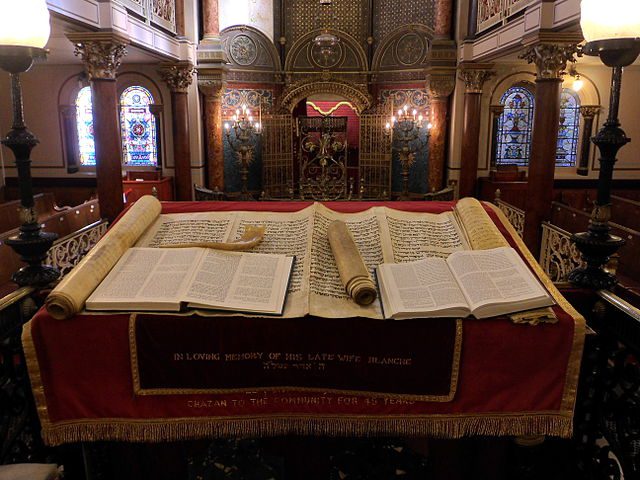
Photo credit: A lovely visual of biblical “tradition”: Torah scrolls at Middle Street Synagogue, Brighton, England. Photograph by “The Voice of Hassocks” (5-5-13) [Wikimedia Commons / Creative Commons CC0 1.0 Universal Public Domain Dedication]

Summary: One of a series of posts documenting the Catholic apologetics efforts of Johann Eck (1486-1543) against various Protestants. This installment addresses tradition.
Previous Post
May 28, 2024
Jesus & Baptism: Jason Engwer's Ridiculous View
Next Post
May 30, 2024 Eck Vs. Protestantism Chronicles: Church Councils
Recent Comments
"Special pleading, and not a serious response to my arguments . . ."
Is Venerating Men & Angels Worship? ..."
""no man needs to teach us."Didn't you just teach us?"
Is Venerating Men & Angels Worship? ..."
""Catholics say they are the only church that can lead people into heaven."In fact, we ..."
Is Venerating Men & Angels Worship? ..."
"And lastly, I belong to no denomination and am free to serve God as He ..."
Is Venerating Men & Angels Worship? ..."
Browse Our Archives
Select a Category & Last Things About Me Anti-Catholicism Atheism & Agnosticism Baptism and Sacramentalism Bible and Tradition Blessed Virgin Mary Books by Dave Armstrong C. S. Lewis Calvinism & General Protestantism Catholic Apologetics Catholic Apologists Catholic conversion Catholic converts Christmas Church (Ecclesiology) Church History Conversion and Converts Development of Doctrine Eastern Orthodoxy Ecumenism & Christian Unity Eucharist & Liturgy Fathers of the Church French Translations G. K. Chesterton Hell Hell & Satan Hell & Satan & Last Things Heresies & Comparative Religion Holistic Health Inquisition & Crusades & Scandals James White Jews & Judaism & Old Testament John Calvin John Henry Newman Liberal / Modernist Theology Life Issues Literary Resume Lutheranism Mariology Martin Luther Music Orthodoxy Papacy & Infallibility Personal Page Philosophy & Science Political & Ethical & Moral Issues Protestant Persecution & Intolerance Protestantism Purgatory Purgatory & Penance Romantic & Imaginative Theology Saints & Purgatory & Penance Salvation Salvation & Justification Satan & Last Things Sexuality and Gender Issues Spanish Translations Traditionalism vs. Radical Catholic Reactionaries Traducciones al español / tradução para português Trinitarianism & Christology Uncategorized Videos
Select a Month October 2026 September 2026 August 2026 July 2026 June 2026 May 2026 April 2026 March 2026 February 2026 January 2026 December 2025 November 2025 October 2025 September 2025 August 2025 July 2025 June 2025 May 2025 April 2025 March 2025 February 2025 January 2025 December 2024 November 2024 October 2024 September 2024 August 2024 July 2024 June 2024 May 2024 April 2024 March 2024 February 2024 January 2024 December 2023 November 2023 October 2023 September 2023 August 2023 July 2023 June 2023 May 2023 April 2023 March 2023 February 2023 January 2023 December 2022 November 2022 October 2022 September 2022 August 2022 July 2022 June 2022 May 2022 April 2022 March 2022 February 2022 January 2022 December 2021 November 2021 October 2021 September 2021 August 2021 July 2021 June 2021 May 2021 April 2021 March 2021 February 2021 January 2021 December 2020 November 2020 October 2020 September 2020 August 2020 July 2020 June 2020 May 2020 April 2020 March 2020 February 2020 January 2020 December 2019 November 2019 October 2019 September 2019 August 2019 July 2019 June 2019 May 2019 April 2019 March 2019 February 2019 January 2019 December 2018 November 2018 October 2018 September 2018 August 2018 July 2018 June 2018 May 2018 April 2018 March 2018 February 2018 January 2018 December 2017 November 2017 October 2017 September 2017 August 2017 July 2017 June 2017 May 2017 April 2017 March 2017 February 2017 January 2017 December 2016 November 2016 October 2016 September 2016 August 2016 July 2016 June 2016 May 2016 April 2016 March 2016 February 2016 January 2016 December 2015 November 2015 October 2015 September 2015 August 2015 July 2015 June 2015 May 2015 April 2015 March 2015 February 2015 January 2015 December 2014 November 2014 October 2014 September 2014 August 2014 July 2014 June 2014 April 2014 March 2014 February 2014 January 2014 December 2013 November 2013 October 2013 September 2013 August 2013 July 2013 June 2013 April 2013 March 2013 February 2013 January 2013 December 2012 November 2012 October 2012 September 2012 August 2012 July 2012 June 2012 May 2012 April 2012 March 2012 February 2012 January 2012 December 2011 November 2011 October 2011 September 2011 August 2011 July 2011 June 2011 April 2011 March 2011 February 2011 October 2010 September 2010 August 2010 July 2010 April 2010 March 2010 December 2009 October 2009 August 2009 July 2009 June 2009 May 2009 March 2009 February 2009 October 2008 September 2008 April 2008 March 2008 February 2008 January 2008 December 2007 November 2007 October 2007 May 2007 March 2007 February 2007 January 2007 November 2006 October 2006 September 2006 August 2006 July 2006 June 2006 May 2006 April 2006 March 2006 February 2006 October 2005 June 2005 April 2005 February 2005 July 2004 May 2004 April 2004
Follow Us!
TAKE THE
Religious Wisdom Quiz
At a well in Samaria, I asked a woman for a drink and told her about living water. How many husbands had she had?
Select your answer to see how you score.
Two Five Three Seven
Books by This Author Books by Dave Armstrong
Related posts from Biblical Evidence for Catholicism

A Few "Worst" & "Best" Arguments vs. Protestantism
Biblical Evidence for Catholicism

Jerusalem Council vs. James White & Sola Scriptura
Biblical Evidence for Catholicism

Book: Martin Luther: Dissenter and Defender
Biblical Evidence for Catholicism

Biblical Perspicuity: Absurd Anti-Catholic "Defense"
Biblical Evidence for Catholicism
TRENDING AT PATHEOS Catholic

Janie Learns the Way of the Cross: A...
Teaching children about Jesus' Passion can be challenging. Many parents and educators...

Looking For Good Catholic Writing - October 2026
He alone extends the heavens, and he walks upon the waves of...

In "Irreplaceable," our book on vocation and technology, Trevor Sutton and I...

I was strolling through the top floor of the brand new Parthenon...

What Does Gêvâh Mean For Kimberley Guifoyle &...
This week, a lot of the news is focused on Kimberly Guilfoyle....

INNER CIRCLE: Profound Mystery (Of Christ In All...
Ephesians 5:31-32 “For this reason, a man will leave his father and...
view all Catholic blogs
What Are Your Thoughts?leave a comment
Ad-Free & Subscriber Log-In Subscription Support
- About Us
- 2026 Calendar
- Videos
- Podcasts
- Library of World Religions
- Faith In Media Tracker
- Advertise With Us
- Write for Us
- Privacy Policy
- Terms of Service
- Do Not Sell My Data
- Contact Us
- Radiant Digital
- Manage Newsletter Subscriptions
- Unsubscribe From Notifications
- Sitemap
Copyright 2008-2026, Patheos. All rights reserved.
Subscription Support Ad-Free & Subscriber Log-In
Follow Patheos