
BuddhistCatholicContemplativeEvangelicalGeneral ChristianHinduJewishLatter-day SaintMuslimNew VisionsProgressive Christian
Beliefs
- Buddhist
- Catholic
- Contemplative
- Evangelical
- General Christian
- Hindu
- Jewish
- Latter-day Saint
- More Voices
- Muslim
- New Visions
- Pagan
- Progressive Christian
Topics
- Religion News
- Food and Religion
- Sports and Religion
- Religious Art
- Religious Music and Entertainment
- Religious Events
- History and Religion
- Style and Religion
- Politics and Religion
- Women in Religion
- Recreation Outdoors and Religion
- Business Finance and Religion
- Careers Workplace and Religion
- Education and Religion
- Family Parenting and Religion
- Health Fitness and Religion
- Home and Religion
- Relationships and Religion
- Technology and Religion
- Travel and Religion
Columnists
- Buddhist Columnists
- Business Finance and Religion Columnists
- Careers Workplace and Religion Columnists
- Catholic Columnists
- Contemplative Columnists
- Education and Religion Columnists
- Evangelists Columnists
- Family Parenting and Religion Columnists
- General Christian Columnists
- Health Fitness and Religion Columnists
- Hindu Columnists
- History and Religion Columnists
- Home and Religion Columnists
- Jewish Columnists
- More Voices Columnists
- Latter Day Columnists
- Muslim Columnists
- New Visions Columnists
- Nonreligious Columnists
- Pagan Columnists
- Politics and Religion Columnists
- Progressive Columnists
- Recreation Outdoors and Religion Columnists
- Relationships and Religion Columnists
- Religion News Columnists
- Religious Art Columnists
- Religious Events Columnists
- Religious Music and Entertainment Columnists
- Sports and Religion Columnists
- Style and Religion Columnists
- Technology and Religion Columnists
- Travel and Religion Columnists
- Women in Religion Columnists
Resource Library
- 2026 Calendar
- Library of World Religions
- The 100 Most Holy Places on Earth
- Patheos Answers
- Podcasts
- Videos
- Faith Leaders Database
- Anglican Episcopalian
- Bahai
- Baptist
- Buddhism
- Christianity
- Confucianism
- Eastern Orthodoxy
- Hinduism
- Holiness and Pentecostal
- ISKCON
- Islam
- Judaism
- Lutheran
- Methodist
- The Church of Jesus Christ of Latter-day Saints
- New Age
- Paganism
- Presbytarian and Reformed
- Protestantism
- Religion Behind the Scenes
- Roman Catholic
- Scientology
- Shia Islam
- Sikhism
- Sufism
- Sunni Islam
- Taoism
- Zen
- See all religions
Research Tools
 Ad-Free & Subscriber Log-In Subscription Support
Ad-Free & Subscriber Log-In Subscription Support
Follow Patheos 

- Trending:
- Forgiveness
- |
- Marriage
- |
- Consciousness
- |
- Death Penalty
- |
- Election
- |
- Halloween

-
About
-
Catholic Apologetics
-
Church History
-
Great Apologists
-
Christian Worldview
-
Protestantism & Misc.
- Home
- Catholic
- History and Religion
- Eck vs. Protestantism Chronicles: Biblical Papacy
Eck vs. Protestantism Chronicles: Biblical Papacy
Last updated on: May 30, 2024 at 10:15 am by Dave Armstrong
Eck vs. Protestantism Chronicles: Biblical Papacy 2024-05-30T10:15:39-04:00 Dave Armstrong
Patheos Explore the world's faith through different perspectives on religion and spirituality! Patheos has the views of the prevalent religions and spiritualities of the world.
“Please Hit ‘Subscribe’”! If you have received benefit from this or any of my other 4,600+ articles, please follow this blog by signing up (with your email address) on the sidebar to the right (you may have to scroll down a bit), above where there is an icon bar, “Sign Me Up!”: to receive notice when I post a new blog article. This is the equivalent of subscribing to a YouTube channel. Please also consider following me on Twitter / X and purchasing one or more of my 55 books. All of this helps me get more exposure, and (however little!) more income for my full-time apologetics work. Thanks so much and happy reading!
***
Johann Eck (1486-1543) was a German Catholic theologian, who was arguably one of Martin Luther’s two most important and formidable debate opponents, along with Erasmus (I’ve compiled several of his devastating replies to Luther as well). He was ordained as a priest in 1508 and in 1510 was installed as a professor of theology at the University of Ingolstadt in Bavaria: which lasted for thirty years. He mastered both Greek and Hebrew and had a prodigious memory, boundless energy, and very considerable debating skills. He famously engaged Luther for eighteen days in the Leipzig Disputation of July 1519.
Eck’s argumentation might be said to be one of the quintessential examples of the Catholic theological and polemical response to the Protestant Revolt up to the opening of the Council of Trent in 1545. This is one of many excerpts from his best-known and principal volume, Enchiridion of Commonplaces Against Luther and Other Enemies of the Church. It first appeared in 1529 and eventually went through 91 editions. I will be using a later edition from 1541 (translated by Ford Lewis Battles, Grand Rapids, Michigan: Baker Book House, 1979; now in the public domain).
Eck’s words will be in black; my interjections in blue, and citations from Luther and other famous Protestants in green. I use RSV for scriptural citations.
***
[On Mt 16:17 ff.] It is clear how he meant to designate the person of Peter, for he set forth his old name, Simon, his new name, Peter, the name of his father Bar-Jonah and properly shows this. “You are, and upon this rock,” Jerome explains: “That is, upon you, and I will give you the keys,” etc. And through these words the holy fathers attest that the primacy was promised to Peter, and upon Peter the Church was to be built.
Cyprian, Epist 68.8, to Pupian, and 54.7, to Cornelius.
Origen, On Matthew, Hom. 6.
Jerome, Against the Pelagians, 1 and On Matthew, 16.
Ambrose, Sermon 47.
Augustine, Against the Epistle of Donatus.
Chrysostom, On Matthew.
[On Jn 21:15] To Peter alone as the prince of the Apostles in the presence of the other Apostles, He committed the flock: for “to [pastor]” in the Scriptures means “to rule,” and in Ez 34:2; Isaiah 44:28; 56:11; Jer 22:22; Jer 23:1; Ps 72:70f, kings are called “shepherds.” This is true in Hebrew and in Greek.
That the primacy was given to Peter through these words, Cyprian, De Simplicitate Praelatorum, attests. Jerome in his Discourse on Peter to Eustochium, Ambrose in his Sermon on Penance, and on the Faith of Peter. Chrysostom On John, Hom. 8, on Repentance, Augustine, Questions on the New and Old Testaments, Qu. 75.
Peter’s primacy is proved from many other passages of Scripture Lk 22:31f: “Simon, behold Satan has desired to have you, that he may sift you as wheat; but I have prayed for you, that your faith may not fail, and you, being once converted, may confirm your brethren.” Note that He prays for Peter more than the rest, and petitions two things: indefectibility of faith and power to confirm the faithful. . . .
Mt 10:2, Mk 3:6, Lk 6:14, where the appointment of the Apostles is described: by all Peter is named as head, first, that Jerome and Chrysostom reckoned on behalf of his primacy on the basis of Jn 21 that Peter alone came to Christ across the waters of the sea.
This is the sign of a singular pontificate, says Bernard, On Consideration, to Eugenius. And if to the other disciples it is commanded that they let down their nets, only to Peter is it said “launch out into the deep” [Lk 3:4]. So ponders Ambrose.
We have now heard from the holy fathers: all attribute the primacy to Peter, first promised by the Lord, then after the resurrection set forth over the whole Church. Let some thing be added to these prior proofs.
Dionysius, On the Divine Names, ch. 3.
Athanasius in his Epistles to Marcus, Liberius, and Felix II, in which he abundantly proves the primacy of the Pope.
Eusebius H.E. [History of the Church], 2.14. Augustine, On John’s Gospel, Tract. 56, Against the Donatists, 2, etc. Lactantius, Divine Institutes 7.
Reason persuades that there was a high priest under the old Law, whose authority was heard [Dt 17 [:9]. And the monarchical rule is
best: and such is the order in the Church Triumphant.
[Deuteronomy 17:9-12 and coming to the Levitical priests, and to the judge who is in office in those days, you shall consult them, and they shall declare to you the decision. [10] Then you shall do according to what they declare to you from that place which the LORD will choose; and you shall be careful to do according to all that they direct you; [11] according to the instructions which they give you, and according to the decision which they pronounce to you, you shall do; you shall not turn aside from the verdict which they declare to you, either to the right hand or to the left. [12] The man who acts presumptuously, by not obeying the priest who stands to minister there before the LORD your God, or the judge, that man shall die; so you shall purge the evil from Israel.]
This is beautifully confirmed by Gregory Nazianzus: Moses in doubtful times provided for the synagogue [Dt 17: 10ff]. Why should not Christ have provided for His bride the Church? . . .
[Objection] And since the Church was built upon a rock, but his rock was Christ [1 Cor 10:4] it cannot be referred to Peter, “… and other foundation can no one lay; save that which has been laid” [1 Cor 3:11]. . . .
[Reply] Even if Christ is the chief rock and primary foundation, yet He has vicars and substitutes, secondary rocks. For alongside Paul’s statement that Christ alone is the foundation stands the statement of John [Rev 21:14]: “And the wall of the city had twelve foundations, and in them, the twelve names of the twelve apostles, and of the Lamb.” . . .
[Objection] The primitive Church of the Apostles would not have been a Church, since Peter, 18 years after Christ had suffered, was still in Jerusalem. Where then was the Roman Church? . . .
[Reply] Luther is mistaken that Peter came so late to Rome: for he was five years in Pontus, and seven years at Antioch in Asia; afterwards he migrated to Rome: although in the 18th year he came from Rome to Jerusalem to the Council. Now, nothing applies to the matter. For Peter was the supreme pontiff wherever he was, although by the revelation of the Spirit, as St. Marcellus the martyr says, he chose a see for himself at Rome. Therefore Peter was for a time supreme bishop before he became Bishop of Rome. . . .
[Objection] Peter never was at Rome. . . .
[Reply] The very ancient man Hegesippus, who came to Rome under Anicetus in the year of our Lord 160, wrote in Book 3 of On the Destruction of Jerusalem, how Nero sought a pretext for killing the Apostles, and when the command was given that the Apostles be seized, Peter was asked that he give himself over to another.
Dionysius Bishop of the Corinthians, living at Rome A.D. 50, says: “You having admonition from Peter and Paul, have joined the planting (plantation) of the Roman Church.” Also both men arriving and teaching in this city at the same time, were crowned too with martyrdom in like manner at one and the same time. A certain writer named Gaius under Pope Zephyrinus attests the same thing.
Saint Ignatius, a disciple of John the Evangelist, writes to the Tarsians: “What of the fact that Peter was crucified? That Paul and James were cut down with swords? That John was banished to Patmos?” And in his letter to the Romans.: “Not just as Peter and Paul do I bid you: for they were Apostles of Jesus Christ, but I am the least.” Irenaeus, bishop of Lyon, Against Heretics, 3.1., says as follows: “Matthew gave the Scripture of the Gospel to the Hebrews in their own language, while Peter and Paul proclaimed the Gospel at Rome, and founded the Church.”
And Ch. 3: “By the two most glorious apostles Peter and Paul, the Churches of Rome were founded and established.” Tertullian, living A.D. 150, wrote in Against Marcion, 3: “To the Romans, Peter and Paul left the Gospel with the seal of their own blood.” And On the Prescription of Heretics, 36, speaking of Rome, he adds: “Where Peter is brought into equality with the Lord’s passion.”
Eusebius of Caesarea, [History of the Church], 2: says: “In those times of Claudius, by the mercy of divine providence, he led Peter, the most approved of all the Apostles, and the greatest in magnificence of faith and merit of virtue, the prime prince, to the city of Rome.”
And in the book De Temporibus: . . . “Peter, a Galilean by birth, the first pontiff of the Christians, after he had first founded the Church of Antioch, proceeded to Rome, where preaching the Gospel he persevered for 25 years as bishop of the same city.” . . .
Jerome, On Famous Men, c.1; “Simon Peter, son of John of the province of Galilee, of the village of Bethsaida, brother of Andrew the Apostle, and prince of the Apostles, after his episcopate of the Church of Antioch, and preaching of the dispersion of those who had believed in the circumcision in Pontus, Galatia, Cappodocia, Asia, and Bythynia, in the second year of the Emperor Claudius hastened to Rome to overcome Simon Magus; there he occupied the episcopal see for 25 years.” Dionysius the Areopagite, St. Paul’s disciple, attested the same to his fellow-disciple Timothy, concerning the passing of the Apostles.
Linus the next pope after Peter, wrote to the Easterns in behalf of the martyrdom of Peter in the city.
Ambrose in Sermon 67, says: “Let us not think it came to pass without cause, that on one day, in one place they bore the sentence of one tyrant, suffered on one day, so that together they came to Christ, in one place, lest Rome should be deprived of either one.” etc. And further on: “In the city of Rome, which obtained the chief position and headship of the nations,” he speaks of Peter and Paul. Papias of Jerusalem, the hearer of John the Evangelist, attests that Peter wrote his first canonical epistle at Rome. . . .
[Objection] How could Peter have been the rock, when in Mt 16:18f Christ said: “Get behind me, Satan” [?] . . .
[Reply] he had not yet received the keys, had not yet been confirmed, and had not yet the fulness of the spirit come upon him. Therefore he was not yet the rock, but after the resurrection Christ founded the Church upon him, as Jerome expressly states in his Commentary on Matthew, at that verse. Lastly, Chrysostom and Hilary would not apply the name of Satan to Peter, but to the devil, the supporter of this advice. [I slightly modified the awkward overly literal translation] . . .
*
***
*
Practical Matters: Perhaps some of my 4,600+ free online articles (the most comprehensive “one-stop” Catholic apologetics site) or fifty-five books have helped you (by God’s grace) to decide to become Catholic or to return to the Church, or better understand some doctrines and why we believe them.
Or you may believe my work is worthy to support for the purpose of apologetics and evangelism in general. If so, please seriously consider a much-needed financial contribution. I’m always in need of more funds: especially monthly support. “The laborer is worthy of his wages” (1 Tim 5:18, NKJV). 1 December 2021 was my 20th anniversary as a full-time Catholic apologist, and February 2022 marked the 25th anniversary of my blog.
PayPal donations are the easiest: just send to my email address: [email protected]. Here’s also a second page to get to PayPal. You’ll see the term “Catholic Used Book Service”, which is my old side-business. To learn about the different methods of contributing (including Zelle), see my page: About Catholic Apologist Dave Armstrong / Donation Information. Thanks a million from the bottom of my heart!
*
***
*
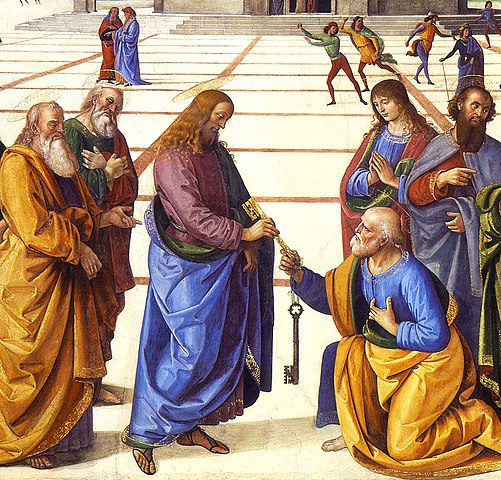
Photo credit: Christ Handing the Keys to St. Peter (c. 1482) by Pietro Perugino (1448-1523) [public domain / Wikimedia Commons]

Summary: One of a series of posts documenting the Catholic apologetics efforts of Johann Eck (1486-1543) against various Protestants. This entry addresses the papacy.
Previous Post
May 30, 2024
Eck Vs. Protestantism Chronicles: Church Councils
Next Post
May 31, 2024 Eck vs. Protestantism Chronicles: Sola Scriptura
Recent Comments
"Special pleading, and not a serious response to my arguments . . ."
Is Venerating Men & Angels Worship? ..."
""no man needs to teach us."Didn't you just teach us?"
Is Venerating Men & Angels Worship? ..."
""Catholics say they are the only church that can lead people into heaven."In fact, we ..."
Is Venerating Men & Angels Worship? ..."
"And lastly, I belong to no denomination and am free to serve God as He ..."
Is Venerating Men & Angels Worship? ..."
Browse Our Archives
Select a Category & Last Things About Me Anti-Catholicism Atheism & Agnosticism Baptism and Sacramentalism Bible and Tradition Blessed Virgin Mary Books by Dave Armstrong C. S. Lewis Calvinism & General Protestantism Catholic Apologetics Catholic Apologists Catholic conversion Catholic converts Christmas Church (Ecclesiology) Church History Conversion and Converts Development of Doctrine Eastern Orthodoxy Ecumenism & Christian Unity Eucharist & Liturgy Fathers of the Church French Translations G. K. Chesterton Hell Hell & Satan Hell & Satan & Last Things Heresies & Comparative Religion Holistic Health Inquisition & Crusades & Scandals James White Jews & Judaism & Old Testament John Calvin John Henry Newman Liberal / Modernist Theology Life Issues Literary Resume Lutheranism Mariology Martin Luther Music Orthodoxy Papacy & Infallibility Personal Page Philosophy & Science Political & Ethical & Moral Issues Protestant Persecution & Intolerance Protestantism Purgatory Purgatory & Penance Romantic & Imaginative Theology Saints & Purgatory & Penance Salvation Salvation & Justification Satan & Last Things Sexuality and Gender Issues Spanish Translations Traditionalism vs. Radical Catholic Reactionaries Traducciones al español / tradução para português Trinitarianism & Christology Uncategorized Videos
Select a Month October 2026 September 2026 August 2026 July 2026 June 2026 May 2026 April 2026 March 2026 February 2026 January 2026 December 2025 November 2025 October 2025 September 2025 August 2025 July 2025 June 2025 May 2025 April 2025 March 2025 February 2025 January 2025 December 2024 November 2024 October 2024 September 2024 August 2024 July 2024 June 2024 May 2024 April 2024 March 2024 February 2024 January 2024 December 2023 November 2023 October 2023 September 2023 August 2023 July 2023 June 2023 May 2023 April 2023 March 2023 February 2023 January 2023 December 2022 November 2022 October 2022 September 2022 August 2022 July 2022 June 2022 May 2022 April 2022 March 2022 February 2022 January 2022 December 2021 November 2021 October 2021 September 2021 August 2021 July 2021 June 2021 May 2021 April 2021 March 2021 February 2021 January 2021 December 2020 November 2020 October 2020 September 2020 August 2020 July 2020 June 2020 May 2020 April 2020 March 2020 February 2020 January 2020 December 2019 November 2019 October 2019 September 2019 August 2019 July 2019 June 2019 May 2019 April 2019 March 2019 February 2019 January 2019 December 2018 November 2018 October 2018 September 2018 August 2018 July 2018 June 2018 May 2018 April 2018 March 2018 February 2018 January 2018 December 2017 November 2017 October 2017 September 2017 August 2017 July 2017 June 2017 May 2017 April 2017 March 2017 February 2017 January 2017 December 2016 November 2016 October 2016 September 2016 August 2016 July 2016 June 2016 May 2016 April 2016 March 2016 February 2016 January 2016 December 2015 November 2015 October 2015 September 2015 August 2015 July 2015 June 2015 May 2015 April 2015 March 2015 February 2015 January 2015 December 2014 November 2014 October 2014 September 2014 August 2014 July 2014 June 2014 April 2014 March 2014 February 2014 January 2014 December 2013 November 2013 October 2013 September 2013 August 2013 July 2013 June 2013 April 2013 March 2013 February 2013 January 2013 December 2012 November 2012 October 2012 September 2012 August 2012 July 2012 June 2012 May 2012 April 2012 March 2012 February 2012 January 2012 December 2011 November 2011 October 2011 September 2011 August 2011 July 2011 June 2011 April 2011 March 2011 February 2011 October 2010 September 2010 August 2010 July 2010 April 2010 March 2010 December 2009 October 2009 August 2009 July 2009 June 2009 May 2009 March 2009 February 2009 October 2008 September 2008 April 2008 March 2008 February 2008 January 2008 December 2007 November 2007 October 2007 May 2007 March 2007 February 2007 January 2007 November 2006 October 2006 September 2006 August 2006 July 2006 June 2006 May 2006 April 2006 March 2006 February 2006 October 2005 June 2005 April 2005 February 2005 July 2004 May 2004 April 2004
Follow Us!
TAKE THE
Religious Wisdom Quiz
What city did God command Jonah to preach to?
Select your answer to see how you score.
Babylon Jericho Nineveh Tyre
Books by This Author Books by Dave Armstrong
Related posts from Biblical Evidence for Catholicism

Was Peter "Any Old" Apostle? 10 Anti-Papal Arguments
Biblical Evidence for Catholicism

17 Church Fathers on Purgatory (Esp. 1 Cor...
Biblical Evidence for Catholicism

Deuterocanon & Javier Perdomo's Straw Men
Biblical Evidence for Catholicism

St. Athanasius & the Deuterocanon (vs. Javier Perdomo)
Biblical Evidence for Catholicism
TRENDING AT PATHEOS Catholic

The Sermon on the Mount, Part I: Matthew...
The Sermon on the Mount, Part I (Matthew 4:12-5:12) St. Matthew moves...

What's up from Crossway: Reviewing some of their latest A few weeks...

Janie Learns the Way of the Cross: A...
Teaching children about Jesus' Passion can be challenging. Many parents and educators...

Looking For Good Catholic Writing - October 2026
He alone extends the heavens, and he walks upon the waves of...

In "Irreplaceable," our book on vocation and technology, Trevor Sutton and I...

I was strolling through the top floor of the brand new Parthenon...
view all Catholic blogs
What Are Your Thoughts?leave a comment
Ad-Free & Subscriber Log-In Subscription Support
- About Us
- 2026 Calendar
- Videos
- Podcasts
- Library of World Religions
- Faith In Media Tracker
- Advertise With Us
- Write for Us
- Privacy Policy
- Terms of Service
- Do Not Sell My Data
- Contact Us
- Radiant Digital
- Manage Newsletter Subscriptions
- Unsubscribe From Notifications
- Sitemap
Copyright 2008-2026, Patheos. All rights reserved.
Subscription Support Ad-Free & Subscriber Log-In
Follow Patheos